

 Download PDF
Market Overview
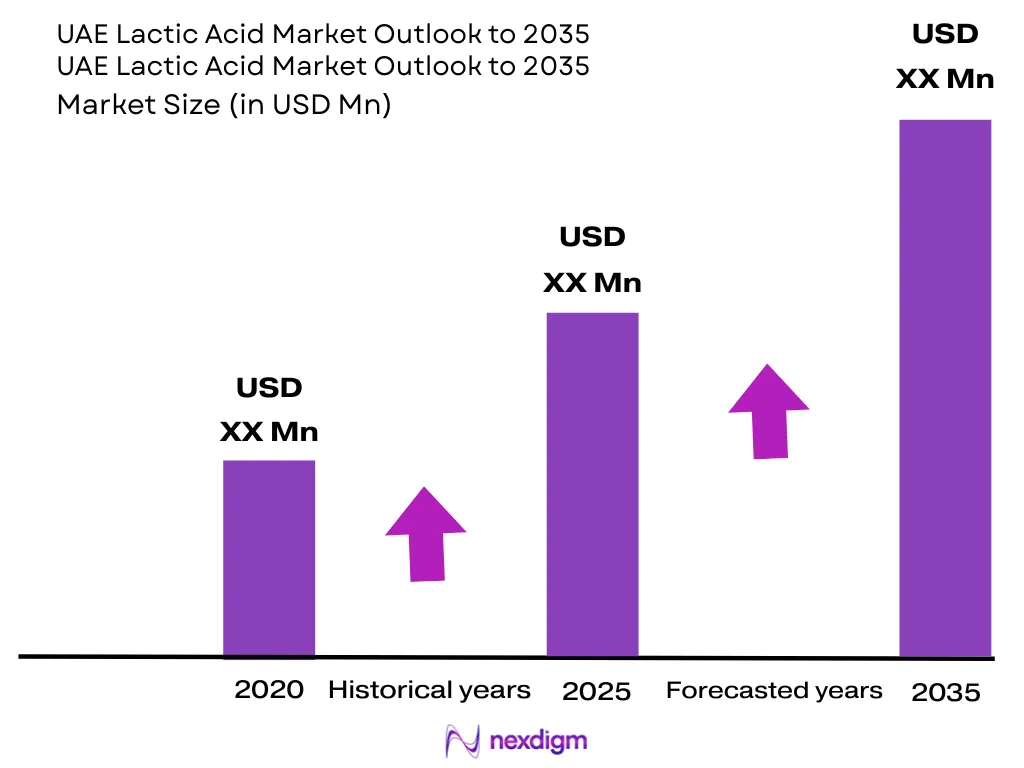
The UAE Lactic Acid Market was valued at USD ~ Million in 2024 and is anticipated to expand at a CAGR of ~% during 2026–2035. The market is primarily driven by the country’s emergence as a regional hub for biodegradable plastics manufacturing, expanding food & beverage, pharmaceutical, and personal care industries, and government-backed efforts to build a bio-based chemicals sector under the Ministry of Industry and Advanced Technology’s (MOIAT) Operation 300bn industrial strategy. Central to this outlook is Emirates Biotech’s planned polylactic acid (PLA) production facility in Abu Dhabi’s KEZAD free zone, a USD 800 million, 160,000-tonne-per-annum project using Sulzer’s licensed technology that is set to become the largest PLA plant in the world once operational in 2028, with lactic acid as its primary feedstock. The UAE’s population reached approximately 11.3 million by the end of 2024 according to the Federal Competitiveness and Statistics Centre (FCSC), and continued industrial diversification, with industrial exports rising 25% in 2025 to a record USD 71.3 billion, continues to sustain demand for lactic acid across food, pharmaceutical, personal care, and industrial applications.
Market Segmentation
By Raw Material
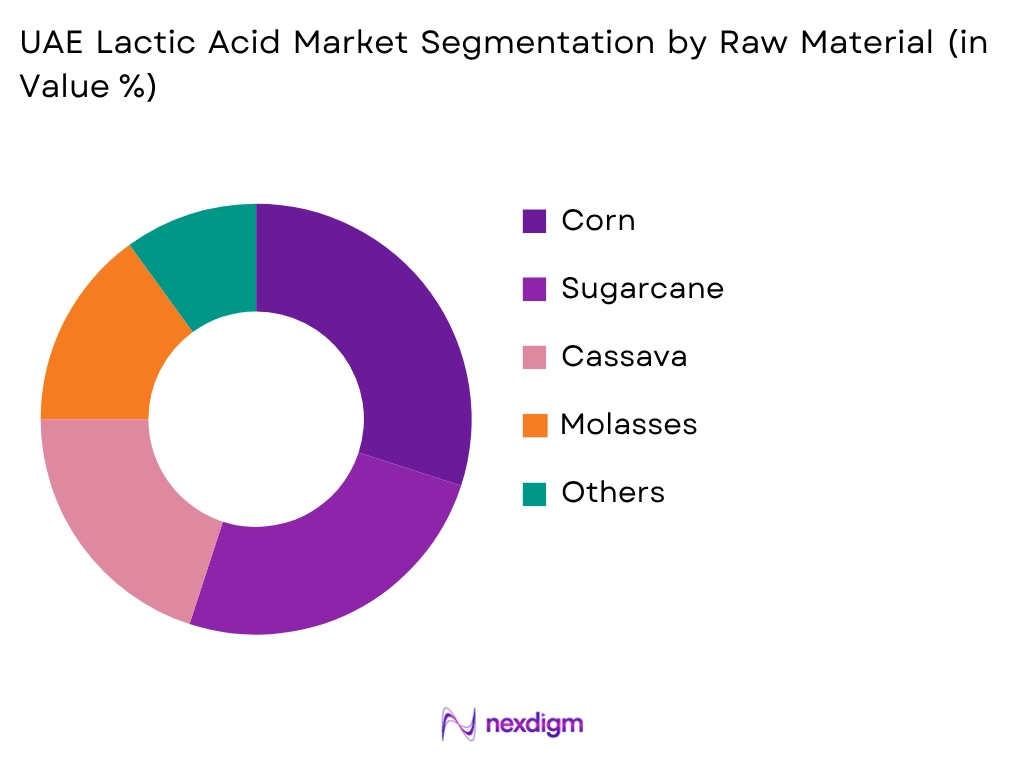
The UAE Lactic Acid Market is segmented by raw material into corn (maize), sugarcane, molasses, cassava, wheat, and sugar beet & other renewable feedstocks. Corn (maize) holds the dominant position due to its widespread use by global lactic acid manufacturers supplying the UAE market. Corn-derived glucose provides a consistent starch composition, high fermentation efficiency, and reliable production yields, making it the preferred feedstock for food-grade, pharmaceutical-grade, and industrial-grade lactic acid. Since the UAE has limited domestic agricultural production, the market relies primarily on imported lactic acid from major producers in North America, Europe, and Asia, where corn-based fermentation is the industry standard. The country’s strong food processing, beverage, pharmaceutical, and personal care industries also favor high-purity corn-derived lactic acid because of its consistent quality, regulatory compliance, and dependable supply chain. Meanwhile, sugarcane and molasses-based lactic acid are increasingly used by suppliers from Asia and Latin America, while cassava-based production remains relatively limited in the UAE due to lower commercial availability and fewer exporting manufacturers.
By Application
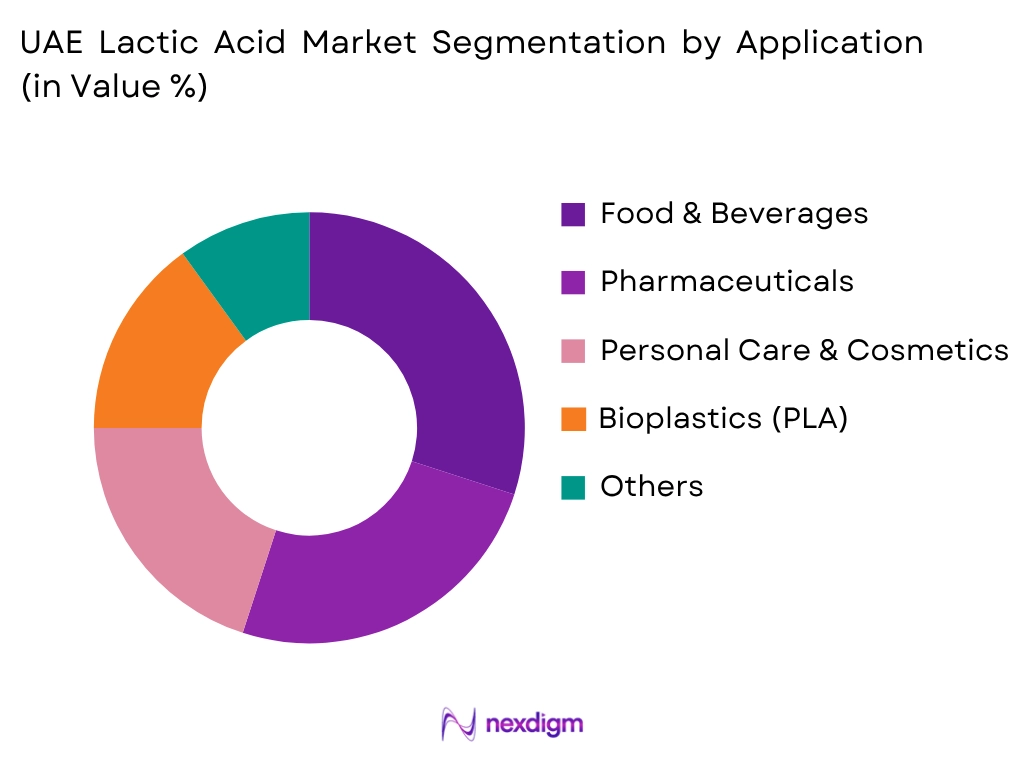
Food & Beverages currently accounts for the largest share of the UAE Lactic Acid Market, reflecting lactic acid’s established role as an acidulant, preservative, and flavor enhancer in dairy products, baked goods, sauces, and beverages, alongside growing regional demand for halal-compliant and clean-label food additives. However, Biodegradable Polymers (PLA) represents the fastest-growing application, a shift anchored by Emirates Biotech’s forthcoming 160,000-tonne PLA facility, which is expected to absorb substantial lactic acid feedstock volumes once operational and to supply bioplastic packaging and disposable products across the UAE and neighboring Gulf markets including Saudi Arabia, Oman, and Kuwait. Pharmaceuticals and Personal Care & Cosmetics applications are also expanding steadily, supported by the UAE’s position as a regional hub for pharmaceutical distribution and cosmetics manufacturing, while Industrial Applications, including use as a marine descaling agent, are gaining traction given the UAE’s large shipping, ports, and marine servicing sector.
Competitive Landscape
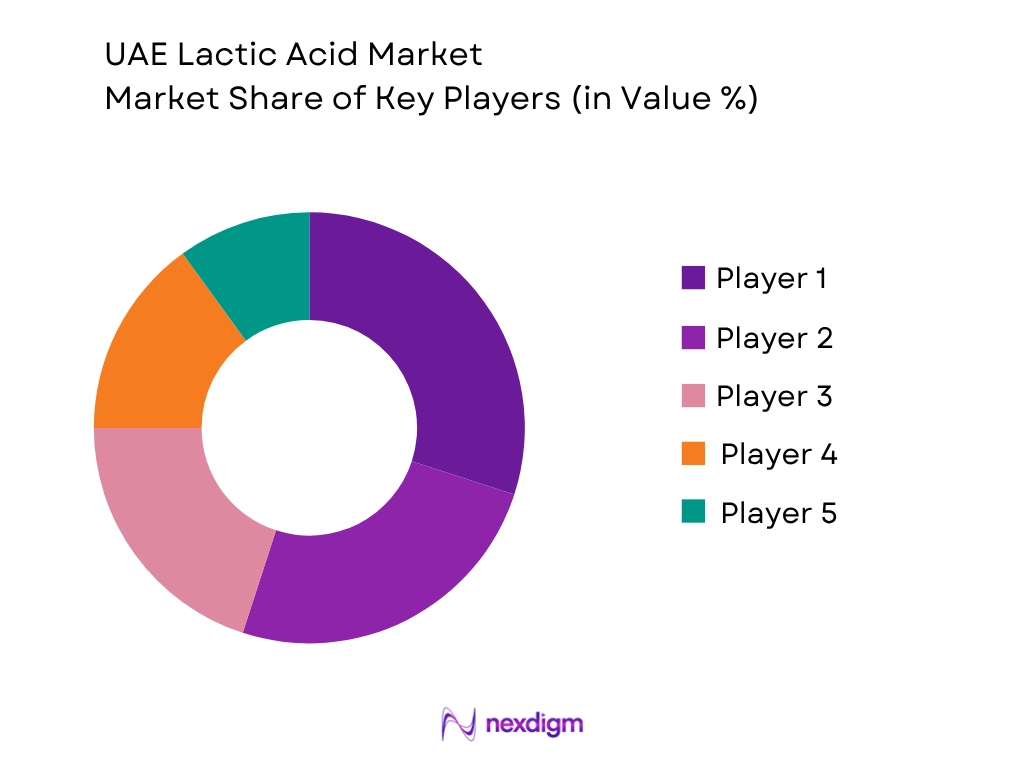
The UAE Lactic Acid Market is currently import-dependent and moderately concentrated, supplied largely by established global fermentation producers, but it is on the cusp of structural change as Emirates Biotech’s PLA facility advances toward operation in 2028. Emirates Biotech, a joint venture formed in 2023 between UAE-based SS Royal Kit Emirates Investment and Hong Kong-based Global Biopolymers Industries, has partnered with Swiss engineering firm Sulzer to build an integrated lactide-to-PLA production facility in Abu Dhabi’s KEZAD free zone, positioning the UAE as a prospective regional production base rather than a purely import-dependent consumption market. In the interim, global lactic acid majors such as Corbion, NatureWorks, and Galactic continue to serve UAE food, pharmaceutical, and bioplastics buyers through import and distribution channels, competing on purity grade, supply reliability, and technical application support. Competitive dynamics are shaped by compliance with MOIAT’s technical regulations and the Emirates Conformity Assessment Scheme (ECAS), alignment with the UAE National Bioeconomy Strategy 2023’s renewable-content requirements, and the ability to serve both the domestic market and the wider Gulf Cooperation Council region from UAE-based free zone facilities.
| Company | Establishment Year | Headquarters | Primary Product Portfolio | Lactic Acid Portfolio
|
Manufacturing Presence | Major End-Use Industries | Key Strategic Focus | Certifications & Compliance |
| Emirates Biotech | 2023 | ~ | ~ | ~ | ~ | ~ | ~ | ~ |
| Sulzer | 1834 | ~ | ~ | ~ | ~ | ~ | ~ | ~ |
| NatureWorks LLC | 1997 | ~ | ~ | ~ | ~ | ~ | ~ | ~ |
| Corbion | 1919 | ~ | ~ | ~ | ~ | ~ | ~ | ~ |
| Galactic | 1994 | ~ | ~ | ~ | ~ | ~ | ~ | ~ |
UAE Lactic Acid Market Analysis
Growth Drivers
UAE’s Emergence as a Global Bioplastics and PLA Manufacturing Hub
The UAE lactic acid market is being reshaped by the country’s ambition to become a global center for biodegradable plastics production. Emirates Biotech’s planned PLA facility in Abu Dhabi’s KEZAD free zone represents a total investment of approximately USD 800 million and will be built in two phases of 80,000 tonnes each, reaching 160,000 tonnes per annum of PLA output once complete, enough to replace an estimated 3.2 billion plastic bottles and reduce CO2 emissions by more than 300,000 tonnes annually. This project sits within the UAE’s broader Operation 300bn industrial strategy, which aims to raise the industrial sector’s contribution to GDP from AED 133 billion to AED 300 billion by 2031 and explicitly prioritizes chemicals, plastics, and advanced materials; UAE industrial exports already rose 25% in 2025 to a record USD 71.3 billion, with medium- and high-tech exports climbing 42% to AED 92 billion. As Emirates Biotech’s CEO has noted, bioplastics currently account for less than 1% of total plastic production in the region, well below levels seen in Europe and the Americas, leaving substantial headroom for lactic acid demand growth as the facility ramps toward its planned 2028 start-up.
Expanding Food, Pharmaceutical, and Personal Care Manufacturing Base
Rising demand from the UAE’s food processing, pharmaceutical, and personal care industries continues to underpin lactic acid consumption. The UAE’s broader fermentation chemicals market, of which lactic acid and other organic acids form a significant part, was valued at approximately USD 370 million, driven by demand for natural preservatives and flavoring agents in food and beverages and rising need for bio-based ingredients in pharmaceuticals and nutritional products. The UAE’s National Bioeconomy Strategy 2023, issued by the Ministry of Climate Change and Environment, mandates greater integration of bio-based and renewable chemicals into industrial processes and requires manufacturers to increase the proportion of renewable-source chemicals in their operations, directly supporting fermentation-derived lactic acid adoption. A population that reached approximately 11.3 million by the end of 2024, combined with the UAE’s position as a regional trade and distribution hub for pharmaceuticals and cosmetics, continues to widen the addressable market for food-grade, pharmaceutical-grade, and cosmetic-grade lactic acid.
Market Challenges
Near-Total Dependence on Imported Lactic Acid and Fermentation Feedstocks
The UAE’s arid climate and minimal arable land mean the country has no meaningful domestic cultivation of corn, sugarcane, or cassava, the primary carbohydrate feedstocks used in fermentation-based lactic acid production. As a result, virtually all lactic acid consumed in the UAE today is imported from established producers in Asia-Pacific, Europe, and North America, exposing buyers to global commodity price volatility, freight costs, and supply chain disruption. Even Emirates Biotech’s forthcoming PLA facility is expected to initially source its plant-based lactic acid feedstock from global markets rather than from domestic fermentation capacity, underscoring that the facility addresses PLA polymerization rather than upstream lactic acid production. This creates a structural gap between the UAE’s fast-growing downstream demand for lactic acid, particularly for PLA, and the near-total absence of local fermentation infrastructure to supply it.
High Technical and Capital Intensity of Fermentation-Based Production
Fermentation-based lactic acid production requires precise control of nutrient optimization, strain selection, and downstream purification to achieve the optical purity required for food, pharmaceutical, and PLA-grade applications, making it a technically demanding and capital-intensive process relative to petrochemical synthesis routes. Establishing new fermentation capacity in the UAE would require significant investment in bioreactor infrastructure, purification technology, and specialized technical expertise that is not yet well established locally. Regulatory compliance adds further complexity: lactic acid products sold in the UAE must meet MOIAT’s technical regulations and, where applicable, obtain Emirates Conformity Assessment Scheme (ECAS) or Emirates Quality Mark (EQM) certification, while food-grade lactic acid must additionally satisfy the Ministry of Climate Change and Environment’s food additive requirements, extending timelines and costs for both new market entrants and prospective domestic producers.
Market Opportunities
Localization of Lactic Acid Fermentation to Feed Domestic PLA Capacity
Emirates Biotech’s 160,000-tonne PLA facility creates a substantial and highly visible source of future demand for lactic acid feedstock, opening a clear opportunity for fermentation producers to establish upstream lactic acid manufacturing within the UAE or nearby free zones to supply the plant directly rather than via long-haul imports. Government support programs under Operation 300bn, including more than AED 40 billion in financing for industrial companies and SMEs over five years and the In-Country Value (ICV) programme redirecting half of government procurement toward local content by 2031, are creating financial and regulatory incentives for exactly this kind of value-chain localization. Abu Dhabi’s KEZAD free zone, where the Emirates Biotech facility is being built, together with other UAE free zones such as JAFZA and DMCC, offers duty exemptions, 100% foreign ownership, and logistics access to the wider GCC, positioning the UAE to capture upstream fermentation investment that has historically located in Asia-Pacific.
Growth in Marine, Industrial, and Personal Care Applications
Beyond food and bioplastics, lactic acid is gaining traction in the UAE’s marine and industrial sectors, where it is used as a biodegradable descaling agent, an application specifically highlighted as a growth driver in markets including the UAE given the country’s extensive ports, shipping, and marine servicing activity centered around Jebel Ali and other major terminals. The UAE’s role as a regional hub for pharmaceutical distribution and cosmetics manufacturing is also expanding demand for high-purity, pharmaceutical- and cosmetic-grade lactic acid used in controlled-release drug formulations, chemical peels, and moisturizing personal care products. With bioplastics currently representing less than 1% of the region’s total plastic production, according to industry executives, and industrial and personal care applications still in early stages of adoption relative to more mature markets, the UAE offers considerable headroom for lactic acid demand growth across multiple non-food end uses over the coming decade.
Future Outlook
The UAE Lactic Acid Market is expected to witness a structural shift over the forecast period, transitioning from a fully import-dependent consumption market toward a market with meaningful domestic production capacity as Emirates Biotech’s PLA facility moves from construction toward its planned 2028 start-up. Growing investment in bioplastics, expanding food, pharmaceutical, and personal care manufacturing, and continued government support through Operation 300bn and the National Bioeconomy Strategy 2023 will further accelerate demand for both bio-based and specialty-grade lactic acid. The market is also likely to benefit from the UAE’s positioning as a re-export and distribution hub, supplying lactic acid and PLA biopolymers to neighboring Gulf markets including Saudi Arabia, Oman, and Kuwait as regional bioplastics adoption continues to rise from a very low base.
Major Players
- Emirates Biotech
- Sulzer
- Corbion
- NatureWorks
- Galactic
- COFCO Biochemical
- Henan Jindan Lactic Acid Technology
- Musashino Chemical
- ADM
- Cargill
- BASF
- Danimer Scientific
- Total Corbion PLA
- Futerro
- Yangtze Labre
Key Target Audience
- Lactic Acid and PLA Manufacturers
- Food & Beverage Processing Companies
- Bioplastics and Packaging Manufacturers
- Pharmaceutical and Personal Care Manufacturers
- Industrial Chemical Manufacturers
- Investment and Venture Capitalist Firms
- Government and Regulatory Bodies (Ministry of Industry and Advanced Technology – MOIAT, Ministry of Climate Change and Environment – MOCCAE, Abu Dhabi and Dubai Municipalities)
- Chemical Distributors and Industrial Raw Material Suppliers
Research Methodology
Step 1: Identification of Key Variables
The research process begins with identifying the complete ecosystem of the UAE Lactic Acid Market, including feedstock importers, fermentation and lactic acid producers, PLA and bioplastics manufacturers, ingredient distributors, food and pharmaceutical processors, and regulatory authorities. Extensive secondary research is conducted using company reports, government publications, trade associations, customs statistics, industry journals, and proprietary databases to determine the variables influencing market demand, pricing, production, consumption, and technological developments.
Step 2: Market Analysis and Construction
Historical market information is collected and analyzed to estimate market size, import volumes, application-wise demand, and pricing trends. A combination of top-down and bottom-up approaches is used to estimate market revenues and validate segment-level performance. Consumption patterns across food & beverages, biodegradable polymers, pharmaceuticals, personal care, and industrial applications are evaluated to establish an accurate representation of the industry.
Step 3: Hypothesis Validation and Expert Consultation
The preliminary findings are validated through Computer-Assisted Telephone Interviews (CATIs) and structured discussions with chemical distributors, procurement managers, process engineers, regulatory experts, and senior executives operating within the UAE’s chemicals and bioplastics industry. These interviews help verify market assumptions, competitive developments, technology adoption trends, pricing dynamics, and future investment opportunities while refining the overall market estimates.
Step 4: Research Synthesis and Final Output
The final stage integrates insights obtained from primary interviews with quantitative information collected through secondary sources. Data triangulation techniques are applied to reconcile differences between supply-side and demand-side estimates, ensuring robust market forecasting. The report is then reviewed through multiple quality assurance checkpoints to deliver a comprehensive analysis covering market size, segmentation, competitive landscape, future outlook, and strategic recommendations for industry stakeholders.

- Executive Summary
- Research Methodology (Market Definitions and Assumptions, Abbreviations, Market Sizing Approach, Top-Down Analysis, Bottom-Up Analysis, Demand-Side Assessment, Supply-Side Assessment, Primary Industry Interviews, Secondary Research Validation, Data Triangulation, Forecasting Framework, Limitations and Future Conclusions)

- Definition and Scope
- Market Evolution and Industry Genesis
- Timeline of Major Industry Developments
- Lactic Acid Industry Value Chain Analysis
- Supply Chain Analysis

- Growth Drivers (Rising Demand for Biodegradable Plastics, Expansion of Food Processing Industry, Growing Pharmaceutical Manufacturing, Increasing Personal Care Production, Government Sustainability Initiatives, Growth in Industrial Applications)
- Market Challenges (High Production and Feedstock Import Costs, Limited Domestic Fermentation Feedstock Availability, Price Competition from Petrochemical-Derived Acids, Technical Complexity of High-Purity Production, Regulatory Compliance Complexity, Supply Chain Concentration Risk)
- Market Opportunities (Localization of Lactic Acid and PLA Manufacturing, Expansion of the Bioplastics Value Chain, Growth in Pharmaceutical-Grade Lactic Acid, Marine and Industrial Cleaning Applications, Regional Export Hub Development, Circular Economy Integration)
- Market Trends (Vertical Integration into PLA, Rising High-Purity L-Lactic Acid Demand, Bio-Based Feedstock Diversification, Single-Use Plastic Bans Accelerating Substitution, Strategic International Partnerships, Free Zone Manufacturing Investment)
- Government Regulations (MOIAT Industrial and Chemical Technical Regulations, ECAS/EQM Conformity Certification, UAE National Bioeconomy Strategy 2023, MOCCAE Food Additive Regulations, Single-Use Plastic Bans, Industrial Decarbonization Roadmap)
- Import and Export Analysis (Trade Volume, Major Import Sources, Export Destinations, HS Code Analysis, Trade Balance)
- Raw Material Availability Analysis (Imported Corn, Sugarcane and Cassava Feedstocks, Petrochemical Propylene Feedstocks, Whey and Dairy By-Product Feedstocks, Regional Feedstock Logistics)
- Technology Landscape (Fermentation Technologies, Purification and Separation Technologies, Lactide Production and Polymerization, Continuous Fermentation Systems, Downstream Processing Innovation)
- Sustainability Assessment (Circular Economy Alignment, Carbon Footprint Reduction, Single-Use Plastic Substitution, Renewable Feedstock Sourcing, Waste Valorization)
- PESTLE Analysis
- SWOT Analysis
- Porter’s Five Forces Analysis
- Stakeholder Ecosystem
- Competition Ecosystem

- By Market Value (2020-2025)
- By Volume Consumption (2020-2025)
- By Average Selling Price (2020-2025)

- By Raw Material (In Value %)
Sugarcane
Corn
Cassava
Yeast Extract
Molasses
Other Crops - By Application (In Value %)
Food & Beverages
Biodegradable Polymers (PLA)
Pharmaceuticals
Personal Care & Cosmetics
Industrial Applications
Animal Feed & Nutrition - By Distribution Channel (In Value %)
Direct Sales to Manufacturers
Chemical Distributors
Industrial Ingredient Suppliers
Online B2B Chemical Platforms
Specialty Ingredient Suppliers - By End User (In Value %)
Food Processing Companies
Bioplastics & Packaging Manufacturers
Pharmaceutical Companies
Personal Care Manufacturers
Industrial Chemical Manufacturers - By Region (In Value %)
Abu Dhabi
Dubai
Sharjah
Northern Emirates
Al Ain & Western Region

- Market Share of Major Players (By Value, Volume, Type, Application Industry, Product Category)
- Cross Comparison Parameters (Fermentation Capacity, Purification Technology, PLA Integration, Application Technical Support Capability, Manufacturing Capacity, Regulatory Compliance & Certifications, Customer Base, Innovation & New Product Launch Frequency)
- SWOT Analysis of Major Players
- Pricing Analysis by Grade and Application
- Production Capacity Analysis
- Manufacturing Footprint Analysis
- Distribution Network Analysis
- Innovation Benchmarking
- Detailed Profiles of Major Companies
Emirates Biotech
Sulzer
Corbion
NatureWorks
Galactic
COFCO Biochemical
Henan Jindan Lactic Acid Technology
Musashino Chemical
ADM
Cargill
BASF
Danimer Scientific
Total Corbion PLA
Futerro
Yangtze Labre

- Consumption Pattern Analysis (Industrial Usage, Batch Size, Application Penetration, Seasonal Demand, Reformulation Activity)
- Purchasing Criteria (Purity Grade, Regulatory Compliance, Cost Efficiency, Supply Reliability, Optical Purity, Shelf Life)
- Procurement and Supplier Selection Analysis
- Bio-Based Adoption Assessment
- Premium vs Conventional Grade Demand
- Product Attribute Preference Analysis (Optical Purity, Concentration Grade, Color and Clarity, pH Stability, Microbial Load, Certification Status)
- Sustainability & ESG Influence on Procurement Decisions
- Pain Point Analysis
- Decision-Making Process

- By Market Value (2026-2035)
- By Volume Consumption (2026-2035)
- By Average Selling Price (2026-2035)


 Request a Sample
 Ask for Customization
 Get a Quote
 Enquire Now