
 Download PDF
Market Overview
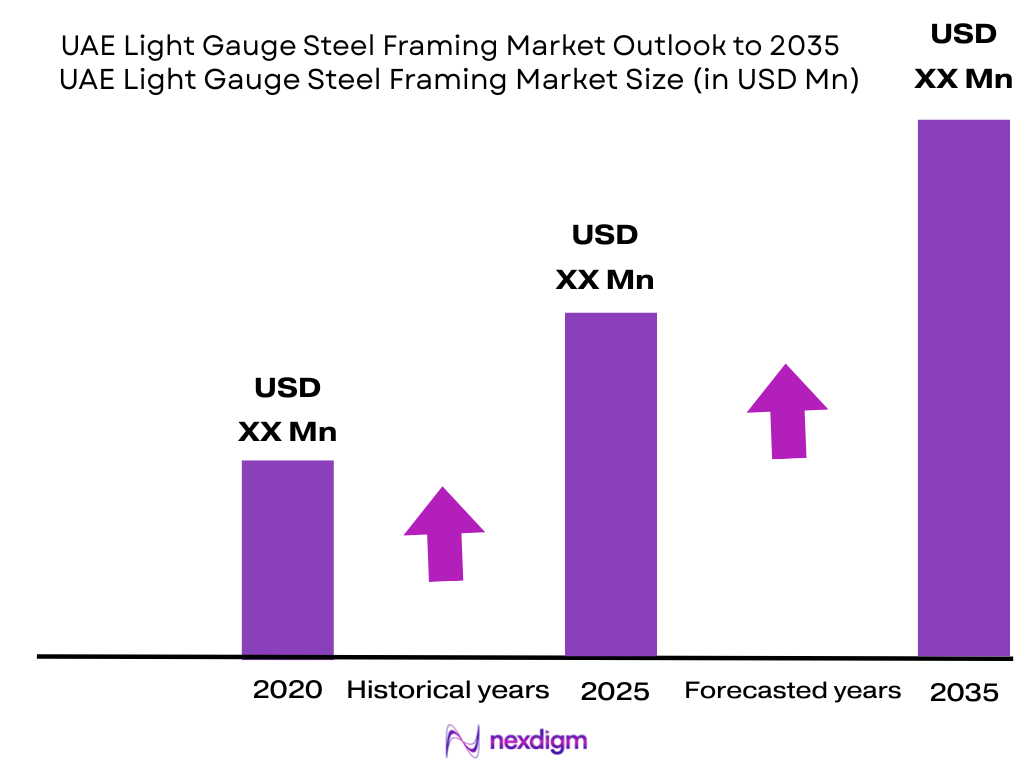
The UAE Gasoline Direct Injection Market is valued at USD ~ million, retained as a placeholder for the final market model. Underlying automotive demand remains substantial: national motor-vehicle sales increased from 758,791 units to 805,034 units, while registered and roadworthy vehicles expanded from approximately 14.86 million to 15.88 million vehicles. This expanding vehicle parc supports demand for GDI injectors, pumps, rails, sensors and electronic controls. Riyadh, Jeddah and the Eastern Region represent the principal UAE Gasoline Direct Injection Market hubs because they combine dense vehicle populations, dealerships, automotive workshops, premium-vehicle demand and parts distribution infrastructure. Consumer activity reinforces their importance, with point-of-sale transactions reaching SAR 225.0 billion in Riyadh, SAR 93.8 billion in Jeddah and SAR 32.9 billion in Dammam. Saudi Arabia also contains 326,585 active enterprises in wholesale, retail and motor-vehicle repair activities.
Market Segmentation
By Component Type
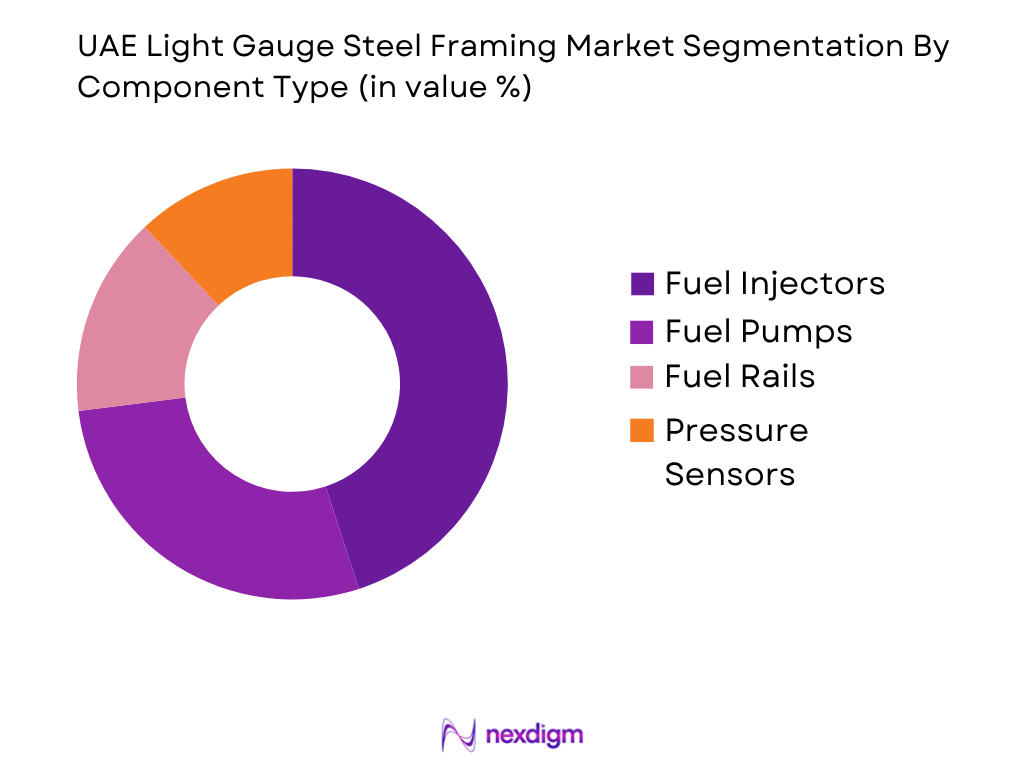
The UAE Gasoline Direct Injection Market is segmented into high-pressure fuel injectors, high-pressure fuel pumps, fuel rails, pressure sensors and control valves, and ECU/high-pressure supporting components. High-pressure fuel injectors hold the dominant modelled market share because every GDI cylinder requires accurately metered fuel delivery directly into the combustion chamber. Injectors govern atomisation, spray targeting, multiple-injection events and combustion quality, making their precision and technological content considerably higher than conventional port-injection hardware. Saudi Arabia’s sizeable SUV, premium-car and turbo-gasoline vehicle base also favours sophisticated multi-cylinder GDI applications. Technology is moving toward higher pressure: Bosch commercial systems support up to 350 bar, Astemo high-pressure pumps reach 50 MPa, and Marelli has developed complete GDI systems operating up to 1,000 bar. This pressure migration strengthens injector value content while increasing requirements for durability, contamination control and thermal resistance under Saudi operating conditions.
By Powertrain Type
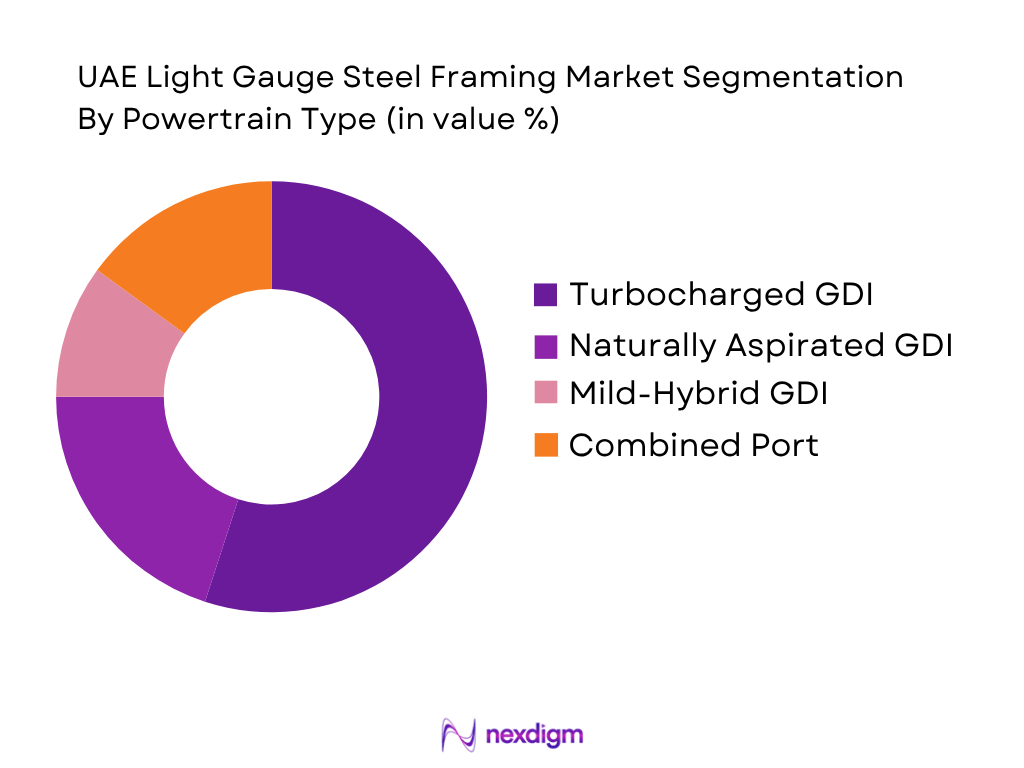
The UAE Gasoline Direct Injection Market is segmented into turbocharged GDI, naturally aspirated GDI, mild-hybrid GDI, strong-hybrid GDI and combined port/direct-injection systems. Turbocharged GDI represents the dominant modelled segment because Saudi passenger-vehicle demand is heavily oriented toward SUVs, crossovers, premium sedans and performance vehicles where turbocharged gasoline engines increasingly balance engine output with fuel-efficiency requirements. Direct injection enables precise in-cylinder mixture preparation and works effectively with engine downsizing and turbocharging. Bosch specifically identifies improved low-speed torque as a key benefit of GDI combined with downsizing. Hybrid-GDI is emerging as an important secondary category because gasoline-electric vehicles retain high-pressure fuel systems while introducing more demanding engine restart and transient operating cycles. These applications preserve injector, pump and rail demand even as Saudi Arabia gradually expands electrified vehicle adoption.
Competitive Landscape
The UAE Gasoline Direct Injection Market is concentrated among technically advanced global automotive suppliers because development of injectors, high-pressure pumps and fuel rails requires precision machining, proprietary spray technology, advanced electronics and extensive OEM validation. Bosch, DENSO, PHINIA, Astemo and Marelli represent important benchmark suppliers. Technology competition increasingly centres on pressure capability, injection precision, hybrid compatibility, integrated fuel delivery and durability. Bosch operates systems up to 350 bar, Astemo offers pumps reaching 50 MPa, while Marelli has developed systems reaching 1,000 bar.
| Major Player | Establishment | Headquarters | GDI Injector Capability | High-Pressure Pump Capability | Fuel-Rail Integration | Pressure Technology | Hybrid/Advanced Powertrain Capability | KSA Market Relevance |
| Robert Bosch GmbH | 1886 | Gerlingen, Germany | ~ | ~ | ~ | ~ | ~ | ~ |
| DENSO Corporation | 1949 | Kariya, Japan | ~ | ~ | ~ | ~ | ~ | ~ |
| PHINIA / Delphi | 2023 | Auburn Hills, USA | ~ | ~ | ~ | ~ | ~ | ~ |
| Astemo Ltd. | 2021 | Tokyo, Japan | ~ | ~ | ~ | ~ | ~ | ~ |
| Marelli | 2019 as integrated entity | Saitama, Japan / Corbetta, Italy | ~ | ~ | ~ | ~ | ~ | ~ |
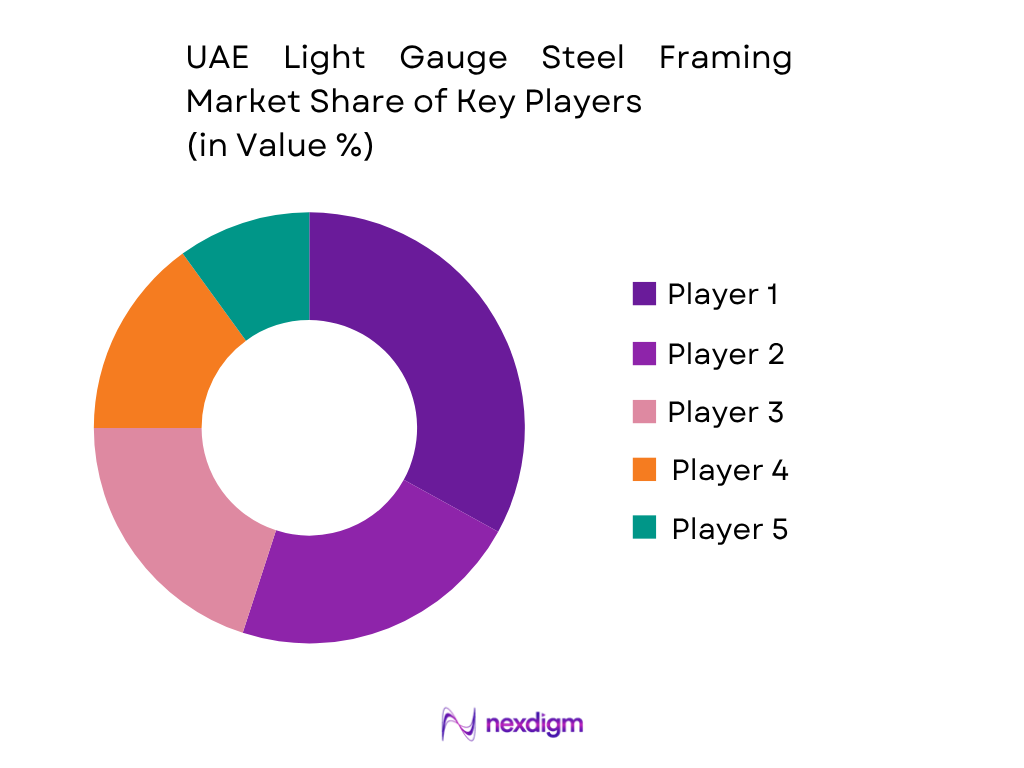
UAE Light Gauge Steel Framing Market Analysis
Growth Drivers
Rapid Residential Construction and Urban Housing Expansion
The UAE Light Gauge Steel Framing Market is supported by sustained residential construction in Abu Dhabi and Dubai, where population growth is translating into continuous requirements for villas, townhouses, low-rise residential buildings, extensions and community infrastructure. Statistics Centre – Abu Dhabi reported 4.14 million residents in Abu Dhabi and the addition of 29,415 residential and commercial units, taking the emirate’s stock to 783,970 units and 299,360 buildings. These figures provide a substantial addressable construction base for light gauge steel framing because cold-formed steel systems are particularly suitable for repetitive low-rise structures, internal partition systems, roof framing and factory-prepared wall panels. At the national level, the World Bank recorded UAE GDP at USD 552.32 billion and GDP per capita at USD 50,273.5, while the IMF places the UAE population at approximately 11.47 million people in 2026. High economic output combined with expanding urban populations strengthens demand for residential space without requiring every project to depend on conventional concrete block and reinforced-concrete walling. LGSF enables developers to shift selected building activities into controlled fabrication environments, reduce structural dead load and accelerate enclosure work. Abu Dhabi’s continued addition of housing units therefore creates a directly relevant demand environment for LGSF suppliers serving villa communities, staff housing, modular accommodation and low-rise mixed-use developments.
Increasing Requirement for Faster Villa, Commercial and Industrial Building Delivery
Light gauge steel framing is gaining relevance in the UAE because contractors increasingly operate within construction programmes that demand rapid structural enclosure, dimensional accuracy and reduced dependence on wet trades. Dubai Municipality issued 1,669 building completion certificates during the first half of 2025, covering 1,484 villas, 74 multi-storey buildings and 60 industrial facilities. These completed projects added approximately 2 million square metres of residential, commercial and industrial floor space within six months, demonstrating the scale and diversity of buildings entering Dubai’s built environment. The predominance of villas within these completions is particularly significant for LGSF because villa roofs, exterior walls, internal partitions, façade backing systems and additional floors are established applications for cold-formed steel profiles. The broader macroeconomic environment supports continuing construction activity: World Bank data place UAE GDP at USD 552.32 billion, while IMF data indicate a population of approximately 11.47 million in 2026. LGSF systems can shorten on-site framing stages by transferring cutting, punching and dimensional coordination to factories, making them attractive where contractors must manage multiple villa units or repetitive layouts simultaneously. The technology also reduces structural weight compared with traditional masonry-heavy solutions, providing additional advantages for rooftop extensions and lightweight secondary structures. The combination of high villa completion volumes and continued commercial construction therefore strengthens the case for industrialised steel framing across Dubai and other rapidly developing emirates.
Market Challenges
Complex Structural, Fire, Thermal and Building-Code Compliance Requirements
The principal technical challenge for the UAE Light Gauge Steel Framing Market is that steel-framed buildings must comply with comprehensive structural, thermal, fire-safety and building-envelope rules designed for demanding local conditions. Dubai Municipality’s Dubai Building Code establishes mandatory requirements covering health, safety, environmental performance and sustainable building design, while its building-regulation framework separately addresses structural codes, seismic design, wind loads, soil conditions, insulation and construction safety. During the first half of 2025, Dubai Municipality conducted approximately 25,000 construction-site inspections, while 1,669 buildings progressed to completion certification. This level of regulatory oversight means LGSF suppliers cannot rely only on roll-forming capacity; they must provide engineering calculations, verified connections, compliant sheathing assemblies, corrosion protection, thermal breaks, fire-rated wall systems and documented material traceability. The UAE’s macroeconomic scale intensifies expectations around construction quality, with World Bank data recording GDP of USD 552.32 billion and GDP per capita of USD 50,273.5. For LGSF projects, steel conductivity creates additional thermal-design complexity because improperly treated studs can form thermal bridges through the envelope. Manufacturers must therefore integrate insulation, external boards, cavity systems and connection detailing into approved assemblies rather than selling framing as an isolated commodity. Companies lacking locally recognised engineering expertise or documented system testing can face longer approvals and restricted access to institutional, villa and commercial projects.
Limited Availability of Specialist LGSF Design, Fabrication and Installation Capabilities
Another market challenge is the specialised technical capability required to convert conventional architectural drawings into engineered cold-formed steel framing systems. LGSF requires coordinated structural modelling, stud and track optimisation, opening reinforcement, connection design, screw specifications, panelisation, fabrication files and disciplined installation sequencing. Dubai Municipality’s regulatory system explicitly requires qualified engineering and contracting organisations, while construction works remain subject to building permits, approved plans and adopted technical standards. The importance of specialist competency is reflected in Dubai Municipality conducting around 25,000 site inspections during the first half of 2025 and issuing completion certificates for 1,484 villas, 74 multi-storey structures and 60 industrial facilities over the same period. A construction environment handling this volume requires reliable engineering capacity, yet contractors experienced primarily in reinforced concrete, concrete blocks and conventional structural steel may require additional training before adopting light-gauge framing at scale. The UAE’s expanding population compounds the requirement for qualified personnel, with the IMF placing the national population at approximately 11.47 million people in 2026. Incorrect stud spacing, inadequate bracing, poor fastener installation or discontinuous thermal and moisture barriers can undermine the speed advantage that LGSF is intended to provide. Suppliers must therefore invest in engineering teams, BIM coordination, installation supervision and contractor training rather than competing only through steel-profile production, making capability development a material barrier for smaller entrants.
Market Opportunities
Expansion of Prefabricated and Digitally Engineered Steel Building Systems
Technological advancement creates a substantial future opportunity for the UAE Light Gauge Steel Framing Market because the country is progressively digitising building approvals and encouraging industrialised construction. Dubai Municipality introduced an updated Dubai Building Permits Application in 2024, enabling owners, contractors and consultants to track projects and interact digitally with permitting processes. The municipality also operates dedicated regulatory frameworks for advanced construction techniques and published its first design and construction guidelines for three-dimensional concrete printing in June 2024, demonstrating institutional acceptance of digitally engineered and factory-controlled construction methods. LGSF is well aligned with this direction because roll-forming equipment can receive BIM-derived fabrication data and automatically cut, punch, label and produce individual framing members for panel assembly. Current construction volumes provide a strong demand base for such systems: Dubai issued 1,669 completion certificates in the first half of 2025, including 1,484 villas, while approximately 2 million square metres of new space was completed. Rather than relying on future construction projections, these current figures demonstrate sufficient project activity for manufacturers to establish automated framing lines, panelisation facilities and BIM-to-production workflows. The strongest opportunity lies in combining structural framing, sheathing, insulation and MEP coordination into prefabricated wall and roof panels that arrive at sites ready for rapid assembly.
Government Housing, Villa Communities and Lightweight Residential Construction
Government-supported housing and the continuing expansion of residential communities provide another significant future opportunity for light gauge steel framing suppliers. The UAE Ministry of Energy and Infrastructure’s Sheikh Zayed Housing Programme approved 460 housing-assistance applications in March 2024, supporting citizens seeking housing solutions, while the ministry continues to maintain housing-assistance mechanisms covering construction, completion, modification and acquisition of homes. At the emirate level, Abu Dhabi added 29,415 residential and commercial units, taking the total to 783,970 units, while Dubai Municipality recorded 1,484 completed villas during only the first half of 2025. These current figures establish a sizeable pipeline environment in which LGSF can be positioned for villas, roof structures, majlis extensions, additional rooms, worker accommodation and repetitive residential developments. The technology is particularly suited to projects requiring standardised designs because steel studs and panels can be produced to repeatable dimensions in factories and transported to multiple sites. World Bank data further show a UAE GDP of USD 552.32 billion, while IMF data indicate approximately 11.47 million residents in 2026, supporting continued requirements for housing and community infrastructure. Future LGSF growth can therefore come from contractors partnering with housing developers and government-approved builders to offer code-compliant prefabricated framing packages rather than individual steel sections. Suppliers that provide engineering, framing, insulation, sheathing and installation as an integrated system will be better positioned to participate in large residential programmes.
Future Outlook
The KSA Gasoline Direct Injection Market is forecast to expand at approximately ~ CAGR during 2026–2035, retained as a placeholder for the final forecast model. Growth will increasingly shift from basic gasoline-engine volume toward higher-pressure GDI, turbocharged SUVs, premium vehicles, hybrid-GDI platforms and more sophisticated engine-management architectures. Saudi Arabia’s large existing combustion-engine vehicle parc gives GDI suppliers a substantial aftermarket base even as electrification expands. Approximately 15.88 million registered and roadworthy vehicles were present at the latest reported year-end, creating long-term injector, pump, rail and sensor replacement requirements. Fuel-economy regulation will reinforce demand for efficient internal-combustion technologies during the transition period. SASO maintains vehicle energy-efficiency requirements and licensing for vehicle efficiency labels, creating regulatory incentives for powertrains capable of combining performance with controlled fuel consumption.
At the same time, electrification represents a structural substitution risk. Battery-electric vehicles eliminate gasoline fuel-delivery hardware completely. Saudi Arabia is developing charging infrastructure and domestic EV manufacturing capabilities, meaning GDI suppliers will increasingly need to focus on segments where combustion technology remains strongest: hybrids, large SUVs, premium cars, performance models and long-distance applications. Technology migration should partly offset declining component opportunity per conventional gasoline platform. Higher pressures require more sophisticated injectors, pumps, rails, controls and materials. Marelli’s 1,000-bar architecture illustrates how substantially GDI system content can advance beyond conventional pressure levels.
Major Players
- Robert Bosch GmbH / Bosch Middle East
- DENSO Corporation
- PHINIA / Delphi
- Astemo Ltd.
- Marelli
- Stanadyne
- Aisan Industry Co., Ltd.
- Mikuni Corporation
- AUMOVIO
- TI Fluid Systems
- AISIN Corporation
- Schaeffler Group
- Standard Motor Products
- GB Remanufacturing
- Motorcar Parts of America
Key Target Audience
- Gasoline Direct Injection System Manufacturers
- High-Pressure Injector and Fuel Pump Manufacturers
- Passenger Vehicle and Engine OEMs
- Automotive Tier-1 and Precision Component Manufacturers
- Automotive Importers, Distributors and Aftermarket Companies
- Fleet Operators and Automotive Service Networks
- Investments and Venture Capitalist Firms
- Government and Regulatory Bodies (Saudi Standards, Metrology and Quality Organization; Saudi Energy Efficiency Center; Ministry of Industry and Mineral Resources; National Industrial Development Center)
Research Methodology
Step 1: Identification of Key Variables
The initial phase constructs the complete KSA Gasoline Direct Injection Market ecosystem covering OEMs, vehicle importers, fuel-system suppliers, authorised distributors, workshops and aftermarket participants. Variables include gasoline vehicle sales, vehicle parc, GDI fitment, turbocharging, engine displacement, injector count, injection pressure, hybridisation, regional vehicle concentration and component replacement cycles.
Saudi statistical and regulatory sources are used to establish the automotive and macroeconomic baseline, supplemented by primary technical documentation from fuel-system manufacturers.
Step 2: Market Analysis and Construction
The top-down assessment begins with Saudi passenger-vehicle volumes and identifies gasoline platforms equipped with direct injection. GDI-equipped vehicle estimates are translated into component demand using cylinder count, injector fitment, high-pressure pump requirement, fuel-rail content and pressure-control hardware.
The bottom-up framework maps individual engine families and vehicle platforms against supplier technology. Pressure classes are benchmarked against commercial architectures such as technologies.
Step 3: Hypothesis Validation and Expert Consultation
Market hypotheses are validated through computer-assisted telephone interviews with vehicle distributors, Tier-1 suppliers, automotive parts importers, dealership technicians and independent workshops. Discussions examine GDI fitment by engine family, injector replacement frequency, high-pressure pump failures, vehicle-origin mix, genuine versus aftermarket sourcing and hybrid powertrain penetration.
Expert interviews are also used to test assumptions concerning hot-climate durability, fuel quality sensitivity, injector deposits, pressure loss, component lead times and premium-vehicle maintenance behaviour.
Step 4: Research Synthesis and Final Output
The final phase triangulates vehicle data, supplier specifications, regulatory requirements, platform mapping and primary-industry feedback. Separate demand models are constructed for naturally aspirated GDI, turbo-GDI, hybrid-GDI and combined port/direct-injection systems.
Forecast assumptions incorporate Saudi vehicle parc expansion, fuel-economy regulation, local automotive manufacturing, premium-SUV demand, injection-pressure migration, aftermarket replacement activity and battery-electric substitution. This provides both a vehicle-level and component-level interpretation of the KSA Gasoline Direct Injection Market.

- Executive Summary
- Research Methodology (Market Definitions and Assumptions, LGSF System Boundary, Abbreviations, Top-Down Market Sizing, Bottom-Up Steel Consumption Assessment, Project Pipeline Mapping, Building Floor-Area Assessment, Tonnes of LGS per Square Metre, Steel Coil Consumption Mapping, Fabricator Capacity Assessment, Roll-Forming Line Assessment, Demand-Side Interviews, Supply-Side Interviews, Contractor Interviews, Structural Engineer Interviews, Data Triangulation, Forecasting Framework, Limitations and Future Conclusions)

- Definition and Scope
- Evolution of Light Gauge Steel Construction in the UAE
- Transition from Conventional Concrete and Masonry to Dry Construction
- Evolution of Cold-Formed Steel Building Systems
- UAE Construction and Real Estate Ecosystem
- Prefabrication and Modular Construction Ecosystem

- Growth Drivers (Residential Construction Pipeline, Villa Development, Modular Construction Adoption, Construction Speed Requirements, Skilled Labour Constraints, Sustainability Requirements, Off-Site Manufacturing, Government Housing)
- Market Challenges (Steel Price Volatility, Fire Design, Corrosion Protection, Contractor Familiarity, Engineering Expertise, Approval Complexity, Imported Technology, Installation Quality)
- Market Opportunities (Modular Housing, Data Centres, Hospitality, Vertical Extensions, Retrofit, Government Housing, Export Manufacturing, Digital Fabrication)
- Market Trends (Digital Design, Automated Roll Forming, BIM, DfMA, Panelisation, Modular Construction, High-Strength Steel, Low-Carbon Construction)
- SWOT Analysis
- Porter’s Five Forces
- PESTLE Analysis

- By Market Value (2020-2025)
- By Steel Consumption Volume (2020-2025)
- By Fabricated LGS Frame Volume (2020-2025)

- By Framing Type (In Value %)
Wall-Bearing Steel Framing
Skeleton Steel Framing
Long-Span Steel Framing
Roof Truss Framing
Floor Joist Framing - By Powertrain Type (In Value %)
Naturally Aspirated GDI
Turbocharged GDI
Twin-Turbo GDI
Mild-Hybrid GDI
Strong-Hybrid GDI - By Application (In Value %)
Wall Systems
Roof Systems
Floor Systems
Ceiling Systems
Partition Systems - By Profile Type (In Value %)
C Sections
U Tracks
Lipped C Sections
Z Sections
Omega Sections - By Emirate (In Value %)
Dubai
Abu Dhabi
Sharjah
Ajman
Ras Al Khaimah

- Market Share of Major Players by Value
- Cross Comparison Parameters (Maximum Roll-Formable Steel Thickness, Available Steel Yield Strength, Zinc/Metallic Coating Capability, Wall-Floor-Roof System Portfolio, Annual LGS Fabrication Capacity, BIM/CAD-to-CAM Integration Capability, Modular and Panelised Project Capability, UAE/GCC Project and Installation Footprint)
- SWOT Analysis of Major Players
- Detailed Profiles of Major Companies
FRAMECAD
Pioner Group
DANA Steel
TSSC Group
Emirates Portacabins Manufacturing
Engineering Consultants Dubai / ECD
Valtek LGS
Mike N Dad
Speed House Group
Liberty Building Systems FZC
Scottsdale Construction Systems
Howick Ltd.
Hadley Group
voestalpine Metsec
William Hare Group

- Real Estate Developers
- Villa Developers
- Modular Building Contractors
- Main Contractors
- Government Housing Developers
- Hospitality Developers

- By Market Value (2026-2035)
- By Steel Consumption Volume (2026-2035)
- By Fabricated LGS Frame Volume (2026-2035)


 Request a Sample
 Ask for Customization
 Get a Quote
 Enquire Now