
 Download PDF
Market Overview
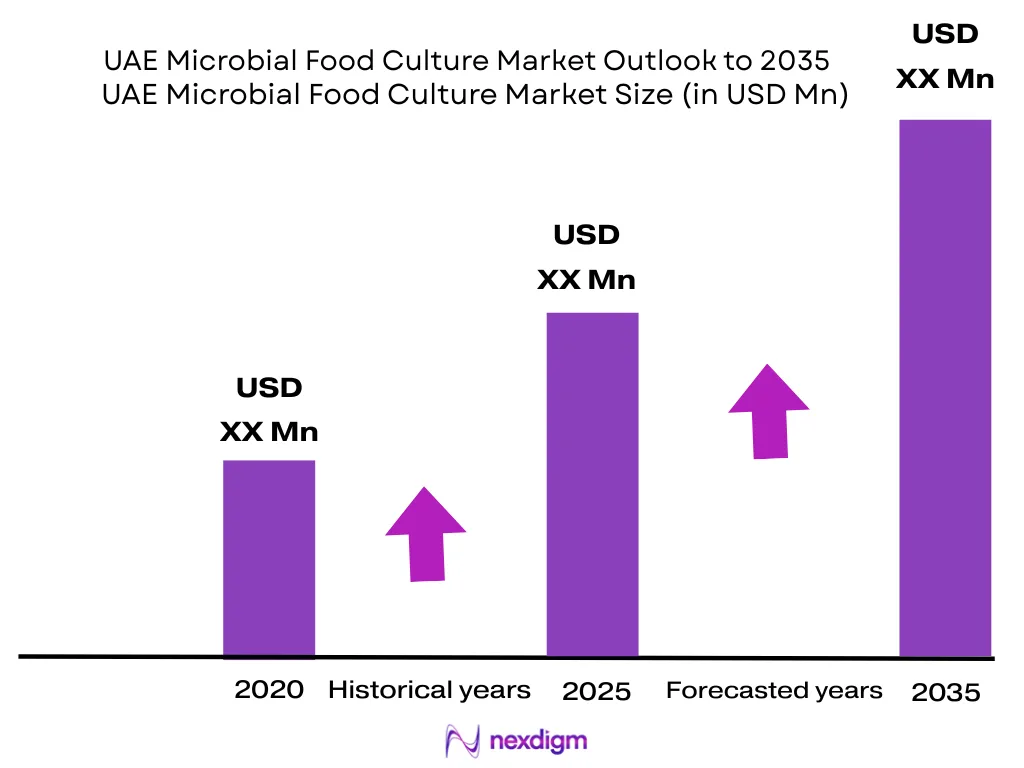
The UAE Microbial Food Culture Market is valued at approximately USD ~ million and is forecast to expand at a CAGR of ~X.X% during 2026–2035. Demand is supported by an economy that expanded from AED 1.68 trillion to AED 1.776 trillion and a population that increased from 10,678,556 to 11,294,243. Larger dairy, bakery, functional-food and hospitality industries are increasing the use of standardized starter, probiotic and protective cultures. Dubai, Abu Dhabi and Sharjah dominate the UAE Microbial Food Culture Market because they combine food factories, dairy processors, central kitchens, ports, refrigerated warehouses and ingredient distributors. Dubai provides access to Jebel Ali, hospitality demand and re-export channels; Abu Dhabi supports large dairy and camel-milk operations; and Sharjah contains cost-efficient industrial production zones. Dubai’s manufacturing output increased from AED 8.3 billion to AED 8.4 billion, while national population expanded by 615,687 residents, supporting broader fermented-food consumption.
Market Segmentation
By Culture Type
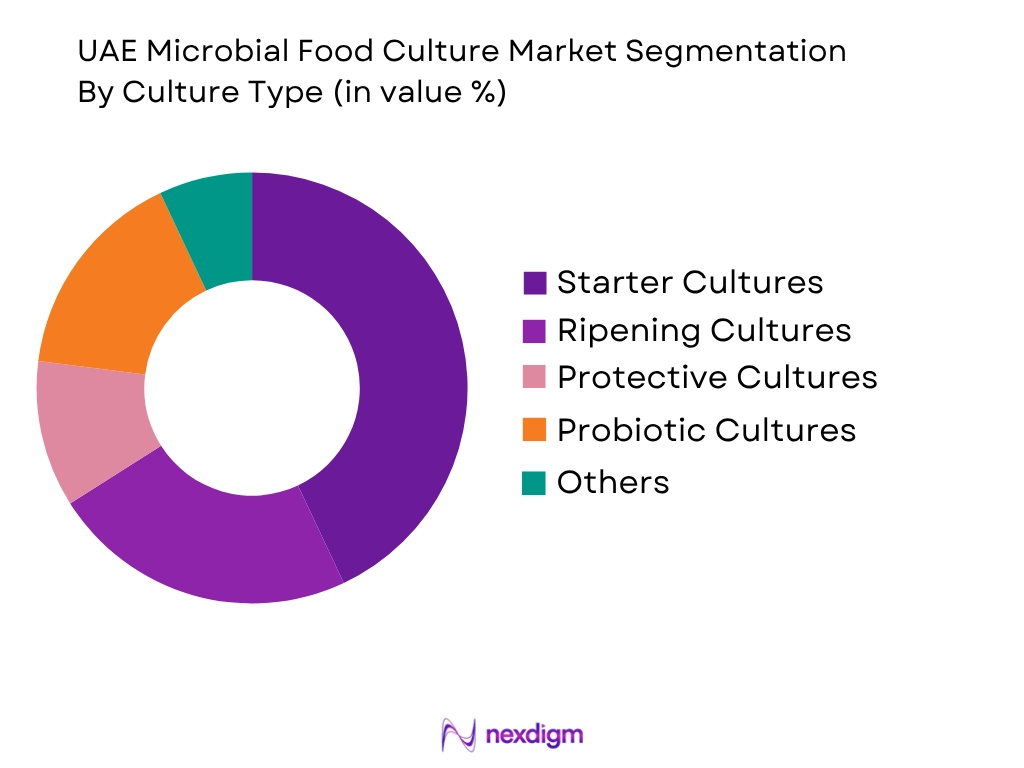
The UAE Microbial Food Culture Market is segmented into starter cultures, probiotic cultures, protective cultures, adjunct and ripening cultures, and customized mixed cultures. Starter cultures hold the dominant market position because they are required in every controlled fermentation cycle for yoghurt, laban, cultured milk, cheese, bread and selected beverages. They establish predictable acidification, fermentation time, flavour and texture while reducing the variability associated with spontaneous fermentation. Direct-vat cultures are particularly suitable for UAE processors because they eliminate several mother-culture preparation stages and reduce contamination exposure. Their use is well established among industrial dairy manufacturers producing high-volume yoghurt and cultured beverages. Probiotic cultures command a smaller but strategically important position due to growing functional-food development, whereas protective cultures are used selectively to inhibit spoilage in dairy, bakery and plant-based products. Adjunct and ripening cultures remain concentrated in cheese manufacturing, where their commercial use depends on cheese variety and maturation requirements.
By Application
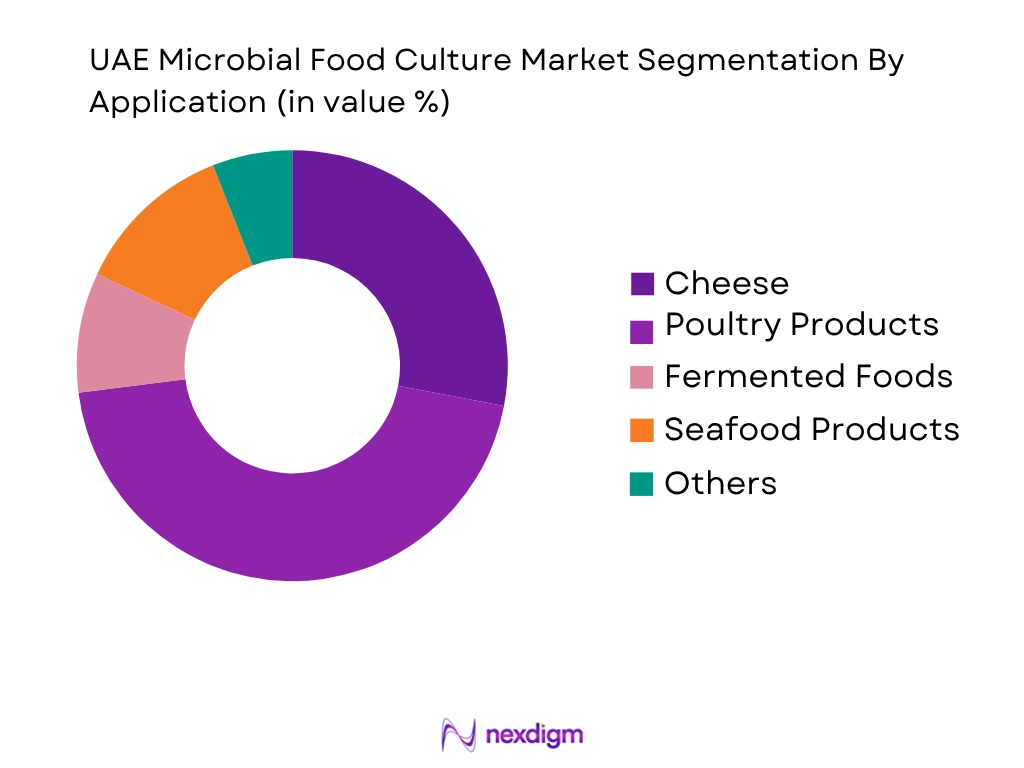
The UAE Microbial Food Culture Market is segmented into fermented dairy products, cheese, bakery and sourdough products, fermented beverages, meat products, and plant-based fermented foods. Fermented dairy products hold the dominant market position because commercial yoghurt, laban, drinking yoghurt, cultured milk and probiotic beverages require starter cultures in every batch. Dairy cultures control pH reduction, gel formation, viscosity, aroma and post-acidification, making them integral production inputs rather than optional ingredients. The segment also benefits from the UAE’s diverse resident population, which sustains demand for Arabic laban, European-style yoghurt, South Asian cultured dairy and functional probiotic drinks. Cheese represents another important application, particularly fresh white cheese, halloumi-type products, mozzarella and brined cheese. Bakery cultures are widely used in industrial bread, Arabic flatbread and sourdough products, although conventional baker’s yeast accounts for much of fermentation demand. Camel-milk fermentation provides a differentiated application opportunity requiring cultures adapted to its distinct protein and mineral composition.
Competitive Landscape
The UAE Microbial Food Culture Market is characterized by multinational bioscience companies supplying cultures through direct accounts, regional commercial teams and specialist ingredient distributors. Novonesis and IFF maintain extensive dairy-culture portfolios, while dsm-firmenich is prominent in probiotic and nutritional applications. Lallemand and Lesaffre contribute strong yeast, bacterial-fermentation and bakery capabilities. Competition is based on strain performance, application support, culture viability, halal documentation, supply reliability and the ability to customize cultures for dairy, camel milk and regional food applications.
| Company | Establishment Year | Headquarters | Core Culture Portfolio | Primary Applications | Product Formats | UAE Route to Market | Technical Capability | Strategic Differentiation |
| Novonesis | 2024 as merged entity | Lyngby, Denmark | ~ | ~ | ~ | ~ | ~ | ~ |
| International Flavors & Fragrances | 1958 | New York, United States | ~ | ~ | ~ | ~ | ~ | ~ |
| dsm-firmenich | 2023 as merged entity | Kaiseraugst and Maastricht | ~ | ~ | ~ | ~ | ~ | ~ |
| Lallemand | 1915 | Montreal, Canada | ~ | ~ | ~ | ~ | ~ | ~ |
| Lesaffre | 1853 | Marcq-en-Barœul, France | ~ | ~ | ~ | ~ | ~ | ~ |
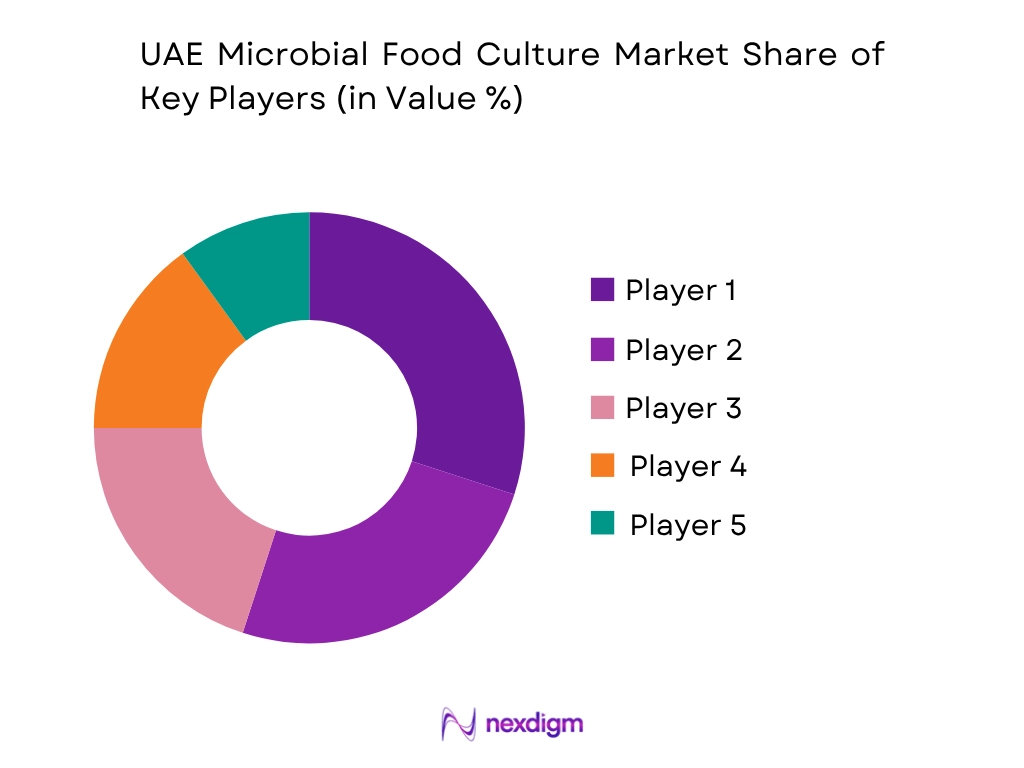
UAE Microbial Food Culture Market Analysis
Growth Drivers
Urban Population, Tourism and Diversified Fermented-Food Demand
The UAE’s expanding resident and visitor populations are increasing demand for standardized microbial cultures used in yoghurt, laban, drinking yoghurt, cheese, sourdough, fermented beverages, probiotics, and plant-based alternatives. Federal Competitiveness and Statistics Centre data recorded 11,294,243 residents in 2024, compared with 10,678,556 residents in 2023, adding 615,687 consumers within one year. The population included 7,235,074 men and 4,059,169 women, reflecting a large and internationally diverse food-consumption base. This diversity supports multiple fermented-food traditions, including Arabic laban, European-style yoghurt and cheese, South Asian cultured milk products, East Asian probiotic beverages, sourdough bakery products, and emerging non-dairy ferments. Manufacturers serving these consumers require starter cultures that deliver consistent acidity, flavour, texture, and fermentation time across high-volume production batches. Tourism adds a second demand layer. Dubai received 18.72 million international overnight visitors in 2024, compared with 17.15 million in 2023. These visitors were supported by 832 hotel establishments and 154,016 available hotel rooms, creating substantial recurring requirements for yoghurt, cheese, bread, pastries, cultured dairy drinks, and foodservice products. Hotels, airlines, restaurant groups, catering companies, and central kitchens require predictable sensory characteristics and reliable shelf performance because the same product may be supplied to numerous outlets. Commercial cultures are more suitable for these applications than uncontrolled fermentation, as they reduce variations caused by ambient conditions, raw-material differences, and repeated starter propagation.
Industrial Localization and Expansion of Food Manufacturing
The UAE’s industrial localization strategy is strengthening the foundation for domestic production of fermented dairy, cheese, bakery, functional foods, and specialty beverages, increasing the need for commercial microbial cultures. The Ministry of Industry and Advanced Technology reported that the industrial sector’s contribution to national gross domestic product reached approximately AED 205 billion in 2024, compared with a projected AED 197 billion in 2023. Industrial exports reached approximately AED 187 billion in 2023, while import-substitution projects were valued at AED 9.3 billion. These figures reflect a policy environment focused on producing more goods domestically, developing local supply chains, and reducing dependence on finished imported products. Microbial cultures benefit when yoghurt, laban, cheese, bread, probiotic drinks, and plant-based fermented products are manufactured locally because cultures are consumed during each production cycle. Domestic plants require standardized strains to control pH reduction, gel strength, aroma development, fermentation duration, and microbiological stability. The UAE’s economic structure provides additional support. World Bank data placed national output at USD 552.32 billion in 2024, with output expanding by 4.0 percentage points and gross domestic product per person reaching USD 50,273.5. In the first quarter of 2025, official UAE data recorded real gross domestic product of AED 455 billion, including AED 352 billion from non-oil activities.
Market Challenges
Import Dependence, Heat Exposure and Culture Viability Management
The UAE microbial food culture market faces a structural challenge because most proprietary starter, probiotic, protective, and ripening cultures are produced outside the country and must pass through international freight, customs clearance, refrigerated storage, and last-mile delivery before use. These cultures contain living microorganisms whose activity can decline when exposed to unsuitable temperature, moisture, oxygen, or repeated freeze-thaw cycles. The problem is particularly important in a country where external temperatures frequently require intensive cold-chain management. Frozen concentrated cultures may require deep-frozen handling, while freeze-dried cultures still need protection from prolonged heat and humidity. The scale of the UAE’s trading system creates both logistical strength and exposure. National non-oil foreign trade reached AED 3 trillion in 2024, while non-oil exports reached AED 561.2 billion. The country’s ports and airports can handle large volumes, but microbial cultures form a small and temperature-sensitive category within this broader flow. Delays in documentation, inspection, transfer, or warehouse receipt can affect activity before the product reaches a dairy, bakery, or beverage factory. The UAE’s population reached 11,294,243 in 2024, and Dubai hosted 18.72 million international overnight visitors, creating year-round food demand that requires processors to maintain adequate culture inventories.
Specialized Skills and Application-Specific Fermentation Complexity
The UAE has advanced food factories and a large international workforce, but the microbial food culture market remains constrained by the limited availability of specialists who combine microbiology, dairy science, fermentation engineering, regulatory knowledge, and industrial troubleshooting. Commercial cultures are not interchangeable commodity ingredients. A technologist must select strains according to substrate composition, processing temperature, desired acidity, flavour profile, texture, storage period, and contamination risk. These requirements become especially complex in the UAE because processors work with cow milk, reconstituted milk, camel milk, goat milk, plant proteins, wheat dough, malt, fruit substrates, and functional-food formulations. The national population reached 11,294,243 in 2024, including 615,687 additional residents compared with 2023, widening the range of food preferences that manufacturers must serve. At the same time, the Ministry of Industry and Advanced Technology reported that the industrial sector created more than 22,000 jobs for UAE nationals by the end of 2024, while companies participating in the National In-Country Value Program employed approximately 19,000 Emiratis in the first half of 2024. These numbers demonstrate industrial workforce development, but microbial fermentation still requires a narrower category of expertise than general manufacturing. Dairy staff must distinguish between slow starter activity, bacteriophage infection, raw-milk inhibitors, incorrect heat treatment, contamination, and dosing error. Camel milk presents additional formulation challenges because standard yoghurt cultures may generate slow acidification or weak texture without strain selection and process adjustment. Probiotic applications require staff to understand viable-count testing, strain-level identification, oxygen sensitivity, storage stability, and claim documentation. Protective cultures require product-specific validation because an organism that inhibits mould in one cheese or yoghurt may not perform similarly in another matrix.
Market Opportunities
Advanced Fermentation Technologies and Camel-Milk Culture Development
Technological advancement creates a major opportunity for the UAE microbial food culture market by enabling processors to improve culture survival, monitor fermentation continuously, customize strains, and develop differentiated products from camel milk and other regional substrates. The UAE’s industrial sector contributed approximately AED 205 billion to gross domestic product in 2024, while national output reached USD 552.32 billion and gross domestic product per person reached USD 50,273.5. These current indicators demonstrate the financial and manufacturing base required to adopt automated dosing, digital fermentation control, rapid microbial testing, microencapsulation, and local application laboratories. Direct-vat inoculation cultures can reduce contamination risks and simplify production because they are added directly to processing tanks without repeated mother-culture propagation. Freeze-dried formats can provide greater transport flexibility, while encapsulation technologies can protect probiotics from oxygen, acidity, and temperature stress. Sensors linked to industrial control systems can record pH, temperature, fermentation time, and agitation, allowing processors to identify abnormal acidification before an entire batch is lost. Such systems are especially valuable in high-volume yoghurt, laban, and cheese production, where small deviations can affect several packaging lines and distribution commitments. Camel-milk fermentation provides a market-specific development opportunity.
International Partnerships and Regional Culture Distribution Hub
The UAE’s position as a global trade, aviation, logistics, and investment centre creates an opportunity to become a regional distribution and technical-support hub for microbial food cultures serving the Gulf, Middle East, Africa, and South Asia. National non-oil foreign trade reached AED 3 trillion in 2024, while non-oil exports reached AED 561.2 billion. The country also operated an expanding network of Comprehensive Economic Partnership Agreements, improving access to major sources of dairy ingredients, food technology, biotechnology, and industrial equipment. These commercial connections can support partnerships between international culture developers, UAE ingredient distributors, local dairies, free-zone operators, contract manufacturers, and testing laboratories. Rather than shipping every small order directly from Europe, North America, or Asia, global suppliers can maintain validated frozen and refrigerated inventories in Dubai or Abu Dhabi and distribute them to customers across neighbouring markets. This model can shorten lead times, improve emergency replacement capability, and reduce the risk of individual processors holding excessive inventory. The UAE’s foodservice and tourism economy strengthens the business case for regional application support. Dubai welcomed 18.72 million international overnight visitors in 2024, compared with 17.15 million in 2023, while the city operated 154,016 hotel rooms. Food manufacturers supplying hotels, airlines, restaurant chains, and catering companies need cultures that can produce consistent products for multinational consumer groups. International partnerships can provide access to strain libraries, phage-management systems, probiotic documentation, cheese-ripening expertise, protective cultures, and sourdough technologies that are not widely developed domestically.
Future Outlook
The UAE Microbial Food Culture Market is expected to expand steadily during 2026–2035 as local food production, functional nutrition and food-security initiatives encourage manufacturers to produce more fermented products domestically. Demand will increasingly move beyond conventional yoghurt cultures toward protective cultures, probiotic strains, customized cheese cultures and systems adapted to camel milk. Technical service, reliable refrigerated distribution and complete regulatory documentation will become stronger competitive differentiators. Direct-vat inoculation cultures are likely to gain wider use among medium and large processors. These formats provide standardized cell activity, reduce the need to maintain production starters and simplify traceability. Freeze-dried cultures should remain particularly relevant because they offer greater distribution flexibility than deeply frozen preparations under the UAE’s high-temperature logistics environment.
Major Players
- Novonesis
- International Flavors & Fragrances
- dsm-firmenich
- Lallemand
- Lesaffre
- Kerry Group
- Sacco System
- CSK Food Enrichment
- Biochem
- Dalton Biotecnologie
- Mediterranea Biotecnologie
- Angel Yeast
- LB Bulgaricum
- Biena
- AB Biotek
Key Target Audience
- Dairy and camel-milk processors
- Cheese and fermented-beverage manufacturers
- Industrial bakery and sourdough producers
- Food-ingredient importers and distributors
- Probiotic and functional-nutrition companies
- Investments and venture capitalist firms
- Private-equity and strategic food-industry investors
- Government and regulatory bodies
Research Methodology
Step 1: Identification of Key Variables
The initial phase involves constructing an ecosystem map covering culture manufacturers, food-ingredient importers, distributors, dairy processors, bakeries, beverage producers, laboratories and regulatory bodies. Secondary and proprietary databases are reviewed to define market variables such as culture format, application, dosage, processor scale, import dependency, technical support and storage requirements.
Step 2: Market Analysis and Construction
Historical information is compiled by culture type, microorganism, application, end-user and emirate. The bottom-up approach evaluates processor output, fermentation-batch frequency, culture dosage and commercial-culture penetration. The top-down approach examines food-manufacturing activity, culture imports, supplier revenues and relevant fermented-product categories to construct an independent market benchmark.
Step 3: Hypothesis Validation and Expert Consultation
Market hypotheses are validated through computer-assisted telephone interviews with culture suppliers, dairy technologists, microbiologists, quality managers, procurement personnel and ingredient distributors. These consultations assess purchasing cycles, culture performance, storage losses, processor conversion, technical-service requirements and competitive positioning across industrial food applications.
Step 4: Research Synthesis and Final Output
Supply-side and demand-side findings are triangulated to reconcile differences between supplier shipments, distributor inventory and processor consumption. Segment structures and forecasts are checked against application trials, regulatory requirements, distribution models and expert feedback. The resulting output provides a consolidated assessment of market value, competitive structure and future opportunities.

- Executive Summary
- Research Methodology (Market Definitions and Assumptions, Product Inclusion and Exclusion Criteria, Abbreviations, Market Sizing Approach, Top-Down Analysis, Bottom-Up Analysis, Culture-Dosage Consumption Model, Demand-Side Assessment, Supply-Side Assessment, Import-Based Supply Assessment, Primary Industry Interviews, Data Triangulation, Forecasting Framework, Scenario Analysis, Limitations and Future Conclusions)

- Definition and Scope
- Market Evolution and Industry Genesis
- Development of Commercial Food Fermentation in the UAE
- Transition from Imported Finished Fermented Foods to Local Processing
- Role of Microbial Cultures in UAE Food Manufacturing

- Growth Drivers (Expansion of Local Dairy Processing, Growth of Yoghurt and Laban Consumption, Development of Camel Milk Products, Food-Security Localization, Expansion of Foodservice and Hospitality, Demand for Functional and Probiotic Foods, Growth of Industrial Bakeries, Increasing Food-Safety Requirements)
- Market Challenges (Dependence on Imported Proprietary Strains, Frozen Cold-Chain Requirements, High Ambient Temperatures, Culture Viability Loss, Limited Local Culture Manufacturing, Bacteriophage Contamination, Small Domestic Raw-Milk Base, Regulatory Documentation Complexity)
- Market Opportunities (Camel Milk Culture Development, Protective Cultures for Clean-Label Preservation, Local Culture Blending and Repacking, Probiotic Functional Beverages, Plant-Based Fermentation, Cultures for Arabic Bread and Sourdough, Application Laboratory Expansion, Regional Re-Export Hub Development)
- Market Trends (Direct-Vat Inoculation, Freeze-Dried Culture Adoption, Multi-Strain Blends, Mild-Acidification Systems, Exopolysaccharide-Producing Cultures, Ambient Yoghurt Technology, Phage-Robust Culture Rotation, Clean-Label Bioprotection, Personalized Probiotic Formulations, Customized Cultures for Camel Milk)
- SWOT Analysis
- Porter’s Five Forces Analysis
- PESTLE Analysis

- By Market Value (2020-2025)
- By Culture Consumption Volume (2020-2025)
- By Active Microbial Preparation Volume (2020-2025)

- By Culture Type (In Value %)
Starter Cultures
Probiotic Cultures
Protective and Biopreservation Cultures
Adjunct and Ripening Cultures
Aroma and Flavour Development Cultures
Customized Mixed Cultures - By Application (In Value %)
Fermented Dairy Products
Cheese and Ripened Dairy Products
Bakery and Sourdough Products
Fermented Beverages
Meat and Poultry Products
Fermented Vegetables and Pickled Foods
Plant-Based Dairy Alternatives - By Distribution Model (In Value %)
Direct Sales by Culture Manufacturers
Authorized Food-Ingredient Distributors
Food-Ingredient Importers
Application-Solution Providers
Specialty Biotechnology Distributors - By Emirate (In Value %)
Dubai
Abu Dhabi
Sharjah
Ras Al Khaimah
Ajman
Fujairah

- Market Share of Major Players (By Value, Culture Volume, Application, Culture Type, Customer Segment and Distribution Mode
- Cross Comparison Parameters (Culture Portfolio Breadth, Microbial-Strain Library Depth, Dairy and Camel Milk Application Coverage, Culture Format and Heat-Stability Performance, UAE Technical-Support Capability, GCC Distribution and Re-Export Reach, Halal and Regulatory Documentation Strength, Product Innovation and Customization Capability)
- SWOT Analysis of Major Players
- Detailed Profiles of Major Companies
Novonesis
International Flavors & Fragrances
dsm-firmenich
Lallemand
Lesaffre
Kerry Group
Sacco System
CSK Food Enrichment
Biochem
Dalton Biotecnologie
Mediterranea Biotecnologie
Angel Yeast
LB Bulgaricum
Biena
AB Biotek

- Dairy Processor Analysis
- Bakery Manufacturer Analysis
- Fermented Beverage Producer Analysis
- Cheese Manufacturer Analysis
- Camel Milk Processor Analysis
- Plant-Based Food Manufacturer Analysis

- By Market Value (2026-2035)
- By Culture Consumption Volume (2026-2035)
- By Active Microbial Preparation Volume (2026-2035)


 Request a Sample
 Ask for Customization
 Get a Quote
 Enquire Now