

 Download PDF
 Download PDF
Market Overview
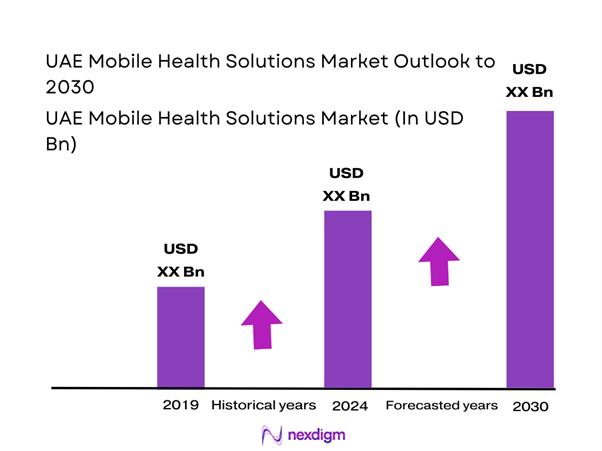
The UAE mobile health solutions market sits inside a broader digital-health stack that spans telehealth, remote monitoring, e-prescribing, EHR connectivity, and analytics across providers and payers. The market’s momentum is visible in the step-up from USD ~ million in the prior year to USD ~ million in the latest year, as digital-first access, smart-care pathways, and system-wide interoperability become operational priorities (not pilots).
Within the UAE, Dubai and Abu Dhabi are the dominant demand-and-deployment hubs because they concentrate hospital networks, specialist density, insurer activity, and large-scale digitization programs (provider portals, appointment ecosystems, teleconsult workflows, and data exchange). These emirates also act as “platform buyers” for the rest of the country—solutions proven in high-throughput urban care settings diffuse to northern emirates through chain rollouts, payer requirements, and integrated referral pathways.
Market Segmentation
By Telemedicine Component
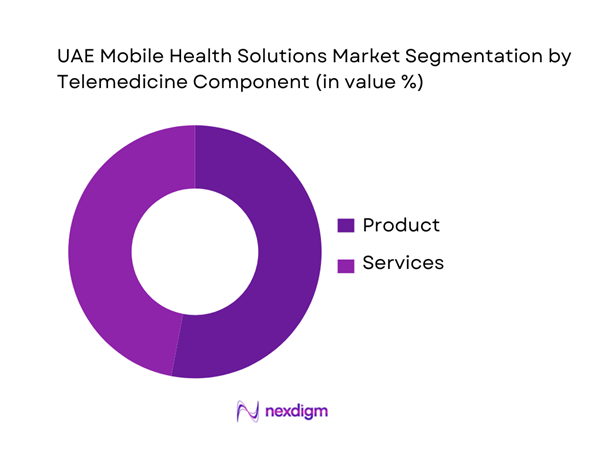
UAE mobile health solutions (teleconsult + virtual care delivery) commonly monetize through platform products (software/platform access) and services (clinical/operational services, enablement, and managed layers). In the latest year, product-led telemedicine dominates because buyers prioritize scalable, compliance-ready platforms that can be deployed across multi-facility networks with consistent workflows (triage, scheduling, eRx, documentation), rather than building bespoke services for every specialty line. This aligns with enterprise procurement behavior in the UAE—provider groups and payers tend to lock in platform capabilities, then add service layers selectively (high-acuity programs, chronic care cohorts, VIP/home-care packages).
By mHealth App Type
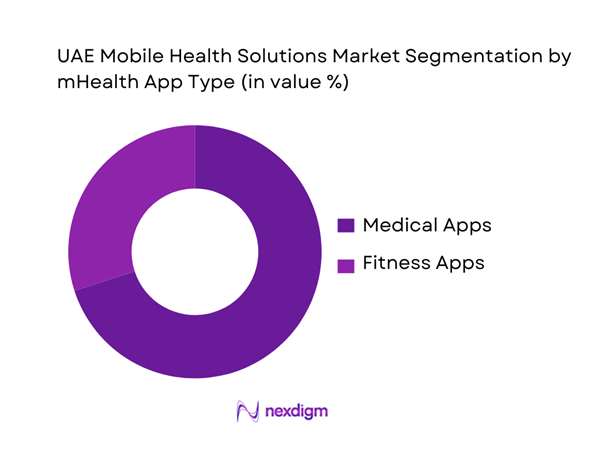
On the app side, the UAE mHealth apps market splits into medical apps (clinical-grade care support, monitoring, medication, provider-linked pathways) and fitness apps (wellness, activity, lifestyle coaching). Medical apps dominate because UAE adoption is increasingly tethered to formal care pathways—hospital/clinic appointment journeys, chronic-condition programs, remote patient monitoring bundles, and insurer-linked digital touchpoints. In practice, medical apps benefit from higher repeat-use frequency (refills, vitals logging, follow-ups), stronger clinician reinforcement, and “stickier” value drivers (continuity of care, outcomes tracking, care-plan adherence). Fitness apps remain meaningful, but they are more substitutable and face faster churn unless tightly integrated into employer wellness or payer reward constructs.
Competitive Landscape
The UAE mobile health solutions landscape is platform-led and partnership-heavy: hospital groups and payers prefer integrated ecosystems (appointments + teleconsult + RPM + payments + records connectivity) over single-feature apps. This creates a market where a small set of scaled provider groups, enterprise health-tech platforms, and health IT vendors can shape adoption—especially those who can meet enterprise security expectations, integrate with provider workflows, and support multilingual patient engagement across Dubai and Abu Dhabi health ecosystems.
| Company | Est. Year | HQ | Primary UAE mHealth Proposition | Core Modality Strength | Enterprise Integration Readiness | Typical Buyer | Go-to-Market | Differentiation Lever |
| PureHealth (incl. SEHA ecosystem) | 2006 | Abu Dhabi, UAE | ~ | ~ | ~ | ~ | ~ | ~ |
| Okadoc | 2017 | Dubai, UAE | ~ | ~ | ~ | ~ | ~ | ~ |
| Mediclinic Middle East | 2007 (UAE entry) | Dubai, UAE | ~ | ~ | ~ | ~ | ~ | ~ |
| Aster DM (UAE brands incl. Medcare) | 1987 | Dubai / UAE ops | ~ | ~ | ~ | ~ | ~ | ~ |
| Oracle Health (Cerner) | 1979 | Kansas City, USA | ~ | ~ | ~ | ~ | ~ | ~ |

UAE Mobile Health Solutions Market Analysis
Growth Drivers
Government-led healthcare digitisation and interoperability push
The UAE’s digital-health acceleration is anchored in scaled national and emirate-level health information exchange (HIE) platforms that make mobile-first care workflows (teleconsults, eRx, referrals, results viewing) operationally feasible at system level. The national Riayati platform has integrated ~ medical records for ~ patients, accessible by over ~ health service providers across ~ medical facilities—creating the interoperability substrate that mobile health apps depend on for longitudinal records and closed-loop care. In Dubai, DHA’s NABIDH unified over ~ patient records and connected more than ~ healthcare facilities, expanding to ~ medical records, ~ licensed facilities, ~ healthcare professionals, and ~ EMR systems by end of June—evidence of rapid digitisation at city scale. These health-system digital backbones sit on a high-capacity macro base: the UAE’s economy is reported at USD ~ billion with population at ~ million, enabling sustained public-sector digitisation spend and national infrastructure build-out that mHealth solutions can plug into for identity, records, and secure exchange.
High smartphone-first service expectations among residents and expatriates
UAE care delivery is shaped by an internationally mobile population and a service culture built around on-demand, app-led experiences—raising expectations that healthcare access should match other “always-on” services. On the supply side, Dubai alone executed nearly ~ telehealth consultations and issued over ~ electronic prescriptions in a single reporting cycle, reflecting real-world volume that typically concentrates in smartphone-led journeys (booking, video consult, eRx fulfilment, follow-up messaging). On the demand side, the UAE’s macro context—USD ~ GDP per capita and ~ million population—supports high device affordability and a consumer mindset that prioritises convenience and time-savings, especially for outpatient, chronic-care follow-ups, and second opinions. This is reinforced by medical travel into Dubai (which is digitally “smartphone-managed” by visitors): ~ international health tourists with AED ~ spend, rising to ~ with AED ~ spend—creating a steady cohort of short-stay users who strongly prefer mobile pre-arrival onboarding, digital document sharing, and post-care remote follow-ups rather than repeated in-person visits.
Challenges
Data localisation and cross-border hosting constraints
Mobile health solutions operating across the UAE must navigate jurisdiction-specific requirements around health data hosting, sharing, and security—especially when apps depend on cloud infrastructure, cross-border support teams, or multi-emirate provider groups. The operational complexity is visible in the scale and heterogeneity of the connected ecosystem: Dubai’s NABIDH environment connects ~ EMR systems across ~ licensed healthcare facilities, and ~ healthcare professionals—a footprint that increases the governance burden for where data resides, how it is accessed, and how third-party apps integrate without violating local requirements. From a systems standpoint, Abu Dhabi’s Malaffi connectivity spans ~ facilities and ~ authorised users, while the national Riayati platform includes ~ medical records across ~ facilities—meaning “cross-border hosting” constraints often become “cross-platform routing” constraints (how data moves between HIE layers, and what can be cached or stored by apps). These constraints can slow vendor onboarding, lengthen security review cycles, and raise the cost of compliance engineering (audit trails, key management, role-based access). The practical implication: mHealth solution design must assume data minimisation, HIE-mediated exchange, and strong consent and access controls from day one.
Cross-emirate telehealth licensing complexity
Telehealth scale is growing, but licensing and operating models still reflect emirate-level regulatory structures—creating compliance overhead for platforms serving patients across multiple emirates or operating provider networks spanning Dubai, Abu Dhabi, and the Northern Emirates. The UAE’s regulator landscape is structurally multi-nodal (with ~ major health regulators commonly shaping market access: DHA, DoH Abu Dhabi, and MOHAP), and that complexity rises with utilisation growth. Dubai’s telehealth system has processed nearly ~ consultations and issued ~ e-prescriptions in a single reporting cycle, which increases regulatory attention on clinical governance, prescribing protocols, and reporting obligations at scale. DHA’s publication of telehealth KPI reporting guidance further signals an environment where operational reporting rigor becomes mandatory as volumes grow—adding a compliance layer for platform operators (service measures, access metrics, referral patterns). For multi-emirate providers and apps, this can translate into duplicated licensing workstreams, separate reporting pipelines, and differing audit expectations, which delays rollouts and complicates “one UAE app” standardisation even when the underlying patient need is national.
Opportunities
Outcomes-based employer healthcare contracts
The UAE’s employment structure and Emiratisation drive create a strong opportunity for outcomes-based employer healthcare models that rely on mobile health solutions for access, navigation, and measurable health improvements. MoHRE reports more than ~ UAE citizens employed in the private sector by end of the reporting period, and later reports more than ~ Emiratis employed by end of June across over ~ companies—a rapidly expanding employer base with direct incentive to manage workforce health, absence, and productivity through organised care pathways. Policy-driven employer scope expansion is also explicit: MoHRE began implementing Emiratisation targets on over ~ private companies with ~ employees, extending compliance-driven HR planning into mid-market employers who typically need structured benefits and care coordination. This environment strengthens the business case for employer-sponsored virtual primary care, mental health access, chronic-condition management, and remote monitoring—because employers can deploy mobile pathways at scale and track outcomes through utilisation, follow-up completion, and claims-linked indicators (without requiring in-person program infrastructure). The macro capacity to fund these programs is supported by the UAE’s high-income profile (GDP per capita USD ~) and large economy (USD ~ billion), enabling employers and payers to invest in digital care models that reduce friction and improve access.
High-acuity remote patient monitoring programs
High-acuity RPM opportunity is strengthened by the UAE’s demonstrated ability to run large digital care volumes and to connect multi-site clinical data at scale—both prerequisites for RPM that is clinically actionable rather than “device-only.” Dubai’s system-level telehealth throughput (nearly ~ consultations and ~ e-prescriptions) shows established clinician and patient operational readiness for virtual care workflows that can be extended into monitored pathways (post-discharge follow-up, medication titration, escalation triggers). Data continuity is a critical enabler for high-acuity RPM, and the UAE is unusually advanced here: Riayati includes ~ medical records across ~ medical facilities and ~ providers, while Dubai’s NABIDH scales to ~ medical records, ~ facilities, and ~ EMR systems—making it feasible to monitor patients across settings and close the loop when they present to different providers. In Abu Dhabi, Malaffi’s connectivity (~ facilities, ~ authorised users) and record scale (reported at ~ clinical records) further supports high-acuity pathways where monitoring data needs to be visible across emergency, specialty, and primary care touchpoints. The commercial opening is that RPM programs become more “contractable” when outcomes and escalations can be documented through connected records and claims workflows, enabling payer/provider/employer programs to operationalise monitoring at scale.
Future Outlook
Over the next planning cycle, the UAE mobile health solutions market is expected to expand as providers industrialize virtual care (not just add it), and as payers tighten requirements around digital access, care navigation, and chronic-disease management journeys. The market’s center of gravity will keep moving toward enterprise-grade platforms that combine teleconsult capacity, remote monitoring, and patient engagement with interoperability, cybersecurity, and measurable outcomes.
Major Players
- PureHealth
- SEHA
- Okadoc
- Mediclinic Middle East
- Aster DM Healthcare
- Teladoc Health
- Apple
- Alphabet
- Samsung Electronics
- AT&T
- Vodafone Group
- IBM
- Epic Systems
- Oracle Health
Key Target Audience
- Investments and venture capitalist firms
- Government and regulatory bodies
- Hospital group strategy and transformation leaders
- Health insurer and TPA leadership
- Telehealth platform operators and virtual care aggregators
- Remote patient monitoring and connected device vendors
- Pharmacy chains and e-pharmacy operators
- Employers and corporate health buyers
Research Methodology
Step 1: Identification of Key Variables
We define UAE-relevant mHealth value pools (telemedicine, apps, RPM, care-navigation) and map stakeholders (regulators, payers, providers, platforms). We validate terminology and scope boundaries for “mobile health solutions” vs “digital health” to avoid category leakage.
Step 2: Market Analysis and Construction
We compile historical and current revenue anchors from credible published sources and isolate UAE-specific figures. We structure the market into monetizable layers (platform product, service/managed layer, app-led revenue), aligned to how buyers procure in the UAE.
Step 3: Hypothesis Validation and Expert Consultation
We run expert interviews with provider digital leaders, payer innovation teams, and platform operators to validate adoption drivers, procurement criteria, and implementation bottlenecks (integration, governance, clinical coverage).
Step 4: Research Synthesis and Final Output
We reconcile top-down market anchors with bottom-up deployment realities (use-cases, buyer segments, channel models). We finalize segment shares, competitor positioning, and forward-looking scenarios grounded in UAE operating constraints and enterprise buying behavior.

- Executive Summary
- Research Methodology (Market definitions and scope boundaries for mHealth vs telehealth vs HIE-enabled services, UAE-specific assumptions and exclusions, abbreviations, triangulated market sizing model using provider volumes, payer claims and app-usage proxies, bottom-up build from care pathways and use-cases, top-down validation using healthcare spend and digital adoption indicators, primary interview program across DHA, DoH and MOHAP licensed providers, insurers, TPAs, HIE and EMR integrators and employers, competitive intelligence approach and validation rules, limitations and sensitivity tests for cross-emirate licensing and data-localisation constraints

- Definition and Scope
- Market Genesis and Evolution
- UAE Digital Health Ecosystem Map
- Care-Delivery Pathways Enabled by Mobile Health
- Supply Chain and Value Chain Analysis

- Growth Drivers
Government-led healthcare digitisation and interoperability push
High smartphone-first service expectations among residents and expatriates
Insurance-led digitisation of access, claims and care coordination
Provider competition on digital experience and access convenience
Medical tourism enablement through digital pre and post-care pathways - Challenges
Data localisation and cross-border hosting constraints
Cross-emirate telehealth licensing complexity
Integration debt across EMR, HIE and payer systems
Clinical evidence and outcome validation requirements
Sustained patient engagement and trust in virtual care - Opportunities
Outcomes-based employer healthcare contracts
High-acuity remote patient monitoring programs
Pharmacy and clinical care convergence models
AI-assisted triage, documentation and care navigation
Women’s health and pediatrics focused digital pathways - Trends
HIE-first interoperability adoption
Shift from appointment marketplaces to longitudinal care programs
Expansion of telehealth quality and performance reporting
Hybrid care pathway standardisation across providers
Growth of digital therapeutics and home diagnostics orchestration - SWOT Analysis
- Stakeholder & Ecosystem Analysis
- Porter’s Five Forces Analysis
- Competitive Intensity & Ecosystem Mapping

- By Value, 2019–2024
- Installed Base of Active Users, 2019–2024
- Service Revenue Mix by Provider Transactions, 2019–2024
- Virtual Consultation Volumes, 2019–2024

- By Fleet Type (in Value %)
Telemedicine and Virtual Consult Platforms
Digital Front Door and Scheduling Solutions
ePharmacy and ePrescription Enablement
Remote Patient Monitoring Solutions
Chronic Care Management Applications - By Application (in Value %)
Primary Care
Specialty Care
Preventive and Wellness Care
Post-Acute and Rehabilitation Care
Occupational and Corporate Health - By Technology Architecture (in Value %)
Cloud-Based Platforms
Hybrid Cloud Architectures
On-Premise and Private Cloud Deployments
API-First Modular Architectures
AI-Enabled Clinical Decision Support Layers - By Connectivity Type (in Value %)
Provider-Owned Applications
Insurer-Owned Applications
Independent Digital Health Marketplaces
Super-App Integrated Health Services
Chat-Based and Messaging-Led Care Models - By End-Use Industry (in Value %)
Hospitals and Health Systems
Clinics and Polyclinics
Home Healthcare Providers
Pharmacies and Diagnostics Networks
Employers and Corporate Health Buyers - By Region (in Value %)
Dubai
Abu Dhabi
Sharjah
Northern Emirates

- Technology Landscape and Vendor Benchmarking
Competitive Strategy Playbooks - Cross Comparison Parameters (regulatory licensing posture and telehealth scope, HIE connectivity maturity across Riayati, NABIDH and Malaffi, payer contracting and reimbursement integration depth, EMR and clinical workflow integration quality, telehealth clinical governance and quality KPI readiness, Arabic and multilingual UX capability, remote patient monitoring device ecosystem and escalation operations, data hosting localisation and cybersecurity posture)
- Competitive Profiles of Major Companies
SEHA
Cleveland Clinic Abu Dhabi
Dubai Health Experience
Okadoc
Daman
Thiqa Programme
PureHealth
Malaffi
NABIDH
Aster DM Healthcare
Mediclinic Middle East
NMC Healthcare
Burjeel Holdings
Saudi German Health

- Patient cohorts
- Employer decision units
- Insurer procurement criteria
- Provider procurement and IT governance
- Pain points

- By Value, 2025–2030
- Installed Base of Active Users, 2025–2030
- Service Revenue Mix by Provider Transactions, 2025–2030
- Virtual Consultation Volumes, 2025–2030


 Request a Sample
 Ask for Customization
 Get a Quote
 Enquire Now