

 Download PDF
Market Overview
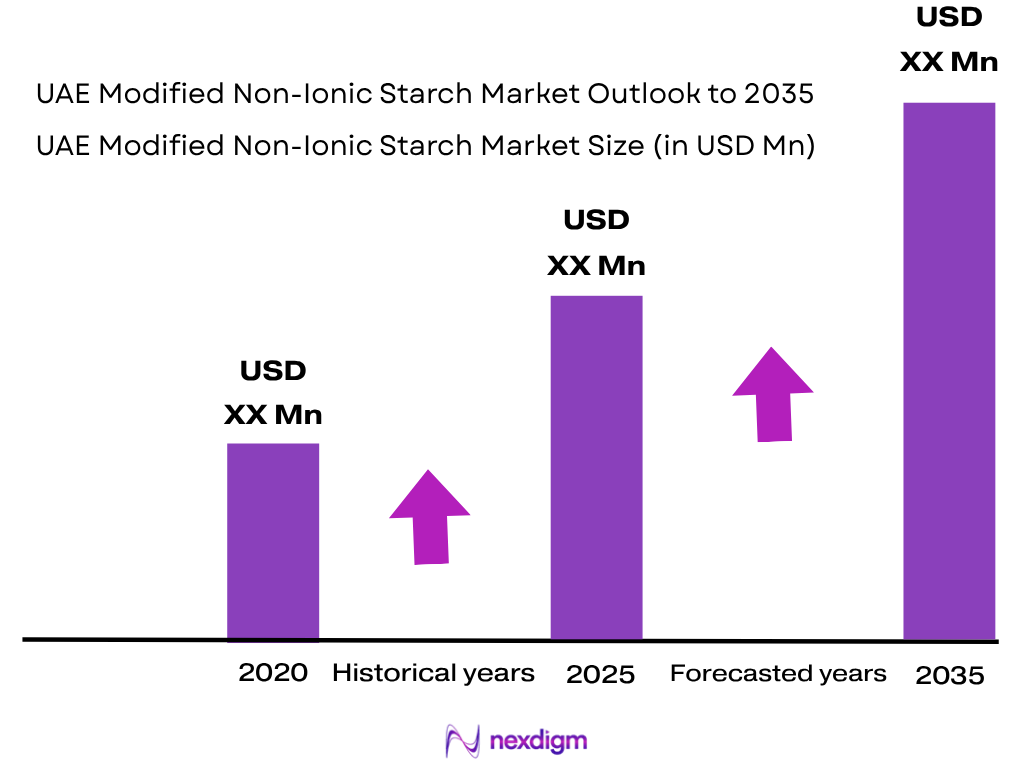
The UAE Modified Non-Ionic Starch market is valued at approximately USD ~ million in 2024, supported by increasing consumption from food processing, bakery, dairy, beverage, pharmaceutical, and industrial applications. The market is primarily driven by the UAE’s dependence on imported functional food ingredients and the expansion of domestic food manufacturing capabilities. Modified starches are used as thickening agents, stabilizers, emulsifiers, and texture enhancers across processed foods, sauces, frozen foods, and confectionery products. Modified starches are produced through physical, chemical, or enzymatic treatment of native starch to improve properties such as heat stability, viscosity control, freeze-thaw resistance, and processing performance. (Wikipedia) The UAE’s growing food manufacturing ecosystem, supported by increasing demand for processed and convenience foods, continues to create demand for specialty starch ingredients.
The UAE Modified Non-Ionic Starch market is concentrated in Dubai, Abu Dhabi, and Sharjah due to their strong food processing infrastructure, logistics connectivity, and concentration of industrial users. Dubai acts as the primary trading and distribution hub because of its international ports, especially Jebel Ali Port, which facilitates the import and redistribution of food ingredients across the UAE and wider GCC region. Abu Dhabi contributes through its food security initiatives, industrial investments, and agricultural development programs, while Sharjah supports manufacturing activities through industrial zones. The UAE imports a significant portion of specialty ingredients because domestic starch production remains limited, making international supplier networks important for food manufacturers, pharmaceutical companies, and industrial users. Modified starch applications extend across food products, pharmaceuticals, paper, textiles, and adhesives due to their functional performance characteristics.
Market Segmentation
By Modification Type
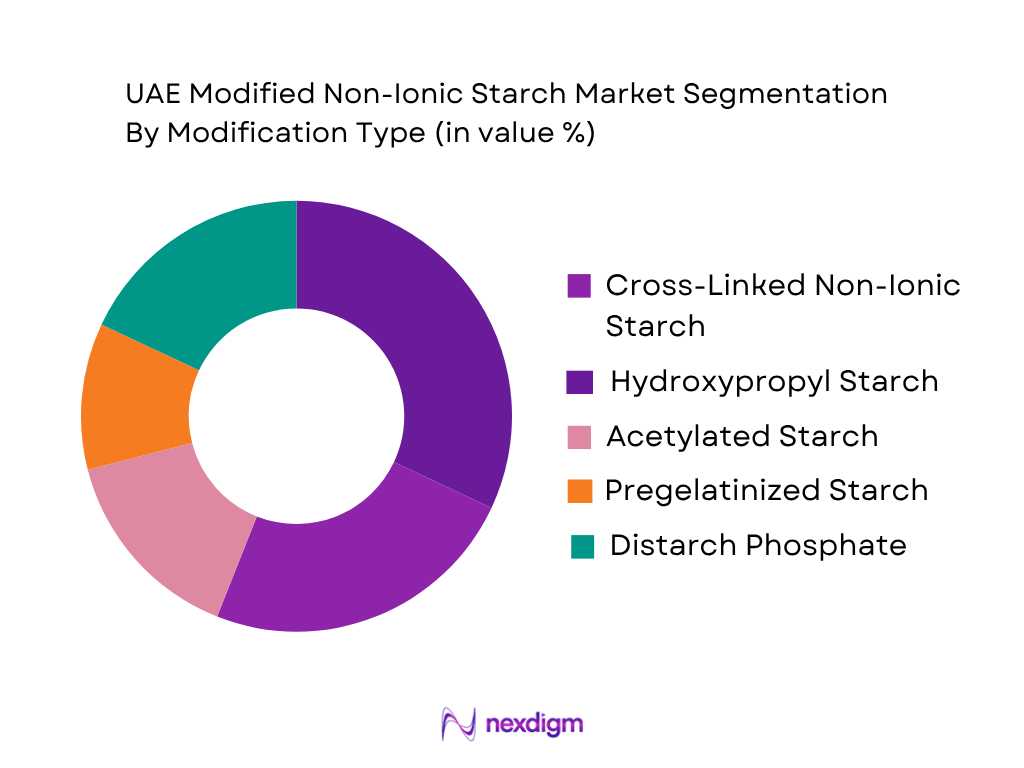
The UAE Modified Non-Ionic Starch market is segmented by modification type into hydroxypropyl starch, acetylated starch, cross-linked starch, pregelatinized starch, oxidized starch, distarch phosphate, and specialty modified starches. Among these, cross-linked and hydroxypropyl starches dominate the market due to their extensive usage in processed food manufacturing, bakery products, dairy formulations, sauces, and frozen foods. Cross-linked starches are preferred because they maintain viscosity and stability under high-temperature processing and acidic conditions. Hydroxypropyl starches are increasingly adopted for applications requiring improved freeze-thaw stability and enhanced texture retention. Food manufacturers in the UAE rely heavily on imported specialty starches to meet formulation requirements for premium food products. Modified starches are widely utilized as stabilizers and texture modifiers across food and industrial applications.
By Application
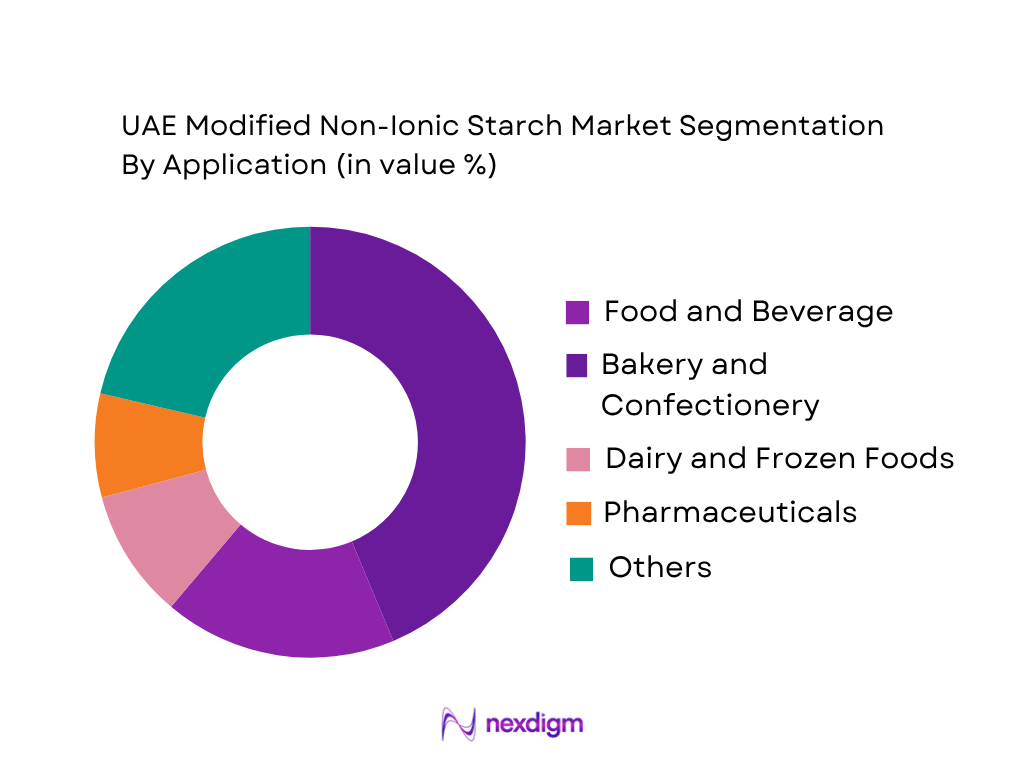
The UAE Modified Non-Ionic Starch market is segmented by application into food and beverages, bakery and confectionery, dairy products, pharmaceuticals, nutraceuticals, industrial adhesives, paper manufacturing, textiles, and cosmetics. The food and beverage segment represents the dominant application area due to increasing demand for processed foods, convenience products, bakery items, sauces, and dairy formulations. Modified starches provide improved texture, consistency, stability, and shelf-life performance, making them valuable ingredients for food manufacturers. The UAE’s large hospitality sector, expanding retail food market, and dependence on processed food imports further support demand for functional ingredients. Pharmaceutical applications are also gaining importance due to the use of modified starches as excipients and binding agents. Industrial sectors such as adhesives and paper manufacturing use modified starches because of their binding and film-forming properties.
Competitive Landscape
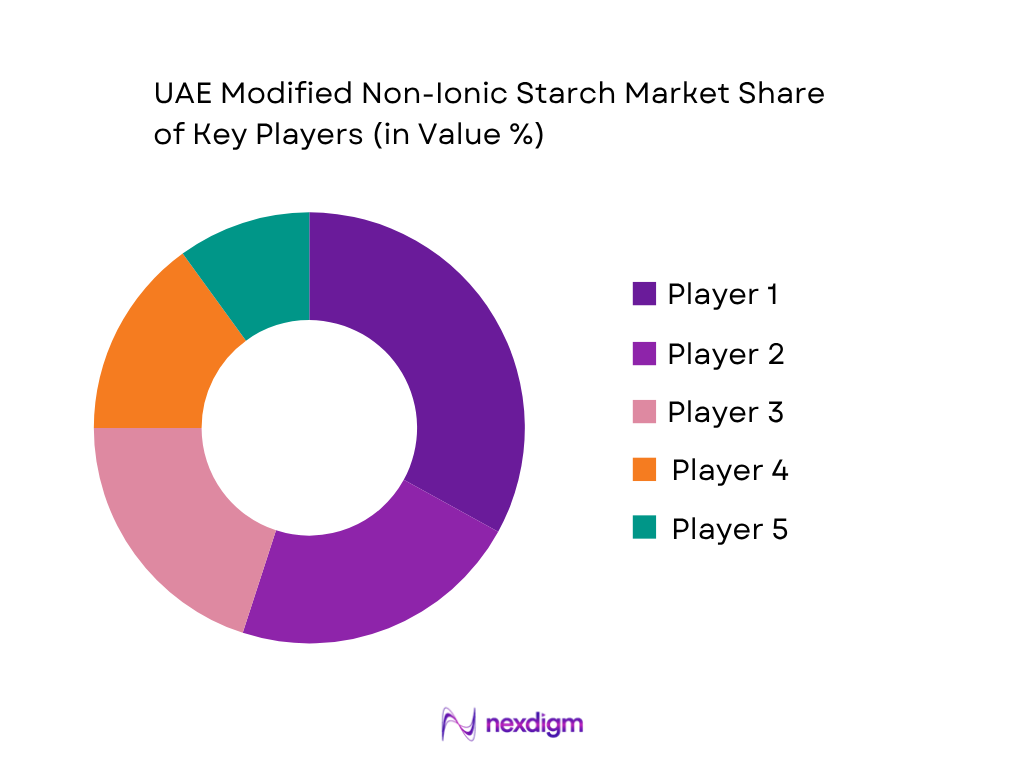
The UAE Modified Non-Ionic Starch market is characterized by the presence of global ingredient manufacturers, international starch processors, and regional distributors. Since domestic production of specialty modified starch remains limited, multinational suppliers play an important role in serving food, pharmaceutical, and industrial customers. Companies compete through product portfolio diversity, technical support, certification capabilities, supply reliability, and regional distribution networks.
| Company | Establishment Year | Headquarters | Modified Starch Portfolio | Food Application Capability | Pharmaceutical Grade Capability | Halal Certification Capability | GCC Distribution Reach |
| Ingredion Incorporated | 1906 | USA | ~ | ~ | ~ | ~ | ~ |
| Cargill Incorporated | 1865 | USA | ~ | ~ | ~ | ~ | ~ |
| Roquette | 1933 | France | ~ | ~ | ~ | ~ | ~ |
| Tate & Lyle PLC | 1921 | UK | ~ | ~ | ~ | ~ | ~ |
| Beneo GmbH | 2007 | Belgium | ~ | ~ | ~ | ~ | ~ |
UAE Modified Non-Ionic Starch Market Analysis
Growth Drivers
Expansion of Food Processing Industry and Imported Food Manufacturing Activities
The UAE Modified Starch market is supported by the rapid expansion of food processing activities, driven by the country’s dependence on imported food ingredients and development of domestic food manufacturing capabilities. The UAE Ministry of Economy reported that the food and beverage sector remains one of the major manufacturing segments, supported by investments in food security initiatives and industrial diversification programs. The UAE recorded merchandise imports of approximately USD 436 billion in 2023, according to World Bank trade indicators, reflecting strong dependence on international supply chains for food ingredients and processing materials. Modified starch demand benefits from food manufacturers producing sauces, bakery products, dairy items, frozen foods, and convenience meals. The UAE population reached approximately 10.2 million people in 2024 according to World Bank demographic indicators, supporting consumption growth for processed food products. Dubai and Abu Dhabi continue to attract food processing investments due to logistics infrastructure, with Jebel Ali Port handling more than 14 million TEUs annually according to port authority data. These factors increase demand for imported specialty starch ingredients used for viscosity control, stabilization, and texture improvement in food formulations.
Growth of Bakery, Dairy Processing and Functional Food Ingredient Applications
The UAE Modified Starch market is increasingly supported by expansion in bakery, dairy processing, and functional ingredient applications. Modified starches are widely used in bakery fillings, dairy desserts, sauces, confectionery products, and ready-to-eat meals because they improve texture stability, moisture retention, and processing efficiency. According to UAE government food security reports, the country imports a significant portion of its food requirements, creating continuous demand for food ingredient suppliers and processors. The UAE processed food sector benefits from strong hospitality and tourism activity, with Dubai International Airport recording more than 86 million passengers in 2023, supporting demand from hotels, restaurants, and catering businesses. The UAE dairy sector also continues to expand through domestic processors requiring stabilizers and texture enhancers for yogurt, beverages, and frozen dairy products. The pharmaceutical manufacturing sector provides additional demand potential, as the UAE pharmaceutical industry has attracted investments under industrial development programs. Modified starch applications in pharmaceutical formulations include binding agents, fillers, and excipients, supporting adoption among local manufacturers seeking functional ingredient solutions.
Market Challenges
High Dependence on Imported Modified Starch Products and Supply Chain Complexity
The UAE Modified Starch market faces challenges due to limited domestic production capacity and significant dependence on international suppliers for specialty starch ingredients. The country imports a large volume of agricultural commodities and food processing inputs because local agricultural production is constrained by climatic conditions. According to World Bank indicators, agricultural land availability in the UAE remains limited, with agricultural activities accounting for a small portion of total land use, increasing reliance on imported raw materials. Modified starch manufacturers depend on global supply networks involving corn, potato, tapioca, and wheat-based starch suppliers. Logistics complexity can affect availability due to transportation disruptions, customs procedures, and international shipping conditions. The UAE handled approximately 1.4 billion tonnes of foreign trade volume through maritime and logistics infrastructure in recent years, demonstrating the scale of import-dependent supply chains. Food manufacturers using modified starch require consistent quality, certifications, and compliance documentation, increasing procurement complexity. Any disruption in global starch-producing regions can impact availability, delivery timelines, and formulation planning for UAE-based food and pharmaceutical companies.
Regulatory Compliance Requirements and Competition from Alternative Ingredients
The UAE Modified Starch market experiences challenges from strict food safety requirements and competition from alternative functional ingredients such as hydrocolloids, gums, and natural stabilizers. Food ingredient suppliers must comply with UAE regulatory frameworks covering food additives, labeling requirements, halal certification, and safety standards. The UAE Ministry of Climate Change and Environment and local food safety authorities regulate imported food ingredients entering the country. The UAE imported food products from more than 200 countries, requiring extensive compliance procedures across international supply chains. Modified starch suppliers must provide technical documentation regarding processing methods, allergen declarations, and product specifications. Additionally, food manufacturers increasingly evaluate alternatives such as xanthan gum, guar gum, pectin, and carrageenan based on formulation requirements. The challenge is intensified among small and medium-sized food producers that may have limited technical expertise regarding starch modification functionality. As clean-label trends increase, suppliers must develop modified starch solutions that maintain performance while meeting consumer preferences for recognizable ingredients and sustainable processing practices.
Market Opportunities
Clean Label Modified Starch Development and Halal Certified Ingredient Expansion
The UAE Modified Starch market presents opportunities through increasing demand for clean-label and halal-certified ingredient solutions. Food manufacturers are seeking functional ingredients that provide processing benefits while meeting consumer expectations regarding transparency and quality. The UAE has a predominantly Muslim population, with Islam practiced by more than 75% of residents according to demographic data, creating strong demand for halal-certified food ingredients across domestic and imported products. Modified starch suppliers with halal certification and traceable sourcing capabilities can support food manufacturers targeting both UAE consumers and wider GCC markets. The country’s food import ecosystem serves as a regional distribution hub, with Dubai acting as a major re-export center for Middle Eastern and African markets. Clean-label starch innovation, including physically modified and minimally processed starch solutions, creates opportunities for bakery, dairy, and convenience food manufacturers. The UAE government’s focus on food security and local food production initiatives encourages investment in advanced food processing technologies. These factors create opportunities for specialty modified starch suppliers offering sustainable, certified, and application-specific solutions.
Plant-Based Food Growth and Pharmaceutical Excipient Applications
The UAE Modified Starch market has growth opportunities from expanding plant-based food applications and pharmaceutical excipient demand. Plant-based food categories require functional ingredients that improve texture, stability, and sensory properties, creating demand for specialty starch solutions. The UAE has been investing in food technology and alternative protein development as part of broader food security initiatives. According to World Bank data, the UAE GDP reached approximately USD 504 billion in 2023, reflecting economic capacity supporting investment in advanced manufacturing sectors including food and pharmaceuticals. Pharmaceutical manufacturing expansion also creates opportunities for modified starch applications as binders, fillers, and stabilizing agents in tablet and capsule formulations. The UAE has promoted pharmaceutical and life sciences manufacturing through industrial development strategies, attracting international companies and local investments. Modified starch suppliers can benefit by developing pharmaceutical-grade products meeting quality standards required by manufacturers. Additionally, the UAE’s strategic location enables companies to supply specialty starch solutions to neighboring GCC markets, where pharmaceutical and food manufacturing activities continue to expand.
Future Outlook
Over the next decade, the UAE Modified Non-Ionic Starch market is expected to demonstrate continued growth driven by increasing processed food manufacturing, expansion of bakery and dairy industries, rising pharmaceutical production, and demand for functional ingredients. The market will benefit from growing preference for specialty starch solutions that improve product quality, processing efficiency, and formulation stability. Future opportunities are expected in clean-label ingredients, halal-certified starch solutions, plant-based food applications, pharmaceutical excipients, and sustainable ingredient technologies. The UAE’s position as a regional food trade hub will continue supporting demand for imported specialty starch products.
Major Players
- Ingredion Incorporated
- Cargill Incorporated
- Archer Daniels Midland Company (ADM)
- Roquette Frères
- Tate & Lyle PLC
- Beneo GmbH
- Tereos Group
- Avebe U.A.
- Emsland Group
- AGRANA Beteiligungs-AG
- KMC Ingredients
- Thai Wah Public Company Limited
- Global Bio-Chem Technology Group
- Universal Starch-Chem Allied Limited
- Gujarat Ambuja Exports Limited
Key Target Audience
- Food and Beverage Manufacturers
- Bakery and Confectionery Manufacturers
- Pharmaceutical Manufacturers and Excipient Producers
- Dairy Product Manufacturers
- Ingredient Importers and Distributors
- Industrial Adhesive and Paper Manufacturers
- Investments and Venture Capitalist Firms (Food Technology Funds, Ingredient Manufacturing Investment Funds)
- Government and Regulatory Bodies (UAE Ministry of Climate Change and Environment, Dubai Municipality Food Safety Department, Abu Dhabi Agriculture and Food Safety Authority)
Research Methodology
Step 1: Identification of Key Variables
The initial phase involves developing an ecosystem map covering stakeholders involved in the UAE Modified Non-Ionic Starch market. This includes international starch manufacturers, importers, distributors, food processors, pharmaceutical companies, and industrial users. Secondary research is conducted to identify market variables including application demand, import dependency, regulatory requirements, and supply chain structure.
Step 2: Market Analysis and Construction
This phase involves analyzing market demand patterns, application penetration, import flows, and end-user requirements. Assessment includes food processing demand, pharmaceutical applications, industrial usage, supplier capabilities, and distribution networks. Historical trends are evaluated to understand market development.
Step 3: Hypothesis Validation and Expert Consultation
Market assumptions are validated through interviews with ingredient suppliers, food manufacturers, pharmaceutical companies, and industrial users. These discussions provide insights into procurement behavior, formulation requirements, product specifications, and competitive dynamics.
Step 4: Research Synthesis and Final Output
The final stage combines primary and secondary research findings to develop a comprehensive assessment of the UAE Modified Non-Ionic Starch market. Data validation is performed through triangulation of supply-side analysis, demand-side evaluation, and competitive intelligence.

- Executive Summary
- Research Methodology (Market Definitions and Assumptions, Abbreviations, UAE Modified Non-Ionic Starch Market Classification, Modified Starch Technology Mapping, Non-Ionic Modification Process Assessment, Hydroxypropyl Starch Evaluation, Acetylated Starch Analysis, Cross-Linked Starch Assessment, Pregelatinized Starch Evaluation, Oxidized Starch Assessment, Distarch Phosphate Analysis, Specialty Modified Starch Assessment, Native Starch Feedstock Mapping, Maize Starch Assessment, Tapioca Starch Assessment, Potato Starch Assessment, Rice Starch Assessment, Import Dependency Analysis, Food Processing Demand Assessment, Bakery Industry Assessment, Dairy Industry Assessment, Beverage Industry Assessment, Pharmaceutical Excipient Assessment, Industrial Application Assessment, Adhesive Industry Assessment, Paper Industry Assessment, Textile Industry Assessment, Supply-Side Assessment, Demand-Side Assessment, Domestic Processing Analysis, Import and Distribution Channel Assessment, International Trade Flow Analysis, Top-Down Market Sizing, Bottom-Up Market Sizing, Primary Industry Interviews, Food Manufacturer Interviews, Ingredient Supplier Discussions, Distributor Analysis, Data Triangulation, Forecasting Framework, Market Share Validation, Limitations and Future Conclusions)

- Definition and Scope
- Market Evolution and Industry Genesis Timeline
- Modified Non-Ionic Starch Value Chain Analysis
- Modified Non-Ionic Starch Supply Chain Analysis

- Growth Drivers (Expansion of Food Processing Industry, Increasing Imported Food Manufacturing Activities, Rising Demand for Functional Food Ingredients, Growth of Bakery and Confectionery Sector, Expansion of Dairy Processing, Increasing Pharmaceutical Manufacturing, Growth of Convenience Food Consumption, Rising Demand for Texture Enhancement Solutions, Expansion of Industrial Adhesive Applications)
- Market Challenges (High Dependence on Imported Modified Starch Products, Limited Domestic Starch Production Capacity, Raw Material Supply Dependency, Import Logistics Complexity, Regulatory Compliance Requirements, Competition from Hydrocolloids and Alternative Ingredients, Limited Local Modification Technology, Supply Chain Disruptions)
- Market Opportunities (Clean Label Modified Starch Development, Halal Certified Ingredient Expansion, Plant-Based Food Product Growth, Pharmaceutical Excipient Applications, Gluten-Free Product Development, Sustainable Ingredient Solutions, Specialty Bakery Ingredient Demand, Food Export Manufacturing Expansion, Industrial Adhesive Applications)
- Market Trends (Growth of Functional Ingredients, Clean Label Food Development, Halal Ingredient Demand, Plant-Based Food Innovation, Premium Bakery Product Expansion, Imported Specialty Ingredient Adoption, Sustainable Food Processing, Customized Starch Formulation Development)
- Government Regulations and Standards (UAE Ministry of Climate Change and Environment Food Regulations, Emirates Authority for Standardization and Metrology Standards, Dubai Municipality Food Safety Regulations, Abu Dhabi Agriculture and Food Safety Authority Requirements, GCC Food Additive Standards, Halal Certification Requirements, Pharmaceutical Manufacturing Regulations)
- SWOT Analysis
- Porter’s Five Forces Analysis
- PESTLE Analysis

- By Market Value (2020-2025)
- By Volume Consumption (2020-2025)
- By Modified Starch Import Volume (2020-2025)
- By Food Grade Modified Starch Consumption (2020-2025)
- By Pharmaceutical Grade Modified Starch Consumption (2020-2025)
- By Industrial Grade Modified Starch Consumption (2020-2025)

- By Modification Type (In Value %)
Hydroxypropyl Starch
Acetylated Starch
Cross-Linked Starch
Pregelatinized Starch
Oxidized Starch
Distarch Phosphate
Hydroxyethyl Starch
Specialty Non-Ionic Modified Starch - By Raw Material Source (In Value %)
Maize-Based Modified Starch
Tapioca-Based Modified Starch
Potato-Based Modified Starch
Rice-Based Modified Starch
Wheat-Based Modified Starch
Other Plant-Based Starch Sources - By Application (In Value %)
Food and Beverage Applications
Bakery and Confectionery Products
Dairy and Frozen Food Products
Sauces and Dressings
Processed and Convenience Foods
Beverage Stabilization Applications
Pharmaceutical Applications
Nutraceutical Applications
Industrial Adhesives
Paper Manufacturing
Textile Processing - By Functionality (In Value %)
Thickening Agents
Texture Enhancement Solutions
Stabilizers
Binding Agents
Moisture Retention Agents
Emulsification Support Ingredients
Film-Forming Agents
Freeze-Thaw Stability Solutions - By End-Use Industry (In Value %)
Food Processing Industry
Beverage Industry
Pharmaceutical Industry
Nutraceutical Industry
Bakery Industry
Dairy Industry
Paper Industry
Textile Industry
Adhesive Industry
Cosmetics Industry - By Distribution Channel (In Value %)
Direct Industrial Supply
Ingredient Importers
Specialty Chemical Distributors
Food Ingredient Distributors
Pharmaceutical Ingredient Distributors
Industrial Raw Material Suppliers
Online Ingredient Platforms

- Market Share of Major Players (By Revenue, Import Volume, Product Portfolio, Modified Starch Technology Coverage, Food Application Presence, Pharmaceutical Application Capability, Industrial Application Coverage, Distribution Network Reach, Regional Supply Capability, Certification Coverage, Customer Base)
- Cross Comparison Parameters (Modified Starch Portfolio Breadth, Non-Ionic Modification Technology Capability, Halal Certified Product Portfolio, Food Grade Application Coverage, Pharmaceutical Grade Capability, Import Distribution Strength, GCC Regional Reach, Specialty Starch Innovation Capability)
- SWOT Analysis of Major Players
- Detailed Profiles of Major Companies
Ingredion Incorporated
Cargill Incorporated
Archer Daniels Midland Company (ADM)
Roquette Frères
Tate & Lyle PLC
Beneo GmbH
Tereos Group
Avebe U.A.
Emsland Group
AGRANA Beteiligungs-AG
KMC Ingredients
Thai Wah Public Company Limited
Global Bio-Chem Technology Group
Universal Starch-Chem Allied Limited
Gujarat Ambuja Exports Limited

- Food Manufacturer Requirement Assessment
- Bakery Industry Ingredient Assessment
- Dairy Industry Starch Requirement Analysis
- Beverage Industry Application Assessment
- Pharmaceutical Industry Excipient Assessment
- Plant-Based Food Application Assessment

- By Market Value (2026-2035)
- By Volume Consumption (2026-2035)
- By Modified Starch Import Volume (2026-2035)
- By Food Grade Modified Starch Consumption (2026-2035)
- By Pharmaceutical Grade Modified Starch Consumption (2026-2035)


 Request a Sample
 Ask for Customization
 Get a Quote
 Enquire Now