
 Download PDF
Market Overview
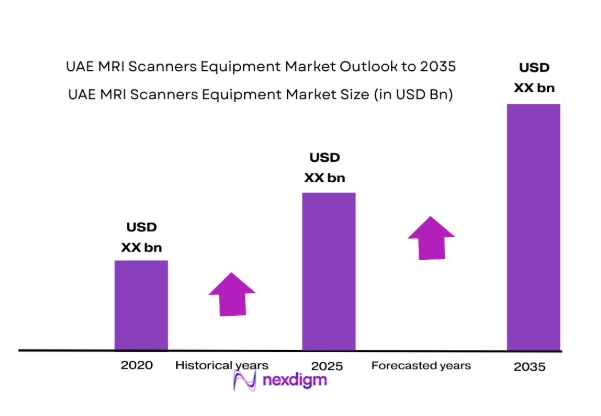
The UAE MRI scanners equipment market demonstrates a high-value diagnostic imaging segment, with the market size recorded at approximately USD ~ million based on a recent historical assessment. This value is driven by strong capital investments in advanced imaging infrastructure, increasing demand for high-resolution diagnostic capabilities, and the expansion of multispecialty hospitals and diagnostic centers. Growth is further supported by premiumization trends toward 3 Tesla systems, rising neurological and oncological case volumes, and continuous upgrades in imaging technology across both public and private healthcare facilities.
Dominance within the market is concentrated in key emirates such as Dubai and Abu Dhabi due to their advanced healthcare ecosystems, higher concentration of tertiary care hospitals, and strong inflow of international patients seeking specialized diagnostics. These regions benefit from robust healthcare funding, early adoption of advanced imaging technologies, and integrated care networks. Additionally, the presence of major private hospital groups and diagnostic chains in these emirates accelerates procurement of high-end MRI systems, reinforcing their leadership in the overall market landscape.
Market Segmentation
By End User Segment
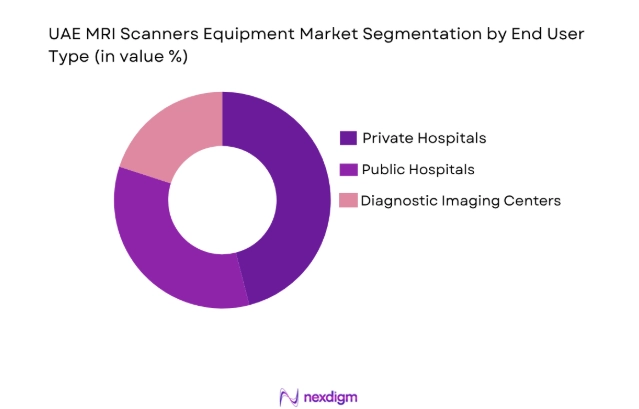
The UAE MRI Scanners Equipment market is segmented by end user into Public Hospitals, Private Hospitals, and Diagnostic Imaging Centers. Recently, Private Hospitals have a dominant market share due to their aggressive expansion strategies, faster procurement cycles, and strong focus on premium healthcare services. These hospitals invest heavily in advanced imaging technologies to attract medical tourists and high-income patients, offering superior diagnostic capabilities and reduced waiting times, which strengthens their position in the market.
By Platform Type
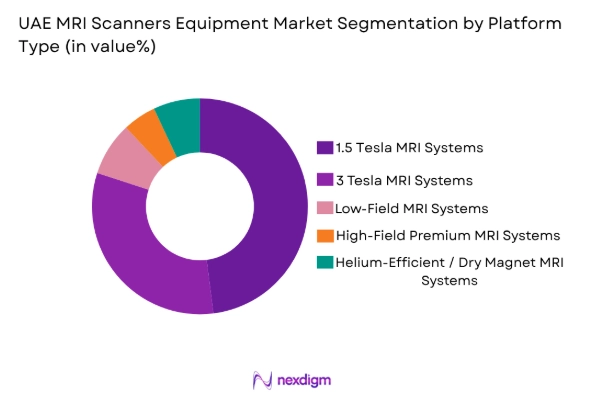
The UAE MRI Scanners Equipment market is segmented by platform type into 1.5 Tesla MRI Systems, 3 Tesla MRI Systems, Low-Field MRI Systems (<1 Tesla), High-Field Premium MRI Systems (>3 Tesla), and Helium-Efficient / Dry Magnet MRI Systems. Recently, 1.5 Tesla MRI Systems have a dominant market share due to their optimal balance between cost, diagnostic capability, and operational efficiency. These systems are widely adopted across both public and private hospitals because they support a broad range of clinical applications while maintaining lower infrastructure and maintenance requirements compared to higher-field systems, making them the preferred choice for most healthcare providers.
Competitive Landscape
The UAE MRI scanners equipment market is moderately consolidated, with a few global OEMs dominating through strong technological capabilities, extensive service networks, and established relationships with healthcare providers. Leading players compete on advanced imaging performance, AI-enabled workflow solutions, and lifecycle service contracts, while regional distributors play a key role in installation and after-sales support. The competitive intensity is shaped by tender-based procurement and long-term service agreements.
| Company Name | Establishment Year | Headquarters | Technology Focus | Market Reach | Key Products | Revenue | UAE Installed Base Strength |
| Siemens Healthineers | 1847 | Germany | ~ | ~ | ~ | ~ | ~ |
| GE HealthCare | 1892 | USA | ~ | ~ | ~ | ~ | ~ |
| Philips Healthcare | 1891 | Netherlands | ~ | ~ | ~ | ~ | ~ |
| Canon Medical Systems | 1914 | Japan | ~ | ~ | ~ | ~ | ~ |
| FUJIFILM Healthcare | 1934 | Japan | ~ | ~ | ~ | ~ | ~ |
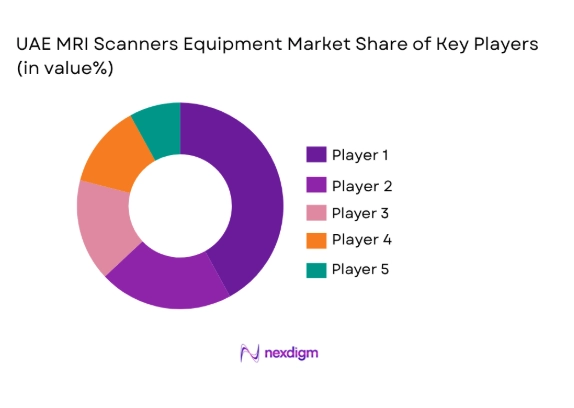
UAE MRI Scanners Equipment Market Analysis
Growth Drivers
Increased Healthcare Investment
The growth of the UAE MRI scanners equipment market is being significantly fueled by increased investments in healthcare infrastructure. The UAE government has been actively investing in the development of state-of-the-art hospitals and diagnostic centers across major cities, thereby creating a surge in demand for advanced medical technologies like MRI systems. This has encouraged private sector participation, making high-end healthcare services more accessible, particularly in urban areas. Moreover, the government’s efforts to improve healthcare quality and access in both public and private healthcare facilities have led to an increase in the number of diagnostic centers, all of which require advanced medical imaging tools. Furthermore, the growing emphasis on non-invasive diagnostic tools and preventive healthcare has been a crucial factor driving the adoption of advanced imaging technologies, including MRI scanners. This trend reflects a broader shift towards early diagnosis and preventive care, where MRI systems play a vital role in offering detailed, accurate imaging without the need for invasive procedures.
Rising Chronic Disease Prevalence
Another key growth driver for the UAE MRI scanners equipment market is the rising prevalence of chronic diseases. Conditions such as cardiovascular diseases, cancer, and neurological disorders are on the rise in the UAE due to lifestyle changes, an aging population, and an increased focus on medical treatment and prevention. MRI scanners play a crucial role in the early detection, diagnosis, and monitoring of these conditions, allowing for timely interventions and improved patient outcomes. As the number of patients requiring diagnostic imaging grows, hospitals and diagnostic centers are increasing their investments in advanced MRI systems to meet the demand for high-quality, non-invasive diagnostic capabilities. The government’s focus on enhancing healthcare outcomes by promoting early detection through advanced imaging techniques further accelerates the demand for MRI systems, as they are essential for diagnosing complex health issues. The rising burden of chronic diseases thus significantly drives the adoption of MRI technology and contributes to the market’s continued growth.
Market Challenges
High Initial Investment Cost
A significant challenge faced by the UAE MRI scanners equipment market is the high initial investment cost associated with the procurement of advanced MRI systems. MRI machines require significant capital investment, not only for purchasing the equipment but also for installation, maintenance, and ongoing operational costs. Smaller healthcare facilities and diagnostic centers, particularly those located in rural or less urbanized areas, often struggle with the high upfront costs associated with acquiring these systems. Despite the growing demand for MRI scans, many healthcare providers face financial constraints that prevent them from upgrading or installing state-of-the-art MRI machines. Additionally, the long-term maintenance and operational costs of MRI systems further limit their affordability, creating a barrier for smaller clinics and centers to integrate these technologies. This challenge is compounded by the limited availability of financing options, making it difficult for some healthcare providers to invest in advanced MRI equipment. Consequently, these financial constraints pose a significant hurdle to the widespread adoption of advanced MRI systems across the UAE.
Shortage of Skilled Technicians
Another notable challenge for the UAE MRI scanners equipment market is the shortage of skilled MRI technicians and radiologists. Proper operation and interpretation of MRI systems require highly trained professionals capable of handling complex imaging procedures and analyzing detailed medical images. The demand for skilled MRI technicians has risen in tandem with the increasing adoption of MRI systems in healthcare settings, but the UAE has faced challenges in meeting this demand. The limited availability of qualified personnel in certain parts of the country, combined with the rapid expansion of diagnostic imaging centers, has created a shortage of professionals who can operate these advanced systems effectively. The shortage of skilled technicians not only strains the healthcare system but also affects the efficiency and utilization of MRI machines. This challenge can lead to delays in imaging procedures, increased operational costs, and potential errors in diagnosis, which in turn can undermine the effectiveness of MRI systems. As the demand for MRI scans continues to rise, addressing this shortage of trained professionals becomes critical to ensuring that the equipment is used optimally.
Opportunities
Expansion of Diagnostic Facilities
One of the key opportunities for the UAE MRI scanners equipment market lies in the expansion of diagnostic facilities throughout the country. The growing demand for healthcare services, coupled with the government’s efforts to increase access to quality healthcare, has led to a significant rise in the number of new hospitals, imaging centers, and diagnostic facilities being established. These new facilities are key drivers of demand for advanced medical technologies, including MRI scanners. As both public and private sectors continue to invest in the creation of modern healthcare infrastructure, MRI systems will be essential for meeting the increased diagnostic needs. Moreover, the government’s initiatives to improve healthcare infrastructure through the construction of new medical facilities, particularly in underserved regions, further support this growth. The continued development of diagnostic centers, along with government-backed projects to enhance healthcare accessibility, presents a substantial opportunity for MRI scanner manufacturers to increase their market presence and capitalize on the expanding healthcare sector in the UAE.
Technological Advancements in MRI Systems
The continuous advancements in MRI technology present a major opportunity for the UAE MRI scanners equipment market. Innovations such as higher resolution imaging, faster scan times, and improved patient comfort have made MRI systems even more valuable in clinical practice. Additionally, the integration of artificial intelligence (AI) and machine learning technologies into MRI systems is transforming diagnostic imaging, improving accuracy, and reducing operational time. These advancements are enabling healthcare providers to obtain more detailed and accurate images while also increasing the efficiency of imaging procedures. Furthermore, developments in portable and compact MRI systems are opening up new opportunities, particularly in underserved regions where larger MRI machines may not be feasible. These portable systems are ideal for use in mobile healthcare settings, rural clinics, or smaller healthcare facilities that require advanced imaging capabilities without the space constraints of traditional MRI systems. As technology continues to evolve, these advancements offer significant opportunities for growth in the UAE MRI scanners equipment market, making it an attractive sector for both manufacturers and healthcare providers.
Future Outlook
The UAE MRI scanners equipment market is poised for steady growth over the next five years, with expected advancements in imaging technology and regulatory support paving the way for innovation. The market is likely to see increased demand driven by rising healthcare investments, technological upgrades, and a focus on non-invasive diagnostic tools. Government initiatives to enhance healthcare access and improve medical facilities will continue to support this growth trajectory. Additionally, advancements such as AI-powered MRI systems and portable MRI solutions will further fuel the demand for modern imaging equipment across the UAE.
Major Players
- GE Healthcare
- Siemens Healthineers
- Philips Healthcare
- Canon Medical Systems
- Hitachi Medical Corporation
- Toshiba Medical Systems
- Hologic Inc.
- Esaote S.p.A
- Fujifilm Holdings Corporation
- Mindray Medical International Limited
- Samsung Medison
- Shenzhen Anke High-tech
- United Imaging Healthcare
- Neusoft Medical Systems
- Shanghai United Imaging Healthcare Co., Ltd.
Key Target Audience
- Investments and venture capitalist firms
- Government and regulatory bodies
- Hospitals and healthcare providers
- Diagnostic imaging centers
- Medical equipment distributors
- Radiology equipment suppliers
- Pharmaceutical companies
Research Methodology
Step 1: Identification of Key Variables
Key variables such as installed base, pricing trends, demand drivers, and procurement patterns are identified. These variables form the foundation of the market analysis. Both quantitative and qualitative factors are considered to ensure accuracy. Additional parameters such as technology adoption rates, service lifecycle revenues, and end-user utilization patterns are also incorporated to enhance analytical depth. Market-specific indicators including field strength mix and infrastructure readiness are evaluated to refine the assessment.
Step 2: Market Analysis and Construction
Market size is constructed using a combination of bottom-up and top-down approaches. Data is collected from industry sources, company reports, and healthcare databases. Validation is performed through cross-referencing multiple data points. Further, demand estimation is aligned with hospital capacity expansion, diagnostic volumes, and procurement cycles. Pricing benchmarks and system-level configurations are analyzed to ensure realistic market valuation.
Step 3: Hypothesis Validation and Expert Consultation
Findings are validated through interviews with industry experts including radiologists, procurement managers, and OEM representatives. This ensures that assumptions align with real-world market conditions. Additional consultations with biomedical engineers and service providers help validate operational and lifecycle assumptions. Feedback loops are incorporated to refine preliminary findings and eliminate data inconsistencies.
Step 4: Research Synthesis and Final Output
All data points are consolidated and analyzed to generate insights. The final report is structured to provide actionable intelligence and strategic recommendations for stakeholders. Advanced analytical models are applied to derive forecasts and identify opportunity areas. The output is further refined to align with decision-making requirements across investors, OEMs, and healthcare providers.

- Executive Summary
- Research Methodology (Definitions, Scope, Industry Assumptions, Market Sizing Approach, Primary & Secondary Research Framework, Data Collection & Verification Protocol, Analytic Models & Forecast Methodology, Limitations & Research Validity Checks)

- Market Definition and Scope
- Value Chain & Stakeholder Ecosystem
- Regulatory / Certification Landscape
- Sector Dynamics Affecting Demand
- Strategic Initiatives & Infrastructure Growth

- Growth Drivers
Rising demand for advanced neuro, oncology, musculoskeletal, and cardiac imaging
Expansion of multispecialty hospitals, premium diagnostics networks, and medical tourism infrastructure
Technology upgrades toward AI-enabled workflow, faster gradients, and helium-efficient systems - Market Challenges
High capital expenditure, site-planning complexity, and shielded-room infrastructure costs
Lengthy procurement cycles, tender qualification requirements, and service dependency
Shortage of specialized MRI technologists, protocol optimization expertise, and uptime management capabilities - Market Opportunities
Replacement demand for aging installed base across hospital and imaging center networks
Growing adoption of outpatient MRI, mobile MRI, and managed equipment service models
Upside in premium 3T, wide-bore, and workflow-automation-led productivity solutions - Trends
Shift toward wide-bore, patient-comfort-centric, and high-throughput MRI platforms
Increasing use of AI reconstruction, remote service diagnostics, and lifecycle service contracts - Government Regulations
- SWOT Analysis
- Porter’s Five Forces

- By Market Value, 2020-2025
- By Installed Units, 2020-2025
- By Average System Price, 2020-2025
- By System Complexity Tier, 2020-2025

- By System Type (In Value%)
Closed-Bore MRI Systems
Wide-Bore MRI Systems
Open MRI Systems
Extremity MRI Systems
Mobile MRI Systems - By Platform Type (In Value%)
1.5 Tesla MRI Systems
3 Tesla MRI Systems
Low-Field MRI Systems
High-Field Premium MRI Systems
Helium-Efficient / Dry Magnet MRI Systems - By Fitment Type (In Value%)
Fixed In-Hospital Installations
Diagnostic Center Installations
Mobile / Trailer-Mounted Installations
Refurbished / Replacement Installations - By End User Segment (In Value%)
Public Hospitals
Private Hospitals
Diagnostic Imaging Centers

- Market Share Analysis
- Cross Comparison Parameters (Installed Base in UAE, Field Strength Portfolio Breadth, Bore Size and Architecture Mix, Gradient Strength and Slew Rate Capability, RF Coil Portfolio Depth, AI Reconstruction and Workflow Automation Capability, Scan Time Efficiency and Throughput, Image Quality and Resolution Benchmarking, Application-Specific Clinical Packages, Helium Consumption and Cryogen Efficiency, Energy Consumption and Sustainability Profile, System Footprint and Site Planning Flexibility, Pricing Positioning Across System Tiers, Service Network Coverage and Response Time, Uptime Guarantee and SLA Performance)
- SWOT Analysis of Key Competitors
- Pricing & Procurement Analysis
- Key Players
Siemens Healthineers
GE HealthCare
Philips Healthcare
Canon Medical Systems
FUJIFILM Healthcare
United Imaging Healthcare
Esaote
Hyperfine
Neusoft Medical Systems
Shenzhen Anke High-tech
AllTech Medical Systems
Time Medical Systems
Aspect Imaging
MR Solutions
FONAR

- Demand intensity by public hospitals, private hospitals, and stand-alone imaging centers
- Procurement behavior, capex allocation patterns, and vendor selection criteria
- Utilization, throughput, downtime sensitivity, and service contract dependence
- Preference mapping for field strength, bore design, workflow software, and upgrade pathways

- Forecast Market Value, 2026-2035
- Forecast Installed Units, 2026-2035
- Price Forecast by System Tier, 2026-2035
- Future Demand by Platform, 2026-2035


 Request a Sample
 Ask for Customization
 Get a Quote
 Enquire Now