

 Download PDF
Market Overview
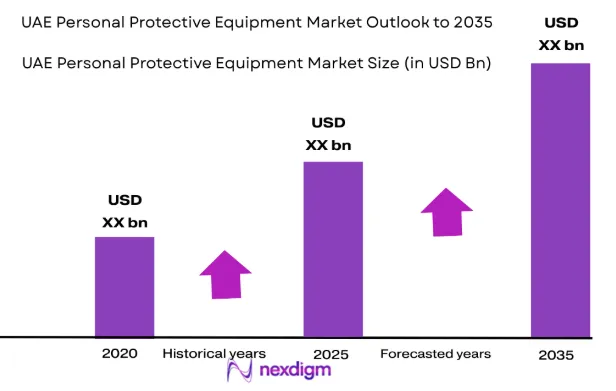
The UAE Personal Protective Equipment (PPE) market is valued at USD ~ billion in 2025 and is expected to continue its upward trajectory in 2026. This growth is primarily driven by the booming construction, oil & gas, and manufacturing sectors, which have stringent safety regulations that mandate the use of PPE. Moreover, heightened awareness of workplace safety and governmental regulations requiring protective equipment further boosts the market. The adoption of advanced PPE technologies, including smart wearables, also plays a significant role in expanding the market.
The UAE PPE market is largely dominated by cities such as Dubai, Abu Dhabi, and Sharjah due to their significant industrial developments, including construction, oil & gas, and healthcare sectors. Dubai, known for its large-scale construction projects, and Abu Dhabi, with its oil and gas hub, have become key drivers for PPE demand. The region’s stringent regulations on worker safety, along with the rapidly growing industrial workforce, solidify the dominance of these cities in the PPE market.
Market Segmentation
By Product Type
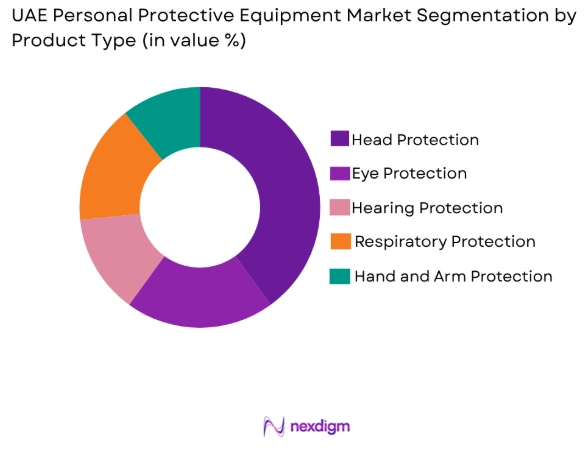
The UAE Personal Protective Equipment Market is segmented by product type into head protection, eye protection, hearing protection, respiratory protection, hand and arm protection, foot and leg protection, body protection, and fall protection. Among these, the head protection segment is dominant due to the high risk of head injuries in the construction and oil & gas industries. The introduction of lightweight, durable materials and advanced helmet designs for increased safety and comfort further contributes to the growth of this segment.
By Application Type
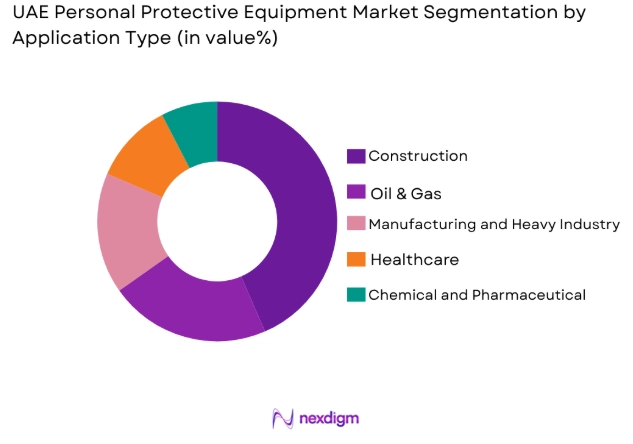
The UAE Personal Protective Equipment Market is segmented by Application Type into construction, oil & gas, manufacturing and heavy industry, healthcare, chemical and pharmaceutical, automotive, and others. The construction sector leads in market share due to the region’s booming infrastructure projects. PPE in construction is essential to protect workers from injuries such as falls, head trauma, and exposure to harmful substances. Increasing construction activities, along with government-imposed safety regulations, have solidified the dominance of this sector.
Competitive Landscape
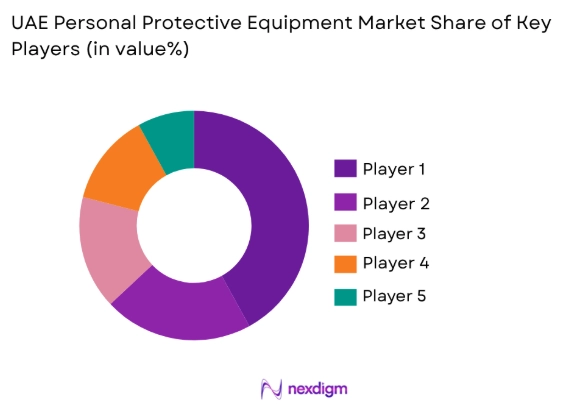
The UAE PPE market is dominated by several major global and regional players, including Honeywell International Inc., 3M Company, Ansell Limited, and MSA Safety. These companies lead the market due to their extensive product portfolios, advanced technological innovations, and strong distribution networks. Additionally, local companies such as Gulf Safety and Al Yamama Trading & Contracting have a significant presence, capitalizing on the growing demand for affordable yet reliable PPE.
| Company Name | Establishment Year | Headquarters | Product Range | Market Strategy | Distribution Network | R&D Investment | Certifications |
| Honeywell International Inc. | 1906 | Morris Plains, New Jersey | ~ | ~ | ~ | ~ | ~ |
| 3M Company | 1902 | St. Paul, Minnesota | ~ | ~ | ~ | ~ | ~ |
| Ansell Limited | 1962 | Melbourne, Australia | ~ | ~ | ~ | ~ | |
| MSA Safety | 1914 | Cranberry Township, PA | ~ | ~ | ~ | ~ | ~ |
| Gulf Safety | 2001 | Dubai, UAE | ~ | ~ | ~ | ~ | ~ |
UAE Personal Protective Equipment Market Analysis
Growth Drivers
Rise in Occupational Safety Standards
The UAE PPE market is being supported by tighter and more explicit workplace safety requirements, not by broad awareness alone. In Abu Dhabi, the ADOSH-SF Code of Practice for Personal Protective Equipment Version 4.0 was issued on 15 July 2024 and applies to all employers within the Emirate of Abu Dhabi. The code also requires employers to maintain PPE-related training records with 6 specific data fields: employee name and ID number, Emirates ID, training subject, training date, trainer details, and the type of PPE issued. At the federal level, the UAE Ministry of Human Resources and Emiratisation states that employers must provide appropriate means of protection against work injuries, occupational diseases, fire incidents, and equipment-related hazards, and that compliance is monitored through periodic field visits. This regulatory tightening matters because the UAE economy remains large and formalized, with GDP at USD 552.32 billion in 2024, GDP per capita at USD 50,273.5, and population at 10,986,400. In parallel, MoIAT’s product conformity portal was showing 19,745 results and explicitly listed PPE-related product groups such as Protective Clothing, Medical Gloves, Protective Gloves, Half Filtered Face Masks, and Voluntary PPE, indicating that compliance-linked product movement is active and administratively visible. Together, these 2024 signals support structurally higher replacement demand for certified helmets, gloves, protective clothing, respirators, and other PPE used in regulated workplaces.
Expanding Workforce in Construction and Industrial Sectors
The UAE PPE market is also being driven by expansion in sectors where PPE consumption is routine, site-based, and non-discretionary. The IMF stated that non-hydrocarbon growth reached 6.2 in 2023, led by activity in tourism, construction, manufacturing, and financial services, and later projected overall GDP growth of 3.7 in 2024 with non-hydrocarbon growth of 4.9. The World Bank reported GDP growth of 4.0 in 2024, while the UAE’s population reached 10,986,400 with population growth of 4.7 in 2024, expanding the worker and contractor base that supports labor-intensive sectors. On the industrial side, MoIAT reported in January 2024 that the industrial sector’s contribution to GDP had reached a projected AED 197 billion, while industrial exports had reached AED 187 billion in 2023 and local procurement by National ICV companies rose to AED 61 billion. By July 2024, MoIAT stated that the industrial sector’s contribution had increased further to about AED 205 billion. Abu Dhabi Investment Office separately reported USD 30.4 billion of manufacturing sector value in 2024, equal to 9.5 of GDP, and noted 15.1 growth in non-oil exports from 2023 to 2024. For the PPE market, this is directly supportive: more factory throughput, more civil works, more warehousing, and more industrial labor hours translate into recurring need for head, eye, hand, respiratory, hearing, and fall-protection equipment across project and plant environments.
Market Challenges
Regulatory Constraints
Regulation supports PPE demand, but it also creates a market-access challenge for suppliers because compliant entry into the UAE requires documentation, conformity assessment, and ongoing certificate management. MoIAT states that regulated products must obtain a UAE Certificate of Conformity before entry and circulation in the domestic market. Separate guidance on UAE product conformity explains that regulated products must hold either an ECAS or EQM certificate to be sold in the country, and this applies to both imported and locally manufactured products. In practice, this adds friction for PPE suppliers that sell multiple SKUs across helmets, gloves, masks, protective clothing, and other safety categories, because each regulated product line must move through a formal approval process. MoIAT’s open product conformity database was showing 19,745 results, and its searchable categories explicitly included Protective Clothing, Medical Gloves, Protective Gloves, Half Filtered Face Masks, and Voluntary PPE, which shows that the certification environment is both active and product-specific. This challenge matters more in a fast-scaling economy: the World Bank put UAE GDP at USD 552.32 billion in 2024, and MoIAT put industrial GDP contribution at about AED 205 billion in 2024, meaning PPE suppliers are trying to serve a large end-user base while also navigating detailed product-approval rules. For established brands, that can favor repeat sales; for new entrants, it can slow launch timing, SKU expansion, and cross-border product rollout.
High Costs of Advanced PPE Products
Advanced PPE remains a challenge in the UAE because a meaningful share of technically specialized products is still tied to imported supply chains, certification steps, and external logistics conditions. World Integrated Trade Solution data, based on UN Comtrade, shows that in 2024 the UAE imported protective garments for surgical/medical use from China worth USD 6.878 million, from Saudi Arabia worth USD 3.027 million, and from India worth USD 2.360 million. In the same year, the UAE imported gloves under HS 401519 from China worth USD 6.569 million, from Thailand worth USD 5.549 million, and from Malaysia worth USD 3.512 million. These figures show that important PPE categories continue to rely on external sourcing across multiple corridors rather than a purely domestic supply base. The IMF also noted in 2024 that direct trade disruption from Red Sea tensions had been limited so far, but global shipping costs had increased. That matters because advanced PPE typically carries more testing, traceability, and import handling than basic safety gear. Even though the World Bank recorded relatively contained UAE consumer inflation at 1.7 in 2024, imported specialized PPE still faces product-specific landed-cost pressure through freight, certification, and supplier concentration. For the UAE PPE market, the implication is clear: buyers in healthcare, industrial, and construction settings may continue purchasing, but premium-category adoption can be paced by procurement discipline and stock rationalization rather than by need alone.
Opportunities
Innovation in Smart PPE
Smart PPE is a credible opportunity in the UAE because the country already has the digital and industrial foundations needed for connected safety equipment, even though the opportunity is future-facing. The World Bank reported that 100 of the UAE population was using the internet in 2024, which materially lowers the barrier for connected safety ecosystems built around wearables, sensors, dashboards, and mobile alerts. On the industrial side, MoIAT’s Technology Transformation Program is explicitly designed to accelerate digitalization and sustainable manufacturing, while the ministry said in June 2024 that the new program had already onboarded the first 20 companies and aims to fast-track 100 high-potential manufacturers to higher digital maturity. MoIAT also describes the Industrial Technology Transformation Index as the first regional digital-maturity tool for industrial technology adoption, and the ministry’s Industry 4.0 agenda is tied directly to factory transformation rather than only to software policy. The macro backdrop is equally supportive: the World Bank recorded GDP at USD 552.32 billion in 2024, and ADIO put Abu Dhabi’s manufacturing sector at USD 30.4 billion in 2024. This combination of near-universal digital connectivity, expanding industrial output, and formal government-backed digitalization programs creates a practical opening for PPE suppliers offering smart helmets, gas-detection wearables, worker-location systems, connected respirators, and compliance-monitoring platforms. The opportunity is not based on hypothetical future adoption alone; it is supported by current digital readiness and current industrial transformation spending already visible in 2024.
Expansion in Emerging Industrial Sectors
The next leg of UAE PPE demand is likely to come from new and diversifying industrial verticals rather than only from conventional construction and oil-linked activity. MoIAT reported in January 2024 that the industrial sector had already reached a projected AED 197 billion contribution to GDP, with AED 9.3 billion in import-substitution projects and AED 61 billion redirected into the national economy through local procurement. In January 2024, the ministry also said that the number of products identified for local manufacturing had risen to more than 1,400, versus 300 announced at the first edition of Make it in the Emirates. MoIAT’s Product Offtake Initiative now identifies opportunities valued at AED 168 billion across more than 4,800 products demanded by partners, which is a strong signal of widening industrial localization scope. At the emirate level, ADIO states that Abu Dhabi’s manufacturing sector value reached USD 30.4 billion in 2024 and represented 9.5 of GDP, while its non-oil exports increased 15.1 from 2023 to 2024. These figures matter for PPE because each newly localized production line in pharmaceuticals, food processing, advanced manufacturing, chemicals, logistics, clean energy components, and related sectors adds recurring requirements for gloves, coveralls, eye protection, footwear, respiratory protection, and clean-environment protective gear. The opportunity therefore reflects current industrial deepening that is already visible in official 2024 data, not speculative long-range market sizing.
Future Outlook
Over the next 5 years, the UAE Personal Protective Equipment market is expected to grow significantly, fueled by continuous developments in the construction and oil & gas sectors, along with stricter regulations regarding worker safety. Advancements in technology, including smart PPE solutions integrated with IoT for real-time data collection, will contribute to enhanced safety standards, further driving market demand. Additionally, the increasing focus on worker health, especially in hazardous environments, will encourage the adoption of innovative protective solutions.
Major Players
- Honeywell International Inc.
- 3M Company
- Ansell Limited
- MSA Safety
- Gulf Safety
- Al Yamama Trading & Contracting
- JSP Limited
- DuPont
- Kimberly-Clark Corporation
- Radians Inc.
- Bullard
- UVEX Safety Group
- Atlas Safety Products
- Delta Plus Group
- Lakeland Industries
Key Target Audience
- Construction Companies
- Oil & Gas Corporations
- Healthcare Providers
- Manufacturers and Heavy Industries
- Automotive Manufacturers
- Chemical and Pharmaceutical Companies
- Investments and Venture Capitalist Firms
- Government and Regulatory Bodies
Research Methodology
Step 1: Identification of Key Variables
The first step involves identifying and defining the key market drivers, restraints, and growth factors that influence the UAE PPE market. This is achieved through comprehensive desk research, using secondary data sources, including industry reports, company publications, and government reports.
Step 2: Market Analysis and Construction
In this phase, the market is analyzed based on historical data to identify patterns in demand, distribution, and market pricing. This involves assessing the demand from various industries such as construction and oil & gas and evaluating the distribution channels used to supply PPE products.
Step 3: Hypothesis Validation and Expert Consultation
Market hypotheses are developed and validated through expert consultations with industry professionals. These interviews with key stakeholders, including manufacturers and suppliers, provide valuable insights into the challenges and opportunities within the market.
Step 4: Research Synthesis and Final Output
The final stage involves synthesizing all collected data, validating it with market experts, and preparing the final report. This includes gathering additional information from manufacturers about product segments, consumer preferences, and sales trends to refine the market forecast.

- Executive Summary
- Research Methodology (Market Definitions and Assumptions, Abbreviations, Market Sizing Approach, Consolidated Research Approach, Understanding Market Potential Through In-Depth Industry Interviews, Primary Research Approach, Limitations and Future Conclusions)

- Definition and Scope
- Overview Genesis
- Market Evolution and Development
- Supply Chain and Value Chain Analysis
- Market Growth Drivers
- Industry Structure and Key Trends
- Regulatory Landscape and Compliance

- Growth Drivers
Rise in Occupational Safety Standards
Expanding Workforce in Construction and Industrial Sectors - Market Challenges
Regulatory Constraints
High Costs of Advanced PPE Products - Opportunities
Innovation in Smart PPE
Expansion in Emerging Industrial Sectors - Government Regulations
- SWOT Analysis
- Porter’s Five Forces

- By Market Value, 2020-2025
- By Installed Units, 2020-2025
- By Average System Price, 2020-2025
- By System Complexity Tier, 2020-2025

- By Product Type (In Value %)
Head Protection
Eye Protection
Respiratory Protection
Hand and Arm Protection - By Application (In Value %)
Construction Industry
Oil & Gas Industry
Manufacturing and Heavy Industry
Healthcare
Chemical and Pharmaceutical Industry - By Distribution Channel (In Value %)
Direct Sales
Online Retail
Offline Retail
Industrial Distributors - By End-User (In Value %)
Individuals
Corporate and Industrial Users
Government and Public Sector - By Region (In Value %)
Dubai
Abu Dhabi

- Market Share of Major Players by Value and Volume
- Cross-Comparison Parameters Company Overview, Business Strategies, Recent Developments, Strength and Weakness, Organizational Structure, Revenue and Revenue by Product Type, Distribution Channels, Number of Dealers and Distributors, Production Capacity and Geographic Reach, Unique Value Offerings
- SWOT Analysis of Key Competitors
- Pricing & Procurement Analysis
- Key players
Honeywell International Inc.
3M Company
DuPont
Ansell Limited
Lakeland Industries, Inc.
MSA Safety
Kimberly-Clark Corporation
Cintas Corporation
Radians, Inc.
Superior Glove Works
Bullard
UVEX Safety Group
Atlas Safety Products
JSP Limited
Delta Plus Group

- Market Demand and Utilization
- Purchasing Power and Budget Allocations
- Regulatory and Compliance Requirements
- Needs, Desires, and Pain Point Analysis
- Decision-Making Process
- Government and Industry Policies Impacting PPE Usage

- By Market Value, 2026-2035
- By Installed Units, 2026-2035
- By Average System Price, 2026-2035
- By System Complexity Tier, 2026-2035


 Request a Sample
 Ask for Customization
 Get a Quote
 Enquire Now