
 Download PDF
Market Overview
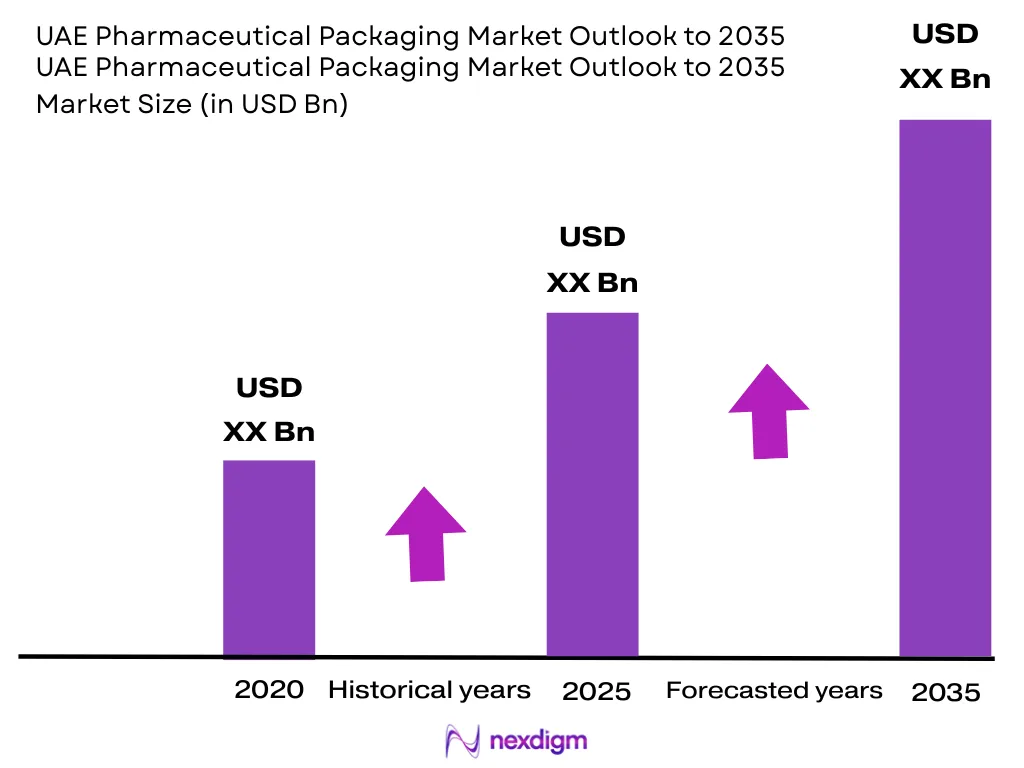
The UAE Pharmaceutical Packaging Market was valued at USD ~ Billion in 2024 and is anticipated to expand at a CAGR of ~% during 2026-2035. The market is directly tied to the growth of the UAE’s pharmaceutical industry, which was valued at approximately USD 4.45 billion in 2025 and is projected to reach approximately USD 8.59 billion by 2034, growing at a compound annual growth rate of approximately 7.01%. The market is further shaped by the UAE government’s 2024 enactment of Federal Decree-Law No. 38, which consolidated oversight of medical products under the newly established Emirates Drug Establishment (EDE), streamlining approvals while enhancing supply chain security and introducing regulatory data protection for innovative products. The Ministry of Health and Prevention (MOHAP) mandates serialization for all pharmaceutical products sold in the UAE, requiring unique product identifiers and track-and-trace capability across primary and secondary packaging, a requirement that continues to drive substantial investment in serialization-ready packaging lines across the country’s manufacturing base.
Market Segmentation
By Material
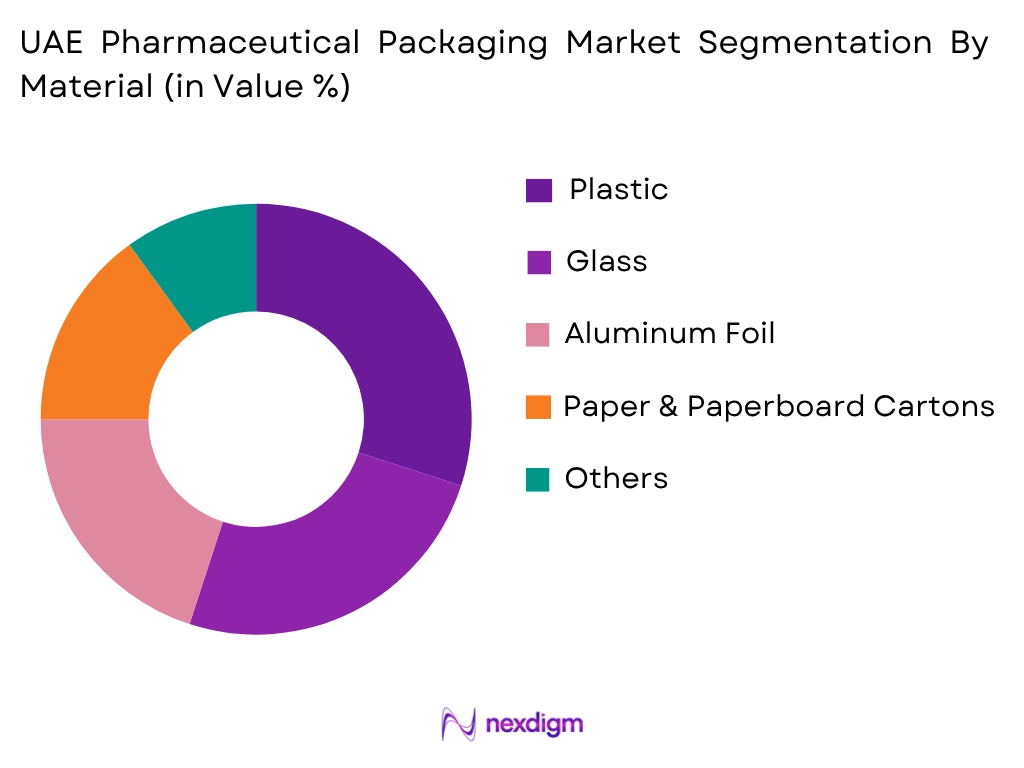
Plastic materials, primarily used in blister films and bottles, hold a substantial share of the UAE Pharmaceutical Packaging Market, favored for their cost-effectiveness, moisture barrier performance, and compatibility with high-speed automated packaging lines operated by the country’s largest manufacturers, including Julphar and Neopharma. Glass packaging, encompassing vials and ampoules, maintains a critical position for injectable and biologic products, where chemical inertness and barrier integrity are essential, particularly as the UAE’s biosimilars and generics production reached approximately USD 5.02 billion in value in 2024. Aluminum foil remains indispensable for blister lidding applications requiring superior moisture and light barrier protection suited to the UAE’s high-temperature climate, while paper and paperboard cartons continue to serve as the primary substrate for secondary packaging carrying mandatory Arabic and English labeling alongside MOHAP-mandated serialization codes.
By Product Type
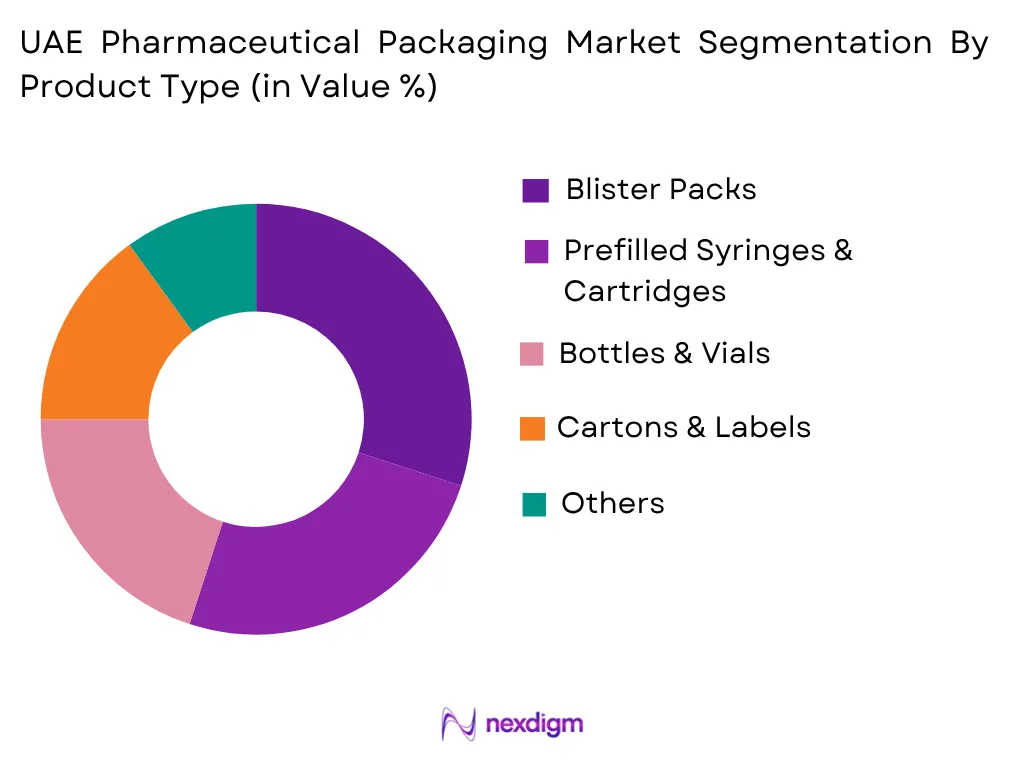
Blister Packs represent the largest product-type segment in the UAE Pharmaceutical Packaging Market, reflecting their widespread use across the country’s expanding generics and OTC consumer health segments, which continue to grow alongside a rising population and increasing prevalence of chronic diseases, including diabetes, which affects approximately 1.3 million people, or 19.3% of the UAE’s adult population. Prefilled Syringes & Cartridges represent the fastest-growing product segment, driven by expanding biologics and biosimilars manufacturing at facilities operated by Neopharma and other local producers investing in sterile injectable capacity. Bottles & Vials maintain a substantial share supporting both oral liquid formulations and injectable products, while Cartons & Labels continue to grow in complexity as MOHAP’s serialization mandate requires increasingly sophisticated printed security features, unique identifiers, and aggregation codes across secondary packaging.
Competitive Landscape
The UAE Pharmaceutical Packaging Market features a distinctive competitive structure in which large, vertically integrated local pharmaceutical manufacturers operate substantial in-house packaging capability alongside specialized global primary packaging suppliers and contract packaging service providers. Julphar, based in Ras Al Khaimah and recognized as the largest Arab pharmaceutical company operating in more than 50 countries, maintains extensive in-house blister packing, bottling, and cartoning capacity supporting both domestic supply and export markets. Neopharma, headquartered in Abu Dhabi, has invested heavily in sterile injectable and biotech manufacturing capability, requiring specialized primary packaging partnerships with global glass and elastomer closure suppliers such as Gerresheimer and Schott. Globalpharma, a WHO-prequalified Sanofi company based in Dubai, provides contract manufacturing and packaging services spanning multiple therapeutic categories, while global packaging specialists including Amcor continue to expand their presence to serve the UAE’s growing base of multinational pharmaceutical companies and export-oriented contract manufacturers navigating the country’s mandatory serialization requirements.
| Company | Establishment Year | Headquarters | Primary Product Portfolio | Pharmaceutical Packaging Portfolio
|
Manufacturing Presence | Major End-Use Industries | Key Strategic Focus | Certifications & Compliance |
| Julphar (Gulf Pharmaceutical Industries) | 1980 | ~ | ~ | ~ | ~ | ~ | ~ | ~ |
| Neopharma LLC | 2006 | ~ | ~ | ~ | ~ | ~ | ~ | ~ |
| Amcor | 1860 | ~ | ~ | ~ | ~ | ~ | ~ | ~ |
| Gerresheimer AG | 1864 | ~ | ~ | ~ | ~ | ~ | ~ | ~ |
| Schott AG | 1884 | ~ | ~ | ~ | ~ | ~ | ~ | ~ |
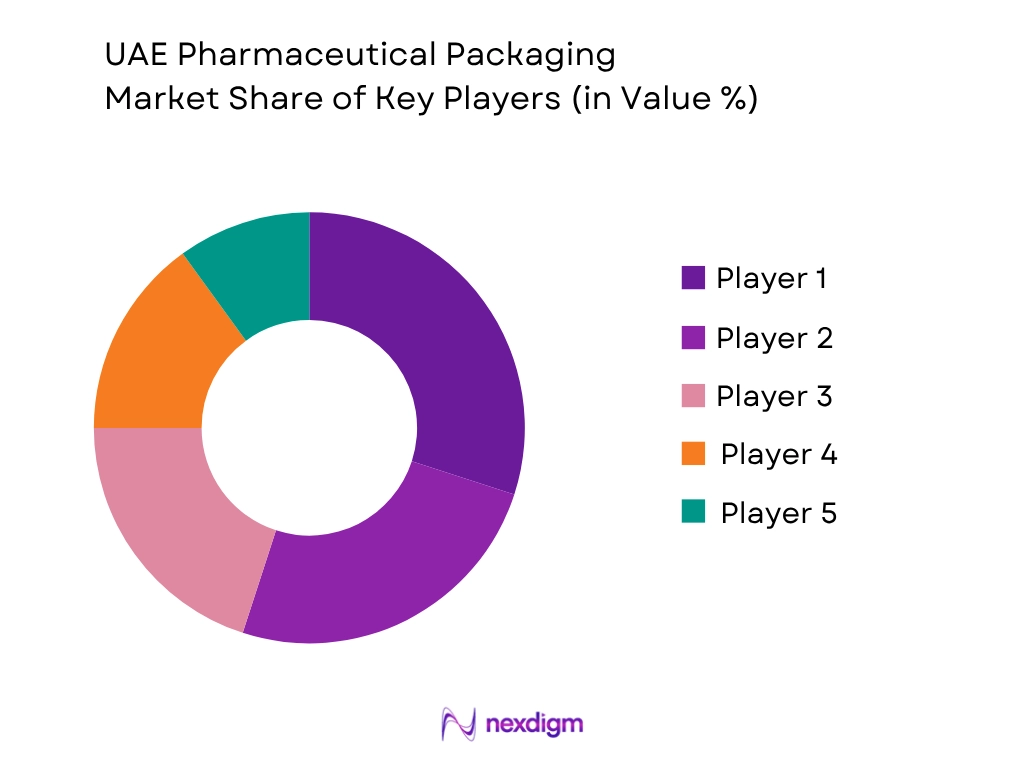
UAE Pharmaceutical Packaging Market Analysis
Growth Drivers
Operation 300bn Healthcare Investment and Local Manufacturing Expansion
The UAE pharmaceutical packaging market is experiencing sustained growth due to the UAE government’s Operation 300bn initiative, which commits approximately AED 300 billion in funding toward healthcare and biotechnology development by 2028, directly supporting expansion of local pharmaceutical manufacturing capacity and the packaging infrastructure required to support it. The UAE’s cutting-edge pharmaceutical manufacturing base, spanning Julphar’s large-scale production facilities in Ras Al Khaimah to Neopharma’s biotech-focused hubs in Abu Dhabi, produced generics and biosimilars worth approximately USD 5.02 billion in 2024. The UAE’s policy framework, which allows 100% foreign direct investment in pharmaceutical manufacturing and offers 0% corporate tax for 50 years within designated free zones, continues to attract international pharmaceutical companies and packaging suppliers seeking to establish regional production and packaging capacity. As the UAE pharmaceutical market itself continues to grow toward a projected USD 8.59 billion by 2034, this sustained expansion in local drug manufacturing directly translates into proportional growth in demand for blister packs, vials, cartons, and other primary and secondary packaging formats.
Mandatory Track-and-Trace Serialization Requirements
The Ministry of Health and Prevention’s mandate requiring serialization for all pharmaceutical products sold in the UAE continues to be a primary structural driver for packaging technology investment across the industry. This regulatory requirement, which mandates unique product identifiers and tamper-evident seals to combat counterfeiting and enhance supply chain traceability, has created sustained demand for specialized printing, coding, and aggregation technology integrated directly into primary and secondary packaging lines. Local manufacturers including Julphar, Neopharma, Pharmax, and Globalpharma, alongside multinational companies such as Johnson & Johnson Gulf, have invested substantially in serialization-compliant packaging infrastructure to meet MOHAP requirements. The Dubai Health Authority and Department of Health Abu Dhabi impose similar digital authentication requirements for high-risk pharmaceutical categories, reinforcing the structural importance of serialization-ready packaging technology across the UAE’s pharmaceutical supply chain regardless of which emirate-level authority a given product falls under.
Market Challenges
Triple-Regulator Compliance Complexity
The UAE Pharmaceutical Packaging Market operates within a uniquely layered regulatory structure spanning the federal Ministry of Health and Prevention, the Dubai Health Authority, and the Department of Health Abu Dhabi, each maintaining overlapping but distinct compliance requirements for pharmaceutical packaging and labeling. This triple-regulator structure requires packaging suppliers and pharmaceutical manufacturers to navigate separate registration, labeling, and digital authentication requirements depending on which emirate a given product will be distributed within, adding administrative complexity and potentially extending time-to-market for new packaging formats or products. The 2024 consolidation of medical product oversight under the Emirates Drug Establishment through Federal Decree-Law No. 38 represents a step toward streamlining this fragmented structure, though full harmonization across all three regulatory bodies remains an ongoing process. Packaging suppliers serving the broader Gulf Cooperation Council region face additional complexity, as a single packaging design may require separate digital content and labeling approval from each GCC member state’s regulatory authority, adding further validation overhead for companies seeking regional rather than purely domestic UAE distribution.
Import Dependency for Pharma-Grade Glass and Specialty Films
The UAE Pharmaceutical Packaging Market remains substantially dependent on imported pharma-grade glass, specialty polymer films, and elastomer closures, as the country’s domestic manufacturing base for these specialized primary packaging materials remains limited relative to global suppliers such as Schott and Gerresheimer. This import dependency exposes UAE-based pharmaceutical manufacturers and contract packagers to global supply chain disruptions, extended lead times, and currency-driven cost volatility for materials requiring stringent pharmaceutical-grade purity and consistency specifications. Cold chain packaging infrastructure required for the UAE’s growing biologics and biosimilars sector adds further cost complexity, as maintaining temperature-controlled logistics across the region’s extreme summer heat requires specialized insulated packaging and monitoring technology beyond what conventional pharmaceutical packaging demands in temperate markets. Limited regional converter capacity for advanced packaging formats, including specialized cold-chain-stable materials and interactive authentication labels, continues to force reliance on long-haul logistics from European and Asian packaging partners, adding cost and lead-time pressure across the supply chain.
Market Opportunities
Growth in Prefilled Syringe and Biologics Packaging
The UAE’s expanding biosimilars and biologics manufacturing base, exemplified by Neopharma’s investment in biotech-focused production hubs in Abu Dhabi, creates substantial opportunity for packaging suppliers specializing in prefilled syringes, cartridges, and other advanced primary containment formats required for injectable biologic products. As the UAE’s generics and biosimilars production, valued at approximately USD 5.02 billion in 2024, continues to expand alongside government-backed Operation 300bn healthcare investment, demand for specialized glass and polymer primary packaging capable of meeting stringent biologic stability and delivery requirements is expected to grow correspondingly. Global primary packaging specialists such as Schott and Gerresheimer, both already engaged with UAE-based sterile manufacturing operations, are well positioned to expand their regional presence as local biologics production scales. Packaging suppliers capable of providing validated, GCC-GMP compliant prefilled delivery systems alongside cold chain packaging expertise are increasingly well positioned to capture growing demand from the UAE’s biotech-focused pharmaceutical manufacturers.
Regional Export Hub Positioning under GCC Harmonization
The UAE’s status as a regional pharmaceutical manufacturing and export hub, anchored by Julphar’s operations spanning more than 50 countries and supported by streamlined MOHAP approval processes that have cut setup time to three to six months, creates substantial opportunity for packaging suppliers capable of serving multi-market GCC and broader MENA distribution from a single UAE manufacturing base. As the Emirates Drug Establishment continues to consolidate and streamline regulatory oversight following the 2024 enactment of Federal Decree-Law No. 38, packaging suppliers that can navigate both UAE-specific serialization requirements and the broader GCC-GMP compliance framework are well positioned to support pharmaceutical manufacturers seeking to use the UAE as an export base for the wider Middle East and North Africa region. The UAE’s combination of 100% foreign direct investment allowance in pharmaceutical manufacturing, tax-free zone incentives, and advanced logistics infrastructure across Dubai and Abu Dhabi continues to attract international pharmaceutical companies seeking a regional production and packaging base, creating sustained long-term opportunity for packaging suppliers willing to invest in UAE-based capacity.
Future Outlook
The UAE Pharmaceutical Packaging Market is expected to witness sustained expansion over the forecast period, supported by continued growth of the UAE’s pharmaceutical manufacturing base under Operation 300bn, expanding biosimilars and biologics production, and ongoing regulatory streamlining under the Emirates Drug Establishment. Continued investment in serialization-ready packaging technology, cold chain infrastructure, and prefilled delivery systems will further shape competitive positioning across the industry as MOHAP’s track-and-trace requirements continue to mature. The market is also likely to benefit from the UAE’s position as a regional pharmaceutical export hub, supported by streamlined approval processes and growing GCC regulatory harmonization efforts.
Major Players
- Julphar (Gulf Pharmaceutical Industries)
- Neopharma LLC
- Amcor
- Gerresheimer AG
- Schott AG
- Globalpharma Co. LLC (A Sanofi Company)
- Pharmax Pharmaceuticals FZ-LLC
- Gulf Inject
- Constantia Flexibles
- West Pharmaceutical Services
- SGD Pharma
- WestRock Company
- Klöckner Pentaplast
- Aluflexpack AG
- CCL Industries
Key Target Audience
- Pharmaceutical Packaging Manufacturers
- Pharmaceutical & Biotechnology Companies
- Contract Manufacturing Organizations (CMOs)
- Hospitals & Pharmacy Chains
- Export-Oriented Pharmaceutical Manufacturers
- Investment and Venture Capitalist Firms
- Government and Regulatory Bodies (Emirates Drug Establishment (EDE), Ministry of Health and Prevention (MOHAP), Dubai Health Authority (DHA))
- Raw Material Suppliers and Primary Packaging Component Manufacturers
Research Methodology
Step 1: Identification of Key Variables
The research process begins with identifying the complete ecosystem of the UAE Pharmaceutical Packaging Market, including raw material suppliers, primary and secondary packaging converters, serialization technology providers, pharmaceutical manufacturers, and regulatory authorities. Extensive secondary research is conducted using company annual reports, government publications, trade associations, customs statistics, industry journals, and proprietary databases to determine the variables influencing market demand, pricing, production, consumption, and technological developments.
Step 2: Market Analysis and Construction
Historical market information is collected and analyzed to estimate market size, production volumes, import-export activity, application-wise demand, and pricing trends. A combination of top-down and bottom-up approaches is used to estimate market revenues and validate segment-level performance. Consumption patterns across generics, biologics, injectables, and OTC packaging are evaluated to establish an accurate representation of the industry.
Step 3: Hypothesis Validation and Expert Consultation
The preliminary findings are validated through Computer-Assisted Telephone Interviews (CATIs) and structured discussions with pharmaceutical packaging suppliers, procurement managers, regulatory affairs specialists, packaging engineers, and senior executives operating within the UAE pharmaceutical industry. These interviews help verify market assumptions, competitive developments, technology adoption trends, pricing dynamics, and future investment opportunities while refining the overall market estimates.
Step 4: Research Synthesis and Final Output
The final stage integrates insights obtained from primary interviews with quantitative information collected through secondary sources. Data triangulation techniques are applied to reconcile differences between supply-side and demand-side estimates, ensuring robust market forecasting. The report is then reviewed through multiple quality assurance checkpoints to deliver a comprehensive analysis covering market size, segmentation, competitive landscape, future outlook, and strategic recommendations for industry stakeholders.

- Executive Summary
- Research Methodology (Market Definitions and Assumptions, Abbreviations, Market Sizing Approach, Top-Down Analysis, Bottom-Up Analysis, Demand-Side Assessment, Supply-Side Assessment, Primary Industry Interviews, Secondary Research Validation, Data Triangulation, Forecasting Framework, Limitations and Future Conclusions)

- Definition and Scope
- Market Evolution and Industry Genesis
- Timeline of Major Industry Developments
- Pharmaceutical Packaging Industry Value Chain Analysis
- Supply Chain Analysis

- Growth Drivers (Operation 300bn Healthcare Investment Program, Mandatory Track-and-Trace Serialization, Growth in Biosimilars & Local Manufacturing, Rising Chronic Disease Prevalence, 100% Foreign Direct Investment Allowance, Expansion of Export-Oriented CMO Capacity)
- Market Challenges (Triple-Regulator Compliance Complexity, Import Dependency for Pharma-Grade Glass & Films, Cold Chain Infrastructure Costs, Serialization Technology Investment Burden, Extreme Heat Packaging Stability Requirements, Regional Regulatory Fragmentation)
- Market Opportunities (Growth in Prefilled Syringe & Biologics Packaging, Regional Export Hub Positioning under GCC Harmonization, Child-Resistant & Senior-Friendly Packaging Innovation, Anti-Counterfeiting Technology Adoption, Sustainable & Recyclable Packaging Development, Free Zone-Enabled Manufacturing Expansion)
- Market Trends (Growth in Serialization & Aggregation Technology, Cold Chain Packaging Expansion, Sustainable Packaging Material Adoption, Smart & Connected Packaging Development, Consolidation under Emirates Drug Establishment, Multilingual Regional Labeling Standardization)
- Government Regulations (Federal Decree-Law No. 38 of 2024, Emirates Drug Establishment (EDE) Oversight, MOHAP Track-and-Trace Mandate, Dubai Health Authority (DHA) Requirements, Department of Health Abu Dhabi (DOH) Requirements, GCC-GMP Compliance Standards)
- Import and Export Analysis (Trade Volume, Major Import Sources, Export Destinations, HS Code Analysis, Trade Balance)
- Raw Material Availability Analysis (Pharma-Grade Glass, Imported Polymer Films, Aluminum Foil Stock, Pharma-Grade Paperboard, Rubber & Elastomer Closures)
- Technology Landscape (Blister Forming & Sealing Technologies, Serialization & Aggregation Systems, Cold Chain Monitoring Technologies, Prefilled Syringe Assembly Technologies, Track-and-Trace Software Platforms)
- Sustainability Assessment (Recyclable Blister Film Adoption, Reduced Carton Material Usage, Cold Chain Energy Efficiency, Glass & Aluminum Circularity, Sustainable Packaging Certification Coverage)
- PESTLE Analysis
- SWOT Analysis
- Porter’s Five Forces Analysis
- Stakeholder Ecosystem
- Competition Ecosystem

- By Market Value (2020-2025)
- By Volume Consumption (2020-2025)
- By Average Selling Price (2020-2025)

- By Material Type (In Value %)
Plastic (Blister Films & Bottles)
Glass (Vials & Ampoules)
Aluminum Foil
Paper & Paperboard Cartons
Rubber & Elastomer Closures - By Product Type (In Value %)
Blister Packs
Bottles & Vials
Ampoules
Prefilled Syringes & Cartridges
Cartons & Labels
Pouches & Sachets
Closures & Caps - By Drug Type (In Value %)
Generics
Biologics & Biosimilars
OTC & Consumer Health Products
Injectables & Vaccines
Oncology Drugs
Specialty & Orphan Drugs - By End User (In Value %)
Pharmaceutical Manufacturers
Contract Manufacturing Organizations (CMOs)
Hospitals & Pharmacies
Export-Oriented Manufacturers
Biotechnology Companies
Clinical Research Organizations - By Region (In Value %)
Abu Dhabi
Dubai
Sharjah
Ras Al Khaimah
Other Emirates

- Market Share of Major Players (By Value, Volume, Material Type, Drug Type, Product Category)
- Cross Comparison Parameters (Product Portfolio Breadth, Serialization & Track-and-Trace Capability, Cold Chain Packaging Expertise, Application Technical Support, Manufacturing Capacity, Regulatory Compliance & Certifications, Pharma Customer Base, Innovation & New Product Launch Frequency)
- SWOT Analysis of Major Players
- Pricing Analysis by Product Category and Format
- Production Capacity Analysis
- Manufacturing Footprint Analysis
- Distribution Network Analysis
- Innovation Benchmarking
- Detailed Profiles of Major Companies
Julphar (Gulf Pharmaceutical Industries)
Neopharma LLC
Amcor
Gerresheimer AG
Schott AG
Globalpharma Co. LLC (A Sanofi Company)
Pharmax Pharmaceuticals FZ-LLC
Gulf Inject
Constantia Flexibles
West Pharmaceutical Services
SGD Pharma
WestRock Company
Klöckner Pentaplast
Aluflexpack AG
CCL Industries

- Consumption Pattern Analysis (Industrial Usage, Batch Size, Product Category Penetration, Seasonal Demand, Reformulation Activity)
- Purchasing Criteria (Regulatory Compliance, Serialization Readiness, Cost Efficiency, Barrier Performance, Tamper-Evidence, Cold Chain Compatibility)
- Procurement and Supplier Selection Analysis
- Serialization Technology Adoption Assessment
- Premium vs Conventional Packaging Demand
- Product Attribute Preference Analysis (Moisture Barrier Performance, Tamper-Evidence, Child-Resistant Design, Print & Label Clarity, Thermal Stability, Anti-Counterfeiting Features)
- Regulatory Compliance Influence on Packaging Investment
- Pain Point Analysis
- Decision-Making Process

- By Market Value (2026-2035)
- By Volume Consumption (2026-2035)
- By Average Selling Price (2026-2035)


 Request a Sample
 Ask for Customization
 Get a Quote
 Enquire Now