

 Download PDF
Market Overview
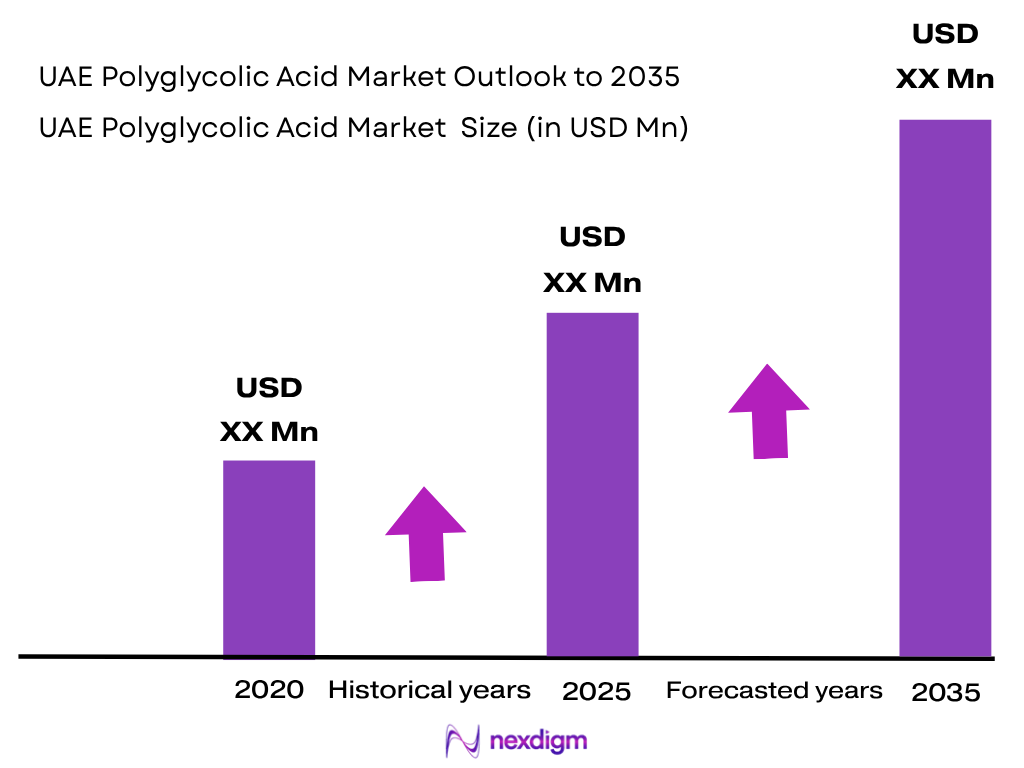
The UAE Polyglycolic Acid Market is assessed at ~USD ~ million in 2024, with the estimate reflecting demand across medical sutures, bioabsorbable devices, oilfield degradable components, specialty packaging, filtration and other industrial applications. The addressable market is supported by the UAE’s high-income economic base and expanding healthcare and energy ecosystems. The UAE recorded GDP of USD 552.32 billion and GDP per capita of USD 50,273.5, while real GDP growth reached 4.0 in the latest World Bank data.
Dubai and Abu Dhabi represent the principal commercial and industrial centres for the UAE Polyglycolic Acid Market because they combine healthcare infrastructure, medical-device procurement, industrial investment, logistics connectivity and energy-sector activity. The UAE had a population of 10,986,400 in the latest World Bank data, while internet usage reached 100 of the population, supporting digitally enabled procurement and specialized B2B distribution. Abu Dhabi is particularly relevant to oilfield applications, whereas Dubai provides a major gateway for imported specialty polymers and medical products.
Market Segmentation
By Form
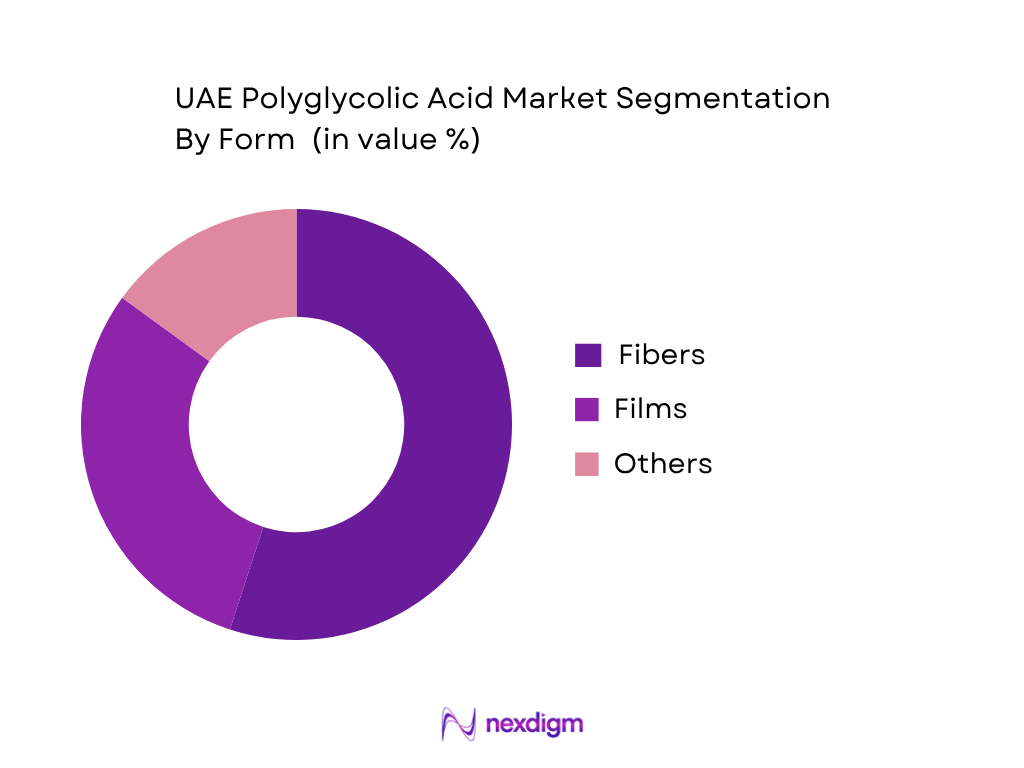
The UAE Polyglycolic Acid Market is segmented by form into PGA resin, PGA fiber, PGA film, PGA sheet, PGA rod, PGA composite and PGA-based medical components. PGA fiber is expected to represent the dominant form because the material’s strongest established commercial application is in absorbable surgical sutures. PGA fiber can be engineered for braided and multifilament structures while maintaining controlled biodegradation and mechanical performance. Its relevance is strengthened by the UAE’s sophisticated hospital network and demand for specialized surgical products. Resin remains strategically important because it is the upstream material used for fiber, film and molded applications. PGA film benefits from the polymer’s strong gas-barrier characteristics, while sheets, rods and composites remain more specialized. The form landscape therefore reflects a combination of mature medical applications and emerging industrial uses. For the UAE, imported finished PGA fibers and medical components are likely to remain more commercially accessible than locally polymerized material, making product qualification, regulatory documentation and supply reliability important competitive factors.
By End-Use Industry
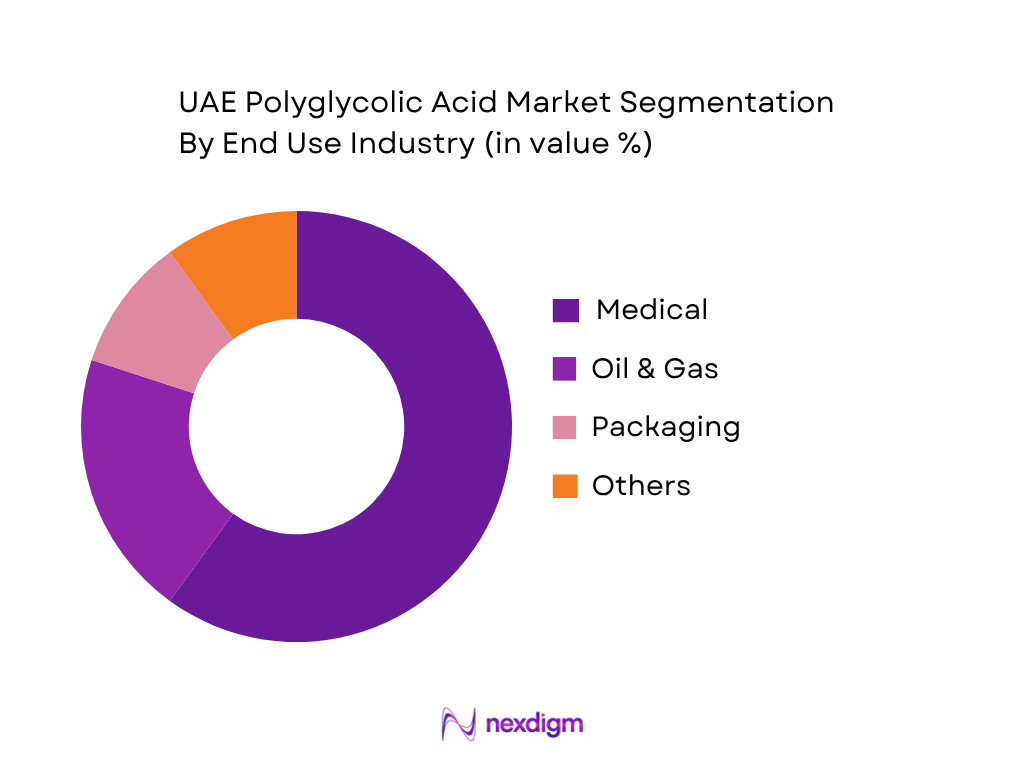
The UAE Polyglycolic Acid Market is segmented by end-use industry into medical and healthcare, oil & gas, packaging, filtration, agriculture, industrial manufacturing and civil engineering. Medical and healthcare is positioned as the leading application segment because PGA offers controlled biodegradation, high initial mechanical strength and established suitability for absorbable surgical materials. Demand is concentrated around sutures and other bioabsorbable applications where material performance and regulatory qualification are more important than commodity-volume consumption. Oil & gas represents the second strategic application area because degradable PGA components can be used in temporary downhole applications where controlled dissolution can reduce the need for conventional intervention. The UAE’s large energy ecosystem gives this application particular relevance. Packaging and filtration offer longer-term diversification through high-barrier and degradable material applications. The segmentation therefore reflects the UAE’s distinctive combination of advanced healthcare procurement and oilfield activity rather than a conventional plastics-consuming economy.
Competitive Landscape
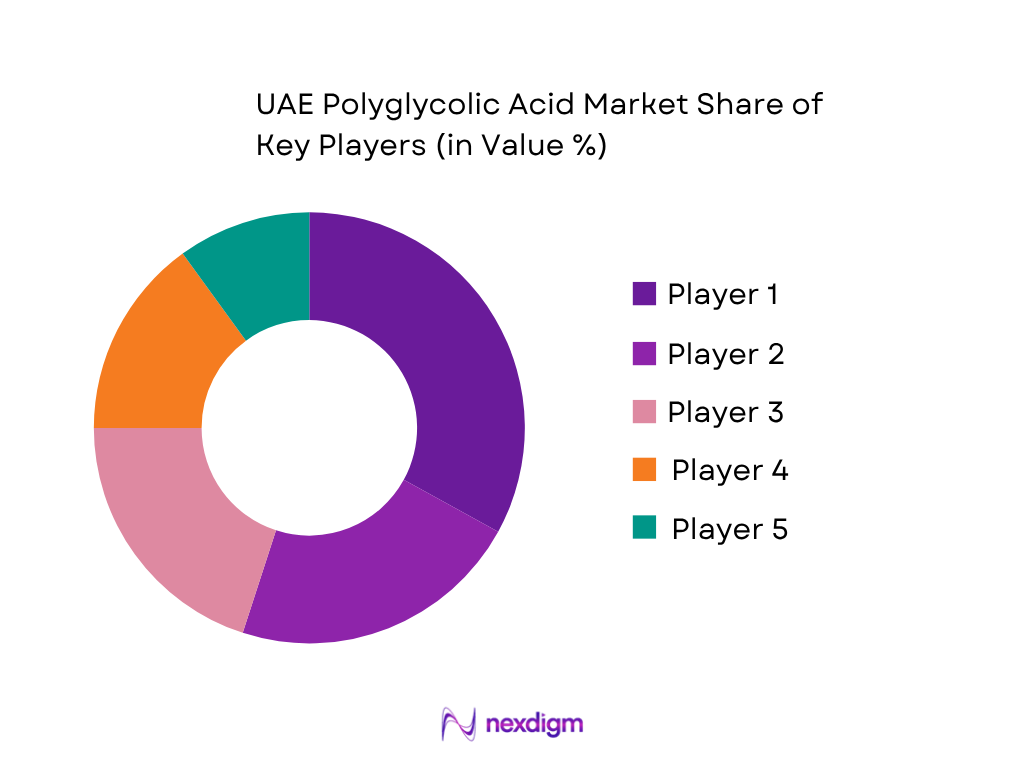
The UAE Polyglycolic Acid Market is characterized by a combination of specialized PGA material suppliers, global medical-device companies, absorbable-suture manufacturers and oilfield technology providers. Competition is shaped less by commodity-scale local production and more by material qualification, medical-grade manufacturing, application engineering, regulatory compliance, supply reliability and access to UAE healthcare and energy customers. Global companies with established PGA-related technologies therefore have an advantage in specialized applications, while distributors and regional partners remain important for market access.
| Company | Established | Headquarters | PGA Product Focus | Medical Applications | Oil & Gas Applications | Manufacturing Capability | Key Competitive Strength |
| Kureha Corporation | 1944 | Tokyo, Japan | ~ | ~ | ~ | ~ | ~ |
| Teleflex Incorporated | 1943 | Wayne, Pennsylvania, USA | ~ | ~ | ~ | ~ | ~ |
| B. Braun | 1839 | Melsungen, Germany | ~ | ~ | ~ | ~ | ~ |
| Medtronic | 1949 | Galway, Ireland | ~ | ~ | ~ | ~ | ~ |
| Smith+Nephew | 1856 | Watford, UK | ~ | ~ | ~ | ~ | ~ |
UAE Polyglycolic Acid Market Analysis
Growth Drivers
Advanced Healthcare Infrastructure
The UAE’s advanced healthcare infrastructure provides a direct demand foundation for polyglycolic acid (PGA), particularly in absorbable sutures, bioabsorbable implants, tissue-engineering materials and other temporary medical devices. The country recorded a population of 10,986,400 and GDP of USD 552.32 billion in 2024, with GDP per capita of USD 50,273.5, indicating a substantial economic base capable of supporting specialized healthcare procurement and high-value medical technologies. The World Bank also records UAE life expectancy at 83 years in 2024, reinforcing the importance of a developed healthcare ecosystem serving a large resident population. UAE Ministry of Health and Prevention data provide dedicated datasets for licensed medical facilities, licensed health workforce and hospital services, demonstrating the scale and institutionalization of the healthcare system. This infrastructure is relevant to PGA because adoption of bioabsorbable materials depends on hospitals, surgeons, medical-device suppliers and procurement systems capable of handling specialized products with defined degradation profiles. The UAE’s healthcare infrastructure is concentrated around sophisticated urban healthcare systems in Abu Dhabi and Dubai, where specialist hospitals and advanced surgical capabilities create channels for premium medical materials. The combination of economic capacity, healthcare infrastructure and specialist clinical services therefore supports greater utilization of PGA-based absorbable products and provides a platform for introducing higher-value bioabsorbable devices.
Expansion of Medical Device Manufacturing
Expansion of medical-device manufacturing and advanced healthcare technology adoption creates a broader downstream opportunity for PGA beyond conventional surgical sutures. The UAE generated USD 552.32 billion of GDP in 2024 and recorded USD 50,273.5 GDP per capita, according to the World Bank, providing a high-income industrial and healthcare environment for specialized medical-device production and regional distribution. The country also recorded 4.0 GDP growth in 2024, while foreign direct investment net inflows were equivalent to 8.3 of GDP, illustrating continued international investment activity across the economy. Although these are macroeconomic indicators rather than PGA-specific measurements, they are relevant because medical-device manufacturing requires capital-intensive facilities, technology partnerships, qualified suppliers and access to sophisticated healthcare customers. PGA is particularly suited to medical-device applications where temporary mechanical support and predictable degradation are required. Its potential use extends from absorbable sutures to fixation devices, tissue-engineering scaffolds and drug-delivery platforms. The UAE’s position as a regional logistics and business hub can further support importation of PGA resin and intermediate components followed by downstream medical-device conversion, sterilization, packaging and distribution. As manufacturers increasingly seek specialized biomaterials rather than conventional permanent polymers, PGA can become relevant to higher-value product development. The investment environment therefore supports gradual localization of selected PGA processing and medical-device activities while allowing international manufacturers to use the UAE as a regional commercialization base.
Market Challenges
Limited Domestic PGA Production
Limited domestic PGA production remains a structural challenge because the UAE Polyglycolic Acid Market depends heavily on international specialty-polymer supply chains for resin, fiber and finished PGA-based medical components. The UAE’s economic scale is substantial, with GDP of USD 552.32 billion and GDP per capita of USD 50,273.5 in 2024, but these indicators do not imply the existence of a domestic PGA polymerization ecosystem. PGA production requires controlled polymerization of glycolide, precise molecular-weight management, moisture control and specialized downstream processing. Consequently, establishing domestic production requires technical know-how, qualified feedstock supply, specialized equipment and sufficient demand from medical and industrial applications. The UAE’s population reached 10,986,400 in 2024, while population growth was 4.7, according to the World Bank. This expanding domestic market can support greater downstream healthcare demand, but the specialized nature of PGA means that local consumption alone may not immediately justify vertically integrated polymer production. Dependence on imported material also exposes UAE buyers to international logistics disruptions, supplier qualification requirements and lead-time variability. For medical applications, switching suppliers can be particularly difficult because material grades may require product-specific validation and regulatory documentation. The challenge therefore extends beyond physical availability: manufacturers must maintain reliable access to consistent molecular weight, purity, degradation characteristics and processing specifications. Developing local conversion capabilities while retaining diversified international resin suppliers could mitigate this constraint without requiring immediate full-scale domestic polymerization.
Dependence on Imported Specialty Materials
Dependence on imported specialty materials creates a significant supply-chain challenge for the UAE Polyglycolic Acid Market because PGA is a technically specialized polymer rather than a conventional commodity resin. The UAE recorded USD 552.32 billion GDP and USD 50,273.5 GDP per capita in 2024, demonstrating strong purchasing capacity, but the domestic economic base does not automatically provide local production of every advanced polymer grade required by medical-device and oilfield applications. PGA materials require controlled purity, molecular weight, hydrolytic stability and application-specific processing characteristics. Medical-grade products additionally require traceability and qualification before incorporation into regulated devices. The UAE’s population of 10,986,400 and population growth of 4.7 in 2024 indicate a growing underlying healthcare and consumer base, increasing the importance of reliable specialty-material supply. At the same time, PGA’s moisture sensitivity means that transportation, storage and processing conditions can affect polymer performance. Imported resin therefore requires disciplined supply-chain management from international manufacturer through UAE distributor or converter to the final medical-device or industrial customer. Multiple qualification requirements can also increase switching barriers when a particular PGA grade is incorporated into an approved medical product. Establishing multiple qualified suppliers, maintaining appropriate inventory of critical grades and developing local processing expertise can reduce supply risk. The UAE’s 100 internet-use rate in 2024 also supports digitally enabled procurement and supply-chain coordination, although digital connectivity does not eliminate physical dependence on international specialty-polymer producers.
Market Opportunities
Bioabsorbable Medical Devices
Bioabsorbable medical devices represent a significant future-facing opportunity for the UAE Polyglycolic Acid Market because PGA can provide temporary mechanical support before gradually degrading within the body. The UAE’s healthcare and economic conditions create an environment in which specialized biomaterials can move beyond conventional absorbable sutures into fixation systems, tissue-engineering scaffolds, drug-delivery structures and other temporary implants. The country recorded GDP of USD 552.32 billion, GDP per capita of USD 50,273.5 and population of 10,986,400 in 2024, according to the World Bank. Life expectancy reached 83 years, while the UAE Ministry of Health and Prevention maintains dedicated 2024 datasets covering licensed medical facilities, licensed healthcare workers and hospital services. These indicators demonstrate a sufficiently developed healthcare ecosystem for advanced medical-device adoption. PGA’s opportunity lies particularly in applications where permanent implants create unnecessary long-term material presence and where controlled degradation can support tissue healing or eliminate subsequent removal procedures. Local medical-device manufacturers can potentially combine imported PGA resin or fiber with UAE-based conversion, sterilization and packaging capabilities, creating higher-value downstream manufacturing rather than relying exclusively on finished imported products. Healthcare procurement organizations can also support adoption through specialist surgical products where clinical performance is the primary purchasing criterion. The opportunity is therefore not limited to increasing consumption of existing PGA sutures; it includes developing an application ecosystem around temporary implants and bioabsorbable structures, creating a pathway toward higher-value PGA utilization across the UAE healthcare system.
Advanced Surgical Sutures
Advanced surgical sutures provide an immediate commercialization opportunity because PGA has an established technical role in absorbable suture applications and can be incorporated into products requiring predictable temporary tensile support. The UAE’s economic and healthcare environment provides a favorable platform for these products. World Bank data show a population of 10,986,400, GDP of USD 552.32 billion, GDP per capita of USD 50,273.5 and life expectancy of 83 years in 2024. The Ministry of Health and Prevention also publishes national datasets covering licensed medical facilities, licensed health workforce and hospital services, confirming an established healthcare delivery infrastructure. Advanced PGA sutures can be differentiated through characteristics such as tensile retention, absorption profile, braid structure, coating and handling performance rather than competing only as generic absorbable products. This creates opportunities for suppliers to move toward specialty surgical indications and higher-value formulations. UAE hospitals and medical-device distributors can serve as important commercialization channels, while local manufacturers can potentially undertake downstream fiber processing, braiding, coating, sterilization and packaging even when polymer resin remains imported. Such activities would increase domestic value capture and technical capabilities without requiring immediate investment in upstream glycolide and PGA polymerization. The country’s 4.0 GDP growth in 2024 also indicates an expanding economic environment in which specialized healthcare technologies can receive continued investment. Consequently, advanced PGA sutures represent one of the most commercially accessible pathways for expanding PGA utilization before more technically complex bioabsorbable-device applications reach broader qualification. Source: World Bank; UAE Ministry of Health and Prevention.
Future Outlook
The UAE Polyglycolic Acid Market is expected to develop through greater penetration of specialized medical applications, bioabsorbable devices and oilfield technologies. Growth should be supported by the UAE’s healthcare modernization, sophisticated hospital procurement ecosystem and continued importance of energy-sector applications. PGA suppliers with strong material qualification, regulatory documentation and application-development capabilities are likely to be better positioned than suppliers competing only on resin availability. The market should progressively diversify from conventional absorbable sutures toward engineered medical and industrial applications.
Major Players
- Kureha Corporation
- Teleflex Incorporated
- B. Braun Melsungen
- Medtronic
- Smith+Nephew
- Johnson & Johnson / Ethicon
- Advanced Medical Solutions Group
- Corbion
- Peters Surgical
- Samyang Biopharm
- Meta Biomed
- Unisur Lifecare
- Dolphin Sutures
- Huizhou Foryou Medical Devices
- Shenzhen Polymtek Biomaterial
Key Target Audience
- Medical Device Manufacturers
- Absorbable Suture Manufacturers
- Oil & Gas Operators and Oilfield Service Companies
- Specialty Polymer Importers and Distributors
- Healthcare Procurement Organizations and Hospital Groups
- Investments and Venture Capitalist Firms (UAE-based healthcare, advanced-materials and industrial-technology investors)
- Government and Regulatory Bodies (Ministry of Health and Prevention, Emirates Health Services, Ministry of Industry and Advanced Technology)
- Packaging, Filtration and Advanced Materials Manufacturers
Research Methodology
Step 1: Identification of Key Variables
The initial phase establishes the UAE Polyglycolic Acid Market ecosystem by mapping PGA suppliers, medical-device manufacturers, hospitals, oilfield operators, oilfield service companies, distributors and specialty-material users. Product forms, grades, applications, import channels and regulatory requirements are identified to establish the market boundary.
Step 2: Market Analysis and Construction
Historical market information is compiled across PGA resin, fiber, film, medical components and industrial applications. The analysis evaluates demand from healthcare, oil & gas, packaging and filtration while separating imported material from domestic conversion and downstream application activity.
Step 3: Hypothesis Validation and Expert Consultation
Market hypotheses are validated through discussions with PGA suppliers, medical-device manufacturers, healthcare procurement specialists, oilfield service providers and specialty polymer distributors. These consultations are used to test application penetration, product qualification, purchasing practices and competitive positioning.
Step 4: Research Synthesis and Final Output
The final research model triangulates supplier-side information, downstream application analysis, trade flows, regulatory information and expert inputs. Bottom-up estimates are cross-checked against demand indicators and application-level consumption patterns before producing the UAE market outlook and competitive assessment.

- Executive Summary
- Research Methodology (Market Definition and Scope, PGA Product Boundary, Market Classification, Application Mapping, Market Sizing Framework, Top-Down Market Assessment, Bottom-Up Market Assessment, Demand-Side Analysis, Supply-Side Analysis, Import–Export Validation, Primary Industry Interviews, Expert Validation, Data Triangulation, Forecasting Framework, Scenario Analysis, Assumptions and Limitations)

- Definition and Scope
- Polyglycolic Acid Material Characteristics and Performance Profile
- UAE PGA Market Evolution and Industry Development
- UAE PGA Industry Ecosystem Mapping
- Domestic Production Versus Import Dependency
- UAE PGA Manufacturing and Processing Infrastructure

- Growth Drivers (Advanced Healthcare Infrastructure, Expansion of Medical Device Manufacturing, Growth of Minimally Invasive Procedures, Oil & Gas Well Intervention Activity, Demand for Bioabsorbable Surgical Materials)
- Market Challenges (Limited Domestic PGA Production, Dependence on Imported Specialty Materials, High Polymerization Complexity, Glycolide Feedstock Dependence, Moisture Sensitivity During Processing, Medical Qualification Requirements, Specialist Processing Requirements, Regulatory Compliance)
- Market Opportunities (Bioabsorbable Medical Devices, Advanced Surgical Sutures, Domestic PGA Processing, Tissue Engineering Applications, Drug Delivery Systems, High-Barrier Packaging, Degradable Oilfield Components, Specialty Filtration)
- Market Trends (Medical Device Localization, Bioabsorbable Material Adoption, PGA Copolymer Development, Controlled Degradation, Surgical Material Innovation, High-Barrier Polymer Applications, Specialty Polymer Substitution)
- Government and Regulatory Framework (Medical Device Registration, Product Classification, Import Licensing, Manufacturing Licensing, Quality Management, Biocompatibility Testing, Sterilization Standards, Post-Market Surveillance)
- SWOT Analysis
- Porter’s Five Forces Analysis
- PESTLE Analysis

- By Market Value (2020-2025)
- By Volume Consumption (2020-2025)
- By PGA Resin Consumption (2020-2025)
- By PGA Fiber Consumption (2020-2025)
- By PGA Film Consumption (2020-2025)

- By Product Form (In Value %)
PGA Resin
PGA Fiber
PGA Film
PGA Sheet
PGA Rod
PGA Composite
PGA-Based Medical Components
Other PGA Forms - By End-Use Industry (In Value %)
Medical and Healthcare
Oil & Gas
Packaging
Filtration
Agriculture
Industrial Manufacturing
Civil Engineering
Other Specialty Applications - By Medical Application (In Value %)
Absorbable Surgical Sutures
Dental Sutures
Ophthalmic Sutures
Orthopaedic Applications
Bioabsorbable Implants
Tissue Reinforcement Materials
Drug Delivery Systems
Tissue Engineering Scaffolds
Other Medical Applications - By Processing Technology (In Value %)
Ring-Opening Polymerization
Melt Polymerization
Solid-State Polymerization
Extrusion
Fiber Spinning
Film Extrusion
Injection Molding
Compression Molding
Composite Processing - By Grade (In Value %)
Medical Grade
Suture Grade
Oilfield Grade
Packaging Grade
Industrial Grade
High-Performance Grade
Biodegradable Grade

- Market Share of Major Players (By Value, Volume, Product Form, Grade, Medical Application, Oil & Gas Application, Industrial Application)
- Cross Comparison Parameters (PGA Product Portfolio Breadth, Medical-Grade Manufacturing Capability, Suture Portfolio Breadth, Oilfield PGA Technology Capability, PGA Processing Technology, Application Portfolio Coverage, Regulatory and Certification Capability, R&D and Product Innovation Capability
- SWOT Analysis of Major Players
- Detailed Profiles of Major Companies
Kureha Corporation
Corbion
Teleflex Incorporated
Johnson & Johnson / Ethicon
Medtronic
B. Braun Melsungen
Smith+Nephew
Peters Surgical
Advanced Medical Solutions Group
Meta Biomed
Samyang Biopharm
Huizhou Foryou Medical Devices
Shenzhen Polymtek Biomaterial
Unisur Lifecare
Dolphin Sutures

- Medical End-User Assessment
- Hospital Procurement Behaviour
- PGA Product Attribute Requirements
- Medical Device Manufacturer Requirements
- Oil & Gas End-User Requirements
- Industrial End-User Requirements
- End-User Switching Analysis

- By Market Value (2026-2035)
- By Volume Consumption (2026-2035)
- By PGA Resin Consumption (2026-2035)
- By PGA Fiber Consumption (2026-2035)
- By PGA Film Consumption (2026-2035)


 Request a Sample
 Ask for Customization
 Get a Quote
 Enquire Now