
 Download PDF
Market Overview
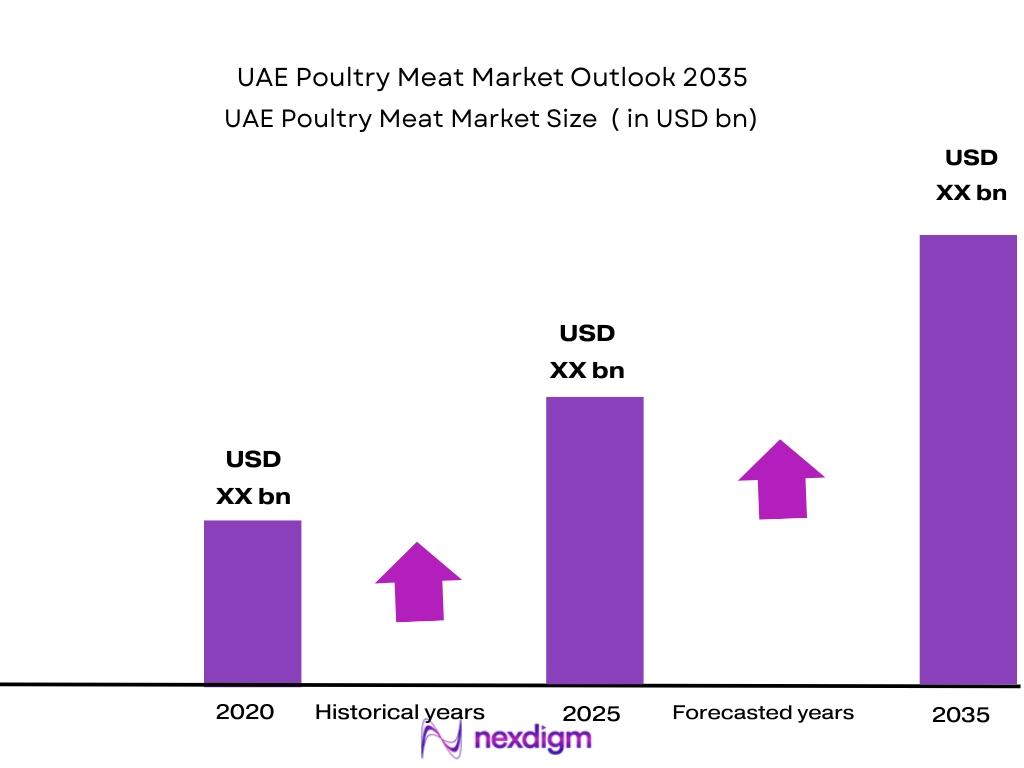
The UAE poultry meat market was valued at approximately USD ~ billion, based on recent industry assessment, and is expected to grow at a forecast CAGR of around 1.62% through 2030. Market demand is supported by high chicken consumption, strong expatriate food demand, tourism-led foodservice growth, and dependence on imported poultry. Poultry meat imports reached USD 1.24 billion in 2024, making the UAE one of the world’s major poultry meat importers. Domestic poultry production was about 52,400 metric tons in 2023, while consumption remained far higher, reinforcing import dependence.
Dubai, Abu Dhabi, and Sharjah dominate the UAE poultry meat market because they concentrate population, retail infrastructure, hotels, restaurants, catering companies, and cold-chain networks. Abu Dhabi’s population reached 4.14 million in 2024, while Dubai crossed about 3.8 million residents by the end of 2024, creating strong demand across retail and foodservice channels. These cities also host major hypermarkets, premium grocery stores, quick-service restaurants, cloud kitchens, and online grocery platforms, making them the key demand centers for fresh, frozen, and processed poultry.
Market Segmentation
By Product Type
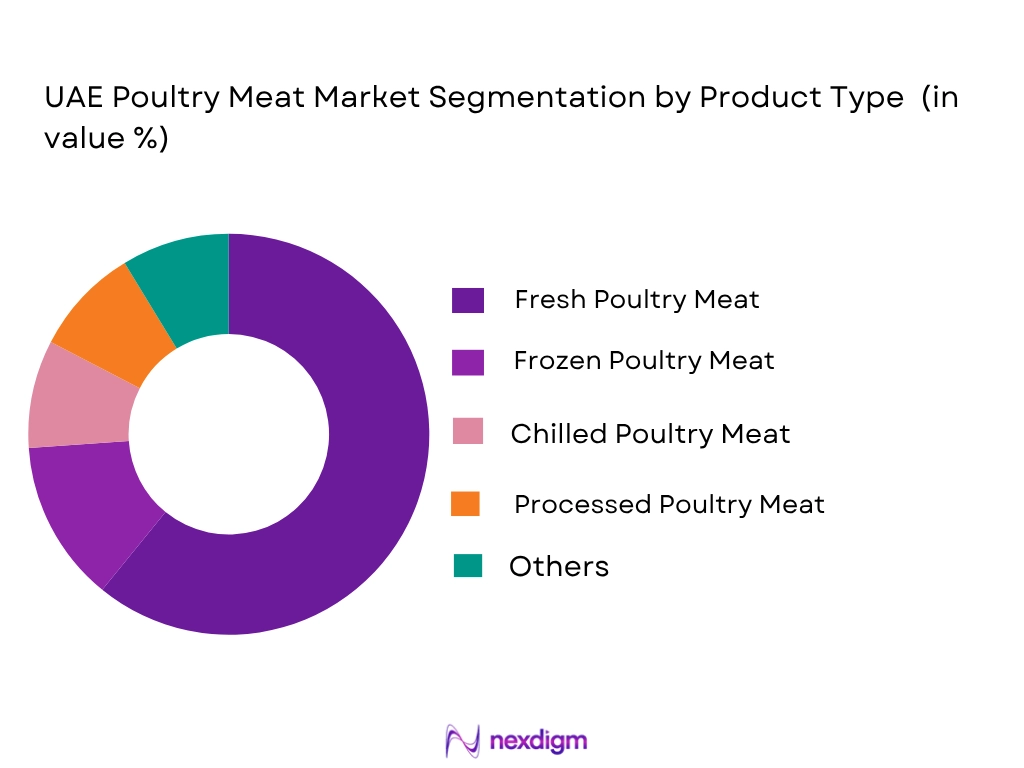
UAE Poultry Meat market is segmented by product type into fresh chicken, frozen chicken, processed poultry, and other poultry meat. Recently, fresh chicken has held a dominant market share under the product type segmentation due to strong consumer preference for freshness, taste, and daily household cooking. UAE consumers, especially in urban households, often associate fresh poultry with better quality and higher food safety when purchased from trusted supermarkets, butchers, and branded retailers. The segment is also supported by local poultry producers that supply chilled chicken to modern retail chains and foodservice buyers. However, frozen chicken remains highly important because the UAE depends heavily on imports from Brazil, Saudi Arabia, and other international suppliers. Processed poultry is growing steadily due to demand for nuggets, sausages, burger patties, marinated chicken, and ready-to-cook products among working professionals and foodservice operators.
By Distribution Channel
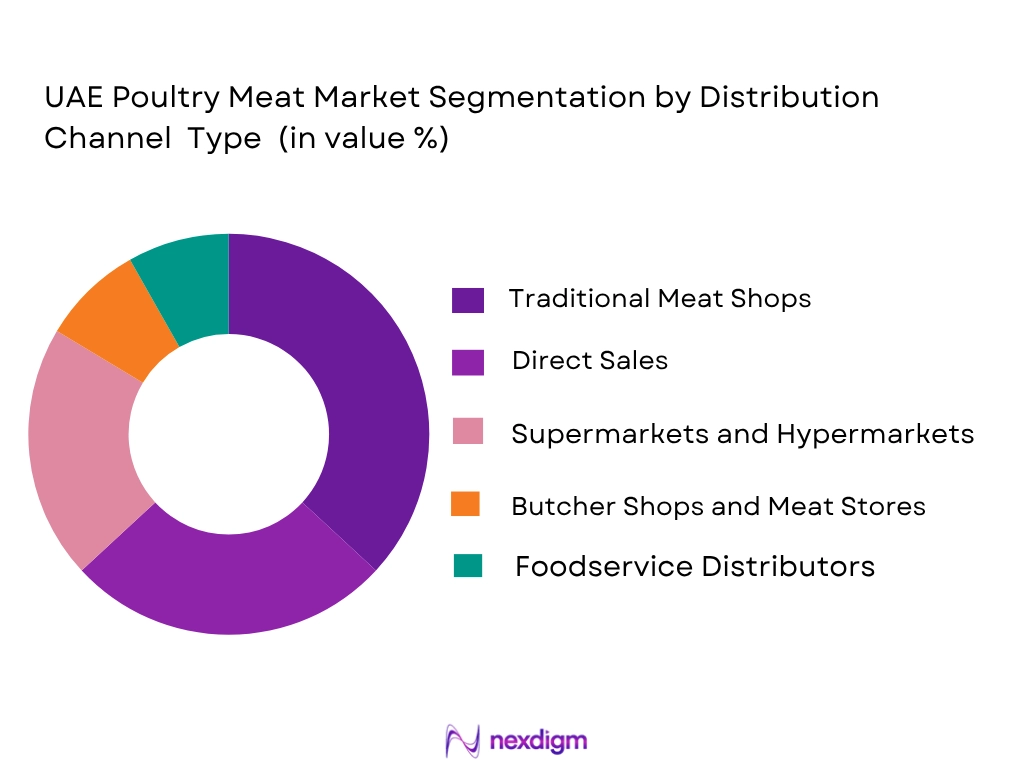
UAE Poultry Meat market is segmented by distribution channel into supermarkets and hypermarkets, traditional meat shops, foodservice and HoReCa, online channels, and quick commerce platforms. Recently, supermarkets and hypermarkets have had a dominant market share under the distribution channel segmentation because they offer consumers hygiene assurance, branded products, imported frozen poultry, chilled chicken, portioned cuts, and processed meat under one roof. Large retail chains such as Carrefour, Lulu, Spinneys, and Union Coop have built strong trust among UAE consumers by maintaining cold-chain standards, halal certification visibility, and broad product choice. Traditional meat shops remain relevant for price-sensitive consumers and community-level purchases, while foodservice demand is driven by hotels, restaurants, catering companies, and quick-service restaurants. Online and quick commerce platforms are expanding quickly as consumers increasingly prefer doorstep delivery, app-based ordering, and faster access to fresh poultry cuts.
Competitive Landscape
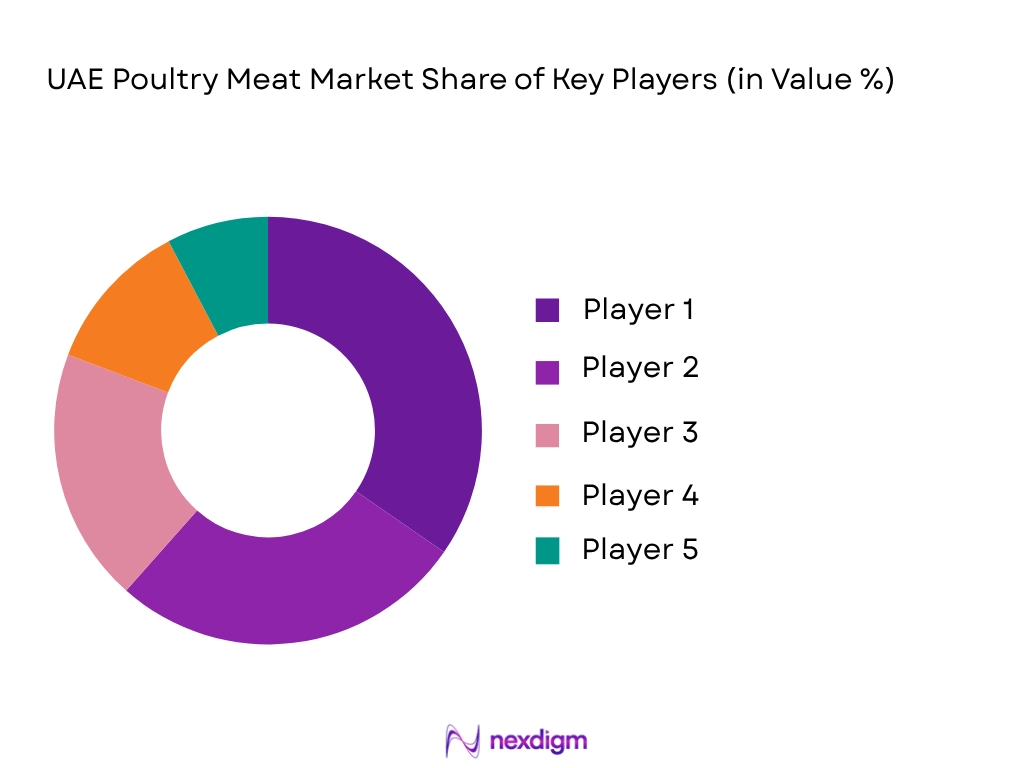
The UAE poultry meat market is moderately consolidated across branded fresh poultry producers, frozen poultry importers, halal processed meat companies, modern retail private labels, and international foodservice suppliers. Local players such as Al Rawdah, Al Ain Farms, and Al Islami Foods benefit from domestic brand recognition and halal credibility, while global poultry companies such as BRF and Tanmiah strengthen supply through frozen and processed poultry products. Competition is increasingly based on food safety, halal certification, pricing, cold-chain reliability, product innovation, and access to supermarkets, HoReCa buyers, and online meat delivery platforms.
| Company | Establishment Year | Headquarters | Core Product Focus | Key Channel Presence | Halal Certification Focus | Cold Chain Capability | Processed Product Portfolio | UAE Market Positioning |
| Emirates Modern Poultry Co. / Al Rawdah | 1994 | Dubai, UAE | ~ | ~ | ~ | ~ | ~ | ~ |
| Al Ain Farms | 1981 | Al Ain, UAE | ~ | ~ | ~ | ~ | ~ | ~ |
| Al Islami Foods | 1981 | Dubai, UAE | ~ | ~ | ~ | ~ | ~ | ~
|
| BRF S.A. / Sadia | 1934 | Itajaí, Brazil | ~ | ~ | ~ | ~ | ~ | ~ |
| Tanmiah Food Company | 1962 | Riyadh, Saudi Arabia | ~ | ~ | ~ | ~ | ~ | ~ |
UAE Poultry Meat Market Analysis
Growth Drivers
Rising Population and Expatriate Workforce
The UAE poultry meat market is strongly supported by the country’s rising population and large expatriate workforce. The UAE has a diverse consumer base made up of Emiratis, South Asians, Arabs, Filipinos, Europeans, and other expatriate communities, creating steady demand for poultry across multiple cuisines. Chicken is widely preferred because it is affordable, easy to cook, halal-compliant, and suitable for household as well as foodservice consumption. As urban centers such as Dubai, Abu Dhabi, and Sharjah continue to attract workers, tourists, and residents, poultry demand increases across supermarkets, restaurants, catering services, and online grocery platforms. This demographic expansion creates a stable consumption base and supports long-term growth in the UAE poultry meat market.
Growth of Foodservice, Hospitality, and Tourism Sector
The growth of the foodservice, hospitality, and tourism sector is a major driver of poultry meat consumption in the UAE. Hotels, restaurants, cafés, quick-service restaurants, cloud kitchens, airline catering companies, and event caterers use large volumes of chicken because it is versatile, cost-effective, and widely accepted by consumers from different cultural backgrounds. Poultry is used in popular dishes such as grilled chicken, shawarma, biryani, burgers, fried chicken, kebabs, sandwiches, and ready meals. Dubai and Abu Dhabi, in particular, have strong restaurant and tourism ecosystems, which continuously support demand from commercial buyers. As tourism, events, and dining-out culture expand, poultry meat remains a core protein for the UAE’s foodservice industry.
Market Challenges
Dependence on Poultry Meat Imports
Dependence on poultry meat imports remains a key challenge for the UAE poultry meat market. Domestic poultry production is limited by land constraints, high temperatures, water scarcity, and feed import dependence, making the country reliant on international suppliers for a large share of its poultry requirements. Imported chicken from countries such as Brazil, Saudi Arabia, and other global suppliers helps meet local demand, but it also exposes the market to shipping disruptions, currency fluctuations, export restrictions, and supply shortages. Any disease outbreak, logistics issue, or trade restriction in supplier countries can affect availability and pricing in the UAE. This dependence creates supply chain vulnerability and increases the need for stronger local production capacity.
Cold Chain and Storage Requirements
Cold chain and storage requirements are significant challenges in the UAE poultry meat market because poultry products are highly temperature-sensitive. Fresh, chilled, frozen, and processed poultry must be transported and stored under strict temperature conditions to maintain safety, quality, and shelf life. The UAE’s hot climate increases the importance of reliable refrigerated logistics, warehouse infrastructure, retail freezers, and last-mile delivery systems. Any break in the cold chain can lead to spoilage, product rejection, food safety risks, and financial losses. Online grocery and quick commerce growth has made cold-chain reliability even more important, as companies must deliver poultry quickly while maintaining freshness. Smaller retailers and distributors may face higher costs in meeting these standards.
Opportunities
Expansion of Domestic Poultry Production
Expansion of domestic poultry production presents a strong opportunity for the UAE poultry meat market. Since the country relies heavily on imports, investment in local poultry farms, controlled-environment housing, automated feeding systems, biosecurity measures, and modern processing facilities can improve food security and supply reliability. Domestic producers can also benefit from consumer preference for fresh, locally sourced, halal-certified chicken. Government focus on food security further supports investment in local agri-food production, including poultry. While climate, water, and feed constraints remain challenges, advanced farming technologies and efficient production systems can help improve output. Expanding domestic production would reduce exposure to import disruptions and strengthen the UAE’s poultry supply chain resilience.
Growth in Ready-to-Cook and Value-Added Poultry Products
Growth in ready-to-cook and value-added poultry products offers a major opportunity in the UAE poultry meat market. Urban consumers increasingly prefer convenient food options that save preparation time while maintaining taste and quality. Products such as marinated chicken, nuggets, sausages, kebabs, burger patties, chicken strips, shawarma cuts, and frozen meal components are gaining popularity among households, working professionals, and foodservice operators. These products also allow brands to earn higher margins compared with basic fresh or frozen chicken. Retailers and poultry processors can target different consumer groups through halal-certified, spicy, organic, antibiotic-free, and cuisine-specific offerings. As modern retail, online grocery, and quick commerce expand, value-added poultry products are expected to see stronger demand.
Future Outlook
Over the next five years, the UAE poultry meat market is expected to expand steadily, supported by population growth, tourism, foodservice activity, and rising demand for convenient protein products. Growth will not be driven only by volume but also by premiumization, branded halal products, healthier cuts, value-added frozen products, and ready-to-cook poultry. The market will remain import-dependent, but domestic producers will continue investing in controlled farming, biosecurity, feed efficiency, and cold-chain improvement.
Major Players
- Emirates Modern Poultry Co. / Al Rawdah
- Al Ain Farms
- Al Islami Foods
- BRF S.A. / Sadia
- Tanmiah Food Company
- Americana Foods
- Lulu Group International
- Carrefour UAE
- Spinneys UAE
- Union Coop
- Kibsons
- FreshToHome UAE
- Noon Minutes
- Instashop
- NRTC Fresh
Key Target Audience
- Poultry meat producers and processors
- Frozen food manufacturers
- Supermarkets and hypermarket chains
- Online meat delivery platforms
- Quick commerce grocery platforms
- Hotels, restaurants, and catering companies
- Investments and venture capitalist firms
- Government and regulatory bodies
Research Methodology
Step 1: Identification of Key Variables
The initial phase involves constructing an ecosystem map of all major stakeholders within the UAE Poultry Meat Market. This includes poultry farms, importers, processors, distributors, retailers, foodservice operators, online channels, and regulatory bodies. The objective is to identify critical variables such as consumption volume, import dependence, product type, distribution channel, pricing, and consumer demand patterns.
Step 2: Market Analysis and Construction
In this phase, historical market data is compiled and analyzed for poultry production, imports, retail sales, frozen poultry demand, processed poultry adoption, and foodservice consumption. The analysis evaluates market penetration across fresh, frozen, and processed poultry categories. Revenue construction is developed by assessing product movement across retail, HoReCa, traditional trade, online platforms, and quick commerce channels.
Step 3: Hypothesis Validation and Expert Consultation
Market hypotheses are developed around key trends such as rising demand for branded halal poultry, growth of online meat delivery, and the importance of imported frozen chicken. These hypotheses are validated through expert consultations with poultry producers, frozen food distributors, retail category managers, foodservice procurement heads, and logistics stakeholders. Their insights help refine demand assumptions and market structure.
Step 4: Research Synthesis and Final Output
The final phase involves synthesizing findings from secondary research, trade data, industry interviews, and channel-level validation. Insights from poultry producers, importers, retailers, and foodservice buyers are combined to assess product segmentation, channel performance, competitive positioning, and growth outlook. The final output presents a structured and validated view of the UAE Poultry Meat Market.

- Executive Summary
- Research Methodology (Market Definitions and Assumptions, Abbreviations, Market Sizing Approach, Consolidated Research Approach, Understanding Market Potential Through In-Depth Industry Interviews, Primary Research Approach, Limitations and Future Conclusions)

- Definition and Scope
- Market Dynamics Overview
- Market Genesis
- Major Players and Market Timeline
- Business Cycle and Trends
- Supply Chain and Value Chain Analysis

- Growth Drivers
Rising Population and Expatriate Workforce
Increasing Demand for Affordable Animal Protein
Growth of Foodservice, Hospitality, and Tourism Sector
Rising Preference for Halal-Certified Poultry Meat
Expansion of Modern Retail and Online Grocery Platforms
Increasing Consumption of Processed and Ready-to-Cook Poultry Products - Market Challenges
Dependence on Poultry Meat Imports
Fluctuations in Feed and Input Costs
High Competition from Imported Poultry Products
Cold Chain and Storage Requirements
Regulatory Compliance and Halal Certification Requirements
Disease Outbreak Risks and Biosecurity Concerns - Opportunities
Expansion of Domestic Poultry Production
Rising Demand for Organic and Antibiotic-Free Poultry
Growth in Ready-to-Cook and Value-Added Poultry Products
Increasing Demand from Hotels, Restaurants, and Catering Sector
Development of E-commerce and Direct-to-Consumer Meat Delivery
Investment in Cold Chain Infrastructure and Food Processing - Key Trends
Shift Toward Fresh and Chilled Poultry Meat
Rising Demand for Halal and Traceable Meat Products
Growth of Private Label Poultry Products
Increasing Popularity of Marinated and Ready-to-Cook Poultry
Adoption of Sustainable and Efficient Poultry Farming Practices
Expansion of Online Meat Delivery Platforms - Government Regulations
Food Safety Regulations
Halal Certification Requirements
Import Regulations and Customs Compliance
Veterinary Health and Biosecurity Standards
Labeling and Packaging Requirements
Cold Chain and Storage Compliance - SWOT Analysis
- Porter’s Five Forces

- By Value, 2020–2025
- By Volume, 2020–2025
- By Average Price, 2020–2025

- By Product Type (In Value %)
Fresh Poultry Meat
Frozen Poultry Meat
Chilled Poultry Meat
Processed Poultry Meat
Others - By Poultry Type (In Value %)
Chicken
Turkey
Duck
Quail
Others - By Form (In Value %)
Whole Poultry
Cuts and Portions
Boneless Poultry Meat
Minced Poultry Meat
Ready-to-Cook Poultry Products - By Application (In Value %)
Household Consumption
Foodservice and HoReCa
Processed Food Manufacturing
Institutional Consumption
Retail Consumption - By Distribution Channel (In Value %)
Hypermarkets and Supermarkets
Traditional Retail Stores
Online Channels
Butcher Shops and Meat Stores
Foodservice Distributors
Direct Sales - By Region (In Value %)
Abu Dhabi
Dubai
Sharjah
Ajman
Ras Al Khaimah
Fujairah
Umm Al Quwain

- Market Share of Major Players by Value/Volume
- Market Share of Major Players by Product Type
- Cross Comparison Parameters (Company Overview, Business Strategies, Recent Developments, Strength, Weakness, Organizational Structure, Revenues, Revenues by Product Type, Number of Touchpoints, Distribution Channels, Number of Dealers and Distributors, Margins, Processing Plants, Production Capacity, Unique Value Offering and Others)
- SWOT Analysis of Major Players
- Pricing Analysis Based on Product Categories for Major Players
- Detailed Profiles of Major Companies
Al Rawdah
Al Ain Farms
Al Islami Foods
BRF S.A.
Sadia
Al Watania Poultry
Emirates Modern Poultry Co.
Arabian Farms
Al Khazna Poultry Farm
Nabil Foods
Americana Foods
Tyson Foods
JBS S.A.
Doux Group

- Market Demand and Utilization
- Purchasing Power and Budget Allocations
- Regulatory and Compliance Requirements
- Needs, Desires, and Pain Point Analysis
- Decision-Making Process

- By Value, 2026–2035
- By Volume, 2026–2035
- By Average Price, 2026–2035


 Request a Sample
 Ask for Customization
 Get a Quote
 Enquire Now