
 Download PDF
Market Overview
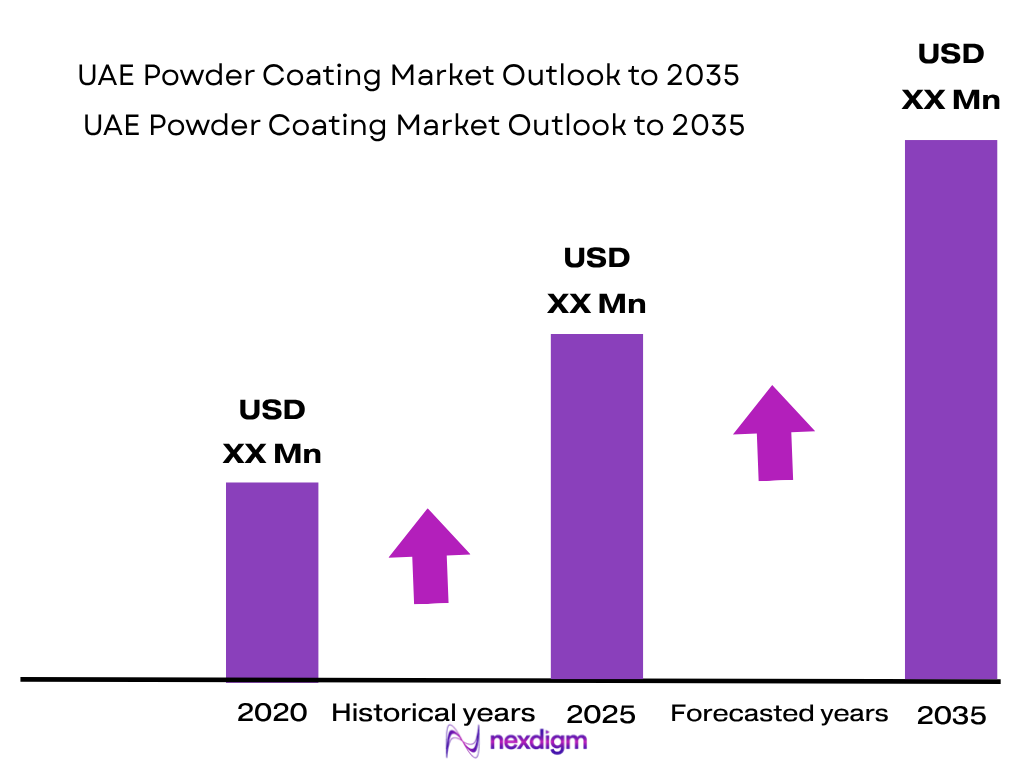
The UAE Powder Coating Market is valued at approximately USD ~X million, compared with approximately USD ~X million in the preceding annual period. Demand is supported by architectural aluminium, construction metalwork, electrical equipment, oilfield components and industrial fabrication. The UAE economy expanded from USD 522.62 billion to USD 552.32 billion, while GDP per capita reached USD 50,273.5, providing a large investment and construction base for durable powder-coated components.
Dubai, Abu Dhabi and Sharjah dominate the UAE Powder Coating Market because they combine major construction projects, aluminium fabrication, industrial zones, ports and large coating-applicator networks. Abu Dhabi’s manufacturing value added reached AED 111.6 billion and construction value added reached AED 107.4 billion, while the emirate added 29,415 housing and commercial units to reach 783,970 units. Dubai contributes strong façade, real-estate and industrial demand, while Sharjah remains an important powder-manufacturing and metal-fabrication centre.
Market Segmentation
By Resin Type
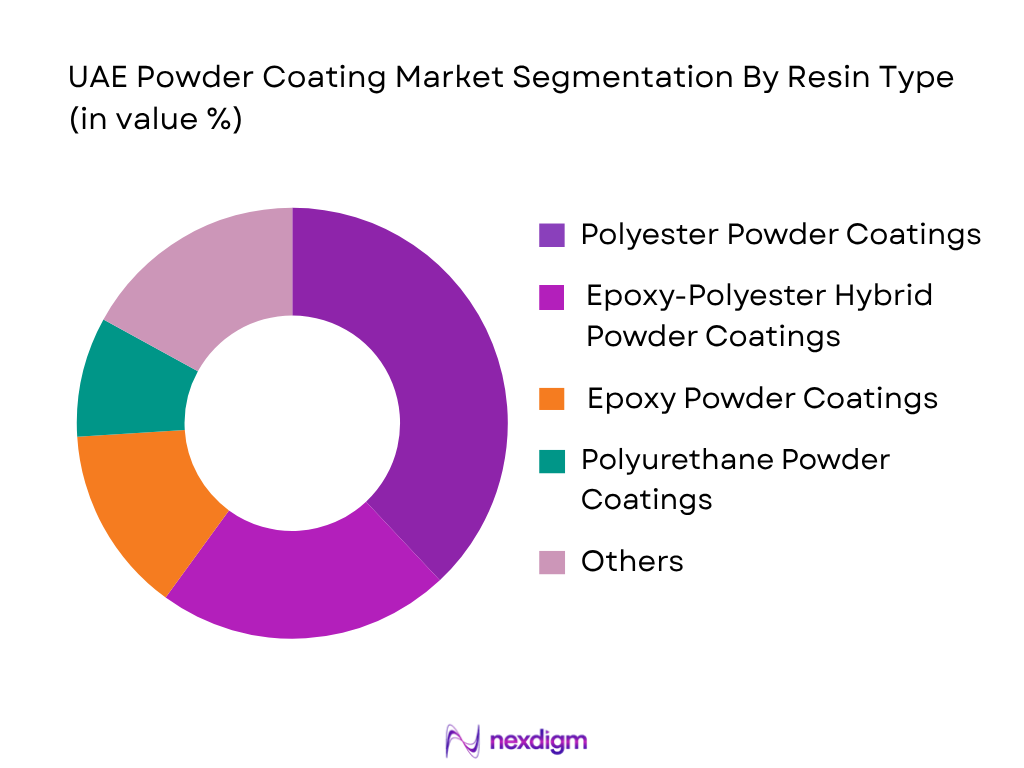
The UAE Powder Coating Market is segmented into polyester, epoxy, epoxy-polyester hybrid, polyurethane, acrylic, thermoplastic and other specialty resin systems. Polyester powder coatings dominate the resin segmentation because the UAE has unusually high exposure to exterior architectural applications, including aluminium façades, windows, doors, curtain walls, balustrades, louvers and outdoor metal structures. These substrates are subjected to strong ultraviolet radiation, heat, humidity, airborne dust and, in coastal areas, salt exposure, making exterior weatherability and colour retention critical procurement parameters. The UAE portfolio of major suppliers reflects this requirement: Jotun offers Qualicoat Class 1, Class 2 and Class 3 architectural powder systems in the country, with product-performance guarantees extending from 10 years to 30 years depending on the specification. Polyester formulations can also be produced in matt, metallic, anodic-effect and textured finishes required by premium buildings. Epoxy products remain important as primers and for industrial or electrical applications, while epoxy-polyester hybrids are more concentrated in interior equipment, furniture and general fabricated-metal applications.
By End-Use Industry
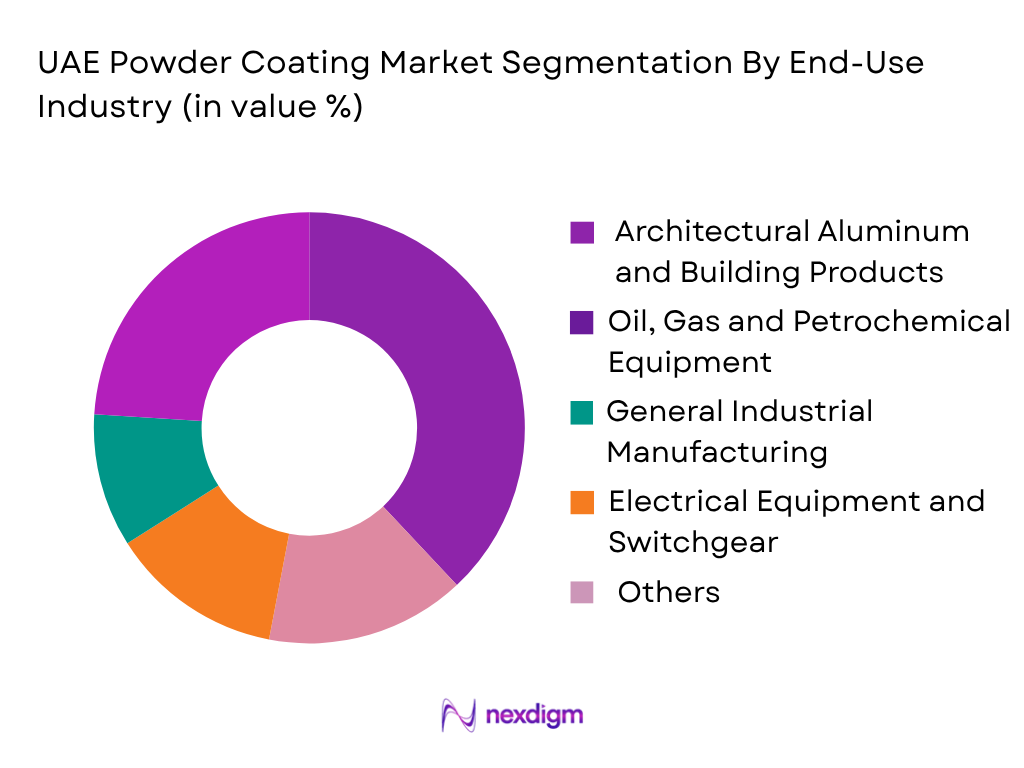
The UAE Powder Coating Market is segmented into architectural aluminium and construction, oil and gas equipment, electrical equipment, general industrial manufacturing, automotive and transportation, HVAC, furniture, renewable energy and other applications. Architectural aluminium and construction dominate this segmentation, reflecting the scale of high-rise, residential, commercial and infrastructure development across Dubai, Abu Dhabi and the northern emirates. Abu Dhabi alone recorded construction value added of AED 107.4 billion, while its total stock of buildings reached 299,360 and housing or commercial units reached 783,970. Dubai’s construction pipeline remains similarly substantial; more than 18,800 buildings under construction covering over 36 million square metres were inspected during the first half of the latest reporting period. Powder coatings are extensively used because aluminium extrusions require consistent decorative appearance, UV durability and corrosion protection without conventional solvent-borne finishing. Oil and gas, electrical equipment and data-centre infrastructure constitute higher-performance subsegments where epoxy primers, corrosion-resistant polyester systems and functional powder coatings gain importance.
Competitive Landscape
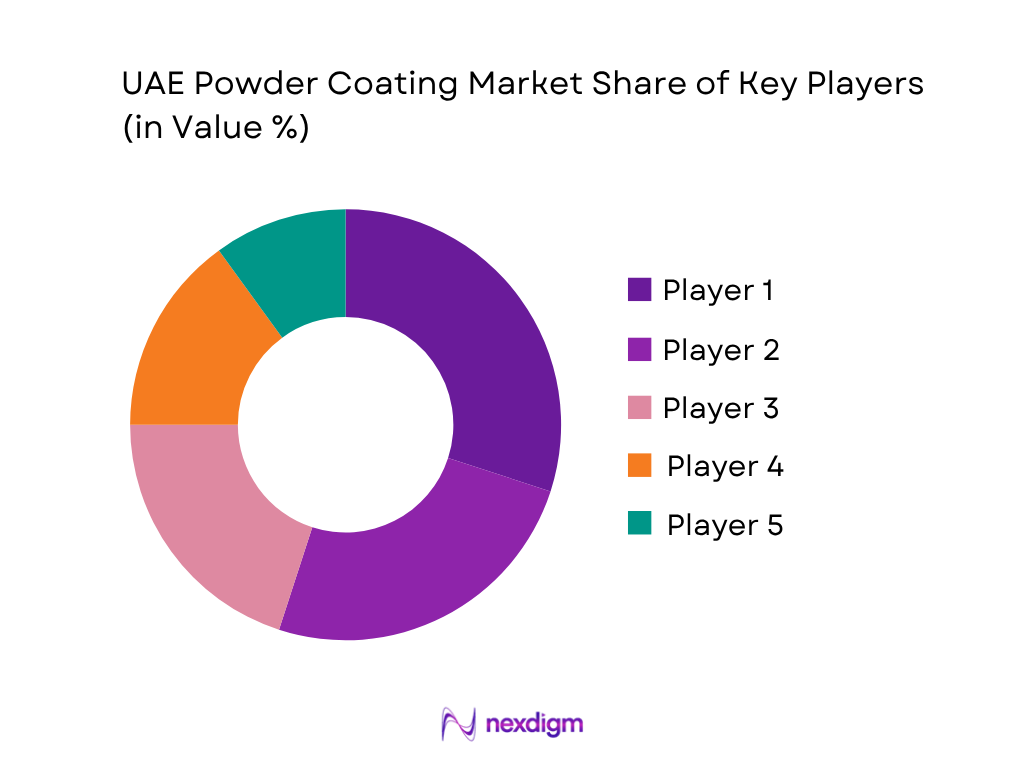
The UAE Powder Coating Market is characterised by competition between multinational technology leaders, regional manufacturers and UAE-based producers. Jotun, AkzoNobel Interpon, National Paints, Axalta and TIGER Coatings are among the prominent suppliers serving architectural, industrial, infrastructure and functional applications. Competitive advantage is based on Qualicoat approvals, super-durable and hyper-durable technology, corrosion-protection capability, local stock availability, custom colour matching and technical support to aluminium extruders and powder applicators. National Paints has operated in the UAE since 1977 and has participated in powder coatings since 2001, illustrating the depth of domestic manufacturing presence.
| Company | Establishment Year | Headquarters | Major Powder Technologies | Key UAE End Uses | Architectural Capability | Corrosion / Functional Capability | UAE / Regional Presence | Technical Support |
| Jotun | 1926 | Sandefjord, Norway | ~ | ~ | ~ | ~ | ~ | ~ |
| AkzoNobel / Interpon | 1994 | Amsterdam, Netherlands | ~ | ~ | ~ | ~ | ~ | ~ |
| National Paints | 1969 | Sharjah, UAE / regional group | ~ | ~ | ~ | ~ | ~ | ~ |
| Axalta Coating Systems | 1866 heritage | Glen Mills, Pennsylvania, US | ~ | ~ | ~ | ~ | ~ | ~ |
| TIGER Coatings | 1930 | Wels, Austria | ~ | ~ | ~ |
UAE Powder Coating Market Analysis
Growth Drivers
Expansion of Construction, Architectural Aluminium and Metal Fabrication
The UAE’s construction and architectural ecosystem is creating sustained demand for polyester, super-durable, epoxy-primer and corrosion-resistant powder coatings used on aluminium façades, curtain walls, windows, doors, balustrades, louvers, railings and external metal structures. Abu Dhabi’s construction sector generated AED 107.4 billion in value added during 2024, while manufacturing generated AED 111.6 billion, providing a sizeable downstream base for coating applicators and metal fabricators. The emirate contained 299,360 buildings and 783,970 residential and commercial units, after 29,415 units were added during the year. Construction intensity has remained strong into 2025, with Dubai Municipality inspecting more than 18,800 buildings under construction covering over 36 million square metres during the first half. These developments directly increase aluminium extrusion and coated architectural-metal requirements. Powder coating is particularly suitable because UAE façade systems need durable colour, UV resistance, abrasion resistance and corrosion protection under desert and coastal conditions. The wider macroeconomic environment supports continued project activity: World Bank data record UAE GDP of USD 552.32 billion in 2024 and GDP per capita of USD 50,273.5. Consequently, construction activity provides both high-volume polyester consumption and demand for technically differentiated exterior powder systems.
Industrial Manufacturing and Electrical Infrastructure Strengthen Powder Coating Consumption
The UAE’s industrial diversification is strengthening demand for powder coatings across electrical enclosures, switchgear, fabricated steel, machinery housings, HVAC equipment, oilfield components and general metal products. The national industrial sector contributed AED 210 billion to GDP during 2024, while industrial exports reached AED 197 billion and medium- and high-technology exports reached AED 62 billion. Abu Dhabi alone generated AED 111.6 billion of manufacturing value added, demonstrating the depth of the country’s industrial-processing base. Electrical infrastructure adds another important demand channel. Dubai Electricity and Water Authority generated 59.19 TWh of electricity during 2024, while annual peak power demand reached 10.76 GW and customer accounts reached 1,270,285. Expansion of power distribution requires coated switchgear cabinets, control panels, cable-management systems and electrical enclosures, where powder coatings provide corrosion protection, dielectric performance and impact resistance. The country’s broader logistics and industrial ecosystem is also substantial, with AED 717.8 billion of re-export activity supporting regional movement of machinery and industrial goods. World Bank data place UAE GDP at USD 552.32 billion in 2024 and GDP per capita at USD 50,273.5. These manufacturing and infrastructure volumes increase demand beyond decorative architectural powders toward functional epoxy, hybrid and corrosion-resistant coating systems.
Market Challenges
Dependence on International Raw-Material and Specialty Chemical Supply Chains
UAE powder-coating manufacturers and applicators remain exposed to international supply chains for polyester resins, epoxy resins, titanium dioxide, specialty pigments, crosslinkers and performance additives needed for architectural and industrial formulations. The scale of the country’s external trade highlights this dependence on internationally sourced industrial materials. UAE non-oil foreign trade exceeded AED 3.8 trillion during 2024, while re-export activity reached approximately AED 717.8 billion. At the same time, the country’s industrial sector generated AED 210 billion of GDP contribution and AED 197 billion of industrial exports, creating substantial requirements for chemical and material inputs across domestic manufacturing. World Bank trade data also show that the UAE functions as an important regional resin distribution hub: Saudi Arabia imported 3,665,650 kilograms of other primary-form polyesters from the UAE and 3,577,160 kilograms of primary-form epoxide resins during 2024, while Oman sourced 905,295 kilograms of polyesters and 843,382 kilograms of epoxide resins from the UAE. These flows demonstrate the interconnected regional resin supply system within which powder-coating manufacturers operate. UAE GDP stood at USD 552.32 billion and GDP per capita at USD 50,273.5 in 2024. Supply disruptions affecting resin, pigment or crosslinker availability can therefore create production-planning and formulation-consistency challenges, particularly for project-specified architectural and functional powders.
Thermal Curing and Extreme Operating Conditions Increase Technical Requirements
Powder coating avoids conventional solvent evaporation but requires substantial thermal energy for curing, making energy management an operational issue for UAE applicators running large ovens for aluminium profiles, steel structures, cabinets and industrial components. Dubai’s electricity demand reached 59,594 GWh during 2024, compared with 56,516 GWh in the preceding year, while DEWA generated 59.19 TWh and recorded peak demand of 10.76 GW. Installed generation capacity subsequently reached 17.179 GW, highlighting the expanding electricity requirements associated with Dubai’s urban and industrial economy. Powder-coating lines add to this load through pretreatment systems, compressed air, electrostatic booths, conveyors and curing ovens, particularly where heavy steel components require long residence times to reach specified metal temperatures. The UAE’s climate further increases technical complexity because exterior coated products face intense sunlight, high ambient temperatures, humidity, airborne sand and marine salt exposure. These conditions raise requirements for UV stability, gloss retention, adhesion and corrosion resistance and can make inadequately specified standard powders unsuitable for long-term exterior service. World Bank data place UAE GDP at USD 552.32 billion in 2024 and GDP per capita at USD 50,273.5. Applicators consequently need low-bake formulations, efficient oven profiling, correct pretreatment and higher-performance exterior resin systems to manage both process-energy requirements and demanding service conditions.
Market Opportunities
Renewable Energy and Electrical Infrastructure Create Functional Coating Opportunities
The UAE’s existing clean-energy infrastructure provides a strong foundation for future demand for powder coatings used on solar mounting components, electrical cabinets, switchgear, battery enclosures, control equipment and outdoor fabricated structures. Government energy data show that the UAE had surpassed 12 GW of clean-energy capacity in 2024, comprising 6.8 GW of renewable-energy capacity and 5.6 GW of nuclear capacity. Dubai’s electricity system generated 59.19 TWh during the same period, including 6.62 TWh of clean electricity, while peak demand reached 10.76 GW. These installed assets require extensive networks of electrical enclosures, substations, cabinets, supporting frames and ancillary equipment exposed to heat, dust and outdoor conditions. Powder coatings are well suited to these applications because super-durable polyester systems can provide UV and weather resistance, while epoxy and hybrid formulations can support electrical insulation and corrosion protection. The opportunity extends beyond generation assets as additional grid and distribution equipment is required to connect renewable capacity with industrial, residential and commercial users. UAE macroeconomic fundamentals support continued industrial investment, with World Bank data recording USD 552.32 billion of GDP in 2024 and GDP per capita of USD 50,273.5. Current clean-energy deployment therefore provides a measurable base from which powder manufacturers can expand into higher-performance electrical, solar and energy-storage coating applications without relying on speculative future-volume assumptions.
Local Specialty Powder Manufacturing Can Capture Industrial and Regional Demand
The UAE’s growing industrial and re-export ecosystem creates an opportunity for domestic manufacturers to localise super-durable architectural powders, marine-grade systems, low-bake products and functional electrical coatings currently supplied through a combination of local production and international sourcing. The industrial sector contributed AED 210 billion to national GDP during 2024, while industrial exports reached AED 197 billion and medium- and high-technology exports reached AED 62 billion. Re-export activity reached approximately AED 717.8 billion, demonstrating the UAE’s role as a distribution platform for neighbouring GCC, Middle Eastern and African markets. Industrial-development financing is also expanding the domestic production ecosystem: Emirates Development Bank reported AED 15.7 billion of cumulative financing under its industrial transformation strategy and AED 50.2 billion of mobilised capital-expenditure financing by the end of 2024, including AED 15 billion supporting greenfield projects. These figures provide a strong current manufacturing base from which specialty powder capacity can be developed. Localised production can shorten project lead times for bespoke façade colours, reduce reliance on imported finished formulations and improve application-engineering support for UAE fabricators. World Bank data record national GDP of USD 552.32 billion in 2024 and GDP per capita of USD 50,273.5. The combination of domestic industry, project demand and regional re-export channels therefore creates future scope for UAE-based specialty powder manufacturing serving both local projects and wider GCC markets.
Future Outlook
The UAE Powder Coating Market is forecast to expand at approximately ~X% CAGR during 2026-2035, supported by construction, industrial diversification, electrical infrastructure, renewable-energy investment and demand for long-life exterior finishes. Architectural aluminium is expected to remain the principal consumption base, while marine-grade, functional and corrosion-resistant powders gain greater strategic relevance. Demand is expected to move toward super-durable and hyper-durable polyester systems because UAE façades operate under intense UV radiation, high temperatures and coastal humidity. Premium architectural projects increasingly require long colour-retention periods, certified applicators and project warranties.
Low-bake and fast-cure technologies should also gain traction as powder applicators seek to reduce oven energy requirements and improve conveyor throughput. These technologies are particularly relevant for aluminium extrusion and large-volume fabrication lines. Functional coatings will broaden the market into data centres, EV components, switchgear, battery systems and industrial equipment. Electrical insulation, chemical resistance, anti-corrosion performance and controlled film thickness will increasingly differentiate premium powder products from standard decorative grades.
Major Players
- Jotun Powder Coatings UAE
- AkzoNobel Powder Coatings / Interpon UAE
- National Paints Factories Co. Ltd.
- Axalta Powder Coating Systems
- TIGER Coatings
- PPG Industries
- Sherwin-Williams
- Protech Group / Oxyplast
- Pulver Kimya
- ST Powder Coatings
- Teknos
- IGP Powder Coatings
- Berger Paints Emirates
- Kansai Paint Middle East
- Kaizen Paints Middle East
Key Target Audience
- Powder Coating Manufacturers and Resin Formulators
- Architectural Aluminium Extruders and Façade Fabricators
- Construction and Building Material Companies
- Oil, Gas, Petrochemical and Industrial Equipment Manufacturers
- Electrical Equipment, Switchgear and Data Centre Infrastructure Companies
- Powder Coating Applicators and Industrial Metal Finishers
- Investments and Venture Capitalist Firms
- Government and Regulatory Bodies (Ministry of Industry and Advanced Technology, Ministry of Climate Change and Environment, Dubai Municipality, Abu Dhabi Department of Economic Development, Environment Agency – Abu Dhabi, Emirates Authority for Standardization and Metrology functions under MoIAT)
Research Methodology
Step 1: Identification of Key Variables
The initial phase involves constructing a detailed UAE Powder Coating Market ecosystem covering resin suppliers, pigment and additive companies, powder manufacturers, distributors, applicators, aluminium extruders, façade fabricators and industrial OEMs. Key variables include resin chemistry, powder consumption, coated surface area, film thickness, cure temperature, transfer efficiency, domestic production, imports, architectural specifications and end-use demand.
Step 2: Market Analysis and Construction
Historical market information is analysed through top-down and bottom-up approaches. The bottom-up framework evaluates powder-manufacturer shipments, domestic production, imports and applicator consumption, while the top-down framework maps powder usage against construction activity, aluminium fabrication, industrial manufacturing, oil and gas equipment, electrical infrastructure and transportation. Powder consumption is reconciled with application-specific film-build and surface-area assumptions.
Step 3: Hypothesis Validation and Expert Consultation
Market hypotheses are validated through structured CATIs and primary discussions with powder manufacturers, aluminium extruders, façade fabricators, approved applicators, distributors and industrial buyers. Interviews examine polyester and epoxy usage, project specifications, Qualicoat requirements, custom colour demand, coastal corrosion performance, powder recovery, curing practices and imported versus locally manufactured supply.
Step 4: Research Synthesis and Final Output
The final stage triangulates primary research with government economic statistics, construction indicators, trade information, corporate disclosures and technical standards. Market values and volumes are reconciled across resin type, end-use industry, application and emirate. Forecast assumptions incorporate construction activity, non-oil manufacturing, data-centre infrastructure, renewable energy, architectural durability requirements and adoption of low-bake and functional powder technologies.

- Executive Summary
- Research Methodology (Market Definition and Scope, UAE Powder Coating Taxonomy, Thermoset and Thermoplastic Powder Coating Classification, Resin Chemistry Mapping, Substrate Assessment, Powder Particle Size Assessment, Curing Technology Assessment, Application Equipment Mapping, End-Use Application Mapping, Raw Material Assessment, Sustainable Powder Coating Technology Evaluation, Market Sizing Framework)

- Definition and Scope
- UAE Powder Coating Industry Evolution and Powder Application Technology
- Development
- Powder Coating Manufacturing and Extrusion Process
- Powder Coating Value Chain Analysis
- UAE Powder Coating Supply Chain Analysis
- Resin, Pigment, Additive and Crosslinker Ecosystem Analysis
- UAE Powder Coating Import Dependency and Domestic Manufacturing Assessment
- OEM Powder Coating Application Architecture and Specialty Coating Solution Framework

- Growth Drivers (Expansion of High-Rise Construction and Façade Demand, Growth of Architectural Aluminium Fabrication, Increasing Industrial Manufacturing Activity, Oil and Gas Equipment Demand, Electrical Infrastructure Investment, Data Centre Development, Replacement of Liquid Coatings, Increasing Demand for High-Durability Surface Finishes)
- Market Challenges (Imported Resin and Pigment Dependency, Energy-Intensive Curing Requirements, Extreme UV and Heat Exposure, Coastal Corrosion, Colour and Batch Consistency Requirements, Applicator Quality Variation, Complex Project Specifications, Competitive Regional Powder Imports)
- Market Opportunities (Hyper-Durable Architectural Powders, Marine-Grade Corrosion Systems, Low-Bake Powder Coatings, Data Centre Equipment Coatings, EV Electrical Insulation Powders, Solar Equipment Coatings, Chromate-Free Pretreatment-Compatible Powders, Domestic Specialty Powder Localization)
- Market Trends (Super-Durable Polyester Adoption, Hyper-Durable Façade Systems, Fine-Texture Powder Finishes, Matt and Metallic Effects, Low-Temperature Cure Systems, Chromate-Free Pretreatment, Automated Powder Recovery, Lower-Carbon Powder Coating Formulations)
- Regulatory and Standards Landscape (UAE Chemical Handling Requirements, Occupational Health and Powder Handling Requirements, Fire and Explosion Safety Requirements, Environmental and Wastewater Compliance Requirements, Qualicoat Architectural Powder Coating Standards, BS and ISO Coating Performance Standards, Green Building Requirements, Industrial and Oilfield Coating Specifications)
- SWOT Analysis
- Porter’s Five Forces Analysis
- PESTLE Analysis
- Stakeholder Ecosystem
- Competition Ecosystem

- By Market Value (2020-2025)
- By Powder Coating Consumption Volume (2020-2025)
- By Coated Surface Area (2020-2025)
- By Domestic Production Volume (2020-2025)
- By Import Volume (2020-2025)
- By Export Volume (2020-2025)
- By Average Powder Consumption per Square Metre (2020-2025)
- By Thermoset Powder Coating Consumption (2020-2025)
- By Thermoplastic Powder Coating Consumption (2020-2025)

- By Resin Type (In Value %)
Polyester Powder Coatings
Epoxy Powder Coatings
Epoxy-Polyester Hybrid Powder Coatings
Polyurethane Powder Coatings
Acrylic Powder Coatings
Polyamide Powder Coatings
Polyethylene Powder Coatings
PVC Powder Coatings
Fluoropolymer Powder Coatings
Other Specialty Resin Systems - By Powder Coating Technology (In Value %)
Thermoset Powder Coatings
Thermoplastic Powder Coatings
Low-Bake Powder Coatings
Fast-Cure Powder Coatings
UV-Curable Powder Coatings
Heat-Sensitive Substrate Powder Coatings
Dual-Layer and Primer-Topcoat Powder Systems - By Substrate Type (In Value %)
Aluminium
Mild Steel
Galvanised Steel
Stainless Steel
Cast Iron
Zinc-Coated Substrates
Magnesium and Light Alloys
MDF and Engineered Wood
Heat-Sensitive Composite Substrates - By End-Use Industry (In Value %)
Architectural Aluminium and Façade Systems
Building and Construction Products
Oil, Gas and Petrochemical Equipment
General Industrial Manufacturing
Electrical Equipment and Switchgear
Automotive and Transportation
Furniture and Metal Fixtures
Appliances and Consumer Durables
HVAC and Refrigeration
Renewable Energy Equipment
Marine and Coastal Infrastructure
Rail and Mass Transit
Retail Fixtures and Shopfitting
Medical and Healthcare Equipment
Data Centre and Electrical Infrastructure - By Distribution Channel (In Value %)
Direct Manufacturer-to-OEM Sales
Direct Sales to Approved Powder Applicators
Specialist Powder Coating Distributors
Industrial Coatings Distributors
Architectural Specification Channels
Contract Coater Supply Channels
Fabricator Supply Channels
Equipment and Powder Solution Distributors
Online and Digital Ordering Channels - By Region (In Value %)
Dubai
Jebel Ali
Dubai Industrial City
Dubai Investment Park
Abu Dhabi
Mussafah
Khalifa Industrial Zone Abu Dhabi
Al Ain

- Market Share of Major Players (By Revenue, Volume, Resin Type, Powder Coating Technology, Substrate Type, End-Use Industry, Market Type, Distribution Channel)
- Cross Comparison Parameters (Resin Chemistry Breadth, UAE Manufacturing and Stocking Footprint, Qualicoat-Approved Architectural Portfolio, Super-Durable and Hyper-Durable Technology Capability, Marine and C5 Corrosion Protection Portfolio, Custom Colour and Special-Effect Capability, Applicator and OEM Technical Support Network, Low-Bake and Sustainable Powder Portfolio)
- SWOT Analysis of Major Players
- Competitive Positioning Matrix
- Product and Technology Portfolio Benchmarking
- Pricing and Distribution Network Benchmarking
- Market Entry Strategy Assessment
- Detailed Profiles of Major Companies
Jotun Powder Coatings UAE
AkzoNobel Powder Coatings / Interpon UAE
National Paints Factories Co. Ltd.
Axalta Powder Coating Systems
TIGER Coatings
PPG Industries
Sherwin-Williams
Protech Group / Oxyplast
Pulver Kimya
ST Powder Coatings
Teknos
IGP Powder Coatings
Berger Paints Emirates
Kansai Paint Middle East
Kaizen Paints Middle East

- Buyer Segmentation
- OEM Procurement Behaviour
- Powder Applicator Procurement Behaviour
- Supplier Selection Criteria
- Buyer Pain Points
- Technology Adoption Assessment
- Replacement and Recoat Behaviour

- By Market Value (2026-2035)
- By Powder Coating Consumption Volume (2026-2035)
- By Coated Surface Area (2026-2035)
- By Domestic Production Volume (2026-2035)
- By Import Volume (2026-2035)
- By Export Volume (2026-2035)
- By Average Powder Consumption per Square Metre (2026-2035)
- By Thermoset Powder Coating Consumption (2026-2035)
- By Thermoplastic Powder Coating Consumption (2026-2035)


 Request a Sample
 Ask for Customization
 Get a Quote
 Enquire Now