
 Download PDF
Market Overview
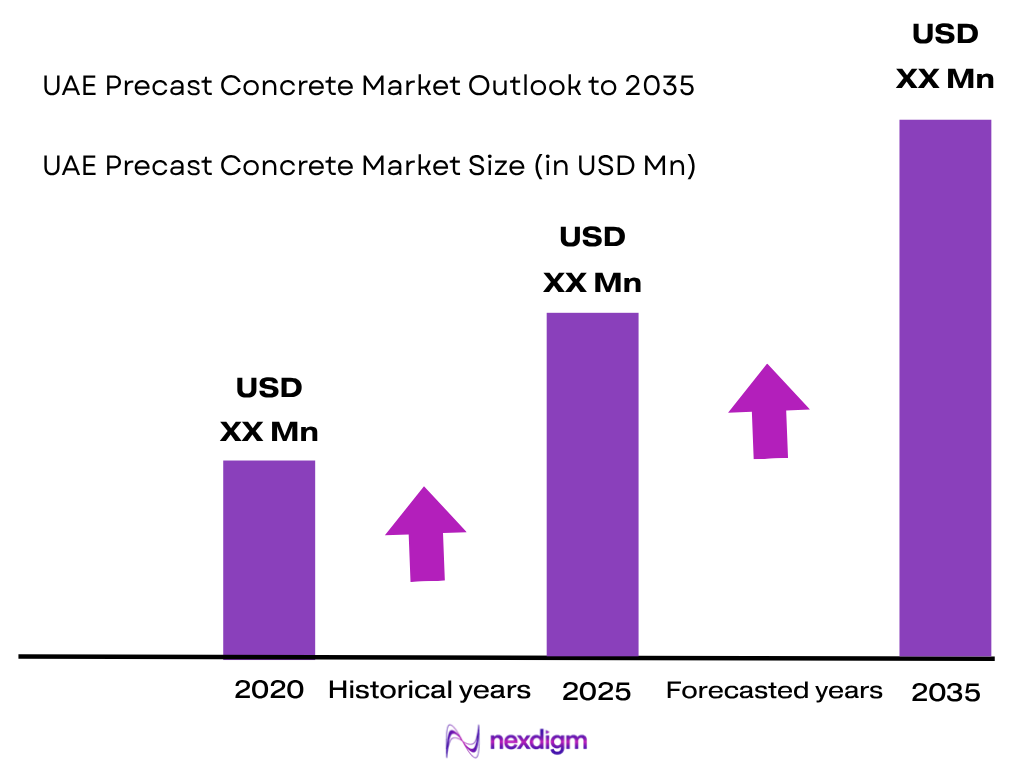
The UAE Precast Concrete Market is valued at approximately USD ~ billion based on the latest historical market series, with the preceding observation at approximately USD 1.985 billion. Demand is closely connected with construction activity, infrastructure development, residential communities, commercial buildings, industrial facilities and the need for faster project execution. The UAE building and construction sector recorded 8.4% growth, while construction and building activities contributed 11.7% of non-oil GDP, reinforcing the importance of construction activity to precast demand.
Dubai and Abu Dhabi represent the principal demand and production centres for the UAE Precast Concrete Market because they combine extensive construction pipelines, major infrastructure programs, large real-estate developments and established manufacturing clusters. Dubai Municipality inspected 18,800 buildings under construction covering more than 36 million square metres during the latest reported period, demonstrating the scale of the construction pipeline. Abu Dhabi has a similarly developed manufacturing ecosystem, with major producers operating in ICAD and supplying residential, commercial, infrastructure, marine, industrial and government projects.
Market Segmentation
By Product Type
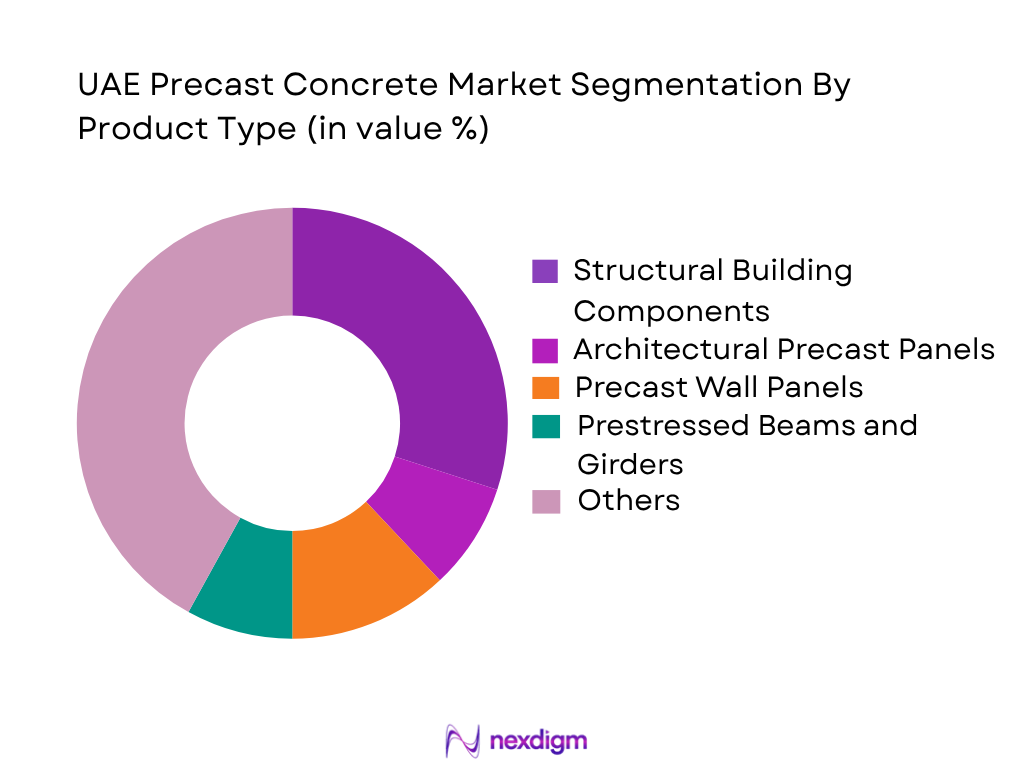
The UAE Precast Concrete Market is segmented by product type into structural building components, architectural precast panels, precast wall panels, prestressed beams and girders, columns and beams, double tees, hollow-core slabs, precast floor and roof systems, precast concrete pipes, box culverts, manholes and utility vaults, drainage structures, bridge components, noise barriers and retaining walls, and precast foundations and piles. Structural building components represent the leading product category because beams, columns, slabs and wall systems can be standardized and repeatedly manufactured for residential, commercial, industrial and institutional developments. Their factory-controlled production supports dimensional consistency and faster site installation. Hollow-core slabs and prestressed products are particularly relevant to projects requiring long spans and rapid floor construction. Exeed Precast, for example, manufactures beams, columns, hollow-core slabs, prestressed elements, wall panels and complete precast building systems, while Abu Dhabi Precast supplies full building systems, prestressed products and infrastructure components.
By End-Use Industry
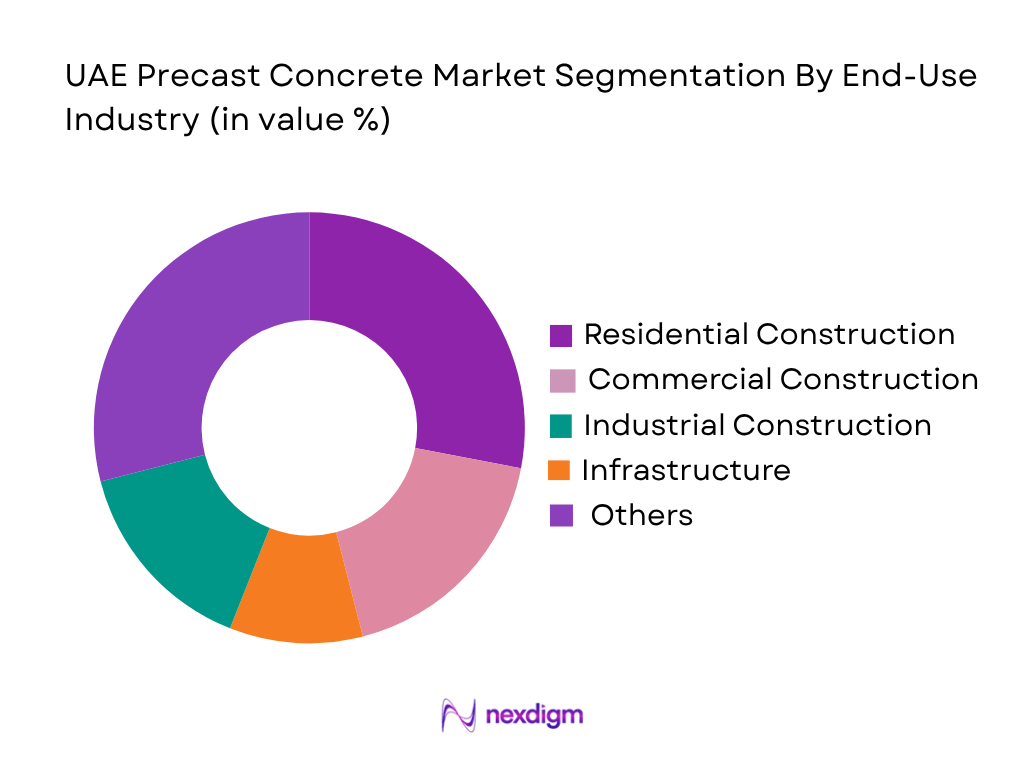
The UAE Precast Concrete Market is segmented by end-use industry into residential construction, commercial construction, industrial construction, infrastructure, institutional construction, hospitality and tourism, transportation infrastructure, water and wastewater infrastructure, energy and utilities, marine construction, government and defense facilities, logistics and warehousing, and data centres. Residential construction represents a leading demand category because repetitive building formats, standardized floor systems and large-scale housing developments are particularly suitable for precast manufacturing. Commercial and infrastructure projects also generate substantial demand because precast components can be manufactured while site preparation progresses, allowing parallel construction activities. Abu Dhabi Precast identifies residential and commercial buildings, infrastructure, marine products and full precast systems within its product offering, while Exeed Precast supplies residential, commercial, industrial, governmental, infrastructure, bridge and oil-and-gas projects.
Competitive Landscape
The UAE Precast Concrete Market includes established domestic manufacturers with capabilities spanning structural precast, prestressed concrete, architectural products, infrastructure components, hollow-core slabs and complete precast building systems. Competition is differentiated by manufacturing capacity, plant automation, geographic coverage, engineering support, transportation and erection capability, product breadth and experience with large-scale projects. Gulf Precast operates five factories and six production facilities across Abu Dhabi and Dubai, while Exeed Precast operates major manufacturing facilities in Abu Dhabi. Dubai Precast combines building, infrastructure and marine product capabilities.
| Company | Establishment | Headquarters | Production / Capacity Indicator | Core Product Capability | Infrastructure Capability | Geographic Coverage | Engineering / Installation |
| Gulf Precast Concrete Company LLC | 1984 | Abu Dhabi | ~ | ~ | ~ | ~ | ~ |
| Exeed Precast LLC | 2006 | Abu Dhabi | ~ | ~ | ~ | ~ | ~ |
| Dubai Precast LLC | 2006 | Dubai | ~ | ~ | ~ | ~ | ~ |
| Abu Dhabi Precast LLC | 2001 | Abu Dhabi | ~ | ~ | ~ | ~ | ~ |
| Baniyas Concrete Products LLC | 1996 | Abu Dhabi | ~ | ~ | ~ | ~ | ~ |
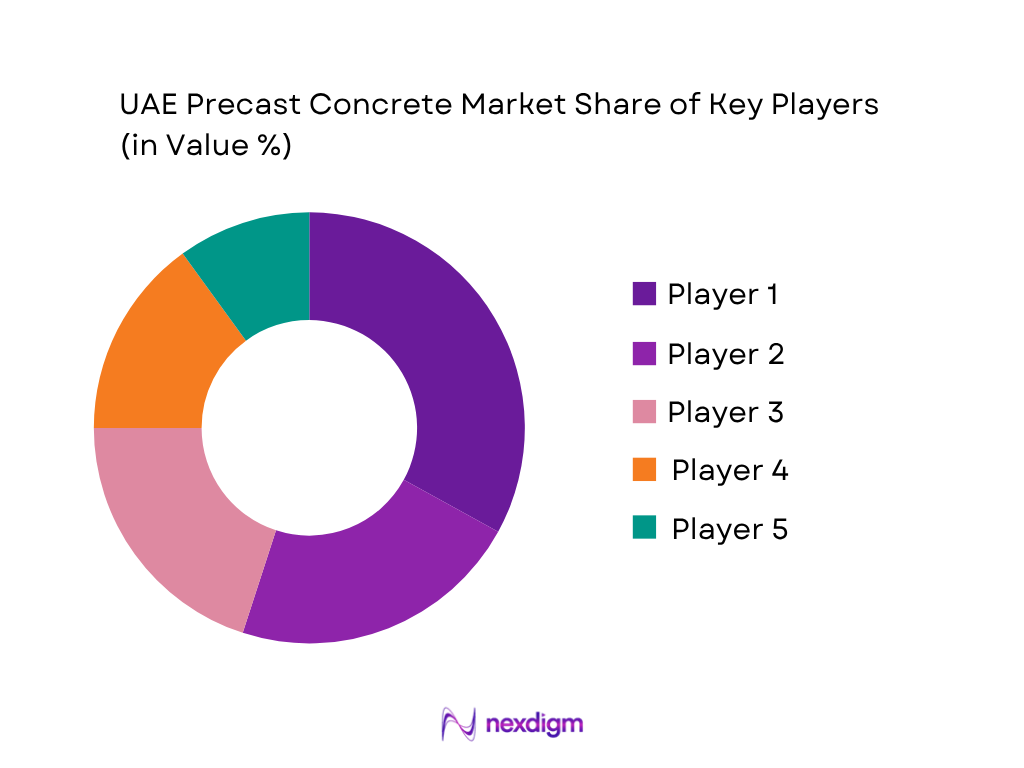
UAE Precast Concrete Market Analysis
Growth Drivers
Construction and Real Estate Expansion
The UAE Precast Concrete Market is supported by strong construction activity and broad-based non-oil economic expansion, creating demand for structural components, wall panels, slabs, beams, columns and infrastructure precast. The Federal Competitiveness and Statistics Centre reports that UAE GDP at constant prices reached AED 1.78 trillion in 2024, while construction grew by 8.4 and accounted for 8.9 of GDP. The World Bank records UAE GDP growth of 4.0 in 2024, while industry including construction represented 44.3 of GDP. These conditions support continued development of residential buildings, commercial assets, industrial facilities, logistics projects and infrastructure requiring factory-produced concrete components. The IMF also identified construction as one of the sectors supporting UAE domestic non-hydrocarbon activity, alongside tourism, manufacturing and financial services. Precast systems benefit particularly from repetitive construction formats because standardized columns, beams, slabs, wall panels and other elements can be manufactured under controlled plant conditions while foundation and site works proceed separately. This parallel-work model can shorten construction schedules and improve consistency. The combination of strong construction activity, real-estate development and infrastructure investment therefore provides a broad demand base for structural and architectural precast products across Abu Dhabi, Dubai and other Emirates.
Infrastructure Development and Industrialized Construction
Infrastructure investment and the UAE’s increasing emphasis on modern construction technologies provide another major growth driver for the UAE Precast Concrete Market. The Ministry of Energy and Infrastructure reported that it had invested AED 13 billion over the preceding decade to execute 258 projects, while its plan covered 127 additional security, educational, service and road projects with a stated cost of AED 9 billion. The Ministry also highlighted modern construction technologies, AI applications and infrastructure innovations in 2024, reinforcing the policy focus on efficient project delivery. Precast concrete is well suited to this environment because bridge beams, barriers, drainage structures, culverts, utility chambers, tunnel components and other standardized elements can be produced away from the construction site and installed rapidly. The UAE’s strong infrastructure position further supports this demand: the Ministry reported that the country ranked 4th globally for infrastructure quality in the World Economic Forum’s Global Competitiveness assessment. The Federal Competitiveness and Statistics Centre also recorded transportation and storage growth of 9.6 in 2024, indicating strong activity across logistics and transportation-related infrastructure. These conditions create sustained requirements for durable, repeatable and rapidly installable precast components across road, transportation, utility, government and infrastructure developments.
Market Challenges
Heavy-Component Logistics and Installation Complexity
The UAE Precast Concrete Market faces operational constraints associated with transporting, storing and installing large and heavy concrete components. Precast beams, columns, bridge elements, wall panels and other structural products often require specialized trailers, lifting equipment, cranes and carefully sequenced deliveries. These requirements become particularly important when manufacturing plants are located away from project sites or when projects involve restricted access, dense urban environments or limited storage space. The challenge is relevant because the UAE construction ecosystem spans multiple Emirates and includes large-scale projects with different site conditions and procurement schedules. The Federal Competitiveness and Statistics Centre recorded 9.6 growth in transportation and storage activity in 2024, reflecting an expanding logistics environment but also increasing requirements on construction supply chains. Manufacturers must coordinate production schedules with transportation and erection teams so that components arrive when cranes and installation crews are available. Delays can create storage requirements at plants or sites and disrupt sequential construction activities. The Ministry of Energy and Infrastructure’s infrastructure program includes roads, buildings, dams, water channels and other geographically distributed projects, further increasing the importance of delivery coordination. Consequently, transportation planning, lifting capacity, route management, storage and site-access conditions remain critical execution considerations for UAE precast producers.
Capital, Manufacturing and Coordination Requirements
The UAE Precast Concrete Market also faces challenges related to capital-intensive manufacturing, production planning and coordination between design and construction stakeholders. Precast plants require specialized molds, casting equipment, reinforcement systems, prestressing equipment, curing facilities, quality-control infrastructure and material-handling systems. Manufacturers must maintain sufficient utilization to justify these fixed investments while accommodating project-specific designs and delivery schedules. The issue becomes more complex when architects or contractors modify designs after molds and production schedules have already been prepared. The Ministry of Energy and Infrastructure has emphasized quality control of construction materials, including development of a federal laboratory for construction materials and a national platform for supplier and construction-material classification, registration and evaluation. This indicates the importance of formal quality and supplier-control processes within the UAE construction ecosystem. At the broader economic level, the World Bank reports that UAE GDP reached USD 552.32 billion in 2024 and GDP per capita reached USD 50,273.5, reflecting a sophisticated construction market where developers can pursue technically demanding projects but also expect high standards of execution. Precast manufacturers therefore need strong engineering, quality assurance, production planning and project coordination capabilities to manage complex building and infrastructure requirements without creating manufacturing bottlenecks.
Market Opportunities
Data Centres, Industrial Facilities and Modular Construction
The UAE Precast Concrete Market has an expanding opportunity in data centres, industrial facilities, logistics assets and modular construction because these developments can benefit from standardized structural components and accelerated installation. The country’s non-oil economy is providing a supportive environment for these applications: the World Bank reported 4.0 real GDP growth in 2024, while the Federal Competitiveness and Statistics Centre recorded 8.4 growth in construction and 9.6 growth in transportation and storage. These conditions support development of warehouses, distribution facilities, industrial buildings and digitally enabled infrastructure requiring rapid construction. Precast systems can provide repeatable columns, beams, floor systems, wall panels and other structural components that are manufactured concurrently with site preparation. Data centres are particularly suited to engineered precast solutions because their buildings require standardized structural layouts, controlled construction processes and rapid project execution. Modular construction can further expand the opportunity by integrating precast structural and envelope components into repeatable building systems. The Ministry of Energy and Infrastructure has also emphasized modern construction technologies and digital systems for infrastructure project management, supporting an environment in which digitally coordinated prefabrication can become more practical. Manufacturers that combine engineering, BIM coordination, automated production, transportation and installation can therefore address higher-value projects rather than supplying individual concrete components alone.
Low-Carbon Precast and Infrastructure Components
Low-carbon precast concrete and specialized infrastructure components represent another opportunity as the UAE continues to develop infrastructure while emphasizing construction efficiency and modern building practices. The UAE recorded GDP of AED 1.78 trillion at constant prices in 2024, with non-oil GDP reaching AED 1.34 trillion, demonstrating the scale of economic activity supporting infrastructure and construction investment. Construction itself grew by 8.4, while manufacturing grew as part of the country’s broader economic diversification. Precast manufacturers can respond by optimizing concrete mix designs, incorporating supplementary cementitious materials where technically appropriate, improving production efficiency and reducing material waste through controlled factory processes. Infrastructure applications provide a parallel opportunity because the Ministry of Energy and Infrastructure continues to oversee roads, buildings, dams and water-channel projects; its 2026 project portfolio included the Emirates Road Enhancement Project and other federal infrastructure developments. Standardized precast drainage systems, bridge components, utility chambers, barriers, tunnel elements and water-management structures can therefore address recurring infrastructure requirements. The Ministry’s focus on construction-material quality control and modern project-management systems further supports demand for engineered products with documented performance. Producers that combine durable precast products with lower-carbon manufacturing, digital quality control and reliable project delivery can strengthen their position in infrastructure procurement and large-scale construction programs.
Future Outlook
The UAE Precast Concrete Market is expected to continue expanding as developers and contractors seek faster construction cycles, controlled manufacturing quality and reduced site-based activities. Demand is expected to remain connected with residential communities, commercial developments, industrial facilities, logistics assets, infrastructure programs and transportation projects. Increasing adoption of BIM, automated production, prestressed systems and modular construction is expected to strengthen the role of precast manufacturers as integrated engineering, manufacturing and installation partners.
The future market is also likely to see greater emphasis on lower-carbon concrete mixes, optimized reinforcement, automated production and digitally coordinated fabrication. Large manufacturers are already expanding capabilities around automated production, hollow-core manufacturing, reinforcement processing and engineered precast systems. Exeed Precast, for example, operates an automated pallet-circulating production system and dedicated halls for hollow-core and prestressed products.
Major Players
- Gulf Precast Concrete Company LLC
- Exeed Precast LLC
- Emirates Precast Construction LLC
- Hard Precast Building Systems LLC
- Dubai Precast LLC
- Abu Dhabi Precast LLC
- Baniyas Concrete Products LLC
- Al Wathba Cement Industries
- RAK Precast FZC
- Pioneer Precast Concrete LLC
- Hi-Tech Concrete Products LLC
- Al Meraikhi Industrial Complex
- Saad Precast LLC
- Nael Cement Products
- Al Ain Precast Concrete
Key Target Audience
- Precast Concrete Manufacturers and Producers
- Real Estate Developers and Master Developers
- Construction Companies and Main Contractors
- Investments and Venture Capitalist Firms
- Government and Regulatory Bodies (Ministry of Energy and Infrastructure, Dubai Municipality, Department of Municipalities and Transport – Abu Dhabi)
- Infrastructure and Transportation Authorities
- Cement, Concrete and Construction Material Producers
- Industrial, Logistics and Data Centre Developers
Research Methodology
Step 1: Identification of Key Variables
The initial phase involves constructing a UAE Precast Concrete Market ecosystem covering manufacturers, cement and aggregate suppliers, reinforcement suppliers, developers, contractors, infrastructure authorities, transport providers and erection specialists. Product-level variables include structural precast, architectural precast, prestressed elements, hollow-core slabs, infrastructure products and utility structures. The assessment also identifies production capacity, plant locations, project pipeline and application-specific demand variables.
Step 2: Market Analysis and Construction
Historical market information is compiled using market-value data, production volumes, manufacturer capacity, construction activity and project-level demand indicators. The analysis separates structural, architectural, infrastructure and utility applications to avoid treating all precast products as a homogeneous category. Supply-side capacity is assessed alongside demand-side construction activity to establish a balanced market framework.
Step 3: Hypothesis Validation and Expert Consultation
Market hypotheses are validated through discussions with manufacturers, production managers, project procurement teams, structural specialists, contractors and infrastructure stakeholders. Interviews focus on product demand, manufacturing utilization, procurement practices, project specifications, transportation constraints and installation requirements. The qualitative findings are used to challenge and refine the quantitative market model.
Step 4: Research Synthesis and Final Output
The final stage integrates top-down construction indicators with bottom-up manufacturer and product-level assessments. Company capabilities, manufacturing facilities, project portfolios and product offerings are mapped against market segments and geographic demand centres. The resulting analysis is triangulated across market value, physical production, project activity and supplier-level evidence before developing the historical and forecast outlook.

- Executive Summary
- Research Methodology (Market Definitions and Assumptions, UAE Precast Concrete Market Classification, Precast and Prestressed Concrete Scope, Product Mapping, Structural Component Mapping, Infrastructure Product Mapping, Architectural Precast Assessment, Structural Precast Assessment, Prestressed Concrete Assessment, Precast Pipe Assessment, Utility Structure Assessment, Bridge Component Assessment, Hollow-Core Slab Assessment, Double-Tee Assessment, Wall Panel Assessment, Production Capacity Assessment, Plant Utilization Assessment, UAE Precast Plant Mapping, UAE Precast Producer Ecosystem Assessment, Supply-Side Assessment, Demand-Side Assessment, Top-Down Market Sizing, Bottom-Up Market Sizing, Primary Industry Interviews, Construction and Infrastructure Project Pipeline Assessment, Data Triangulation, Forecasting Framework)

- Definition and Scope
- UAE Precast Concrete Industry Evolution and Development of Structural Precast Systems, Prestressed Concrete Systems, Architectural Precast, Total Precast Buildings, Precast Wall Panels, Double Tees, Hollow-Core Slabs, Precast Beams and Girders, Precast Concrete Pipes, Box Culverts, Utility Vaults, Bridge Components, Modular Precast Systems, High-Performance Concrete, Automated Casting Technologies, Low-Carbon Precast Concrete
- Precast Concrete Value Chain Analysis
- Precast Concrete Supply Chain Analysis
- Cement Suppliers, Aggregate Producers, Supplementary Cementitious Material Suppliers, Reinforcing Steel Suppliers, Prestressing Strand Suppliers, Admixture Suppliers, Formwork and Mold Providers, Precast Manufacturing Plants, Prestressing Facilities, Engineering and Design Companies, Heavy-Haul Transportation Providers, Crane and Erection Contractors, General Contractors, Real Estate Developers, Infrastructure Developers, Municipal Authorities, Utilities, Transport Authorities, Certification and Testing Organizations

- Growth Drivers (Large-Scale Construction Development, Federal Infrastructure Investment, Dubai Urban Development, Abu Dhabi Infrastructure Development, Residential Construction, High-Rise Development, Commercial Real Estate Expansion, Data Center Construction, Industrial and Warehouse Development, Hospitality Construction, Transportation Infrastructure, Off-Site Construction Adoption, Labor Productivity Requirements, Faster Construction Schedules)
- Market Challenges (Heavy Component Transportation Constraints, Crane and Erection Requirements, Prestressing Steel Availability, Cement and Aggregate Supply Constraints, Skilled Plant Labor Requirements, Connection Engineering Complexity, Regional Manufacturing Coverage, Freight Radius Limitations, Project-Specific Mold Requirements, Capital-Intensive Manufacturing Plants, Construction Cycle Volatility, Late-Stage Design Modification Constraints)
- Market Opportunities (Data Center Structural Systems, Water and Wastewater Structures, Bridge Components, Utility Vaults, Total Precast Buildings, Institutional Construction, Modular Concrete Systems, Low-Carbon Concrete, Accelerated Construction, Precast Pavement Systems, Stormwater Management Infrastructure, Industrial and Logistics Facilities, Sustainable Precast Components, Domestic Manufacturing Expansion)
- Market Trends (Total Precast Construction, Design-Assist Procurement, Prefabrication and Off-Site Manufacturing, High-Performance Concrete, Self-Consolidating Concrete, Digital Production Planning, BIM-to-Fabrication Integration, Automated Reinforcement Placement, Robotic Mold Production, Carbon-Reduced Mix Designs, Supplementary Cementitious Material Adoption, Embedded Sensors, Digital Quality Control)
- Government Regulations and Standards (UAE Building Code Requirements, Dubai Building Regulations, Abu Dhabi Building Regulations, Dubai Municipality Requirements, Abu Dhabi Department of Municipalities and Transport Requirements, UAE Fire and Life Safety Code, UAE Concrete Standards, Structural Concrete Requirements, Prestressed Concrete Requirements, ASTM Standards, ACI Requirements, Product Testing and Certification Requirements)
- SWOT Analysis
- Porter’s Five Forces Analysis
- PESTLE Analysis
- Stakeholder Ecosystem
- Precast Concrete Production and Construction Ecosystem

- By Market Value (2020-2025)
- By Precast Concrete Production Volume (2020-2025)
- By Precast and Prestressed Concrete Shipment Volume (2020-2025)
- By Structural Precast Production Volume (2020-2025)
- By Architectural Precast Production Volume (2020-2025)
- By Infrastructure Precast Production Volume (2020-2025)
- By Precast Concrete Pipe Production Volume (2020-2025)
- By Precast Wall Panel Production Volume (2020-2025)
- By Hollow-Core Slab Production Volume (2020-2025)
- By Double-Tee Production Volume (2020-2025)
- By Bridge Component Production Volume (2020-2025)
- By Utility and Underground Structure Production Volume (2020-2025)
- By Installed Precast Concrete Volume (2020-2025)
- By Production Capacity Utilization (2020-2025)

- By Product Type (In Value %)
Structural Building Components
Architectural Precast Panels
Precast Wall Panels
Prestressed Beams and Girders
Columns and Beams
Double Tees
Hollow-Core Slabs
Precast Floor and Roof Systems
Precast Concrete Pipes
Box Culverts
Manholes and Utility Vaults
Drainage Structures
Bridge Components
Noise Barriers and Retaining Walls
Precast Foundations and Piles - By Construction System (In Value %)
Structural Precast Systems
Prestressed Concrete Systems
Total Precast Building Systems
Architectural Precast Systems
Precast Envelope Systems
Hybrid Precast-Steel Systems
Hybrid Precast-Cast-in-Place Systems
Modular Precast Concrete Systems - By Application (In Value %)
Commercial Buildings
Institutional Buildings
Parking Structures
Residential Buildings
Industrial and Warehouse Buildings
Data Centers
Manufacturing Facilities
Bridges and Transportation Infrastructure
Water and Wastewater Infrastructure
Utility Infrastructure
Energy Infrastructure
Marine Structures
Government and Defense Facilities - By Manufacturing Technology (In Value %)
Conventional Wet-Cast Precast
Prestressed Precast
Dry-Cast Concrete
Self-Consolidating Concrete Precast
High-Performance Concrete Precast
Automated Precast Production
Modular and Volumetric Precast
Low-Carbon Precast Concrete - By Region (In Value %)
Dubai
Abu Dhabi
Sharjah
Ras Al Khaimah
Ajman
Fujairah
Umm Al Quwain
Northern Emirates

- Market Share of Major Players (By UAE Revenue, Precast Production Capacity, Number of Manufacturing Plants, Structural Precast Capacity, Prestressed Concrete Capacity, Architectural Precast Capability, Infrastructure Product Portfolio, Production Capacity Utilization, Geographic Coverage, Engineering and Design-Assist Capability, Heavy-Haul Capability, Erection Capability, Major Project Portfolio)
- Cross Comparison Parameters (Annual Precast Production Capacity, Manufacturing Plant Network, Structural and Prestressed Product Breadth, Infrastructure Product Portfolio, Prestressing and Long-Span Capability, Engineering and Design-Assist Capability, Heavy-Haul and Erection Capability, Manufacturing Automation and Quality-Control Capability)
- SWOT Analysis of Major Players
- Competitive Positioning Matrix
- Precast Concrete Product and Technology Benchmarking
- Major Companies
Gulf Precast Concrete Company LLC
Exeed Precast LLC
Emirates Precast Construction LLC
Hard Precast Building Systems LLC
Dubai Precast LLC
Abu Dhabi Precast LLC
Hi-Tech Concrete Products LLC
RAK Precast FZC
Nael Cement Products
Al Wathba Cement Industries
SIFTEC
Pioneer Precast Concrete LLC
Emarat Europe Precast
Al Fara’a Precast
Contech Precast Division

- Real Estate Developer Precast Requirement Assessment
- General Contractor Procurement Assessment
- Precast Erection Contractor Requirement Analysis
- Structural Engineer Specification Assessment
- Government and Municipal Precast Procurement Assessment
- Commercial Building Precast Requirement Assessment
- Parking Structure Precast Requirement Assessment
- Data Center Precast Requirement Assessment
- Industrial and Warehouse Precast Requirement Assessment
- Bridge and Transportation Precast Assessment
- Water and Wastewater Utility Precast Assessment
- Precast Performance Requirement Assessment (Structural Load Capacity, Compressive Strength, Prestressing Performance, Fire Resistance, Thermal Performance, Water Tightness, Durability, Service Life, Dimensional Accuracy, Installation Speed)

- By Market Value (2026-2035)
- By Precast Concrete Production Volume (2026-2035)
- By Structural Precast Production Volume (2026-2035)
- By Prestressed Concrete Production Volume (2026-2035)
- By Architectural Precast Production Volume (2026-2035)
- By Infrastructure Precast Production Volume (2026-2035)
- By Precast Concrete Pipe Production Volume (2026-2035)
- By Bridge Component Production Volume (2026-2035)
- By Water and Wastewater Precast Demand (2026-2035)
- By Data Center Precast Demand (2026-2035)
- By Parking Structure Precast Demand (2026-2035)
- By Industrial and Manufacturing Precast Demand (2026-2035)
- By Total Precast Building System Demand (2026-2035)
- By Low-Carbon Precast Concrete Demand (2026-2035)


 Request a Sample
 Ask for Customization
 Get a Quote
 Enquire Now
