
 Download PDF
Market Overview
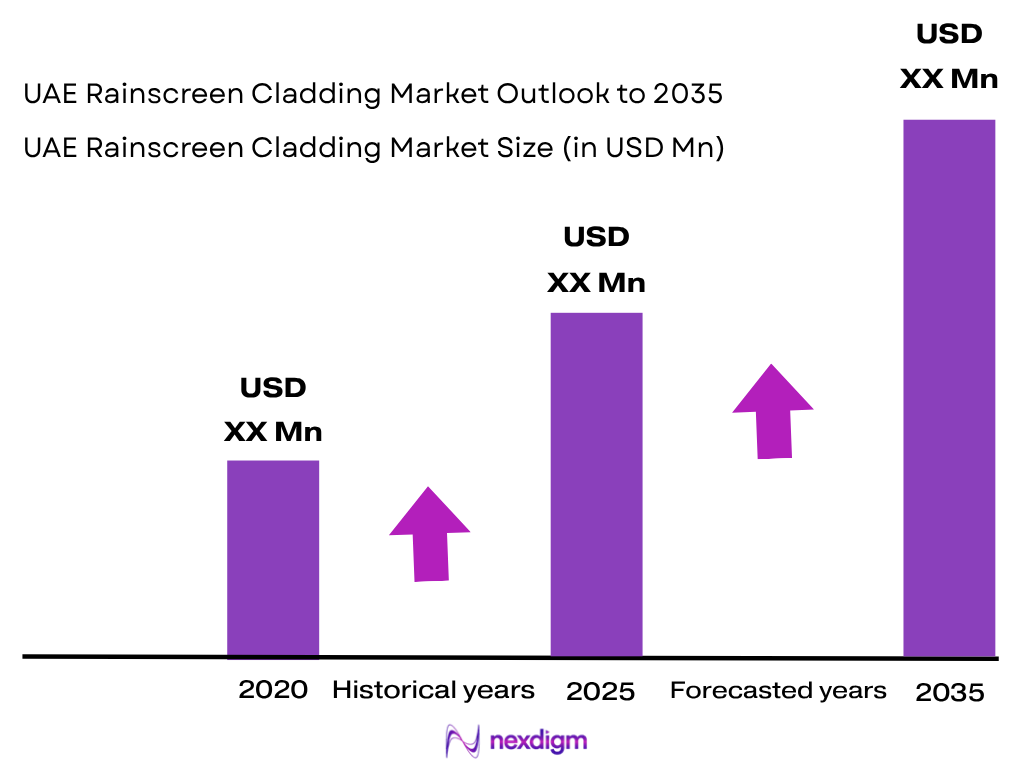
The UAE Rainscreen Cladding Market is valued at approximately ~USD XX million, supported by high-rise construction, hospitality development, façade remediation and sustainability regulations. Dubai’s construction economic activity increased from AED 25.98 billion in the preceding annual period to AED 26.79 billion in the latest period. UAE GDP simultaneously increased from approximately USD 522.62 billion to USD 552.32 billion, supporting continued capital deployment into residential, commercial and infrastructure assets.
Dubai and Abu Dhabi dominate UAE Rainscreen Cladding Market demand because they concentrate skyscrapers, hotels, mixed-use towers, government buildings and premium developments requiring fire-safe, thermally efficient façades. Dubai’s hotel inventory increased from 150,291 rooms across 821 establishments to 154,016 rooms across 832 establishments, while Abu Dhabi’s economy reached AED 1.2 trillion in the latest annual period. These construction-intensive urban economies sustain demand for aluminium, terracotta, fiber-cement and engineered rainscreen systems.
Market Segmentation
By Material Type
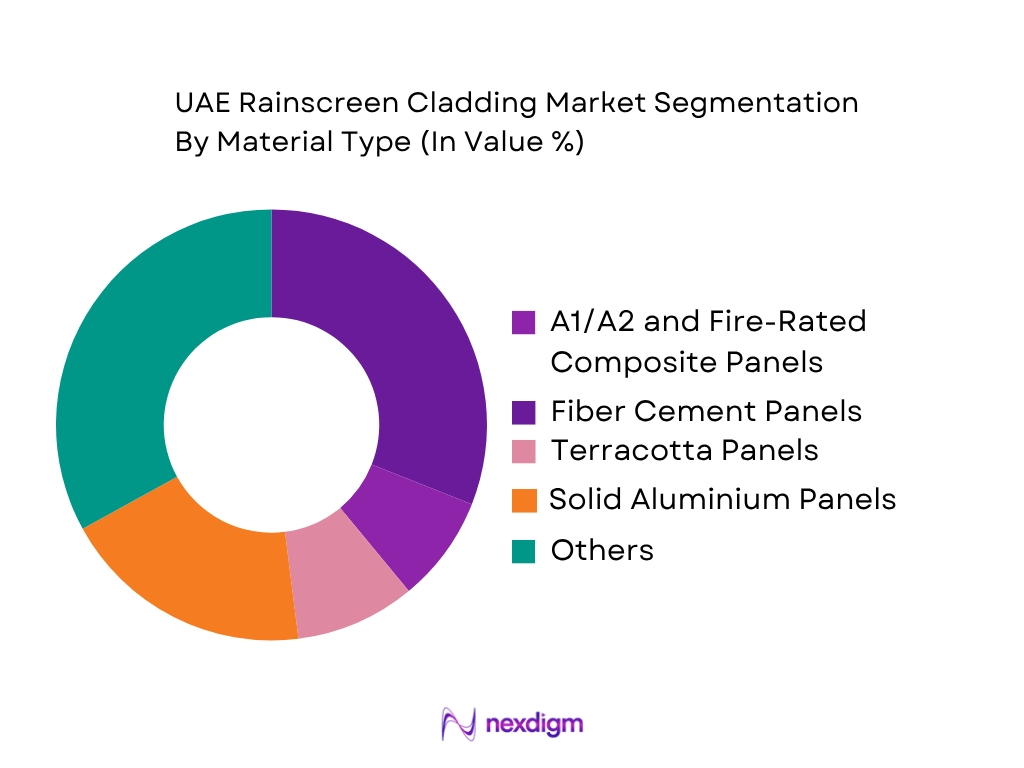
The UAE Rainscreen Cladding Market is segmented into aluminium composite panels, A1 and A2 fire-safe composite panels, solid aluminium panels, aluminium honeycomb panels, terracotta, fiber cement, HPL, natural stone, ceramic, perforated metal and other architectural cladding. Aluminium-based cladding holds the dominant modeled market share because the UAE has an established ecosystem covering aluminium production, extrusion, coil coating, ACP manufacture, CNC fabrication and high-rise façade installation. Aluminium suits UAE projects because its low dead load reduces substructure requirements, while PVDF and related coatings support durability under intense UV exposure. Fire-safety regulation has also shifted specifications toward A1, A2 and solid-metal solutions. Local production strengthens this position: Alubond’s UAE-linked manufacturing network includes integrated FR-core production and forms part of a global 25 million square metre processing platform. Its portfolio includes A1, A2, B-rated composite panels and solid aluminium suitable for high-rise envelope applications.
By Building Type
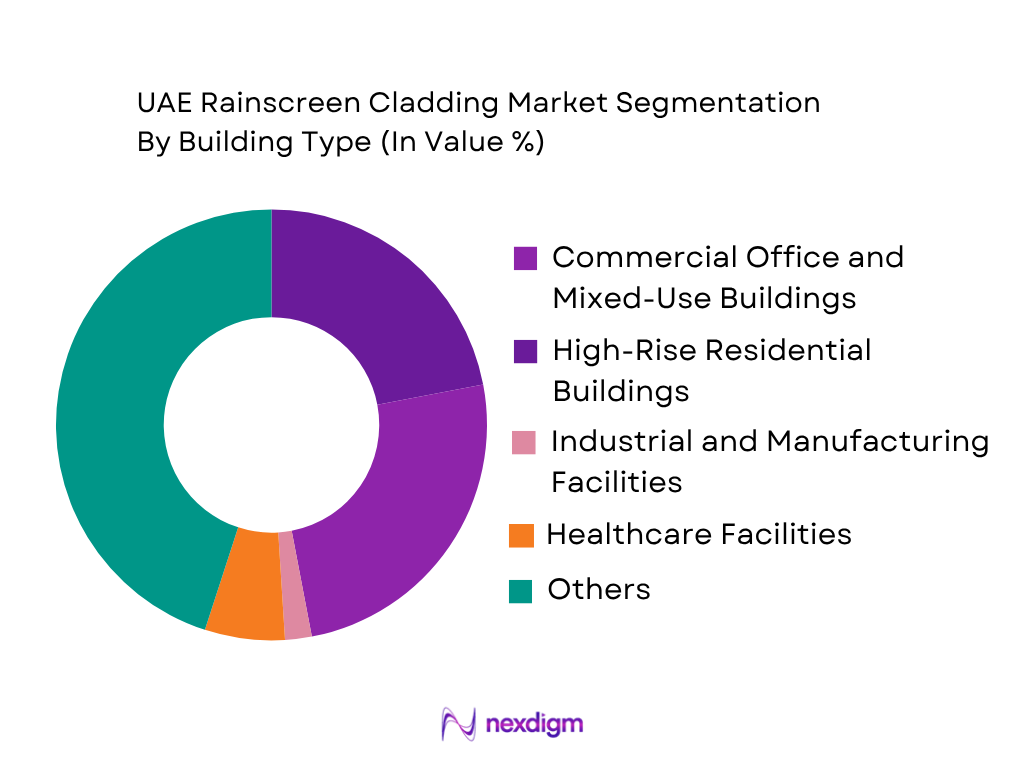
The UAE Rainscreen Cladding Market is segmented into high-rise residential towers, commercial offices, mixed-use developments, hotels and resorts, retail buildings, healthcare facilities, government buildings, data centres, transportation infrastructure and luxury residential properties. High-rise residential and mixed-use developments represent the dominant modeled demand cluster, reflecting the extensive tower stock of Dubai and Abu Dhabi and the requirement for lightweight façade systems that can accommodate wind pressure, thermal expansion and floor-to-floor movement. Premium tower projects also place significant emphasis on architectural differentiation, creating opportunities for cassette aluminium, perforated panels, natural stone and terracotta rainscreens. Dubai’s mandatory Al Sa’fat system requires all new buildings to achieve at least Silver Sa’fa compliance, encouraging building-envelope efficiency and integrated material selection. The system specifically addresses energy, water and material performance and has been mandatory across new-building categories, reinforcing demand for thermally optimized exterior-wall configurations.
Competitive Landscape
The UAE Rainscreen Cladding Market combines locally based ACP manufacturers, aluminium fabricators, large façade contractors and international architectural-material suppliers. Local production is particularly important in aluminium composite and solid-metal systems, while premium imported brands compete in fiber cement, HPL, terracotta and high-specification rainscreens. Competitive differentiation increasingly depends on UAE Civil Defence documentation, A1/A2 fire classifications, full-scale façade testing, high-rise engineering, local fabrication capacity, consultant specification relationships and the ability to withstand extreme heat and coastal exposure.
| Major Player | Establishment Year | Headquarters | Primary Rainscreen Offering | Fire-Safe Capability | Local Manufacturing / Fabrication | High-Rise Engineering | Technical Support | Sustainability / Envelope Positioning |
| Alubond U.S.A. / Mulk Holdings | 2004 UAE rights acquisition | Sharjah, UAE | ~ | ~ | ~ | ~ | ~ | ~ |
| Al Abbar Group | 1968 | Dubai, UAE | ~ | ~ | ~ | ~ | ~ | ~ |
| Gulf Extrusions | 1976 | Dubai, UAE | ~ | ~ | ~ | ~ | ~ | ~ |
| Etex / EQUITONE | 1905 | Zaventem, Belgium | ~ | ~ | ~ | ~ | ~ | ~ |
| FunderMax | 1890 | St. Veit/Glan, Austria | ~ | ~ | ~ | ~ | ~ | ~ |
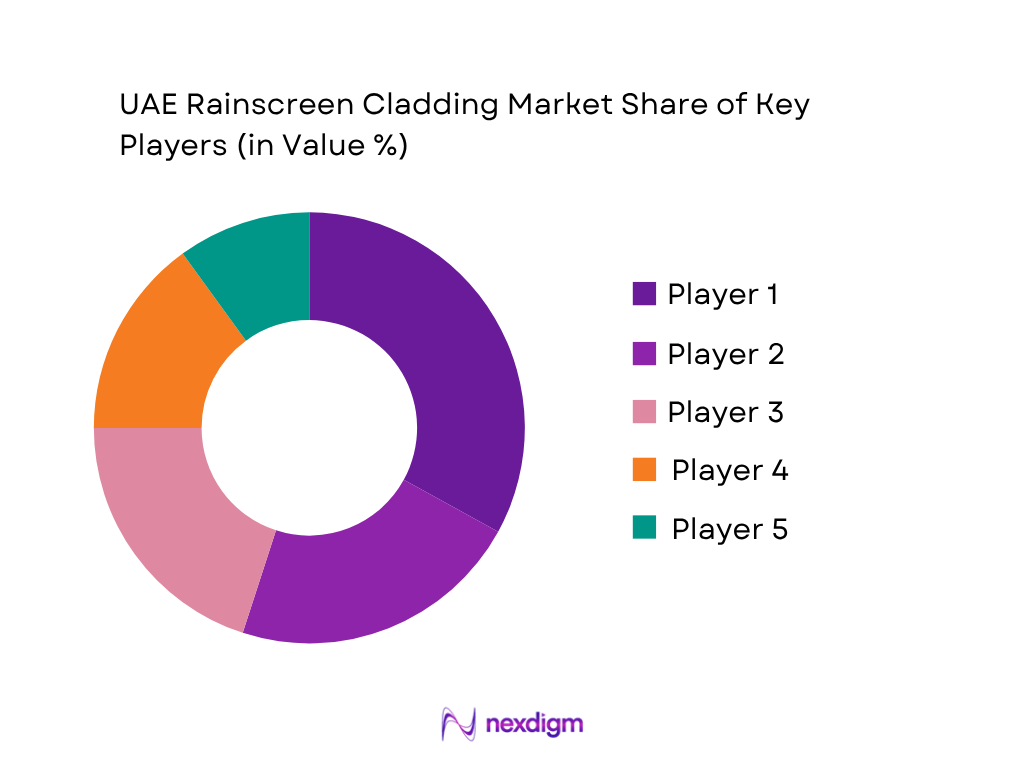
UAE Rainscreen Cladding Market Analysis
Growth Drivers
High-Rise, Hospitality and Luxury Real Estate Development
Dubai and Abu Dhabi’s concentration of high-rise residential, hospitality and mixed-use development is sustaining demand for fire-safe aluminium, terracotta, fiber-cement and engineered rainscreen systems. Statistics Centre – Abu Dhabi recorded AED 107.4 billion of construction-sector value added in 2024, while the Abu Dhabi Projects and Infrastructure Centre approved 144 projects with budgets of approximately AED 66 billion, including more than AED 59 billion for housing and public facilities. Hospitality construction adds another façade-intensive demand stream: the UAE Ministry of Economy and Tourism reported 1,251 hotels and 216,966 hotel rooms nationally in 2024. Dubai alone had 154,016 available rooms across 832 establishments, compared with 150,291 rooms across 821 establishments in the preceding period. High-rise and hospitality projects require lightweight cladding, wind-resistant substructures, solar-resistant finishes, cavity fire barriers and low-maintenance façade assemblies. World Bank data place UAE GDP at USD 552.32 billion and GDP per capita at USD 50,273.5 in 2024, while the Federal Competitiveness and Statistics Centre recorded a national population of 11.29 million. These fundamentals support continued premium building-envelope investment.
Commercial Asset Modernization and Infrastructure Construction
Commercial modernization and major infrastructure development are strengthening UAE rainscreen demand because new and upgraded buildings increasingly require integrated thermal, fire and durability performance rather than decorative panel installation alone. The Federal Competitiveness and Statistics Centre reported UAE real GDP of AED 1.776 trillion in 2024, including AED 1.342 trillion generated by non-oil activities. Abu Dhabi’s construction sector produced AED 107.4 billion of value added, while the Department of Municipalities and Transport completed AED 4 billion of key infrastructure projects during 2024 within broader initiatives exceeding AED 75 billion. Aviation infrastructure also remains façade-intensive: UAE airports handled 147.8 million passengers and more than 800,000 aircraft movements in 2024. Airports, terminals, office complexes and associated hospitality facilities require highly durable external envelopes capable of tolerating solar exposure, wind pressure, dust and intensive maintenance cycles. Dubai Municipality’s first-half 2025 inspections covered more than 18,800 buildings under construction representing over 36 million square metres, demonstrating the scale of the active building pipeline. World Bank figures of USD 552.32 billion GDP in 2024 reinforce the investment capacity supporting commercial and infrastructure-oriented façade projects.
Market Challenges
Civil Defence Approval and Fire-Test Documentation Complexity
Fire-safety approval creates a significant technical and administrative challenge for UAE rainscreen suppliers because cladding materials must be supported by product certification, testing documentation and system-level compatibility. Dubai Civil Defence introduced a major compliance change effective 1 January 2024, requiring the Emirates Safety Laboratory to evaluate Certificates of Conformity and issue conformity-assurance certification before product-approval applications. The requirement explicitly covers cladding materials and façade systems, as well as fire barriers, roofing systems and related fire-safety components. This means suppliers must coordinate panel classification, insulation, membranes, cavity barriers, fasteners and tested assemblies rather than relying only on individual material certificates. The compliance burden is substantial given Dubai’s building activity: Dubai Municipality conducted 25,000 construction-site inspections in the first half of 2025 across more than 18,800 buildings and 36 million square metres of construction area, while issuing 1,669 completion certificates, including 74 multi-storey buildings. World Bank data show UAE GDP at USD 552.32 billion and GDP per capita at USD 50,273.5 in 2024. Within this large construction economy, approval delays or incomplete fire documentation can materially disrupt façade procurement and installation sequencing.
Extreme Weather, Water Management and High-Rise Substructure Engineering
The UAE’s environmental conditions create difficult performance requirements for rainscreen cladding, particularly around drainage, fixing strength, corrosion resistance, thermal movement and weather-barrier continuity. The National Centre of Meteorology recorded 254.8 mm of rainfall at Khatm Al Shakla in Al Ain during the exceptional April 2024 storm, while Dubai recorded rainfall exceeding 220 mm in less than 24 hours. The federal government subsequently approved an AED 2 billion relief package addressing damage to citizens’ homes. These events demonstrate that UAE façade systems must accommodate not only prolonged heat and solar radiation but also intense short-duration rainfall and water pressure. Tall buildings further require carefully engineered aluminium or stainless-steel brackets, anchors, rails and movement joints to control panel deflection and prevent water ingress at open or closed joints. High construction volumes increase the execution challenge: more than 18,800 Dubai buildings representing 36 million square metres were under construction and inspected during the first half of 2025. World Bank data place UAE GDP at USD 552.32 billion in 2024, while FCSC reports a population of 11.29 million, underscoring the scale of high-value assets dependent on durable façade engineering.
Market Opportunities
A1/A2 Non-Combustible Systems and High-Rise Recladding
The transition toward higher fire-performance façades creates a strong future opportunity for A1 systems, A2 mineral-core panels, solid aluminium, terracotta and fiber-cement rainscreens. Dubai Civil Defence made Emirates Safety Laboratory conformity evaluation mandatory from 1 January 2024 for façade systems and cladding materials seeking product approval, strengthening the commercial importance of tested and traceable exterior-wall assemblies. The opportunity extends beyond new construction because the UAE contains a substantial stock of towers, hotels and mixed-use buildings requiring periodic façade modernization. The Ministry of Economy and Tourism recorded 1,251 hotels containing 216,966 rooms nationally in 2024, while Dubai alone operated 832 establishments containing 154,016 rooms. Dubai Municipality also issued 1,669 building completion certificates during the first half of 2025 and inspected more than 18,800 active buildings, indicating continual expansion of the future installed façade base. World Bank data place UAE GDP at USD 552.32 billion and GDP per capita at USD 50,273.5 in 2024. These current fundamentals create scope for suppliers offering complete fire-safe rainscreen packages comprising certified panels, mineral insulation, cavity barriers, brackets and engineered fixing systems.
Prefabricated Rainscreens, Local Substructures and High-Performance Building Envelopes
Local fabrication and prefabricated rainscreen systems represent an attractive future growth avenue as UAE construction moves toward faster project delivery, more controlled quality and stronger building-envelope integration. Dubai Municipality inspected more than 18,800 buildings under construction covering over 36 million square metres during the first half of 2025 and issued 1,669 completion certificates, of which 74 related to multi-storey buildings and 60 to industrial facilities. Abu Dhabi separately recorded AED 107.4 billion of construction-sector value added in 2024, while 144 infrastructure and development projects carrying approximately AED 66 billion of approved budgets broaden the addressable project base. This volume supports greater use of factory-fabricated cassettes, aluminium rails, thermally optimized brackets, stainless-steel fasteners and pre-engineered attachment kits that can improve consistency on complex high-rise projects. Localized production can also reduce project dependence on imported secondary components in a country where FCSC recorded AED 2.8 trillion of non-oil foreign trade during 2024. World Bank data show UAE GDP at USD 552.32 billion and GDP per capita of USD 50,273.5, providing strong economic foundations for higher-specification façades combining prefabrication, fire safety, thermal control and replaceable cladding modules.
Future Outlook
The UAE Rainscreen Cladding Market is forecast to expand at approximately ~X.X% CAGR during 2026–2035, supported by high-rise development, hospitality investment, façade replacement, stricter fire-safety requirements and sustainable building regulations. The market is expected to shift further from basic decorative ACP toward tested exterior-wall systems combining fire-safe cladding, non-combustible insulation, engineered substructures and high-performance coatings.
Major Players
- Alubond U.S.A. / Mulk Holdings
- ALUCOPANEL
- ALCOBOND
- 3A Composites / ALUCOBOND
- Al Abbar Group
- White Aluminium Enterprises
- Gulf Extrusions
- EQUITONE / Etex
- FunderMax
- Trespa International
- ROCKWOOL Middle East
- Kingspan Insulated Panels
- SFS Middle East
- Hilti Emirates
- Al Ghurair Construction Aluminium
Key Target Audience
- Rainscreen Cladding and Architectural Panel Manufacturers
- Aluminium Composite Panel and Solid Aluminium Manufacturers
- Facade Contractors, Fabricators and System Integrators
- Property Developers and Commercial Real Estate Owners
- Hospitality and Mixed-Use Development Companies
- Main Contractors and EPC Companies
- Investments and Venture Capitalist Firms
- Government and Regulatory Bodies (Dubai Municipality, Dubai Civil Defence, Abu Dhabi Civil Defence Authority, Department of Municipalities and Transport, Dubai Central Laboratory, Ministry of Energy and Infrastructure)
Research Methodology
Step 1: Identification of Key Variables
The initial phase involves constructing an ecosystem map of the UAE Rainscreen Cladding Market covering cladding manufacturers, aluminium extruders, insulation suppliers, façade contractors, developers, architects and regulatory authorities. Secondary research identifies critical variables including installed façade area, fire classification, high-rise exposure, building type, material mix, recladding activity, thermal performance and emirate-level construction demand.
Step 2: Market Analysis and Construction
Historical market demand is evaluated through combined top-down and bottom-up analysis. Top-down analysis examines UAE construction activity, real-estate development, hotel inventory, high-rise construction and sustainability regulations. Bottom-up analysis maps representative building footprints, elevations and façade areas against material penetration, attachment configuration, insulation use and typical rainscreen system requirements.
Step 3: Hypothesis Validation and Expert Consultation
Market hypotheses are validated through CATI interviews and direct consultations with cladding manufacturers, façade contractors, architects, developers, fire consultants and distributors. These interactions validate A1/A2 adoption, recladding demand, high-rise engineering practices, Civil Defence documentation, material substitution, local manufacturing penetration, installation constraints and consultant-driven specification patterns.
Step 4: Research Synthesis and Final Output
The final phase triangulates UAE government statistics, authority regulations, company disclosures, construction indicators and primary research. Supplier-level findings are reconciled with project-level façade-area calculations and top-down building activity. The final model evaluates material shares, building applications, emirate demand, competitive positioning, fire-remediation requirements and opportunities in new-build and existing-building rainscreens.

- Executive Summary
- Research Methodology (Market Definitions and Assumptions, UAE Rainscreen Cladding Market Classification, Building-Envelope Scope, Ventilated Facade Mapping, Pressure-Equalized Rainscreen Assessment, Open-Joint Rainscreen Assessment, Closed-Joint Rainscreen Assessment, ACP Assessment, A1 and A2 Composite Panel Assessment, Solid Aluminium Assessment, Terracotta Assessment, Fiber Cement Assessment, HPL Assessment, Natural Stone Assessment, Ceramic Assessment, Metal Panel Assessment, Substructure Assessment, Fastener and Anchor Assessment, Exterior Insulation Assessment, Air-Water Barrier Assessment, Fire-Performance Assessment, NFPA 285 Assessment, BS 8414 Assessment, EN 13501 Assessment, Wind-Load Assessment, Coastal Corrosion Assessment, Thermal Performance Assessment, Solar-Heat Assessment, Al Sa’fat Compliance Assessment, Estidama Assessment, Supply-Side Assessment, Demand-Side Assessment, Top-Down Market Sizing, Bottom-Up Market Sizing, Primary Industry Interviews, Construction Pipeline Mapping, Recladding Pipeline Assessment, Data Triangulation, Forecasting Framework)

- Definition and Scope
- UAE Building-Envelope Industry Evolution and Development of Ventilated Rainscreen Facades, Aluminium Composite Panel Facades, Fire-Rated ACP, A1 Non-Combustible Composite Panels, A2 Mineral-Core Composite Panels, Solid Aluminium Facades, Terracotta Rainscreens, Fiber Cement Facades, HPL Cladding, Natural Stone Rainscreens, Ceramic Facades, Insulated Metal Panels, Expanded and Perforated Metal Facades, Mashrabiya-Inspired Screens, Thermally Optimized Substructures, Prefabricated Facades, High-Rise Recladding Systems, Sustainable Building Envelopes
- Rainscreen Cladding Value Chain Analysis
- Rainscreen Cladding Supply Chain Analysis

- Growth Drivers (Dubai and Abu Dhabi High-Rise Development, Hospitality and Luxury Real Estate Construction, Al Sa’fat Compliance, Estidama Requirements, Fire-Safe Facade Replacement, Commercial Asset Modernization, Data Centre Construction, Airport Development, Domestic ACP Manufacturing, Premium Architectural Facades)
- Market Challenges (Civil Defence Approval Complexity, Fire-Test Documentation, Existing Combustible ACP Stock, Skilled Facade Installer Availability, High-Rise Access Requirements, Substructure Engineering Complexity, Coastal Corrosion, Extreme Heat and UV Exposure, Wind-Load Requirements, Imported Premium Material Dependence)
- Market Opportunities (A1 Non-Combustible ACP, A2 Mineral-Core ACP, High-Rise Recladding, Thermally Broken Rainscreens, Hospitality Facade Renovation, Data Centre Building Envelopes, Terracotta and Fiber Cement Facades, Prefabricated Rainscreen Panels, Low-Carbon Aluminium, Locally Manufactured Substructures)
- Market Trends (Transition from PE-Core ACP to Fire-Safe Systems, A1 and A2 Panel Adoption, Solid Aluminium Cladding, Large-Format Panels, Perforated Mashrabiya Facades, Terracotta Rainscreens, Concealed Fixing, Thermally Optimized Brackets, BIM-Based Facade Engineering, Prefabricated Cassette Panels, Low-Carbon Aluminium, Circular Facade Systems)
- Government Regulations and Standards (UAE Fire and Life Safety Code of Practice, Dubai Building Code, Dubai Civil Defence Facade Requirements, Abu Dhabi Civil Defence Requirements, Al Sa’fat Green Building System, Estidama Pearl Building Rating System, NFPA 285 Exterior Wall Assembly Testing, BS 8414 Facade Fire Testing, EN 13501 Fire Classification, ASTM E84 Surface Burning, Wind-Load Requirements, Dubai Central Laboratory Product Certification)
- SWOT Analysis
- Porter’s Five Forces Analysis
- PESTLE Analysis

- By Market Value (2020-2025)
- By Installed Rainscreen Cladding Area (2020-2025)
- By ACP and Composite Panel Installation Area (2020-2025)
- By A1 and A2 Fire-Safe Composite Panel Installation Area (2020-2025)
- By Solid Aluminium Cladding Installation Area (2020-2025)
- By Terracotta Rainscreen Installation Area (2020-2025)
- By Fiber Cement Rainscreen Installation Area (2020-2025)

- By Material Type (In Value %)
Aluminium Composite Panels
A2 Mineral-Core Composite Panels
Fire-Retardant ACP
Terracotta Panels
Fiber Cement Panels
High-Pressure Laminate Panels
Natural Stone Panels
Ceramic and Porcelain Panels
Steel and Zinc Panels
Expanded and Perforated Aluminium Panels
GFRC and UHPC Panels
Other Architectural Rainscreen Materials - By Fire Classification (In Value %)
A1 Non-Combustible Cladding Systems
A2-s1,d0 Cladding Systems
Fire-Retardant Mineral-Core ACP Systems
Solid Metal Non-Combustible Systems
Fiber Cement Non-Combustible Systems
Terracotta Non-Combustible Systems
Stone and Ceramic Systems
Other Approved Fire-Performance Systems - By Rainscreen Configuration (In Value %)
Open-Joint Ventilated Rainscreens
Closed-Joint Rainscreens
Pressure-Equalized Rainscreens
Drained and Back-Ventilated Systems
Cassette Panel Systems
Tray Panel Systems
Clip-and-Rail Systems
Concealed-Fix Systems
Large-Format Panel Systems
Prefabricated Rainscreen Assemblies - By Application (In Value %)
New Building Construction
Existing-Building Recladding
Fire-Safety Facade Replacement
Energy-Efficiency Retrofit
Facade Modernization
Water-Ingress Remediation
Thermal Insulation Upgrade
High-Rise Envelope Upgrade
Hospitality Refurbishment
Commercial Asset Repositioning - By Building Type (In Value %)
High-Rise Residential Towers
Commercial Office Towers
Mixed-Use Developments
Healthcare Facilities
Government and Civic Buildings
Airports and Transportation Buildings
Data Centres
Industrial and Logistics Buildings
Luxury Villas and Low-Rise Premium Residential
Cultural and Landmark Buildings

- Market Share of Major Players (By UAE Revenue, Installed Area, ACP Volume, A1/A2 Panel Volume, Solid Aluminium Portfolio, High-Rise Project Presence, Recladding Projects, Hospitality Projects, Emirate Coverage, Local Manufacturing, Fabrication Capability, Technical Support, Fire-Test Portfolio, Consultant Specification Presence)
- Cross Comparison Parameters (A1/A2 and Fire-Safe Cladding Portfolio Breadth, UAE Civil Defence and Full-Scale Fire-Test Documentation Capability, Local Manufacturing and Fabrication Capacity, High-Rise Wind-Load and Substructure Engineering Capability, Al Sa’fat and Estidama Building-Envelope Compatibility, UAE-Wide Contractor and Distributor Network, Recladding and Fire-Remediation Project Capability, Extreme-Heat and Coastal-Corrosion Performance Capability)
- SWOT Analysis of Major Players (Manufacturing Scale, Fire Certification, High-Rise References, Product Breadth, Engineering Support, Distribution Reach, Localisation, Sustainability)
- Detailed Profiles of Major Companies
Alubond U.S.A. / Mulk Holdings
ALUCOPANEL
ALCOBOND
3A Composites / ALUCOBOND
Al Abbar Group
White Aluminium Enterprises
Gulf Extrusions
EQUITONE / Etex
FunderMax
Trespa International
ROCKWOOL Middle East
Kingspan Insulated Panels
SFS Middle East
Hilti Emirates
Al Ghurair Construction Aluminium

- Developer Facade Requirement Assessment
- Facade Consultant Specification Assessment
- Main Contractor Procurement Assessment
- Facade Contractor Product Preference Assessment
- Hospitality Developer Requirement Assessment
- Government Procurement Assessment
- Civil Defence Approval Decision Factors
- Fire-Rating Decision Factors
- Thermal Performance Decision Factors

- By Market Value (2026-2035)
- By Installed Rainscreen Cladding Area (2026-2035)
- By ACP and Composite Panel Installation Area (2026-2035)
- By A1 and A2 Fire-Safe Composite Panel Installation Area (2026-2035)
- By Solid Aluminium Cladding Installation Area (2026-2035)
- By Terracotta Rainscreen Installation Area (2026-2035)
- By Fiber Cement Rainscreen Installation Area (2026-2035)


 Request a Sample
 Ask for Customization
 Get a Quote
 Enquire Now