
 Download PDF
Market Overview
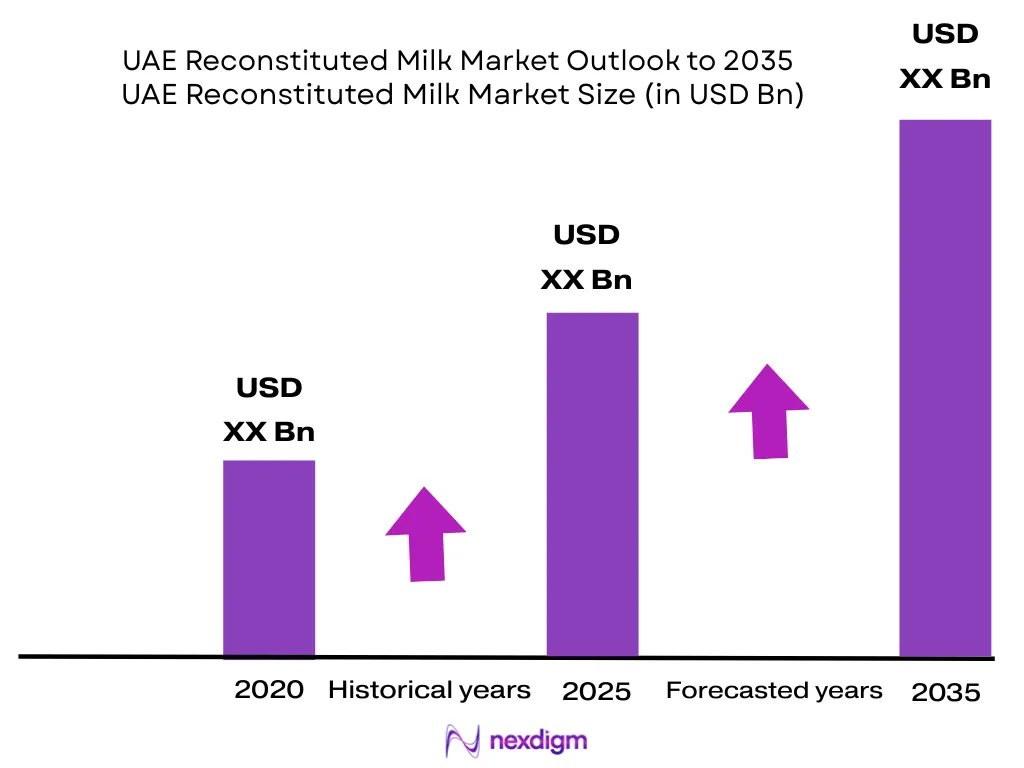
The UAE Reconstituted Milk Market is valued at USD ~ billion, based on the published UAE reconstituted milk trajectory. Demand is driven by imported milk powder, recombined dairy, UHT milk, long-life milk, flavoured milk, hospitality consumption and foodservice dairy bases. The earlier published base stood at USD 2.74 billion, while UAE consumer-oriented food imports reached USD 16.2 billion, reflecting the import-reliant food system supporting dairy formulation.
Dubai, Abu Dhabi and Sharjah dominate the UAE Reconstituted Milk Market because they combine modern retail concentration, hospitality demand, foodservice distribution, imported dairy warehousing, domestic dairy farms and institutional consumption. Dubai leads through hotels, cafés, airline catering, Jebel Ali logistics and premium supermarkets. Abu Dhabi supports local dairy production, government procurement and institutional catering, while Sharjah connects residential demand, value retail and food-manufacturing distribution corridors.
Market Segmentation
By Source
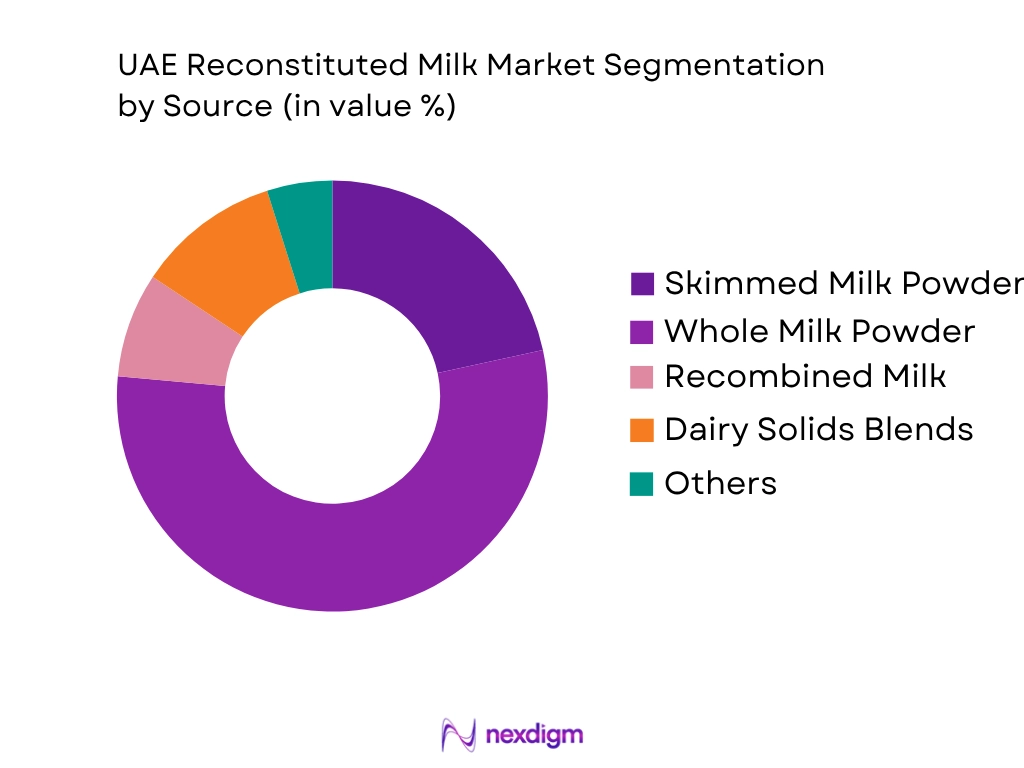
UAE Reconstituted Milk Market is segmented by source into whole milk powder based reconstituted milk, skim milk powder based reconstituted milk, recombined milk with butterfat or cream, whey and lactose dairy solids blends, and milk protein concentrate based reconstituted milk. Whole milk powder based reconstituted milk holds the dominant market share because the UAE’s dairy system depends heavily on imported dairy solids and long-life milk formats. Whole milk powder gives processors a fat-containing base suitable for UHT milk, flavoured milk, laban-style beverages, hotel breakfast dairy, bakery fillings and family dairy packs. It is especially relevant in a desert-climate country where domestic raw milk production is structurally limited and imported dairy ingredients help maintain year-round supply. The segment also benefits from expatriate households, modern retail chains and hospitality buyers that require consistent taste, shelf life and product availability.
By Application
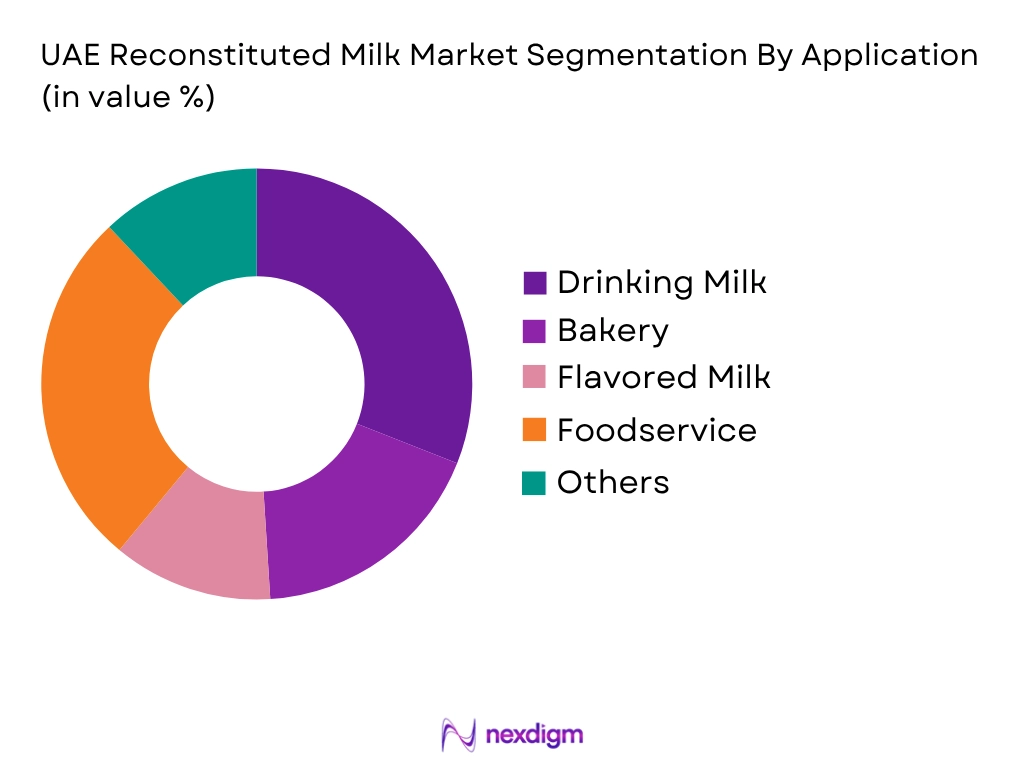
UAE Reconstituted Milk Market is segmented by application into UHT and long-life drinking milk, foodservice and hospitality milk bases, flavoured milk and dairy beverages, bakery, confectionery and dessert manufacturing, institutional and labour accommodation supply, and household milk powder reconstitution. UHT and long-life drinking milk dominates the market because it fits UAE household storage habits, hot-climate distribution needs and supermarket inventory models. Reconstituted milk allows processors to use imported powder, butterfat and dairy solids to manufacture shelf-stable milk with consistent fat, protein and flavour performance. The segment is also supported by the UAE’s expatriate-heavy population, which creates demand for multiple dairy formats across full-cream, low-fat, fortified, lactose-free and flavoured variants. Long-life formats are commercially important for hypermarkets, baqala stores, e-commerce grocery, hotel kitchens, labour accommodations and institutional catering because they reduce spoilage and simplify stock management.
Competitive Landscape
The UAE Reconstituted Milk Market is moderately consolidated, led by domestic dairy farms, GCC dairy players, long-life milk specialists, imported dairy brands and foodservice ingredient suppliers. Al Ain Farms, Al Rawabi Dairy, Marmum Dairy Farm, NFPC/Lacnor and Almarai are among the key players because they combine dairy processing, UHT capability, strong distribution, hospitality supply and brand recognition. Competition is shaped by imported milk powder access, domestic farm integration, halal compliance, supermarket listing strength, foodservice reach, functional dairy portfolios and temperature-resilient logistics.
| Company | Establishment Year | Headquarters | Imported Powder Access | Domestic Farm Integration | UHT / Aseptic Capability | Key Product Exposure | Channel Strength | Strategic Positioning |
| Al Ain Farms | 1981 | Al Ain, UAE | ~ | ~ | ~ | ~ | ~ | ~ |
| Al Rawabi Dairy | 1989 | Dubai, UAE | ~ | ~ | ~ | ~ | ~ | ~ |
| Marmum Dairy Farm | 1984 | Dubai, UAE | ~ | ~ | ~ | ~ | ~ | ~ |
| NFPC / Lacnor | 1971 | Abu Dhabi, UAE | ~ | ~ | ~ | ~ | ~ | ~ |
| Almarai | 1977 | Riyadh, Saudi Arabia | ~ | ~ | ~ | ~ | ~ | ~ |
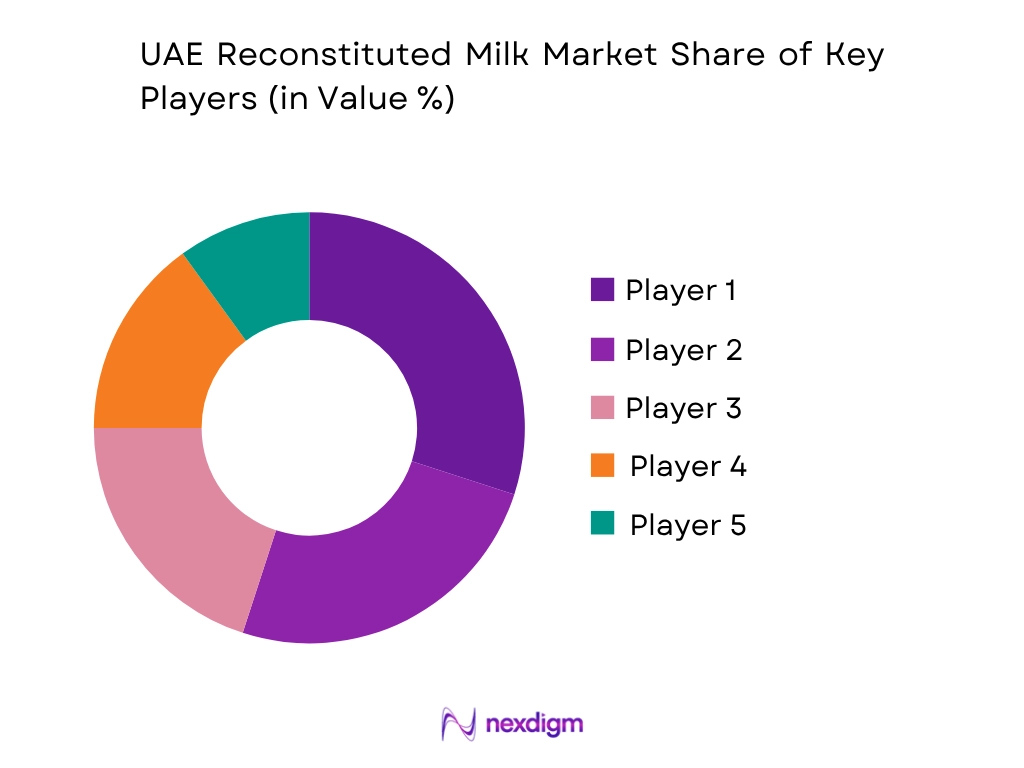
UAE Reconstituted Milk Market Analysis
Growth Drivers
Import-Reliant Dairy Ingredient Base Supports Reconstituted Milk Production
UAE Reconstituted Milk Market is supported by the country’s reliance on imported food and dairy ingredients, which makes whole milk powder, skim milk powder and dairy solids important for UHT milk, recombined milk, flavoured dairy, bakery ingredients and foodservice milk bases. USDA FAS reports that more than 570 food and beverage processors operate in the UAE and produce 5.96 million metric tons annually, while the country imported USD 2.0 billion of dairy products within consumer-oriented imports in 2024. World Bank records UAE GDP at USD 552.32 billion and GDP per capita at USD 50,273.5 in 2024, supporting strong retail, household and institutional dairy consumption.
Hospitality, Foodservice and Transit Demand Strengthen Bulk Dairy Use
UAE Reconstituted Milk Market is driven by hotels, cafés, airline catering, institutional kitchens and QSRs, where reconstituted milk supports bulk dairy consistency across coffee, desserts, breakfast buffets, sauces, bakery and flavoured beverages. USDA FAS reports UAE food industry channel values of USD 17.9 billion for foodservice-HRI and USD 7.6 billion for food processing in 2024, while Dubai’s official tourism report records 18.72 million international visitors in 2024. Dubai International Airport also handled 92 million passengers in 2024, increasing catering and transit-linked dairy requirements. World Bank records UAE GDP growth at 4.0 in 2024, supporting demand across hospitality and foodservice outlets.
Market Challenges
Imported Milk Powder Exposure Creates Supply-Reliability Risk
UAE Reconstituted Milk Market faces sourcing risk because milk powder is a core input for reconstituted milk, recombined dairy, UHT milk and foodservice dairy bases. World Bank WITS shows that low-fat solid milk and cream exports to the UAE included 21,226,800 kg from the European Union, 8,994,030 kg from New Zealand, 5,631,280 kg from France, 4,569,100 kg from Belgium and 2,431,020 kg from Saudi Arabia in 2024. USDA FAS also states that approximately 80 percent of UAE agricultural products are imported. This import structure exposes processors to shipping, documentation, supplier concentration and border-clearance risks. World Bank records UAE population growth at 4.7 in 2024, adding demand pressure to imported ingredient supply chains.
Specialized Labelling and Shelf-Life Rules Increase Compliance Burden
UAE Reconstituted Milk Market faces operating complexity because reconstituted and recombined dairy products must comply with ingredient declaration, Arabic labelling, halal documentation, shelf-life validation and emirate-level food control requirements. USDA FAS identifies “specialized labeling and restrictive shelf-life requirements” as a weakness for the UAE food sector, directly relevant for UHT milk, milk powder blends, fortified dairy and flavoured reconstituted beverages. The same report notes over 570 food and beverage processors and USD 16.2 billion in consumer-oriented agricultural imports in 2024, which increases product-registration and border-control workload. World Bank records UAE inflation at 1.7 in 2024, limiting scope for processors to absorb avoidable compliance inefficiencies through higher consumer prices.
Market Opportunities
Private-Label UHT and Long-Life Milk Can Scale Through Modern Retail
UAE Reconstituted Milk Market has an opportunity in private-label UHT and long-life dairy because imported milk powder can be converted into shelf-stable cartons for hypermarkets, supermarkets, e-commerce and neighbourhood grocery channels. USDA FAS reports UAE retail food industry value of USD 18.1 billion, food e-commerce retail sales of USD 1.08 billion, and food and grocery retail revenue of USD 38.84 billion in the latest reported retail base. The same source lists Carrefour, Lulu Hypermarket, Nesto Hypermarket, Union Co-operative Society, Abu Dhabi Co-operative Society and Sharjah Co-operative Society as leading retailers. World Bank records UAE GDP per capita at USD 50,273.5, supporting premium, value and family-pack dairy formats.
B2B Dairy Bases Can Expand in Food Processing, Bakery and Catering
UAE Reconstituted Milk Market has an opportunity in B2B dairy ingredients because reconstituted milk can serve bakeries, confectionery, desserts, ready meals, coffee chains, hotel kitchens, airline catering and labour accommodation caterers. USDA FAS reports more than 570 food and beverage processors producing 5.96 million metric tons annually, with 2.3 million metric tons classified as staple foods in an earlier foodservice base. The 2024 food-processing channel is reported at USD 7.6 billion, while foodservice-HRI is USD 17.9 billion, giving powder-based milk bases multiple institutional and commercial uses. World Bank records UAE GDP at USD 552.32 billion in 2024, supporting investment in processed foods, hospitality kitchens and chilled-plus-ambient dairy distribution.
Future Outlook
The UAE Reconstituted Milk Market is expected to grow at a forecast benchmark CAGR of 8.4% during the 2026–2035 period, supported by imported milk powder availability, UHT milk consumption, hospitality demand, foodservice expansion, functional dairy and private-label long-life milk. The country’s limited raw milk base, hot climate and high reliance on food imports make reconstituted and recombined dairy structurally important for food security and year-round supply. Over the next decade, processors are expected to invest in imported dairy ingredient procurement, aseptic packaging, domestic farm integration, halal-certified formulations, fortified milk, lactose-free products, high-protein milk and foodservice bulk packs. Dubai will remain the strongest commercial hub due to tourism, hotels, airline catering and modern trade. Abu Dhabi will remain important through domestic dairy farms, institutional procurement and government-linked food security strategies. Sharjah and the Northern Emirates will support value retail, household dairy and long-life milk consumption.
Major Players
- Al Ain Farms
- Al Rawabi Dairy
- Marmum Dairy Farm
- National Food Products Company / Lacnor
- Agthia Group
- Emirates Rawabi
- Gulf and Safa Dairies
- Hayatna
- Almarai
- Baladna
- Arla Foods
- FrieslandCampina
- Nestlé Middle East
- Danone Middle East
- Fonterra
Key Target Audience
- Dairy processors and UHT milk manufacturers
- Milk powder importers and dairy ingredient suppliers
- Long-life milk and aseptic packaging companies
- Food and beverage processing companies
- Hypermarket, supermarket and e-commerce retail chains
- Hospitality, airline catering and foodservice procurement teams
- Investments and venture capitalist firms
- Government and regulatory bodies (Ministry of Climate Change and Environment, Ministry of Industry and Advanced Technology, Dubai Municipality, Abu Dhabi Agriculture and Food Safety Authority, Emirates Authority for Standardization and Metrology legacy standards system, UAE Halal certification authorities)
Research Methodology
Step 1: Identification of Key Variables
The initial phase involves mapping the UAE Reconstituted Milk Market ecosystem, covering milk powder importers, domestic dairy farms, UHT processors, aseptic packaging suppliers, retailers, hotels, caterers, institutional buyers and regulators. Key variables include imported powder dependence, domestic milk availability, UHT demand, halal compliance, hospitality consumption and retail channel penetration.
Step 2: Market Analysis and Construction
This phase compiles data on dairy imports, food processing, long-life milk demand, modern retail distribution, hospitality consumption, institutional procurement and company portfolios. The market is constructed using top-down dairy demand assessment and bottom-up modelling based on powder-to-liquid conversion, processor capability, application use and channel movement.
Step 3: Hypothesis Validation and Expert Consultation
Market hypotheses are validated through structured interviews with dairy processors, ingredient importers, retail category managers, foodservice distributors, hotel procurement teams, catering companies and packaging suppliers. These consultations help refine source mix, channel demand, imported powder usage, UHT adoption, halal requirements and application-level market assumptions.
Step 4: Research Synthesis and Final Output
The final phase integrates secondary data, primary validation, company benchmarking and segment-level triangulation. The final output is cross-checked against UAE-specific reconstituted milk values, dairy import context, processor portfolios, channel dynamics, regulatory requirements and commercial use cases to build a reliable assessment of the UAE Reconstituted Milk Market.

- Executive Summary
- Research Methodology (Market definitions and assumptions, reconstituted milk classification, recombined milk scope, whole milk powder and skim milk powder inclusion, powder-to-liquid conversion, fluid milk equivalent calculation, UAE import-dependence adjustment, domestic dairy production validation, top-down dairy balance sheet approach, bottom-up processor and SKU analysis, interviews with dairy processors and importers, foodservice distributor checks, retail audit, institutional demand validation, limitations and forecast framework)

- Definition and Scope
- Market Genesis and Evolution
- Role of Reconstituted Milk in the UAE Dairy Industry
- Business Cycle and Seasonality
- Supply Chain and Value Chain Analysis

- Growth Drivers (Food import dependence, hospitality expansion, UHT milk demand, retail modernization, expatriate demographics, domestic dairy processing investments, functional dairy demand)
- Market Challenges (Import exposure, freight disruption, domestic raw milk limitations, high operating costs, temperature-sensitive logistics, product identity and labelling compliance, plant-based alternatives)
- Opportunities (Private-label UHT milk, fortified dairy, lactose-free milk, high-protein milk, hospitality dairy bases, labour accommodation bulk formats, B2B bakery ingredients)
- Trends (Aseptic packaging, protein-enriched dairy, lactose-free milk, date-flavoured milk, camel milk premiumisation, e-commerce grocery, halal-certified dairy imports, sustainable packaging)
- SWOT Analysis
- PESTLE Analysis
- Porter’s Five Forces

- By Value (2020-2025)
- By Volume (2020-2025)
- By Average Realization Price (2020-2025)

- By Product Type (In Value %)
Whole Reconstituted Milk
Skimmed Reconstituted Milk
Recombined Milk
Fortified Reconstituted Milk
Lactose-Free Reconstituted Milk - By Distribution Channel (In Value %)
Hypermarkets and Supermarkets
Convenience Stores and Petrol-Station Retail
Traditional Grocery and Baqala Stores
E-Commerce and Quick Commerce
Foodservice Distribution
Institutional Tender Supply - By End User (In Value %)
Households
Expatriate Families
Hotels, Restaurants and Catering
Cafés and Coffee Chains
Food and Beverage Manufacturers - By Emirate (In Value %)
Dubai
Abu Dhabi
Sharjah
Ajman
Ras Al Khaimah

- Market Share of Major Players (Value share, volume share, liquid milk-equivalent share, powder-equivalent share, long-life milk-linked share)
- Cross Comparison Parameters (Imported milk powder sourcing model, domestic dairy farm integration, UHT and aseptic processing capability, halal and UAE.S compliance strength, modern retail and private-label exposure, foodservice and hospitality channel strength, functional and lactose-free dairy portfolio, cold-chain and dry-storage network)
- SWOT Analysis of Major Players
- SKU and Price Benchmarking
- Detailed Profiles of Major Companies
Al Ain Farms
Al Rawabi Dairy
Marmum Dairy Farm
National Food Products Company / Lacnor
Agthia Group
Emirates Rawabi
Gulf and Safa Dairies
Hayatna
Almarai
Baladna
Arla Foods
FrieslandCampina
Nestlé Middle East
Danone Middle East
Fonterra

- Household Consumer Analysis
- Hospitality and Foodservice Operator Analysis
- Retail Buyer Analysis
- Institutional Buyer Analysis
- Food Manufacturer Analysis

- By Value (2026-2035)
- By Volume (2026-2035)
- By Average Realization Price (2026-2035)


 Request a Sample
 Ask for Customization
 Get a Quote
 Enquire Now