
 Download PDF
Market Overview
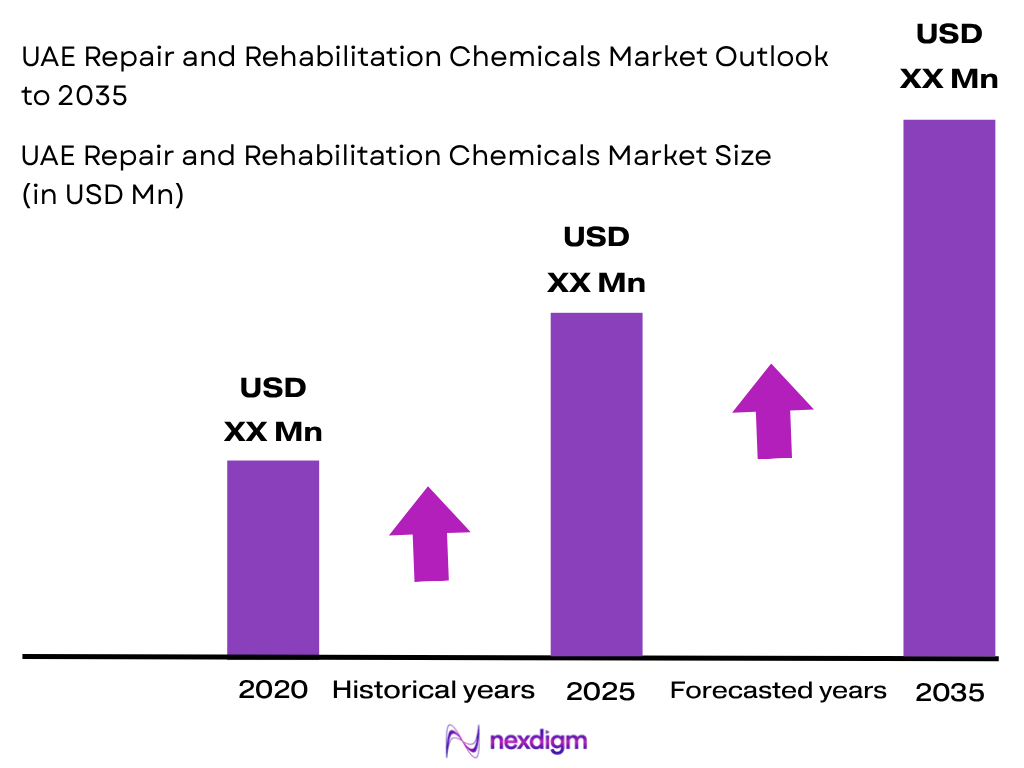
The UAE Repair and Rehabilitation Chemicals Market is valued at approximately ~USD XX million, supported by an expanding concrete asset base and recurring maintenance of towers, transport structures, utilities and marine infrastructure. Dubai construction value added increased from AED27.09 billion in the preceding period to AED27.69 billion in the latest period, while buildings under construction increased from 15,722 to 18,114, expanding future requirements for repair mortars, injection systems and protective treatments.
Dubai and Abu Dhabi dominate UAE Repair and Rehabilitation Chemicals demand because they combine dense building stocks, major transport assets, marine exposure and utility infrastructure. Abu Dhabi’s building inventory increased from approximately 281,780 to 299,360 buildings, alongside 783,970 real-estate units in the latest period. Dubai simultaneously recorded 18,114 buildings under construction, compared with 15,722 previously, reinforcing future rehabilitation requirements across towers, parking structures, podiums, industrial facilities and infrastructure.
Market Segmentation
By Product Type
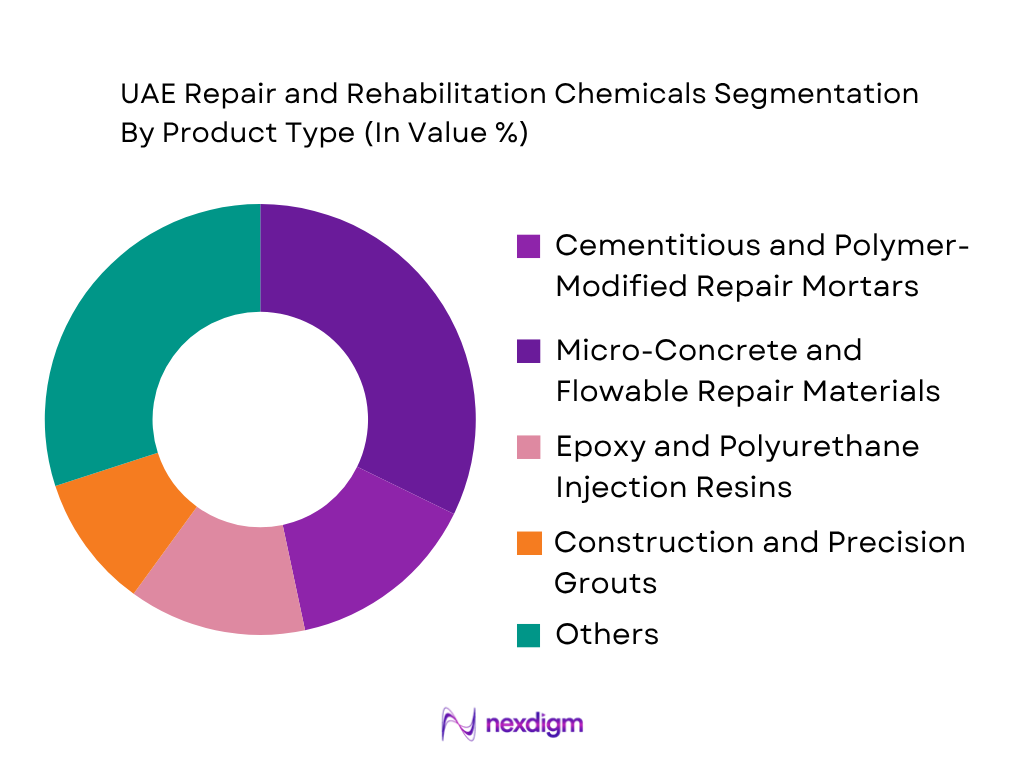
By Product Type: The UAE Repair and Rehabilitation Chemicals Market is segmented into cementitious and polymer-modified repair mortars, sulfate- and chloride-resistant repair systems, flowable micro-concrete, epoxy and polyurethane injection products, non-shrink and precision grouts, corrosion-protection systems, protective coatings, CFRP strengthening materials and waterproofing rehabilitation chemicals. Cementitious and polymer-modified repair mortars hold the dominant position because reinforced-concrete towers, parking structures, podiums, bridges and utility assets require recurring spalling repair and section reinstatement under harsh thermal and saline exposure. The UAE’s coastal environment further increases the importance of chloride-resistant formulations, reinforcement passivation and low-permeability repair systems. Abu Dhabi alone contained 299,360 buildings in the latest census, including 12,170 high-rise buildings, while Dubai had 18,114 buildings under construction, creating a continuously expanding future maintenance base. High-flow micro-concrete is also widely applicable to columns, beams and difficult-to-access structural repairs where conventional hand-applied mortars are insufficient.
By Repair Application
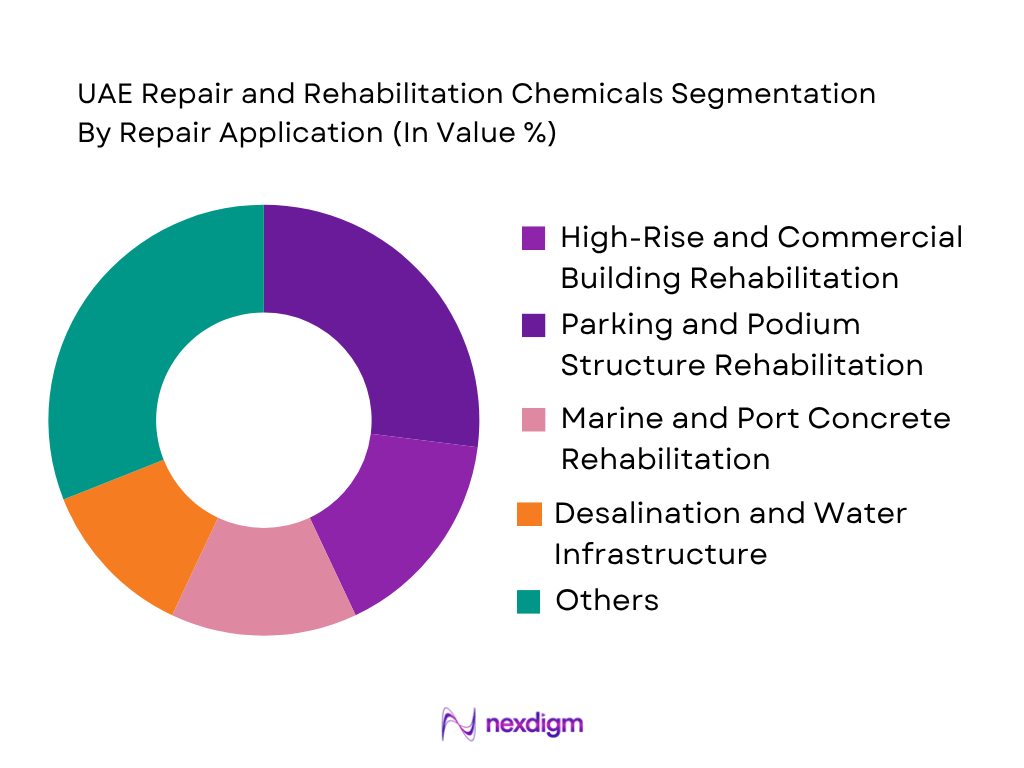
The UAE Repair and Rehabilitation Chemicals Market is segmented into high-rise and commercial building rehabilitation, parking and podium restoration, marine and port concrete repair, bridge and tunnel rehabilitation, desalination and water-infrastructure repair, industrial maintenance, leakage injection and structural strengthening. High-rise and commercial building rehabilitation holds the dominant share because Dubai and Abu Dhabi contain dense concentrations of towers exposed to heat, thermal movement, moisture, façade deterioration and parking-deck corrosion. Abu Dhabi recorded 299,360 buildings and 783,970 real-estate units, while Dubai’s building pipeline contained 18,114 structures under construction. Parking decks and podiums require recurring traffic-bearing coatings, joint repair, crack injection and chloride protection. Marine and utility structures form another important application base because Jebel Ali Port handled 15.5 million TEU and 5.4 million tonnes of breakbulk cargo, while Dubai produced 150,478 million imperial gallons of desalinated water, requiring substantial concrete infrastructure to remain operational.
Competitive Landscape
The UAE Repair and Rehabilitation Chemicals Market is led by multinational construction-chemical suppliers with established GCC manufacturing, warehousing and technical-support capabilities. Competition is based on complete-system coverage across structural repair mortars, micro-concrete, injection resins, grouts, corrosion mitigation, waterproofing, protective coatings and CFRP strengthening. Local manufacturing is particularly relevant because projects require short lead times and formulations suited to extreme heat, chloride exposure and sulfate-rich environments. Fosroc established its Dubai joint venture and regional manufacturing presence in 1975, illustrating the long-standing importance of local production in this market.
| Major Player | Establishment Year | Headquarters | Repair Mortars / Micro-Concrete | Injection & Grouting | Corrosion Protection | Structural Strengthening | UAE/GCC Manufacturing | Technical Project Support |
| Sika | 1910 | Baar, Switzerland | ||||||
| Fosroc | 1972 | Dubai, UAE regional base | ||||||
| MAPEI | 1937 | Milan, Italy | ||||||
| Saint-Gobain | 1665 | Courbevoie, France | ||||||
| ARDEX | 1949 | Witten, Germany |
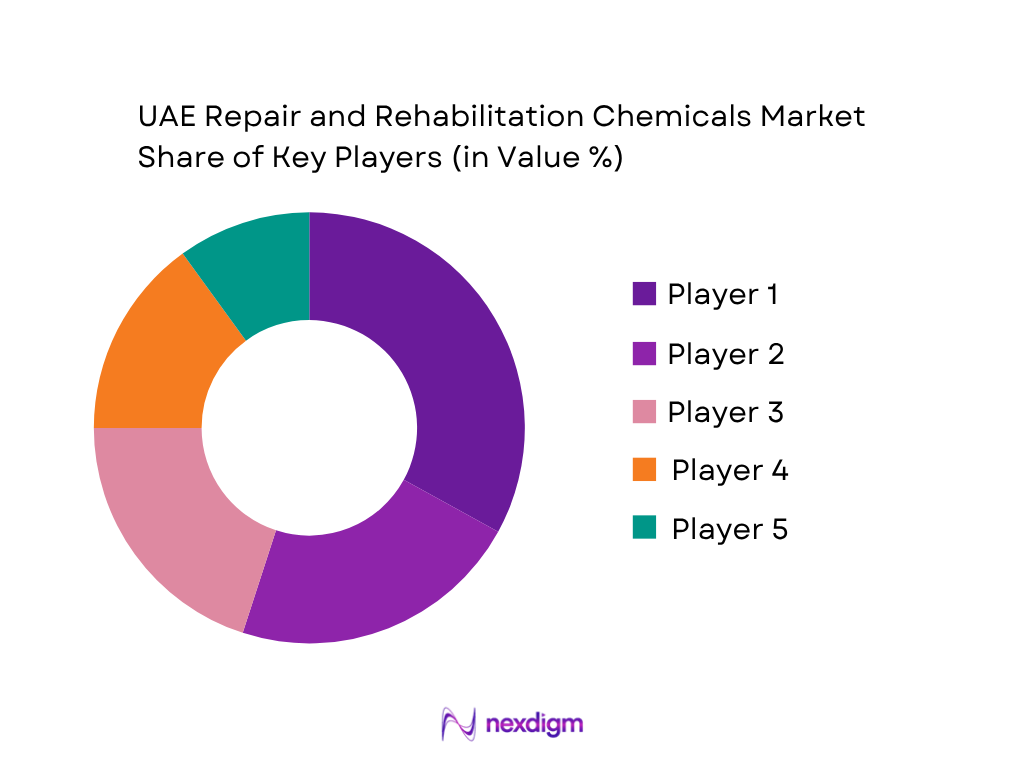
UAE Repair and Rehabilitation Chemicals Market Analysis
Growth Drivers
Expanding High-Rise and Urban Building Stock Is Deepening Lifecycle Rehabilitation Demand
The UAE Repair and Rehabilitation Chemicals Market is supported by the continuing expansion and ageing of reinforced-concrete residential, commercial, hospitality and mixed-use assets, particularly in Dubai and Abu Dhabi. Statistics Centre – Abu Dhabi recorded 299,360 buildings in 2024, after 29,415 new real-estate units were added and the total residential and commercial unit stock reached 783,970 units. Abu Dhabi’s construction activity simultaneously reached AED107.4 billion, demonstrating the scale of concrete assets entering the long-term maintenance cycle. Dubai also maintained a substantial building pipeline, with 18,114 buildings under construction, compared with 15,722 in the preceding reporting period. As towers, podiums, balconies, basements and parking structures mature, thermal movement, water ingress, reinforcement corrosion and concrete spalling create recurring requirements for polymer-modified repair mortars, micro-concrete, epoxy injection, waterproofing systems and protective coatings. World Bank data record UAE nominal GDP at USD552.32 billion in 2024 and GDP per capita at USD50,273.5. The expanding premium asset base therefore creates sustained lifecycle demand for engineered rehabilitation rather than temporary concrete patching.
Transport, Marine and Water Infrastructure Create a Broad Recurring Maintenance Base
UAE infrastructure expansion is creating a large installed asset base requiring continuing rehabilitation under traffic, saline water, heat and operational loading. Roads and Transport Authority data show Dubai’s road network reached 18,990 lane-kilometres and contained 1,070 vehicle bridges and tunnels, alongside 129 pedestrian bridges and tunnels, creating significant future requirements for rapid-setting concrete repair, structural grouts, crack injection and protective systems. Marine infrastructure adds severe chloride exposure: Jebel Ali Port processed 15.5 million TEU and 5.4 million metric tonnes of breakbulk cargo in 2024, while its infrastructure includes more than 100 berths and approximately 25 km of quay length. Water infrastructure is similarly extensive. DEWA produced 150,478 million imperial gallons of desalinated water in 2024 while maintaining 495 MIGD of installed desalination capacity. These operating assets require continuous concrete protection and leakage control. World Bank data place UAE nominal GDP at USD552.32 billion in 2024 and GDP per capita at USD50,273.5, supporting continued investment in infrastructure maintenance and structural life extension.
Market Challenges
Extreme Heat Restricts Application Windows and Raises Repair-Material Performance Requirements
Extreme summer conditions create a distinctive technical challenge for the UAE Repair and Rehabilitation Chemicals Market because repair mortars, epoxy systems, polyurethane injections and protective coatings are sensitive to substrate temperature, pot life, evaporation and curing conditions. The Ministry of Human Resources and Emiratisation prohibited outdoor work under direct sunlight between 12:30 PM and 3:00 PM from 15 June to 15 September 2024, creating a daily 2.5-hour restricted period across three peak-summer months. The regulation specifically recognizes technically necessary activities such as concrete pouring and urgent repair work, demonstrating how construction and rehabilitation activities must be planned around heat exposure. High temperatures can shorten epoxy working time, accelerate mortar moisture loss and increase the risk of inadequate curing, particularly on façades, bridge decks, parking structures and marine surfaces. The challenge affects a substantial asset base: Abu Dhabi alone contained 299,360 buildings, while Dubai operated 1,070 vehicle bridges and tunnels. World Bank data record UAE nominal GDP at USD552.32 billion in 2024 and GDP per capita at USD50,273.5. Suppliers therefore need high-temperature-compatible formulations, controlled curing protocols and strong site-support capabilities.
Chloride Exposure and Operating-Asset Constraints Make Durable Rehabilitation Technically Complex
Repair execution in the UAE is complicated by the combination of high chloride exposure and the need to keep buildings, ports, roads and utility infrastructure operational. Jebel Ali Port handled 15.5 million TEU in 2024, including 5.4 million metric tonnes of breakbulk cargo, while the port provides annual container capacity of 19.4 million TEU, more than 100 berths and approximately 25 km of quay infrastructure. Concrete repairs in this environment must often be completed without materially disrupting cargo operations while addressing saltwater-driven reinforcement corrosion. Road infrastructure presents similar constraints: Dubai has 1,070 vehicle bridges and tunnels supporting a road system of 18,990 lane-kilometres, with daytime vehicle numbers reaching approximately 3.5 million. Limited closure windows increase reliance on rapid-setting mortars, quick-cure coatings and fast structural injection systems, while residual chlorides can cause corrosion to recur if repairs are insufficiently comprehensive. World Bank data place UAE nominal GDP at USD552.32 billion in 2024 and GDP per capita at USD50,273.5. These operating conditions make durability, diagnosis, surface preparation and application speed simultaneously critical.
Market Opportunities
Marine and Desalination Assets Create Strong Potential for Advanced Corrosion-Protection Systems
Marine and water infrastructure offers substantial future opportunity for chloride-resistant mortars, galvanic anodes, corrosion inhibitors, silane treatments and protective linings because the UAE operates high-value concrete assets under continuous saline exposure. Jebel Ali Port handled 15.5 million TEU and 5.4 million metric tonnes of breakbulk cargo in 2024, with infrastructure extending across approximately 25 km of quay length and more than 100 berths. Dubai’s desalination infrastructure adds another major exposure base. DEWA produced 150,478 million imperial gallons of desalinated water in 2024 compared with 143,309 million imperial gallons in the preceding period, while installed capacity remained 495 MIGD. Peak daily water demand reached 455.067 MIGD, placing high operational importance on the durability of desalination and distribution assets. Concrete exposed to seawater, chlorides and continuous wet-dry cycling is well suited to system-based rehabilitation combining reinforcement treatment, low-permeability mortar and surface protection. World Bank data record UAE nominal GDP of USD552.32 billion in 2024 and GDP per capita of USD50,273.5. These current assets support future growth in high-durability rehabilitation technologies.
CFRP, Micro-Concrete and Parking-Structure Rehabilitation Offer High-Value Expansion Potential
Structural strengthening and complex building rehabilitation represent another significant future opportunity as the UAE’s large tower and property stock moves deeper into its maintenance lifecycle. Statistics Centre – Abu Dhabi recorded 299,360 buildings and 783,970 residential and commercial real-estate units in 2024, after 29,415 units were added during the year. Abu Dhabi construction activity reached AED107.4 billion, while Dubai simultaneously had 18,114 buildings under construction, ensuring that the long-term rehabilitation base continues to expand. High-rise buildings, podiums and parking decks experience thermal movement, vehicle loading, water ingress and localized reinforcement corrosion, creating applications for high-flow micro-concrete, low-viscosity epoxy injection, rapid-setting mortars and CFRP strengthening. CFRP systems are particularly relevant where beams, slabs or columns need additional capacity without substantial enlargement or prolonged closure, while rapid-setting materials are valuable in continuously occupied developments. World Bank data record UAE nominal GDP at USD552.32 billion in 2024 and GDP per capita at USD50,273.5. The scale of existing and newly delivered property assets therefore provides a strong foundation for higher-value structural rehabilitation systems.
Future Outlook
The UAE Repair and Rehabilitation Chemicals Market is expected to expand at approximately ~X.X% CAGR during 2026-2035, supported by an increasing shift toward lifecycle maintenance of towers, parking structures, transport assets, utilities and marine infrastructure. The market is likely to become more technically specialized as owners seek longer service life under extreme thermal and chloride exposure. Dubai’s road infrastructure provides a substantial future maintenance base. RTA reported 18,990 lane-kilometres of roads, 1,070 vehicle bridges and tunnels, and 129 pedestrian bridges and tunnels, in addition to further bridge and tunnel construction across strategic corridors. These assets will require concrete patching, crack injection, bearing-area repair, structural strengthening and protective treatments throughout their service lives.
Major Players
- Sika UAE
- Fosroc UAE
- MAPEI Construction Chemicals LLC
- Saint-Gobain Construction Chemicals UAE
- ARDEX Middle East
- MC-Bauchemie Middle East
- Tremco CPG Middle East
- Hilti Emirates
- Don Construction Products UAE
- Terraco Gulf
- CONMIX Ltd.
- Penetron Middle East
- Kryton International / UAE Distribution
- Jotun UAE
- Henkel UAE
Key Target Audience
- Repair and Rehabilitation Chemical Manufacturers
- Structural Repair and Strengthening Contractors
- Marine, Port and Coastal Infrastructure Contractors
- Real Estate Developers and Facility Management Companies
- Water, Desalination and Utility Infrastructure Operators
- Investments and Venture Capitalist Firms
- Government and Regulatory Bodies (Dubai Municipality, Abu Dhabi Department of Municipalities and Transport, Roads and Transport Authority Dubai, Dubai Electricity and Water Authority, Department of Energy Abu Dhabi)
- Construction Chemical Distributors and Specialist Applicator Networks
Research Methodology
Step 1: Identification of Key Variables
The initial phase constructs an ecosystem map covering repair-chemical manufacturers, distributors, specialist contractors, structural engineers, developers, facility managers and government asset owners. Secondary and proprietary databases are used to define UAE-specific deterioration mechanisms and rehabilitation technologies. Key variables include asset age, chloride exposure, sulfate exposure, repair area, defect type, project category and material-consumption intensity.
Step 2: Market Analysis and Construction
Historical demand is assessed using building-stock data, transport infrastructure, marine activity, desalination assets and construction indicators. The top-down methodology estimates demand from the addressable installed asset base, while the bottom-up approach evaluates supplier sales, distributor throughput and project-level repair-material consumption. Results are reconciled across mortars, micro-concrete, injection systems, grouts, coatings, corrosion control and strengthening materials.
Step 3: Hypothesis Validation and Expert Consultation
Market hypotheses are validated through computer-assisted telephone interviews with structural repair contractors, façade specialists, marine contractors, waterproofing applicators, distributors and structural engineers. Discussions examine repair depth, chloride contamination, high-temperature installation, crack injection, podium deterioration, waterproofing interfaces and product-approval requirements. The findings are used to refine application-specific demand and competitive positioning.
Step 4: Research Synthesis and Final Output
The final phase triangulates official building, transport, utility and port statistics with supplier disclosures and primary research. Market estimates are validated by product type, application, emirate and customer category. Forecasting incorporates high-rise ageing, podium and parking rehabilitation, transport maintenance, marine corrosion, desalination infrastructure, structural strengthening and adoption of higher-durability rehabilitation technologies.

- Executive Summary
- Research Methodology (Market Definitions and Assumptions, UAE Repair and Rehabilitation Chemicals Market Classification, Cementitious Repair Mortar Assessment, Polymer-Modified Repair Mortar Assessment, Sulfate-Resistant Repair Mortar Assessment, Chloride-Resistant Repair Mortar Assessment, Flowable Micro-Concrete Assessment, Epoxy Repair Assessment, Epoxy Injection Resin Assessment, Polyurethane Injection Assessment, Cementitious Injection Grout Assessment, Non-Shrink Grout Assessment, Precision Grout Assessment, Reinforcement Passivation Assessment, Corrosion Inhibitor Assessment, Galvanic Corrosion Control Assessment, Silane and Siloxane Treatment Assessment, Anti-Carbonation Coating Assessment, Protective Coating Assessment, CFRP Strengthening Assessment, Structural Epoxy Bonding Assessment, Waterproofing Rehabilitation Assessment, High-Rise Façade Rehabilitation Assessment, Parking Structure Assessment, Bridge and Tunnel Rehabilitation Assessment, Marine Concrete Rehabilitation Assessment, Desalination and Water Structure Assessment, Extreme Heat Exposure Assessment, Chloride and Sulfate Exposure Assessment, Dubai Building Code Assessment, Abu Dhabi Building Code Assessment, ASTM Repair Material Assessment, EN 1504 Repair Principle Assessment, Top-Down Market Sizing, Bottom-Up Market Sizing, Contractor Interviews, Structural Engineer Interviews, Distributor Mapping, Project Specification Analysis, Data Triangulation, Forecasting Framework)

- Definition and Scope
- UAE Repair and Rehabilitation Chemicals Industry Evolution and Development of Conventional Cementitious Patching, Polymer-Modified Repair Mortars, Sulfate-Resistant Repair Systems, Chloride-Resistant Structural Mortars, Flowable Micro-Concrete, Non-Shrink Precision Grouts, Low-Viscosity Epoxy Injection, Polyurethane Leakage Injection, Reinforcement Passivation, Galvanic Protection, Corrosion Inhibitors, Silane Treatments, Anti-Carbonation Coatings, Elastomeric Protective Coatings, Structural Epoxy Bonding, CFRP Strengthening, Podium Rehabilitation, Parking Deck Restoration, Façade Repair, Marine Concrete Protection, Desalination Infrastructure Repair and High-Temperature Rehabilitation Technologies
- Repair and Rehabilitation Chemicals Value Chain Analysis
- Repair and Rehabilitation Chemicals Supply Chain Analysis
- Cement and SCM Suppliers, Polymer Modifier Suppliers, Epoxy Resin Suppliers, Polyurethane Resin Suppliers, Corrosion Inhibitor Suppliers, Zinc Anode Suppliers, Silane and Siloxane Suppliers, Carbon Fibre Suppliers, Mineral Filler Suppliers, Specialty Additive Suppliers, Repair Chemical Manufacturers, UAE Dry-Mix Manufacturers, Importers, Construction Chemical Distributors, Structural Repair Contractors, Waterproofing Contractors, Injection Contractors, Façade Contractors, Marine Contractors, Infrastructure Contractors, Structural Engineers, Developers, Facility Managers and Government Asset Owners

- Growth Drivers (High-Rise Building Aging, Parking and Podium Rehabilitation, Marine and Port Asset Maintenance, Bridge and Tunnel Rehabilitation, Desalination and Water Infrastructure Maintenance, Hotel and Commercial Asset Refurbishment, Industrial Facility Maintenance, Chloride-Induced Corrosion, Sulfate Exposure, Extreme Heat and Thermal Cycling, Waterproofing Rehabilitation, Asset-Life Extension)
- Market Challenges (Extreme Heat Application Conditions, High Chloride Exposure, Sulfate-Rich Ground Conditions, Skilled Specialist Applicator Availability, Incorrect Defect Diagnosis, Poor Surface Preparation, Hidden Reinforcement Corrosion, Moisture Behind Repairs, Repair-Material Compatibility, Crack Reopening, Imported Specialty Raw Material Dependence, Occupied-Building Constraints, Short Traffic Closure Windows, Project-Specific Approval Requirements)
- Market Opportunities (Sulfate and Chloride-Resistant Structural Mortars, High-Flow Micro-Concrete, Rapid-Setting Repair Systems, Low-Viscosity Epoxy Injection, PU Leakage Injection, Galvanic Anodes, Migrating Corrosion Inhibitors, Silane Hydrophobic Treatments, CFRP Strengthening, Parking Deck Rehabilitation, Marine Concrete Protection, Desalination Plant Rehabilitation, High-Rise Façade Repair, Low-Carbon Repair Materials)
- Market Trends (Polymer-Modified Structural Mortars, Sulfate-Resistant Repair Systems, Chloride-Resistant Repair Mortars, High-Flow Micro-Concrete, Hydrophilic PU Injection, Galvanic Corrosion Protection, Silane Impregnation, CFRP Strengthening, Rapid-Cure Repair Materials, Integrated Waterproofing and Repair Systems, Marine-Grade Rehabilitation Systems, High-Temperature Formulations, Lifecycle-Based Maintenance, Low-Carbon Rehabilitation)
- Government Regulations and Standards (Dubai Building Code, Dubai Municipality Structural Codes, Abu Dhabi Building Code, UAE Fire and Life Safety Requirements, Municipality Building Maintenance Requirements, ASTM Concrete Repair Standards, EN 1504 Concrete Repair Principles, ACI Repair Requirements, UAE Occupational Safety Requirements, Municipality Product Approval Requirements, Infrastructure Authority Specifications, Potable Water and Desalination Material Requirements)
- SWOT Analysis
- Porter’s Five Forces Analysis
- PESTLE Analysis
- Stakeholder Ecosystem
- Repair and Rehabilitation Project Ecosystem

- By Market Value (2020-2025)
- By Repair Chemical Consumption Volume (2020-2025)
- By Cementitious Repair Mortar Consumption (2020-2025)
- By Polymer-Modified Repair Mortar Consumption (2020-2025)
- By Sulfate and Chloride-Resistant Repair Mortar Consumption (2020-2025)
- By Flowable Micro-Concrete Consumption (2020-2025)
- By Epoxy Injection Resin Consumption (2020-2025)

- By Product Type (In Value %)
Cementitious Repair Mortars
Polymer-Modified Repair Mortars
Sulfate-Resistant Repair Mortars
Chloride-Resistant Repair Mortars
Flowable Micro-Concrete
Epoxy Repair Mortars
Rapid-Setting Repair Mortars
Low-Viscosity Epoxy Injection Resins
Polyurethane Injection Resins - By Repair Application (In Value %)
Spalling Concrete Repair
Delaminated Concrete Repair
Honeycombing Repair
Structural Crack Injection
Non-Structural Crack Sealing
Reinforcement Corrosion Repair
Concrete Section Reinstatement
Column and Beam Repair - By Deterioration Mechanism (In Value %)
Chloride-Induced Reinforcement Corrosion
Sulfate Attack
Carbonation-Induced Corrosion
Water Ingress
Thermal Cracking
Concrete Delamination
Spalling
Honeycombing - By Structure Type (In Value %)
High-Rise Residential Towers
Commercial Towers
Hotels and Resorts
Shopping Malls
Hospitals and Institutional Buildings
Parking Structures
Podium Structures
Industrial Facilities
Warehouses and Logistics Buildings
Bridges and Flyovers - By Repair Technology (In Value %)
Hand-Applied Repair Mortar
Form-and-Pour Micro-Concrete
Wet-Spray Repair Mortar
Rapid-Set Horizontal Repair
Epoxy Pressure Injection
Polyurethane Water-Stopping Injection
Cementitious Injection Grouting
Non-Shrink Grouting
Galvanic Corrosion Control - By Emirate (In Value %)
Dubai
Abu Dhabi
Sharjah
Ajman
Ras Al Khaimah
Fujairah
Umm Al Quwain

- Market Share of Major Players (By UAE Revenue, Repair Mortar Volume, Micro-Concrete Portfolio, Injection Resin Portfolio, Grouting Portfolio, Corrosion Protection Portfolio, Protective Coating Portfolio, CFRP Strengthening Exposure, High-Rise Rehabilitation Exposure, Parking Structure Exposure, Marine and Port Exposure, Desalination and Water Infrastructure Exposure, UAE Manufacturing Capacity, Distributor Network, Technical Specification Support)
- Cross Comparison Parameters (Structural Repair Mortar Micro-Concrete and Grout Portfolio Breadth, Epoxy Polyurethane and Cementitious Injection Technology Capability, Chloride Sulfate and Reinforcement Corrosion Protection Capability, CFRP Structural Strengthening and Structural Bonding Capability, High-Rise Parking Marine and Desalination Rehabilitation Reference Base, UAE Manufacturing Warehousing and Construction Distribution Network Reach, Extreme Heat Marine Exposure and High-Salinity Durability Performance, Structural Engineer Contractor Training Field Testing and Technical Support Capability)
- SWOT Analysis of Major Players
- Major Companies
Sika UAE
Fosroc UAE
MAPEI Construction Chemicals LLC
Saint-Gobain Construction Chemicals UAE
ARDEX Middle East
MC-Bauchemie Middle East
Tremco CPG Middle East
Hilti Emirates
Don Construction Products UAE
Terraco Gulf
CONMIX Ltd.
Penetron Middle East
Kryton International / UAE Distribution
Jotun UAE
Henkel UAE

- Structural Repair Contractor Requirement Assessment
- Injection Specialist Requirement Assessment
- Waterproofing Contractor Requirement Assessment
- Façade Contractor Requirement Assessment
- Parking Structure Contractor Requirement Assessment
- Marine Contractor Requirement Assessment
- Infrastructure Contractor Requirement Assessment
- Structural Engineer Specification Assessment

- By Market Value (2026-2035)
- By Repair Chemical Consumption Volume (2026-2035)
- By Cementitious Repair Mortar Consumption (2026-2035)
- By Polymer-Modified Repair Mortar Consumption (2026-2035)
- By Sulfate and Chloride-Resistant Repair Mortar Consumption (2026-2035)
- By Flowable Micro-Concrete Consumption (2026-2035)
- By Epoxy Injection Resin Consumption (2026-2035)


 Request a Sample
 Ask for Customization
 Get a Quote
 Enquire Now
