
 Download PDF
Market Overview
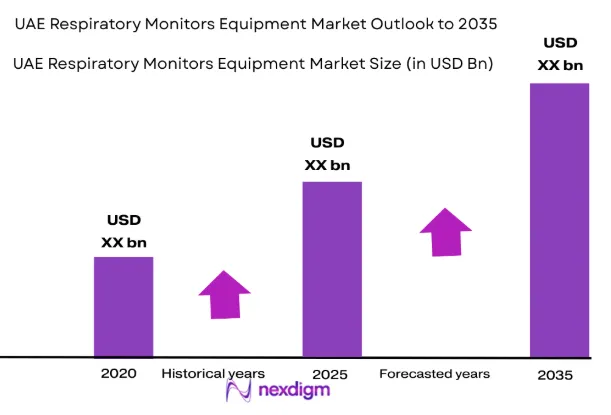
The UAE Respiratory Monitors Equipment market is valued at USD ~ billion, driven by the rising prevalence of respiratory diseases, especially due to the region’s high air pollution levels and increasing healthcare awareness. The growing elderly population also contributes significantly to market growth. With more hospitals investing in advanced respiratory care, the demand for high-quality, non-invasive respiratory monitors has surged. The market is further supported by technological advancements and the availability of innovative monitoring solutions, such as wearable and portable devices.
Dubai and Abu Dhabi are the dominant cities in the UAE Respiratory Monitors Equipment market due to their robust healthcare infrastructure and the presence of leading healthcare providers. These cities are home to numerous hospitals and healthcare facilities offering advanced treatment, fueling the demand for respiratory monitoring devices. Furthermore, the high economic standards in these cities make them key hubs for healthcare innovation and the adoption of cutting-edge medical equipment.
Market Segmentation
By Product Type
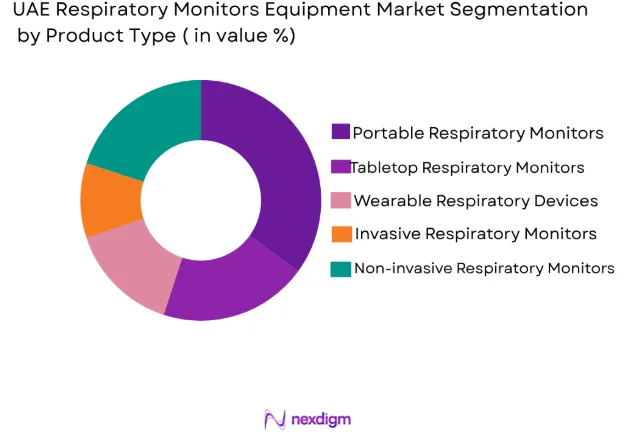
The UAE Respiratory Monitors Equipment market is segmented by product type into portable respiratory monitors, tabletop respiratory monitors, wearable respiratory monitors, invasive respiratory monitors, and non-invasive respiratory monitors. Currently, portable respiratory monitors dominate the market due to their convenience, affordability, and ability to be used in home healthcare settings. With the increasing trend towards home-based care, these monitors are gaining popularity. Additionally, technological innovations such as Bluetooth and wireless connectivity have enhanced the appeal of portable devices.
By Application Type
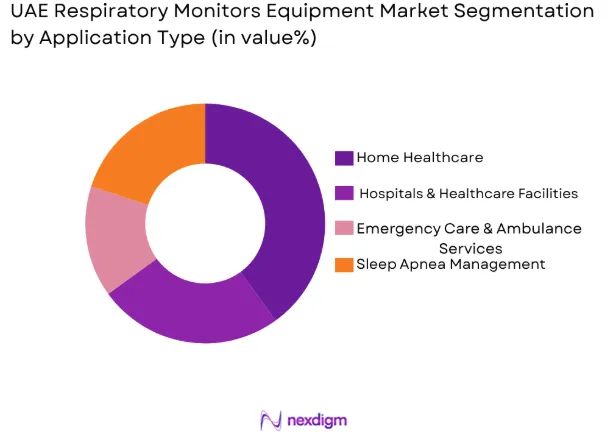
The market is segmented by application into home healthcare, hospitals and healthcare facilities, emergency care and ambulance services, and sleep apnea management. Home healthcare currently holds the dominant market share due to a significant increase in the number of people opting for in-home respiratory care. Factors like convenience, reduced healthcare costs, and the growing elderly population contribute to this segment’s dominance. Additionally, the rise in chronic respiratory diseases like asthma and COPD is further boosting demand for home care monitoring devices.
Competitive Landscape
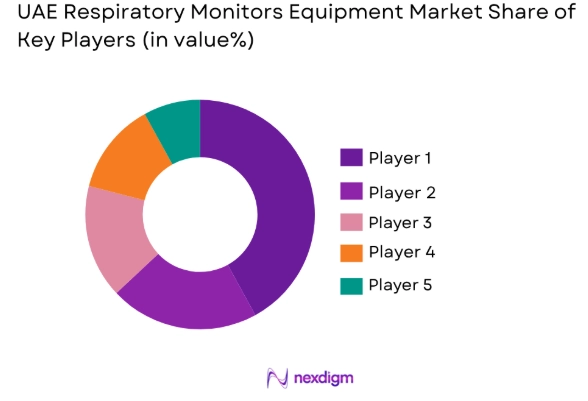
The UAE Respiratory Monitors Equipment market is dominated by a few key players, including global healthcare giants and regional providers. Major companies in the market include Philips Healthcare, GE Healthcare, ResMed, Medtronic, and Drägerwerk. These players are leading the market due to their comprehensive product offerings, strong distribution networks, and innovative solutions. The presence of these industry leaders ensures a competitive landscape where market share is primarily influenced by technology, product quality, and customer relationships.
| Company Name | Establishment Year | Headquarters | Technology Focus | Market Reach | Key Products | Revenue | Additional Parameter |
| Philips Healthcare | 1891 | Netherlands | ~ | ~ | ~ | ~ | ~ |
| Medtronic | 1949 | Ireland | ~ | ~ | ~ | ~ | ~ |
| GE Healthcare | 1892 | USA | ~ | ~ | ~ | ~ | ~ |
| ResMed | 1989 | USA | ~ | ~ | ~ | ~ | ~ |
| Drägerwerk AG & Co. KGaA | 1889 | Germany | ~ | ~ | ~ | ~ | ~ |
UAE Respiratory Monitors Equipment Market Analysis
Growth Drivers
Rising Respiratory Disorders and Aging Population
The growing incidence of respiratory disorders in the UAE has become a key driver for the respiratory monitors equipment market. Respiratory diseases such as asthma, chronic obstructive pulmonary disease (COPD), and sleep apnea are on the rise, with COPD being one of the leading causes of mortality in the region. According to the World Health Organization (WHO), COPD alone affects over 15% of the population in the Middle East and North Africa (MENA). Additionally, the UAE has seen a sharp rise in the elderly population, with 11.3% of the total population aged 65 and above in 2022, increasing the demand for respiratory monitoring devices for home care and healthcare facilities. With respiratory diseases contributing to a significant portion of the burden of disease in the UAE, advanced monitoring devices have become essential for timely diagnosis and management. The rising number of elderly patients, along with an increase in respiratory diseases, is a strong market driver.
Increased Awareness of Home Healthcare Solutions
The awareness around home healthcare solutions has increased significantly, especially since the COVID-19 pandemic. In the UAE, patients and healthcare providers have shifted towards in-home care options for non-acute conditions, including respiratory diseases. The government of the UAE has supported home healthcare by initiating the home healthcare program for patients with chronic diseases like asthma and COPD. According to the UAE Ministry of Health, home healthcare services grew by 15% between 2022 and 2023. With a greater focus on reducing hospital visits and promoting self-management of chronic diseases, demand for respiratory monitoring devices, especially portable and wearable devices, is increasing. The government’s push for affordable home healthcare services and more personalized care is also fueling the growth of this sector.
Market Challenges
Regulatory Challenges and Compliance Standards
The regulatory landscape for medical devices in the UAE is complex, posing a significant challenge to market growth. The UAE government follows strict medical device regulations set by the UAE National Health Regulatory Authority (NHRA) and international standards like ISO 13485 for quality management in medical devices. The approval process for respiratory monitoring devices can be lengthy, and manufacturers often face challenges related to local testing and certification requirements. Additionally, compliance with the global standards set by the European Union Medical Device Regulation (MDR) and the FDA’s device standards is mandatory for international manufacturers entering the market. These stringent regulations add to the cost and time required to bring new products to market, thereby impacting growth.
High Cost of Advanced Equipment
The high cost of advanced respiratory monitoring equipment remains a significant barrier to market expansion. Advanced devices, particularly those used in hospitals and healthcare facilities, are often prohibitively expensive. The cost of these devices can range from AED 10,000 to AED 50,000 depending on the technology and features. This is particularly challenging for smaller healthcare facilities and home care providers who need to balance cost efficiency with the adoption of innovative technologies. According to the UAE Ministry of Health and Prevention, budget constraints and the high upfront costs of advanced equipment continue to be a hurdle for adopting new respiratory monitoring devices. These costs also hinder the adoption of non-invasive and wearable devices that could provide more accessible healthcare options for the growing elderly population.
Market Opportunities
Expansion of Home Healthcare Services
The expansion of home healthcare services is a significant opportunity for the UAE respiratory monitors equipment market. The UAE government is investing heavily in expanding home healthcare infrastructure to manage the growing prevalence of chronic diseases such as asthma and COPD. As per the UAE Ministry of Health and Prevention, the number of home healthcare visits in the UAE grew by 12% in 2022, and this trend is expected to continue. With a strong focus on reducing hospital admissions and encouraging patient self-management, home healthcare solutions, including respiratory monitoring equipment, have become a crucial part of the healthcare strategy. The demand for portable respiratory devices for in-home use has surged, with more patients opting for remote monitoring options to manage chronic conditions. As the market shifts towards home-based care, manufacturers are increasingly focusing on developing cost-effective, easy-to-use respiratory devices for home care settings.
Demand for Non-invasive Monitoring Solutions
Non-invasive respiratory monitoring solutions are expected to see an increased demand in the UAE, driven by the growing preference for less invasive medical procedures. Non-invasive monitoring devices, such as pulse oximeters, are gaining popularity due to their ease of use, affordability, and minimal patient discomfort. In 2022, the UAE government expanded its efforts to integrate non-invasive diagnostic tools in both hospitals and home care settings, reducing the reliance on invasive procedures for respiratory conditions. The market for non-invasive respiratory monitoring equipment is supported by the increasing awareness among healthcare providers and patients about the benefits of these solutions in improving patient comfort and reducing the risk of complications. This trend is expected to continue, as non-invasive solutions become integral to the management of respiratory diseases in both home and hospital settings.
Future Outlook
The future outlook for the UAE Respiratory Monitors Equipment Market over the next five years looks promising, with anticipated growth driven by technological advancements and increasing healthcare demand. Innovations in smart respiratory monitors, particularly those integrating with telemedicine and mobile health platforms, are expected to shape the market. Government support for healthcare expansion and regulatory efforts to streamline medical device certification will further bolster market growth. Additionally, rising consumer awareness about respiratory health and the increasing prevalence of chronic respiratory diseases will continue to fuel demand for advanced respiratory monitoring solutions.
Major Players
- Philips Healthcare
- GE Healthcare
- ResMed
- Medtronic
- Drägerwerk AG
- Nihon Kohden
- Masimo
- Hamilton Medical
- Mindray
- Siemens Healthineers
- Carestream Health
- Smiths Medical
- Zoll Medical
- Becton Dickinson and Company
- Fisher & Paykel Healthcare
Key Target Audience
- Hospitals and Healthcare Providers
- Home Healthcare Service Providers
- Medical Equipment Distributors and Dealers
- Emergency Medical Services (EMS) and Ambulance Operators
- Investments and Venture Capitalist Firms
- Government and Regulatory Bodies
- Insurance Companies
- Pharmaceutical Companies
Research Methodology
Step 1: Identification of Key Variables
The first step involves identifying the key variables that influence the market, including market size, technological trends, and demographic factors. These variables help in constructing the research framework. Additional parameters such as regulatory environment, pricing dynamics, and supply chain structure are also considered to ensure a holistic assessment. This step establishes the foundation for accurate and consistent market evaluation.
Step 2: Market Analysis and Construction
This step involves collecting data from multiple sources to construct the market structure, identifying key growth drivers, challenges, and segmentation. Both primary and secondary research inputs are utilized to validate data accuracy and relevance. The process also includes mapping historical trends and aligning them with current industry developments to build a reliable market model.
Step 3: Hypothesis Validation and Expert Consultation
Market hypotheses are validated through consultations with industry experts and stakeholders, ensuring the accuracy and relevance of findings. Feedback from key opinion leaders, healthcare professionals, and manufacturers is incorporated to refine assumptions. This step ensures that the insights reflect real-world market conditions and emerging trends.
Step 4: Research Synthesis and Final Output
The final output is derived by synthesizing all research findings, and the resulting data is structured into a comprehensive market report. Analytical tools and forecasting models are applied to generate actionable insights and projections. The report is further reviewed for consistency, ensuring clarity, accuracy, and strategic relevance for stakeholders.

- Executive Summary
- Research Methodology (Definitions, Scope, Industry Assumptions, Market Sizing Approach, Primary & Secondary Research Framework, Data Collection & Verification Protocol, Analytic Models & Forecast Methodology, Limitations & Research Validity Checks)

- Definition and Scope
- Overview Genesis
- Evolution of Respiratory Monitoring in UAE
- Business Cycle Analysis
- Supply Chain and Value Chain Analysis
- Technological Landscape of Respiratory Monitoring Devices

- Growth Drivers
Rising Respiratory Disorders and Aging Population
Increased Awareness of Home Healthcare Solutions - Market Challenges
Regulatory Challenges and Compliance Standards
High Cost of Advanced Equipment - Market Opportunities
Expansion of Home Healthcare Services
Demand for Non-invasive Monitoring Solutions - Trends
Integrations of AI and IoT in Respiratory Monitoring
Demand for Real-time Monitoring and Data Sharing - Government Regulations
- SWOT Analysis
- Porter’s Five Forces

- By Value, 2020-2026
- By Volume, 2020-2026
- By Average Price, 2020-2026

- By Product Type (In Value%)
Portable Respiratory Monitors
Tabletop Respiratory Monitor
Wearable Respiratory Devices
Invasive Respiratory Monitors
Non-invasive Respiratory Monitors - By Application,(In Value %)
Home Healthcare
Hospitals & Healthcare Facilities
Emergency Care & Ambulance Services
Sleep Apnea Management - By Distribution Channel,(In Value %)
Direct Sales
Distributors & Dealers
Online Retail
- By End User, (In Value %)
Hospitals
Homecare Providers
Diagnostic Centers
Emergency Medical Services
- By Region, (In Value %)
Dubai
Abu Dhabi
Sharjah
Northern Emirates

- Market Share Analysis
- Cross Comparison Parameters (Company Overview, Business Strategies, Recent Developments, Strengths, Weaknesses, Revenue, Distribution Network, Dealer and Distributor Network, Production Capacity, Market Share by Product Type, Service Offerings, Pricing, Technology Adoption, Regulatory Compliance, Product Innovation, Customer Reach)
- SWOT Analysis of Key Competitors
- Pricing & Procurement Analysis
- Key Players
Philips Healthcare
GE Healthcare
ResMed
Medtronic
Drägerwerk AG
Nihon Kohden
Masimo
Hamilton Medical
Mindray
Siemens Healthineers
Carestream Health
Smiths Medical
Zoll Medical
Becton Dickinson and Company
Fisher & Paykel Healthcare

- Market Demand and Utilization by Sector
- Purchasing Power and Budget Allocations for Healthcare Providers
- Needs, Desires, and Pain Points in Respiratory Monitoring
- Adoption Barriers and Decision-Making Process

- By Value, 2026-2035
- By Volume, 2026-2035
- By Average Price, 2026-2035


 Request a Sample
 Ask for Customization
 Get a Quote
 Enquire Now