
 Download PDF
Market Overview
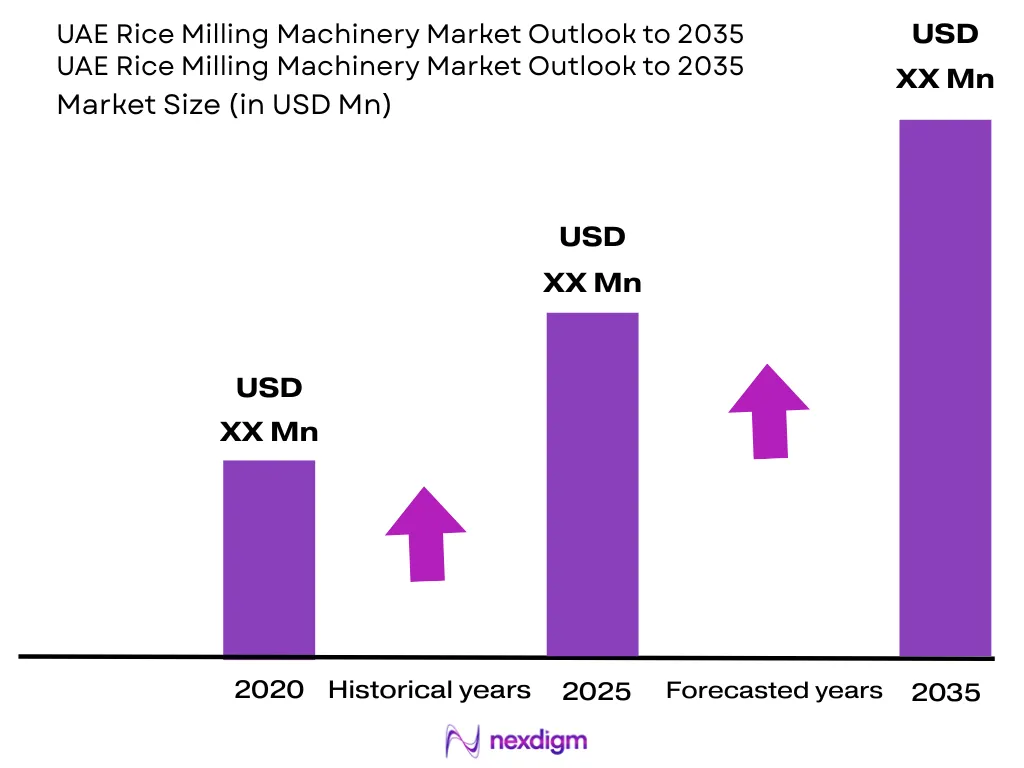
The UAE Rice Milling Machinery Market was valued at USD ~ Million in 2024, anchored by the country’s strategic position as one of the world’s most important rice import, re-milling, and re-export hubs. The United Arab Emirates does not produce rice domestically but has developed a highly sophisticated food processing and re-export ecosystem within its free zones and industrial areas that supports significant rice milling and re-packaging activity. According to data published by the UAE Ministry of Economy, the Federal Competitiveness and Statistics Centre (FCSC), and trade data from Dubai Customs, the UAE imports approximately 1.2 to 1.5 million metric tons of rice annually, sourced predominantly from India, Pakistan, Thailand, and Vietnam, making it one of the largest rice importers in the Middle East and North Africa region. Dubai’s Jebel Ali Free Zone (JAFZA) and Abu Dhabi’s industrial zones serve as critical platforms for rice re-milling, quality sorting, repackaging, and re-export to markets across the GCC, East Africa, and wider Middle East. Continuous modernization of processing infrastructure, growing demand for premium basmati and parboiled rice, accelerating adoption of automated sorting and packaging systems, and rising food safety standards driven by government regulatory bodies are the principal factors driving equipment demand across the UAE.
Market Segmentation
By Machinery Type
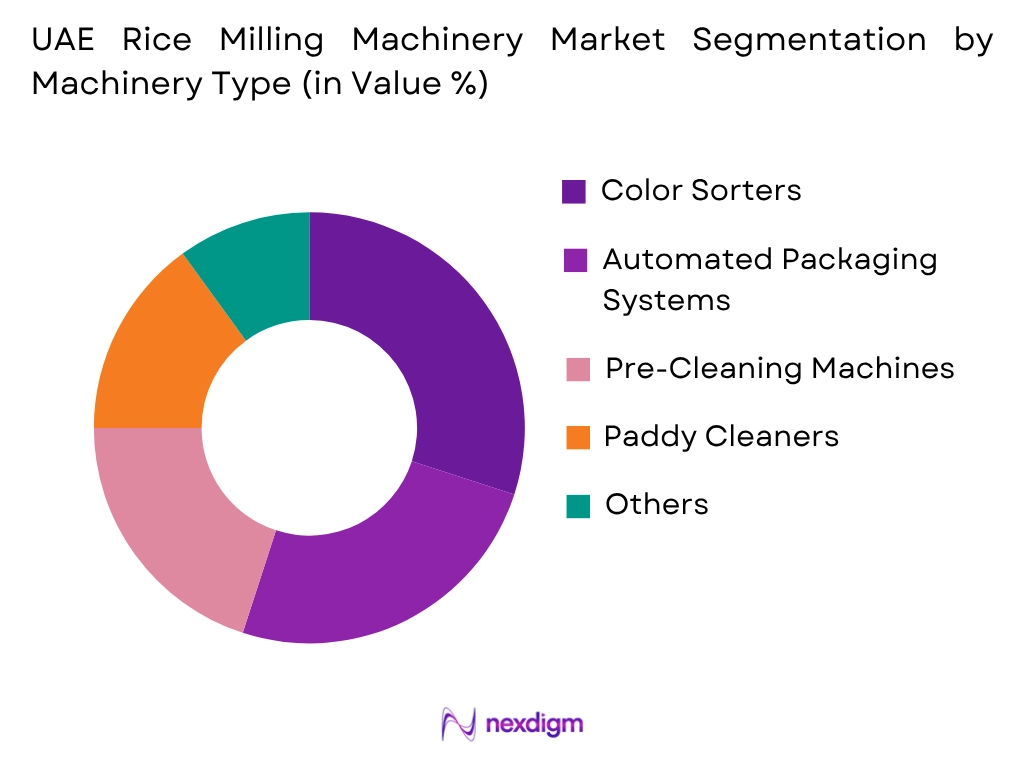
UAE Rice Milling Machinery Market is segmented by machinery type into Pre-Cleaning Machines, Paddy Cleaners, Destoners, Rubber Roll Huskers, Paddy Separators, Rice Whiteners, Rice Polishers, Color Sorters, Rice Graders, Length Graders, Packaging Systems, and Complete Rice Milling Plants. Recently, Color Sorters and Automated Packaging Systems hold the dominant market share within this segmentation, reflecting the UAE’s primary role as a rice re-milling, quality sorting, and re-export hub rather than a primary paddy processing economy. UAE-based rice processors and re-packers are heavily focused on achieving the visual quality, grain uniformity, and food safety standards demanded by GCC retail chains, East African importers, and other re-export destination markets. The expansion of branded consumer rice under private label and retail own-brand programs, combined with the stringent food safety audit requirements of major UAE hypermarket chains including LuLu Hypermarket, Carrefour, and Union Co-op, has driven significant investment in precision sorting, grading, and automated packaging equipment. Furthermore, the increasing sophistication of UAE consumers and the premium commanded by visually superior rice in the Middle East market encourage processors to invest in advanced optical sorting technologies capable of detecting color defects, foreign matter, and impurities to the highest precision levels. Their direct influence on final product quality presentation, food safety compliance, and commercial margins makes color sorting and packaging systems the most critical equipment investments for UAE-based rice processors and re-exporters.
By Automation Level
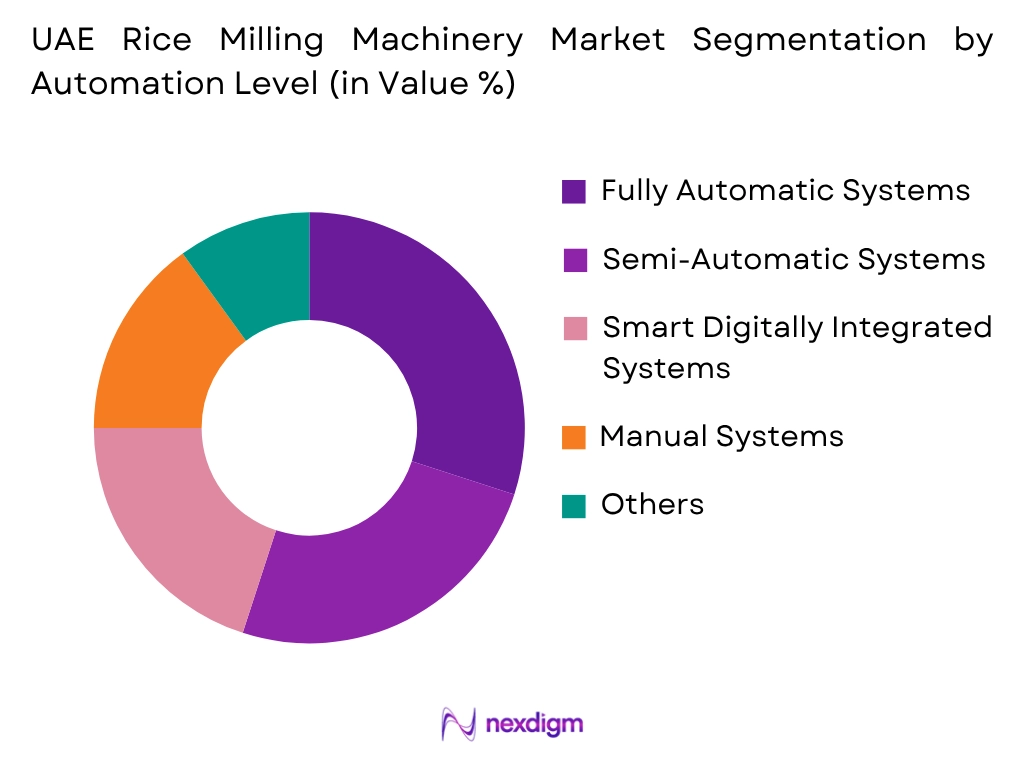
UAE Rice Milling Machinery Market is segmented by automation level into Manual Systems, Semi-Automatic Systems, Fully Automatic Systems, and Smart Digitally Integrated Systems. Currently, Fully Automatic Systems dominate the UAE market, reflecting the country’s high labor cost environment, stringent food safety compliance requirements, and the operational sophistication of rice processing enterprises established within UAE free zones and industrial areas. The UAE’s National Food Security Strategy 2051 and associated investment programs have reinforced the focus on technologically advanced food processing infrastructure. Labor regulations governing migrant worker employment, combined with the administrative cost of managing large processing workforces, create strong financial incentives for UAE-based rice processors to maximize automation across sorting, grading, milling, and packaging operations. Leading UAE food processors operating in JAFZA, Dubai Industrial City, and Abu Dhabi Industrial Zone maintain world-class automated production facilities equipped with advanced PLC-controlled milling lines, AI-powered optical sorters, and integrated enterprise resource planning systems. The UAE’s advanced logistics infrastructure, reliable power supply, and proximity to global equipment suppliers further support the adoption of high-specification automated milling systems. Smart and digitally integrated systems are also gaining traction as processors seek to implement full product traceability, batch management, and real-time quality monitoring capabilities aligned with international food safety management standards.
Competitive Landscape
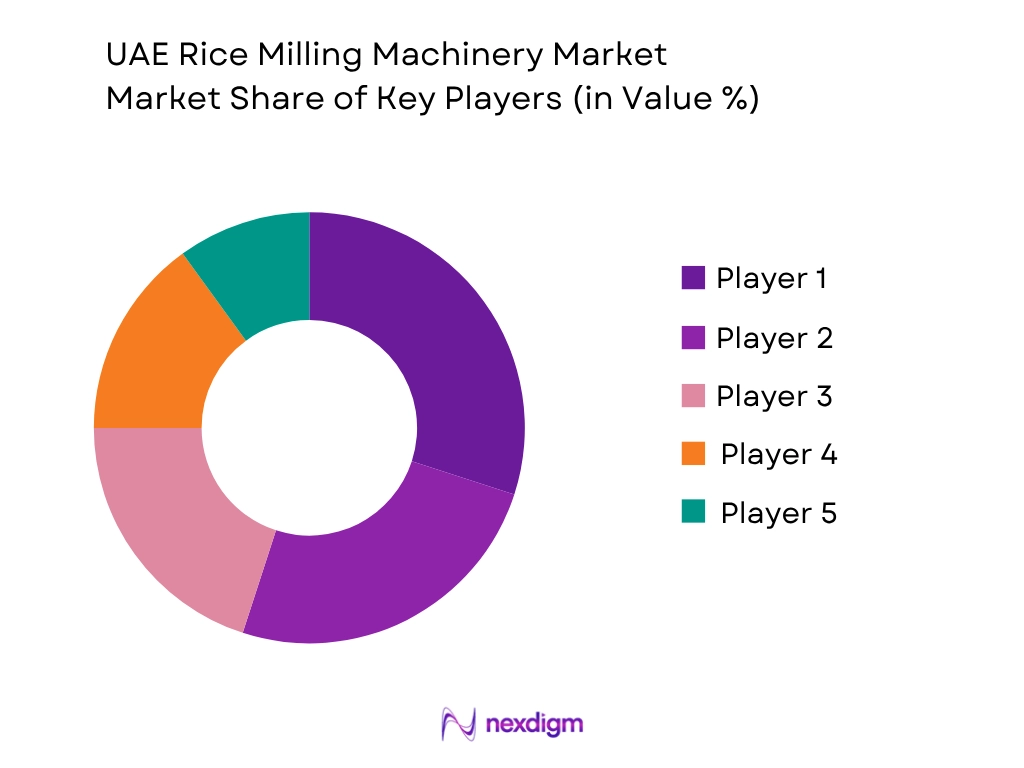
The UAE Rice Milling Machinery Market is characterized by the presence of leading global technology suppliers, established regional food processing conglomerates, and specialized equipment distributors serving the country’s import-driven and re-export-oriented rice processing industry. International companies such as Bühler Group and Satake Corporation hold strong positions through advanced milling technologies and dedicated Middle East service networks, while established UAE and GCC food processing groups such as Al Ghurair Foods and LuLu Group International operate large-scale rice processing and packaging facilities that represent significant end-user demand. Chinese machinery suppliers have also established a growing presence in the mid-market segment through cost-competitive offerings. Competition is primarily driven by equipment precision, automation capabilities, food safety compliance features, energy efficiency, service responsiveness, and the ability to deliver comprehensive turnkey processing solutions compatible with UAE free zone operational requirements.
| Company | Establishment Year | Headquarters | Rice Milling Portfolio | Automation Capability
|
Color Sorting Technology | Service Network | Turnkey Plant Solutions | Processing Capacity Range |
| Bühler Group | 1860 | ~ | ~ | ~ | ~ | ~ | ~ | ~ |
| Satake Corporation | 1896 | ~ | ~ | ~ | ~ | ~ | ~ | ~ |
| Al Ghurair Foods | 1960 | ~ | ~ | ~ | ~ | ~ | ~ | ~ |
| Milltec Machinery | 1998 | ~ | ~ | ~ | ~ | ~ | ~ | ~ |
| LuLu Group International | 1995 | ~ | ~ | ~ | ~ | ~ | ~ | ~ |
UAE Rice Milling Machinery Market Analysis
Growth Drivers
Strategic Position as a Regional Rice Re-Milling, Distribution, and Re-Export Hub
The UAE rice milling machinery market is fundamentally supported by the country’s unrivalled strategic position as the Middle East’s premier food processing, re-milling, and re-export platform. According to UAE Ministry of Economy trade statistics and Dubai Customs data, the UAE imports approximately 1.2 to 1.5 million metric tons of rice annually and re-exports significant volumes to GCC member states, East African markets, and other regional destinations. Dubai’s Jebel Ali Free Zone (JAFZA), one of the world’s largest free trade zones with over 8,000 registered companies and direct access to Jebel Ali Port, provides an unmatched platform for rice importers and processors to operate large-scale re-milling and repackaging facilities with preferential customs and tax treatment. Abu Dhabi’s KIZAD and Sharjah’s Hamriyah Free Zone offer additional processing and logistics infrastructure supporting the broader UAE rice processing ecosystem. The Federal Competitiveness and Statistics Centre (FCSC) data confirms that food and beverage re-exports represent a major component of UAE non-oil trade, with rice consistently among the most significant food commodities in re-export flows to the wider Middle East, North Africa, and East Africa. The UAE’s world-class port infrastructure, including Jebel Ali Port and Abu Dhabi Ports, facilitates efficient receipt of bulk rice imports from India, Pakistan, Thailand, and Vietnam and seamless re-export of processed and packaged rice to destination markets. This structural role as a regional processing and distribution hub creates sustained and growing demand for color sorters, polishers, graders, and automated packaging systems capable of transforming bulk-imported rice into retail-ready products meeting the quality expectations of diverse regional consumer markets.
UAE National Food Security Strategy and Investment in Advanced Food Processing Infrastructure
The UAE government’s strong and sustained commitment to food security investment is a major driver of modernization and expansion within the country’s rice processing sector. The UAE National Food Security Strategy 2051, launched under the direction of the UAE Food Security Council, establishes ambitious targets for strengthening domestic food processing capacity, diversifying food import sources, and building strategic food reserves. The strategy explicitly prioritizes investment in advanced food processing technologies, automation, and supply chain resilience as critical pillars of the UAE’s long-term food security architecture. The Ministry of Climate Change and Environment (MOCCAE) and Abu Dhabi Agriculture and Food Safety Authority (ADAFSA) actively support food processing modernization through regulatory frameworks, certification programs, and investment facilitation. According to the World Bank, the UAE’s GDP per capita among the highest in the world reflects a high-income economy with the financial capacity and policy willingness to invest in premium food processing infrastructure. The Abu Dhabi Investment Office (ADIO) and Dubai’s Department of Economy and Tourism actively attract foreign direct investment into food processing through tailored incentive packages, streamlined licensing, and access to world-class industrial and free zone facilities. Government procurement requirements for strategic rice reserves managed by UAE federal and emirate-level authorities also stimulate demand for large-scale, high-capacity processing equipment. The combination of strong government policy support, FDI attraction programs, and food security investment mandates creates a uniquely favorable environment for advanced rice milling machinery adoption in the UAE.
Market Challenges
Complete Absence of Domestic Rice Production and Total Dependence on Imported Supply Chains
The most fundamental structural challenge facing the UAE rice milling machinery market is the country’s complete absence of domestic rice production, making the entire processing industry wholly dependent on imported paddy, semi-milled rice, and fully milled rice from source countries. The UAE’s arid climate, extremely limited agricultural land, and severe water scarcity make rice cultivation economically and technically unviable, leaving processors entirely exposed to the supply chain dynamics, pricing volatility, and logistical complexity of international rice trade. Disruptions in source country production, such as export restrictions, monsoon failures, or trade policy changes in India or Pakistan, can materially affect the availability and cost of raw materials for UAE-based processors. India’s temporary ban on non-basmati white rice exports in 2023, for example, created significant supply chain disruptions for UAE rice importers and processors dependent on Indian supply. The International Monetary Fund has highlighted that the UAE, as a small open economy with near-zero agricultural self-sufficiency, faces inherent food import dependency risks that require sophisticated supply chain diversification and strategic reserve management. Additionally, fluctuations in global rice prices and ocean freight costs directly affect the economics of the UAE’s re-milling and re-export operations, creating margin pressure that can delay investment in new processing equipment. The complete reliance on imported machinery, spare parts, and technical expertise for all rice processing equipment further compounds operational and supply chain vulnerability for UAE-based processors.
High Operational Costs Including Energy, Labor, and Industrial Facility Expenses
Elevated operational costs present a persistent challenge for rice processing operations in the UAE, particularly given the country’s high energy consumption requirements in an extreme heat environment, premium industrial real estate costs in free zones, and the administrative expense of managing a predominantly expatriate processing workforce. Rice milling operations are energy-intensive, requiring substantial electricity for husking, whitening, polishing, air-cooling, and refrigerated storage in the UAE’s high-ambient-temperature climate, where cooling energy loads are significantly higher than in temperate processing economies. While the UAE benefits from relatively subsidized industrial electricity tariffs compared to European markets, energy remains a significant cost component for large-scale rice processing facilities. The UAE’s reliance on a migrant labor force for processing and packaging operations introduces recurring recruitment costs, visa and permit expenses, accommodation and transportation obligations, and compliance costs associated with the country’s evolving labor regulations. Industrial facility costs in premium free zones such as JAFZA and Dubai Industrial City, while offering significant trade and tax advantages, are substantially higher than comparable processing locations in source countries or emerging regional competitors. These combined cost pressures require UAE rice processors to invest in high-efficiency automated equipment that minimizes energy consumption and labor dependency, creating a paradox where the solution to cost pressures requires significant upfront capital expenditure on advanced processing machinery.
Market Opportunities
Expansion of Premium Basmati and Specialty Rice Processing for GCC and Regional Export Markets
The UAE’s rice processing industry presents compelling and growing opportunities for suppliers of advanced precision milling and premium packaging equipment, driven by the expanding market for high-quality basmati and specialty rice across the GCC and wider Middle East region. The GCC rice market is characterized by among the highest per-capita rice consumption rates in the world, with UAE, Saudi Arabia, Kuwait, Bahrain, Oman, and Qatar collectively importing millions of metric tons of rice annually for a population with strong cultural preference for premium long-grain basmati and fragrant rice varieties. UAE-based processors serving GCC retail and food service markets are under continuous pressure to deliver visually superior, uniformly sized, and consistently high-quality rice products meeting the exacting standards of regional hypermarket chains and premium food service operators. This demand environment creates strong commercial incentives for investment in optical color sorters, length graders, high-precision whiteners and polishers, and automated retail packaging lines capable of producing premium-presentation consumer packs. The growing popularity of branded premium rice in GCC retail, the expansion of private-label rice programs by major regional hypermarket chains, and increasing consumer awareness of rice quality attributes further stimulate demand for precision processing equipment. UAE processors with advanced sorting and packaging capabilities can also serve as quality upgraders for rice sourced from multiple origins, blending and processing to consistent consumer specifications, creating additional value-added processing opportunities that justify investment in high-specification milling equipment.
Growth of UAE as a Re-Export Processing Hub Serving Africa and Emerging Market Corridors
The continued development of the UAE’s role as a regional food processing and re-export platform for rice flowing to Africa, South Asia, and other emerging market corridors represents a significant and expanding opportunity for rice milling machinery suppliers. East Africa, including markets such as Kenya, Tanzania, Ethiopia, Somalia, and Mozambique, represents a large and rapidly growing rice import market where UAE-based traders and processors play an important intermediary role in sourcing, quality sorting, repackaging, and distributing rice from Asian origins. The UAE’s deep trade and logistics relationships with East African markets, supported by strong Emirati and South Asian diaspora trading networks, provide a durable commercial foundation for re-export-oriented processing operations. As African consumer markets become more quality-conscious and retail formalization advances, the need for quality-sorted, hygienically packaged, and consistently graded rice products creates demand for UAE processors to invest in more sophisticated sorting, grading, and packaging equipment. The broader growth of South-South trade flows facilitated through UAE entrepot trade infrastructure, combined with increasing FDI by UAE food groups into African food distribution networks, is creating deeper integration of UAE processing capacity into emerging market rice supply chains. Jebel Ali Port’s connectivity to over 140 shipping lines and 800 global destinations reinforces the UAE’s logistical advantage as a processing and distribution hub. As re-export rice volumes grow and quality requirements in destination markets rise, investment in advanced milling and packaging machinery in the UAE is expected to expand correspondingly throughout the forecast period.
Future Outlook
The UAE Rice Milling Machinery Market is expected to witness steady growth over the forecast period, supported by the country’s expanding role as a regional rice re-milling and re-export hub, rising consumer demand for premium and specialty rice products across the GCC, and increasing adoption of automated processing and packaging technologies. The UAE National Food Security Strategy 2051 and associated government investment programs are expected to continue stimulating modernization of food processing infrastructure, including rice milling and packaging facilities. Growing re-export volumes to Africa and emerging market corridors, stricter food safety compliance requirements under ADAFSA and Dubai Municipality frameworks, and rising investment from UAE food conglomerates in world-class processing facilities will collectively drive sustained equipment demand through 2035.
Major Players
- Bühler Group
- Satake Corporation
- Al Ghurair Foods
- LuLu Group International
- Milltec Machinery
- Riviana Foods Middle East
- Ricepoint Arabia
- Zhengzhou VOS Machinery
- Hunan Chenzhou Grain & Oil Machinery
- Wuhan Anon Tech
- CIMBRIA Group
- Alapala Machine Industry
- AKY Technology
- Alvan Blanch Group
- AGT Food and Ingredients
Key Target Audience
- Rice Milling Plant Owners and Operators
- Agricultural Equipment Manufacturers
- Grain Processing Equipment Distributors
- Rice Re-Milling and Re-Packaging Enterprises
- Food Processing and Packaging Companies
- Investments and Venture Capitalist Firms
- Government and Regulatory Bodies (MOCCAE – Ministry of Climate Change and Environment, ADAFSA – Abu Dhabi Agriculture and Food Safety Authority, Dubai Municipality Food Safety Department, ESMA – Emirates Authority for Standardization and Metrology, UAE Food Security Council)
- Agricultural Infrastructure and Industrial Development Companies
Research Methodology
Step 1: Identification of Key Variables
The initial phase involves constructing a comprehensive ecosystem map covering rice importers, re-millers, re-packaging operators, equipment manufacturers, distributors, technology providers, and regulatory authorities within the UAE Rice Milling Machinery Market. Extensive secondary research is conducted using industry databases, trade publications, company reports, and government statistics published by the UAE Ministry of Economy, FCSC, Dubai Customs, ADAFSA, and other relevant bodies to identify the critical variables influencing market performance.
Step 2: Market Analysis and Construction
Historical industry data is compiled and analyzed to evaluate machinery installations, equipment replacement cycles, processing capacity additions, and revenue generation across UAE emirates and free zone processing clusters. Market sizing is developed through both demand-side and supply-side assessments, enabling a robust understanding of industry dynamics and competitive positioning within the UAE’s unique import-driven, re-export-oriented rice processing ecosystem.
Step 3: Hypothesis Validation and Expert Consultation
Market assumptions and preliminary findings are validated through computer-assisted telephone interviews (CATIs) and consultations with rice processing operators, free zone-based food manufacturers, machinery distributors, and industry experts across Dubai, Abu Dhabi, and Sharjah. These interactions provide operational insights, purchasing behavior trends, technology adoption patterns, and future investment perspectives specific to the UAE’s re-milling and re-export-oriented processing environment.
Step 4: Research Synthesis and Final Output
The final phase involves triangulating data obtained from primary interviews, secondary sources, and proprietary databases. Information regarding product segments, machinery demand, emirate-level consumption patterns, free zone processing activity, and competitive developments is consolidated to produce a comprehensive and validated assessment of the UAE Rice Milling Machinery Market.

- Executive Summary
- Research Methodology (Market Definitions and Assumptions, Abbreviations, Market Sizing Approach, Top-Down Analysis, Bottom-Up Analysis, Demand-Side Assessment, Supply-Side Assessment, Primary Industry Interviews with Rice Millers and Equipment Manufacturers, Trade Data Analysis, Data Triangulation, Forecasting Framework, Limitations and Future Conclusions)

- Definition and Scope
- Market Evolution and Industry Genesis
- Timeline of Major Industry Developments in Rice Processing Industry
- UAE Rice Production and Processing Ecosystem
- Rice Milling Industry Value Chain Analysis

- Growth Drivers (Rising Rice Import and Re-Processing Volumes, Expansion of Free Zone Food Processing Facilities, Growing Demand for Premium and Specialty Rice Quality, Increasing Processing Efficiency Requirements, Adoption of Automated Milling and Packaging Technologies)
- Market Challenges (No Domestic Rice Production, Complete Dependence on Imported Paddy and Semi-Milled Rice, High Energy and Operational Costs, Competition from Established Regional Processing Hubs, Skilled Technician Shortages)
- Market Opportunities (Color Sorting Expansion, Smart Mill Automation, Energy-Efficient Milling Solutions, Rice Bran Value Recovery Systems, Integrated Turnkey Milling and Re-Packaging Plants)
- Market Trends (IoT-Enabled Milling Equipment, Optical Sorting Adoption, High Yield Milling Systems, Low Broken Rice Technologies, Digital Monitoring and Traceability Platforms)
- Government Regulations (UAE Food Safety Law No. 2 of 2008, Abu Dhabi Agriculture and Food Safety Authority (ADAFSA) Standards, Dubai Municipality Food Safety Department Regulations, Emirates Authority for Standardization and Metrology (ESMA) Certifications, Energy Efficiency Regulations)
- SWOT Analysis
- Porter’s Five Forces Analysis
- PESTLE Analysis
- Stakeholder Ecosystem
- Competition Ecosystem
- Rice Processing Cluster Analysis
- Rice Processing Infrastructure Assessment
- Machinery Import and Procurement Assessment

- By Market Value (2020-2025)
- By Units Installed (2020-2025)
- By Average Selling Price (2020-2025)

- By Machinery Type (In Value %)
Pre-Cleaning Machines
Paddy Cleaners
Destoners
Rubber Roll Huskers
Paddy Separators Rice Whitener Machines
Rice Polishers
Rice Graders
Color Sorters
Length Graders
Packaging and Bagging Systems
Complete Rice Milling Plants - By Milling Capacity (In Value %)
Less than 2 Tons/Hour
2–5 Tons/Hour
5–10 Tons/Hour
10–20 Tons/Hour
Above 20 Tons/Hour - By Automation Level (In Value %)
Manual Systems
Semi-Automatic Systems
Fully Automatic Systems
Smart and Digitally Integrated Systems - By Rice Processing Stage (In Value %)
Pre-Processing Equipment
Husking Equipment
Whitening Equipment
Polishing Equipment
Sorting and Grading Equipment
Packaging Equipment - By End User (In Value %)
Small-Scale Rice Mills
Medium-Scale Rice Mills
Large Commercial Rice Mills
Rice Re-Milling and Re-Packaging Facilities
Integrated Food Processing Companies - By Emirate (In Value %)
Dubai
Abu Dhabi
Sharjah
Ras Al Khaimah
Ajman
Other Emirates

- Market Share of Major Players (By Value, Units Sold, Installed Base, Product Category, Milling Capacity Segment)
- Cross Comparison Parameters
- (Rice Milling Capacity Range, Head Rice Recovery Performance, Energy Consumption per Ton Processed, Automation and Digital Integration Capability, Color Sorting Accuracy, After-Sales Service Network Strength, Spare Parts Availability and Lead Time, Turnkey Plant Installation Expertise)
- SWOT Analysis of Major Players
- Pricing Analysis by Equipment Category and Capacity
- Distributor and Dealer Network Assessment
- Detailed Profiles of Major Companies
Bühler Group
Satake Corporation
Al Ghurair Foods
LuLu Group International
Milltec Machinery
Riviana Foods Middle East
Ricepoint Arabia
Zhengzhou VOS Machinery
Hunan Chenzhou Grain & Oil Machinery
Wuhan Anon Tech
CIMBRIA Group
Alapala Machine Industry
AKY Technology
Alvan Blanch Group
AGT Food and Ingredients

- Milling Capacity Utilization Assessment (Plant Throughput, Downtime, Processing Efficiency, Recovery Rates, Operational Hours)
- Investment and Procurement Analysis (Capex Allocation, Equipment Replacement Cycles, Financing Patterns, Vendor Selection Criteria)
- Rice Recovery and Yield Optimization Assessment (Head Rice Yield, Broken Rice Ratio, Bran Recovery, Milling Losses, Product Quality Consistency)
- Operational Pain Point Analysis (Maintenance Costs, Labor Dependency, Energy Consumption, Spare Parts Availability, Machine Downtime)
- Technology Adoption Assessment (Automation Penetration, Smart Controls Usage, Sensor Integration, Data Monitoring, Predictive Maintenance Adoption)

- By Market Value (2026-2035)
- By Units Installed (2026-2035)
- By Average Selling Price (2026-2035)


 Request a Sample
 Ask for Customization
 Get a Quote
 Enquire Now