
 Download PDF
Market Overview
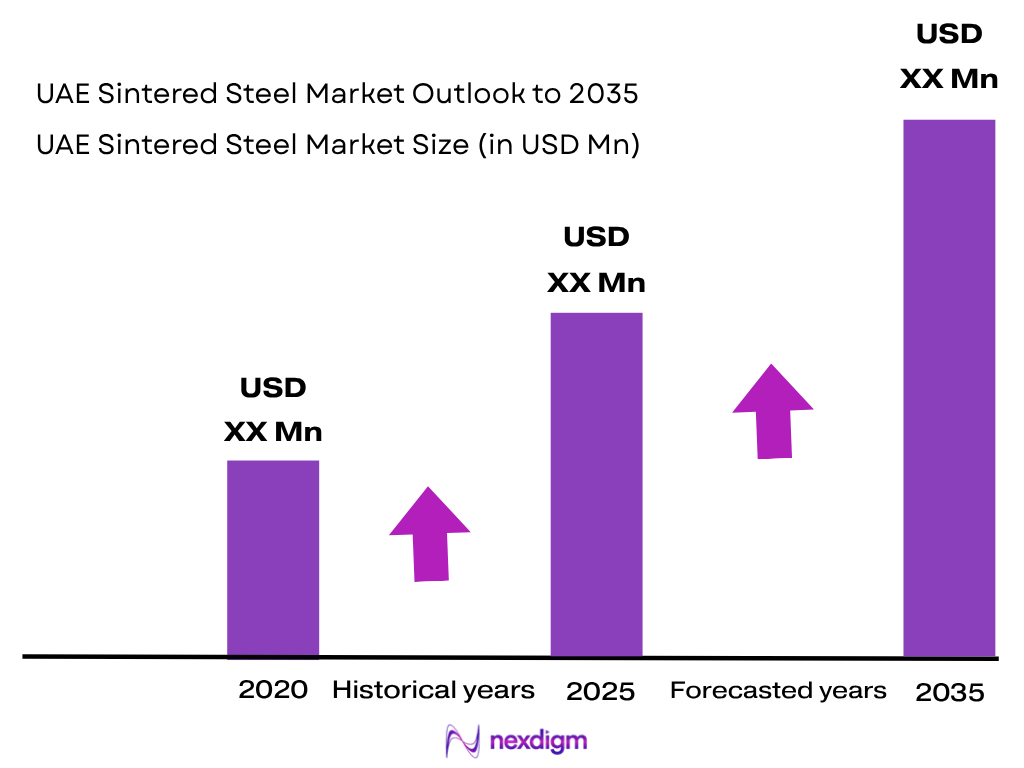
The UAE Sintered Steel Market is supported by the country’s expanding industrial manufacturing ecosystem, particularly automotive components, industrial machinery, oil and gas equipment, electrical equipment and precision engineering. The UAE’s Operation 300bn targets an increase in industrial-sector GDP contribution from AED 133 billion to AED 300 billion, creating a long-term policy framework for domestic manufacturing and industrial localization. The UAE also introduced a federal energy-management regulation for industrial facilities, targeting a 33% reduction in industrial energy demand by 2050. These initiatives support demand for material-efficient manufacturing technologies such as powder metallurgy, where near-net-shape production can reduce material waste and secondary machining requirements. u.ae
Abu Dhabi and Dubai represent the principal industrial and commercial centers relevant to UAE sintered steel demand because they combine large industrial clusters, logistics infrastructure, engineering companies, energy-sector activity and access to international supply chains. Abu Dhabi is particularly important for oil and gas, energy, heavy industry and industrial manufacturing applications, while Dubai provides a major trading, distribution and engineering hub. Sharjah, Ras Al Khaimah and other emirates add manufacturing capacity across machinery, metal processing, construction-related equipment and industrial products. The UAE’s Make it in the Emirates program specifically promotes local production and investment in priority industrial products, strengthening the potential customer base for locally supplied precision components. Ministry of Economy and Industry
Market Segmentation
By Product Type
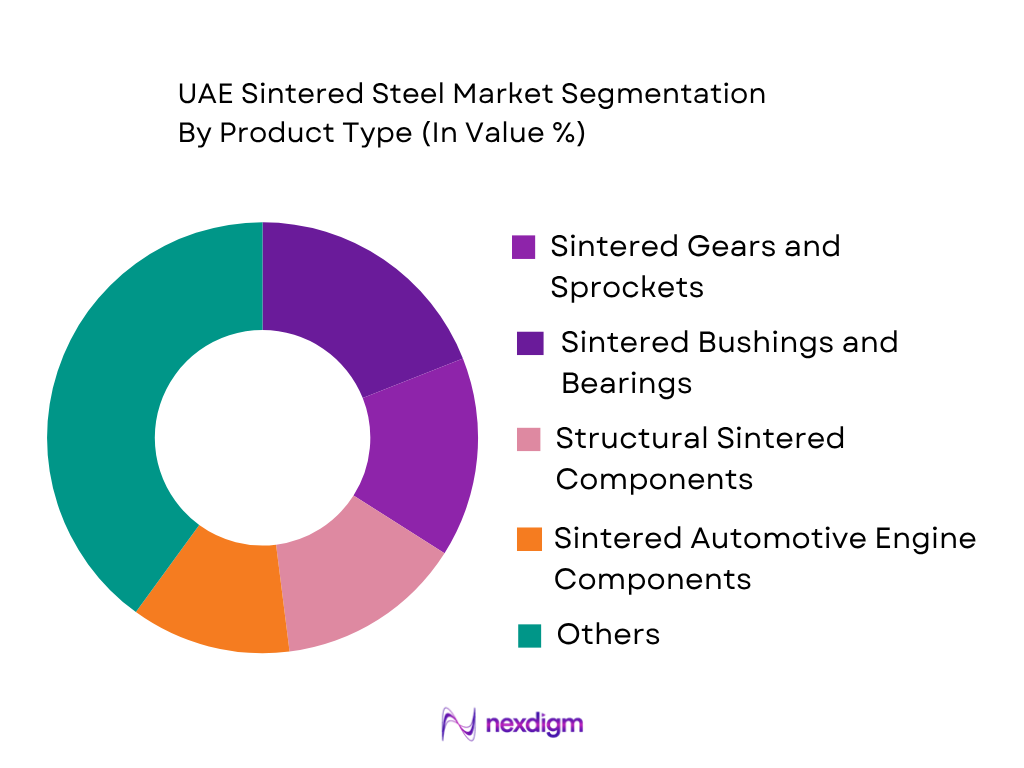
The UAE Sintered Steel Market is segmented by product type into structural sintered steel components, sintered gears and sprockets, bushings and bearings, engine components, transmission components, electrical and magnetic components, compressor components, pump components, filters and other precision components. Sintered gears and sprockets are expected to represent a leading product category because powder metallurgy is suited to repeatable production of geometrically complex components requiring dimensional consistency and controlled material properties. Automotive, industrial machinery, HVAC, pumps and power-equipment applications provide multiple demand channels. The UAE’s industrial strategy supports local manufacturing and technology adoption, while its substantial oil and gas and engineering ecosystem creates demand for pumps, compressors, actuators and rotating equipment. The country’s industrial energy-management framework also encourages investment in efficient manufacturing technologies. These conditions create a potential pathway for sintered components that combine material efficiency, repeatable production and integration into automated manufacturing lines. The percentage figures below are analytical placeholders, rather than publicly reported UAE market shares.
By End-Use Industry
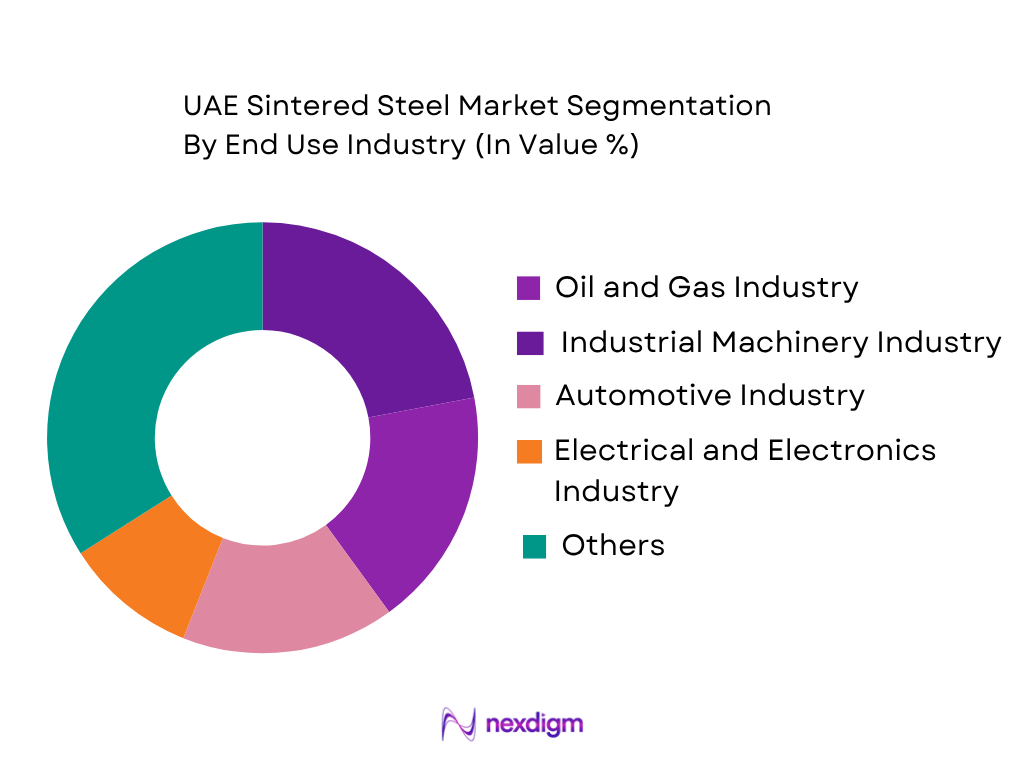
The UAE Sintered Steel Market is segmented by end-use industry into automotive, electric vehicle and hybrid vehicle, oil and gas, industrial machinery, aerospace, electrical and electronics, HVAC and refrigeration, power generation, construction equipment, marine and offshore, and medical and precision engineering. Oil and gas and industrial equipment applications represent important demand areas because the UAE has a large energy and engineering ecosystem requiring pumps, valves, compressors, gears, bearings and other precision metal components. OPEC records UAE crude production at 2.916 million barrels per day in 2024, illustrating the scale of the upstream energy ecosystem that supports extensive equipment and maintenance requirements. At the same time, Operation 300bn and Make it in the Emirates are designed to increase local industrial production and localization, supporting opportunities for domestic component manufacturing.
Competitive Landscape
The UAE Sintered Steel Market comprises international powder-metallurgy specialists, metal-powder producers and engineering-component manufacturers serving UAE customers through direct operations, regional subsidiaries, distributors or industrial partnerships. Competition is influenced by powder-material expertise, component design capability, production scalability, automotive and industrial qualification experience, secondary processing and proximity to customers. Local industrial-policy initiatives also create a competitive dimension around localization, technology transfer and domestic value creation. The UAE’s Ministry of Industry and Advanced Technology provides an industrial ecosystem focused on increasing the contribution of manufacturing to GDP and promoting advanced technologies.
| Company | Establishment Year | Headquarters | Powder Metallurgy Capability | Key Component Focus | Major End-Use Exposure | Material Capability | Manufacturing Model | UAE Market Relevance |
| GKN Powder Metallurgy | 1935 | Germany | ~ | ~ | ~ | ~ | ~ | ~ |
| Höganäs AB | 1797 | Sweden | ~ | ~ | ~ | ~ | ~ | ~ |
| Miba AG | 1927 | Austria | ~ | ~ | ~ | ~ | ~ | ~ |
| Sumitomo Electric Industries | 1897 | Japan | ~ | ~ | ~ | ~ | ~ | ~ |
| Ames Group | 1951 | Spain | ~ | ~ | ~ | ~ | ~ | ~ |
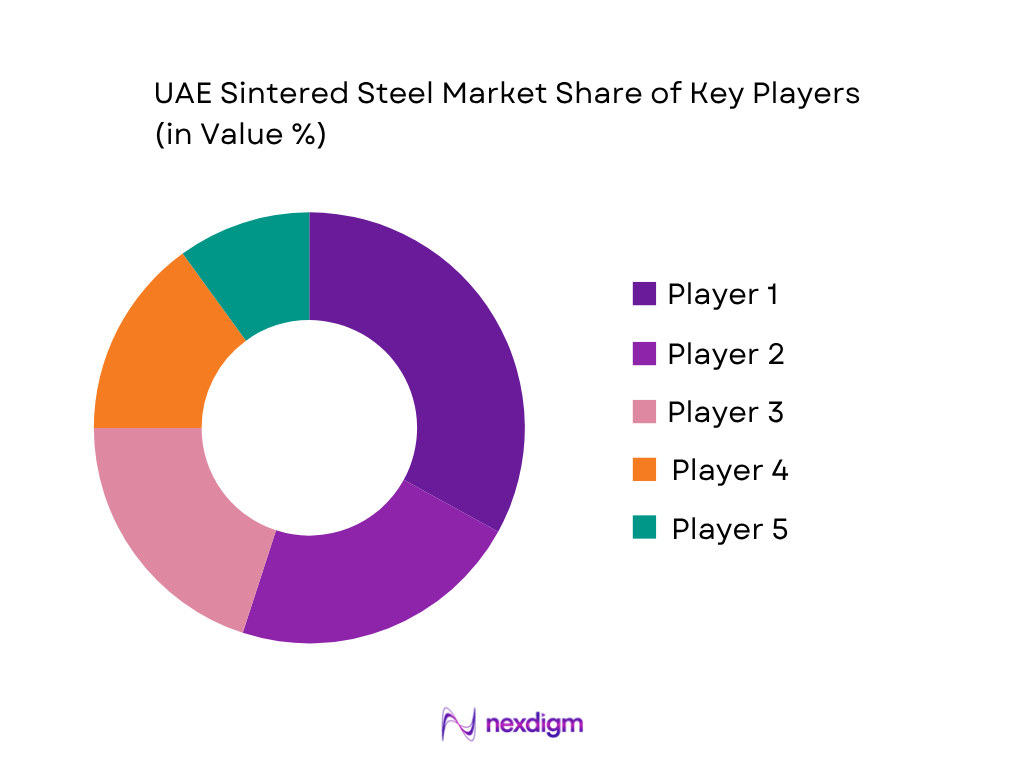
UAE Sintered Steel Market Analysis
Growth Drivers
Expansion of Advanced Manufacturing
The UAE Sintered Steel Market is supported by the country’s rapid development of advanced and technology-intensive manufacturing, creating a broader downstream base for powder-metallurgy components used in machinery, automotive systems, electrical equipment, pumps and precision-engineered products. The World Bank reports that industry, including construction, accounted for 44.3% of UAE GDP in 2024, while manufacturing value added represented approximately 9% of GDP, demonstrating the scale of industrial activity relevant to engineered metal components. The UAE Ministry of Industry and Advanced Technology reported AED 9.5 billion in industrial-sector financing during 2024, including AED 1.1 billion directed toward advanced technology. The same industrial ecosystem is being supported through Operation 300bn, which targets an industrial GDP contribution of AED 300 billion. In addition, the Transform 4.0 initiative launched in 2024 targets 100 high-potential manufacturers for digital transformation and Industry 4.0 adoption. These investments support automation, precision production, digital quality control and advanced manufacturing capabilities, creating favorable conditions for sintered steel components where repeatability, material efficiency and complex geometries are important. The combination of industrial financing, manufacturing modernization and technology transformation strengthens the potential adoption of powder-metallurgy solutions across UAE industrial applications.
Automotive and Mobility Component Development
Automotive and mobility manufacturing provides an important downstream opportunity for the UAE Sintered Steel Market because powder-metallurgy components can be incorporated into gears, bushings, bearings, rotors, transmission systems, actuator assemblies and other precision applications. The UAE’s industrial diversification strategy explicitly identifies advanced manufacturing and transportation-related industries as priority areas, while the Ministry of Industry and Advanced Technology reported AED 3.3 billion of industrial investments in biotechnology, hydrogen and electric vehicles in its reported industrial achievements. The UAE’s broader manufacturing ecosystem is also supported by AED 73 billion in corporate spending redirected into the national economy through the National In-Country Value Programme as of Q3 2024. This localization mechanism can encourage procurement from UAE-based manufacturers and suppliers, creating opportunities for precision-component producers. The automotive opportunity also extends beyond conventional internal-combustion vehicles because EV platforms require electric-motor components, magnetic components, thermal-management hardware and compact mechanical assemblies. The UAE’s industrial policy is therefore relevant to sintered steel producers seeking to establish local component manufacturing, qualification and supply relationships. As manufacturing becomes more automated and component designs increasingly emphasize dimensional accuracy, lightweight construction and material utilization, powder metallurgy can address applications requiring high-volume repeatability and near-net-shape production.
Market Challenges
Dependence on Imported Metal Powders
Dependence on imported iron, alloy and specialty metal powders presents a structural challenge for the UAE Sintered Steel Market because local component manufacturers require reliable access to qualified powder grades, consistent particle-size distributions and application-specific alloy compositions. UAE industrial activity is substantial, with the World Bank recording industry including construction at 44.3% of GDP in 2024, but the country’s powder-metallurgy ecosystem remains considerably narrower than its broader industrial base. The UAE Ministry of Industry and Advanced Technology’s industrial strategy is consequently focused on increasing domestic manufacturing and import substitution. The ministry reported AED 9.3 billion in import-substitution projects in its industrial achievements, illustrating the scale of opportunity associated with reducing dependence on externally supplied industrial products. The National ICV Programme had redirected more than AED 73 billion of corporate spending into the national economy by Q3 2024, reinforcing the policy emphasis on domestic value creation. For sintered steel producers, however, localization requires more than component pressing and sintering; access to qualified powders, technical material specifications and stable international supply chains remains essential. Exposure to international logistics, alloy availability and foreign material qualification can therefore affect production planning. Building local powder-processing capabilities and developing qualified regional supply relationships would help address this constraint while supporting the UAE’s wider industrial-localization objectives.
High Tooling Requirements and Specialized Sintering Equipment
High tooling requirements, specialized presses and controlled-atmosphere sintering equipment can restrict entry and expansion within the UAE Sintered Steel Market, particularly for manufacturers seeking to produce complex automotive, aerospace, oil and gas or safety-critical components. Powder-metallurgy production requires coordinated investment in powder handling, die tooling, compaction, sintering, sizing, heat treatment and inspection systems, while technical qualification becomes more demanding for components exposed to high loads, temperature or wear. UAE industrial financing has expanded to support these technology requirements: the Ministry of Industry and Advanced Technology reported AED 9.5 billion in industrial financing during 2024, including AED 1.1 billion for advanced technology. The government also launched Transform 4.0 with an objective of supporting 100 manufacturers in advancing digital maturity and Industry 4.0 capabilities. These figures indicate an industrial environment increasingly oriented toward technology-intensive manufacturing, but they also highlight the capital and capability requirements facing component producers. Energy efficiency is another consideration because sintering requires controlled thermal processing. The UAE’s federal energy-management framework targets a 33% reduction in industrial energy demand by 2050, increasing the importance of efficient furnaces, process control and energy monitoring. Consequently, manufacturers must balance tooling utilization, equipment productivity, quality requirements and energy efficiency when scaling sintered steel production.
Market Opportunities
Automotive, EV and Industrial Sintered Components
The UAE Sintered Steel Market has an opportunity to expand through localized production of automotive, EV and industrial components as the country increases domestic manufacturing and technology-intensive industrial activity. The UAE’s industrial sector is supported by Operation 300bn, whose target is to raise industrial GDP contribution to AED 300 billion, while the Emirates Development Bank has allocated a AED 30 billion financing portfolio for priority industrial sectors. These sectors include manufacturing areas such as heavy industries, machinery, electrical appliances and renewable-energy equipment, which correspond with several applications for sintered components. The UAE also recorded AED 73 billion in corporate spending redirected into the national economy through the National ICV Programme by Q3 2024, creating a stronger policy environment for domestic supplier development. Automotive and EV applications can include gears, bushings, bearings, rotors, motor components and structural parts, while industrial machinery can utilize precision components for pumps, compressors, actuators and drive systems. The opportunity is particularly relevant where manufacturers require repeatable production, complex geometries and efficient material utilization. As local industrial procurement expands, sintered steel suppliers can develop application-specific components rather than relying exclusively on imported finished parts. This creates potential for technology partnerships, localized tooling, component qualification and integration with UAE automotive, machinery and advanced-manufacturing supply chains.
Oil and Gas, Aerospace and Advanced Sintering Technologies
Oil and gas, aerospace, high-performance industrial equipment and advanced manufacturing provide additional opportunities for the UAE Sintered Steel Market because these industries require precision components capable of meeting demanding dimensional, mechanical and durability specifications. OPEC records UAE crude oil production at 2.916 million barrels per day in 2024, providing a substantial energy-sector equipment ecosystem for pumps, compressors, valves, rotating machinery and related components. At the same time, IMF analysis indicates that non-hydrocarbon activity remained a major driver of UAE economic performance, with non-hydrocarbon output growing 5% in 2024, supported by diversification and domestic demand. The UAE’s industrial financing structure also allocated AED 1.1 billion toward advanced technology during 2024, creating an enabling environment for higher-value manufacturing. Advanced sintering technologies such as sinter-hardening, high-density compaction, controlled-atmosphere processing and specialized alloy systems can help producers target applications where conventional manufacturing involves extensive machining or material waste. Powder-based additive manufacturing can further complement conventional powder metallurgy for low-volume, complex geometries and development-stage components. The opportunity therefore extends beyond standard automotive parts toward specialized industrial components, energy equipment and aerospace applications requiring engineered materials and tighter manufacturing control.
Future Outlook
Over the coming decade, the UAE Sintered Steel Market is expected to develop alongside industrial localization, advanced manufacturing and engineering-intensive industries. Demand opportunities are linked to automotive components, industrial machinery, oil and gas equipment, aerospace manufacturing, electrical systems and emerging electrification applications. Operation 300bn provides a strategic foundation for expanding domestic industrial production, while Make it in the Emirates is designed to attract investment and encourage localization of priority products. The government’s energy-management regulation also creates an operating environment increasingly focused on efficient industrial technologies and resource utilization. Ministry of Economy and Industry
Major Players
- GKN Powder Metallurgy
- Höganäs AB
- Miba AG
- Sumitomo Electric Industries Ltd.
- Ames Group
- Fine Sinter Co., Ltd.
- Hitachi Powdered Metals
- Porite Corporation
- Tsubaki Nakashima Co., Ltd.
- Sandvik AB
- Kobe Steel Ltd.
- Kymera International
- Pometon Powder
- Burgess-Norton
- Sumitomo Electric Sintered Alloy Ltd.
Key Target Audience
- Automotive and Automotive Component Manufacturers
- Industrial Machinery and Equipment Manufacturers
- Oil and Gas Equipment Manufacturers
- Aerospace and Defense Component Manufacturers
- Electrical, Electronics and Motor Manufacturers
- Investments and Venture Capitalist Firms (Industrial Technology, Advanced Manufacturing and Manufacturing Localization Investors)
- Government and Regulatory Bodies (Ministry of Industry and Advanced Technology, Ministry of Energy and Infrastructure, Abu Dhabi Department of Economic Development, Dubai Department of Economy and Tourism)
- Industrial Distributors and Engineering Procurement Companies
Research Methodology
Step 1: Identification of Key Variables
The initial phase involves mapping the UAE sintered steel ecosystem across metal-powder suppliers, tooling companies, powder-metallurgy manufacturers, engineering companies, distributors and end-use industries. Variables include component production, powder consumption, manufacturing processes, application demand, localization, imports and industrial investment. UAE industrial policies and manufacturing initiatives are incorporated into the market framework. Ministry of Interior Affairs
Step 2: Market Analysis and Construction
Historical and current industry information is compiled to construct the UAE Sintered Steel Market database. The assessment evaluates component demand across automotive, oil and gas, industrial machinery, aerospace, HVAC, electrical equipment and other applications. Bottom-up calculations are structured around component consumption, manufacturing capacity, application penetration and supplier-level activity rather than relying solely on broad steel-industry indicators.
Step 3: Hypothesis Validation and Expert Consultation
Market hypotheses are validated through discussions with manufacturers, component buyers, engineering companies, industrial distributors and technical specialists. Interviews focus on powder-material requirements, component qualification, production processes, application specifications, supplier selection and localization. Secondary information from UAE government industrial databases is used to corroborate company-level and industry-level observations.
Step 4: Research Synthesis and Final Output
The final stage triangulates supply-side, demand-side and macro-industrial evidence to establish market estimates and segmentation structures. Government initiatives, industrial-development programs, energy regulations and manufacturing indicators are evaluated alongside component-level information. The resulting analysis separates directly observed information from analytical estimates and identifies areas where UAE-specific public data are unavailable. Ministry of Interior Affairs

- Executive Summary
- Research Methodology (Market Definitions and Assumptions, UAE Sintered Steel Market Classification, Powder Metallurgy Process Mapping, Market Sizing Framework, Top-Down Market Assessment, Bottom-Up Component Assessment, Demand-Side Evaluation, Supply-Side Evaluation, Primary Industry Interviews, Manufacturer and Distributor Validation, Data Triangulation, Forecasting Framework, Market Boundary Conditions, Limitations and Conclusions)

- Definition and Scope
- UAE Sintered Steel Industry Evolution
- Sintered Steel Manufacturing Process Analysis
- UAE Sintered Steel Value Chain Analysis
- UAE Sintered Steel Supply Chain Analysis

- Growth Drivers (Expansion of Advanced Manufacturing, Automotive and Mobility Component Development, Industrial Machinery Manufacturing, Oil and Gas Equipment Demand, Aerospace Manufacturing Development, In-Country Value Programs, Make it in the Emirates Initiative, Industrial Automation, Precision Engineering and Manufacturing Localization)
- Market Challenges (Dependence on Imported Metal Powders, Limited Domestic Powder Metallurgy Capacity, High Tooling Requirements, Specialized Sintering Equipment, Technical Qualification Requirements, Material Qualification Constraints, Energy-Intensive Processing, Limited Local Alloy Powder Availability, Competition from Machining and Forging and Dependence on International Technology)
- Market Opportunities (Automotive Sintered Components, EV Motor Components, Oil and Gas Equipment Components, Aerospace Powder Metal Components, Industrial Machinery Components, Soft Magnetic Components, Compressor and Pump Components, High-Density Powder Metallurgy Components, Advanced Sintering Technologies and Powder-Based Additive Manufacturing)
- Market Trends (Near-Net-Shape Manufacturing, Lightweight Component Development, Powder Metallurgy for Electrification, Soft Magnetic Materials, Advanced Sinter-Hardening, Digital Manufacturing, Automated Quality Inspection, Material Efficiency, Additive Manufacturing Integration and Sustainable Industrial Production)
- Government Regulations and Standards (UAE Industrial Strategy, Operation 300bn, Make it in the Emirates, In-Country Value Program, UAE Industrial Registry, Federal Energy Management Regulation in Industrial Facilities, UAE Quality Infrastructure, Emirates Authority for Standardization and Metrology Requirements, Environmental Compliance and Industrial Licensing Requirements)
- SWOT Analysis
- Porter’s Five Forces Analysis
- PESTLE Analysis
- Stakeholder Ecosystem

- By Market Value (2020-2025)
- By Production Volume (2020-2025)
- By Consumption Volume (2020-2025)
- By Sintered Component Production Volume (2020-2025)
- By Metal Powder Consumption Volume (2020-2025)
- By Iron-Based Powder Consumption Volume (2020-2025)

- By Product Type (In Value %)
Structural Sintered Steel Components
Sintered Gears and Sprockets
Sintered Bushings and Bearings
Sintered Engine Components
Sintered Chassis and Suspension Components
Sintered Electrical and Magnetic Components
Sintered Compressor Components
Sintered Pump Components
Sintered Power Tool Components
Other Precision Sintered Steel Components - By Material Type (In Value %)
Iron-Based Sintered Steel
Iron-Carbon Sintered Steel
Iron-Copper Sintered Steel
Iron-Nickel Sintered Steel
Low-Alloy Sintered Steel
High-Strength Sintered Steel
Stainless Sintered Steel
Soft Magnetic Sintered Materials
High-Performance Alloy Powder Materials - By Manufacturing Process (In Value %)
Conventional Pressing and Sintering
High-Temperature Sintering
Metal Injection Molding
Warm Compaction
High-Velocity Compaction
Hot Isostatic Pressing
Secondary Machining and Sizing
Heat Treatment and Surface Hardening - By End-Use Industry (In Value %)
Automotive Industry
Electric Vehicle and Hybrid Vehicle Industry
Oil and Gas Industry
Industrial Machinery Industry
Electrical and Electronics Industry
HVAC and Refrigeration Industry
Power Generation Industry
Construction Equipment Industry
Marine and Offshore Industry
Medical and Precision Engineering Industry - By Component Application (In Value %)
Gears and Transmission Components
Bushings and Bearings
Rotors and Magnetic Components
Pumps and Fluid Handling Components
Compressors and HVAC Components
Engine and Powertrain Components
Valves and Flow-Control Components
Structural and Load-Bearing Components
Electrical and Electromagnetic Components
Filtration and Porous Components - By Customer Type (In Value %)
Automotive OEMs
Automotive Tier-1 Suppliers
Industrial Equipment Manufacturers
Oil and Gas Equipment Manufacturers
Aerospace Component Manufacturers
Electrical Equipment Manufacturers
HVAC and Refrigeration Manufacturers
Industrial Distributors

- Market Share of Major Players (By UAE Revenue, Product Portfolio, Sintered Component Capacity, Material Portfolio, End-Use Industry Coverage, Automotive Applications, Industrial Applications, Regional Presence, Distribution Reach, Customer Base, Technology Capability, Manufacturing Footprint, R&D Capability and Export Coverage)
- Cross Comparison Parameters (Sintered Component Product Breadth, Powder Metallurgy Technology Coverage, Metal Powder Portfolio, Automotive Component Capability, Industrial Component Capability, Production Capacity, Advanced Sintering Capability, EV and Electrification Component Capability)
- SWOT Analysis of Major Players
- Detailed Profiles of Major Companies
GKN Powder Metallurgy
Höganäs AB
Miba AG
Sumitomo Electric Industries Ltd.
Hitachi Powdered Metals
Porite Corporation
Fine Sinter Co., Ltd.
Burgess-Norton
Sintercom India Pvt. Ltd.
AMES Group
Pometon Powder
Tsubaki Nakashima Co., Ltd.
Kobe Steel Ltd.
Kymera International
Sandvik AB

- Automotive Component Procurement Assessment
- Electric Vehicle Component Requirement Assessment
- Oil and Gas Equipment Requirement Assessment
- Industrial Machinery Procurement Assessment
- Aerospace Component Requirement Assessment
- Electrical and Electronics Component Requirement Assessment

- By Market Value (2026-2035)
- By Production Volume (2026-2035)
- By Consumption Volume (2026-2035)
- By Sintered Component Production Volume (2026-2035)
- By Metal Powder Consumption Volume (2026-2035)
- By Iron-Based Powder Consumption Volume (2026-2035)


 Request a Sample
 Ask for Customization
 Get a Quote
 Enquire Now