

 Download PDF
 Download PDF
Market Overview
The UAE Small UAV market is driven by increasing government investments in defense and security, technological advancements, and growing commercial applications. With an estimated market size of USD ~ million based on a recent historical assessment, the demand for small UAVs is fueled by their ability to conduct surveillance, reconnaissance, and mapping tasks efficiently. The continuous improvement in UAV technology, particularly in autonomous systems and AI integration, contributes to a higher adoption rate across industries like agriculture, logistics, and defense.
The UAE has emerged as a key player in the small UAV market due to its strategic geopolitical position, robust infrastructure, and substantial investment in defense technology. The nation’s strong push towards innovation and smart city development has led to an increased focus on UAVs, with major cities like Dubai and Abu Dhabi serving as hubs for UAV adoption. Regulatory frameworks and government policies fostering UAV usage in both commercial and military sectors have reinforced its market dominance, with ongoing projects supporting UAV applications for disaster management and urban monitoring.

Market Segmentation
By Product Type
UAE Small UAV market is segmented by product type into surveillance UAVs, reconnaissance UAVs, mapping UAVs, inspection UAVs, and delivery UAVs. Recently, surveillance UAVs have a dominant market share due to their wide range of applications in defense, security, and infrastructure monitoring. The growing need for border surveillance, urban security, and monitoring large events has increased the demand for surveillance UAVs. The integration of AI and real-time data processing further enhances their capabilities, making them a go-to solution for various industries seeking efficient and reliable aerial surveillance.

By Platform Type
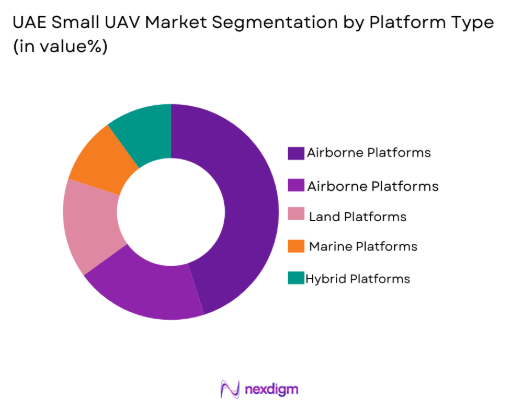
UAE Small UAV market is segmented by platform type into land platforms, airborne platforms, marine platforms, integrated platforms, and hybrid platforms. Airborne platforms dominate the market due to their versatile range, ability to cover large areas, and efficient surveillance and reconnaissance capabilities. These platforms are widely used in defense and commercial applications such as border control, surveillance of infrastructure, and aerial photography. Airborne UAVs’ ability to operate over long distances, coupled with the growing trend of autonomous systems, strengthens their position as the leading platform type in the UAE Small UAV market.
Competitive Landscape
The competitive landscape of the UAE Small UAV market is marked by a strong presence of both global and regional players. Consolidation is evident as major companies seek to enhance their market share through acquisitions and partnerships. Leading players such as DJI Innovations, Parrot SA, and AeroVironment dominate the market due to their advanced technology offerings and strong distribution networks. The market is also seeing the rise of homegrown players supported by government initiatives, pushing for more localized manufacturing and technology development.
|
Company Name |
Establishment Year | Headquarters | Technology Focus | Market Reach | Key Products | Revenue (USD) | Additional Parameter |
| DJI Innovations | 2006 | China | ~ | ~ | ~ | ~ | ~ |
| Parrot SA | 1994 | France | ~ | ~ | ~ | ~ | ~ |
| AeroVironment | 1978 | USA | ~ | ~ | ~ | ~ | ~ |
| Elbit Systems | 1966 | Israel | ~ | ~ | ~ | ~ | ~ |
| Northrop Grumman | 1939 | USA | ~ | ~ | ~ | ~ | ~ |

UAE Small UAV Market Analysis
Growth Drivers
Government Investment in UAV Technology
The UAE government’s focus on enhancing national security and defense capabilities has led to substantial investments in UAV technology. The government has recognized the potential of small UAVs in surveillance, reconnaissance, and defense operations. With the ongoing conflict in the region and an increasing need for border control, these UAVs are a critical component of the UAE’s defense strategy. Furthermore, the UAE’s vision to become a leader in advanced technology has resulted in funding and initiatives to promote the development and deployment of UAVs across various sectors. Additionally, collaborations with private companies and international defense players have helped the country to advance its capabilities in this domain, leading to a strong demand for small UAV systems.
Technological Advancements in UAV Systems
Rapid advancements in drone technology have significantly contributed to the growth of the UAE Small UAV market. Innovations such as enhanced battery life, autonomous navigation, and real-time data processing have made UAVs more efficient and practical for a range of applications. AI-powered UAVs capable of identifying targets, tracking movements, and providing real-time data to control centers have made significant strides. These developments, combined with improved manufacturing techniques, have made UAVs more accessible to commercial sectors such as logistics, construction, and agriculture. As the technology matures, the cost of UAV systems continues to decrease, expanding the market further.
Market Challenges
Regulatory Barriers and Airspace Restrictions
A major challenge to the growth of the UAE Small UAV market is the stringent regulatory environment and airspace restrictions imposed by authorities. While the government has made efforts to regulate UAV operations, there are still concerns about the integration of UAVs into controlled airspace, particularly in urban environments. Issues such as privacy concerns, security risks, and the potential for UAVs to interfere with manned aircraft pose significant challenges. Additionally, the approval process for commercial UAV operations can be lengthy, creating delays for businesses looking to adopt UAV technology. Navigating these regulatory hurdles is an ongoing challenge for both local and international companies looking to enter the market.
Cybersecurity and Data Protection Concerns
With the increasing use of UAVs for surveillance, reconnaissance, and military applications, there is growing concern over cybersecurity and the protection of sensitive data. Small UAVs often transmit data in real-time to central control systems, making them vulnerable to hacking, interference, and data breaches. The use of UAVs in military operations further heightens the risk of cyberattacks targeting critical infrastructure. Ensuring secure communication channels and encryption for data transmission is essential to mitigate these risks. However, addressing these cybersecurity concerns requires substantial investment in secure technologies, creating a barrier for some players in the market.
Opportunities
Expansion of UAV Applications in Commercial Sectors
One of the significant opportunities in the UAE Small UAV market is the expansion of UAV applications in the commercial sector. As industries such as logistics, agriculture, and construction seek innovative solutions to improve efficiency and reduce costs, small UAVs present a valuable tool. UAVs are already being used for tasks like aerial surveying, infrastructure inspection, and precision agriculture. In logistics, drones are being tested for last-mile deliveries, promising faster and cost-effective solutions. The UAE government’s commitment to fostering innovation, coupled with its push for smart city development, further strengthens the case for UAVs across these sectors.
Integration of AI and Machine Learning into UAVs
The integration of AI and machine learning technologies into small UAVs presents a tremendous growth opportunity in the market. These advanced technologies enable UAVs to process data more efficiently, make autonomous decisions, and improve operational performance. AI-driven UAVs are capable of identifying patterns, recognizing objects, and adapting to changing conditions in real-time. This technological leap opens new possibilities in sectors like agriculture for crop monitoring, in security for facial recognition, and in logistics for route optimization. As AI technology continues to evolve, small UAVs are expected to become more intelligent and versatile, further increasing their adoption.
Future Outlook
The future outlook for the UAE Small UAV market is promising, with continued growth expected over the next five years. Advances in UAV technology, particularly in AI and autonomy, will drive market expansion, while government support for innovation and regulatory frameworks will further facilitate adoption across industries. The demand for UAVs will continue to rise in defense, security, and commercial sectors as their applications expand. With substantial investment in infrastructure and technological development, the UAE is poised to remain a key player in the global UAV market, particularly in the Middle East region.
Major Players
- DJI Innovations
- Parrot SA
- AeroVironment
- Northrop Grumman
- General Atomics Aeronautical Systems
- Lockheed Martin
- Boeing
- Raytheon Technologies
- L3 Technologies
- Elbit Systems
- Saab Group
- Thales Group
- Israel Aerospace Industries
- FLIR Systems
- Textron Systems
Key Target Audience
- Investments and venture capitalist firms
- Government and regulatory bodies
- Defense and aerospace companies
- Logistics and transportation firms
- Security and surveillance service providers
- Technology firms focusing on AI and drones
- Military forces
- Research and development organizations
Research Methodology
Step 1: Identification of Key Variables
Identifying key factors such as technological trends, market drivers, and regulatory barriers that influence the small UAV market in the UAE.
Step 2: Market Analysis and Construction
Collecting primary and secondary data through expert interviews, industry reports, and government publications to construct a comprehensive market analysis.
Step 3: Hypothesis Validation and Expert Consultation
Validating the initial market hypotheses through consultations with industry experts, stakeholders, and relevant government bodies to ensure accuracy and reliability.
Step 4: Research Synthesis and Final Output
Synthesizing the collected data into a final report, analyzing trends, challenges, and growth opportunities to provide actionable insights for stakeholders in the UAE Small UAV market.

- Executive Summary
- Research Methodology (Definitions, Scope, Industry Assumptions, Market Sizing Approach, Primary & Secondary Research Framework, Data Collection & Verification Protocol, Analytic Models & Forecast Methodology, Limitations & Research Validity Checks)

- Market Definition and Scope
- Value Chain & Stakeholder Ecosystem
- Regulatory / Certification Landscape
- Sector Dynamics Affecting Demand
- Strategic Initiatives & Infrastructure Growth

- Growth Drivers
Rising Defense Expenditure and Military Modernization
Technological Advancements in Drone Systems
Increased Demand for UAVs in Commercial Sectors
Strategic Geopolitical Position of the UAE
Government Initiatives for UAV Development and Regulation - Market Challenges
High Initial Capital Investment
Regulatory Hurdles for UAV Operations
Cybersecurity Risks and Data Protection Concerns
Limited Battery Life and Range of Small UAVs
Public Perception and Privacy Concerns - Market Opportunities
Integration of AI and Machine Learning in UAV Systems
Expansion of UAV Applications in Commercial Industries
Development of Urban Air Mobility and Autonomous Systems - Trends
Adoption of UAVs for Delivery and Logistics
Integration of 5G Technology in UAV Operations
Increased Use of Small UAVs in Defense and Surveillance
Advancements in Battery Technology for UAVs
Collaboration between UAV Manufacturers and Government Bodies - Government Regulations & Defense Policy
Regulations for Civil UAV Use in National Airspace
Export Control and Compliance Policies for UAV Technologies
Government Funding and Grants for Drone Technology Development
SWOT Analysis
Stakeholder and Ecosystem Analysis
Porter’s Five Forces Analysis
Competition Intensity and Ecosystem Mapping

- By Market Value, 2020-2025
- By Installed Units, 2020-2025
- By Average System Price, 2020-2025
- By System Complexity Tier, 2020-2025

- By System Type (In Value%)
Surveillance UAVs
Reconnaissance UAVs
Mapping UAVs
Inspection UAVs
Delivery UAVs - By Platform Type (In Value%)
Land Platforms
Airborne Platforms
Marine Platforms
Integrated Platforms
Hybrid Platforms - By Fitment Type (In Value%)
Fixed-wing UAVs
Rotary-wing UAVs
Hybrid UAVs
Nano UAVs
Autonomous UAVs - By EndUser Segment (In Value%)
Military Forces
Government Agencies
Security & Surveillance Services
Private Sector / Technology Firms
Research Institutions - By Procurement Channel (In Value%)
Direct Procurement
Government Tenders
Private Sector Procurement
Online Bidding Platforms
Third-party Distributor - By Material / Technology (In Value%)
Carbon Fiber Materials
Composite Materials
Lithium Polymer Batteries
Autonomous Systems
AI & Machine Learning Technologies

- Market structure and competitive positioning
- Market share snapshot of major players
- Cross Comparison Parameters (System Type, Platform Type, Procurement Channel, EndUser Segment, Fitment Type)
- SWOT Analysis of Key Competitors
- Pricing & Procurement Analysis
- Porter’s Five Forces
- Key Players
DJI Innovations
Parrot SA
AeroVironment
Northrop Grumman
General Atomics Aeronautical Systems
Lockheed Martin
Boeing
Raytheon Technologies
L3 Technologies
Elbit Systems
Saab Group
Thales Group
Israel Aerospace Industries
FLIR Systems
Textron Systems

- Military Forces’ Growing Demand for Surveillance UAVs
- Government Agencies Seeking UAVs for Disaster Management
- Private Sector Adoption of UAVs for Commercial Applications
- Technology Firms Focusing on UAV Innovation for Automation

- Forecast Market Value, 2026-2035
- Forecast Installed Units, 2026-2035
- Price Forecast by System Tier, 2026-2035
- Future Demand by Platform, 2026-2035


 Request a Sample
 Ask for Customization
 Get a Quote
 Enquire Now