
 Download PDF
Market Overview
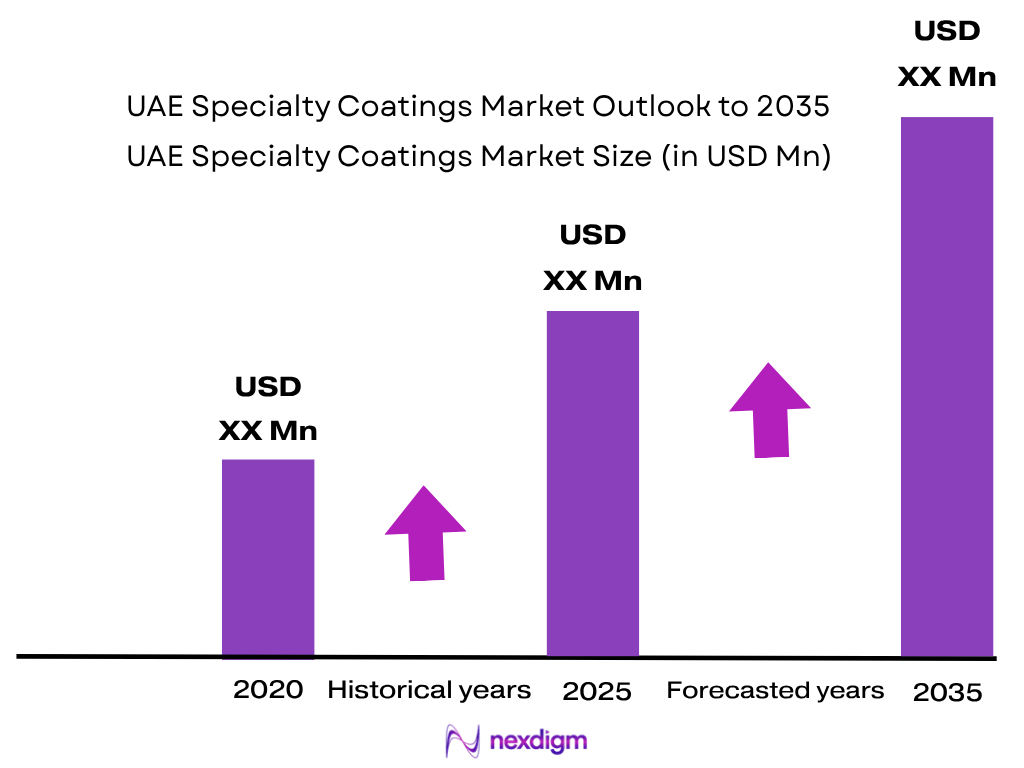
The UAE Specialty Coatings Market is valued at approximately USD ~ million, supported by construction, oil and gas, marine, manufacturing and infrastructure demand. Underlying activity remains strong: UAE construction expanded by 8.9% in the preceding annual period and by 8.4% in the latest reported annual period. Abu Dhabi construction alone generated more than AED 97 billion in value added in the earlier period, strengthening consumption of corrosion-resistant, protective and industrial coating systems.
Abu Dhabi and Dubai represent the UAE’s principal specialty-coatings demand centres. Abu Dhabi benefits from a large oil-and-gas asset base, industrial facilities and infrastructure investment; ADNOC operates around 35 producing fields and has approximately 4.85 million barrels per day of production capacity. Dubai benefits from large-scale real estate, infrastructure, aluminium façade, marine and commercial construction activity. UAE airport traffic also reached 147.8 million passengers in the latest reported period, supporting aviation and infrastructure-related coating demand.
Market Segmentation
By Product Type
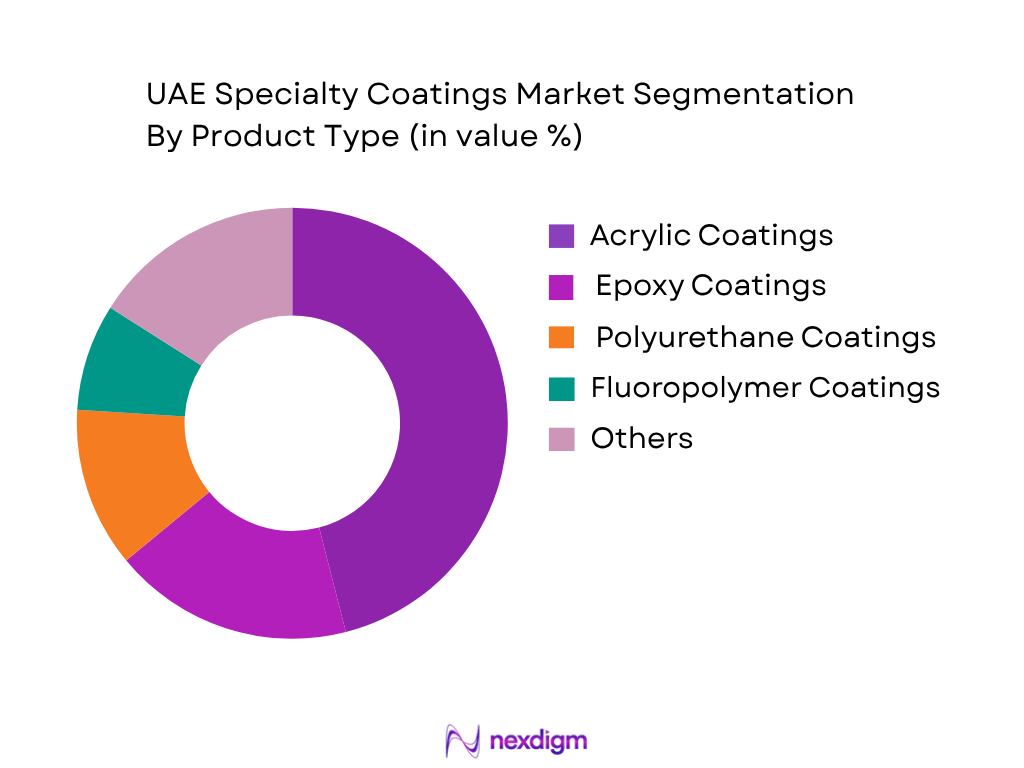
The UAE Specialty Coatings Market is segmented by product type into acrylic coatings, epoxy coatings, polyurethane coatings, fluoropolymer coatings, silicone coatings, alkyd coatings and other specialized systems. Acrylic coatings currently represent the dominant product category. Their position is supported by a combination of UV resistance, weatherability, relatively attractive cost, adhesion and compatibility with several substrates, including metal, plastic, glass and construction surfaces. These characteristics are particularly relevant in the UAE, where high solar exposure, temperature extremes and demanding exterior conditions influence coating selection. Acrylic products also address a broader application spectrum than highly specialized fluoropolymer or silicone systems, allowing suppliers to serve construction, transportation, electronics and industrial customers through one chemistry platform. Public industry research reports that acrylic coatings account for more than 45% of the UAE specialty-coatings market, confirming the category’s leading position.
By Application
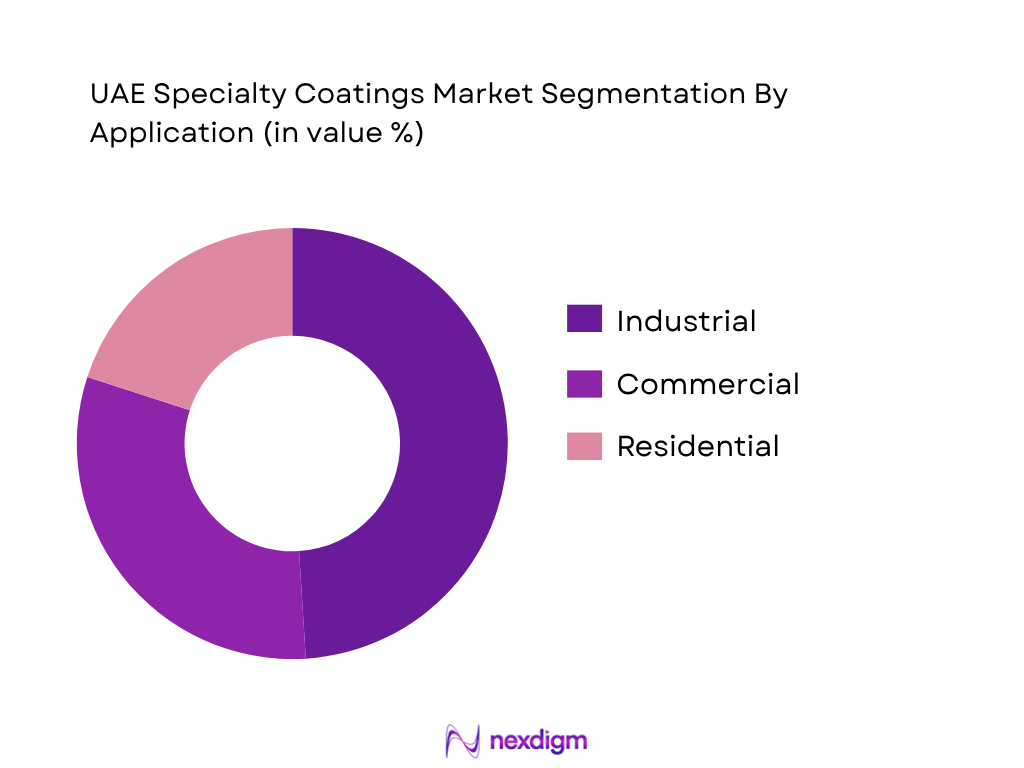
The UAE Specialty Coatings Market is segmented by application into industrial, commercial and residential applications, with industrial demand further encompassing manufacturing, automotive, energy, marine, aerospace and electronics. The industrial segment is dominant because UAE assets frequently operate under demanding heat, salinity, chemical exposure and abrasion conditions that require higher-performance coating systems. Oil and gas installations, fabricated steel, marine vessels, industrial machinery and energy facilities generate both initial coating demand and recurring maintenance requirements. The UAE’s strategy of expanding domestic manufacturing further reinforces this segment by increasing the installed base of machinery, metal structures and production assets requiring protection. Public specialty-coatings research identifies industrial applications as accounting for more than 48% of demand, placing the segment ahead of commercial infrastructure, buildings and residential applications.
Competitive Landscape
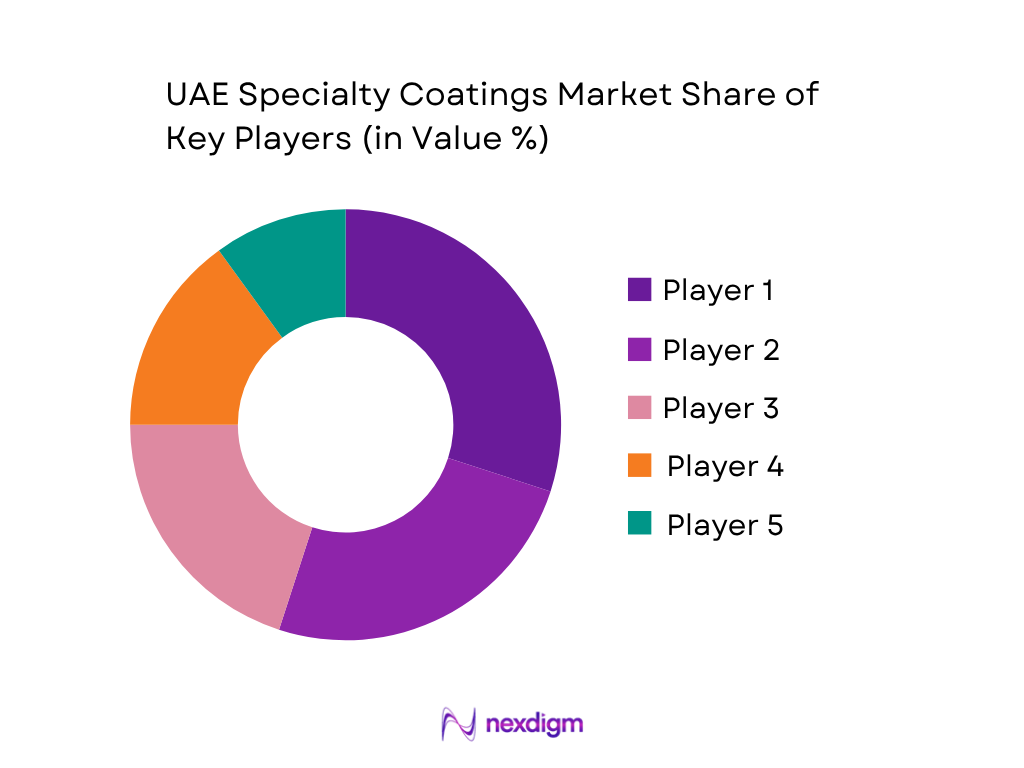
The UAE Specialty Coatings Market has a mixed competitive structure comprising large international coating groups and established regional manufacturers. Jotun, AkzoNobel, Hempel, PPG Industries and Sherwin-Williams benefit from broad performance-coatings portfolios, international technical expertise and established relationships with industrial customers, EPC contractors, fabricators and asset owners. Competition increasingly extends beyond product pricing to approved-vendor status, technical service, coating-system life, application productivity, sustainability performance and local availability. UAE protective-coatings research also identifies Jotun, AkzoNobel and Sherwin-Williams among prominent market participants.
| Company | Establishment Year | Headquarters | UAE / Regional Presence | Key Specialty Coatings | Core UAE End Uses | Technology Capability | Technical / Application Support | Sustainability / Qualification Position |
| Jotun | 1926 | Sandefjord, Norway | ~ | ~ | ~ | ~ | ~ | ~ |
| AkzoNobel | 1994 | Amsterdam, Netherlands | ~ | ~ | ~ | ~ | ~ | ~ |
| Hempel | 1915 | Kongens Lyngby, Denmark | ~ | ~ | ~ | ~ | ~ | ~ |
| PPG Industries | 1883 | Pittsburgh, United States | ~ | ~ | ~ | ~ | ~ | ~ |
| Sherwin-Williams | 1866 | Cleveland, United States | ~ | ~ | ~ | ~ |
UAE Specialty Coatings Market Analysis
Growth Drivers
Expanding Construction and Infrastructure Asset Base
The expansion of construction activity across Abu Dhabi and Dubai is a direct demand driver for the UAE Specialty Coatings Market because new buildings, structural steel, façades, concrete floors, utility structures and transport infrastructure require protective, fire-resistant, floor and weather-resistant coating systems. Statistics Centre – Abu Dhabi reported AED 107.4 billion of construction-sector value added in 2024, while manufacturing generated another AED 111.6 billion, creating a substantial installed base of structures and industrial assets requiring coating protection. Dubai Municipality data published through Digital Dubai recorded 18,114 buildings under construction in 2024, comprising 9,297 private villas, 6,277 investment villas, 1,024 multi-storey buildings, 969 public buildings and 547 industrial buildings. At the broader macroeconomic level, the World Bank recorded UAE GDP at USD 552.32 billion and GDP per capita at USD 50,273.5 in 2024. These activity levels support recurring consumption of epoxy primers, polyurethane topcoats, powder coatings, intumescent systems, concrete-protection coatings and architectural performance finishes, particularly where assets face intense heat, ultraviolet exposure, coastal conditions and demanding lifecycle specifications.
Large Oil, Gas and Offshore Asset-Protection Requirement
The UAE Specialty Coatings Market is strongly supported by the scale of Abu Dhabi’s hydrocarbon infrastructure, where corrosion-control coatings, tank linings, high-temperature coatings, offshore systems and chemical-resistant technologies are critical to asset integrity. ADNOC’s 2024 Sustainability Report states that its upstream operations cover 35 producing fields, supported by production capacity of approximately 4.85 million barrels of oil per day and 11.5 billion standard cubic feet of gas per day. ADNOC Offshore separately operates 9 established offshore fields, 8 super complexes and 6 artificial islands, creating extensive steel surfaces exposed to seawater, humidity, splash-zone corrosion and aggressive operating conditions. ADNOC Drilling ended 2024 with 142 rigs, including 95 onshore rigs and 47 offshore rigs, while ADNOC Refining operates a pipeline network extending approximately 1,600 kilometres and facilities capable of refining nearly 1 million barrels of crude oil and condensates per day. These operating assets require scheduled inspection, maintenance and recoating, sustaining demand beyond initial project construction and favouring technically qualified specialty-coating suppliers with offshore, immersion, tank-lining and high-temperature capabilities.
Market Challenges
Dependence on International Supply Chains for Coating Inputs and Finished Systems
Supply-chain exposure remains a material challenge for the UAE Specialty Coatings Market because specialty formulations depend on globally sourced epoxy resins, polyols, isocyanates, pigments, additives, solvents and other performance chemicals, while several premium finished systems are also imported. Official UAE foreign-trade data show non-oil imports reached AED 1.701 trillion in 2024, illustrating the scale of the country’s dependence on international supply channels for manufactured products and industrial inputs. Abu Dhabi Customs separately reported AED 140.2 billion of non-oil imports during 2024. The logistical system supporting these flows is extensive: Jebel Ali Port handled 15.5 million TEUs and 5.4 million metric tonnes of breakbulk cargo during 2024, while AD Ports Group handled 6.3 million TEUs and 56.1 million tonnes of general and bulk cargo. For specialty-coatings suppliers, disruption in shipping lanes, imported chemical availability or container movement can translate into longer replenishment cycles and inventory-management pressure. The challenge is especially relevant to project coatings because EPC contractors and applicators typically require complete multi-layer systems, compatible thinners, hardeners and primers to be available simultaneously for scheduled application windows.
Product Qualification and Application-Control Complexity Across High-Performance Projects
Specialty coatings in the UAE face a demanding qualification environment because products used on regulated buildings, industrial facilities, infrastructure and energy assets must satisfy technical specifications, laboratory testing requirements and customer approval procedures before application. The Ministry of Industry and Advanced Technology’s product-conformity platform currently contains 19,745 product-conformity records, and its database includes ECAS certificates specifically covering paint categories such as interior flat paints and multilayer primers. The scale of assets requiring specification control adds further complexity: Dubai Municipality recorded 18,114 buildings under construction in 2024, while ADNOC operated 35 producing fields and ADNOC Drilling maintained 142 rigs during the same period. These assets involve substantially different substrates, film-thickness requirements, corrosion classes, curing conditions and inspection procedures. Failure to match coating chemistry with exposure conditions can lead to adhesion loss, premature corrosion or costly recoating. Consequently, manufacturers must maintain technical-documentation capability, accredited testing support, qualified applicator relationships and field-level inspection assistance. Smaller suppliers may find it difficult to secure specification acceptance where established asset owners require documented technical performance and complete coating-system compatibility.
Market Opportunities
Industrial Localization Creates Scope for Higher-Performance Factory-Applied Coatings
Continued expansion of domestic manufacturing creates a substantial future opportunity for the UAE Specialty Coatings Market, particularly for powder coatings, protective systems, machinery coatings, floor coatings, chemical-resistant linings and coatings for fabricated metal components. Statistics Centre – Abu Dhabi recorded manufacturing value added of AED 111.6 billion in 2024, demonstrating the scale already achieved by one of the country’s principal industrial centres. Dubai Municipality simultaneously recorded 547 industrial buildings under construction, providing an additional pipeline of production and warehousing assets requiring industrial floors, steel protection and functional surface finishes. National trade statistics show UAE non-oil goods exports reached AED 561.2 billion in 2024, while total non-oil foreign trade reached AED 2.997 trillion. This manufacturing and export base provides coating producers with opportunities to move beyond construction demand and become embedded within domestic fabrication, aluminium processing, machinery, metal-products and industrial-equipment supply chains. Suppliers that establish local blending, colour matching, rapid technical service and specification support can benefit from shorter delivery requirements and the UAE’s emphasis on domestic industrial capability, while powder and high-solids systems are particularly suited to organized factory-application environments.
Marine, Port and Transportation Assets Expand the Addressable Specialty-Coating Base
The UAE’s exceptionally active port and vehicle-logistics ecosystem provides a strong future opportunity for marine, anti-corrosion, antifouling, automotive-refinish and heavy-equipment specialty coatings. DP World reported that Jebel Ali Port handled 15.5 million TEUs and 5.4 million metric tonnes of breakbulk cargo in 2024. The port has more than 100 berths, a 25-kilometre quay and annual container capacity of 19.4 million TEUs, creating a large concentration of marine infrastructure exposed to saltwater, abrasion and intensive cargo operations. In Abu Dhabi, AD Ports Group handled 6.3 million TEUs and 56.1 million tonnes of general and bulk cargo during 2024. Transportation-related demand is also significant: DP World’s Dubai terminals processed 1.3 million vehicles in 2024, including nearly 960,000 units through Jebel Ali. These current activity levels create an expanding installed base of vessels, port structures, containers, handling equipment, automotive assets and fabricated steel requiring protective maintenance. Suppliers offering antifouling systems, immersion coatings, zinc-rich primers, high-build epoxies, polyurethane topcoats and automotive refinishing technologies are positioned to capture recurring maintenance and refurbishment requirements.
Future Outlook
The UAE Specialty Coatings Market is expected to expand at a forecast CAGR of approximately ~XX% during 2026–2035. Growth will increasingly be influenced by industrial diversification, oil-and-gas asset protection, large infrastructure programs, marine maintenance and higher demand for coating systems that reduce lifecycle maintenance costs. Low-VOC, waterborne, high-solids, powder and solvent-free technologies are also expected to gain relevance as environmental and project-performance requirements tighten.
The strongest opportunity will remain in corrosion-intensive applications. UAE infrastructure and industrial assets are exposed to intense UV radiation, high temperatures, humidity and coastal salinity, creating recurring demand for epoxy primers, polyurethane topcoats, zinc-rich systems and specialist protective layers. In energy, ADNOC is expanding toward 5 million barrels per day of production capacity, supporting future requirements for pipelines, processing assets, tanks, offshore structures and industrial maintenance coatings. Powder coatings are expected to remain important for architectural aluminium, fabricated steel and industrial components because their application process can reduce solvent emissions and permit overspray recovery. Sustainability pressures should simultaneously stimulate demand for high-solids and waterborne products. Research on UAE protective coatings identifies rising powder-coating demand as an important future opportunity, while specialty-coatings research highlights increasing adoption of sustainable formulations.
Major Players
- Jotun
- AkzoNobel
- Hempel
- PPG Industries
- The Sherwin-Williams Company
- Axalta Coating Systems
- Kansai Paint
- Nippon Paint Holdings
- National Paints Factories
- Asian Paints
- Berger Paints
- RPM International
- Sika
- Ritver Paints & Coatings
- Caparol
Key Target Audience
- Specialty Coatings Manufacturers and Formulators
- Industrial Paint, Resin, Pigment and Additive Suppliers
- Oil & Gas, Marine, Infrastructure and Industrial Asset Owners
- EPC Contractors, Steel Fabricators and Certified Coating Applicators
- Paint and Specialty Coatings Distributors and Importers
- Investments and Venture Capitalist Firms
- Private Equity Firms, Strategic Investors and Industrial Conglomerates
- Government and Regulatory Bodies (Ministry of Industry and Advanced Technology, Ministry of Energy and Infrastructure, Dubai Municipality, Abu Dhabi Department of Economic Development, Environment Agency – Abu Dhabi)
Research Methodology
Step 1: Identification of Key Variables
The initial stage involves constructing the complete UAE Specialty Coatings Market ecosystem, covering raw-material suppliers, manufacturers, importers, distributors, applicators, EPC contractors, consultants and end users. Secondary research is used to identify the variables influencing demand, including resin chemistry, coating technology, substrate, end-use exposure, specification requirements, project activity and maintenance cycles.
Step 2: Market Analysis and Construction
Historical market information is analyzed using both top-down and bottom-up methods. The top-down process reviews the UAE coatings industry, industrial production, construction activity, energy assets and specialty-coating penetration, while bottom-up analysis assesses supplier revenues, coating consumption, imports, application area, coating thickness, average selling prices and product mix to construct market value and volume.
Step 3: Hypothesis Validation and Expert Consultation
Initial market hypotheses are validated through computer-assisted telephone interviews and direct discussions with coating manufacturers, distributors, EPC procurement personnel, fabricators, applicators and industry specialists. These interviews help validate product-category shares, pricing, specification practices, maintenance cycles, end-user demand and competitive positioning while identifying differences between published data and actual market operating conditions.
Step 4: Research Synthesis and Final Output
Primary findings are triangulated against company information, government statistics, trade records, project activity and published industry studies. Supplier-level demand is reconciled with end-use consumption to avoid double counting. The resulting database is then used to construct historical trends, segmentation, competitive benchmarking and scenario-based forecasts for the UAE Specialty Coatings Market through the forecast period.

- Executive Summary
- Research Methodology (Market Definition and Scope, UAE Specialty Coatings Taxonomy, Coating Chemistry Classification, Functional Coating Mapping, Market Sizing Framework, Top-Down Analysis, Bottom-Up Analysis, Domestic Manufacturing Assessment, Import Dependency Assessment, Demand-Side Assessment, Supply-Side Assessment, End-Use Application Mapping, Project Pipeline Assessment, Primary Industry Interviews, Trade-Flow Validation, Data Triangulation, Forecasting Framework, Scenario Analysis, Assumptions and Limitations)

- Definition and Scope
- UAE Specialty Coatings Industry Evolution and Technology Development
- Specialty Coatings Manufacturing and Formulation Process
- Specialty Coatings Value Chain Analysis
- UAE Specialty Coatings Supply Chain Analysis
- UAE Specialty Coatings Raw Material and Feedstock Ecosystem
- UAE Specialty Coatings Specification, Approval and Application Ecosystem

- Growth Drivers (Oil and Gas Asset Protection Requirements, Infrastructure Expansion, Construction Project Pipeline, Marine and Offshore Activity, Industrial Localization, Aging Asset Maintenance, Architectural Aluminium Demand, Harsh Coastal Corrosion Conditions)
- Market Challenges (Imported Raw Material Dependency, Epoxy and Isocyanate Price Volatility, Long Product Approval Cycles, Contractor-Led Price Pressure, Surface Preparation Quality Issues, Skilled Applicator Constraints, VOC Compliance Requirements, Premium Coating Cost Sensitivity)
- Market Opportunities (High-Solids Protective Coatings, Solvent-Free Systems, Low-VOC Waterborne Coatings, Intumescent Coatings, Marine Antifouling Systems, Industrial Flooring, Smart Functional Coatings, Local Manufacturing and Import Substitution, Renewable Energy Infrastructure Coatings)
- Market Trends (Low-VOC Technology Adoption, High-Solids Formulations, Powder-Coating Penetration, Longer-Life Corrosion Systems, Cool-Roof Coatings, Nano-Enhanced Coatings, Low-Temperature-Cure Powder Systems, Digital Coating Inspection, Lifecycle-Cost-Based Procurement)
- Regulatory and Standards Landscape (MOIAT Conformity Requirements, UAE Paints and Varnishes Technical Regulations, Dubai Municipality Requirements, Al Sa’fat Green Building Requirements, VOC Limits, Heavy-Metal Restrictions, ISO 12944, ASTM Standards, AMPP/NACE Standards, QUALICOAT Requirements)
- SWOT Analysis
- Porter’s Five Forces Analysis
- PESTLE Analysis

- By Market Value (2020-2025)
- By Coatings Consumption Volume (2020-2025)
- By Domestic Production Volume (2020-2025)
- By Import Volume (2020-2025)
- By Export and Re-export Volume (2020-2025)
- By Maintenance and Recoating Volume (2020-2025)
- By New-Build Coating Consumption Volume (2020-2025)
- By Average Realized Selling Price (2020-2025)
- By Application Revenue (2020-2025)

- By Coating Type (In Value %)
Protective and Anti-Corrosion Coatings
Marine and Antifouling Coatings
Industrial Floor Coatings
Fire-Protective and Intumescent Coatings
Powder Coatings
Automotive OEM and Refinish Coatings
Thermal and Heat-Resistant Coatings
Chemical-Resistant and Tank-Lining Coatings
Abrasion- and Wear-Resistant Coatings
Functional and Specialty Surface Coatings - By Resin Type (In Value %)
Epoxy Coatings
Polyurethane Coatings
Acrylic Coatings
Polyester Coatings
Alkyd Coatings
Fluoropolymer Coatings
Silicone and Silicone-Modified Coatings
Vinyl Ester and Novolac Coatings
Hybrid Resin Coatings - By Technology (In Value %)
Solvent-Borne Coatings
Waterborne Coatings
Powder Coatings
High-Solids Coatings
Solvent-Free Coatings
UV/EB-Cured Coatings - By End-Use Industry (In Value %)
Oil and Gas
Construction and Real Estate
Infrastructure
Marine, Shipbuilding and Offshore
Power Generation and Utilities
Industrial Manufacturing and Metal Fabrication
Automotive and Transportation
Aerospace and Aviation MRO
Food and Beverage Processing
Pharmaceutical and Healthcare Facilities - By Sales Channel (In Value %)
Direct-to-Asset Owner Sales
EPC and Main Contractor Sales
Fabricator and OEM Sales
Authorized Distributor and Dealer Sales
Specialist Applicator Sales
Automotive Refinish Distribution - By Emirate (In Value %)
Abu Dhabi
Dubai
Sharjah
Ras Al Khaimah
Fujairah
Ajman
Umm Al Quwain

- Market Share of Major Players (By Revenue, Volume, Coating Type, Resin Type, End-Use Industry, Technology, Emirate, Distribution Channel)
- Cross Comparison Parameters (Specialty Coating Portfolio Breadth, UAE Manufacturing and Blending Capacity, Asset-Owner and Consultant Specification Footprint, Resin Chemistry and Technology Breadth, Oil & Gas–Marine–Construction–Industrial End-Use Coverage, Distributor and Certified Applicator Network Reach, Local Technical Service and Application-Engineering Capability, Low-VOC and Sustainability-Compliant Portfolio)
- SWOT Analysis of Major Players (Product Strength, Local Presence, Specification Access, Technical Capability, Channel Reach, Pricing Position, Innovation Capability, End-Use Exposure)
- Competitive Pricing Benchmarking (AED per Litre, AED per Kilogram, Applied Cost per Square Metre, Project Discounting, Distributor Margin, Premium vs Standard Systems)
- Specification and Approved-Vendor Positioning (Asset-Owner Approvals, Consultant Specifications, EPC Prequalification, Marine Approvals, Architectural Certifications, Applicator Approvals)
- Local Manufacturing and Supply Capability Benchmarking (UAE Production Footprint, Blending Capacity, Powder-Coating Capacity, Inventory Availability, Lead Time, Import Dependence, Regional Re-export Capability)
- Detailed Profiles of Major Companies
Jotun
AkzoNobel
Hempel
PPG Industries
The Sherwin-Williams Company
Axalta Coating Systems
Kansai Paint
Nippon Paint Holdings
National Paints Factories
Asian Paints
Berger Paints
RPM International
Sika
Ritver Paints & Coatings
Caparol

- Buyer Segmentation
- Procurement Behaviour
- Supplier Selection Criteria
- Buyer Pain Points
- Technology Adoption Assessment
- Replacement and Repurchase Behaviour

- By Market Value (2026-2035)
- By Coatings Consumption Volume (2026-2035)
- By Domestic Production Volume (2026-2035)
- By Import Volume (2026-2035)
- By Export and Re-export Volume (2026-2035)
- By Maintenance and Recoating Volume (2026-2035)
- By New-Build Coating Consumption Volume (2026-2035)
- By Average Realized Selling Price (2026-2035)
- By Application Revenue (2026-2035)


 Request a Sample
 Ask for Customization
 Get a Quote
 Enquire Now