

 Download PDF
Market Overview
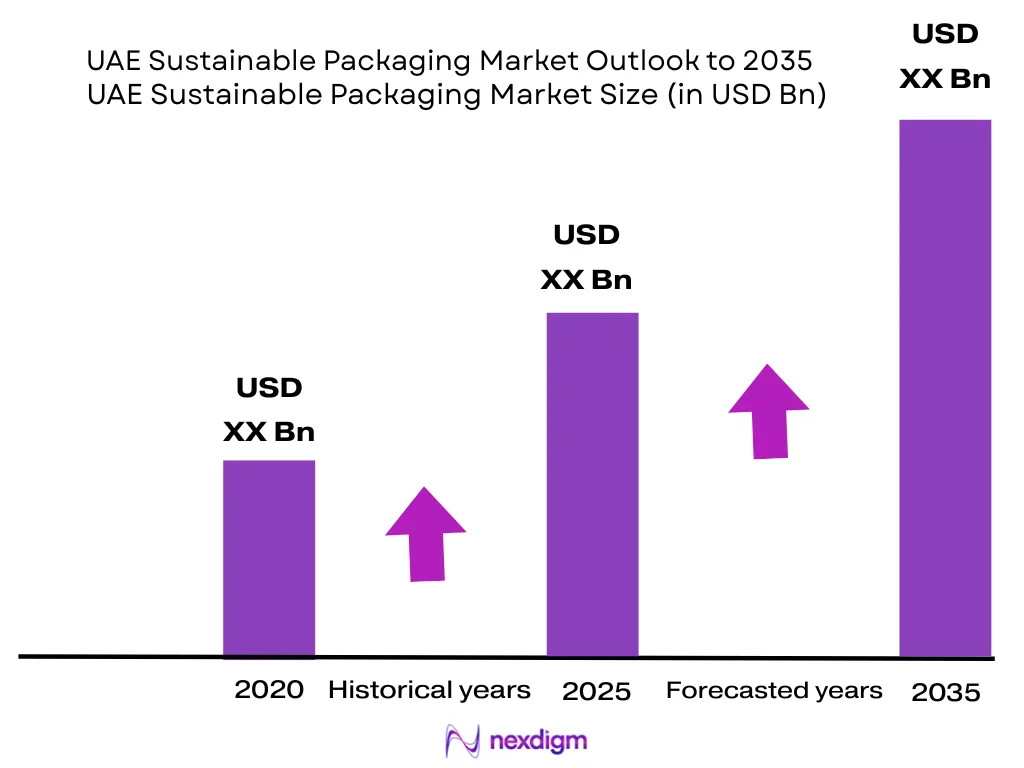
The UAE Sustainable Packaging Market is valued at approximately USD ~ billion in 2024 and is forecast to expand at a CAGR of % during 2026–2035. Demand is supported by foodservice, tourism, aviation, packaged beverages, retail, e-commerce, healthcare, and regional re-export activity. Federal and emirate-level restrictions on single-use products are accelerating substitution toward paper, molded fiber, reusable formats, recyclable polymers, recycled-content packaging, aluminum, and glass. Dubai, Abu Dhabi, and Sharjah dominate the UAE Sustainable Packaging Market, supported by Jebel Ali Free Zone, Dubai Industrial City, National Industries Park, Khalifa Economic Zones Abu Dhabi, Mussafah, Sharjah Industrial Areas, and Hamriyah Free Zone. These hubs combine packaging conversion, food manufacturing, hospitality procurement, logistics, ports, free-zone trade, recycling, and regional distribution. Ras Al Khaimah and Ajman are also relevant through industrial manufacturing, warehousing, plastics conversion, and access to northern-emirate customers.
Market Segmentation
By Material Type
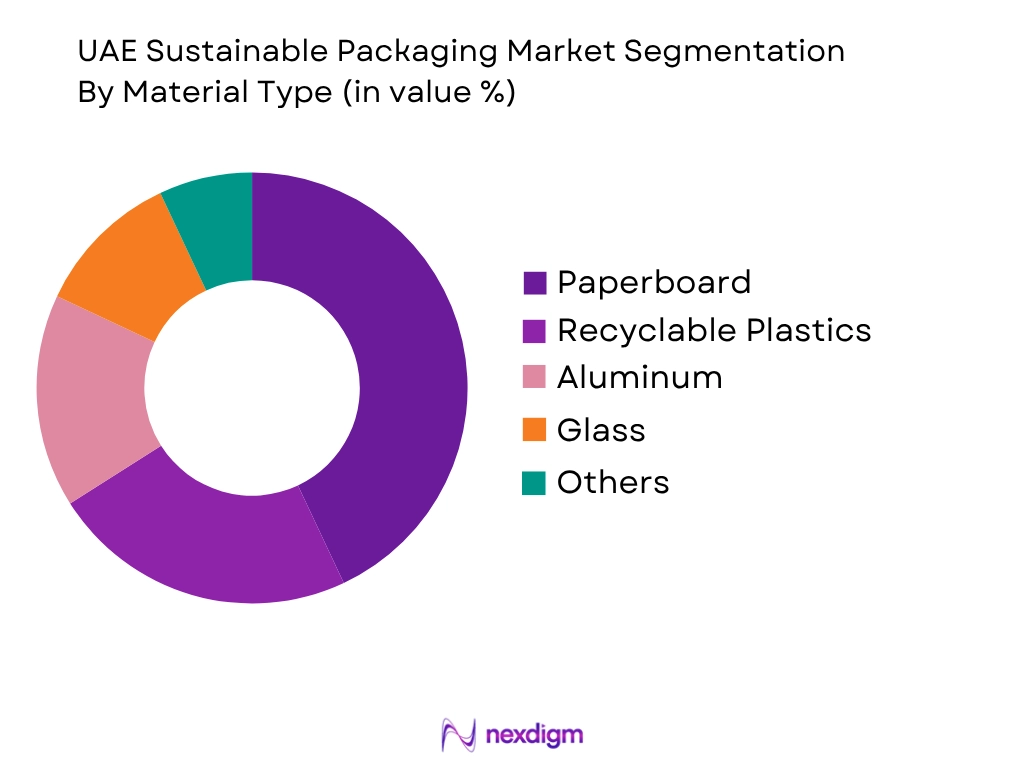
The UAE Sustainable Packaging Market is segmented into paper and paperboard, recycled and recyclable plastics, aluminum and steel, glass, bio-based and compostable materials, wood, and sustainable multi-material structures. Paper and paperboard hold the dominant position because foodservice operators, hotels, cafés, airlines, caterers, grocery retailers, and e-commerce businesses are replacing selected plastic bags, cups, lids, trays, wraps, and takeaway containers with paper-based alternatives. Domestic packaging companies manufacture corrugated boxes, paper bags, folding cartons, cups, molded-fiber products, and foodservice packaging at industrial scale. Paper-based substitution is reinforced by Dubai’s final phase of its single-use plastic ban, effective 1 January 2026, which covers products including cups, lids, cutlery, plates, and tableware. Plastics remain essential where moisture resistance, transparency, sealing, durability, or lightweight transport is required. Aluminum has a strong position in beverage cans, trays, foil, and airline catering, while glass remains important in premium beverages, hospitality, food, cosmetics, and pharmaceuticals.
By End-Use Industry
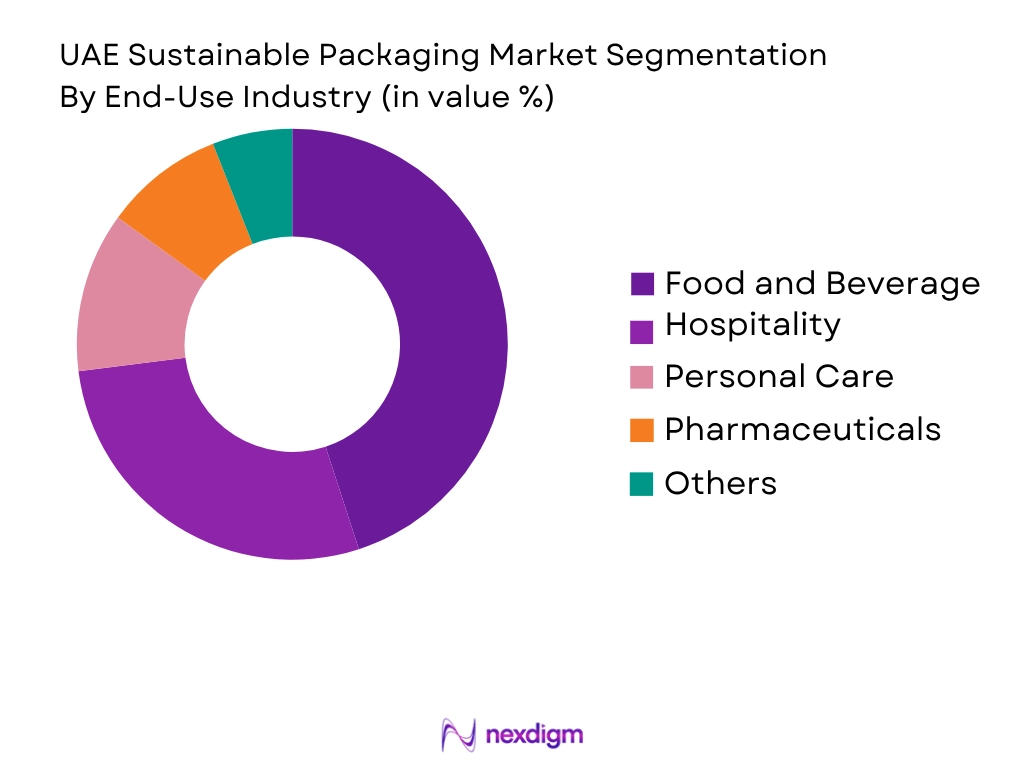
The UAE Sustainable Packaging Market is segmented into food and beverage, foodservice and hospitality, e-commerce and retail, personal and household care, healthcare and pharmaceuticals, aviation catering, industrial goods, and other applications. Food and beverage hold the dominant position because the UAE has high consumption of bottled water, dairy products, juices, ready meals, bakery products, confectionery, imported food, takeaway meals, and premium beverages. These categories require bottles, cartons, cans, trays, films, pouches, corrugated cases, labels, and temperature-resistant containers. Foodservice and hospitality form another major segment because hotels, restaurants, cafés, events, catering companies, cloud kitchens, and tourism operators use substantial quantities of cups, lids, cutlery, takeaway boxes, napkins, wraps, and meal trays. Regulatory restrictions are accelerating movement toward reusable, paper, molded-fiber, wooden, and certified alternative formats. E-commerce increases demand for right-sized corrugated packaging, recyclable mailers, paper void fill, and return-ready formats.
Competitive Landscape
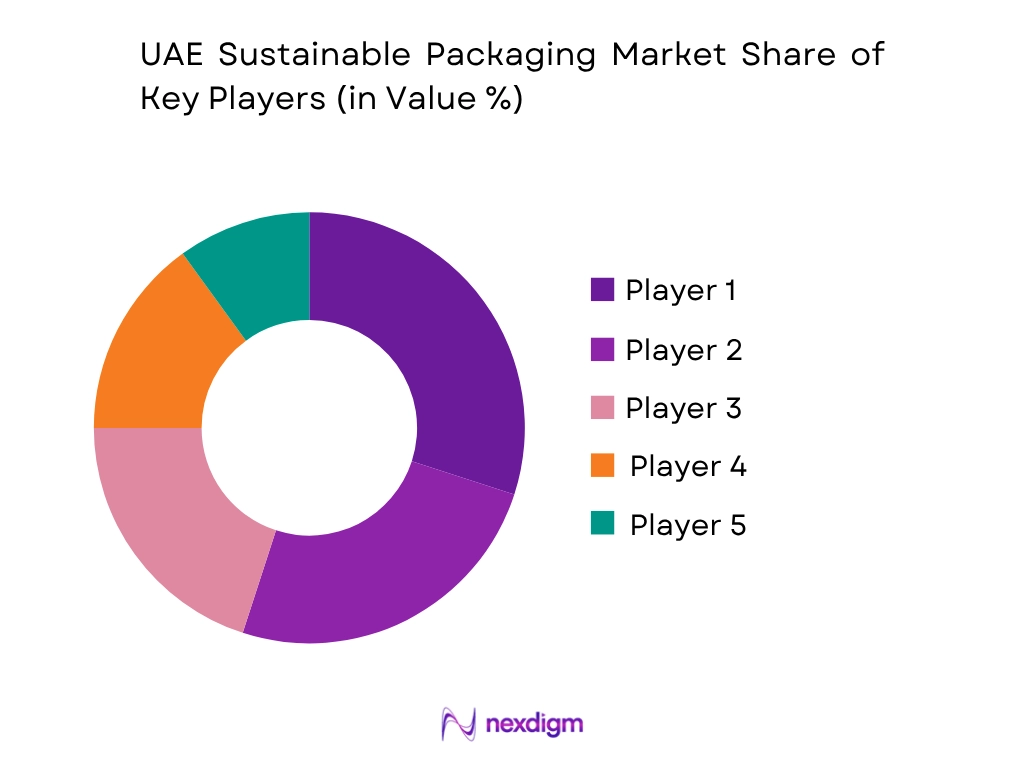
The UAE Sustainable Packaging Market includes domestic foodservice-packaging manufacturers, flexible-packaging converters, paper and corrugated producers, rigid-plastic companies, aluminum suppliers, and multinational carton and film businesses. Hotpack Global, Falcon Pack, and Al Bayader International have strong regional distribution and broad foodservice portfolios. Huhtamaki and ENPI compete in flexible and printed packaging, while Taghleef Industries supplies films used in labels and flexible structures. Competition increasingly depends on recyclable-material portfolios, certified fiber sourcing, product-conformity capability, food-contact compliance, manufacturing scale, export reach, and the ability to replace restricted single-use products without compromising heat resistance, grease resistance, barrier protection, or operational efficiency.
| Company | Establishment Year | Headquarters | Sustainable Portfolio | Principal End Uses | Material Capability | UAE Footprint | Circularity Capability | Strategic Differentiation |
| Hotpack Global | 1995 | Dubai, UAE | ~ | ~ | ~ | ~ | ~ | ~ |
| Falcon Pack | 1992 operational heritage | Sharjah, UAE | ~ | ~ | ~ | ~ | ~ | ~ |
| Al Bayader International | 1991 | Sharjah, UAE | ~ | ~ | ~ | ~ | ~ | ~ |
| Huhtamaki Flexible Packaging UAE | 1920 group heritage | Espoo, Finland | ~ | ~ | ~ | ~ | ~ | ~ |
| ENPI Group | 1995 operational heritage | Sharjah, UAE | ~ | ~ | ~ | ~ | ~ | ~ |
UAE Sustainable Packaging Market Analysis
Growth Drivers
Urban Consumption, Hospitality, and Distribution Activity
The UAE’s highly urbanized consumer economy supports sustained demand for recyclable beverage containers, paper-based foodservice packaging, molded-fiber trays, lightweight flexible films, corrugated transit cases, reusable catering products, refill formats, and e-commerce mailers. World Bank data place the country’s population at approximately 10.99 million people in 2024, while national economic output reached USD 552.32 billion. The country’s urban population exceeded 9 million residents, concentrating packaging consumption in Dubai, Abu Dhabi, Sharjah, Ajman, and the connected industrial and logistics corridors. This concentration is important because supermarkets, hotels, restaurants, cafés, airlines, hospitals, food-delivery companies, and e-commerce warehouses purchase large volumes of primary, secondary, and service packaging. The UAE’s packaging demand is also supported by a non-oil economy built around wholesale trade, tourism, aviation, construction, manufacturing, healthcare, transport, and financial services. In the first quarter of 2025, real GDP reached AED 455 billion, including AED 352 billion generated by non-oil activities. These activities require packaged food, bottled beverages, personal-care products, pharmaceuticals, cleaning products, spare parts, electronics, luxury goods, takeaway meals, and transport protection. Sustainable packaging adoption is particularly relevant to hospitality and foodservice because operators consume cups, lids, straws, cutlery, plates, takeaway containers, amenity bottles, meal trays, wraps, napkins, aluminum containers, and corrugated cases every day. High population density allows reusable packaging systems to operate across shorter collection and redistribution routes than would be practical in dispersed markets. Hotels can introduce refillable amenity dispensers, corporate campuses can operate reusable cup pools, and recurring grocery-delivery routes can recover crates, totes, and insulated containers. E-commerce companies can reduce package dimensions, replace plastic void fill with paper protection, and design boxes for outbound and return journeys. Beverage producers can increase the use of recycled PET or aluminum where collection and food-contact requirements are satisfied. The UAE’s USD 552.32 billion economy and more than 10 million consumers therefore provide a broad demand platform for sustainable packaging, while urban concentration improves the economics of collection, reuse, reverse vending, material aggregation, and regional recycling partnerships.
Single-Use Product Restrictions and Government-Led Substitution
Federal and emirate-level restrictions are directly changing packaging specifications across foodservice, hospitality, retail, events, travel, and consumer-product distribution. Dubai’s initial restrictions on single-use bags entered into force during 2024, and the final phase of the emirate’s program became effective on 1 January 2026. The expanded rules cover items including plastic plates, cutlery, chopsticks, beverage cups, lids, polystyrene food containers, plastic stirrers, straws, cotton buds, and table covers. At the federal level, the second phase of restrictions on the import, production, and trade of selected single-use consumer plastic products also started on 1 January 2026. These measures create an immediate requirement for alternative products based on paper, molded fiber, wood, aluminum, reusable polymers, recycled materials, and other compliant structures. Packaging manufacturers must provide products that meet functional requirements rather than merely replacing plastic by weight. Beverage cups require leak resistance, heat protection, lid compatibility, stacking performance, and food-contact safety. Takeaway containers must withstand grease, steam, transport vibration, temperature changes, and delivery times. Wooden or fiber cutlery must retain strength during use, while paper and molded-fiber trays must resist deformation and moisture. Abu Dhabi’s single-use plastic policy demonstrates how regulatory intervention can change material flows. By December 2024, the Environment Agency–Abu Dhabi reported the avoidance of 364 million single-use plastic bags, corresponding to approximately 2,400 tonnes of plastic. The emirate’s bottle-return initiatives had collected more than 130 million bottles, representing about 2,000 tonnes of recyclable plastic, through approximately 150 reverse-vending machines, smart bins, and collection channels. During 2024 alone, 67 million bottles were returned for recycling. These numbers provide packaging companies with evidence that regulation, consumer incentives, and collection infrastructure can operate together. Manufacturers can respond by developing bottles designed for high-value recycling, wash-off labels, compatible closures, paper products with repulpable coatings, reusable foodservice systems, and fiber alternatives that do not rely on difficult-to-separate laminates. The regulatory driver therefore extends beyond banning selected items. It creates demand for testing, product conformity, food-contact documentation, recycled-material verification, disposal instructions, retailer training, and packaging redesign across thousands of foodservice and retail specifications.
Market Challenges
Limited Domestic Recycled Feedstock and Collection Quality
The UAE sustainable packaging market is constrained by limited domestic availability of consistent, specification-grade recycled material. The country’s population and high level of packaged consumption generate substantial quantities of PET bottles, paperboard, aluminum cans, glass containers, flexible films, foodservice packaging, and corrugated cases, but these materials do not automatically become usable feedstock. Collection systems differ across emirates, building types, commercial zones, hotels, labour accommodation, industrial facilities, retail sites, and residential communities. High-value aluminum, cardboard, and clear PET are more attractive to collectors, while multilayer films, small plastic components, dark-colored packaging, pumps, sachets, contaminated trays, and composite products are harder to recover economically. Even when packaging is collected, material quality can vary because of food residue, moisture, sand, labels, adhesives, pigments, incompatible polymers, and mixed waste. Recycled PET intended for bottles or food containers requires controlled collection, sorting, washing, decontamination, testing, and traceability. Recycled polyethylene and polypropylene can show variation in colour, odour, melt flow, impact strength, and processing stability. Recovered paper can be weakened by grease, moisture, wax, wet-strength chemicals, and polymer coatings. Glass requires colour separation and contaminant removal, while its weight makes long-distance movement comparatively energy intensive. Abu Dhabi’s collection program illustrates both progress and the scale of the remaining infrastructure requirement. More than 130 million bottles, equal to around 2,000 tonnes of plastic, had been collected through about 150 machines and associated collection routes by December 2024. However, this system remains concentrated in a defined emirate and selected high-footfall locations. The original deployment included 70 reverse-vending machines and 26 smart bins, indicating that dedicated equipment, consumer incentives, software, maintenance, transport, and recycler offtake are needed to secure clean material. Domestic converters may therefore depend on imported recycled resin, recovered fiber, certified paper, aluminum inputs, or specialty bio-based polymers when local supply cannot meet technical requirements. Import dependence increases exposure to shipping conditions, documentation, supplier certification, and availability. The main challenge is not the absence of discarded packaging; it is creating predictable streams that meet requirements for composition, cleanliness, food contact, colour, strength, odour, and processing performance. Expansion will require more source separation, commercial collection contracts, reverse-vending coverage, hospitality partnerships, material recovery facilities, washing capacity, and long-term purchasing agreements between recyclers and packaging manufacturers.
Technical Performance and Multi-Jurisdiction Compliance
Sustainable packaging conversion in the UAE is technically complex because materials must withstand high temperatures, humidity, chilled distribution, long storage periods, food oils, product migration requirements, and regional logistics. A paper container may appear environmentally preferable to a plastic format but can require polymer coatings to resist liquids and grease, reducing its compatibility with paper-recycling systems. A compostable cup or film may perform well under laboratory conditions but degrade during storage if exposed to excessive heat or moisture. Mono-material pouches can improve recycling compatibility but may provide weaker oxygen, aroma, puncture, or heat resistance than conventional multilayer laminates. Increasing recycled content can alter colour, odour, transparency, impact strength, and processing behaviour. Lightweighting may reduce material use but create bottle deformation, seal failures, carton compression, or damage during distribution. These challenges require packaging engineers, food-contact specialists, polymer technologists, paper scientists, testing laboratories, machinery technicians, and quality-control personnel. Regulatory requirements also operate across federal and emirate-level systems. A company supplying products in Dubai, Abu Dhabi, Sharjah, and other emirates must monitor national single-use product restrictions, municipal rules, product conformity, food-contact standards, waste-segregation requirements, import documentation, and environmental claims. Dubai’s regulations progressed through several stages between 2024 and 2026, while Abu Dhabi operates its own single-use plastic policy and bottle-recovery framework. Businesses must determine whether a product is prohibited, exempt, reusable, made from recycled material, intended for export, or covered by a different material category. Marketing terms such as recyclable, biodegradable, compostable, reusable, or made with recycled content also require evidence. A product may be technically recyclable but have limited access to collection and processing. A compostable item may be certified but lack a dedicated organic-waste route. A reusable system can produce limited environmental benefit when containers are lost after only a few cycles or transported long distances for washing. Small foodservice businesses and importers may not maintain dedicated regulatory and packaging teams, increasing dependence on distributors and converters for compliant specifications. The challenge is therefore coordinating material science, product safety, testing, climate performance, machinery compatibility, local restrictions, import requirements, and credible consumer communication. Suppliers that cannot provide documentation and technical support face a higher risk of rejected products, reformulation, supply disruption, or misleading sustainability claims.
Market Opportunities
Smart Collection, Reverse Vending, and Packaging-to-Packaging Recycling
The UAE has a significant opportunity to expand sustainable packaging through smart collection systems, reverse-vending machines, automated sorting, digital traceability, and higher-value packaging-to-packaging recycling. Abu Dhabi’s bottle-return infrastructure provides an operating foundation. The emirate initially deployed 70 reverse-vending machines and 26 smart bins, targeting the recovery of 20 million bottles annually. By December 2024, the wider system had collected more than 130 million bottles, including 67 million during 2024, and recovered approximately 2,000 tonnes of recyclable plastic. These figures demonstrate that consumer incentives and dedicated collection points can generate cleaner material than mixed municipal waste. Expansion across supermarkets, shopping centres, fuel stations, airports, hotels, schools, universities, residential buildings, events, beaches, and business districts could create a more reliable supply of PET bottles and aluminum cans. Technology providers can supply machines, sensors, compactors, payment or reward systems, maintenance services, transport optimization, fraud controls, and data dashboards. Packaging manufacturers can design bottles and cans that perform better in this system through clear resin, removable labels, compatible adhesives, standardized colours, tethered or recyclable closures, and accurate barcode registration. Optical sorting and near-infrared detection can separate polymers and colours, while artificial intelligence can identify contamination or incorrectly deposited materials. Advanced washing, deodorization, melt filtration, and pelletizing can improve recycled-resin consistency. Digital records can connect each container stream with collection location, weight, material type, recycler, and final output, supporting verified recycled-content claims and corporate sustainability reporting. Aluminum recovery presents an additional opportunity because the material retains commercial value and can be repeatedly remelted. Beverage companies, airports, hotels, and event venues can establish closed-loop collection agreements with can processors. Corrugated packaging from e-commerce and retail can also be collected through dedicated commercial routes, reducing contamination and improving fiber quality. The UAE’s compact urban geography and advanced digital infrastructure make it suitable for collection systems that combine physical packaging with consumer applications, loyalty programs, and real-time reporting. The commercial opportunity extends beyond manufacturing containers: it includes recovery equipment, logistics, data management, quality assurance, recycled-resin production, retailer partnerships, and brand-specific closed loops. Current collection data demonstrate that the necessary consumer participation and operational capability already exist at meaningful scale, providing a factual base for future market development without relying on speculative future volumes.
Reusable Foodservice Systems and Regional Sustainable Packaging Exports
The UAE’s hospitality, aviation, retail, and logistics infrastructure creates an opportunity to scale reusable foodservice packaging, refill systems, alternative fiber formats, and regional sustainable-packaging exports. Federal and Dubai restrictions effective in 2026 cover several high-volume disposable products, creating a current need for compliant cups, lids, plates, cutlery, takeaway containers, and serviceware. Businesses can respond through two pathways: material substitution and system redesign. Material substitution includes molded-fiber trays, paperboard cartons, wooden cutlery, aluminum containers, recycled-content products, and certified alternative polymers. System redesign involves reusable cups, returnable meal boxes, refillable hotel amenities, pooled catering containers, reusable grocery crates, and durable business-to-business transport packaging. Reuse is particularly suitable for airports, airlines, corporate campuses, universities, hospitals, hotels, events, residential communities, and recurring food-delivery services because these environments provide controlled collection points and predictable customer flows. Commercial systems require container tracking, deposits or incentives, washing facilities, inspection standards, redistribution logistics, and clear responsibility for losses. Digital identification using QR codes, radio-frequency tags, or barcodes can record circulation cycles and support inventory control. The opportunity also extends to regional exports. The UAE’s 2024 GDP of USD 552.32 billion, major ports, free zones, air cargo networks, and re-export functions support production and distribution to Saudi Arabia, Oman, Bahrain, Kuwait, Qatar, Africa, and South Asia. Domestic packaging companies can manufacture GCC-compliant paper cups, molded-fiber food containers, recyclable flexible packaging, aluminum products, and reusable systems for regional customers. The federal restrictions distinguish certain products intended for export and products containing recycled material, making material documentation and destination control commercially important. Companies able to provide food-contact certificates, compostability evidence, recycled-content verification, and multilingual product documentation can serve international foodservice and retail chains. The UAE can also attract partnerships with global material developers, machinery manufacturers, chemical recyclers, and reuse-platform operators seeking a Gulf production base. Current national economic scale, high non-oil activity, and the implementation of restrictions across 2024–2026 provide the demand and policy conditions for investment. The strongest growth opportunity lies in integrated systems combining compliant products, collection, washing, reuse tracking, recycling partnerships, and regional distribution rather than isolated sales of items marketed as environmentally friendly.
Future Outlook
The UAE Sustainable Packaging Market is expected to develop substantially during 2026–2035 as single-use product restrictions, circular-economy policy, hospitality sustainability programs, beverage-container recovery, and regional manufacturing investment reshape packaging procurement. The market will move beyond replacing plastic bags and cutlery toward broader redesign involving recycled content, lightweighting, reuse, refill systems, packaging traceability, and recovery infrastructure. Federal policy will remain a major driver. The UAE activated the second phase of its nationwide restrictions on the import and trade of specified single-use consumer plastic products from 1 January 2026. Covered products include beverage cups and lids, cutlery, chopsticks, straws, stirrers, plates, and expanded-polystyrene food containers. Products intended for export and certain products made from recycled material are treated differently under the policy, creating incentives for domestic producers to develop qualifying recycled and alternative-material formats.
Major Players
- Hotpack Global
- Falcon Pack
- Al Bayader International
- Huhtamaki Flexible Packaging UAE
- ENPI Group
- Integrated Plastics Packaging
- Arabian Flexible Packaging
- Amber Packaging Industries
- Taghleef Industries
- Gulf East Paper and Plastic Industries
- Aalmir Plastic Industries
- Tetra Pak Arabia
- SIG Combibloc Obeikan
- Napco National
- Crown Emirates
Key Target Audience
- Packaging material manufacturers and converters
- Food, beverage, personal-care, and pharmaceutical brand owners
- Hotels, restaurants, cafés, airlines, and catering companies
- Retailers, e-commerce platforms, and food-delivery operators
- Recycling, reverse-vending, waste-management, and reuse-system providers
- Investments and venture capitalist firms
- Private-equity and strategic packaging investors
- Government and regulatory bodies
Research Methodology
Step 1: Identification of Key Variables
The first phase develops an ecosystem map covering packaging-material producers, converters, brand owners, foodservice distributors, hospitality groups, retailers, airlines, waste operators, recyclers, municipalities, and regulators. The assessment identifies material type, format, package weight, recycled content, food-contact requirements, single-use restriction exposure, recovery pathway, and converter capacity as core variables.
Step 2: Market Analysis and Construction
Historical information is compiled by material, packaging format, end-use industry, emirate, sustainability strategy, and end-of-life route. The bottom-up model evaluates converter shipments, product units, material consumption, customer procurement, and recycled-content adoption. The top-down model reviews industrial output, trade, imports, tourism, foodservice activity, company revenues, and collection infrastructure.
Step 3: Hypothesis Validation and Expert Consultation
Preliminary hypotheses are validated through computer-assisted telephone interviews with packaging manufacturers, foodservice suppliers, hotel procurement teams, sustainability executives, recyclers, waste operators, retailers, airlines, and regulatory professionals. Interviews examine material substitution, product qualification, food-contact testing, recycling access, procurement standards, and customer switching behavior.
Step 4: Research Synthesis and Final Output
Supply-side and demand-side findings are triangulated to reconcile packaging output, raw-material availability, imports, customer demand, and recovery activity. Segment shares and forecasts are tested against unit volumes, package weights, manufacturing capacity, regulatory restrictions, hospitality demand, regional trade, and expert feedback.

- Executive Summary
- Research Methodology (Market Definitions and Assumptions, Sustainable Packaging Inclusion and Exclusion Criteria, Abbreviations, Market Sizing Approach, Top-Down Analysis, Bottom-Up Analysis, Packaging-Volume Conversion Model, Material Flow Analysis, Demand-Side Assessment, Supply-Side Assessment, Converter Capacity Assessment, Primary Industry Interviews, Data Triangulation, Regulatory Scenario Modelling, Forecasting Framework, Limitations and Future Conclusions)

- Definition and Scope
- Market Evolution and Industry Genesis
- Transition from Conventional Packaging to Circular Packaging Systems
- Evolution of Packaging Lightweighting and Source Reduction
- Development of Recycled-Content Packaging
- Expansion of Fiber-Based Packaging Substitution

- Growth Drivers (Single-Use Product Restrictions, Circular Economy Policy, Food and Beverage Manufacturing, Hospitality and Tourism, E-Commerce Expansion, Aviation Catering, Retailer Sustainability Standards and Corporate Net-Zero Commitments)
- Market Challenges (Dependence on Imported Raw Materials, Limited Domestic Recycled Feedstock, Food-Grade PCR Constraints, Flexible Packaging Recovery Gaps, Composting Infrastructure Limitations, Emirate-Level Regulatory Variation, High Cooling and Barrier Requirements and Capital-Intensive Conversion)
- Market Opportunities (High-Barrier Recyclable Paper, Mono-Material Flexible Packaging, Food-Grade Recycled PET, Molded Fiber, Reusable Foodservice Systems, Reverse-Vending Networks, Smart Sorting and Regional Export Packaging)
- Market Trends (Paperization, Lightweighting, High-PCR Packaging, Refill Pouches, Reusable Cups, Recyclable Laminates, Fiber-Based Foodservice Packaging, Digital Waste Traceability, Wash-Off Labels and Packaging Carbon Disclosure)
- SWOT Analysis
- Porter’s Five Forces Analysis
- PESTLE Analysis
- Stakeholder Ecosystem (Material Producers, Packaging Converters, Brand Owners, Retailers, Municipalities, Waste Operators, Recyclers, Regulators, Hospitality Groups and Certification Bodies)

- By Market Value (2020-2025)
- By Packaging Volume (2020-2025)
- By Packaging Unit Shipments (2020-2025)

- By Material Type (In Value %)
Paper and Paperboard
Corrugated Board
Molded Fiber
Recycled Plastic
Bio-Based Plastic
Compostable Plastic
Aluminum - By End-Use Industry (In Value %)
Food and Beverage
Personal Care and Cosmetics
Household Care
Healthcare and Pharmaceuticals
E-Commerce
Retail and Consumer Goods
Foodservice and Hospitality - By Distribution Channel (In Value %)
Direct Sales to Brand Owners
Packaging Distributors
Contract Packaging Companies
Digital Packaging Platforms
Industrial Wholesalers
Retail Packaging Suppliers
E-Commerce Packaging Providers - By Emirate (In Value %)
Dubai
Abu Dhabi
Sharjah
Ras Al Khaimah
Ajman
Fujairah
Umm Al Quwain

- Market Share of Major Players (By Value, Packaging Volume, Material Type, Packaging Format, End-Use Industry and Emirate)
- Cross Comparison Parameters (Sustainable Material Portfolio Breadth, Post-Consumer Recycled Content Capability, Mono-Material and Design-for-Recycling Expertise, UAE Manufacturing and Conversion Footprint, Food-Contact and Product-Conformity Capability, Recovery and Reverse-Vending Partnership Capability, End-Use Industry Coverage, Packaging Innovation and Commercialization Speed)
- SWOT Analysis of Major Players
- Detailed Profiles of Major Companies
Hotpack Global
Falcon Pack
Al Bayader International
Huhtamaki Flexible Packaging UAE
ENPI Group
Integrated Plastics Packaging
Arabian Flexible Packaging
Amber Packaging Industries
Taghleef Industries
Gulf East Paper and Plastic Industries
Aalmir Plastic Industries
Tetra Pak Arabia
SIG Combibloc Obeikan
Napco National
Crown Emirates

- Food and Beverage Brand Analysis
- Bottled Water and Beverage Analysis
- Grocery Retailer Analysis
- E-Commerce and Marketplace Analysis
- Foodservice Operator Analysis
- Hotel and Tourism Analysis

- By Market Value (2026-2035)
- By Packaging Volume (2026-2035)
- By Packaging Unit Shipments (2026-2035)


 Request a Sample
 Ask for Customization
 Get a Quote
 Enquire Now