
 Download PDF
Market Overview
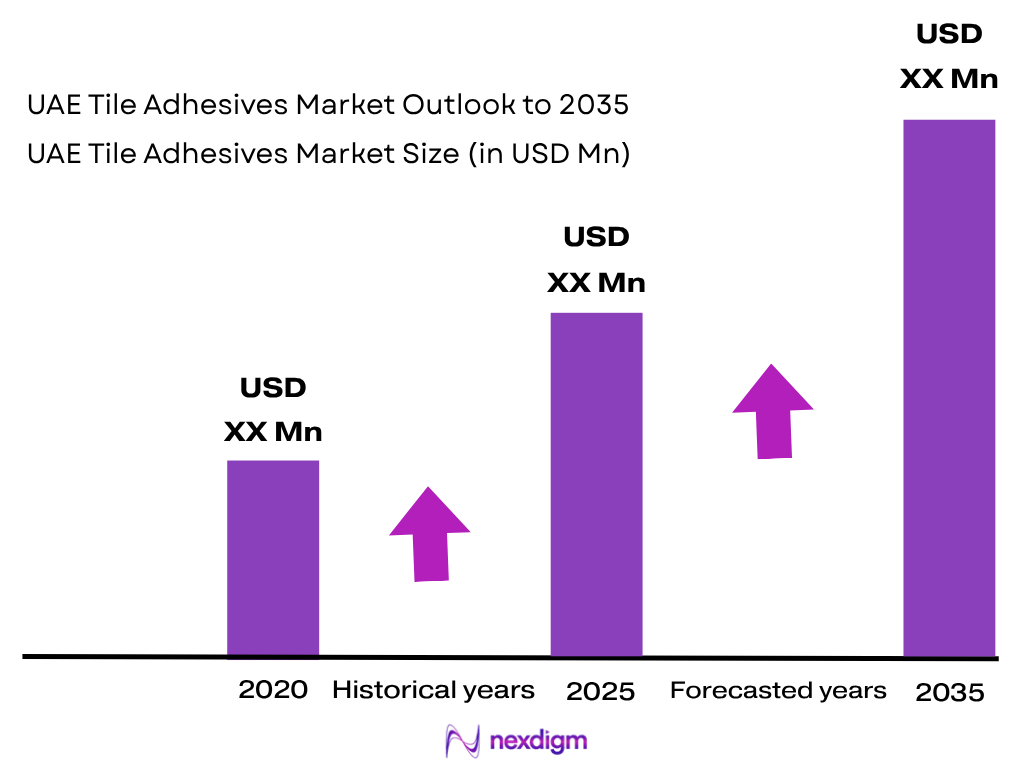
The UAE Tile Adhesives Market is valued at approximately ~USD XX million, supported by residential construction, hospitality, airports, large-format porcelain installation and natural-stone finishing. Across the latest two annual observations, UAE GDP increased to USD 552.32 billion, while Dubai International passenger traffic moved from about 87 million to 92.3 million, reinforcing construction and refurbishment activity across terminals, hotels, retail, mixed-use buildings and premium residential projects.
Dubai and Abu Dhabi dominate the UAE Tile Adhesives Market because they concentrate high-rise housing, luxury villas, hotels, malls, airports and large public projects. Abu Dhabi approved 144 projects with a combined budget of AED 66 billion, including more than AED 59 billion for housing and public facilities, while Dubai’s aviation and tourism infrastructure handled 92.3 million passengers, sustaining intensive demand for porcelain, stone and large-format installation systems.
Market Segmentation
By Adhesive Technology
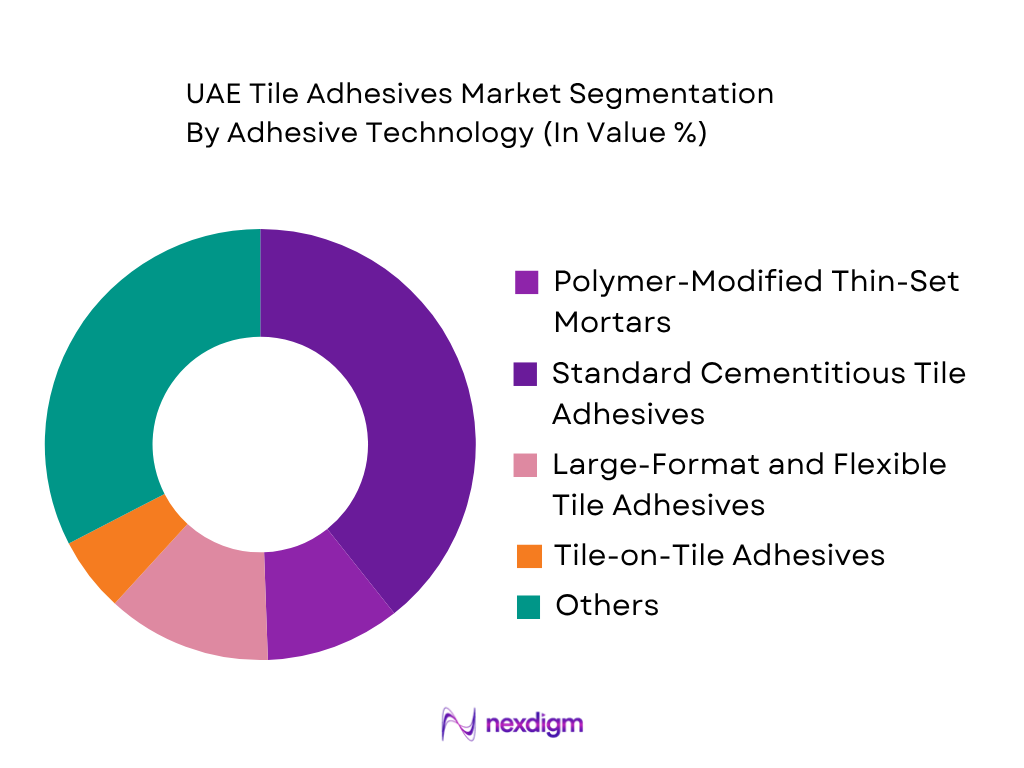
The UAE Tile Adhesives Market is segmented into standard cementitious products, polymer-modified mortars, C2 high-performance adhesives, C2TE systems, S1/S2 flexible adhesives, large-format mortars, rapid-setting products, epoxy adhesives and ready-mixed systems. Polymer-modified and C2-class cementitious adhesives hold the dominant modeled share because they address porcelain, ceramic and natural-stone applications while offering stronger adhesion, longer open time and better durability under demanding project conditions. The UAE’s premium construction profile increases the need for factory-controlled formulations rather than conventional cement mortar, particularly in hotels, high-rise residences and large public buildings. MAPEI’s UAE production operates from a 40,000 m² facility at Dubai Investments Park and manufactures products to GSO ISO 13007-1, demonstrating the importance of standardized local dry-mix production and formal tile-installation performance. Dubai Municipality also lists certified tile adhesives under Al Sa’fat, increasing the relevance of tested products in project specifications.
By Tile and Stone Type
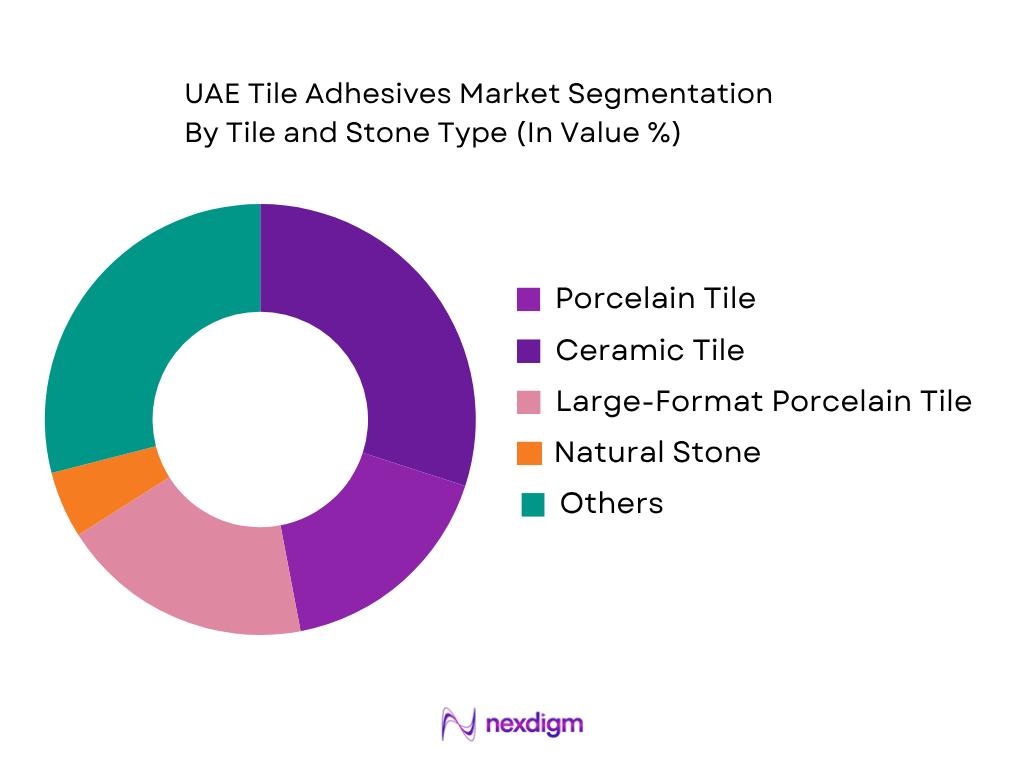
The UAE Tile Adhesives Market is segmented into ceramic, porcelain, large-format porcelain, slabs, marble, granite, travertine, engineered stone and mosaics. Porcelain and large-format porcelain dominate the modeled demand mix because they are extensively specified in premium residential towers, villas, hospitality properties, retail spaces and airports. Their low absorption and larger dimensions place higher technical requirements on adhesive wetting, transfer, slip resistance and deformability than traditional ceramic tiles. Natural stone also represents a technically important category because marble and engineered stone may require white or rapid-setting systems to minimize staining or dimensional instability. MAPEI’s UAE operation provides dedicated stone testing for stability and absorption, highlighting the need to match adhesive chemistry with stone behavior rather than treating all finishes similarly. The country’s high-value construction base therefore creates a product mix weighted toward C2, S1/S2 and stone-compatible systems.
Competitive Landscape
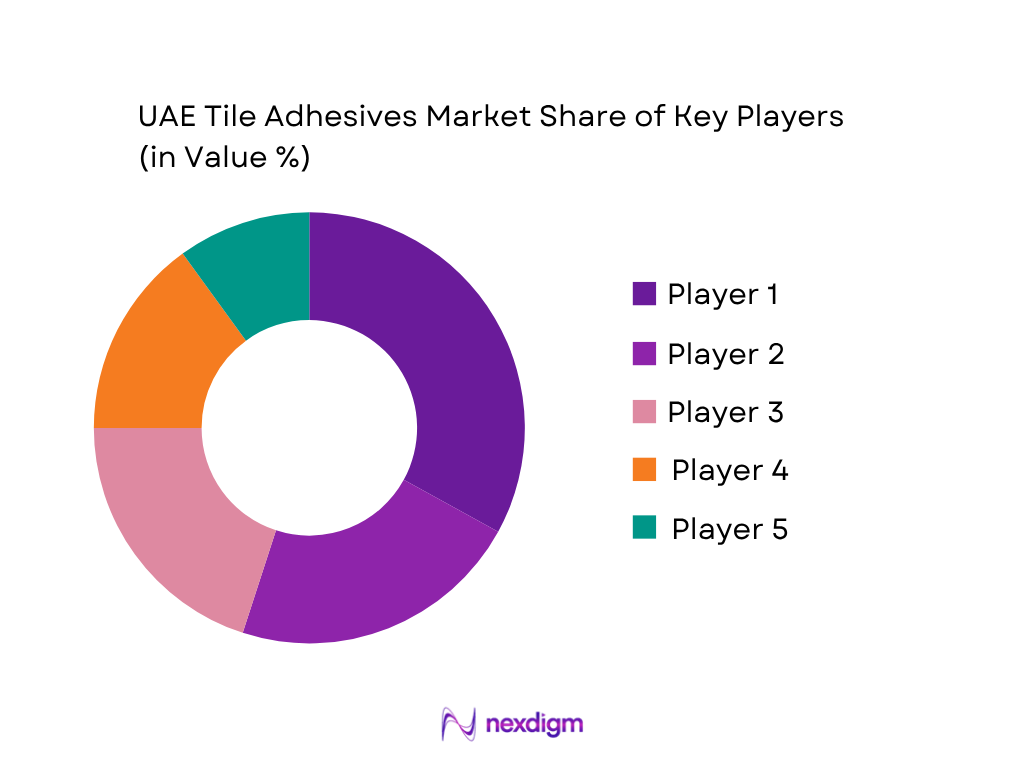
The UAE Tile Adhesives Market is characterized by multinational construction-chemical suppliers, regional dry-mix manufacturers and locally established brands competing through C2/C2TE performance, large-format capability, S1/S2 flexibility, natural-stone expertise and project technical support. Sika, MAPEI, Fosroc, Saint-Gobain Weber and LATICRETE have strong positions because the market increasingly rewards local production, certification, specification support and compatibility with demanding porcelain and stone applications rather than basic commodity mortar alone.
| Major Player | Establishment Year | Headquarters | C2 / C2TE Capability | S1 / S2 & Large-Format Capability | UAE Manufacturing / Supply | Natural Stone Capability | Wet-Area / Exterior Systems | Technical Support |
| Sika | 1910 | Baar, Switzerland | ~ | ~ | ~ | ~ | ~ | ~ |
| MAPEI | 1937 | Milan, Italy | ~ | ~ | ~ | ~ | ~ | ~ |
| Fosroc | 1972 | Dubai, UAE | ~ | ~ | ~ | ~ | ~ | ~ |
| Saint-Gobain Weber | 1900 | Courbevoie, France | ~ | ~ | ~ | ~ | ~ | ~ |
| LATICRETE | 1956 | Bethany, Connecticut, USA | ~ | ~ | ~ | ~ | ~ | ~ |
UAE Tile Adhesives Market Analysis
Growth Drivers
High-Rise Housing and Large Residential Programs Are Expanding Tile Adhesive Consumption
Large residential and mixed-use construction programs in Dubai and Abu Dhabi are expanding demand for polymer-modified, porcelain, large-format and natural-stone tile adhesives. Abu Dhabi approved 144 infrastructure and development projects with an aggregate budget of AED66 billion in 2024, with more than AED59 billion allocated to housing and public facilities. The program includes almost 13,000 housing units across Abu Dhabi, Al Ain and Al Dhafra, creating extensive floor, wall, bathroom, kitchen and communal-area tile installations. These projects increasingly require factory-produced mortars because standardized mixing, controlled polymer content and consistent bond strength are important when thousands of repetitive installations are executed across large developments. Premium apartments and villas also use porcelain, marble and larger slab formats that demand greater adhesive transfer, slip resistance and deformability than traditional cement mortar. The broader macroeconomic environment reinforces this demand: World Bank data record UAE 2024 GDP at USD552.32 billion and GDP per capita at USD50,273.5, while the IMF identifies construction as one of the principal sectors supporting non-hydrocarbon activity. These current construction and economic indicators provide a substantial platform for organized tile adhesive consumption.
Aviation, Hospitality and Premium Fit-Out Activity Are Driving Higher-Performance Adhesive Usage
Dubai’s aviation, tourism and hospitality infrastructure is increasing demand for C2-class, rapid-setting, large-format and natural-stone tile adhesives used in terminals, hotels, malls, restaurants and premium public interiors. Dubai International handled 92.3 million passengers in 2024, the highest annual passenger volume in its history, while the airport has processed more than 700 million passengers across 3.3 million flights during the past decade. High-traffic aviation properties require continuous refurbishment of porcelain floors, bathrooms, retail areas and passenger facilities, creating recurrent demand beyond initial construction. Dubai’s wider aviation development also includes the announced USD35 billion expansion program at Dubai World Central, reinforcing the long-duration construction ecosystem surrounding terminals, hospitality and commercial facilities. Premium tile installations in these environments favor high-transfer mortars, deformable products and rapid-setting adhesives because installation downtime and bond reliability carry greater operational importance. World Bank data place UAE 2024 GDP at USD552.32 billion and GDP per capita at USD50,273.5; the IMF additionally identifies tourism and construction as key contributors to strong domestic non-hydrocarbon activity. These indicators support continued premium tile-system specification.
Market Challenges
Extreme Heat and Rapid Moisture Loss Increase Installation and Bond-Failure Risk
Extreme outdoor temperatures create a market-specific challenge for tile adhesive installation because cementitious mortars depend on controlled water retention, open time and curing. The UAE Ministry of Human Resources and Emiratisation prohibited outdoor work under direct sunlight between 12:30 pm and 3:00 pm from 15 June through 15 September 2024, demonstrating the severity of seasonal jobsite heat. Hot substrates can accelerate evaporation from freshly spread adhesive, shorten workable open time and reduce mortar transfer if tiles are installed after skin formation begins. The technical risk is higher for large-format porcelain, exterior walls and façades because low-absorption tile bodies require complete adhesive contact and flexible polymer modification; inadequate coverage can contribute to hollow areas, lippage or detachment. Installers must therefore coordinate substrate cooling, mixing-water control, trowel coverage, back-buttering and product selection rather than relying on standard mortar practices. This execution challenge exists within a substantial construction economy: World Bank data show UAE 2024 GDP of USD552.32 billion, GDP per capita of USD50,273.5 and economic growth of 4.0. The IMF also highlights construction as an important non-hydrocarbon growth sector, increasing the commercial importance of heat-tolerant application practices.
Product Certification and Performance Compliance Raise Entry and Quality-Control Requirements
Tile adhesive suppliers in the UAE face increasing qualification requirements because major projects and Dubai’s regulated construction-material ecosystem place greater emphasis on documented conformity rather than informal product acceptance. Dubai Municipality states that identified construction products must obtain independent certification before they can be sold or used where applicable, and its current Type 1 certified-product register includes ACE FIX Plus tile adhesive under certificate BBCE-2025-000328, demonstrating that tile adhesives are directly represented within the certification framework. Al Sa’fat documentation also specifies a 65 g/L VOC limit for water-based ceramic tile adhesives, requiring manufacturers to control formulation chemistry while still delivering adhesion, workability and open-time performance. Such requirements create barriers for low-grade or inconsistent products and increase testing, factory-control and documentation obligations for organized suppliers. They also become more complex as contractors increasingly install porcelain, large-format tile and natural stone across substrates that require different adhesion profiles. The compliance burden operates within a large and sophisticated economy: World Bank data record UAE 2024 GDP at USD552.32 billion and GDP per capita at USD50,273.5, while IMF analysis identifies construction and manufacturing among major non-hydrocarbon growth contributors. Suppliers therefore need laboratory discipline alongside competitive distribution.
Market Opportunities
C2TE, S1 and S2 Systems Can Capture Large-Format and Exterior Tile Applications
C2TE and deformable S1/S2 tile adhesives represent a strong future opportunity because UAE projects increasingly combine large porcelain formats, exterior applications and thermally active substrates. The current construction base is substantial: Abu Dhabi approved 144 projects with AED66 billion of funding in 2024, including more than AED59 billion for housing and public facilities and nearly 13,000 housing units. These projects generate large amounts of floor, wall and wet-area installation, while premium developments increasingly use heavier porcelain and stone formats that require stronger adhesion, extended open time and movement accommodation. Exterior installations face additional thermal stress, making deformability and high-temperature workability valuable product attributes rather than optional premium features. Formal standards and project specifications can therefore shift consumption away from basic cement mortar toward performance-classified systems suited to large-format tile, façades and swimming pools. World Bank data place UAE 2024 GDP at USD552.32 billion, GDP per capita at USD50,273.5, and growth at 4.0. IMF analysis identifies construction as a major driver of domestic activity. These current construction and macroeconomic indicators support future expansion of technically differentiated C2TE and flexible adhesive platforms without relying on projected market statistics.
Low-VOC, Renovation and Rapid-Setting Adhesives Offer Higher-Value Future Demand
Low-VOC, tile-on-tile and rapid-setting systems offer another growth route as the UAE’s large stock of hotels, airports, malls and premium residences moves through recurring refurbishment cycles. Dubai Municipality’s Al Sa’fat documentation sets a 65 g/L VOC ceiling for water-based ceramic tile adhesives, while its certified-product register already includes dedicated tile adhesive products, creating a defined regulatory route for low-emission formulations. Renovation demand is reinforced by the operating scale of Dubai International, which handled 92.3 million passengers in 2024 and therefore requires continuous maintenance and phased refurbishment across terminals, retail areas, lounges, bathrooms and food-service spaces. Tile-on-tile products can reduce demolition in occupied properties, while rapid-setting mortars shorten the interval before grouting and reopening, giving hotels and commercial operators a practical reason to specify higher-value systems. Low-emission products additionally align with green-building and indoor-environment requirements rather than competing solely on basic bond strength. The macroeconomic foundation is strong: World Bank data record UAE 2024 GDP at USD552.32 billion and GDP per capita at USD50,273.5, while IMF analysis identifies tourism and construction among the principal non-hydrocarbon activity drivers. These current indicators support future premiumization of renovation-oriented tile adhesive technologies.
Future Outlook
The UAE Tile Adhesives Market is forecast to expand at approximately ~X.X% CAGR during 2026–2035, driven by luxury residential development, high-rise construction, hospitality, infrastructure refurbishment and growing use of porcelain slabs and large-format tiles. Product demand is expected to shift further toward C2TE, S1/S2, high-temperature and low-VOC systems that can meet both technical installation requirements and green-building specifications. Abu Dhabi provides a strong project pipeline. The Abu Dhabi Projects and Infrastructure Centre approved 144 projects worth approximately AED 66 billion, with more than AED 59 billion allocated to housing and public facilities. These projects cover communities, public buildings, education and tourism, generating significant tile and stone surfaces across bathrooms, kitchens, floors, lobbies, public areas and outdoor spaces.
Major Players
- Sika UAE LLC
- MAPEI Construction Chemicals LLC
- Al Gurg Fosroc LLC
- Saint-Gobain Weber UAE
- LATICRETE Middle East LLC
- ARDEX Middle East
- CONMIX Ltd.
- DCP International
- Terraco UAE
- Saveto / Saudi Vetonit UAE
- Bostik Middle East / Arkema
- MC-Bauchemie Middle East LLC
- ACE Impacts Adhesives Industry LLC
- Danube Building Materials / MilanoFix
- Kerakoll Gulf
Key Target Audience
- Tile Adhesive and Dry-Mix Mortar Manufacturers
- Porcelain, Ceramic and Natural Stone Manufacturers
- Real Estate Developers and Main Contractors
- Tile, Stone and Interior Fit-Out Contractors
- Building Material and Construction Chemical Distributors
- Hospitality, Airport and Infrastructure Project Developers
- Investments and Venture Capitalist Firms
- Government and Regulatory Bodies (Dubai Municipality, Abu Dhabi Department of Municipalities and Transport, Ministry of Industry and Advanced Technology, Abu Dhabi Projects and Infrastructure Centre)
Research Methodology
Step 1: Identification of Key Variables
The initial phase involves building an ecosystem map covering cement and polymer suppliers, tile adhesive manufacturers, tile and stone companies, distributors, contractors and applicators. Secondary and proprietary research identifies critical variables including EN 12004 / ISO 13007 class, tile dimension, substrate type, deformability, local production, climate exposure and project specification.
Step 2: Market Analysis and Construction
Historical information for the UAE Tile Adhesives Market is analyzed through top-down and bottom-up approaches. Top-down analysis assesses residential, hospitality, infrastructure and commercial construction, while bottom-up modelling estimates adhesive demand from tile area, mortar thickness, coverage rates, tile format, project category and the mix of standard versus premium systems.
Step 3: Hypothesis Validation and Expert Consultation
Market hypotheses are validated through computer-assisted telephone interviews with tile adhesive manufacturers, distributors, tile contractors, stone installers, interior fit-out companies and project procurement teams. These consultations test assumptions around C2/C2TE usage, S1/S2 adoption, natural-stone requirements, project certification and contractor preferences.
Step 4: Research Synthesis and Final Output
The final stage triangulates government project data, Dubai Municipality certification information, manufacturer technical documentation and primary research. Bottom-up adhesive-consumption models are reconciled against UAE construction activity to produce the final segmentation, competitive analysis, application assessment and strategic outlook for the UAE Tile Adhesives Market.

- Executive Summary
- Research Methodology (Market Definitions and Assumptions, UAE Tile Adhesives Market Boundary, Cementitious versus Dispersion and Reactive Adhesive Classification, EN 12004 Performance Mapping, ISO 13007 Classification, C1 and C2 Adhesive Assessment, C2TE Adhesive Assessment, S1 and S2 Deformability Assessment, Large-Format Tile Adhesive Assessment, Porcelain Slab Adhesive Assessment, Natural Stone Adhesive Assessment, Exterior Tile Adhesive Assessment, Swimming Pool Adhesive Assessment, Tile-on-Tile Adhesive Assessment, High-Temperature Application Assessment, Dubai Municipality Product Certification Mapping, Al Sa’fat Compliance Assessment, Applicator Mapping, Distributor Mapping, Supply-Side Assessment, Demand-Side Assessment, Top-Down Market Sizing, Bottom-Up Market Sizing, Primary Industry Interviews, Project Pipeline Assessment, Data Triangulation, Forecasting Framework)

- Definition and Scope
- Evolution of Tile Fixing Practices in the UAE
- Transition from Conventional Cement-Sand Mortar to Factory-Mixed Tile Adhesives
- Development of Polymer-Modified Cementitious Adhesives
- Evolution of Porcelain and Low-Absorption Tile Installation
- Growth of Large-Format Tile and Porcelain Slab Applications
- Development of Marble and Natural Stone Adhesives
- Adoption of C2, C2TE, S1 and S2 Performance Classes

- Growth Drivers (Dubai High-Rise Development, Abu Dhabi Housing Expansion, Luxury Villa Construction, Hotel and Resort Development, Porcelain Tile Adoption, Large-Format Tile Installation, Marble and Natural Stone Usage, Airport Infrastructure, Interior Fit-Out Demand, Factory-Mixed Mortar Adoption, Skilled-Labor Productivity Requirements, Specification-Based Construction)
- Market Challenges (Traditional Cement Mortar Competition, Low-Cost Product Substitution, Extreme Ambient Temperatures, Rapid Moisture Loss, Incorrect Adhesive Selection, Poor Substrate Preparation, Inadequate Adhesive Coverage, Applicator Skill Variation, Large-Format Tile Lippage, Imported Polymer Dependence, Product Certification Requirements, Natural Stone Staining Risk)
- Market Opportunities (C2TE Tile Adhesives, S1 and S2 Flexible Adhesives, Large-Format Porcelain Slab Adhesives, High-Temperature Exterior Adhesives, Natural Stone Adhesives, Tile-on-Tile Renovation Systems, Epoxy Tile and Stone Systems, Rapid-Setting Adhesives, Lightweight Adhesives, Swimming Pool Adhesives, Low-VOC Tile Adhesives, Contractor Training and Certification)
- Market Trends (C2-Class Adhesive Adoption, Flexible S1 and S2 Systems, Large-and-Heavy-Tile Mortars, Large Porcelain Slabs, Extended Open-Time Adhesives, High-Temperature Mortars, Tile-on-Tile Systems, White Stone Adhesives, Epoxy Adhesives, Lightweight Technology, Rapid-Setting Systems, Low-VOC Formulations)
- Government Regulations and Standards (Dubai Municipality Product Certification, Al Sa’fat Green Building System, ISO 13007-1 Tile Adhesive Requirements, EN 12004 Classification, EN 12002 Deformability, Dubai Building Code Requirements, Abu Dhabi Building Requirements, Product Conformity Certification, Low-Emitting Material Requirements, Chemical Labelling and Worker Safety)
- SWOT Analysis
- Porter’s Five Forces Analysis
- PESTLE Analysis

- By Market Value (2020-2025)
- By Tile Adhesive Consumption Volume (2020-2025)
- By Standard Cementitious Tile Adhesive Consumption (2020-2025)
- By Polymer-Modified Tile Adhesive Consumption (2020-2025)
- By C2 High-Performance Adhesive Consumption (2020-2025)
- By Flexible S1 and S2 Adhesive Consumption (2020-2025)
- By Large-Format Tile Adhesive Consumption (2020-2025)

- By Adhesive Technology (In Value %)
Standard Cementitious Tile Adhesives
Polymer-Modified Cementitious Tile Adhesives
C2 High-Performance Tile Adhesives
C2TE Extended Open-Time Adhesives
S1 Flexible Tile Adhesives
S2 Highly Deformable Tile Adhesives
Large-and-Heavy-Tile Adhesives
Rapid-Setting Tile Adhesives
Lightweight Tile Adhesives
Tile-on-Tile Adhesives
Epoxy and Reaction-Resin Adhesives
Ready-Mixed Dispersion Adhesives
White Tile and Stone Adhesives
Specialty High-Bond Adhesives - By Tile and Stone Type (In Value %)
Ceramic Tiles
Porcelain Tiles
Large-Format Porcelain Tiles
Porcelain Slabs
Natural Stone
Marble
Granite
Travertine
Engineered Stone
Glass Mosaic
Ceramic Mosaic
Existing Tile Surfaces - By Application (In Value %)
Interior Floor Tile Installation
Interior Wall Tile Installation
Bathroom and Wet-Area Installation
Kitchen Tile Installation
Large-Format Tile Installation
Tile-on-Tile Installation
Exterior Wall Tile Installation
Façade Tile Installation
Swimming Pool Tile Installation
Natural Stone Installation
Hotel and Resort Tile Installation
Commercial Flooring Installation
Airport and Transport Building Installation - By Performance Class (In Value %)
C1 Normal Cementitious Adhesives
C2 Improved Cementitious Adhesives
C2T Slip-Resistant Adhesives
C2E Extended Open-Time Adhesives
C2TE High-Performance Adhesives
S1 Deformable Adhesives
S2 Highly Deformable Adhesives
Fast-Setting Adhesives
High-Temperature Adhesives
Water-Immersion-Resistant Adhesives
Heavy-Tile Adhesives
Exterior Weather-Resistant Adhesives - By Construction Activity (In Value %)
New Residential Construction
Luxury Villa Construction
High-Rise Residential Construction
Commercial Construction
Hospitality Construction
Infrastructure Construction
Airport Construction
Residential Renovation
Hotel Refurbishment
Retail Refurbishment
Bathroom Renovation
Tile Replacement - By Building Type (In Value %)
High-Rise Residential Towers
Luxury Villas
Mid-Rise Residential Buildings
Commercial Offices
Shopping Malls and Retail Buildings
Hotels and Resorts
Hospitals and Healthcare Facilities
Educational Buildings
Airports and Transport Buildings
Government Buildings
Data Centres
Mixed-Use Developments
Premium Residential Properties - By End User (In Value %)
Real Estate Developers
Main Contractors
Tile Contractors
Stone Contractors
Interior Fit-Out Contractors
Hospitality Contractors
Infrastructure Contractors
Swimming Pool Contractors
Institutional Contractors
Individual Homeowners - By Distribution Channel (In Value %)
Construction Chemical Distributors
Tile and Sanitaryware Dealers
Stone and Marble Dealers
Building Material Distributors
Direct Project Sales
Applicator and Contractor Channel
Hardware and Building Material Retailers
Modern Home Improvement Retail
Online and E-Commerce
Institutional Procurement

- Market Share of Major Players (By UAE Revenue, Tile Adhesive Volume, Polymer-Modified Adhesive Portfolio, C2 and C2TE Portfolio, S1 and S2 Portfolio, Large-Format Tile Adhesive Portfolio, Porcelain Tile Exposure, Natural Stone Exposure, Hospitality Exposure, Residential Exposure, Manufacturing Footprint, Distributor Network, Applicator Network, Project Specification Presence, Technical Support)
- Cross Comparison Parameters (Tile and Stone Adhesive Portfolio Breadth, EN 12004 ISO 13007 C2 and C2TE Performance Capability, S1 S2 Large-Format Porcelain and Slab Adhesive Capability, Exterior Wet-Area Tile-on-Tile and Natural Stone Capability, UAE Dry-Mix Manufacturing Formulation and Supply Footprint, Tile Stone Distributor Applicator and Project Network Reach, High-Temperature Low-VOC Lightweight and Premium Polymer Technology Capability, Technical Specification Product Certification Applicator Training and Jobsite Support Capability)
- SWOT Analysis of Major Players (Technology Portfolio, Local Manufacturing, Distribution, Specification Strength, Contractor Reach)
- Major Companies
Sika UAE LLC
MAPEI Construction Chemicals LLC
Al Gurg Fosroc LLC
Saint-Gobain Weber UAE
LATICRETE Middle East LLC
ARDEX Middle East
CONMIX Ltd.
DCP International
Terraco UAE
Saveto / Saudi Vetonit UAE
Bostik Middle East / Arkema
MC-Bauchemie Middle East LLC
ACE Impacts Adhesives Industry LLC
Danube Building Materials / MilanoFix
Kerakoll Gulf

- Real Estate Developer Requirement Assessment
- Main Contractor Requirement Assessment
- Tile Contractor Requirement Assessment
- Stone Contractor Requirement Assessment
- Interior Fit-Out Contractor Requirement Assessment
- Hospitality Contractor Requirement Assessment
- Swimming Pool Contractor Requirement Assessment
- Architect and Specification Requirement Assessment
- Tile Manufacturer Partnership Assessment

- By Market Value (2026-2035)
- By Tile Adhesive Consumption Volume (2026-2035)
- By Standard Cementitious Tile Adhesive Consumption (2026-2035)
- By Polymer-Modified Tile Adhesive Consumption (2026-2035)
- By C2 High-Performance Adhesive Consumption (2026-2035)
- By Flexible S1 and S2 Adhesive Consumption (2026-2035)
- By Large-Format Tile Adhesive Consumption (2026-2035)


 Request a Sample
 Ask for Customization
 Get a Quote
 Enquire Now
