

 Download PDF
Market Overview
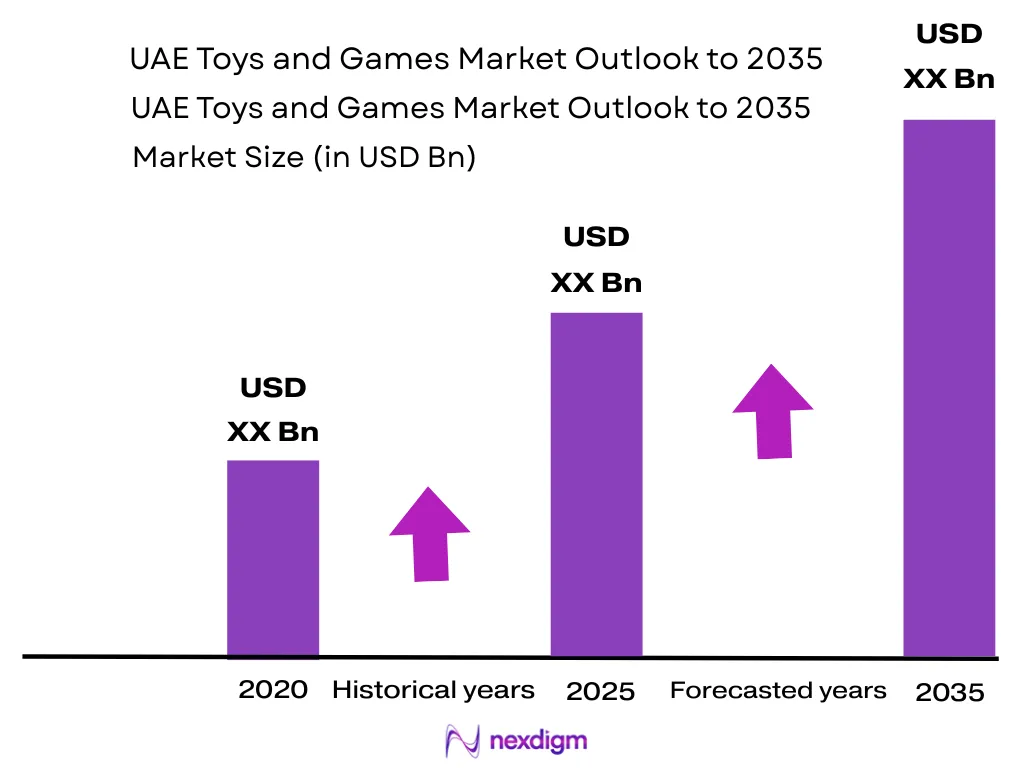
The UAE toys and games market is valued at USD ~ billion in retail revenue, reflecting a robust consumer base across leisure, educational, licensed, and electronic toy products. This level of market activity is driven by high per capita disposable incomes, supported by UAE GDP and consumer expenditure dynamics feeding premium toy purchases (e.g., branded dolls, STEM kits, and interactive electronic toys). Leading toy retailers focus on education‑plus‑play formats, reflecting parents’ prioritization of developmental value, while organized retail and e‑commerce platforms increase market reach. Dubai and Abu Dhabi remain pivotal demand hubs due to dense population clusters and expansive organized retail infrastructure that supports broad product selection and seasonal toy merchandising.
Dubai and Abu Dhabi dominate the UAE toy space. Dubai’s position stems from its status as an international retail and tourism hub with significant mall‑based toy store presence and large expatriate family populations drawing global toy brands. Abu Dhabi exhibits strong family household demand patterns and wider premium retail environments backed by high household incomes, supporting both mainstream and niche toy segments. Sharjah and Ajman also contribute but at smaller scales, with expansion of specialty stores and localized community retail supporting market penetration among diverse socioeconomic groups. Dubai’s high footfall in organized retail, combined with strong online adoption across major e‑commerce channels, reinforces its leading market influence.
Market Segmentation
By Product Type
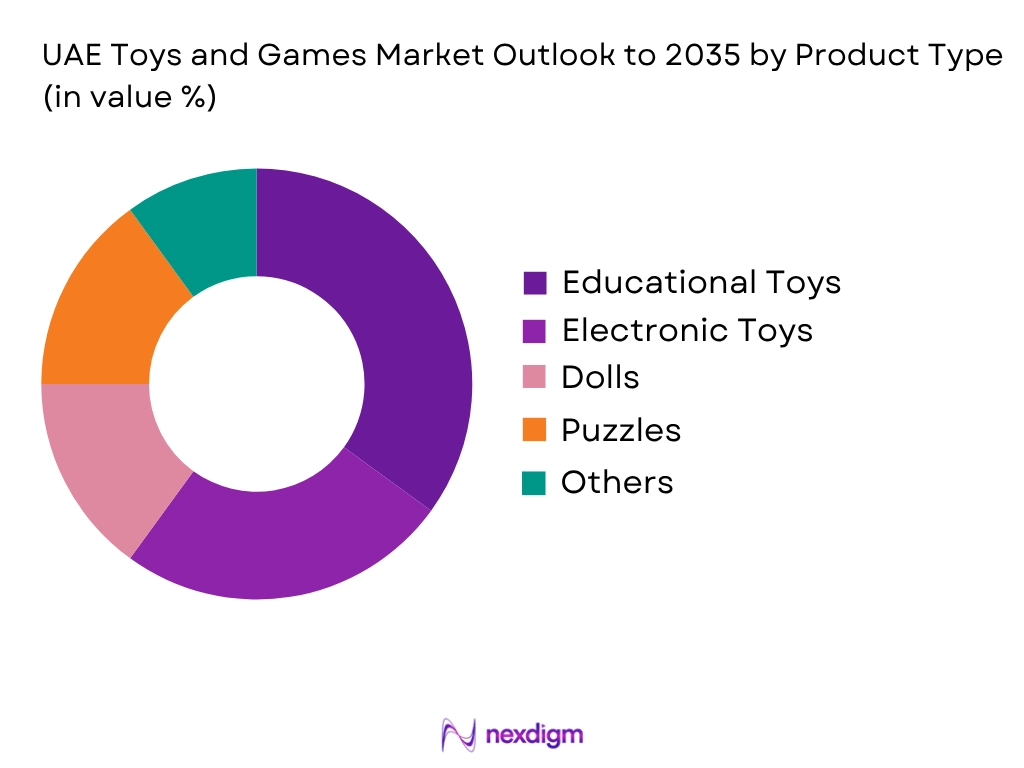
Educational toys lead the UAE market due to increasing parental preference for toys that support early cognitive development, school readiness, and STEM skill enhancement. Many UAE parents integrate educational toys (e.g., building kits, learning games) into family routines to reinforce learning objectives beyond formal education. Licensed multimedia characters anchored by global franchises also reinforce appeal within this category, attracting premium spending. Electronic and interactive toys follow closely, fueled by technology adoption and a desire for hybrid learning/play experiences, enabled by mobile and digital platforms.
By Distribution Channel
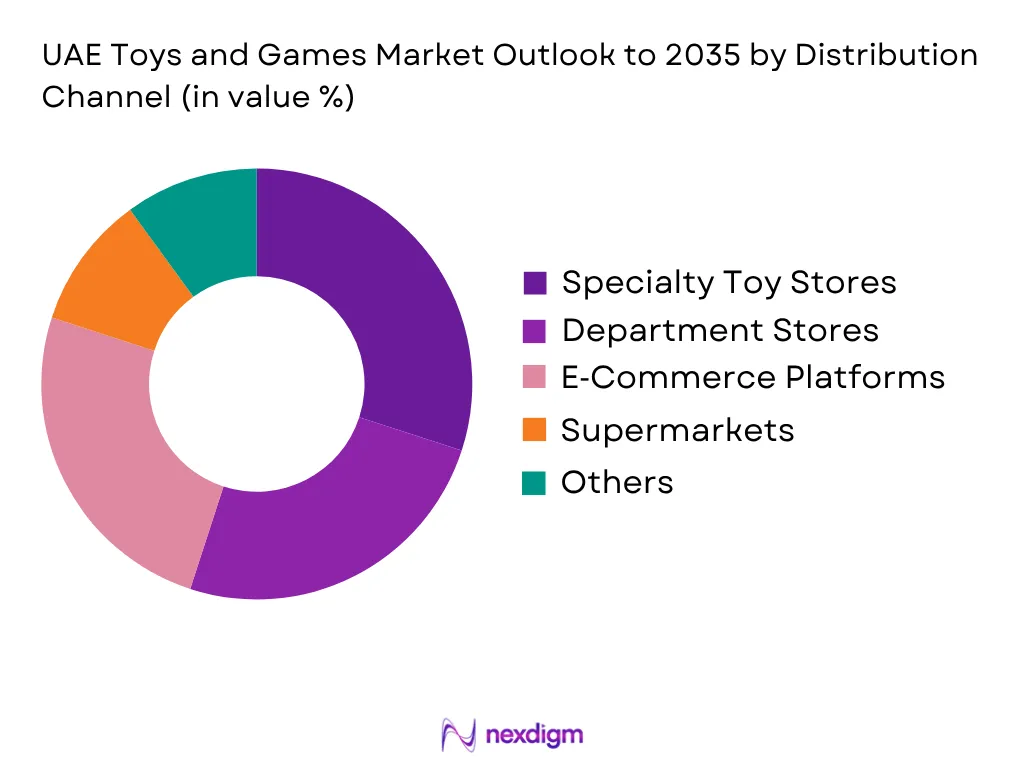
Specialty toy stores dominate distribution owing to curated product assortments, brand exclusive partnerships, and tailored customer experiences that align with high‑income consumer preferences. These outlets often stock premium and licensed collections not widely available through general channels. E‑commerce and department store channels have surged, offering convenience, broad selection, and competitive pricing, serving both expat and local consumers seeking variety and ease of purchase, particularly around festive seasons and holiday peaks.
Competitive Landscape
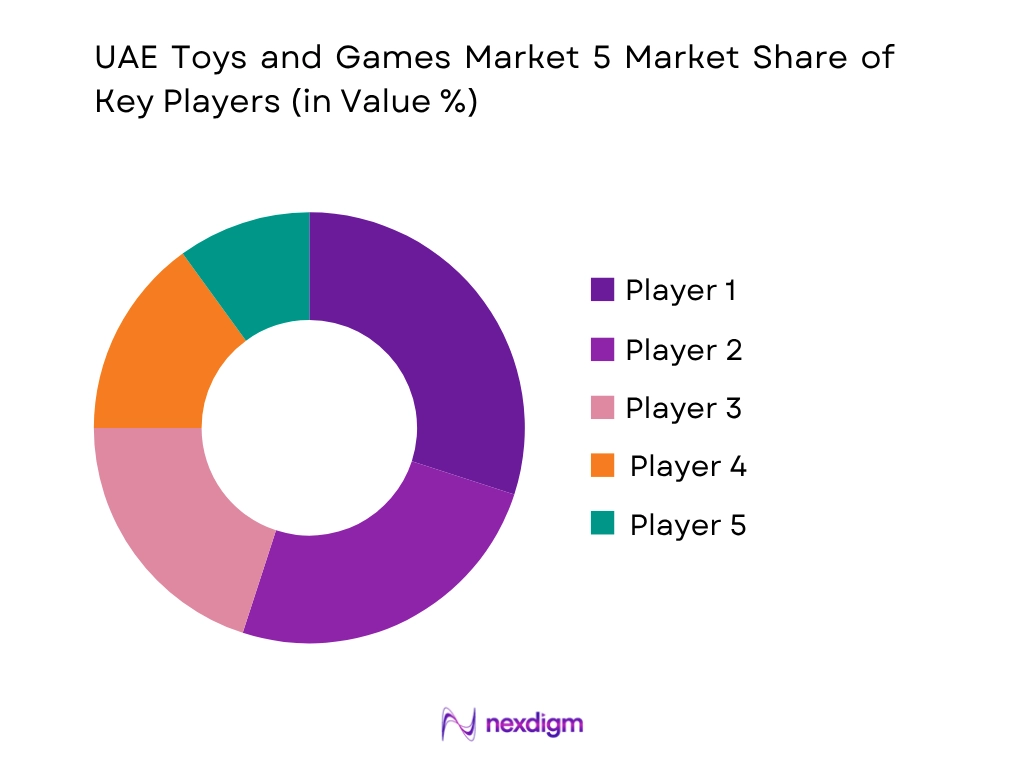
The UAE toys and games market is moderately competitive, with both international and regional companies operating across retail, distribution, and branded segments. Leading players blend global portfolios with local retail strategies to capture value across premium and mainstream segments.
| Company | Establishment Year | Headquarters | Distribution Footprint | Licensing Partnerships | E‑Commerce Integration | Safety/Compliance Focus | Retail Format | Brand Portfolio |
| Hamleys UAE | 1760s | UK | ~ | ~ | ~ | ~ | ~ | ~ |
| Toys R Us UAE | 1957 | USA | ~ | ~ | ~ | ~ | ~ | ~ |
| Early Learning Centre UAE | 1974 | UK | ~ | ~ | ~ | ~ | ~ | ~ |
| LEGO Group | 1932 | Denmark | ~ | ~ | ~ | ~ | ~ | ~ |
| Mattel Inc. | 1945 | USA | ~ | ~ | ~ | ~ | ~ |
UAE Toys and Games Market
Growth Drivers
Strong National Income and Consumer Spending Boosting Retail Demand
The UAE’s macroeconomic environment in 2024 provides a robust foundation for consumer spending on discretionary goods such as toys and games, driven by elevated income levels and household consumption patterns. According to World Bank data, the country’s gross domestic product (GDP) stands at USD 552.32 billion, while GDP per capita is USD 50,273.5, indicating high average income levels compared to global peers. These income figures correlate with strong household purchasing power, which supports demand for non‑essential retail categories including leisure and play products. Complementing this, United Nations statistics show that total household consumption expenditure reached AED 1,106,403,985,910, reflecting extensive household outlays across goods and services that include toys and lifestyle products. High internet penetration — 100% of the population using the internet — further facilitates online discovery and purchase of toys through digital channels, enabling broader reach beyond traditional retail footprints. The UAE’s population of 10,986,400 also features a significant expatriate demographic with diverse cultural toy preferences, adding to demand heterogeneity. Taken together, these indicators underscore how macroeconomic strength and elevated household consumption dynamics underpin retail demand for toys and games.
Urbanization and Digital Engagement Expanding Market Reach
Urban concentration and digital connectivity in the UAE significantly enhance access to toys and games products across consumer segments. In 2024, the population of 10,986,400 people resides predominantly in urban emirates such as Dubai, Abu Dhabi, and Sharjah, where retail infrastructure — including malls, specialty stores, and experiential outlets — is highly developed. High per capita incomes and dense urban living encourage frequent retail engagement. World Bank data confirm that internet usage reached 100%, signifying ubiquitous digital access which supports e‑commerce penetration for toys and games. This connectivity is crucial, as online marketplaces have become essential platforms for consumers to explore diverse product ranges, especially premium and educational toys that may not be widely stocked in smaller physical outlets. Additionally, macro retail reports indicate substantial consumer spending in retail categories such as technology and FMCG (e.g., AED 14.3 billion in Q2 2024 on FMCG and tech items), revealing broad consumer engagement with marketed goods. The combination of urban retail infrastructure, high digital engagement, and significant household consumption positions the UAE’s toys and games market to benefit from integrated physical and digital sales channels that cater to modern lifestyles.
Market Challenges
High Import Dependence and Supply Chain Vulnerability
The UAE toys and games market faces structural challenges due to heavy reliance on imports for product supply and inventory flows. Market data indicate that approximately 85% of toys in the UAE are imported from countries such as China, the United States, and Germany, reflecting limited local production capacity within the domestic toy sector. This import dependency exposes retailers and distributors to global supply chain disruptions, exchange rate fluctuations, and international logistical constraints. Imports constitute a significant portion of product availability, making the market sensitive to international trade dynamics and freight cost volatility. Furthermore, strong adherence to international safety and quality standards results in a notable proportion of imported stock being rejected at entry points — with around 15% of imported toys failing compliance checks, affecting availability and increasing operational complexity for distributors. High import reliance also contributes to price pressures for consumers, particularly when global shipping costs spike or geopolitical events disrupt trade routes. These factors collectively challenge market stability and inventory predictability for retailers and importers in the UAE toy ecosystem, necessitating robust supply chain strategies to mitigate risk.
Price Sensitivity and Competitive Pricing Dynamics
Despite high average incomes, consumer price sensitivity in the UAE presents a challenge for the toys and games market, particularly in segments targeting lower‑income or expatriate groups. Retail pricing in the UAE can reflect high operational costs, such as premium mall rents and logistics overheads, which are often passed on to end consumers. Anecdotal consumer feedback highlights instances where relatively modest toys retail at significantly elevated prices compared with other markets, illustrating how local costs influence final sale values for both branded and action figure categories. This pricing dynamic can temper demand among price‑conscious shoppers and encourage substitution toward lower‑cost alternatives, second‑hand purchases, or cross‑border procurement through online global marketplaces. A significant share of UAE consumers expresses concern about expensive branded toys, which can limit discretionary purchase activity for premium price tiers. The result is an uneven demand pattern where consumers may defer purchases or shift their preferences toward more competitively priced offerings, posing a strategic challenge for retailers and suppliers aiming to balance pricing, margin, and volume objectives in the UAE’s heterogeneous consumer market.
Market Opportunities
Educational and STEM Toy Demand Linked to Parental Preferences
An emerging opportunity in the UAE’s toys and games market lies in growing demand for educational and STEM‑oriented products that align with parental priorities for cognitive development and skill building. Industry segmentation data indicate that educational toys — including building kits, problem‑solving games, and skill development sets — are among the leading product categories in terms of consumer preference, driven by a cultural emphasis on quality education and early learning. This trend is underpinned by demographic and macro consumption patterns; households allocate a significant portion of discretionary spending toward youth development and enrichment activities, supported by high consumption expenditure figures such as AED 1,106,403,985,910 total household spending reported in national accounts. Education‑linked toy segments benefit from extended engagement cycles and repeat purchases as children progress through age stages, creating sustained category demand across multiple age groups. Additionally, these products often command higher unit values due to perceived educational benefits, enhancing retailer margin potential. The strong performance of educational toys underscores an opportunity for brands and distributors to expand portfolios that emphasize learning and developmental value, capitalizing on parental willingness to invest in enriched play experiences that complement formal education.
Expanding Digital and E‑Commerce Retail Channels
The UAE’s advanced digital infrastructure and integration of online commerce represent a significant opportunity for the toys and games market to expand distribution reach and customer engagement. World Bank data show 100% internet usage among the population, indicating universal digital connectivity that enables widespread adoption of online shopping platforms. This connectivity supports robust e‑commerce ecosystems where consumers increasingly explore and purchase toys and games across digital marketplaces, including regionally accessible platforms. High internet access, coupled with smart device proliferation, allows retailers to leverage targeted digital marketing, immersive product showcases, and seamless fulfilment services, enhancing convenience for both local and expatriate families. Digital channels also facilitate access to niche and premium toy categories that may not be widely stocked in physical stores, broadening consumer choice. Furthermore, growth in consumer spending on tech and related categories, such as the AED 14.3 billion spent on FMCG and tech products in a single quarter, signals strong digital commerce activity and a willingness among consumers to transact online across diverse retail categories. This environment presents an opportunity for toy brands and retailers to integrate omnichannel strategies that blend digital and physical retail advantages, boosting overall market penetration and customer satisfaction.
Future Outlook
The UAE toys and games market is expected to continue upward expansion driven by persistent demand for educational, tech‑enabled, and licensed play experiences. Urbanization, high disposable incomes, and sustained family‑oriented spending underpin growth. Retail modernization, expanding online marketplaces, and evolved consumer preferences for differentiated products (e.g., augmented play, STEM toys) will accelerate category diversification. Over the next decade, industry investment in omnichannel experiences, experiential retail, and integrated learning play formats is set to enhance overall market sophistication.
Major Players
- Hamleys UAE
- Toys R Us UAE
- Early Learning Centre UAE
- LEGO Group
- Mattel Inc.
- Hasbro Inc.
- Spin Master Corp.
- Simba Dickie Group
- JAKKS Pacific Inc.
- Funko LLC
- Bandai Namco
- Tomy Company Ltd.
- Babyshop Toys (Al‑Futtaim)
- Mumzworld (Online Marketplace)
- Sprii (Online Marketplace)
Key Target Audience
- Retail Investors & Venture Capitalist Firms
- Consumer Goods Distributors
- Toy Manufacturers & Importers
- Retail Chain Operators
- E‑Commerce Platform Operators
- Government and Regulatory Bodies
- Licensing and Brand Partners
- Supply Chain & Logistics Providers
Research Methodology
Step 1: Identification of Key Variables
The initial phase involves detailed desk research to map stakeholder ecosystems in the UAE toy market, defining variables such as product categories, distribution channels, and consumer demand drivers.
Step 2: Data Collection and Market Mapping
Historical retail revenue, channel distribution, and product segment data are compiled from primary and secondary sources. This phase assesses organized vs. unorganized market contributions and demand patterns.
Step 3: Hypothesis Validation and Expert Inputs
Market hypotheses are validated through interviews with industry practitioners including retailers, brand representatives, and importers to refine operational and consumer insights.
Step 4: Research Synthesis and Forecasting
The final phase integrates quantitative revenues with qualitative insights to build comprehensive growth forecasts and segmentation charts, ensuring robust analysis and actionable market intelligence.

- Executive Summary
- Research Methodology (Market Definitions & Assumptions; Abbreviations; Market Sizing Approach; Consolidated Research Approach; Demand‑Supply Modelling; Primary Research Framework; Limitations & Future Considerations)

- Definition and Scope
- Market Genesis and Industry Evolution
- Economic Context (Per Capita Disposable Income, Population & Consumption Trends)
- Consumer Preference Dynamics (Rise of Educational & Interactive Play)
- Retail & Distribution Environment (Mall Culture, Specialty Stores & E‑Commerce Penetration)

- Growth Drivers (Rising Disposable Incomes & Premium Purchases, Expatriate Household Consumption Patterns, Focus on Educational & STEM‑Led Products, Digital Gaming & App‑Integrated Play Trends, Seasonal & Festive Retail Dynamics)
- Market Challenges (Price Sensitivity & Import Cost Pressures, Stringent Safety & Conformity Regulations, Dependence on Imported Product Flows, Rapid Product Lifecycle & Inventory Risks)
- Market Opportunities (Expanding E‑Commerce Reach & Omnichannel Penetration, Tech‑Enabled & AI‑Integrated Toy Demand, Sustainability & Eco‑Friendly Toy Segments, Export & Distribution Hub Potential)
- Trends (Kidult & Collectibles Segment Growth, Interactive & Augmented Reality Toys, Licensed Franchise Impact on Product Demand)
- SWOT Analysis
- Porter’s Five Forces
- Consumer Behaviour Mapping

- By Value (2020-2025)
- By Volume (2020-2025)
- By Retail Pricing & ASP Evolution (2020-2025)

- By Product Type (In Value %)
Educational & STEM Toys
Action Figures & Licensed Characters
Dolls & Accessories
Electronic & Digital Toys
Puzzles & Board Games - By Age Group (In Value %)
0–2 Years
3–5 Years
6–12 Years
13+ Years - By Distribution Channel (In Value %)
Specialty Toy Stores
Department Stores & Hypermarkets
E‑Commerce Platforms
Supermarkets & Mass Merchandisers
Independent Retailers - By Geographic Emirates (In Value %)
Dubai
Abu Dhabi
Sharjah
Northern Emirates
Other Urban Zones

- Market Share by Revenue & Volume
- Cross‑Comparison Parameters (Company Overview & Legal Structure, Product Portfolio Breadth & Licensing Partnerships, Channel Penetration & Retail Footprint, Distribution Network & Logistics Reach, Revenue by Product Category, Marketing & Promotional Reach, Safety & Quality Compliance (ESMA/GCC), Retail Pricing & Discount Strategies)
- SWOT Analysis of Major Players
- Pricing & SKU Tier Analysis
- Detailed Company Profiles
Hamleys UAE
Toys R Us UAE
Early Learning Centre UAE
Virgin Megastore – Toys & Games Division
Centrepoint Toys
Babyshop Toys
FirstCry UAE
(Dubai/Abu Dhabi Outlets)
Mattel UAE Distribution
Hasbro UAE Distribution
Spin Master Licensed Partners
Funskool Regional Distribution
Ubongo & Educational Toy Distributors
Melissa & Doug (Distributor Partners)
Nickelodeon/Disney Licensed Stockists

- Consumer Spending Patterns on Toys
- Urban Household Purchase Behaviour
- Expatriate vs. Local Consumer Preferences
- Parental Attitudes Toward Educational Value
- Seasonal & Gift Purchasing Trends

- By Value (2026-2035)
- By Volume (2026-2035)
- By Retail Pricing & ASP Evolution (2026-2035)


 Request a Sample
 Ask for Customization
 Get a Quote
 Enquire Now