
 Download PDF
Market Overview
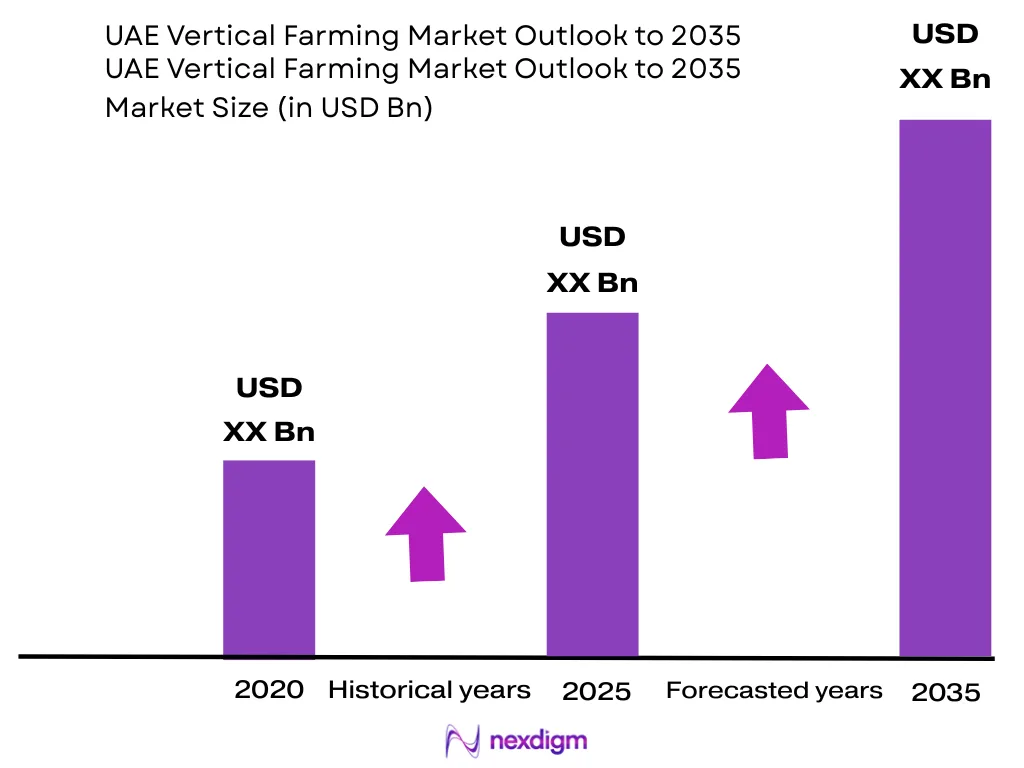
The UAE Vertical Farming Market was valued at approximately USD ~ Billion in 2024 and has emerged as the largest and fastest-growing vertical farming market within the Middle East and Africa region, commanding the leading share of regional market value. Market growth is fundamentally driven by the UAE’s structural food security vulnerabilities: the country imports more than 85% of the food it consumes, at an annual cost exceeding USD 13 billion, while domestic food consumption is projected to rise by approximately 50% by 2030 as the population continues to grow. With less than 1% of UAE land classified as arable and among the world’s most acute per-capita freshwater scarcity levels, conventional open-field agriculture remains fundamentally constrained, positioning controlled environment agriculture as a strategic national priority rather than a niche agricultural segment.
Market Segmentation
By Crop Type
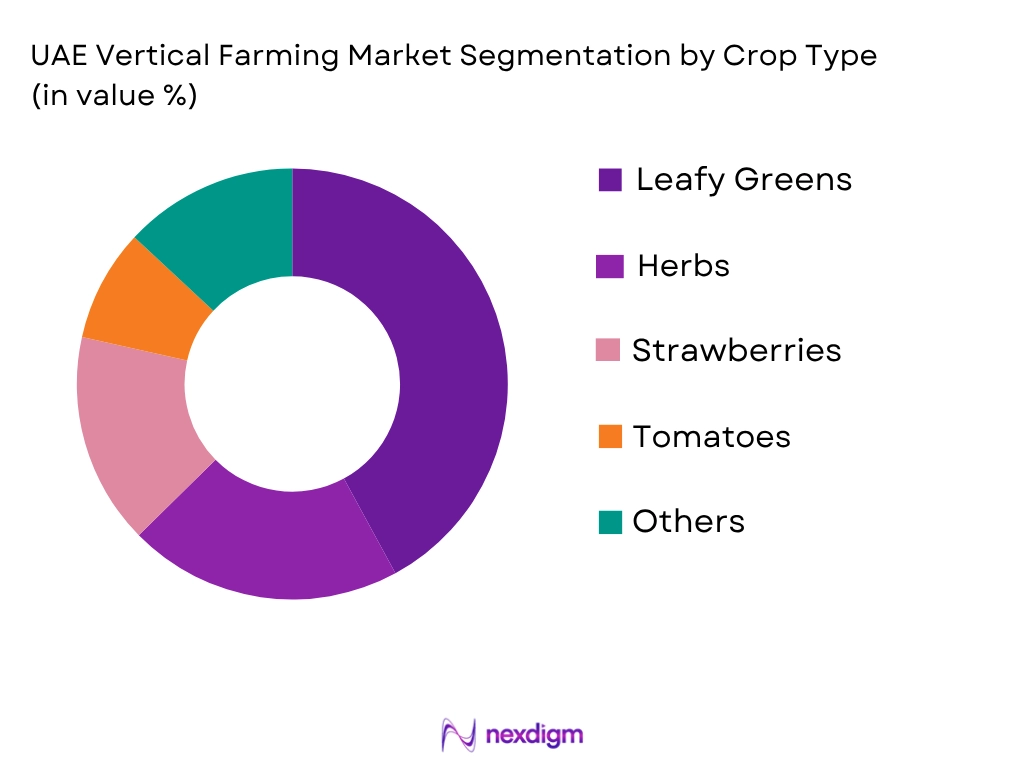
The UAE Vertical Farming Market is segmented by crop type into leafy greens, herbs, microgreens, tomatoes, strawberries, cucumbers, and other specialty crops including saffron. Leafy greens, led by lettuce and kale, dominate the market due to their short cultivation cycles, high yield density, and strong demand from retailers, hospitality groups, and airline caterers. Lettuce in particular benefits from exceptional compatibility with hydroponic systems, requiring a small fraction of the water consumed by open-field cultivation — a critical advantage in a country where desalinated water represents the primary source of potable supply. Leafy greens also command premium prices owing to their pesticide-free production and superior freshness, attributes increasingly valued by the UAE’s large expatriate population and health-conscious Emirati consumers across Dubai and Abu Dhabi. The segment further benefits from the operational expertise concentrated among large-scale operators such as Bustanica, making it the preferred crop category for maximising facility utilisation and profitability within the UAE market, while fruiting crops such as tomatoes and strawberries represent the fastest-growing categories as operators including Pure Harvest Smart Farms and the Plenty-Mawarid joint venture expand greenhouse and high-tech vertical production capacity.
By Growing Mechanism
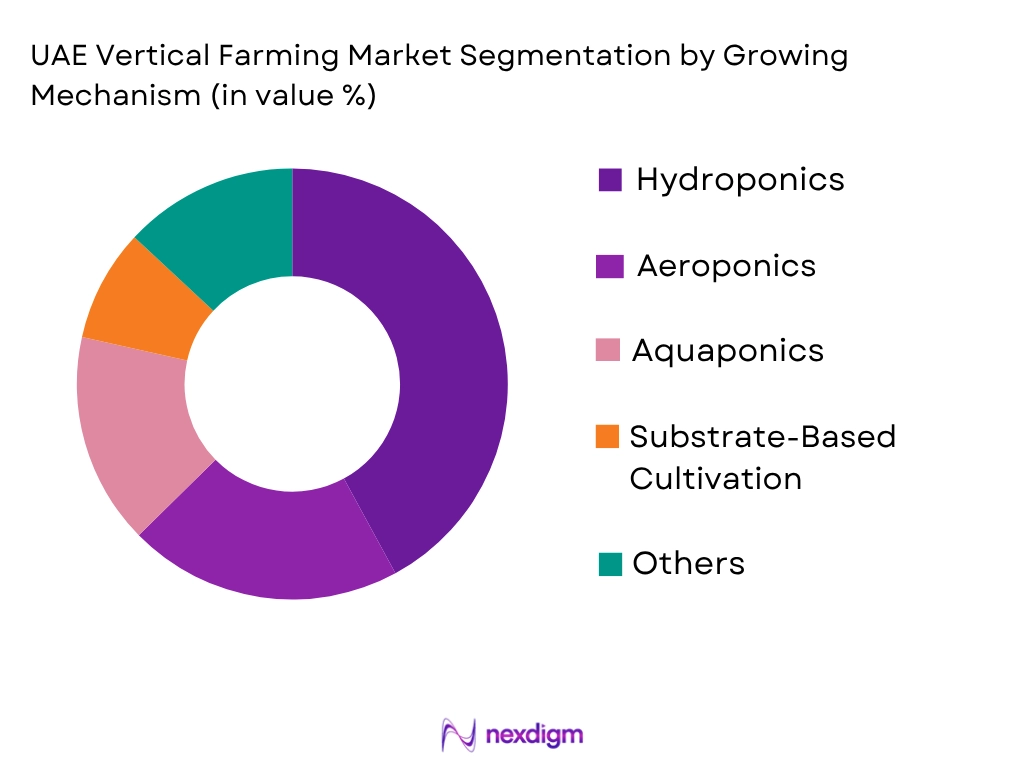
The UAE Vertical Farming Market is segmented by growing mechanism into hydroponics, aeroponics, aquaponics, and substrate-based cultivation. Hydroponics holds the dominant market share due to its proven commercial viability, lower operational complexity, and substantial water-saving advantages relative to conventional agriculture — a paramount consideration in a country ranked among the most water-scarce in the world and almost entirely dependent on energy-intensive desalination for potable water supply. Hydroponic systems enable precise nutrient delivery while reducing water consumption dramatically compared to open-field cultivation, supporting predictable, scalable production well suited to integration with IoT-based automation and climate-control technologies essential for year-round cultivation in extreme desert heat. Most leading UAE operators, including Bustanica and Madar Farms, have standardised hydroponic systems for leafy greens and herbs, while aeroponic cultivation — championed by AeroFarms AgX in Abu Dhabi — represents a smaller but technologically advanced segment focused on maximising water efficiency and supporting R&D into climate-resilient cultivation methods suited to arid environments. The increasing availability of specialised hydroponic equipment suppliers and growing technical expertise fostered through initiatives such as Food Tech Valley further reinforce hydroponics’ position as the UAE industry’s preferred cultivation method.
Competitive Landscape
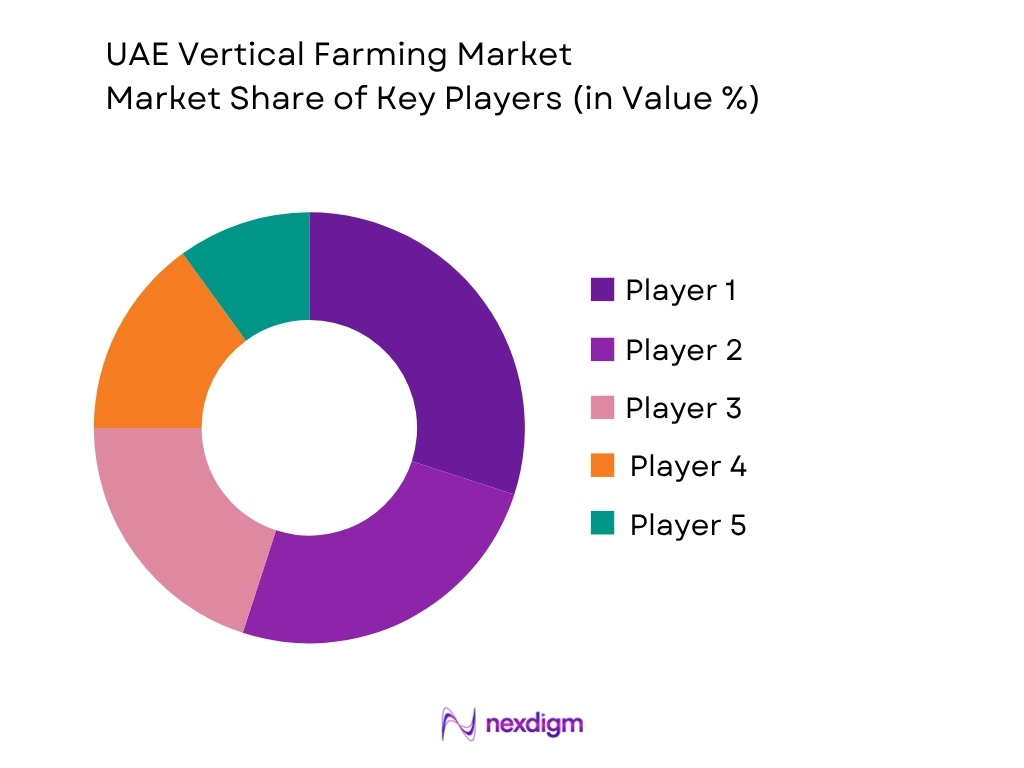
The UAE Vertical Farming Market is characterised by a moderately concentrated yet increasingly competitive environment, led by a combination of sovereign-backed mega-facilities and specialised technology-driven operators focused on indoor and greenhouse cultivation, automation, and sustainable food production. Leading participants continue to invest in sensor networks, climate-control systems, and advanced greenhouse technologies to improve operational efficiency and profitability in a high energy-cost environment. Strategic partnerships with hospitality groups, airline caterers, and retail chains — including Emirates Flight Catering, Spinneys, Waitrose, Carrefour, and Lulu Group — remain critical competitive advantages. The market has also witnessed substantial inbound investment from international operators and technology providers, including US-based Crop One Holdings, AeroFarms, and Plenty Unlimited, alongside strong sovereign wealth backing through entities such as the Abu Dhabi Investment Office (ADIO) and ADQ-linked Silal, reflecting growing global confidence in the UAE’s position as a regional vertical farming and food security hub.
| Company | Establishment Year | Headquarters | Primary Crop Focus | Growing Technology | Automation Level | Geographic Presence | Retail Partnerships | Sustainability Focus |
| Bustanica (Emirates Crop One) | 2022 | ~ | ~ | ~ | ~ | ~ | ~ | ~ |
| Pure Harvest Smart Farms | 2016 | ~ | ~ | ~ | ~ | ~ | ~ | ~ |
| Madar Farms | 2017 | ~ | ~ | ~ | ~ | ~ | ~ | ~ |
| AeroFarms (AgX) | 2020 | ~ | ~ | ~ | ~ | ~ | ~ | ~ |
| Badia Farms | 2016 | ~ | ~ | ~ | ~ | ~ | ~ | ~ |
UAE Vertical Farming Market Analysis
Growth Drivers
Acute Water Scarcity, Arid Climate, and Food Security Imperatives
The UAE’s extreme water scarcity and desert climate are the foundational drivers of the Vertical Farming Market, as conventional open-field agriculture remains structurally constrained by negligible arable land and dependence on energy-intensive desalinated water. According to national authorities, the UAE imports more than 85% of the food it consumes, at an estimated annual cost exceeding USD 13 billion, exposing the country to significant vulnerability from global supply chain disruptions, geopolitical instability, and volatile international commodity prices. The launch of the National Food Security Strategy 2051 formally established food security as a top national priority, targeting a position among the world’s leading countries in the Global Food Security Index and a substantial increase in domestic food production. Vertical farming directly addresses these structural constraints by enabling cultivation independent of arable land and rainfall, using hydroponic systems that consume a small fraction of the water required by traditional agriculture. As domestic food consumption is projected to rise by approximately 50% by 2030 amid continued population growth, vertical farming is positioned as a central pillar of the UAE’s long-term food resilience strategy.
Rising Demand from Premium Hospitality, Airline Catering, and Retail Channels
The UAE’s globally significant hospitality, tourism, and aviation sectors represent a uniquely powerful demand driver for the Vertical Farming Market. Dubai and Abu Dhabi host an exceptionally dense concentration of five-star hotels and fine-dining establishments, many of which increasingly specify sourcing produce from within a limited geographic radius to guarantee freshness and minimise harvest-to-plate time. Emirates Flight Catering’s integration with Bustanica — supplying fresh leafy greens for Emirates Airlines’ in-flight meal service — illustrates the scale of opportunity within airline catering, an end-user category with limited parallel elsewhere in the world. Organised retailers including Spinneys, Waitrose, Carrefour, and Lulu Group have expanded partnerships with vertical farming operators to secure consistent, traceable, premium-quality produce supply, capitalising on strong consumer willingness to pay for food safety certification and guaranteed freshness within the UAE’s high-income, expatriate-heavy consumer base. As the UAE continues to position itself as a premier global tourism and business destination, sustained growth in hospitality and foodservice demand is expected to reinforce vertical farming’s commercial viability.
Market Challenges
High Energy Consumption and Cooling Cost Constraints
High energy consumption represents the most significant structural challenge facing the UAE Vertical Farming Market. Indoor and greenhouse facilities require continuous lighting, climate control, ventilation, and dehumidification to maintain optimal growing conditions, with cooling loads particularly pronounced given the UAE’s extreme summer temperatures, which routinely exceed 45 degrees Celsius. Industry analysis indicates that LED lighting and climate-control systems can account for 60-70% of total facility operating expenditure, tying operator profitability closely to grid electricity pricing and exposing margins to volatility in regional energy markets. While the UAE has expanded renewable energy capacity in recent years, many vertical farm operators continue to depend heavily on conventional grid electricity for the continuous, reliable power supply required for uninterrupted cultivation. This energy intensity creates persistent pressure on operational margins and represents a key consideration in facility siting, technology selection, and long-term scalability decisions across the sector.
Capital Intensive Infrastructure and Equipment Import Dependency
Establishing commercial-scale vertical farming facilities requires substantial upfront capital investment, with industry estimates placing the cost of new facilities in a range from several million to tens of millions of US dollars depending on scale and technology sophistication. The UAE’s vertical farming sector remains heavily dependent on imported technology components, including LED lighting systems, climate-control equipment, and sensor arrays, with manufacturing concentrated primarily in East Asian and Western supply bases. This equipment import dependency exposes operators to shipping cost volatility, customs clearance delays, and currency fluctuation risk, while also limiting the pace at which domestic technology capacity can develop to support the sector’s continued expansion. Smaller and emerging operators in particular face significant barriers to entry given the scale of capital required relative to the still-developing track record of commercial returns within the sector.
Market Opportunities
Expansion of Retail Partnerships and Regional Export Hub Positioning
The growing emphasis on food safety, traceability, and local sourcing presents a major opportunity for the UAE Vertical Farming Market. Food safety awareness and demand for certified, pesticide-free produce have risen significantly among the UAE’s affluent and health-conscious consumer base, supported by national food safety frameworks administered by MOCCAE and ADAFSA. The UAE’s modern retail sector, including supermarkets such as Spinneys, Waitrose, Carrefour, and Lulu Group, alongside quick-commerce delivery platforms, has continued to expand, creating a substantial addressable market for premium indoor- and greenhouse-grown produce. Beyond domestic demand, the UAE’s position as a global logistics and trade hub presents a significant opportunity for vertical farming operators to serve as a regional export and re-export gateway, supplying neighbouring GCC markets such as Saudi Arabia, Qatar, and Bahrain, leveraging the UAE’s superior port and air-freight infrastructure, free zone frameworks, and established trade relationships. As organised retailers and quick-commerce platforms continue prioritising traceability and premium produce categories, vertical farming operators are well positioned to strengthen distribution networks both domestically and across the wider region.
Renewable Energy Integration and AI-Driven Automation
The accelerating adoption of solar power, AI, IoT sensors, and advanced automation technologies creates significant opportunities for the future growth of the UAE Vertical Farming Market. The UAE has made substantial investments in solar energy infrastructure, including the Mohammed bin Rashid Al Maktoum Solar Park, one of the world’s largest single-site solar installations, creating a pathway for vertical farming operators to offset the sector’s significant electricity demands with renewable generation and improve long-term cost competitiveness. The UAE’s substantial GDP, a fast-growing domestic technology sector, and significant venture capital investment in agri-tech innovation continue to attract global technology providers and research institutions to the market. AI-powered crop monitoring systems can analyse plant health, optimise nutrient delivery, and improve environmental controls with high precision — capabilities particularly valuable given the operational intensity required to maintain optimal growing conditions in the UAE’s extreme desert climate. The launch of tools such as the CHAG AgriGPT platform and continued ADAFSA-led precision irrigation initiatives illustrate the breadth of opportunity for technology-driven efficiency gains. As renewable energy costs continue to decline and the UAE’s domestic capacity for agri-tech component integration expands, vertical farming facilities can achieve greater scalability and improved profitability within the market.
Future Outlook
The UAE Vertical Farming Market is expected to witness substantial expansion over the forecast period, supported by sustained government investment under the National Food Security Strategy 2051, continued demand growth from the country’s premium hospitality, airline catering, and retail sectors, and ongoing advancements in controlled environment agriculture technologies suited to the UAE’s extreme desert climate. Commercial operators are expected to prioritise renewable energy integration, AI-driven crop monitoring, and increasingly automated harvesting systems to enhance profitability and reduce dependency on volatile grid electricity costs. Sustainability objectives, water conservation imperatives, and food security requirements will continue to encourage adoption among UAE retailers, hospitality groups, and institutional foodservice buyers, while major economic clusters such as the AgriFood Growth and Water Abundance Cluster (Agwa) and Food Tech Valley are expected to channel substantial new investment into the sector. Additionally, technological improvements are likely to expand the commercial viability of fruiting and high-value specialty crops, building on the greenhouse expertise already established by operators such as Pure Harvest Smart Farms and the Plenty-Mawarid strawberry joint venture. Greater integration of solar and renewable energy systems, alongside smart climate-control solutions, will further reduce operational costs and improve competitiveness relative to imported produce. Increasing partnerships between UAE agri-tech firms, sovereign investment vehicles, and major hospitality, retail, and airline catering operators are expected to strengthen market penetration and reinforce the UAE’s position as the leading vertical farming hub within the Middle East and Africa region through 2035.
Major Players
- Bustanica (Emirates Crop One)
- Pure Harvest Smart Farms
- Madar Farms
- AeroFarms
- Badia Farms
- VeggiTech
- CRYSP Farms
- Mowarid (Plenty Unlimited UAE Joint Venture)
- iFarm UAE
- Emirates Hydroponics Farms
- Silal
- GreenFactory Emirates
- Al Aliyo Hydrofarms
- UNS Farms
- Agritech by Sila
Key Target Audience
- Vertical Farming Operators and Indoor Agriculture Companies
- Fresh Produce Retail Chains and Supermarkets
- Hospitality, Hotel and Fine-Dining Procurement Organisations
- Airline Catering and Foodservice Companies
- Agricultural Technology Equipment Manufacturers
- Investment, Venture Capital and Sovereign Wealth Entities
- Government and Regulatory Bodies (Ministry of Climate Change and Environment, Abu Dhabi Agriculture and Food Safety Authority, Abu Dhabi Investment Office, Food Tech Valley)
- Controlled Environment Agriculture Infrastructure Developers
- Sustainable Food Supply Chain and Distribution Companies
Research Methodology
Step 1: Identification of Key Variables
The initial phase involves constructing an ecosystem map encompassing all major stakeholders within the UAE Vertical Farming Market. Extensive secondary research is conducted through industry publications, government databases, company reports, and agricultural technology resources. The objective is to identify key variables influencing production capacity, crop yields, technology adoption, investment activity, and market growth across all seven emirates.
Step 2: Market Analysis and Construction
This phase focuses on collecting and analysing historical industry data related to production volume, facility expansion, crop output, technology deployment, and revenue generation. Market segmentation is developed based on crop types, cultivation technologies, and end-user demand patterns across the UAE’s emirate-level markets. Supply-side and demand-side assessments are integrated to establish accurate market estimates.
Step 3: Hypothesis Validation and Expert Consultation
Market assumptions and forecasts are validated through structured interviews with vertical farm operators, agricultural technology providers, equipment manufacturers, distributors, and industry specialists. These consultations provide operational insights regarding yield performance, cost structures, expansion strategies, and future technology adoption trends specific to the UAE vertical farming sector.
Step 4: Research Synthesis and Final Output
The final stage combines insights obtained from primary and secondary research sources. Data triangulation techniques are applied to validate market estimates and segment-level findings. The resulting analysis provides a comprehensive view of competitive dynamics, growth opportunities, future trends, and strategic recommendations within the UAE Vertical Farming Market.

- Executive Summary
- Research Methodology (Market Definitions and Assumptions, Abbreviations, Market Sizing Approach, Top-Down Analysis, Bottom-Up Analysis, Controlled Environment Agriculture Assessment, Demand-Side Assessment, Supply-Side Assessment, Primary Industry Interviews, Data Triangulation, Forecasting Framework, Limitations and Future Conclusions)

- Definition and Scope
- Market Evolution and Industry Genesis
- Timeline of Major Industry Developments
- Vertical Farming Ecosystem Structure
- Controlled Environment Agriculture Value Chain Analysis

- Growth Drivers (Acute Water Scarcity and Arid Climate Constraints, National Food Security Strategy 2051 and Import Dependence Reduction, Rising Demand from Premium Hospitality and Airline Catering Channels, Sovereign Wealth and Government Investment in AgTech, Government Free Zones and Regulatory Incentives, Advancements in AI, Robotics and Climate-Control Automation)
- Market Challenges (High Energy Consumption and Cooling Costs, Capital Intensive Infrastructure Requirements, Profitability Constraints in a Price-Sensitive Segment, Equipment Import Dependency, Skilled Workforce Shortage, Crop Portfolio Limitations)
- Market Opportunities (AI-Driven Farm Optimisation, Expansion into Fruiting and High-Value Crops, Renewable Energy and Solar-Powered Farm Integration, Regional Export Hub Positioning, Retailer-Owned and Hotel-Integrated Vertical Farms, Smart City and Giga-Project Food Production Systems)
- Market Trends (Robotic Harvesting Systems, Digital Twin Farm Management, Dynamic Spectrum LED Lighting, Desert-Resilient Production Systems, Renewable Energy and Solar Integration, Farm-as-a-Service Business Models)
- Government Regulations (Ministry of Climate Change and Environment Initiatives, National Food Security Strategy 2051, ADAFSA and Emirate-Level Agricultural Authorities, Food Safety and Traceability Compliance, Water Resource Management Regulations, Free Zone and Investment Incentives)
- SWOT Analysis
- PESTLE Analysis
- Porter’s Five Forces Analysis
- Stakeholder Ecosystem
- Competition Ecosystem

- By Market Value (2020-2025)
- By Production Volume (2020-2025)
- By Average Selling Price (2020-2025)

- By Crop Type (In Value %)
Lettuce
Kale and Leafy Salad Greens
Microgreens
Herbs (Basil, Mint, Coriander, Parsley)
Strawberries
Tomatoes
Cucumbers
Saffron and High-Value Specialty Crops - By Farming Structure (In Value %)
Building-Based Vertical Farms
Shipping Container Farms
Greenhouse-Integrated Vertical Farms
Hybrid Controlled Environment Farms - By Growing Mechanism (In Value %)
Hydroponics
Aeroponics
Aquaponics
Substrate-Based Cultivation - By Emirate (In Value %)
Dubai
Abu Dhabi
Sharjah
Northern Emirates (Ras Al Khaimah, Fujairah, Ajman, Umm Al Quwain) - By End User (In Value %)
Retail Chains and Supermarkets
Hospitality, Hotels and Fine-Dining Restaurants
Airline Catering and Quick Service Restaurants
Institutional Buyers
Direct-to-Consumer
Food Processors

- Market Share Analysis of Major Players (By Revenue, Production Volume, Cultivation Capacity, Crop Portfolio, Emirate-Level Presence)
- Market Concentration Analysis
- Cross Comparison Parameters (Cultivation Capacity, Annual Yield Output, Number of Vertical Farming Facilities, Crop Portfolio Diversity, Stacking Density Efficiency, Automation & Robotics Integration Level, Energy Consumption per Kg of Produce, Retail & Foodservice Distribution Reach)
- SWOT Analysis of Major Players
- Pricing Analysis (Per Kilogram Pricing, Premium vs Conventional Produce Pricing, Retail Channel Pricing, Crop-Wise Pricing Benchmarking)
- Detailed Profiles of Major Companies
Bustanica (Emirates Crop One)
Pure Harvest Smart Farms
Madar Farms
AeroFarms (AgX Abu Dhabi)
Badia Farms
VeggiTech
CRYSP Farms
Mowarid (Plenty UAE Joint Venture)
iFarm UAE
Emirates Hydroponics Farms
Silal
GreenFactory Emirates
Al Aliyo Hydrofarms
UNS Farms
Agritech by Sila

- Fresh Produce Consumption and Utilisation Assessment (Consumption Frequency, Freshness Preference, Local Produce Demand, Premium Produce Adoption)
- Procurement Behaviour Analysis (Contract Farming Preference, Supplier Switching Rate, Procurement Volume, Supply Consistency Requirements)
- Purchasing Power and Spending Analysis
- Sustainability-Driven Purchase Behaviour (Carbon Footprint Awareness, Water Conservation Preference, Food Miles Reduction Importance)
- Premium Pricing Acceptance Analysis

- By Market Value (2026-2035)
- By Production Volume (2026-2035)
- By Average Selling Price (2026-2035)


 Request a Sample
 Ask for Customization
 Get a Quote
 Enquire Now