
 Download PDF
Market Overview
The UAE Waterproofing Chemicals Market is supported by the country’s large construction and industrial base, where protection against water ingress, thermal cycling and demanding environmental conditions is important for building durability. The UAE recorded GDP of USD 552.32 billion and GDP per capita of USD 50,273.5, while industry including construction generated USD 244.84 billion of value added. These conditions support demand from residential, commercial, industrial and infrastructure projects, particularly where waterproofing forms part of concrete protection and building-envelope specifications.
Dubai and Abu Dhabi represent the principal demand centers for UAE Waterproofing Chemicals because they combine extensive high-rise development, hospitality assets, commercial buildings, infrastructure and large-scale real-estate projects. Dubai’s hotel inventory reached 154,016 rooms across 832 establishments, compared with 150,291 rooms in 2023, while occupied room nights reached 43.03 million, creating recurring requirements for roofs, terraces, wet areas, pools, podiums and below-grade structures. Dubai also recorded 18.72 million international overnight visitors, reinforcing continued hospitality construction and refurbishment activity.
Market Segmentation
By Product Type
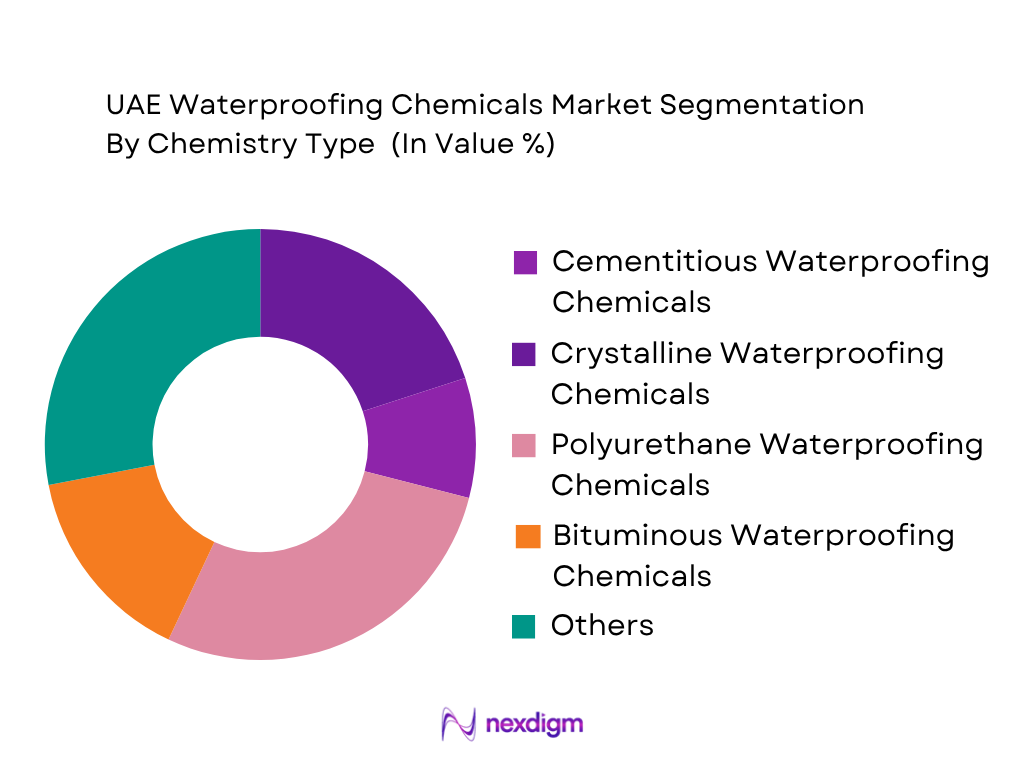
The UAE Waterproofing Chemicals Market is segmented into cementitious waterproofing coatings, polyurethane waterproofing coatings, polyurea waterproofing systems, bituminous waterproofing coatings, acrylic waterproofing coatings, crystalline waterproofing systems, epoxy waterproofing systems, integral waterproofing admixtures, injection grouting chemicals, and silane and siloxane treatments. Polyurethane waterproofing coatings are expected to hold the dominant modeled share because their seamless application, elasticity, adhesion and suitability for roofs, terraces, podiums, balconies and wet areas align well with UAE construction requirements. Liquid-applied polyurethane systems can accommodate complex geometries while minimizing joints, making them useful where continuous waterproofing is required. Their applicability across both new construction and refurbishment also broadens their addressable demand. The technology is supported by established construction-chemical suppliers operating in the region. Mapei, for example, offers liquid membrane solutions for exposed roofs, terraces, balconies, bathrooms and wet areas, alongside dedicated below-grade and infrastructure waterproofing technologies.
By Application
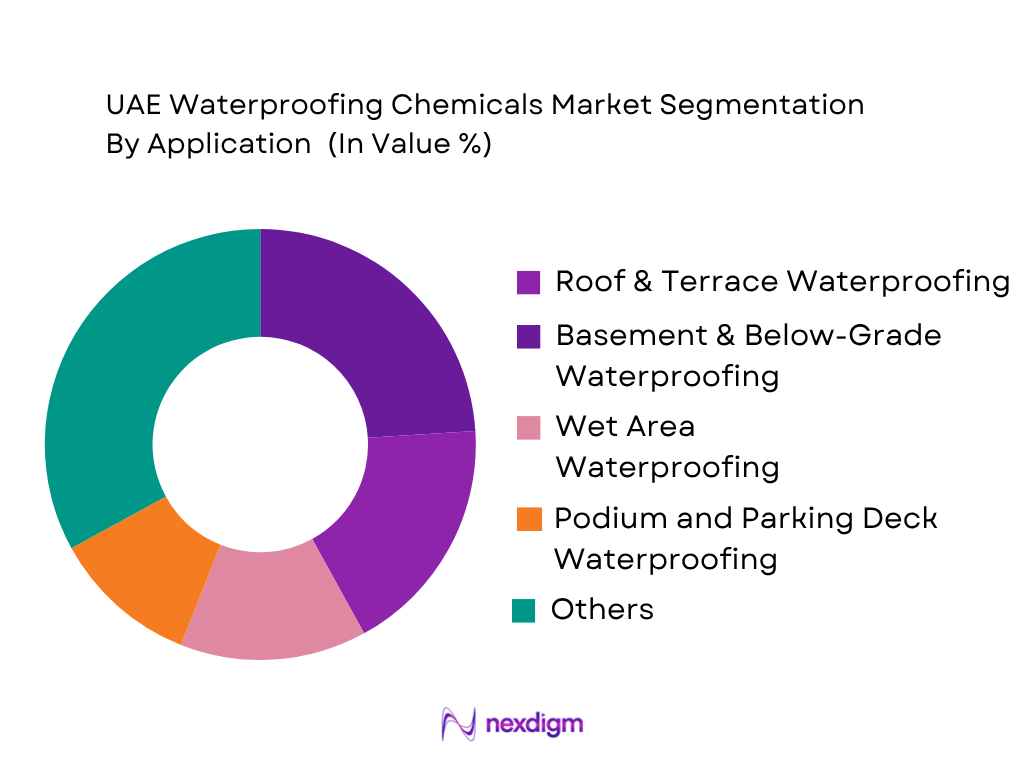
The UAE Waterproofing Chemicals Market is segmented into roof and terrace waterproofing, basement and below-grade waterproofing, wet-area waterproofing, water tanks and reservoirs, swimming pools, podiums and parking decks, bridges and infrastructure, concrete joints and cracks, façades and building envelopes, and industrial areas. Roof and terrace waterproofing is expected to represent the dominant modeled application because UAE buildings are extensively exposed to intense solar radiation, high temperatures and occasional heavy rainfall, making roof-envelope integrity important throughout the asset lifecycle. Dubai’s substantial hospitality inventory, with 154,016 rooms across 832 establishments, creates a large installed base requiring roof, terrace, balcony, pool and wet-area protection. Waterproofing also remains relevant during refurbishment because liquid-applied systems can be deployed over complex existing substrates. Mapei’s UAE portfolio specifically covers balconies, terraces, bathrooms, swimming pools, hydraulic structures, tanks, bridge decks and below-grade structures, illustrating the breadth of applications available to UAE contractors and specifiers.
Competitive Landscape
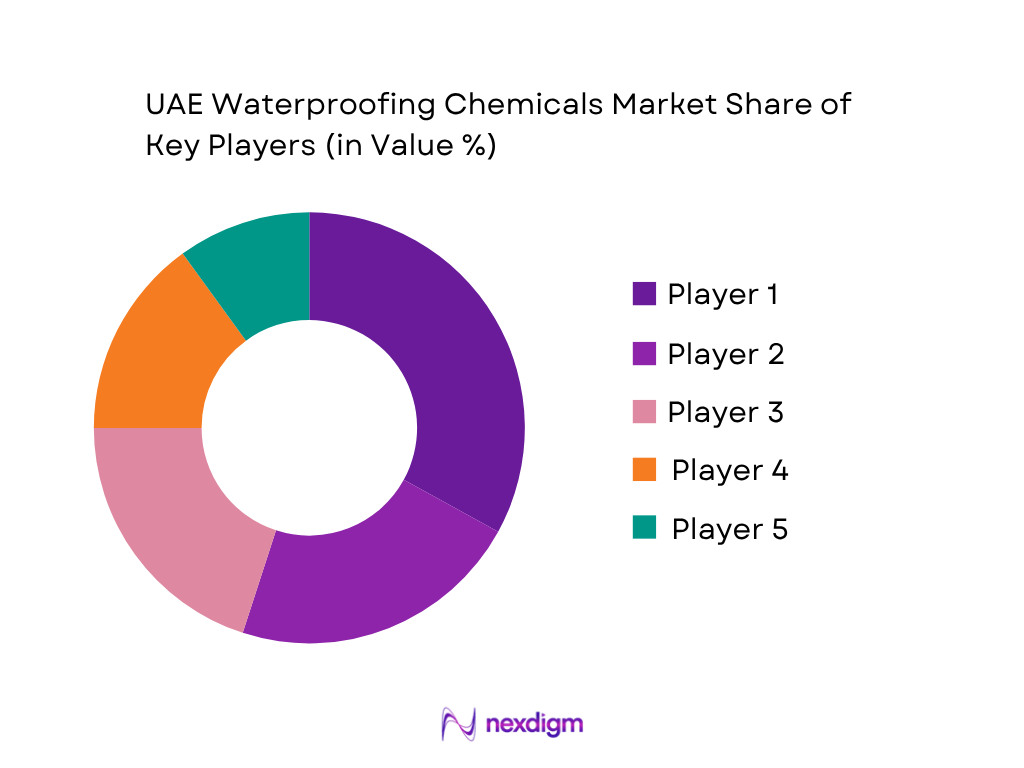
The UAE Waterproofing Chemicals Market is characterized by international construction-chemical manufacturers with broad product portfolios spanning cementitious coatings, polyurethane, polyurea, crystalline systems, membranes, concrete repair and protective coatings. Competition is influenced by technical specification capabilities, distributor relationships, contractor networks, product certification and the ability to provide application support. Major suppliers include Sika, Fosroc, Mapei, Saint-Gobain Weber and Henkel, with each competing across multiple waterproofing applications rather than a single chemistry.
| Company | Establishment Year | Headquarters | Waterproofing Chemistry Coverage | UAE Application Coverage | Concrete Protection | Technical Support | Distribution / Contractor Reach |
| Sika | 1910 | Baar, Switzerland | ~ | ~ | ~ | ~ | ~ |
| Fosroc | 1934 | Dubai, UAE / Global operations | ~ | ~ | ~ | ~ | ~ |
| Mapei | 1937 | Milan, Italy | ~ | ~ | ~ | ~ | ~ |
| Saint-Gobain Weber | 1665 | Paris, France | ~ | ~ | ~ | ~ | ~ |
| Henkel / Polybit | 1876 | Düsseldorf, Germany | ~ | ~ | ~ | ~ | ~ |
UAE Waterproofing Chemicals Market Analysis
Growth Drivers
High-Rise and Mixed-Use Construction, Commercial Real Estate Development
Dubai’s active construction and real-estate pipeline is a direct demand driver for waterproofing chemicals used in basements, raft foundations, retaining walls, podium decks, roofs, balconies, terraces, wet areas, parking structures, swimming pools and landscaped decks. Dubai Municipality reported that more than 18,800 buildings were under construction during H1 2025, representing more than 36 million square metres of built-up area. During the same six-month period, the municipality issued 1,669 building completion certificates, covering 1,484 villas, 74 multi-storey buildings and 60 industrial facilities, while approximately 2 million square metres of additional residential, commercial and industrial space reached completion. These figures are particularly relevant for liquid-applied polyurethane, cementitious, acrylic, crystalline and other chemical waterproofing systems because large mixed-use developments contain several interfaces where rigid structures, podiums, roofs and below-grade elements require continuity of protection. Dubai Land Department data also show the scale of property activity supporting the construction cycle: 2.78 million real-estate procedures were recorded during 2024, including 226,000 real-estate transactions and 217,000 investments. Although transaction statistics do not themselves represent waterproofing consumption, they demonstrate the depth of the development ecosystem supporting new residential towers, commercial assets and mixed-use communities. The macroeconomic environment provides an additional demand foundation. World Bank data place UAE GDP at USD 552.32 billion in 2024, with GDP per capita of USD 50,273.5, while the IMF reported a UAE population of 11.3 million in 2024. This economic and demographic base supports continued occupancy, property investment and construction utilization. For waterproofing-chemical suppliers, the significance lies in the technical complexity of UAE developments rather than simply the number of projects. High-rise buildings generally combine deep foundations, underground parking, podium structures, rooftop mechanical areas, planter systems and water-retaining features, meaning waterproofing specifications can extend from substructure works to the final building envelope. Dubai Municipality’s 25,000 construction-site field inspections in H1 2025 further indicate that projects are being executed within an increasingly controlled building-regulation environment. This favors systems with documented substrate compatibility, concrete protection performance and application procedures because waterproofing failures can compromise occupied areas, structural concrete and high-value interior finishes. Consequently, sustained multi-storey and mixed-use construction creates recurring demand for primers, joint treatments, cementitious coatings, polyurethane systems, liquid membranes, crystalline materials and protective coatings across multiple construction stages rather than at a single application point.
Hospitality, Tourism and Infrastructure Development
The combination of Dubai’s hospitality intensity, passenger volumes and transport-infrastructure activity provides another measurable growth driver for the UAE waterproofing chemicals market. Dubai received 18.72 million international overnight visitors in 2024, while its hotel inventory reached 154,016 available rooms across 832 establishments at year-end. The hospitality sector also generated 43.03 million occupied room nights during 2024. Separately, Dubai International Airport handled 92.3 million guests in 2024, illustrating the scale of the physical infrastructure required to support tourism, aviation, retail and business travel. Hotels and tourism-oriented mixed-use properties are intensive waterproofing users because they incorporate bathrooms, kitchens, swimming pools, spas, podiums, roof decks, landscaped areas, fountains, basements and service zones where long-term moisture protection is essential. Growth in visitor throughput also places higher utilization loads on existing properties, increasing the importance of roof maintenance, wet-area rehabilitation and protective coatings that can be applied with limited disruption to operating assets. Transport construction broadens the addressable market beyond buildings. Dubai’s Roads and Transport Authority completed the Al Jamayel Street project in 2024 with 4 bridges extending a combined 2,874 metres and approximately 7 kilometres of road works, together with rainwater drainage infrastructure. RTA also completed internal-road and street-lighting works covering 35 kilometres across Margham, Lehbab, Al Lesaili and Hatta during 2024; individual project scopes included drainage networks alongside road construction. These infrastructure assets create technically different requirements from conventional residential construction, including concrete deck protection, joint sealing, below-grade moisture barriers, drainage-structure coatings and chemical protection of reinforced concrete exposed to water and aggressive environmental conditions. The overall economic backdrop remains supportive: World Bank data recorded USD 552.32 billion of UAE GDP in 2024 and USD 50,273.5 of GDP per capita, while IMF data placed the national population at 11.3 million. These indicators are relevant because hospitality, aviation, urban mobility and commercial construction depend on a broad economic and population base capable of sustaining heavy asset utilization. The waterproofing implication is therefore distributed across both newly constructed assets and heavily used existing facilities. Hotels require maintenance of roofs, pools and wet areas; airports require durable podium, roof and service-area systems; bridges and road structures need concrete and joint protection; and drainage installations require resistance to continuous or intermittent water exposure. This diversified end-use base reduces reliance on a single construction category and supports demand for cementitious, polyurethane, crystalline, acrylic, joint-sealing and concrete-protection chemicals tailored to distinct exposure conditions.
Market Challenges
Extreme Heat Exposure, UV and Thermal Cycling, and Substrate Moisture Conditions
UAE climatic conditions create unusually demanding performance requirements for liquid-applied and cementitious waterproofing systems because waterproofed surfaces can encounter very high temperatures, rapid thermal movement and episodic heavy moisture exposure within the same operating environment. Federal Competitiveness and Statistics Centre data show that the UAE’s highest monthly temperature reached 48.9°C in May 2024, 51.7°C in June, 50.8°C in July, 50.7°C in August and 47.6°C in September. Even October recorded a national monthly maximum of 43.5°C. Such conditions are directly relevant to exposed roof coatings, podium membranes, polyurethane systems and joint treatments because the waterproofing assembly must remain bonded and flexible while the underlying concrete, screed and metal interfaces expand and contract. Heat also affects installation: chemical membranes generally require defined substrate temperature, moisture and curing conditions, making timing and surface preparation critical during UAE summers. Moisture presents the opposite but complementary challenge. On 16 April 2024, the UAE experienced its heaviest rainfall event since national climate records began in 1949, and Khatm Al Shakla in Al Ain recorded 254.8 millimetres of rainfall in less than 24 hours. This event highlighted the consequences of intense water exposure for roofs, podiums, basements, drainage structures and construction sites where substrates may remain wet or contain trapped moisture. For chemical waterproofing products, applying primers or membranes over unsuitable moisture conditions can interfere with adhesion, curing and continuity, while existing systems must resist ponding, hydrostatic pressure and water penetration at joints and penetrations. The scale of the construction economy magnifies these technical challenges. Dubai Municipality inspected more than 18,800 buildings under construction covering over 36 million square metres in H1 2025, meaning climatic exposure affects a very large active construction footprint. At the national level, the World Bank reported UAE GDP of USD 552.32 billion in 2024 and GDP per capita of USD 50,273.5, while the IMF placed the population at 11.3 million, supporting continued intensive urban development in this climatic environment. Consequently, product selection cannot be based solely on basic water resistance. UAE specifications increasingly need to consider UV exposure, thermal movement, elongation, adhesion, crack bridging, substrate moisture tolerance, curing windows and compatibility between primers, membranes, protection layers and topcoats. These factors can extend application procedures and increase the consequences of workmanship variation, particularly on complex roofs, landscaped podiums and below-grade structures where later repair requires removal of finishes or excavation. Climate therefore remains a structural technical challenge for the waterproofing chemicals market even as construction demand expands.
Skilled Applicator Requirements, Surface Preparation Complexity and Application Quality Variability
Application quality represents a significant challenge for UAE waterproofing chemicals because liquid membranes, crystalline treatments, cementitious coatings and polyurethane systems depend on site execution to achieve their specified performance. Dubai Municipality’s regulatory activity provides a clear indication of the scale at which construction quality must be controlled. During H1 2025, the municipality carried out more than 25,000 construction field inspections covering over 18,800 buildings under construction and more than 36 million square metres of built-up area. It also issued 1,669 building completion certificates during the period and reported approximately 1.5 million cubic metres of green concrete used across Dubai construction. These numbers matter for waterproofing because every large concrete construction program generates interfaces requiring surface assessment, crack treatment, joint detailing, penetration sealing and protection before a waterproofing coating or membrane can perform correctly. Dubai Municipality’s regulatory framework separately includes a dedicated waterproofing category under Section 8-2 of its building and planning circulars, while the Dubai Building Code establishes minimum building requirements covering safety, environmental performance and sustainable development. The existence of specific waterproofing requirements makes specification compliance important, but it does not eliminate execution risk. Chemical waterproofing is especially sensitive to practical variables such as laitance, dust, curing compounds, concrete moisture, honeycombing, moving cracks, sharp internal corners, insufficient primer coverage, inconsistent wet-film thickness and poor detailing around drains or expansion joints. Large UAE projects also involve several subcontracting layers, making continuity between structural works, MEP penetrations, screeding, waterproofing and finishing trades particularly important. A membrane can be correctly specified yet still fail when installed over a contaminated substrate or damaged before the protective screed is placed. The macroeconomic scale of construction reinforces the challenge. The World Bank recorded USD 552.32 billion in UAE GDP during 2024 and GDP per capita of USD 50,273.5, while the IMF reported 11.3 million residents in the same year. Within this expanding economy, Dubai’s 2.78 million real-estate procedures in 2024 and 226,000 property transactions illustrate the volume of assets moving through the wider property ecosystem. For chemical suppliers, this places increasing importance on applicator training, method statements, mock-ups, surface-moisture checks, pull-off testing, wet-film controls and documented compatibility between system components. The challenge is therefore not simply competition between products. It is ensuring that a technically suitable product is installed consistently across thousands of roofs, basements, podiums, water features and wet areas under different site conditions. Suppliers able to reduce this execution variability through simplified systems, technical supervision and clearly defined substrate requirements are better positioned in specification-driven UAE projects.
Market Opportunities
Water-Tank Protection and Integrated Concrete Waterproofing Systems
Dubai’s existing water-production and storage infrastructure provides a substantial opportunity for waterproofing chemicals designed for potable-water reservoirs, reinforced-concrete tanks, utility structures and related civil works. DEWA produced 150,478 million imperial gallons of desalinated water during 2024 from an installed desalination capacity of 495 million imperial gallons per day, while average daily water demand reached 413.865 million imperial gallons per day and peak daily demand reached 455.067 million imperial gallons on 26 August 2024. Reservoir infrastructure expanded materially during the same year. DEWA commissioned a 120 million imperial gallon reservoir at Enkhali, followed by a 60 million imperial gallon reservoir at Lusaily and a 30 million imperial gallon reservoir at Hatta. DEWA’s annual statistics place total reservoir storage capacity at approximately 1,002 million imperial gallons in 2024. These operating figures create a direct technical opportunity for cementitious waterproofing, crystalline concrete treatments, protective coatings, joint-sealing systems and integrated concrete-protection solutions because water-storage structures must control leakage while remaining compatible with reinforced concrete and potable-water service conditions. Reservoir structures also create multiple waterproofing interfaces, including construction joints, wall-to-slab junctions, pipe penetrations, movement joints and roof slabs. Unlike decorative building applications, failure in these facilities can affect stored-water integrity, concrete durability and operational reliability, making long-life chemical systems and detailed substrate preparation strategically relevant. The opportunity also extends beyond newly commissioned tanks. A large installed base of operating reservoirs, transmission pipelines and desalination infrastructure requires inspection, repair and protection during its service life. DEWA statistics show 1,463 kilometres of 1,200-millimetre water-transmission pipelines and 350 kilometres of 900-millimetre pipelines in 2024, demonstrating the wider scale of the network connected to water-production and storage assets. The macroeconomic context strengthens the requirement for resilient water infrastructure: the World Bank recorded UAE GDP of USD 552.32 billion in 2024 and GDP per capita of USD 50,273.5, while the IMF reported a population of 11.3 million. For waterproofing-chemical manufacturers, this makes water infrastructure a technically differentiated growth area rather than a conventional building-coating application. Products capable of resisting permanent immersion, protecting reinforced concrete, sealing active or dormant cracks and accommodating detailing around penetrations can address reservoir rehabilitation and new civil works. Crystalline systems are particularly relevant where treatment is integrated into concrete or applied to mineral substrates, while high-build cementitious and resin coatings can provide supplementary surface protection. The combination of 150,478 million imperial gallons of annual production, 1,002 million imperial gallons of existing reservoir capacity and multiple major reservoir commissions demonstrates a sizeable physical infrastructure base supporting continued demand for water-retaining and concrete-protection waterproofing solutions without relying on market-value forecasts.
Bridge, Tunnel and Below-Grade Infrastructure Waterproofing
Transport and drainage infrastructure creates a forward opportunity for UAE waterproofing-chemical suppliers because recent projects contain extensive reinforced-concrete decks, retaining structures, tunnels, drainage networks, joints and below-grade sections where water ingress can shorten asset life if concrete protection is inadequate. The physical scale of current works provides the clearest evidence. Dubai RTA completed the Al Jamayel Street development in 2024 with 4 bridges extending 2,874 metres in aggregate and around 7 kilometres of road works, together with rainwater drainage systems. In the Al Shindagha Corridor program, construction activity during 2024 included a 1,335-metre bridge, a 780-metre bridge and a 985-metre bridge, alongside 4.8 kilometres of connecting road works, pedestrian structures, drainage and associated infrastructure. RTA also completed 35 kilometres of internal-road and lighting works across Margham, Lehbab, Al Lesaili and Hatta in 2024, with individual schemes incorporating rainwater drainage. These assets create opportunities for polyurethane and polyurea systems, bridge-deck protection, cementitious coatings, crack injection, joint sealants, concrete-protection coatings and waterproofing behind retaining or below-grade structures. The requirement has become more strategically visible following the UAE’s 16 April 2024 rainfall event, when Khatm Al Shakla recorded 254.8 millimetres of rain in less than 24 hours, the country’s most substantial rainfall episode since climate records began in 1949. Water resilience is therefore relevant not only to conventional building basements but also to tunnels, underpasses, bridge abutments, utility chambers and drainage structures exposed to sudden water loading. Dubai’s existing drainage infrastructure is also being treated as a major urban-resilience priority, creating additional specification space for concrete-protection and water-resistant chemical systems wherever new drainage assets interface with civil structures. The economic base supporting infrastructure utilization remains substantial: World Bank data show UAE GDP at USD 552.32 billion in 2024 and GDP per capita at USD 50,273.5, while IMF figures place the population at 11.3 million. For suppliers, the attractive feature of infrastructure waterproofing is its lifecycle character. Demand can originate during initial construction, but bridges, tunnels, underpasses and drainage structures subsequently require crack remediation, joint renewal, protective recoating and leakage treatment as the structures experience heat, traffic vibration and water exposure. This creates scope for high-performance systems able to bond to concrete, tolerate movement, protect reinforcement and cure reliably under UAE site conditions. Infrastructure applications also favor technically specified solutions over generic waterproofing products because access for later repair can require lane closures or major civil intervention. The scale of active road, bridge and drainage works therefore gives bridge-deck, tunnel, below-grade and integrated concrete-protection systems a credible path for future demand supported by current UAE infrastructure activity rather than unsupported market forecasts.
Future Outlook
Over the next decade, the UAE Waterproofing Chemicals Market is expected to benefit from continued development of commercial, hospitality, residential and infrastructure assets. Demand is likely to shift toward seamless, high-performance systems that combine waterproofing with concrete protection and longer service life. Polyurethane, polyurea, crystalline technologies and advanced cementitious systems are expected to gain greater specification attention. Renovation, roof restoration, below-grade protection and infrastructure rehabilitation should complement new-build demand and broaden the market’s application base.
Major Players
- Sika
- Fosroc
- Mapei
- Saint-Gobain Weber
- Henkel / Polybit
- Jotun
- BASF / Master Builders Solutions
- Pidilite / Dr. Fixit
- Kryton International
- Penetron
- DCP International
- Al Muqarram Group
- Terraco
- BITUMAT
- Soprema
Key Target Audience
- Waterproofing Chemical Manufacturers and Product Developers
- Construction Chemical Distributors and Importers
- Real Estate Developers and Property Owners
- Main Contractors and Specialist Waterproofing Contractors
- Infrastructure Developers and Asset Operators
- Investments and Venture Capitalist Firms
- Government and Regulatory Bodies (Dubai Municipality, Abu Dhabi Department of Municipalities and Transport, UAE Ministry of Energy and Infrastructure)
- Facility Management and Building Maintenance Companies
Research Methodology
Step 1: Identification of Key Variables
The initial phase involves constructing an ecosystem map covering UAE waterproofing chemical manufacturers, distributors, contractors, applicators, developers, consultants, infrastructure owners and material suppliers. Product-level variables include chemistry, application, substrate, curing characteristics, durability requirements and project specifications. Secondary research is used to establish the construction and infrastructure demand base.
Step 2: Market Analysis and Construction
Historical market information is compiled through product-category, application and end-use analysis. The assessment separates new construction from refurbishment and evaluates demand across roofs, basements, wet areas, water-retaining structures, podiums, infrastructure and industrial facilities. Top-down construction indicators are reconciled with bottom-up product and project assessments.
Step 3: Hypothesis Validation and Expert Consultation
Market hypotheses are validated through discussions with waterproofing manufacturers, distributors, contractors, applicators and project-specification professionals. Interviews focus on product selection, chemistry adoption, application practices, project pipelines, contractor preferences and technical requirements. These inputs are used to test assumptions developed from secondary research.
Step 4: Research Synthesis and Final Output
The final analysis triangulates demand-side indicators, supply-side information, company portfolios and application-level assessments. Company capabilities, distribution networks and project references are compared to determine the competitive structure. The resulting dataset is used to construct market segmentation, historical assessment, competitive benchmarking and the long-term outlook.

- Executive Summary
- Research Methodology (Market Definition and Scope, UAE Waterproofing Chemicals Classification, Waterproofing Chemistry Mapping, Market Sizing Framework, Top-Down Assessment, Bottom-Up Assessment, Demand-Side Assessment, Supply-Side Assessment, Primary Industry Interviews, Project Pipeline Analysis, Product-Level Validation, Application-Level Validation, Data Triangulation, Forecasting Framework, Market Share Estimation, Limitations and Conclusions)

- Definition and Scope
- UAE Waterproofing Chemicals Industry Evolution and Development of Cementitious Waterproofing, Bituminous Waterproofing Coatings, Polyurethane Waterproofing Systems, Polyurea Spray Systems, Acrylic Waterproofing Coatings, Crystalline Waterproofing, Epoxy Waterproofing Systems, Injection Grouting Chemicals, Concrete Integral Waterproofing Admixtures, Roof Waterproofing Systems, Below-Grade Waterproofing, Water-Tank Waterproofing and Concrete Protection Systems
- Waterproofing Chemicals Value Chain Analysis
- Waterproofing Chemicals Supply Chain Analysis
- Cement and Mineral Binder Suppliers, Polymer and Resin Suppliers, Bitumen Suppliers, Chemical Additive Manufacturers, Polyurethane Raw Material Suppliers, Acrylic Polymer Suppliers, Crystalline Waterproofing Technology Providers, Waterproofing Chemical Manufacturers, Construction Chemical Distributors, Specialist Waterproofing Contractors, Applicators, Civil Contractors, Main Contractors, Structural Consultants, Architects, Real Estate Developers, Infrastructure Developers, Facility Management Companies and Building Owners

- Growth Drivers (High-Rise and Mixed-Use Construction, Commercial Real Estate Development, Hospitality and Tourism Projects, Data Center Construction, Industrial and Logistics Facility Expansion, Infrastructure Development, Below-Grade Construction, Roof and Podium Construction, Water Infrastructure Development, Building Durability Requirements)
- Market Challenges (Extreme Heat Exposure, UV and Thermal Cycling, Substrate Moisture Conditions, Skilled Applicator Requirements, Surface Preparation Complexity, Imported Specialty Chemical Dependence, Product Compatibility Requirements, Application Quality Variability, Specification-Based Procurement, Competition from Sheet and Membrane Systems)
- Market Opportunities (Data Center Waterproofing, Infrastructure Rehabilitation, Below-Grade Waterproofing Modernization, Roof Restoration, Low-VOC Formulations, Polyurea Spray Applications, High-Performance Polyurethane Systems, Crystalline Concrete Waterproofing, Water-Tank Protection, Bridge and Tunnel Waterproofing, Integrated Concrete Protection Systems, Smart Building Envelope Solutions)
- Market Trends (Seamless Liquid-Applied Waterproofing, High-Performance Polyurea Adoption, Crystalline Concrete Protection, Low-VOC Formulation Development, Integrated Waterproofing and Concrete Repair, Faster-Curing Systems, Long-Life Roof Protection, Waterproofing System Certification, Digital Project Quality Documentation, High-Durability Building Envelope Systems)
- Government Regulations and Standards (Dubai Building Code, Dubai Municipality Building Regulations and Specifications, Abu Dhabi International Building Code, Abu Dhabi International Energy Conservation Code, Ras Al Khaimah Structural Regulations, ACI Concrete Requirements, EN 1504 Concrete Protection Requirements, ASTM Waterproofing Test Methods, Fire and Building Safety Requirements, Environmental and Chemical Compliance Requirements)
- SWOT Analysis
- Porter’s Five Forces Analysis
- PESTLE Analysis
- Stakeholder Ecosystem
- Competition Ecosystem

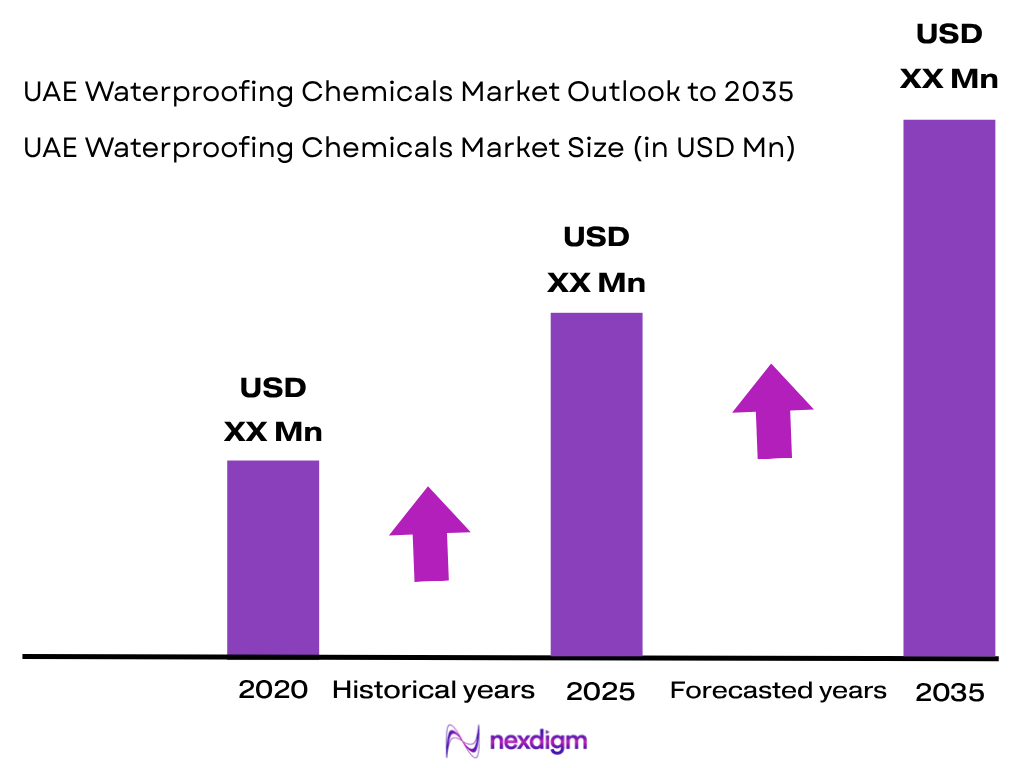
- By Market Value (2020-2025)
- By Volume Consumption (2020-2025)
- By Waterproofing Chemical Consumption Volume (2020-2025)
- By Waterproofed Surface Area (2020-2025)
- By Construction Application Volume (2020-2025)
- By New Construction Waterproofing Volume (2020-2025)
- By Renovation and Refurbishment Waterproofing Volume (2020-2025)

- By Product Type (In Value %)
Cementitious Waterproofing Coatings
Polyurethane Waterproofing Coatings
Polyurea Waterproofing Systems
Bituminous Waterproofing Coatings
Acrylic Waterproofing Coatings
Crystalline Waterproofing Systems
Epoxy Waterproofing Systems
Integral Waterproofing Admixtures
Injection Grouting Chemicals
Silane and Siloxane Waterproofing Treatments - By Application (In Value %)
Roof and Terrace Waterproofing
Basement and Below-Grade Waterproofing
Wet Area Waterproofing
Water Tank and Reservoir Waterproofing
Swimming Pool Waterproofing
Podium and Parking Deck Waterproofing
Bridge and Infrastructure Waterproofing
Concrete Joint and Crack Waterproofing
Façade and Building Envelope Waterproofing
Industrial Floor and Process Area Waterproofing - By Construction Activity (In Value %)
New Building Construction
Building Renovation and Refurbishment
Infrastructure Rehabilitation
Roof Restoration
Concrete Repair and Protection
Below-Grade Retrofitting
Waterproofing Failure Remediation - By End-Use Sector (In Value %)
Residential Buildings
Commercial Offices
Retail and Shopping Centers
Hotels and Hospitality
Industrial and Manufacturing Facilities
Warehouses and Logistics Facilities
Data Centers
Healthcare Facilities
Educational and Institutional Buildings
Government and Civic Buildings - By End-User (In Value %)
Real Estate Developers
Main Contractors
Specialist Waterproofing Contractors
Infrastructure Developers
Industrial Facility Owners
Facility Management Companies
Government Infrastructure Authorities
Property Owners and Operators - By Region (In Value %)
Dubai
Abu Dhabi
Sharjah
Ajman
Ras Al Khaimah
Fujairah
Umm Al Quwain
Rest of UAE

- Market Share of Major Players (By UAE Revenue, Product Portfolio Breadth, Waterproofing Chemistry Coverage, Application Coverage, Distribution Network, Contractor Network, Project Specification Reach, Infrastructure Project Presence, Residential Project Presence, Commercial Project Presence, Technical Support Capability, Applicator Training Capability, Product Certification, Project Reference Base, UAE Manufacturing and Stocking Capability)
- Cross Comparison Parameters (Waterproofing Chemistry Portfolio Breadth, Polyurethane and Polyurea System Capability, Crystalline Waterproofing Technology Capability, Below-Grade Waterproofing Coverage, Roof and Podium Waterproofing Capability, Concrete Repair and Protection Portfolio, UAE Distribution and Stocking Network, Technical Specification and Applicator Support Capability)
- SWOT Analysis of Major Players
- Detailed Profiles of Major Companies
Sika UAE
Fosroc UAE
Mapei UAE
Saint-Gobain Weber UAE
Henkel Polybit
Jotun UAE
BASF / Master Builders Solutions
Dr. Fixit / Pidilite
Kryton International
Penetron
DCP International
Al Muqarram Group
Terraco UAE
BITUMAT
Soprema

- Residential Construction Demand Assessment
- Commercial Building Waterproofing Requirement Analysis
- Hotel and Hospitality Waterproofing Requirement Analysis
- Data Center Waterproofing Requirement Analysis
- Industrial Facility Waterproofing Requirement Analysis
- Infrastructure and Transportation Waterproofing Requirement Analysis
- Roof, Podium and Terrace Waterproofing Requirement Analysis
- Below-Grade and Basement Waterproofing Requirement Analysis
- Building Renovation and Waterproofing Remediation Assessment

- By Market Value (2026-2035)
- By Volume Consumption (2026-2035)
- By Waterproofing Chemical Consumption Volume (2026-2035)
- By Waterproofed Surface Area (2026-2035)
- By Construction Application Volume (2026-2035)
- By New Construction Waterproofing Volume (2026-2035)
- By Renovation and Refurbishment Waterproofing Volume (2026-2035)


 Request a Sample
 Ask for Customization
 Get a Quote
 Enquire Now