
 Download PDF
 Download PDF
Market Overview
The UAE Wellness Tracking Solutions market sits at the intersection of digital health, wearable technology, and behavior-change software. In the latest year, the UAE’s digital health market was valued at USD ~ million, up from USD ~ million in the prior year, supported by government-led digitization, rising preventive-care adoption, and the scaling of mHealth, telehealth, and health analytics platforms that increasingly embed wellness tracking and continuous engagement features. The market’s forecast trajectory is reinforced by a USD ~ million base and a ~ CAGR.
The UAE market is dominated by Dubai and Abu Dhabi because they combine the deepest concentration of private healthcare networks and employer-funded benefits, the strongest consumer electronics retail density for wearables, and the most mature digital-health infrastructure and governance stack (integrated health record initiatives and telehealth standards). Beyond the UAE, solution design and ecosystem integrations are heavily influenced by global platform leaders (US/EU/China device and OS ecosystems) because wellness tracking value is tightly coupled with operating systems, app stores, sensor silicon, and cloud services that are largely headquartered outside the country.

Market Segmentation
By Product Form Factor
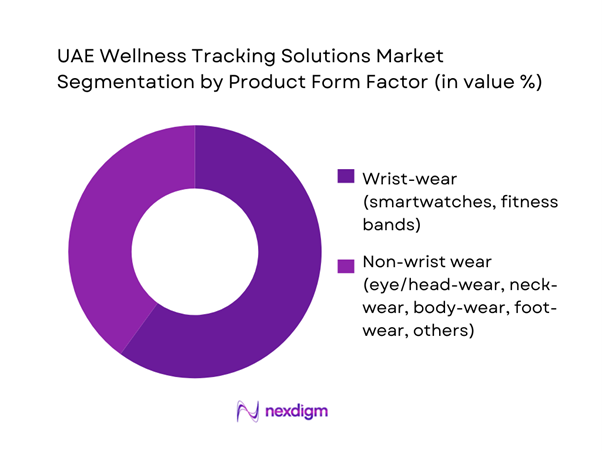
The UAE market skews toward wrist-wear because it is the most practical “always-on” wellness interface—users get continuous heart rate, activity, sleep insights, and nudges without changing routine. Retail availability (premium malls, telco bundles, and brand stores), strong gifting culture, and rapid upgrade cycles amplify volumes. Wrist-wear also wins on ecosystem stickiness: the watch becomes the control layer for coaching apps, hydration reminders, training plans, and health dashboards, and it integrates seamlessly with phones, payments, and workplace tools. In addition, corporate wellness programs often standardize on wrist devices due to easier enrollment, higher engagement, and simpler reporting versus niche categories like smart apparel or footwear. The result is a category that captures the highest share and anchors most wellness tracking journeys in the UAE.
By Solution Type
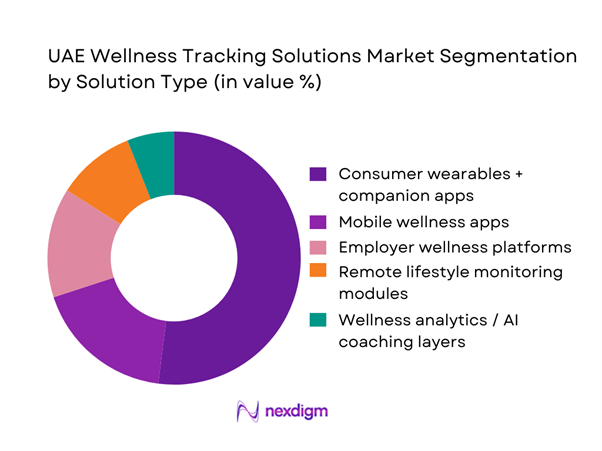
Consumer wearables + companion apps dominate because they offer the fastest time-to-value for users and the broadest distribution routes—electronics retail, telco bundles, e-commerce, and device ecosystem upgrades. In the UAE, high smartphone readiness and premium device affinity enable immediate adoption, while app ecosystems convert raw sensor data into actionable routines (sleep scores, step goals, stress nudges, cardio zones). This segment also benefits from “family account” and “workforce challenge” portability—devices purchased for personal wellness are easily repurposed into corporate wellness initiatives, strengthening utilization without requiring new procurement cycles. Standalone apps are large but face higher churn, while enterprise platforms require buyer buy-in, integration, and governance. Device-led stacks therefore remain the anchor category, with other solution types layering on top for coaching, incentives, and employer reporting.
Competitive Landscape
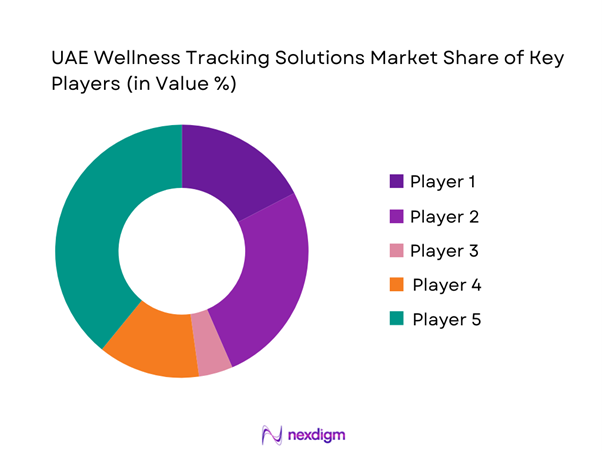
The UAE Wellness Tracking Solutions market is influenced by a small set of global device ecosystems and a growing layer of regional healthcare platforms, employer wellbeing providers, and digital health infrastructure players. Competitive advantage typically comes from (i) ecosystem lock-in (OS + app + cloud), (ii) data fidelity (sensor quality + algorithms), (iii) distribution power in UAE retail/telco channels, and (iv) enterprise readiness (privacy, dashboards, and outcomes reporting).
| Company | Est. Year | HQ | Primary Wellness Proposition (UAE fit) | Core Form Factor | Key Tracking Domains | Ecosystem / Integrations | UAE Route-to-Market | Differentiation Lever |
| Apple | 1976 | USA | ~ | ~ | ~ | ~ | ~ | ~ |
| Samsung | 1938 | South Korea | ~ | ~ | ~ | ~ | ~ | ~ |
| Huawei | 1987 | China | ~ | ~ | ~ | ~ | ~ | ~ |
| Google (Fitbit) | 1998 | USA | ~ | ~ | ~ | ~ | ~ | ~ |
| Garmin | 1989 | USA | ~ | ~ | ~ | ~ | ~ | ~ |
UAE Wellness Tracking Solutions Market Analysis
Growth Drivers
Dubai-wide movement initiatives and participation programs
Dubai’s city-scale activity programming creates an unusually large “top-of-funnel” for wellness tracking adoption, because consumers join mass events first and then convert into repeat tracking (steps, heart rate, sleep, training load) through apps and wearables. The Dubai Fitness Challenge recorded ~ participants across its latest edition, and its structured activation layer shows why tracking solutions benefit: ~ visits across the three ~ Fitness Villages and ~ participants engaging via ~ community hubs—all of which are settings where QR registrations, app check-ins, and wearable-linked challenges become normalised. This participation base is reinforced by UAE-level macro capacity to fund public-health programming and digital services: the UAE GDP at USD ~ billion and GDP per capita at USD ~. Together, these numbers explain why Dubai can run sustained, free-to-access movement infrastructure that continuously feeds consumer demand for tracking apps, wearable ecosystems, and employer/insurer wellness overlays.
Employer-sponsored wellbeing budgets
The UAE’s employer landscape is structurally supportive of workplace wellness tracking because (a) the private sector workforce is large and formalised and (b) government policy keeps HR and benefits functions highly active—conditions that increase receptivity to digital wellbeing programs, device subsidies, and platform rollouts. Labour enforcement intensity is visible in operational scale: in one recent cycle, authorities report conducting ~ field inspections, reflecting how actively employers manage compliance and employee programs. At the same time, the number of UAE citizens employed in the private sector reached ~ by the end of the same cycle—an indicator of ongoing workforce nationalisation and structured employer programs where wellbeing benefits are commonly bundled (health checks, activity challenges, coaching, and tracking dashboards). This sits within a high-capacity macro context: UAE GDP at USD ~ billion supports continued enterprise investment in benefits infrastructure, and population at ~ underpins the scale of addressable employees across emirates. These workforce and governance realities push employers toward measurable, auditable wellbeing interventions—exactly the use case where tracking solutions (device + app + analytics) become procurement-ready.
Challenges
Health data governance and compliance complexity
Wellness tracking solutions in the UAE must operate within a layered governance environment spanning healthcare data rules, emirate-level health systems, and cross-border cloud/data processing realities—raising compliance cost and slowing deployments, especially for solutions that touch clinical workflows or insurer programs. At the federal level, the UAE has a dedicated healthcare ICT and data framework through Federal Law No. ~ concerning the use of ICT in health fields, establishing obligations around confidentiality and protection of health data. At the ecosystem level, the UAE’s HIE infrastructure highlights the scale of regulated health information flows: Dubai’s NABIDH unifies ~ million patient records across ~ facilities, while Abu Dhabi’s Malaffi connects ~ facilities. For wellness tracking providers, this means integrations and data-sharing models must be carefully designed (consents, minimisation, hosting/processing controls, auditability) when moving from “consumer wellness” into employer/insurer/clinical adjacencies. Macroeconomic context matters because the market is large enough to attract sophisticated enterprise-grade solutions: UAE GDP USD ~ billion implies a high level of enterprise procurement scrutiny and regulator attention. The compliance challenge is therefore not optional—it is a core market design constraint that shapes product architecture, partner strategy, and time-to-contract.
Cross-platform interoperability gaps
Despite high digital maturity, interoperability remains a practical barrier because wellness tracking involves many endpoints (wearables, gym systems, employer platforms, insurer programs, and sometimes clinical records) that do not share a single nationwide rail. The UAE’s health data exchange landscape itself signals multi-platform integration needs: Abu Dhabi’s Malaffi connects ~ facilities and is integrated with national and other emirate systems, while Dubai’s NABIDH connects ~ facilities and unifies ~ million patient records. These figures demonstrate both the scale and the fragmentation: multiple large HIEs exist, and wellness solutions that want “clinical-grade adjacency” must bridge workflows across systems, vendors, and identity models. Interoperability challenges also show up in the consumer layer: telecom indicators show ~ active mobile subscriptions in the end-of-March period and ~ total telecom subscriptions, reflecting a highly multi-device environment where users often operate more than one connected line or device—raising the importance of cross-platform identity continuity and data deduplication. In short, the UAE has the scale to justify integrations, but the number of systems and endpoints makes integration a sustained operational challenge rather than a one-time API project.
Opportunities
Outcomes-based employer wellness contracts
The UAE’s employer wellness market has a clear pathway to shift from “engagement programs” to outcomes-based contracting because employers and health systems operate at sufficient scale to measure results and because healthcare utilisation volumes are large enough to justify ROI scrutiny (absenteeism, productivity, chronic risk, and care navigation). Dubai’s health spending context illustrates the budget environment that makes outcomes contracting credible: health accounts reporting indicates total current health expenditure of AED ~ billion and AED ~ billion across successive cycles, showing a large and trackable health economy where payers and employers will increasingly demand measurable impact rather than activity-only reporting. At the ecosystem level, Dubai’s NABIDH unifies ~ million patient records across ~ facilities, enabling more robust linkage between “wellness behaviour” and care pathways (screenings, follow-ups, chronic management)—a prerequisite for outcomes-based designs. Macro conditions support adoption: UAE GDP USD ~ billion provides the spending headroom for enterprise programs, while population ~ provides scale for statistically meaningful cohort analytics in large employers. The near-term opportunity is therefore to structure corporate wellness contracts around measurable operational endpoints (participation continuity, verified screenings, care-plan adherence, return-to-work enablement) while using tracking data as the behavioural engine—without needing to cite future market projections to justify feasibility.
Insurer premium optimization via wellness data
The UAE is structurally positioned to expand insurer analytics and premium optimisation using wellness data because the country already runs large-scale digital health data exchange systems, and because connected-device volumes support continuous behavioural data capture. Dubai’s NABIDH milestone—~ million patient records unified and ~ facilities connected—creates a validated clinical data spine; Abu Dhabi’s Malaffi adds a second large spine with ~ facilities connected. These foundations enable insurers (and TPAs or providers operating insurer-adjacent programs) to move beyond static demographic underwriting toward dynamic risk engagement: wellness data can be used to drive preventive engagement (screenings, care-plan adherence, lifestyle coaching) while clinical records validate outcomes and reduce gaming. The telecom layer supports continuity of data capture: telecom statistics for the end-of-March period cite ~ active mobile subscriptions and ~ total telecom subscriptions, providing the always-connected infrastructure needed for wearable syncing, coaching notifications, and app-based adherence loops. Macro capacity remains supportive—UAE GDP USD ~ billion and population ~—meaning insurers can justify investments in data platforms and member engagement at meaningful scale. The practical opportunity is to position wellness tracking as an insurer-grade “risk engagement layer” tied to measurable behaviours and validated care events, rather than as a standalone consumer feature set.
Future Outlook
Over the next several years, UAE wellness tracking will expand from “steps and sleep” to continuous, multi-signal lifestyle intelligence—blending wearables, personalized coaching, and clinical pathways where appropriate. Growth will be propelled by employer demand for measurable wellbeing, the scaling of digital health infrastructure, and consumers shifting toward prevention-led routines (sleep, stress, metabolic health). Regulatory maturity and standardized telehealth frameworks will further accelerate enterprise-grade deployment, especially where wellness tracking is embedded into broader care journeys.
Major Players
- Apple
- Samsung
- Huawei
- Garmin
- Xiaomi
- Oura
- Whoop
- Withings
- Polar
- Amazfit
- Suunto
- Under Armour
- Nike
Key Target Audience
- Investments and venture capitalist firms
- Government and regulatory bodies
- Health system operators and hospital groups
- Health insurers and TPAs
- Large employers and HR benefits owners
- Consumer electronics retailers and e-commerce operators
- Telecom operators
- Fitness chains and premium gyms
Research Methodology
Step 1: Identification of Key Variables
We develop a UAE ecosystem map covering device OEMs, app players, employers, insurers, healthcare providers, and regulators. Desk research is paired with UAE policy and telehealth standards review to define compliance-sensitive variables and buying triggers.
Step 2: Market Analysis and Construction
We consolidate historical adoption signals across digital health and wearables, then size the wellness tracking opportunity using triangulation across consumer device revenues, digital health platform spend, and enterprise wellness procurement behavior.
Step 3: Hypothesis Validation and Expert Consultation
We run structured CATIs with stakeholders across retail channel heads, telco device category teams, HR or benefits owners, insurer wellness leads, and provider innovation teams to validate adoption, churn drivers, and monetization levers.
Step 3: Research Synthesis and Final Output
We reconcile top-down (macro digital health) and bottom-up (device + platform) sizing, validate segment splits via expert inputs, and produce buyer-ready insights: competitive benchmarking, go-to-market routes, and regulatory risk filters.

- Executive Summary
- Research Methodology (Market definitions and assumptions, UAE-specific scoping logic for wellness vs clinical, market sizing approach across devices apps platforms, bottom-up adoption modeling by user cohorts, primary research across employers insurers gyms retailers, channel checks across UAE e-commerce and specialty retail, app-store intelligence and feature benchmarking, regulatory triangulation using UAE PDPL and Health Data Law, limitations and data-confidence scoring)

- Definition and Scope
- Market Genesis and Digital Health Context
- Ecosystem Map
- UAE Health Data Infrastructure Touchpoints
- Value Chain and Route-to-Market Overview

- Growth Drivers
Dubai-wide movement initiatives and participation programs
Employer-sponsored wellbeing budgets
Insurer-linked wellness and reward programs
Premium wearable penetration
Gym digitization and hybrid fitness adoption - Challenges
Health data governance and compliance complexity
Cross-platform interoperability gaps
User engagement decay post onboarding
Enterprise procurement cycle delays
Fragmented B2B integrations - Opportunities
Outcomes-based employer wellness contracts
Insurer premium optimization via wellness data
Localized rewards and incentive marketplaces
Enterprise analytics for ESG and wellbeing reporting
Wellness-to-clinical pathway integration - Trends
Sleep and recovery-centric tracking
Ring and strap form factor adoption
AI-led personalized coaching
Workplace challenge-based engagement
Multi-partner wellness ecosystems - Regulatory & Policy Landscape
- SWOT Analysis
- Stakeholder & Ecosystem Analysis
- Porter’s Five Forces Analysis
- Competitive Intensity & Ecosystem Mapping

- By Value, 2019–2024
- Installed Base Linked to Apps, 2019–2024
- Service Revenue Mix, 2019–2024
- Average Realization Metrics, 2019–2024

- By Fleet Type (in Value %)
Wearable-first tracking
App-only tracking
Corporate wellbeing platforms
Insurer-integrated wellness solutions
Gym ecosystem platforms - By Application (in Value %)
Activity and step tracking
Sleep and recovery monitoring
Cardio and heart rate zones
Stress and HRV monitoring
Nutrition and hydration tracking - By Technology Architecture (in Value %)
Device-tethered platforms
Cloud-native wellness platforms
API-led enterprise platforms
White-labeled corporate instances
Embedded insurance wellness stacks - By Connectivity Type (in Value %)
Bluetooth-enabled devices
Wi-Fi enabled devices
Cellular-enabled wearables
Hybrid connectivity solutions - By End-Use Industry (in Value %)
Individual consumers
Corporate employers and HR
Health insurers and TPAs
Gyms and fitness chains
Healthcare-linked wellness programs - By Region (in Value %)
Dubai
Abu Dhabi
Sharjah
Northern Emirates

- Market Share of Major Players
- Cross Comparison Parameters (UAE PDPL and data residency readiness, health data infrastructure integration posture, Arabic localization depth, wearable interoperability breadth, rewards marketplace strength, enterprise analytics capability, insurer and TPA integration readiness, engagement mechanics for national challenges)
- Competitive Moats and Vulnerabilities
- SWOT of Major Players
- Detailed Profiles of Major Companies
Apple
Samsung
Huawei
Google Fitbit
Garmin
Xiaomi
WHOOP
Oura
Withings
Polar
Amazfit
Technogym
STEPPI
Wellx

- Premium buyers, value buyers and fitness-focused
- Employers/HR
- Insurers/TPAs
- Gyms/Fitness Chains
- Channel Partners

- By Value, 2025–2030
- Installed Base Linked to Apps, 2025–2030
- Service Revenue Mix, 2025–2030
- Average Realization Metrics, 2025–2030


 Request a Sample
 Ask for Customization
 Get a Quote
 Enquire Now