

 Download PDF
Market Overview
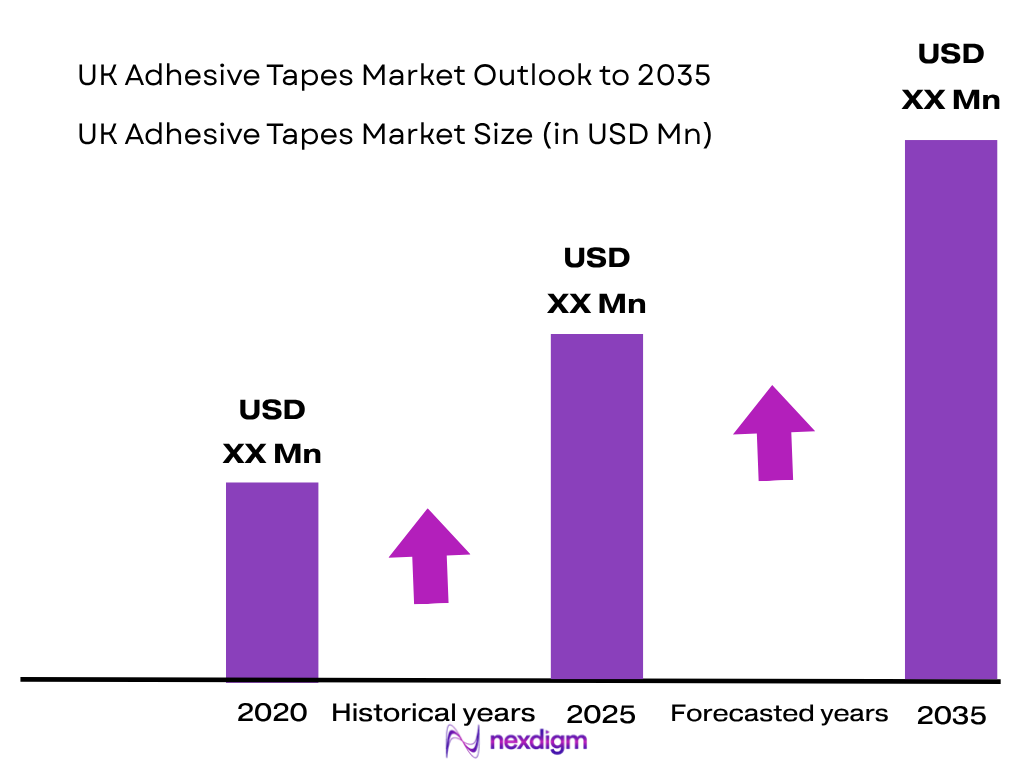
The UK Adhesive Tapes Market is valued at approximately USD ~XX billion, supported by packaging, construction, automotive, healthcare and industrial manufacturing demand. Great Britain’s online retail sales increased from approximately £28.42 billion to £29.24 billion, strengthening recurring carton-sealing and fulfilment-tape consumption. UK factories produced approximately 905,233 vehicles, including 779,584 cars and 125,649 commercial vehicles, maintaining demand for masking, wire-harness, surface-protection, foam-bonding and specialty assembly tapes.
Dominant Regional Demand Centres: The West Midlands, South East England, Greater London, North West England and East Midlands form important adhesive-tape demand centres because they combine automotive manufacturing, aerospace, logistics, construction, packaging and converting activities. Great Britain’s new construction work increased from approximately £138.78 billion to £140.68 billion, while annual online retail sales moved from about £28.42 billion to £29.24 billion. These industrial and logistics concentrations support frequent consumption of packaging, construction, masking, automotive and high-performance technical tapes.
Market Segmentation
By Product Type
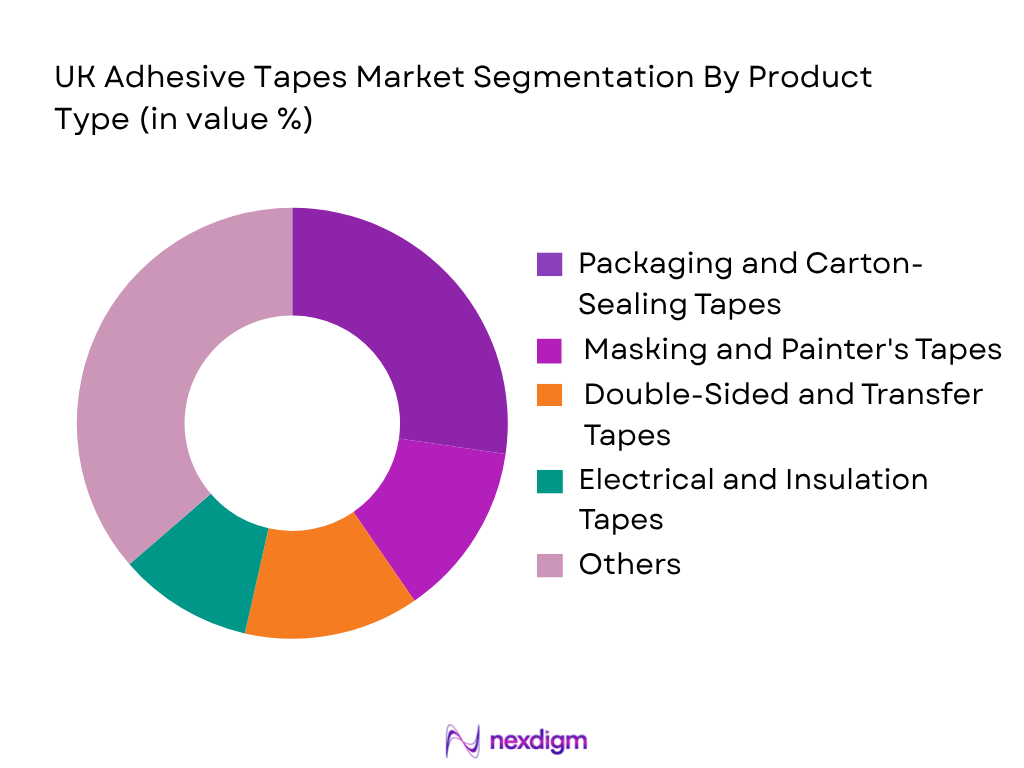
The UK Adhesive Tapes Market is segmented into packaging and carton-sealing tapes, masking and painter’s tapes, double-sided and transfer tapes, electrical tapes, foam tapes, medical tapes, duct and cloth tapes, construction tapes, filament tapes and specialty industrial tapes. Packaging and carton-sealing tapes represent the dominant product segment because the UK maintains a large e-commerce, retail distribution and parcel-delivery ecosystem in which tapes are consumed every time a carton is prepared for shipment. Great Britain’s internet retail channel generated approximately £29.24 billion in sales based on monthly ONS values, sustaining extensive fulfilment activity. Packaging tapes also differ from durable industrial bonding systems because they are consumed on a shipment-by-shipment basis, creating continuous replenishment demand. Polypropylene-backed carton sealing remains important for standard distribution, while paper-backed and recycling-compatible solutions are gaining relevance as packaging sustainability requirements evolve. Specialty segments nevertheless have higher technical requirements, particularly foam bonding, medical fixation, electrical insulation and aerospace processing tapes.
By Adhesive Chemistry
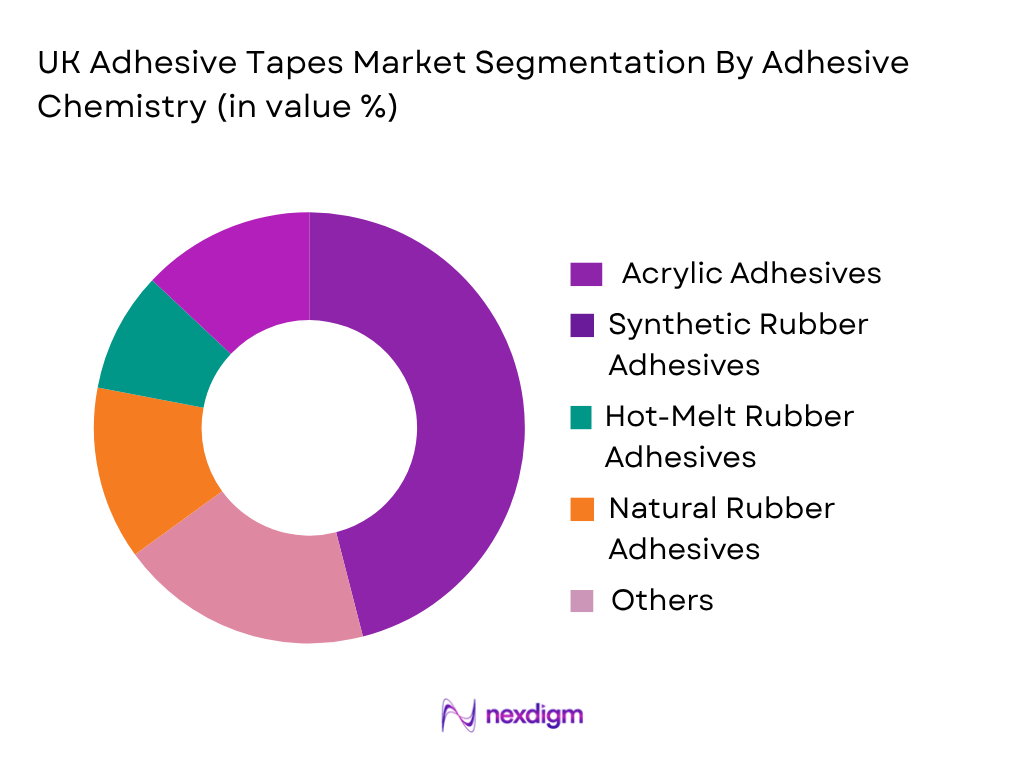
The UK Adhesive Tapes Market is segmented into acrylic adhesives, synthetic rubber adhesives, hot-melt rubber adhesives, natural rubber adhesives, silicone adhesives and hybrid systems. Acrylic adhesives hold the dominant position because they offer a strong combination of long-term aging resistance, UV stability, temperature resistance and adhesion across industrial substrates. These attributes make acrylic technologies suitable for construction, automotive, electronics, transportation and durable industrial bonding. Rubber-based systems remain important where high initial tack and rapid bond formation are required, particularly in packaging and general-purpose products. Silicone adhesive tapes occupy smaller but technically critical applications requiring high-temperature performance, low-surface-energy compatibility or specialist electrical and medical functionality. Greater use of engineered tape in vehicles, devices and building systems is also increasing the importance of application-specific formulation rather than generic adhesive chemistry. Future innovation will focus on maintaining bond performance while reducing solvents, liner waste and material consumption.
Competitive Landscape
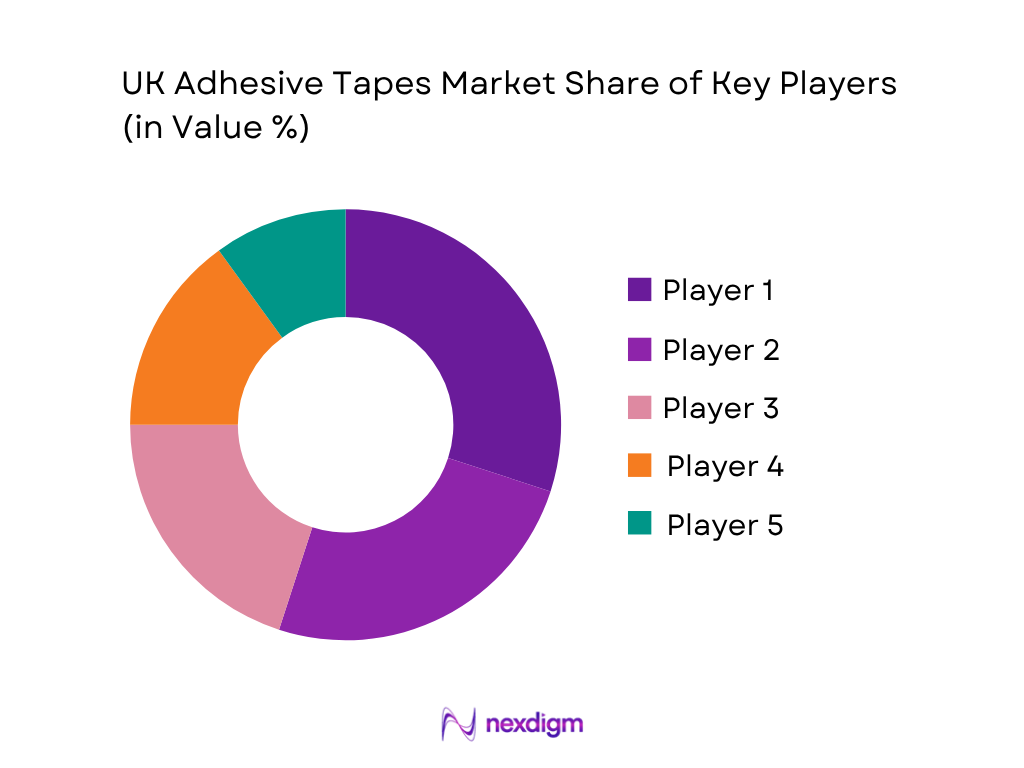
The UK Adhesive Tapes Market combines global pressure-sensitive adhesive technology companies with UK-based manufacturers, specialist converters and technical distributors. 3M, tesa, Nitto and Avery Dennison compete through proprietary adhesive technologies and broad industrial application expertise, while Scapa Industrial, now associated with Mativ, has deep UK roots in specialist bonding solutions. Competition is increasingly based on adhesive performance, custom converting, OEM qualification, technical engineering and sustainability rather than solely on availability of standard tape rolls.
| Company | Establishment Year | Headquarters | Adhesive Chemistry Capability | Tape Portfolio | Major End Uses | UK Market Footprint | Converting / Engineering Capability | Sustainability Focus |
| 3M Company | 1902 | St. Paul, Minnesota, US | ~ | ~ | ~ | ~ | ~ | ~ |
| tesa SE | 2001* | Norderstedt, Germany | ~ | ~ | ~ | ~ | ~ | ~ |
| Nitto Denko Corporation | 1918 | Osaka, Japan | ~ | ~ | ~ | ~ | ~ | ~ |
| Avery Dennison Corporation | 1935 | Mentor, Ohio, US | ~ | ~ | ~ | ~ | ~ | ~ |
| Scapa Industrial / Mativ | 1927** | Greater Manchester, UK heritage | ~ | ~ | ~ | ~ |
UK Adhesive Tapes Market Analysis
Growth Drivers
Expansion of E-Commerce and Packaging Activity
The UK Adhesive Tapes Market is supported by the scale of online retail and distribution activity, which creates repeat consumption of carton-sealing, reinforcement, tamper-evident and specialty packaging tapes. Office for National Statistics monthly internet retail data totalled approximately £29.242 billion in 2024, including £3.228 billion in December, £3.023 billion in November and £2.507 billion in October, demonstrating the intensity of parcel and fulfilment operations during peak trading periods. This activity directly increases adhesive tape usage because every carton entering warehouse, retail and parcel networks may require sealing, bundling or reinforcement. The wider economic environment also supports this demand base. World Bank data record UK GDP at USD 3.686 trillion in 2024 and GDP per capita at USD 53,246.4, reflecting substantial consumer purchasing power and a large service-led economy. Packaging tape suppliers consequently benefit from highly recurring material consumption rather than long replacement cycles. Demand extends beyond conventional polypropylene carton-sealing tape toward reinforced tape, paper-backed formats, printed security tapes and application-compatible materials designed for automated case-sealing machinery used by fulfilment centres and logistics operators. Source: Office for National Statistics; World Bank.
Automotive Manufacturing and Electrified Vehicle Production
The UK Adhesive Tapes Market benefits from an established automotive manufacturing ecosystem where tapes are required for masking, wire harnessing, interior attachment, exterior trim, acoustic control, surface protection, battery insulation and assembly of lightweight components. British factories produced 905,233 vehicles in 2024, comprising 779,584 cars and 125,649 commercial vehicles, according to the Society of Motor Manufacturers and Traders. The UK automotive supply chain also includes more than 2,500 component providers and supports approximately 198,000 manufacturing jobs, creating a broad industrial customer base for technical adhesive products. The sector generated approximately £93 billion in turnover and £22 billion in value added, while automotive companies typically undertake about £4 billion of annual research and development activity. These manufacturing capabilities are supported by a wider economy valued at USD 3.686 trillion in 2024, according to the World Bank, with GDP per capita of USD 53,246.4. Adhesive tapes therefore increasingly function as engineered production materials rather than consumables alone, especially where manufacturers seek lightweight joining, controlled bond thickness, vibration reduction and cleaner alternatives to mechanical fasteners and wet-applied adhesives. Source: Society of Motor Manufacturers and Traders; World Bank.
Market Challenges
Automotive Production Restructuring and OEM Qualification Complexity
The UK Adhesive Tapes Market faces demand uncertainty from the restructuring of domestic automotive manufacturing as vehicle factories transition between internal-combustion and electrified platforms. UK vehicle production stood at 905,233 units in 2024, including 779,584 passenger cars and 125,649 commercial vehicles, compared with more than 1.025 million vehicles produced across the preceding car and commercial-vehicle datasets. December production alone fell to 45,022 vehicles, highlighting the effect of plant retooling, model transitions and changing export demand. For adhesive tape manufacturers, automotive fluctuations are particularly significant because products used for structural attachment, battery applications, electronics, trim and wire harnesses frequently require extensive OEM validation. A change in backing film, adhesive chemistry, coat weight or supplier can require requalification before commercial adoption, limiting the ability to substitute materials rapidly when supply or production conditions change. The wider economic base remains substantial, with World Bank data recording UK GDP at USD 3.686 trillion in 2024 and GDP per capita at USD 53,246.4. However, tape suppliers serving automotive customers must manage production volatility while maintaining technical engineering, traceability, quality consistency and specification continuity. Source: Society of Motor Manufacturers and Traders; World Bank.
Dependence on Technically Complex Coating, Chemical and Converting Inputs
The UK Adhesive Tapes Market relies on multiple upstream materials, including acrylic polymers, synthetic elastomers, tackifier resins, silicone systems, polypropylene and PET films, foams, papers, release liners and speciality coatings. This makes the industry sensitive to the availability and specification consistency of imported or externally sourced inputs. The UK economy recorded USD 3.686 trillion in GDP in 2024, while GDP per capita reached USD 53,246.4, according to the World Bank, illustrating the scale of the industrial economy requiring reliable materials supply. Tape production is particularly demanding because relatively small changes in backing thickness, adhesive coat weight, release force or polymer characteristics can affect peel adhesion, shear strength, unwind behaviour and ageing performance. The challenge is intensified in precision applications where converted products must meet narrow dimensional tolerances. The UK life sciences industry alone contained 7,320 companies, while 196,000 people were employed in medical technology activities during the 2023/2024 reporting period, demonstrating the scale of technically demanding downstream customers. Suppliers serving medical, automotive, aerospace and electronics manufacturers must therefore maintain qualified material sources, production consistency, documentation and alternative supply pathways without altering validated product performance. Source: World Bank; Office for Life Sciences.
Market Opportunities
Medical Technology and Wearable Adhesive Applications
The UK Adhesive Tapes Market has a strong future opportunity in medical-device assembly, wound-care products, wearable sensors, diagnostic devices and extended-wear skin-contact applications because the existing UK medical technology ecosystem already provides a sizeable customer base. Office for Life Sciences data identify 4,360 medical technology companies operating in the UK during the 2023/2024 reporting period, employing approximately 196,000 people and generating £48.0 billion in turnover. The broader life sciences sector contained 7,320 companies, employed 359,600 people and generated £146.9 billion, while life sciences manufacturing businesses employed approximately 130,300 people. These figures demonstrate a deep domestic base for healthcare manufacturing and product development. World Bank data place UK GDP at USD 3.686 trillion in 2024 and GDP per capita at USD 53,246.4, supporting healthcare innovation and specialised manufacturing activity. This creates future growth potential for adhesive suppliers capable of offering breathable medical tapes, skin-compatible acrylic systems, foam constructions, hydrocolloid-compatible laminates and precision die-cut components. Medical applications can also support greater converter involvement because manufacturers often require parts supplied in finished shapes, multilayer constructions or clean manufacturing formats rather than standard adhesive rolls. Source: Office for Life Sciences; World Bank.
Construction, Building Envelope and Infrastructure Tape Applications
The UK Adhesive Tapes Market has significant future potential in building-envelope sealing, window installation, vapour barriers, insulation attachment, HVAC systems, roofing and infrastructure applications because current construction activity already creates a large installed demand platform. Office for National Statistics data show that total new construction work in Great Britain reached £140.684 billion in 2024, while construction new orders totalled £71.707 billion. Public new housing activity added £3.826 billion compared with the preceding period, while private infrastructure work added £1.731 billion, illustrating ongoing investment in applications where adhesive tapes can support air sealing, moisture management and component attachment. New infrastructure construction alone represented £33.9 billion of activity. The wider economic backdrop remains substantial, with World Bank data showing UK GDP of USD 3.686 trillion in 2024 and GDP per capita of USD 53,246.4. These current construction volumes provide a basis for future adoption of flashing tapes, foil tapes, acrylic foam tapes, membrane-sealing products and double-sided mounting systems. Suppliers that demonstrate durable adhesion to membranes, masonry, metals and plastics can expand as builders seek installation methods that reduce curing time, improve consistency and simplify site application. Source: Office for National Statistics; World Bank.
Future Outlook
The UK Adhesive Tapes Market is forecast to expand at approximately ~X.X% CAGR during 2026–2035, with the final rate retained as a placeholder for the proprietary forecast. Future development will increasingly favour high-performance and application-engineered tapes rather than conventional commodity products alone. Electrified vehicles, medical wearables, aerospace composites, energy-efficient construction and recyclable packaging will create opportunities for manufacturers capable of delivering specialised adhesive chemistry and precision-converted components.
Automotive transformation will remain important even as production volumes fluctuate during factory retooling. UK plants produced 905,233 vehicles in 2024, including 275,896 battery-electric, plug-in hybrid and hybrid vehicles, while approximately £3.5 billion of additional automotive investment commitments were announced. These investments are relevant to foam tapes, wire-harnessing tapes, battery assembly materials, thermal-management tapes and structural bonding solutions.
Major Players
- 3M United Kingdom plc
- tesa UK Ltd
- Nitto Denko UK Ltd
- Avery Dennison Performance Tapes
- Intertape Polymer Group
- Shurtape Technologies
- Berry Global
- Saint-Gobain Tape Solutions
- Lohmann Technologies UK Ltd
- Mactac Europe
- LINTEC Corporation
- Scapa Group / Mativ
- Advance Tapes International Ltd
- Parafix Tapes & Conversions Ltd / ADDEV Parafix
- Indasol Industrial Adhesives & Tapes
Key Target Audience
- Adhesive Tape Manufacturers
- Pressure-Sensitive Adhesive and Specialty Polymer Producers
- Tape Converters, Laminators and Precision Die-Cutters
- Automotive, Aerospace, Electronics, Medical Device and Packaging OEMs
- Industrial Packaging, MRO and Specialty Material Distributors
- Backing Film, Foam, Release-Liner and Tackifier Suppliers
- Investments and Venture Capitalist Firms
- Government and Regulatory Bodies (Department for Business and Trade, Health and Safety Executive, Environment Agency, Medicines and Healthcare products Regulatory Agency, Department for Environment, Food and Rural Affairs)
Research Methodology
Step 1: Identification of Key Variables
The initial phase constructs an ecosystem map covering UK adhesive-tape manufacturers, international suppliers, adhesive formulators, backing producers, converters, distributors and major OEM customers. Secondary and proprietary datasets are reviewed to identify product categories, adhesive chemistries, backing materials, end-use applications, domestic production, imports, conversion requirements and regional demand. The exercise establishes the critical variables required for detailed market sizing and segmentation.
Step 2: Market Analysis and Construction
Historical demand is assessed through both top-down and bottom-up modelling. The top-down approach considers e-commerce activity, packaging shipments, automotive manufacturing, construction, healthcare, aerospace and industrial production. Bottom-up analysis evaluates manufacturer revenues, imported products, converter throughput, product volumes and customer consumption. Commodity packaging tapes are separated from technically specialised tapes because their volume intensity, specification requirements and commercial structures differ significantly.
Step 3: Hypothesis Validation and Expert Consultation
Market hypotheses are validated through CATI and structured interviews with tape manufacturers, converters, distributors, adhesive formulators, automotive suppliers, packaging companies and industrial procurement personnel. Interviews test assumptions around adhesive chemistry, tape consumption, specification changes, converter utilisation, supplier qualification, switching behaviour and sustainability requirements. Primary feedback is used to adjust preliminary market allocations and reconcile differences between manufacturer-side and end-user-side observations.
Step 4: Research Synthesis and Final Output
The final stage triangulates company information, UK government statistics, trade flows, manufacturing indicators and end-use consumption assumptions. Tape demand is cross-validated against application intensity in packaging, automotive, healthcare, electronics, aerospace and construction. Forecast scenarios incorporate electrification, e-commerce, precision conversion, sustainable packaging, building-envelope requirements and advanced adhesive technologies. This produces the final UK Adhesive Tapes Market structure, segmentation, competitive assessment and long-term outlook.

- Executive Summary
- Research Methodology (Market Definition and Scope, UK Adhesive Tapes Taxonomy, Pressure-Sensitive Adhesive Tape Classification, Commodity and Specialty Tape Classification, Adhesive Chemistry Mapping, Backing Material Assessment, Tape Construction Framework, Adhesive Coating Technology Assessment, Application Mapping, Raw Material Assessment, Sustainable Tape Technology Evaluation, Market Sizing Framework)

- Definition and Scope
- UK Adhesive Tapes Industry Evolution and Pressure-Sensitive Adhesive Technology Development
- Adhesive Tape Manufacturing and Coating Process
- Adhesive Tape Value Chain Analysis
- UK Adhesive Tapes Supply Chain Analysis
- Adhesive Resin, Backing Material and Release-Liner Ecosystem Analysis
- UK Adhesive Tapes Import Dependency and Localization Assessment
- OEM Adhesive Tape Application Architecture and Specialty Tape Solution Framework

- Growth Drivers (Expansion of E-Commerce Packaging Volumes, Increasing Lightweight Automotive Bonding, Growth of Aerospace Manufacturing Applications, Rising Adoption of Medical Wearables, Expansion of Construction Sealing Applications, Manufacturing Automation, Mechanical Fastener Replacement, Increasing High-Performance Pressure-Sensitive Adhesive Adoption)
- Market Challenges (Raw Material Price Volatility, VOC Compliance Requirements, Complex Substrate Compatibility, Long OEM Qualification Cycles, Specialty Silicone and Resin Dependency, Packaging Recyclability Requirements, Fragmented Converter Ecosystem, Imported Adhesive Tape Competition)
- Market Opportunities (EV Battery Assembly Tapes, Medical Wearable Adhesives, Aerospace Composite Processing Tapes, Recyclable Packaging Tapes, Low-VOC Adhesive Systems, Automation-Compatible Tape Formats, Low-Surface-Energy Bonding Solutions, Structural Bonding Tape Substitution)
- Market Trends (High-Bond Acrylic Foam Tapes, Linerless Tape Development, Paper-Based Packaging Tapes, Bio-Based Adhesive Formulations, Debond-on-Demand Technology, Thin-Gauge Electronics Tapes, Extended-Wear Medical Adhesives, Precision Die-Cut Adhesive Components)
- Regulatory and Standards Landscape (UK REACH Chemical Compliance, GB Classification Labelling and Packaging Requirements, HSE Chemical Exposure Requirements, COSHH Regulations, Industrial Emissions and VOC Control Requirements, Packaging Extended Producer Responsibility Requirements, Medical Device Adhesive Requirements, BS and ISO Adhesive Tape Test Standards)
- SWOT Analysis
- Porter’s Five Forces Analysis
- PESTLE Analysis
- Stakeholder Ecosystem
- Competition Ecosystem

- By Market Value (2020-2025)
- By Adhesive Tape Consumption Volume (2020-2025)
- By Coated Surface Area (2020-2025)
- By Domestic Production Volume (2020-2025)
- By Import Volume (2020-2025)
- By Export Volume (2020-2025)
- By Average Selling Price (2020-2025)
- By Commodity Adhesive Tape Consumption (2020-2025)
- By Specialty Adhesive Tape Consumption (2020-2025)

- By Product Type (In Value %)
Packaging and Carton Sealing Tapes
Masking and Painter’s Tapes
Double-Sided Tapes
Transfer Tapes
Duct and Cloth Tapes
Electrical and Insulation Tapes
Foam Tapes
Filament and Strapping Tapes
Medical and Healthcare Tapes
Automotive Adhesive Tapes
Construction and Building Tapes
HVAC and Foil Tapes
Protective Films and Surface Protection Tapes
Splicing Tapes
Specialty High-Performance Industrial Tapes - By Adhesive Chemistry (In Value %)
Acrylic Adhesives
Natural Rubber Adhesives
Synthetic Rubber Adhesives
Hot-Melt Rubber Adhesives
Silicone Adhesives
Hybrid Adhesive Systems
Bio-Based and Renewable-Content Adhesive Systems - By Backing Material (In Value %)
Polypropylene Film
Polyethylene Film
Polyvinyl Chloride Film
Polyethylene Terephthalate Film
Paper
Cloth and Fabric
Aluminum Foil
Copper Foil
Foam
Nonwoven Materials
Polyimide Film
Glass Cloth
Unsupported and Carrier-Free Constructions - By End-Use Industry (In Value %)
Packaging and E-Commerce
Automotive and Mobility
Building and Construction
Electrical and Electronics
Medical and Healthcare
Aerospace and Defense
Appliances
HVAC and Refrigeration
General Industrial Manufacturing
Paper, Printing and Converting
Renewable Energy
Transportation and Rail
Signs and Graphics
Retail and Consumer Applications - By Distribution Channel (In Value %)
Direct Manufacturer-to-OEM Sales
Authorized Industrial Distributors
Adhesive Tape Converters
Packaging Distributors
Electrical and Electronics Distributors
Construction Supply Distributors
Medical Material Converters and Distributors
Automotive Tier Supplier Channels
Industrial MRO Distributors
Online B2B Platforms - By Region (In Value %)
London and South East England
West Midlands
East Midlands
North West England
North East England
Yorkshire and the Humber
East of England
South West England
Scotland
Wales
Northern Ireland

- Market Share of Major Players (By Revenue, Volume, Product Type, Adhesive Chemistry, Backing Material, End-Use Industry, Market Type, Distribution Channel)
- Cross Comparison Parameters (Adhesive Chemistry Breadth, Backing and Carrier Technology Breadth, UK Manufacturing and Converting Footprint, High-Performance Specialty Tape Capability, OEM Application Engineering and Qualification Support, Precision Die-Cutting and Custom Converting Capability, Sustainable and Low-VOC Tape Portfolio, End-Use Industry Coverage)
- SWOT Analysis of Major Players
- Competitive Positioning Matrix
- Pricing and Distribution Network Benchmarking
- Detailed Profiles of Major Companies
3M United Kingdom plc
tesa UK Ltd
Nitto Denko UK Ltd
Avery Dennison Performance Tapes
Intertape Polymer Group
Shurtape Technologies
Berry Global
Saint-Gobain Tape Solutions
Lohmann Technologies UK Ltd
Mactac Europe
LINTEC Corporation
Scapa Group / Mativ
Advance Tapes International Ltd
Parafix Tapes & Conversions Ltd
Indasol Industrial Adhesives & Tapes

- Buyer Segmentation
- OEM Procurement Behaviour
- Supplier Selection Criteria
- Buyer Pain Points
- Technology Adoption Assessment
- Replacement and Repurchase Behaviour

- By Market Value (2026-2035)
- By Adhesive Tape Consumption Volume (2026-2035)
- By Coated Surface Area (2026-2035)
- By Domestic Production Volume (2026-2035)
- By Import Volume (2026-2035)
- By Export Volume (2026-2035)
- By Average Selling Price (2026-2035)
- By Commodity Adhesive Tape Consumption (2026-2035)
- By Specialty Adhesive Tape Consumption (2026-2035)


 Request a Sample
 Ask for Customization
 Get a Quote
 Enquire Now