
 Download PDF
Market Overview
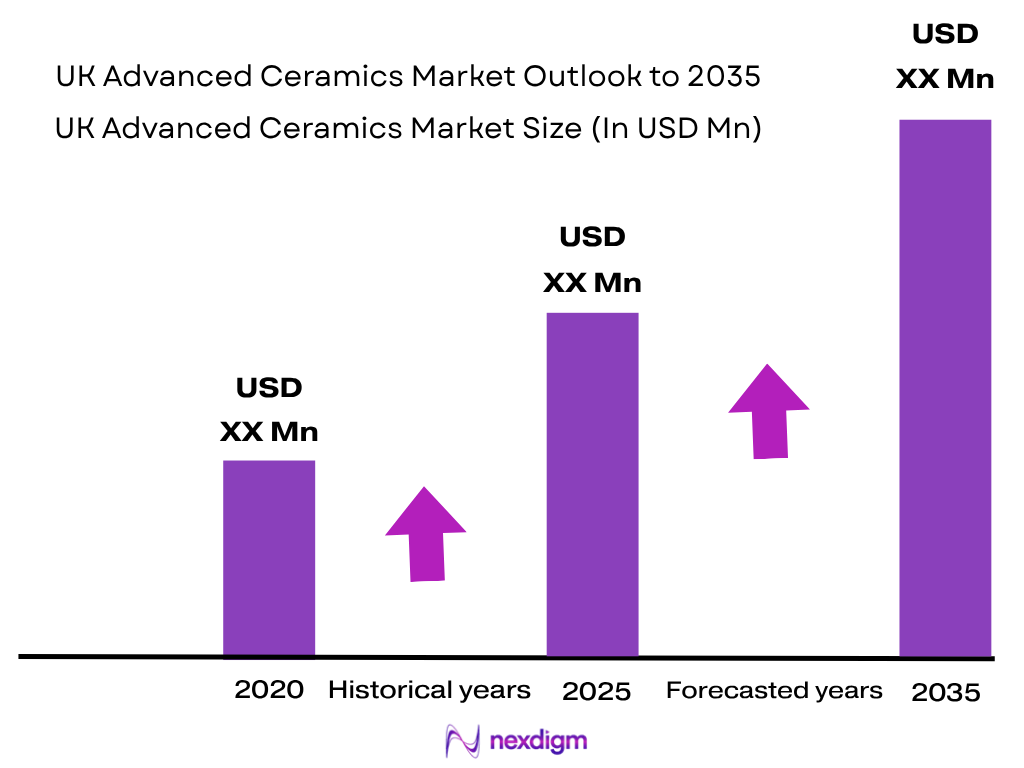
The UK Advanced Ceramics Market is valued at approximately USD ~XX million, based on historical industry analysis. Demand is supported by aerospace, defence, electronics, semiconductor equipment, healthcare and high-temperature industrial applications. In the preceding reporting period, Stoke-on-Trent’s ceramics, materials and metals cluster contained 24 businesses, 666 employees and £87.2 million turnover; the latest aerospace, defence, security and space ecosystem generated £100 billion turnover and supported 443,000 direct jobs, strengthening demand for high-performance ceramic components.
Stoke-on-Trent, Birmingham and the West Midlands, together with South Wales, dominate the UK Advanced Ceramics Market ecosystem because they combine ceramic processing, precision engineering, aerospace supply chains and semiconductor activity. Stoke’s prior-period advanced-manufacturing cluster comprised 24 businesses and 666 employees, while North Staffordshire’s latest dataset identified 123 ceramics firms. South Wales additionally hosts the UK’s major compound-semiconductor cluster, connecting ceramic substrates, thermal-management materials, semiconductor equipment and power-electronics applications with an established advanced-materials supply chain.
Market Segmentation
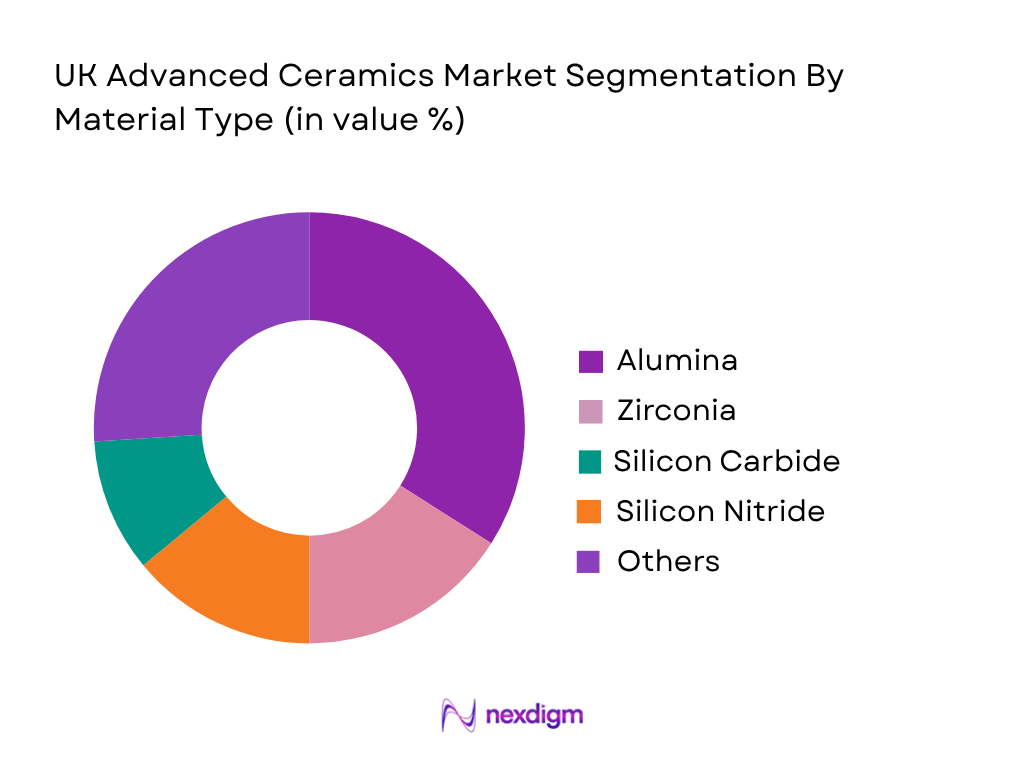
By Material Type
The UK Advanced Ceramics Market is segmented into alumina, zirconia, aluminium nitride, silicon carbide, silicon nitride, boron carbide, titanate and piezoelectric ceramics, machinable glass ceramics and ultra-high-temperature ceramics. Alumina holds the dominant share under material-type segmentation because it offers a commercially effective balance of electrical insulation, wear resistance, temperature stability, chemical resistance and manufacturability. These properties allow alumina components to serve semiconductor equipment, electrical insulation, aerospace assemblies, medical devices, instrumentation and general industrial engineering. UK-based and UK-serving suppliers such as Morgan Advanced Materials, Precision Ceramics and CeramTec maintain extensive alumina capabilities, reinforcing material availability and engineering familiarity. Alumina also benefits from established forming, sintering, grinding and metallisation processes, reducing adoption barriers compared with more specialised non-oxide ceramics. Higher-performance materials such as aluminium nitride, silicon carbide and silicon nitride remain strategically important where thermal conductivity, thermal shock resistance or demanding mechanical characteristics outweigh the broader cost-performance and processing advantages of alumina.
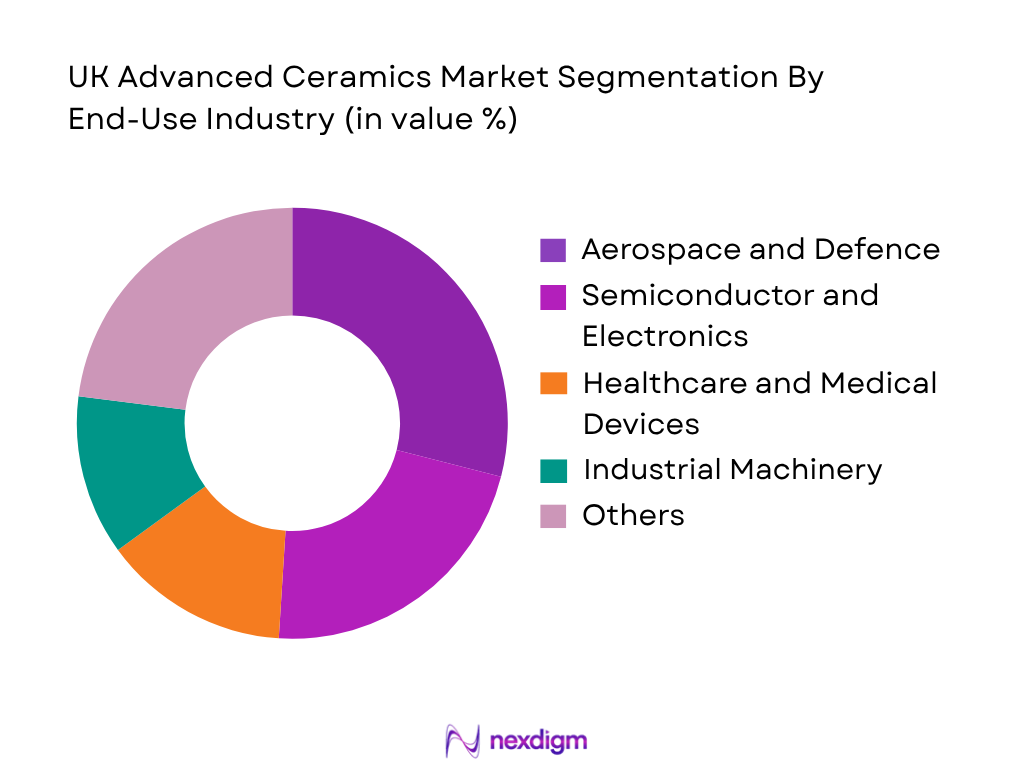
By End-Use Industry
The UK Advanced Ceramics Market is segmented into aerospace and defence, semiconductor and electronics, healthcare and medical devices, energy and power generation, nuclear, automotive and transportation, industrial machinery and chemical/process industries. Aerospace and defence hold the dominant share under end-use segmentation because advanced ceramics address demanding operating conditions involving high temperatures, wear, corrosion, electrical insulation, weight reduction and thermal protection. The UK possesses a substantial aerospace and defence manufacturing ecosystem, creating demand for ceramic components in aero-engines, sensors, armour, radomes, electrical systems, thermal-management assemblies and high-temperature applications. Advanced ceramics also benefit from stringent lifecycle-performance requirements that favour engineered materials over conventional metals and polymers in critical locations. Semiconductor and electronics applications form another high-value demand cluster, particularly for high-purity alumina, aluminium nitride, silicon carbide and silicon nitride components used in processing equipment, substrates, power electronics and thermal-management systems. The UK government’s semiconductor strategy specifically identifies compound semiconductors and advanced-material technologies as national strengths.
Competitive Landscape
The UK Advanced Ceramics Market combines established British technical-ceramics manufacturers with large international engineered-material suppliers. Morgan Advanced Materials has deep domestic manufacturing and engineering roots, while Precision Ceramics provides specialist UK machining and customised technical-ceramic components. CoorsTek, CeramTec and Kyocera add broad global portfolios across alumina, zirconia, silicon carbide, silicon nitride, aluminium nitride and electronic ceramics. Competition centres on material purity, forming and sintering expertise, precision machining, application engineering, qualification support and the ability to manufacture complex components to demanding tolerances.
| Company | Establishment Year | Headquarters | Core Advanced Ceramics | Processing Capability | Key Application Exposure | UK Market Position | Semiconductor Capability | Aerospace / Medical Capability |
| Morgan Advanced Materials | 1856 | Windsor, UK | ~ | ~ | ~ | ~ | ~ | ~ |
| CoorsTek | 1910 | Golden, Colorado, USA | ~ | ~ | ~ | ~ | ~ | ~ |
| CeramTec | 1903 industrial roots | Plochingen, Germany | ~ | ~ | ~ | ~ | ~ | ~ |
| Kyocera Corporation | 1959 | Kyoto, Japan | ~ | ~ | ~ | ~ | ~ | ~ |
| Precision Ceramics | 1992 | Birmingham, UK | ~ | ~ | ~ | ~ | ~ | ~ |
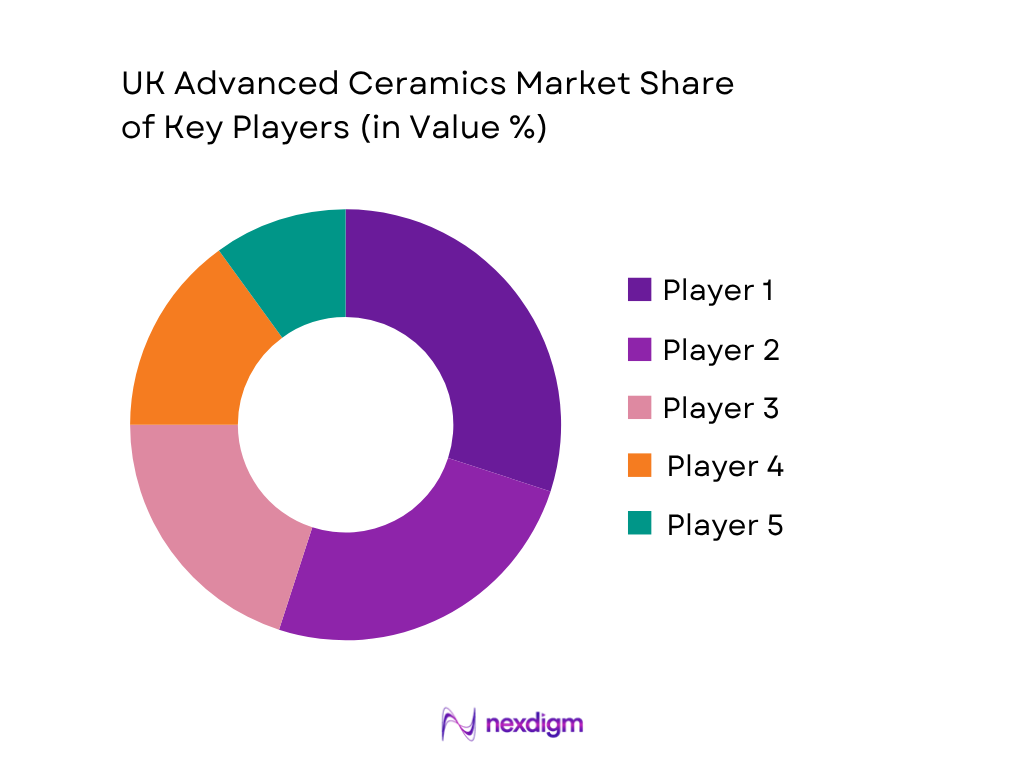
UK Advanced Ceramics Market Analysis
Growth Drivers
Expanding Aerospace and Defence Manufacturing Base Driving High-Performance Ceramic Demand
The UK Advanced Ceramics Market is being strengthened by the scale of domestic aerospace and defence manufacturing, where alumina, silicon carbide, silicon nitride and ultra-high-temperature ceramics are required for electrical insulation, thermal protection, wear components, sensors, armour and high-temperature assemblies. UK aerospace activity generated £34 billion in turnover, contributed £13.6 billion to the economy, supported 100,000 direct jobs and recorded £1.9 billion of business R&D expenditure in 2024. Government support for aerospace technology was reinforced through £975 million of programme funding announced in 2024 and more than £250 million of joint industrial investment announced in 2025 for advanced aerospace technologies. Defence provides an additional demand platform: direct expenditure with UK industry reached £31.9 billion in 2024/25, supporting an estimated 274,000 direct and indirect full-time-equivalent jobs. These sectors require ceramic components capable of operating under demanding thermal, mechanical, electrical and corrosive conditions, increasing opportunities for precision ceramic manufacturers and ceramic-to-metal specialists. The wider economic environment provides significant industrial purchasing capacity, with UK GDP reaching USD 3,686.03 billion and GDP per capita USD 53,246.4 in 2024.
Expansion of Semiconductor and Power-Electronics Manufacturing Supporting Technical Ceramics
The UK Advanced Ceramics Market is also benefiting from expansion of semiconductor, compound-semiconductor and power-electronics manufacturing, where high-purity alumina, aluminium nitride, silicon carbide and silicon nitride are used in substrates, insulating components, wafer-processing equipment, thermal-management systems and precision semiconductor assemblies. The UK semiconductor ecosystem contained 703 companies in the latest 2026 sector assessment, including 295 dedicated semiconductor companies and 408 diversified companies; dedicated companies generated £7.5 billion in gross value added and directly employed approximately 16,350 people in 2025. South Wales is particularly important for ceramic-enabled semiconductor applications, with a £250 million manufacturing investment announced in Newport in 2025 to strengthen the country’s compound-semiconductor production capability. Semiconductor processing equipment requires materials with controlled purity, dielectric strength, dimensional stability, plasma resistance and high thermal conductivity, creating technically differentiated demand for advanced ceramic components rather than conventional industrial ceramics. Expansion of power electronics for EVs, energy infrastructure and advanced computing further supports aluminium-nitride and silicon-nitride substrate applications. The underlying economic capacity is substantial, with the UK recording USD 3,686.03 billion of GDP and USD 53,246.4 GDP per capita in 2024, supporting capital-intensive semiconductor and advanced-material investments.
Market Challenges
Concentrated Domestic Ceramics Manufacturing Base and Energy-Intensive Processing Requirements
A major challenge for the UK Advanced Ceramics Market is maintaining internationally competitive domestic manufacturing capacity while advanced ceramics continue to require tightly controlled forming, firing, sintering, grinding and finishing operations. North Staffordshire, one of Britain’s most important ceramics clusters, contained 123 ceramics companies in 2024, illustrating that the specialist manufacturing base is concentrated within a relatively limited number of producers and processing businesses. Recognising constraints around commercialisation and manufacturing efficiency, public authorities reported £29.8 million of research and innovation investment in Staffordshire in 2025, including £18 million for the Midlands Advanced Ceramics for Industry 4.0 programme. The programme specifically targets faster proving and commercialisation of new ceramic technologies while reducing energy requirements and process emissions, highlighting the technical and manufacturing barriers confronting the sector. Advanced ceramics additionally demand expensive high-temperature furnaces, controlled atmospheres, precision grinding equipment and stringent dimensional inspection, particularly for semiconductor, aerospace and medical components. These requirements can restrict scaling among smaller processors and increase dependence on specialised manufacturing infrastructure. This challenge exists despite a large national economic base, with UK GDP at USD 3,686.03 billion and GDP per capita at USD 53,246.4 in 2024, making productivity and domestic processing capability key competitive issues.
Dependence on Resilient Specialty-Material and Critical-Mineral Supply Chains
Supply security represents another significant challenge for the UK Advanced Ceramics Market, because high-performance ceramic production depends on consistent access to high-purity powders, specialty additives and mineral-derived inputs suitable for controlled sintering and precision applications. The UK’s 2025 Critical Minerals Strategy identifies supply-chain resilience as a national industrial priority and reports that the domestic critical-minerals sector contributes £1.79 billion to the UK economy, directly supports more than 50,000 jobs and contains more than 50 active mining, processing or recycling projects. Government subsequently established funding of up to £50 million to accelerate domestic critical-mineral production and processing. These figures demonstrate the broader material-security challenge facing advanced manufacturing sectors that require controlled-quality mineral inputs. Advanced ceramics are particularly sensitive to feedstock consistency because particle size, impurity content and powder chemistry directly affect grain structure, thermal conductivity, dielectric properties, strength and component yield after sintering. Suppliers serving aerospace, semiconductor and medical applications must therefore maintain qualified sources and material traceability while managing international supply exposure. The challenge is economically important within a country whose 2024 GDP reached USD 3,686.03 billion and GDP per capita reached USD 53,246.4, because advanced manufacturing competitiveness increasingly depends on secure upstream material availability as well as downstream processing expertise.
Market Opportunities
Semiconductor Manufacturing Expansion Creating Opportunities for High-Purity Ceramic Components
The UK Advanced Ceramics Market has a substantial future opportunity in semiconductor manufacturing, where high-purity ceramic components are required for wafer processing, thermal management, electrical insulation, plasma-facing equipment and power-electronic packaging. The latest government sector assessment identifies 703 semiconductor companies operating in the UK, while dedicated semiconductor businesses directly employed approximately 16,350 people and generated £7.5 billion of gross value added in 2025. Manufacturing capacity is receiving additional investment, illustrated by the £250 million investment announced for the Newport semiconductor facility in 2025, reinforcing South Wales as a strategic compound-semiconductor cluster. A further £1.1 billion semiconductor and computing initiative announced in 2026 strengthens the environment for chip design, manufacturing capability, hardware development and commercialisation. These investments create downstream opportunities for alumina process components, aluminium-nitride thermal substrates, silicon-carbide fixtures and silicon-nitride power-module substrates that meet stringent purity, dimensional and thermal-performance requirements. The opportunity therefore extends from ceramic powder suppliers to precision machining, metallisation, brazing and ceramic-to-metal integration businesses. Current macroeconomic capacity supports continued technology investment, with the UK recording USD 3,686.03 billion GDP and USD 53,246.4 GDP per capita in 2024, providing a strong economic base for advanced semiconductor manufacturing and supporting-material localisation.
Fusion and Advanced Nuclear Development Opening New Extreme-Environment Ceramic Applications
The UK Advanced Ceramics Market has another significant future opportunity in fusion and advanced nuclear engineering, where ceramic materials can provide electrical insulation, high-temperature stability, corrosion resistance, radiation tolerance and specialised structural performance. Government funding committed £410 million to the UK fusion programme for 2025/26, including support for STEP, Fusion Futures and new fuel-development infrastructure. The Lithium Breeding Tritium Innovation programme separately carries £200 million of funding to develop fusion-fuel technology and supporting industrial capability. The 2026 fusion funding framework expanded current programme allocations, including £740 million for R&D infrastructure and facilities, £180 million for LIBRTI, £110 million for wider industry support and commercialisation, £80 million for international collaboration and £50 million for fusion-skills development. These programmes create an addressable engineering environment for advanced alumina, silicon carbide, silicon nitride and other specialised ceramics used in insulating systems, diagnostic assemblies, vacuum components, high-temperature structures and radiation-facing applications. Ceramic suppliers capable of qualifying materials for extreme environments can therefore move into higher-value energy applications alongside established aerospace and semiconductor markets. The economic foundation for such technology-intensive programmes remains substantial, with UK 2024 GDP of USD 3,686.03 billion and GDP per capita of USD 53,246.4.
Future Outlook
The UK Advanced Ceramics Market is expected to expand at approximately ~XX% CAGR during 2026–2035, supported by increasing material-performance requirements across aerospace, defence, power electronics, semiconductor equipment, medical devices and emerging energy technologies. Growth will increasingly shift toward higher-purity materials, complex component geometries, advanced thermal management and ceramic-to-metal integration.
Semiconductor and power-electronics applications are expected to become progressively important. Aluminium nitride offers attractive thermal-management properties, while silicon nitride provides mechanical and thermal performance for demanding power-module substrates. Alumina should retain a broad application base because of its established processing infrastructure and balanced electrical, mechanical and chemical characteristics. CeramTec’s semiconductor portfolio already covers alumina, aluminium nitride, zirconia-toughened alumina and silicon nitride substrate systems, demonstrating the breadth of ceramic materials being integrated into modern electronics.
Major Players
- Morgan Advanced Materials
- CoorsTek
- CeramTec
- Kyocera Fineceramics
- Saint-Gobain Ceramics
- Precision Ceramics
- Dynamic Ceramic
- Mantec Technical Ceramics
- International Syalons
- McDanel Advanced Ceramic Technologies
- 3M Advanced Materials
- NGK Insulators
- MARUWA
- Elan Technology
- Lucideon
Key Target Audience
- Advanced Ceramic Material Manufacturers
- Aerospace, Defence and Space Component Manufacturers
- Semiconductor and Power Electronics Manufacturers
- Medical Device and Bioceramic Manufacturers
- Energy, Nuclear and High-Temperature Equipment Manufacturers
- Advanced Manufacturing and Industrial Engineering Companies
- Investments and Venture Capitalist Firms
- Government and Regulatory Bodies (Department for Business and Trade, Department for Science, Innovation and Technology, Office for Nuclear Regulation, Medicines and Healthcare products Regulatory Agency, Health and Safety Executive)
Research Methodology
Step 1: Identification of Key Variables
The initial phase involves constructing a complete ecosystem map for the UK Advanced Ceramics Market, covering powder suppliers, technical ceramic manufacturers, precision processors, ceramic-to-metal specialists, distributors and major end-use industries. Critical variables include ceramic material type, purity, processing technology, component geometry, application environment, qualification requirements and supply-chain positioning.
Step 2: Market Analysis and Construction
Historical market demand is evaluated through combined top-down and bottom-up analysis. The top-down approach considers aerospace, defence, semiconductor, healthcare, energy and industrial manufacturing activity, while bottom-up construction evaluates component consumption, ceramic content per application, supplier revenues, production capability and product mix across oxide and non-oxide ceramics.
Step 3: Hypothesis Validation and Expert Consultation
Market hypotheses are validated through computer-assisted telephone interviews with technical ceramic manufacturers, material engineers, aerospace suppliers, semiconductor-equipment companies, medical-device manufacturers, distributors and industrial end users. These interactions validate material preferences, qualification cycles, procurement practices, production constraints and evolving requirements for purity, thermal behaviour and mechanical performance.
Step 4: Research Synthesis and Final Output
The final phase triangulates demand-side information with supplier capability, production processes and application-level ceramic consumption. Material demand is reconciled across alumina, zirconia, silicon carbide, silicon nitride, aluminium nitride and specialised ceramics. The resulting analysis establishes market segmentation, competitive positioning, application outlook and long-term opportunities within the UK Advanced Ceramics Market.

- Executive Summary
- Research Methodology (Market Definition and Scope, UK Advanced Ceramics Market Classification, Oxide and Non-Oxide Ceramic Mapping, Structural and Functional Ceramic Assessment, Advanced Ceramic Powder Demand Analysis, Technical Ceramic Component Mapping, Aerospace and Defence Application Assessment, Semiconductor and Electronics Ceramic Evaluation, Medical and Bioceramic Application Mapping, Energy and Nuclear Ceramic Assessment, Advanced Ceramic Manufacturing Ecosystem Analysis)

- Definition and Scope
- UK Advanced Ceramics Industry Evolution and Development of High-Performance Materials Ecosystem
- Advanced Ceramic Material Chemistry, Microstructure and Performance Characteristics
- UK Advanced Ceramics Value Chain Analysis
- UK Advanced Ceramics Supply Chain Analysis
- Ceramic Powder, Formulation, Forming, Sintering, Precision Machining, Coating and Component Integration Ecosystem Analysis
- Advanced Ceramic Integration Assessment Across Aerospace, Defence, Semiconductor, Electronics, Medical, Energy, Automotive and Industrial Applications

- Growth Drivers (Strong Aerospace and Defence Manufacturing Base, Expansion of Semiconductor and Compound Semiconductor Ecosystem, Increasing Demand for High-Temperature Materials, Growth of Medical and Dental Ceramic Applications, Increasing Power Electronics Deployment, Rising Requirement for Wear-Resistant Industrial Components)
- Market Challenges (High Advanced Ceramic Processing Complexity, Energy-Intensive Sintering Requirements, Dependence on Specialty Ceramic Powder Imports, Brittleness and Difficult Machining Characteristics, Long Aerospace and Medical Qualification Cycles, Shortage of Specialist Ceramic Processing Skills)
- Market Opportunities (Ultra-High-Temperature Ceramics for Aerospace, Advanced Ceramic Components for Semiconductor Equipment, Aluminium Nitride Thermal Management Substrates, Silicon Carbide Components for Power Electronics, Medical and Dental Bioceramics, Nuclear and Fusion Energy Applications, Additive Manufacturing of Complex Ceramic Components)
- Market Trends (Ceramic Additive Manufacturing, Ultra-High-Purity Alumina Adoption, Silicon Carbide and Silicon Nitride Expansion, Ceramic-to-Metal Integration, Advanced Thermal Management, Near-Net-Shape Manufacturing, High-Temperature Ceramic Coatings, Digital Process Control)
- Regulatory and Standards Landscape (UKCA Product Compliance, Aerospace AS9100 Quality Requirements, ISO 13485 Medical Device Quality Requirements, UK Medical Device Regulations, Nuclear Quality Assurance Requirements, Defence Material Qualification Standards, UK REACH Chemical Compliance, Industrial Emissions Requirements)
- SWOT Analysis
- Porter’s Five Forces Analysis
- PESTLE Analysis
- Stakeholder Ecosystem
- Competition Ecosystem

- By Market Value (2020-2025)
- By Advanced Ceramic Consumption Volume (2020-2025)
- By Oxide Ceramic Consumption Volume (2020-2025)
- By Non-Oxide Ceramic Consumption Volume (2020-2025)
- By Structural Ceramic Consumption Volume (2020-2025)
- By Functional Ceramic Consumption Volume (2020-2025)
- By Precision Ceramic Component Shipment Volume (2020-2025)

- By Material Type (In Value %)
Alumina
Zirconia
Aluminium Nitride
Silicon Carbide
Silicon Nitride
Boron Carbide
Titanate Ceramics
Piezoelectric Ceramics
Machinable Glass Ceramics
Ultra-High-Temperature Ceramics - By Ceramic Function (In Value %)
Structural Ceramics
Electrical Insulating Ceramics
Electronic and Dielectric Ceramics
Piezoelectric Ceramics
Thermal Management Ceramics
Wear-Resistant Ceramics
Bioceramics
Optical and Transparent Ceramics
Ultra-High-Temperature Ceramics - By Application Type (In Value %)
Aero-Engine Components
Armour and Ballistic Protection
Semiconductor Processing Components
Electronic Substrates and Insulators
Medical and Dental Components
Industrial Wear Components
Mechanical Seals and Bearings
Energy and Power Generation Components
Nuclear Applications
Automotive Sensors and Power Electronics - By End-Use Industry (In Value %)
Aerospace and Defence
Semiconductor and Electronics
Healthcare and Medical Devices
Energy and Power Generation
Nuclear Industry
Automotive and Transportation
Industrial Machinery
Chemical and Process Industries
Telecommunications
High-Technology Manufacturing - By Product Form (In Value %)
Advanced Ceramic Powders
Pressed Ceramic Components
Extruded Ceramic Components
Injection-Moulded Ceramic Components
Precision-Machined Ceramic Components
Ceramic Substrates
Ceramic Tubes and Rods
Ceramic-to-Metal Assemblies
Ceramic Coatings
Additively Manufactured Ceramic Components - By Processing Technology (In Value %)
Dry Pressing
Isostatic Pressing
Injection Moulding
Extrusion
Tape Casting
Slip Casting
Hot Pressing
Hot Isostatic Pressing
Pressureless Sintering
Spark Plasma Sintering
Additive Manufacturing
Precision Grinding and Lapping - By Sales Channel (In Value %)
Direct Manufacturer-to-OEM Supply
Tier-1 Engineering Supplier Network
Specialty Ceramic Distributors
Aerospace and Defence Procurement
Medical Device OEM Procurement
Semiconductor Equipment Manufacturer Procurement
Industrial Engineering Distributors
Custom Engineering and Contract Manufacturing - By Region (In Value %)
West Midlands
East Midlands
North West England
South West England
South East England
Yorkshire and the Humber
Scotland
Wales
Northern Ireland

- Market Share of Major Players (By Revenue, Material Type, Ceramic Product Category, End-Use Industry, Processing Technology, Manufacturing Footprint, Customer Segment, UK Market Presence)
- Cross Comparison Parameters (Advanced Ceramic Material Portfolio Breadth, High-Purity Ceramic Processing Capability, Precision Forming and Sintering Expertise, Dimensional Tolerance and Surface-Finishing Capability, Aerospace and Medical Certification Readiness, Semiconductor-Grade Ceramic Capability, UK Manufacturing and Customer Support Footprint, Application Development and Ceramic R&D Capability)
- SWOT Analysis of Major Players
- Competitive Positioning Matrix
- Detailed Profiles of Major Companies
Morgan Advanced Materials – Alumina, Silicon Carbide, Technical Ceramics, Ceramic-to-Metal Assemblies and Semiconductor Components
CoorsTek – Alumina, Zirconia, Silicon Carbide, Silicon Nitride, Aluminium Nitride and Precision Technical Ceramic Components
CeramTec – Advanced Structural Ceramics, Piezoceramics, Electronic Ceramics and Semiconductor Components
Kyocera Fineceramics – Fine Ceramic Components, Electronic Ceramics, Structural Ceramics and Precision Engineered Materials
Saint-Gobain Ceramics – Silicon Carbide, Boron Nitride, Refractory Ceramics and High-Performance Ceramic Solutions
Precision Ceramics – Alumina, Aluminium Nitride, Boron Nitride, Silicon Carbide, Macor and Precision-Machined Ceramic Components
Dynamic Ceramic – Precision Technical Ceramic Components, Alumina, Zirconia, Silicon Carbide and Engineering Ceramics
Mantec Technical Ceramics – Technical Ceramic Components, Porous Ceramics and High-Temperature Industrial Ceramic Solutions
International Syalons – Sialon and Silicon Nitride Advanced Ceramic Components
McDanel Advanced Ceramic Technologies – Alumina and Mullite Ceramic Tubes, Rods and Custom Technical Ceramics
3M Advanced Materials – Technical Ceramics, Boron Nitride, Ceramic Abrasives and Industrial Ceramic Materials
NGK Insulators – Electronic Ceramics, Ceramic Substrates, Industrial Ceramics and High-Performance Functional Ceramics
MARUWA – Alumina and Aluminium Nitride Ceramic Substrates, Electronic Ceramics and Thermal Management Components
Elan Technology – Technical Ceramic Components, Ceramic-to-Metal Seals and High-Performance Engineered Materials
Lucideon – Advanced Ceramic Materials Development, Pilot-Scale Processing, Testing and Ceramic Technology Commercialisation

- Aerospace OEM Advanced Ceramic Adoption Assessment
- Defence Contractor Ceramic Material Requirements Analysis
- Semiconductor Equipment Manufacturer Component Assessment
- Electronics Manufacturer Thermal Management Requirements Analysis
- Medical Device Manufacturer Bioceramic Adoption Assessment
- Nuclear and Energy Operator Ceramic Application Assessment
- Automotive OEM and Tier-1 Ceramic Requirements Analysis
- Industrial Machinery Manufacturer Wear-Component Assessment
- Advanced Manufacturing Company Ceramic Procurement Analysis

- By Market Value (2026-2035)
- By Advanced Ceramic Consumption Volume (2026-2035)
- By Oxide Ceramic Consumption Volume (2026-2035)
- By Non-Oxide Ceramic Consumption Volume (2026-2035)
- By Aerospace and Defence Ceramic Consumption Volume (2026-2035)
- By Semiconductor and Electronics Ceramic Consumption Volume (2026-2035)
- By Medical Ceramic Consumption Volume (2026-2035)
- By Energy and Nuclear Ceramic Consumption Volume (2026-2035)
- By Additively Manufactured Ceramic Component Volume (2026-2035)


 Request a Sample
 Ask for Customization
 Get a Quote
 Enquire Now