
 Download PDF
Market Overview
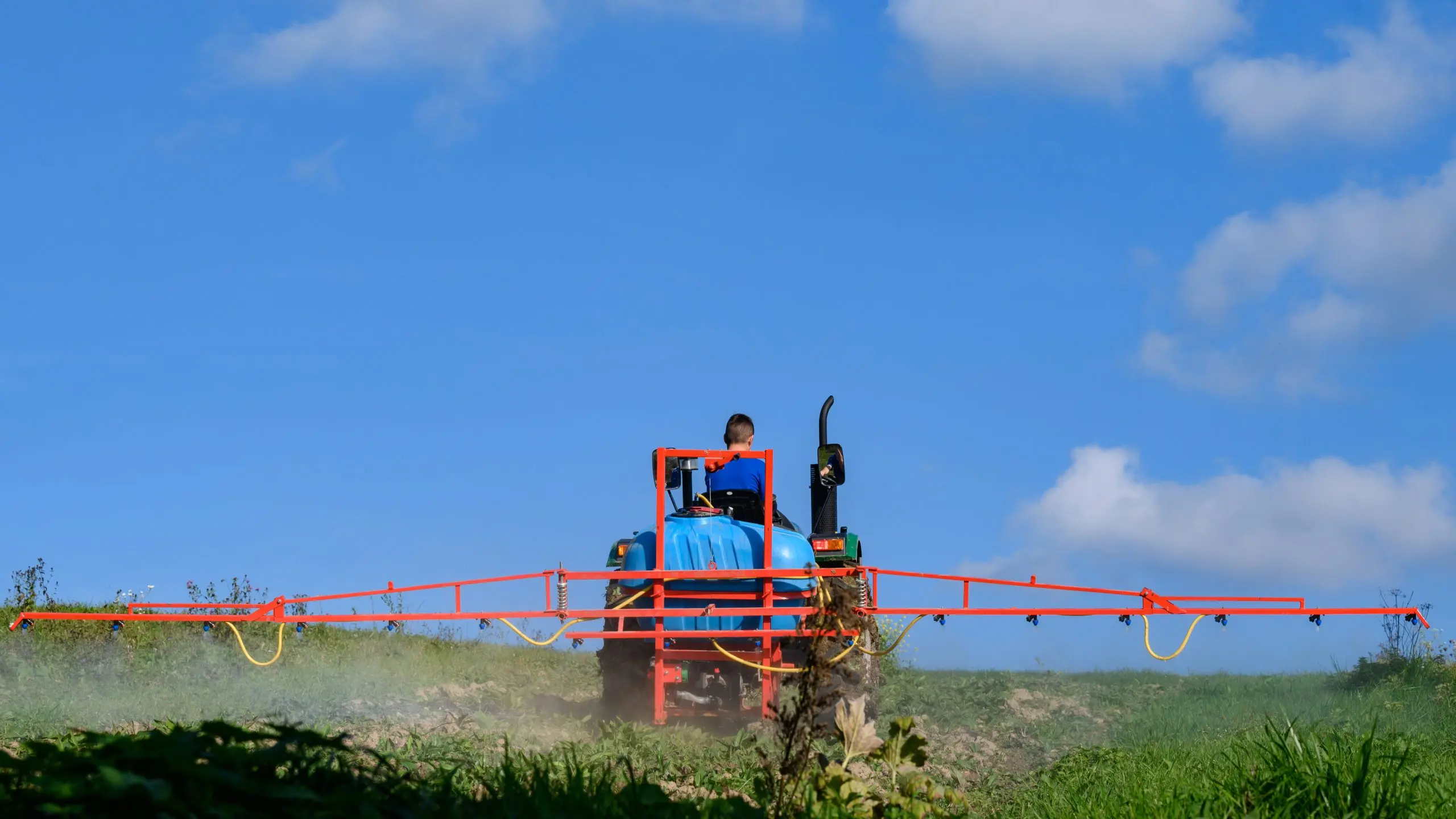
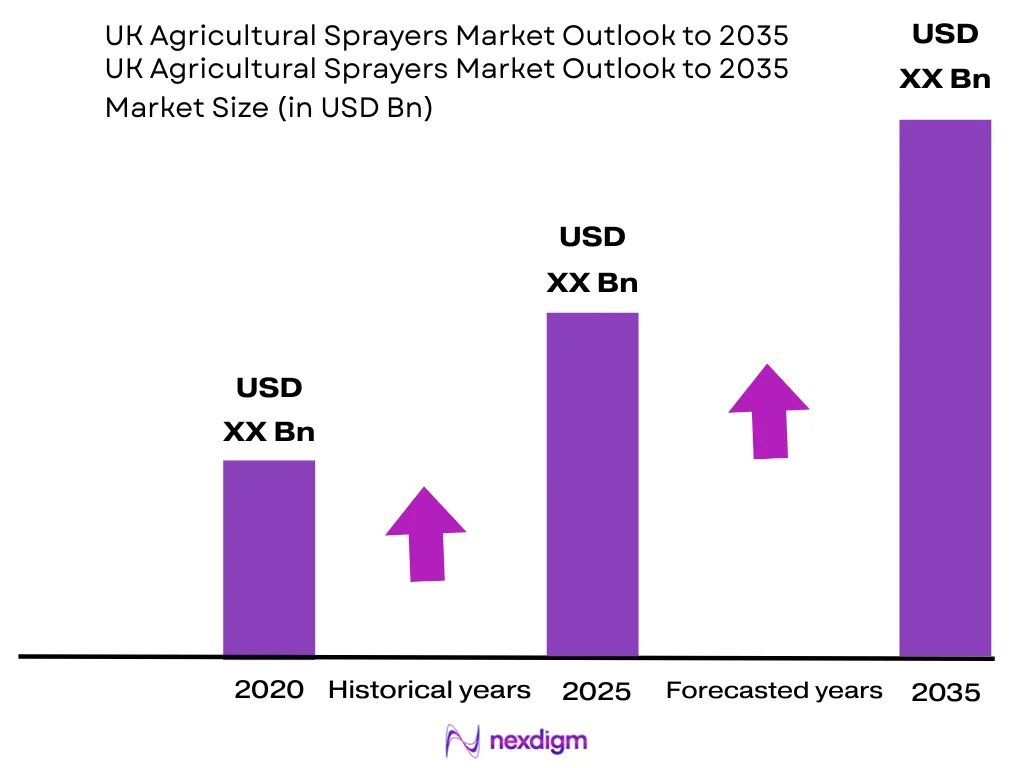
The UK Agricultural Sprayers Market was valued at approximately USD ~ billion in 2024 based on a comprehensive assessment of agricultural machinery sales, crop protection equipment demand, and mechanisation trends across major farming regions. The market is primarily driven by the United Kingdom’s well-established arable sector, with significant production of winter wheat, oilseed rape, barley, and sugar beet. According to data published by the Department for Environment, Food and Rural Affairs (DEFRA) and the Agriculture and Horticulture Development Board (AHDB), total cereal and oilseed production remained substantial, while cultivated arable acreage continued to be managed intensively across England, Scotland, and Wales. Rising adoption of precision agriculture technologies, increasing crop protection chemical usage, and greater emphasis on operational efficiency have accelerated demand for advanced spraying equipment among arable farming operators.
Market Segmentation
By Sprayer Type
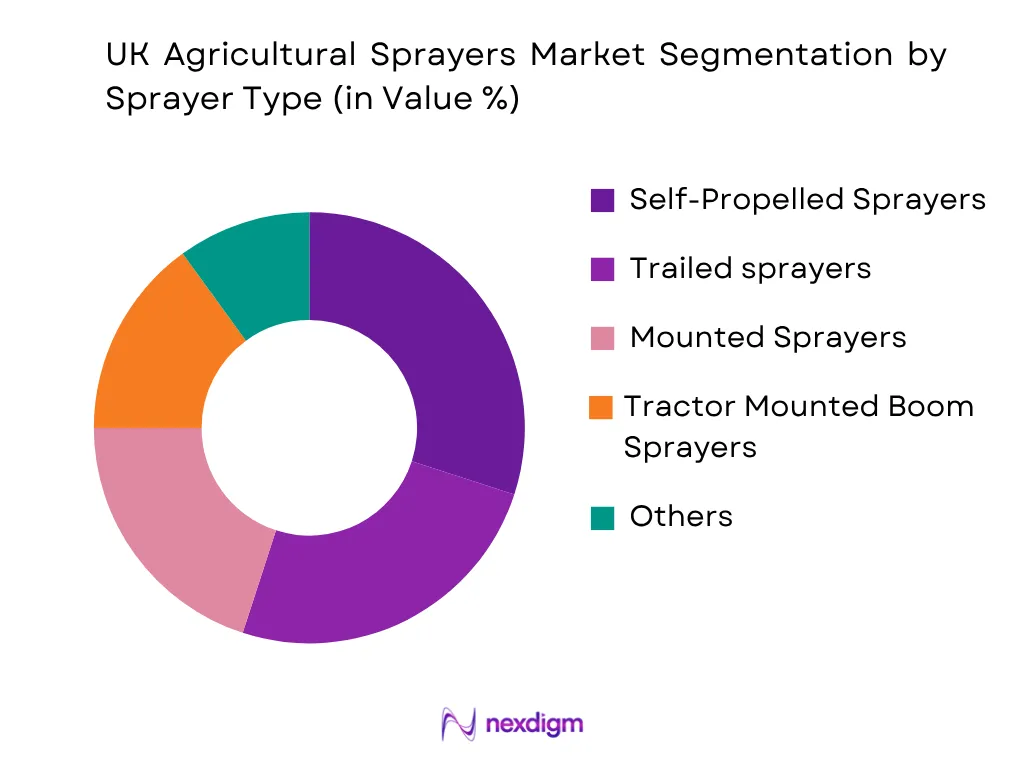
UK Agricultural Sprayers Market is segmented by sprayer type into self-propelled sprayers, trailed sprayers, mounted sprayers, tractor-mounted boom sprayers, air-assisted sprayers, orchard and vineyard sprayers, UAV/drone sprayers, and backpack sprayers. Trailed and self-propelled sprayers collectively dominate the market, reflecting the structure of UK arable farming where large-scale cereal and oilseed enterprises require high-capacity equipment capable of covering significant field areas efficiently. UK farms cultivating winter wheat, oilseed rape, and barley require multiple spray applications for disease control, weed management, and crop nutrition. These machines offer enhanced precision, GPS guidance systems, automatic section control, and reduced operator workload. Furthermore, increasing adoption of precision agriculture practices and innovations such as telematics and variable-rate application technology continue strengthening demand for advanced sprayer types across major arable regions.
By Crop Type
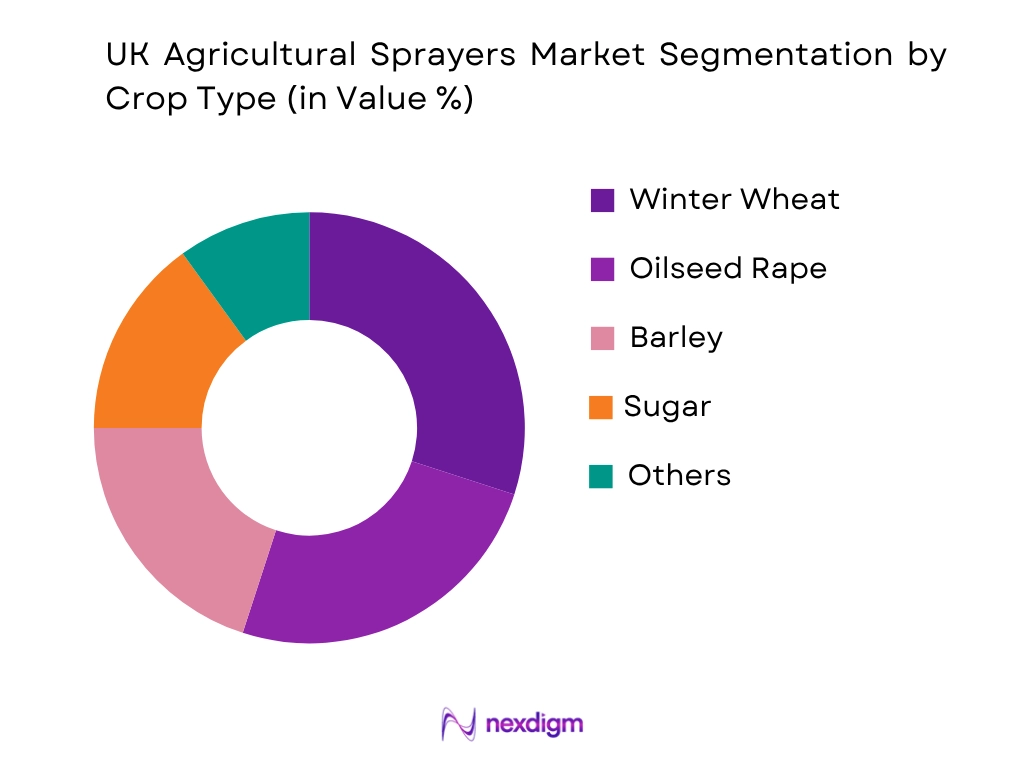
UK Agricultural Sprayers Market is segmented by crop type into winter wheat, oilseed rape, barley, sugar beet, potatoes, fruits and vegetables, oats, and other arable crops. Winter wheat accounts for the largest market share owing to its status as the United Kingdom’s most widely cultivated cereal crop and its requirement for multiple fungicide, herbicide, and growth regulator applications throughout the growing season. According to AHDB and DEFRA statistics, winter wheat regularly accounts for over two million hectares of harvested area, creating substantial and recurring demand for high-capacity spraying equipment. Additionally, the high disease pressure associated with UK cereal production, including yellow rust and septoria leaf blotch, necessitates frequent and precision spray applications, further driving demand for technologically advanced sprayers with variable-rate and section control capabilities.
Competitive Landscape
The UK Agricultural Sprayers Market is characterised by the presence of both domestic and international agricultural equipment manufacturers. The competitive environment features established global brands with strong dealer networks and after-sales service capabilities alongside specialist UK manufacturers offering market-specific products suited to British farming conditions. International players leverage technological expertise and broad product portfolios, while domestic and European manufacturers benefit from familiarity with UK regulatory requirements, field conditions, and farm structures. The market is supported by a well-developed agricultural machinery dealer network, particularly concentrated in arable farming regions across the East of England, East Midlands, and Yorkshire.
| Company | Establishment Year | Headquarters | Product Portfolio | Precision Agriculture Integration
|
Tank Capacity Range | Dealer Network Strength | After-Sales Support | Innovation Capability |
| CNH Industrial (Case IH) | 2013 | ~ | ~ | ~ | ~ | ~ | ~ | ~ |
| John Deere | 1837 | ~ | ~ | ~ | ~ | ~ | ~ | ~ |
| AGCO Corporation | 1990 | ~ | ~ | ~ | ~ | ~ | ~ | ~ |
| Amazone | 1883 | ~ | ~ | ~ | ~ | ~ | ~ | ~ |
| Hardi International | 1957 | ~ | ~ | ~ | ~ | ~ | ~ | ~ |
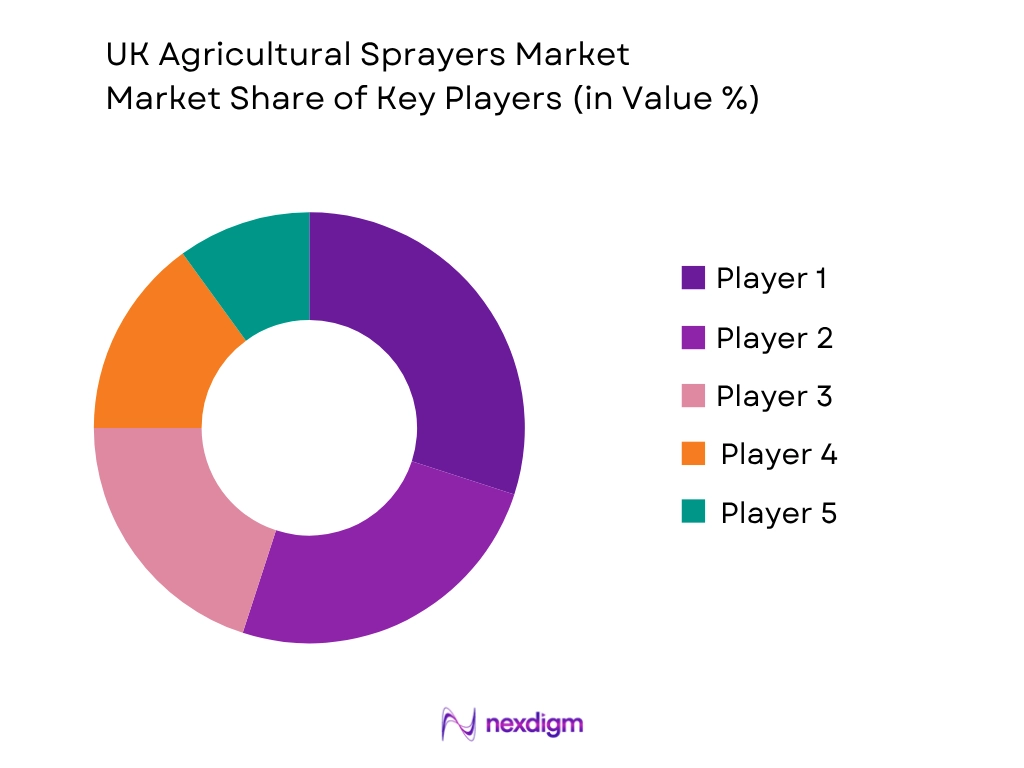
UK Agricultural Sprayers Market Analysis
Growth Drivers
Sustained Arable Crop Production and Crop Protection Requirements
The UK agricultural sprayers market is strongly supported by the country’s established arable sector, which demands extensive crop protection activities throughout each growing season. According to DEFRA and AHDB, the United Kingdom harvests approximately 14 to 15 million tonnes of wheat annually alongside substantial volumes of barley, oilseed rape, and other cereals. Total arable land in the UK covers approximately 4.5 million hectares, with England accounting for the largest share of cereal and oilseed production. Oilseed rape cultivation, while subject to acreage fluctuations due to pest pressures including cabbage stem flea beetle, continues to require multiple spray applications across its production cycle. The East of England and East Midlands represent the most intensive arable farming regions, generating consistent demand for high-capacity sprayers across commercial farm operations. Furthermore, AHDB crop production outlooks indicate continued investment in disease management and weed control programmes as growers seek to maintain yield potential in a challenging agronomic environment. The scale and intensity of UK arable production creates sustained demand for advanced spraying equipment capable of delivering precise and timely applications, making crop production activity one of the most significant demand drivers for the UK Agricultural Sprayers Market.
Increasing Availability of Agricultural Equipment Financing and Government Support Schemes
Access to agricultural finance and government support mechanisms continues to facilitate investment in modern sprayers across the United Kingdom. The UK government’s Farming Equipment and Technology Fund (FETF), administered by DEFRA and Rural Payments Agency (RPA), provides grants to support the purchase of precision equipment, including advanced sprayer technologies, variable-rate application systems, and GPS-guided machinery. Additionally, the Sustainable Farming Incentive (SFI) and Countryside Stewardship schemes incentivise adoption of environmentally responsible practices, indirectly supporting investment in precision spraying equipment that reduces chemical inputs and improves application accuracy. Commercial agricultural lenders and equipment finance providers offer competitive hire purchase and leasing arrangements, enabling farm businesses to access modern machinery without large upfront capital expenditure. The Agricultural Mortgage Corporation (AMC) and specialist agricultural banks further support farm investment through dedicated lending products. The combination of government grant funding and commercial finance availability has strengthened the investment capacity of UK arable businesses, supporting adoption of technologically advanced spraying systems equipped with GPS guidance, automatic section control, and telematics integration.
Market Challenges
Weather Variability and Seasonal Spraying Constraints
The agricultural sprayers market in the United Kingdom remains significantly dependent on seasonal weather conditions, which directly influence spraying windows and equipment utilisation. The UK’s temperate maritime climate, characterised by frequent rainfall, high humidity, and variable wind speeds, regularly restricts available spraying days throughout the growing season. According to DEFRA agricultural statistics, adverse weather events including prolonged wet periods during autumn drilling and spring applications have periodically disrupted crop protection programmes and delayed spray timing. Restricted spraying windows reduce equipment utilisation rates and can compress purchasing decisions as farmers evaluate return on investment. Additionally, the increasing frequency of extreme weather events linked to climate variability, including drought conditions in eastern England and flooding in low-lying arable areas, has added uncertainty to farm planning and capital expenditure decisions. Such fluctuations directly affect farm income, machinery replacement cycles, and investment confidence. These structural weather-related constraints represent an ongoing challenge for consistent equipment demand across the UK market.
High Capital Requirements and Post-Brexit Regulatory Adjustments
Modern agricultural sprayers increasingly incorporate precision agriculture technologies including GPS guidance, variable-rate application, telematics, automatic boom height control, and section control systems. While these technologies improve operational efficiency and reduce input wastage, they significantly increase equipment complexity and acquisition costs. UK farm businesses frequently rely on hire purchase agreements, lease finance, and grant funding to support sprayer investments, highlighting the substantial capital commitment required for modern machinery. Additionally, the United Kingdom’s departure from the European Union has introduced a period of regulatory adjustment affecting pesticide approvals, machinery certification standards, and cross-border equipment supply chains. Changes to active substance approvals under the UK Health and Safety Executive (HSE) regulatory framework have altered the crop protection landscape, with some chemistries losing approval status, thereby affecting demand for specialist application equipment. Smaller arable holdings face particular challenges balancing investment in precision spraying technology against constrained farm incomes and evolving support payment structures under the Agricultural Transition Plan. These financial and regulatory complexities continue to present barriers to broader market penetration among smaller farm enterprises.
Market Opportunities
Growing Adoption of Precision Agriculture and Sustainable Input Management
Precision agriculture presents one of the strongest growth opportunities for the UK Agricultural Sprayers Market. The UK government’s commitment to sustainable farming, articulated through the Environmental Land Management (ELM) scheme and the Agriculture Act 2020, is driving demand for technology that improves input efficiency and reduces environmental impact. DEFRA’s productivity statistics indicate continued investment by UK farm businesses in precision equipment capable of reducing herbicide, fungicide, and insecticide usage through site-specific application. Advanced sprayers equipped with GPS section control, variable-rate nozzle technology, and real-time canopy sensing enable farmers to apply crop protection products with greater accuracy, supporting both economic and environmental objectives. The increasing integration of farm management software, remote sensing data, and telematics with sprayer control systems creates further opportunities for technology-led equipment upgrades. As UK arable farmers seek to demonstrate environmental stewardship to meet scheme requirements and supply chain sustainability expectations, investment in precision spraying technology is expected to strengthen across the major arable regions of England and Scotland.
Expansion of Drone Spraying and Autonomous Application Technologies
The United Kingdom’s regulatory environment is progressively supporting the adoption of unmanned aerial vehicle (UAV) and autonomous spraying technologies, creating significant market development opportunities. The Civil Aviation Authority (CAA) and Health and Safety Executive have established frameworks governing commercial drone operations in agriculture, enabling expansion of UAV-based crop protection applications particularly suited to difficult terrain, smaller irregular fields, and orchard or horticultural settings. Biological crop protection products and precision application techniques require greater spraying accuracy compared with conventional methods, increasing demand for advanced nozzle systems, drift-reduction technologies, automated rate control, and data-driven application equipment. Furthermore, the Farming Innovation Programme, supported by Innovate UK, funds research and development in autonomous agricultural machinery, accelerating commercialisation of smart sprayer and robotic application technologies. The combination of regulatory enablement, government innovation funding, and growing farmer interest in labour-saving technologies creates a compelling growth pathway for advanced spraying solutions in the UK market.
Future Outlook
The UK Agricultural Sprayers Market is expected to experience moderate but sustained growth over the forecast period, supported by continued investment in precision farming technologies, evolving regulatory requirements favouring input efficiency, and the ongoing transition away from area-based farm support payments toward productivity and sustainability incentives. Demand for advanced spraying systems is anticipated to strengthen as farmers seek greater operational efficiency, reduced chemical usage, and compliance with tightening environmental standards. Technological developments such as autonomous sprayers, AI-enabled application optimisation, drone-based spraying solutions, and telematics integration are expected to gradually reshape the industry landscape. Continued government support for agricultural innovation and the long-term adjustment of farm businesses to post-Brexit support frameworks will influence equipment investment patterns across major arable regions.
Major Players
- John Deere
- CNH Industrial (Case IH & New Holland Agriculture)
- AGCO Corporation (Fendt & Massey Ferguson)
- Amazone
- Hardi International
- Kuhn Group
- Horsch
- Bateman Engineering
- Knight Farm Machinery
- Chafer Machinery
- Berthoud
- Kverneland Group
- DJI Agriculture
- Trimble (Precision Agriculture)
- Spraytec
Key Target Audience
- Agricultural Equipment Manufacturers
- Agricultural Machinery Distributors and Dealers
- Large Commercial Arable Farming Enterprises
- Precision Agriculture Technology Providers
- Crop Protection Chemical Manufacturers
- Investments and Venture Capitalist Firms
- Government and Regulatory Bodies (DEFRA, AHDB, Rural Payments Agency, Health and Safety Executive, Innovate UK)
- Agricultural Equipment Rental and Leasing Companies
Research Methodology
Step 1: Identification of Key Variables
The initial phase involves constructing an ecosystem map encompassing all major stakeholders within the UK Agricultural Sprayers Market. This process includes extensive secondary research through industry publications, government agricultural databases, manufacturer reports, trade associations, and agricultural machinery statistics. The objective is to identify critical market variables including equipment demand, crop acreage, mechanisation rates, technology adoption, and purchasing behaviour.
Step 2: Market Analysis and Construction
Historical market data relating to agricultural machinery sales, crop production trends, farm equipment penetration, and spraying technology adoption are collected and analysed. Demand-side assessment focuses on farm-level purchasing patterns and crop protection requirements, while supply-side analysis evaluates manufacturer revenues, dealer sales, production capacities, and distribution networks. Both approaches contribute to market size estimation and forecasting.
Step 3: Hypothesis Validation and Expert Consultation
Preliminary market findings and assumptions are validated through structured interviews with industry participants including agricultural equipment manufacturers, distributors, farm operators, agronomists, precision agriculture specialists, and industry associations. These consultations provide practical insights regarding market trends, technological developments, operational challenges, and future demand outlook, thereby strengthening the reliability of the research findings.
Step 4: Research Synthesis and Final Output
The final stage involves triangulating information collected from primary interviews, secondary research sources, and proprietary databases. Market estimates are refined through cross-verification across multiple data points and stakeholder perspectives. Forecast models are developed using agricultural production outlooks, mechanisation trends, technology adoption rates, and investment patterns to generate comprehensive and reliable market intelligence.

- Executive Summary
- Research Methodology (Market Definitions and Assumptions, Abbreviations, Market Sizing Approach, Top-Down Analysis, Bottom-Up Analysis, Demand-Side Assessment, Supply-Side Assessment, Primary Industry Interviews, Distributor and Dealer Validation, Farm-Level Survey Assessment, Data Triangulation, Forecasting Framework, Limitations and Future Conclusions)

- Definition and Scope
- Industry Evolution and Market Genesis
- Timeline of Technological Advancements in Agricultural Spraying
- Agricultural Equipment Value Chain Analysis
- Agricultural Sprayer Supply Chain Analysis

- Growth Drivers (Expansion of Arable Crop Acreage, Growth in Crop Protection Chemical Usage, Rising Mechanisation Rate, Precision Agriculture Adoption, Increasing Farm Consolidation)
- Market Challenges (High Equipment Acquisition Costs, Credit Accessibility Constraints, Skilled Operator Shortages, Equipment Maintenance Costs, Climatic Variability Impacting Utilisation)
- Market Opportunities (Drone Sprayer Penetration, Biological Crop Input Application, Precision Farming Investments, Smart Sprayer Retrofits, Sustainable Farming Practices)
- Market Trends (Pulse Width Modulation Systems, Automatic Boom Height Control, Telematics Integration, AI-Based Spray Optimisation, Low-Drift Nozzle Adoption)
- Government Regulations (DEFRA Machinery Standards, Environmental Spray Drift Regulations, HSE Farm Safety Requirements, Emission Compliance Standards, Countryside Stewardship and Sustainable Farming Incentive Programmes)
- SWOT Analysis
- PESTLE Analysis
- Stakeholder Ecosystem
- Porter’s Five Forces Analysis
- Competition Ecosystem

- By Market Value (2020-2025)
- By Units Sold (2020-2025)
- By Average Selling Price (2020-2025)

- By Sprayer Type (In Value %)
Self-Propelled Sprayers
Trailed Sprayers
Mounted Sprayers
Tractor-Mounted Boom Sprayers
Air-Assisted Sprayers
Orchard and Vineyard Sprayers
Backpack and Portable Sprayers
UAV/Drone Sprayers - By Application (In Value %)
Herbicide Application
Fungicide Application
Insecticide Application
Foliar Fertilizer Application
Biological Inputs Application - By Crop Type (In Value %)
Winter Wheat
Oilseed Rape
Barley
Sugar Beet
Potatoes
Fruits and Vegetables
Oats
Other Arable Crops - By Distribution Channel (In Value %)
OEM Direct Sales
Agricultural Equipment Dealers
Agri-Input Retail Networks
Equipment Rental and Leasing Providers
Online Agricultural Equipment Platforms - By Region (In Value %)
East of England (Lincolnshire, Norfolk, Cambridgeshire)
East Midlands (Nottinghamshire, Leicestershire, Northamptonshire)
Yorkshire and the Humber
Scotland
Wales and Other Regions

- Market Share of Major Players (By Value, Units Sold, Sprayer Type, Crop Segment, Region)
- Cross Comparison Parameters (Boom Width Portfolio, Tank Capacity Range, Field Coverage Efficiency (ha/hr), Precision Spraying Capability, Variable Rate Application Integration, Dealer Network Strength, After-Sales Service Reach, Spray Drift Reduction Technology)
- Competitive Positioning Matrix (Technology Leadership, Pricing Competitiveness, Brand Recognition, Regional Presence)
- SWOT Analysis of Major Players
- Pricing Analysis by Sprayer Category and Capacity
- Detailed Profiles of Major Companies
John Deere
CNH Industrial (Case IH & New Holland Agriculture)
AGCO Corporation (Fendt & Massey Ferguson)
Amazone
Hardi International
Kuhn Group
Horsch
Bateman Engineering
Knight Farm Machinery
Chafer Machinery
Berthoud
Kverneland Group
DJI Agriculture
Trimble (Precision Agriculture)
Spraytec

- Farm Equipment Ownership and Utilisation Analysis (Hours of Operation, Spraying Frequency, Fleet Age, Seasonal Utilisation Rate)
- Farm Mechanisation Assessment (Mechanisation Index, Equipment Density per Hectare, Technology Adoption Rate)
- Purchasing Power and Investment Capacity Analysis (Farm Income, Access to Agricultural Finance, ROI Expectations, Capital Expenditure Trends)
- Crop Protection Spending Analysis (Chemical Input Spend, Application Cost per Hectare, Spray Frequency by Crop)
- Farmer Needs and Pain Point Assessment (Labour Availability, Input Efficiency, Downtime Reduction, Coverage Accuracy, Fuel Consumption)

- By Market Value (2026-2035)
- By Units Sold (2026-2035)
- By Average Selling Price (2026-2035)


 Request a Sample
 Ask for Customization
 Get a Quote
 Enquire Now