
 Download PDF
Market Overview
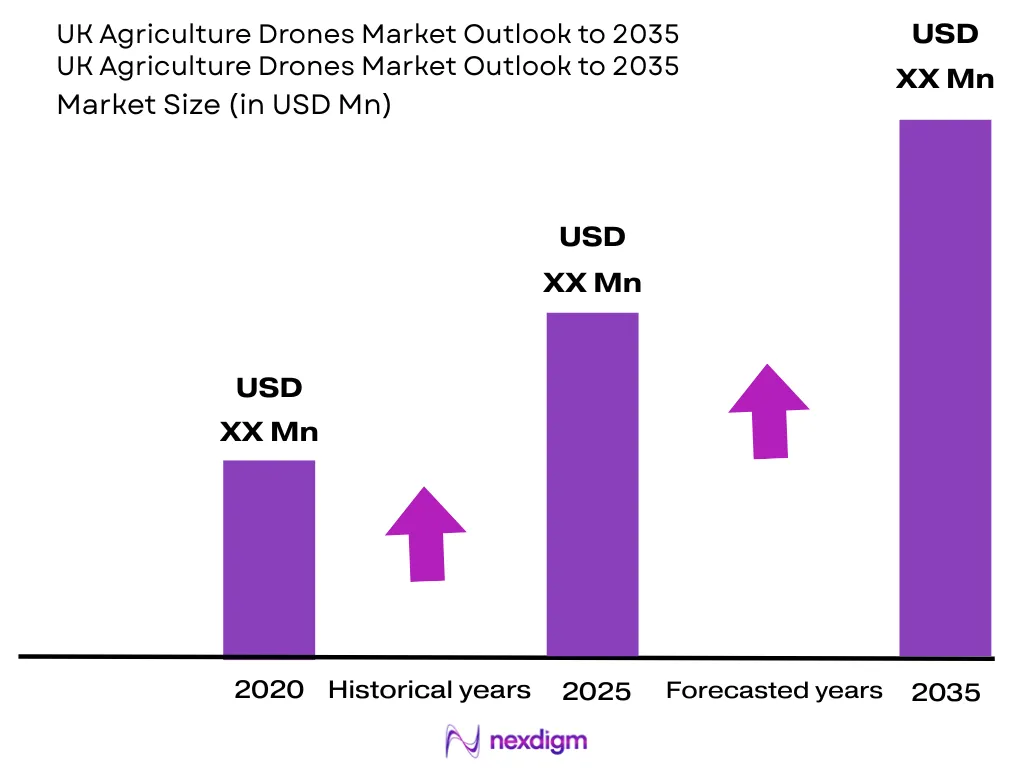
The UK Agriculture Drones Market is valued at approximately USD ~ Million in 2024, supported by the growing adoption of precision agriculture technologies across the country’s farming sector. According to the UK Department for Environment, Food & Rural Affairs (DEFRA), the United Kingdom manages more than 17 million hectares of agricultural land, while arable farming accounts for a substantial share of land utilization. The increasing need for crop monitoring, precision input application, yield optimization, and sustainable farming practices has accelerated demand for drone-based solutions. Additionally, government-supported agri-tech initiatives, rising adoption of digital farming tools, and labor constraints in agricultural operations continue to strengthen market growth.
Market Segmentation
By Drone Type
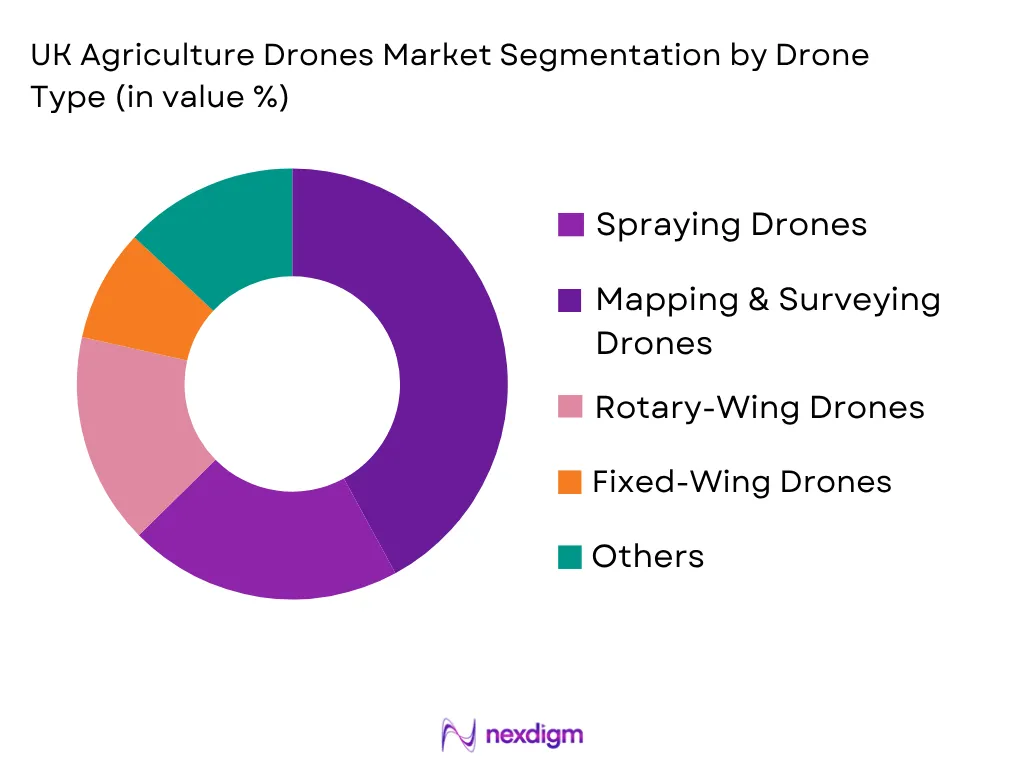
UK Agriculture Drones Market is segmented by drone type into Fixed-Wing Drones, Rotary-Wing Drones, Hybrid VTOL Drones, Spraying Drones, Mapping & Surveying Drones, and Autonomous Swarm Drones. Recently, Mapping & Surveying Drones have held the dominant market share under this segmentation. Their dominance is primarily attributed to the increasing emphasis on precision agriculture and field intelligence across UK farming operations. These drones enable rapid collection of high-resolution aerial imagery and geospatial data, supporting crop health assessments, drainage monitoring, field mapping, and variable-rate application planning. Farmers increasingly rely on mapping drones to improve operational efficiency while reducing unnecessary input use. The UK’s focus on sustainable agriculture and environmental stewardship programs further supports adoption, as detailed field-level data assists compliance with evolving land management requirements. Their relatively lower regulatory complexity compared to spraying drones also contributes to widespread utilization among commercial farmers and agricultural service providers.
By Application
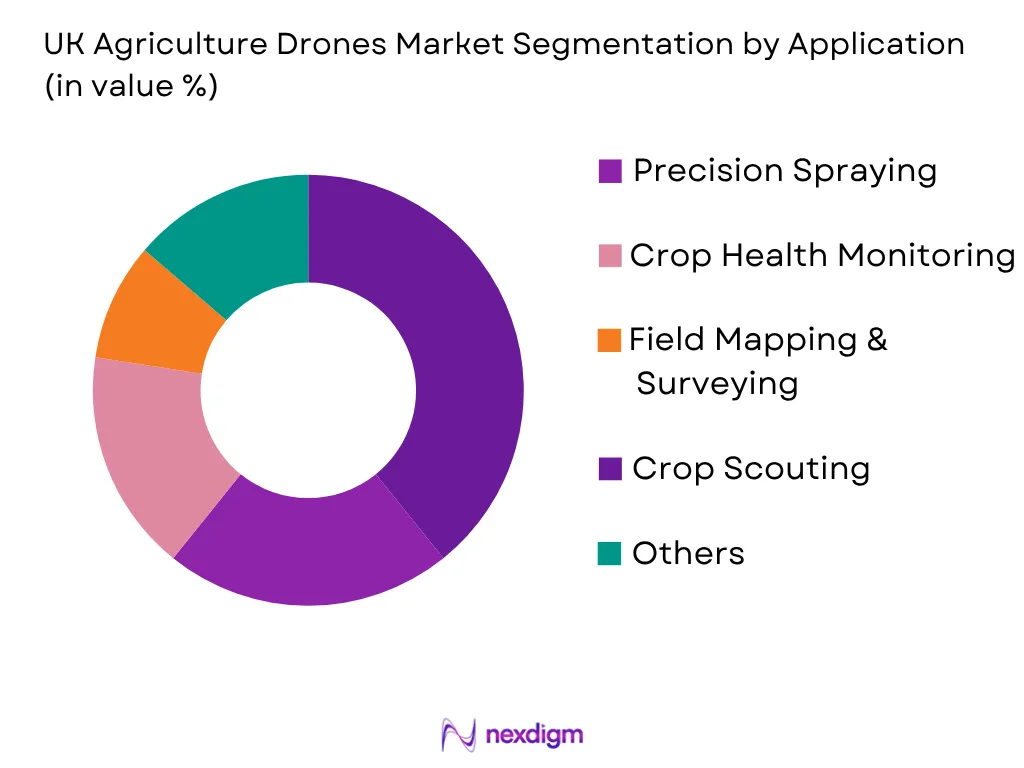
UK Agriculture Drones Market is segmented by application into Crop Health Monitoring, Precision Spraying, Field Mapping & Surveying, Crop Scouting, Livestock Monitoring, Yield Forecasting, Soil Assessment, Irrigation Monitoring, and Disease Detection. Recently, Crop Health Monitoring has emerged as the dominant segment. Farmers increasingly utilize drones equipped with multispectral and thermal imaging sensors to identify crop stress, nutrient deficiencies, pest infestations, and disease outbreaks before they become visible to the naked eye. The UK’s focus on maximizing productivity while reducing chemical inputs has encouraged widespread adoption of crop monitoring applications. Drone-generated insights support more precise agronomic decision-making and allow targeted intervention measures. Additionally, climate variability and increasing pressure on farm profitability have strengthened demand for technologies capable of improving crop performance and operational efficiency. As precision farming practices continue expanding, crop health monitoring remains the most widely adopted application within the UK Agriculture Drones Market.
Competitive Landscape
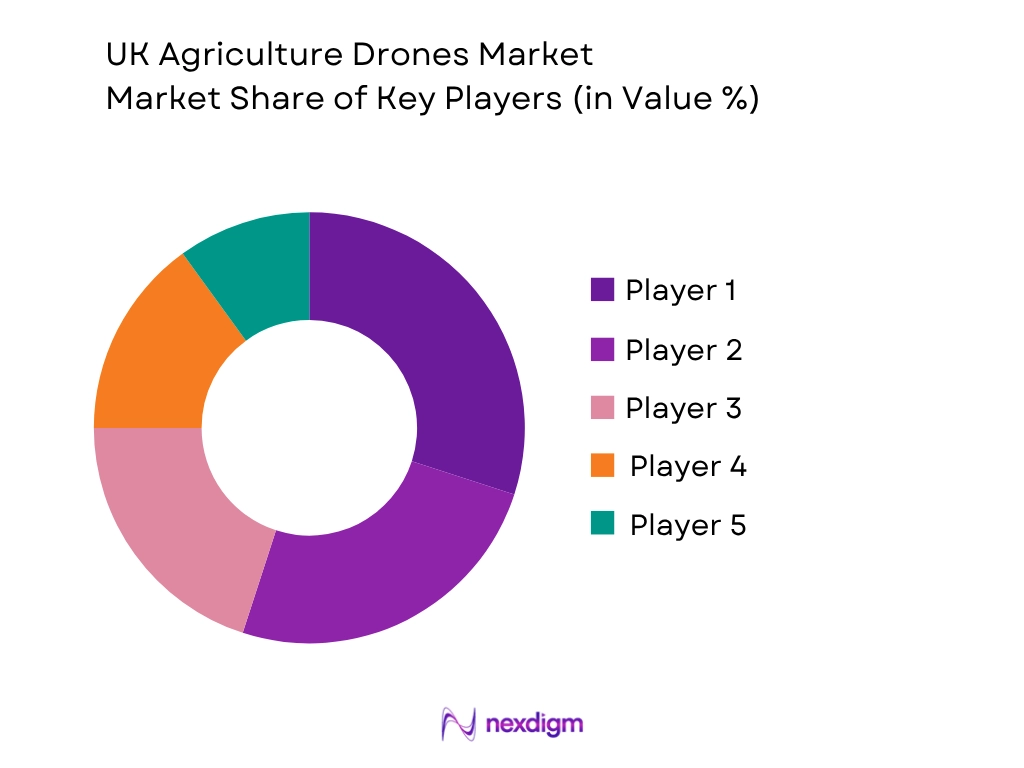
The UK Agriculture Drones Market is moderately fragmented, featuring a combination of international drone manufacturers, agricultural technology companies, software providers, and specialized precision farming firms. Market participants increasingly compete through technological innovation, AI-powered analytics, advanced imaging capabilities, autonomous flight systems, and integrated farm management solutions. Strategic partnerships with agricultural contractors, agribusinesses, and technology platforms continue shaping the competitive landscape.
| Company | Establishment Year | Headquarters | Agriculture Drone Portfolio | Max Payload Capacity | Precision Spraying Capability | AI Analytics Integration | UK Distribution Network | Precision Agriculture Solutions |
| DJI Agriculture | 2006 | ~ | ~ | ~ | ~ | ~ | ~ | ~ |
| Hummingbird Technologies | 2015 | ~ | ~ | ~ | ~ | ~ | ~ | ~ |
| Sentera | 2014 | ~ | ~ | ~ | ~ | ~ | ~ | ~ |
| AgEagle Aerial Systems | 2010 | ~ | ~ | ~ | ~ | ~ | ~ | ~ |
| DroneDeploy | 2013 | ~ | ~ | ~ | ~ | ~ | ~ | ~ |
UK Agriculture Drones Market Analysis
Growth Drivers
Precision Agriculture Adoption Across Arable Farming
The increasing adoption of precision agriculture technologies is one of the strongest growth drivers for the UK Agriculture Drones Market. According to the UK Department for Environment, Food & Rural Affairs (DEFRA), the United Kingdom maintains approximately 17.2 million hectares of agricultural land, of which more than 4.5 million hectares are utilized for cereal production. Wheat production exceeded 13 million tonnes, while barley production remained above 7 million tonnes, making efficient crop management increasingly important for farmers. The UK government continues to support agricultural modernization through Environmental Land Management Schemes and productivity-focused initiatives that encourage the adoption of digital farming technologies. Agriculture drones enable growers to monitor crop health, identify nutrient deficiencies, assess pest infestations, and optimize field operations across large agricultural areas. As farm businesses face increasing pressure to improve productivity while reducing environmental impacts, drone-generated field intelligence has become an essential component of precision agriculture programs. The ability of drones to deliver high-resolution imagery, multispectral analysis, and real-time agronomic insights supports improved decision-making and more efficient resource allocation. Consequently, the increasing integration of data-driven farming practices across the UK agricultural sector continues to accelerate demand for advanced agricultural drone solutions.
Rising Demand for Sustainable Farming and Resource Optimization
Sustainability requirements across UK agriculture are significantly contributing to the growth of the agriculture drones market. Agriculture remains one of the largest land-use sectors in the United Kingdom, accounting for approximately 70% of total land area according to DEFRA. The UK agricultural sector generated more than GBP 14 billion in total income from farming, while crop production contributes substantially to national food security objectives. Farmers increasingly face pressure to reduce fertilizer use, optimize pesticide application, improve water efficiency, and meet environmental compliance requirements. Agriculture drones equipped with multispectral and thermal sensors help producers identify specific areas requiring intervention, thereby reducing unnecessary chemical applications and supporting precision input management. In addition, environmental stewardship programs encourage the adoption of technologies capable of monitoring biodiversity, soil conditions, and crop performance. Drones provide accurate field-level intelligence that supports these objectives while minimizing operational inefficiencies. As sustainability becomes a core priority across farming operations, agricultural drones are increasingly viewed as tools that help balance productivity goals with environmental responsibility, creating strong long-term demand across both arable and mixed farming systems throughout the United Kingdom.
Market Challenges
Regulatory Restrictions and Airspace Compliance Requirements
Regulatory compliance remains a major challenge for the UK Agriculture Drones Market. The Civil Aviation Authority (CAA) oversees commercial drone operations across the United Kingdom and requires operators to comply with specific operational limitations, certification standards, and airspace regulations. Agriculture drones are increasingly deployed across more than 17 million hectares of agricultural land, yet many farming operations remain subject to restrictions regarding flight distances, altitude limitations, and operational permissions. Commercial drone operators often require additional approvals for specialized activities such as beyond visual line of sight operations, which can limit scalability across larger farming estates. Furthermore, agriculture drone deployments must coexist with broader aviation safety requirements covering airports, controlled airspace, and populated areas. Compliance requirements can increase administrative complexity for farmers and agricultural contractors seeking to integrate drone technologies into routine operations. While regulatory frameworks support safe drone deployment, evolving compliance obligations may slow adoption among smaller agricultural businesses with limited technical resources. As drone utilization expands across crop monitoring, surveying, and precision spraying applications, navigating regulatory requirements continues to represent a significant operational challenge for market participants.
Weather Dependency and Operational Limitations
Weather variability across the United Kingdom presents a substantial challenge for agricultural drone deployment. According to the UK Met Office, annual rainfall levels vary significantly across England, Scotland, Wales, and Northern Ireland, with many agricultural regions experiencing prolonged periods of rainfall, strong winds, and low-visibility conditions. Agriculture drones require favorable weather conditions to conduct accurate crop monitoring, field mapping, and spraying operations. The UK agricultural sector manages more than 17 million hectares of farmland, much of which is exposed to changing climatic conditions throughout the growing season. Excessive rainfall can delay drone missions, while strong winds may reduce flight stability and data collection accuracy. These limitations can affect operational planning, particularly during critical crop growth stages when timely monitoring is essential. In addition, weather-related disruptions can reduce the frequency of drone deployments and limit utilization rates for service providers. Although advances in drone design, navigation systems, and imaging technologies continue to improve operational resilience, weather dependency remains an unavoidable constraint that affects the consistency and efficiency of agricultural drone operations throughout the United Kingdom.
Market Opportunities
Expansion of Drone-as-a-Service Business Models
The expansion of Drone-as-a-Service (DaaS) models represents a major opportunity for the UK Agriculture Drones Market. The United Kingdom has approximately 209,000 agricultural holdings, according to DEFRA statistics, ranging from small family-owned farms to large commercial enterprises. Many agricultural businesses seek access to precision farming technologies without investing in equipment ownership, software subscriptions, pilot certification, and maintenance infrastructure. DaaS providers address these challenges by offering crop monitoring, mapping, surveying, and analytics services on a contract basis. The UK’s extensive agricultural landscape, including cereal production, horticulture, grassland management, and livestock operations, creates a broad customer base for service-oriented drone solutions. Additionally, many smaller farms lack the operational scale necessary to justify direct ownership of advanced drone platforms. Service-based models enable these businesses to access high-quality aerial intelligence while minimizing capital commitments. As precision agriculture adoption continues expanding and demand for actionable agronomic data increases, DaaS providers are positioned to play a central role in delivering scalable, cost-effective drone solutions throughout the UK farming sector.
Integration of Artificial Intelligence and Advanced Farm Analytics
The growing integration of artificial intelligence, machine learning, and advanced farm analytics presents significant opportunities for the UK Agriculture Drones Market. The UK agricultural sector manages more than 17 million hectares of farmland, generating vast amounts of operational data that can be leveraged to improve productivity and sustainability outcomes. Agriculture drones equipped with RGB, multispectral, thermal, and LiDAR sensors are increasingly used to collect highly detailed field information. Artificial intelligence platforms can analyze this data to identify crop stress, disease outbreaks, nutrient deficiencies, and irrigation issues with greater speed and accuracy than traditional methods. The UK government’s continued support for agricultural innovation and digital transformation further strengthens demand for data-driven decision-making tools. As farmers increasingly seek predictive insights rather than simple imagery, drone manufacturers and software providers have opportunities to develop integrated analytics ecosystems capable of delivering actionable recommendations. The convergence of drones, artificial intelligence, cloud computing, and precision agriculture platforms is transforming agricultural management practices and creating substantial opportunities for technology providers across the UK agriculture ecosystem.
Future Outlook
The UK Agriculture Drones Market is expected to witness strong growth over the coming decade driven by increasing digital transformation across farming operations. Greater adoption of precision agriculture technologies, growing environmental compliance requirements, and increasing demand for sustainable farming practices are anticipated to support market expansion. Advancements in AI-powered analytics, autonomous flight technologies, multispectral imaging, and drone-as-a-service business models are expected to create new opportunities for both technology providers and agricultural enterprises. Continued government support for agri-tech innovation and farm modernization initiatives is likely to further accelerate adoption across the sector.
Major Players
- DJI Agriculture
- XAG
- AgEagle Aerial Systems
- PrecisionHawk
- Sentera
- DroneDeploy
- Delair
- Quantum Systems
- Parrot
- Yamaha Motor
- Hummingbird Technologies
- Skysquirrel Technologies
- ABZ Innovation
- Guardian Agriculture
- Trimble Agriculture
Key Target Audience
- Agriculture Drone Manufacturers
- Precision Agriculture Technology Providers
- Agricultural Contractors
- Agribusiness Corporations
- Agricultural Cooperatives
- Crop Protection & Agrochemical Companies
- Investments and Venture Capitalist Firms
- Government and Regulatory Bodies (DEFRA, Civil Aviation Authority, Environment Agency)
Research Methodology
Step 1: Identification of Key Variables
The initial phase involves constructing an ecosystem map encompassing all major stakeholders within the UK Agriculture Drones Market. Extensive desk research is conducted using government publications, agricultural databases, company reports, aviation regulatory frameworks, and agri-tech resources. The objective is to identify critical market variables influencing adoption, investment, regulation, and technological development.
Step 2: Market Analysis and Construction
In this phase, historical market information related to drone deployments, precision agriculture adoption, software utilization, and agricultural technology spending is analyzed. Demand-side and supply-side assessments are performed to estimate market performance across key segments including drone type, application, end user, and region.
Step 3: Hypothesis Validation and Expert Consultation
Market assumptions are validated through computer-assisted telephone interviews (CATIs) and consultations with drone manufacturers, precision agriculture specialists, agricultural contractors, technology providers, and regulatory experts. These interactions provide valuable operational insights and support refinement of market estimates.
Step 4: Research Synthesis and Final Output
The final stage involves consolidating primary and secondary research findings into a comprehensive market framework. Data triangulation techniques are applied to validate market sizing, segmentation, competitive positioning, and future forecasts. The outcome is a robust and decision-oriented assessment of the UK Agriculture Drones Market.

- Executive Summary
- Research Methodology (Market Definitions and Assumptions, Abbreviations, Market Sizing Approach, Top-Down Analysis, Bottom-Up Analysis, Demand-Side Assessment, Supply-Side Assessment, Precision Agriculture Adoption Assessment, Farm Digitization Analysis, Primary Industry Interviews, Data Triangulation, Forecasting Framework, Limitations and Future Conclusions)

- Definition and Scope
- Market Evolution and Industry Genesis
- Timeline of Major Industry Developments
- Precision Agriculture Value Chain Analysis
- Agriculture Drone Supply Chain Analysis

- Growth Drivers (Precision Farming Adoption, Sustainable Agriculture Initiatives, Farm Labor Constraints, Input Optimization Requirements, Agri-Tech Investments)
- Market Challenges (CAA Regulatory Compliance, Weather Dependency, High Equipment Investment, Limited Rural Connectivity, Data Processing Complexity)
- Market Opportunities (Drone-as-a-Service Expansion, Carbon Farming Monitoring, AI-Powered Crop Analytics, Smart Farming Integration, Environmental Compliance Solutions)
- Market Trends (Multispectral Imaging Adoption, Autonomous Flight Systems, Variable Rate Application Technologies, Digital Farm Mapping, Real-Time Agronomic Intelligence)
- Government Regulations (CAA Drone Regulations, UK Drone Code Compliance, Environmental Land Management Schemes, DEFRA Precision Farming Initiatives, Pesticide Application Regulations)
- SWOT Analysis
- Porter’s Five Forces Analysis
- PESTLE Analysis
- Competitive Ecosystem

- By Market Value (2020-2025)
- By Volume (2020-2025)
- By Average Selling Price (2020-2025)

- By Drone Type (In Value %)
Fixed-Wing Drones
Rotary-Wing Drones
Hybrid VTOL Drones
Spraying Drones
Mapping & Surveying Drones
Autonomous Swarm Drones - By Application (In Value %)
Crop Health Monitoring
Precision Spraying
Field Mapping & Surveying
Crop Scouting
Soil Health Assessment
Irrigation & Drainage Monitoring
Livestock Monitoring
Yield Forecasting
Disease & Pest Detection
Planting & Seeding Operations - By Crop Type (In Value %)
Cereals (Wheat, Barley, Oats)
Oilseeds (Rapeseed)
Potatoes
Sugar Beet
Fruits & Orchards
Vegetables
Vineyards
Grassland & Forage Crops
Horticultural Crops
Mixed Farming Operations - By Region (In Value %)
England
Scotland
Wales
Northern Ireland - By End User (In Value %)
Arable Farmers
Livestock Farmers
Agricultural Contractors
Agricultural Cooperatives
Precision Agriculture Service Providers
Government & Environmental Agencies
Agricultural Research Organizations

- Market Share of Major Players (By Value, Drone Units, Installed Base, Hectares Covered, Application Segment)
- Cross Comparison Parameters (Agriculture Drone Portfolio Breadth, Precision Spraying Capability, Sensor & Imaging Technology Strength, Hectares Covered per Flight, AI & Data Analytics Integration, Farm Management Software Compatibility, Dealer & Service Network Reach, Drone-as-a-Service Capability)
- SWOT Analysis of Major Players
- Pricing Analysis by Payload Category, Flight Endurance and Sensor Configuration
- Detailed Profiles of Major Companies
DJI Agriculture
XAG
AgEagle Aerial Systems
PrecisionHawk
Sentera
DroneDeploy
Delair
Quantum Systems
Parrot
Yamaha Motor
Hummingbird Technologies
Skysquirrel Technologies
ABZ Innovation
Guardian Agriculture
Trimble Agriculture

- Market Demand and Utilization Analysis (Flights per Season, Hectares Covered per Mission, Application Frequency, Data Collection Intensity)
- Farm Digitization Assessment (Precision Farming Adoption, Farm Management Software Usage, Connectivity Readiness)
- Purchasing Power and Budget Allocation Analysis (Capital Expenditure, Technology Investments, Farm Modernization Spending)
- Regulatory Compliance Assessment (CAA Requirements, Environmental Compliance, Agricultural Application Standards)
- Needs, Desires and Pain Point Analysis (Yield Optimization, Input Cost Reduction, Labor Efficiency, Sustainability Targets)

- By Market Value (2026-2035)
- By Volume (2026-2035)
- By Average Selling Price (2026-2035)


 Request a Sample
 Ask for Customization
 Get a Quote
 Enquire Now