

 Download PDF
 Download PDF
Market Overview
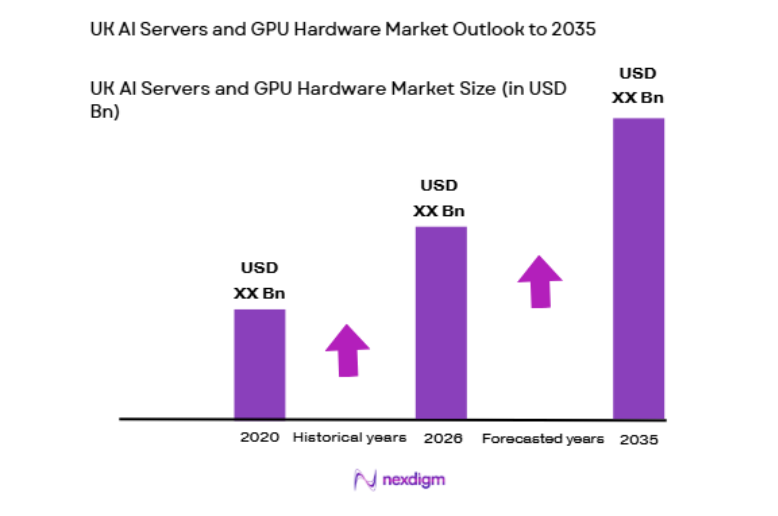
The UK AI servers and GPU hardware market reached approximately USD ~ billion based on recent industry assessments, driven by hyperscale cloud expansion, enterprise AI adoption, and sovereign compute investments. Demand growth is anchored in large-scale model training, generative AI deployment, and accelerated data center buildouts. Procurement is increasingly concentrated around high-density GPU servers, liquid-cooled racks, and AI-optimized networking stacks. Public and private funding programs targeting national AI infrastructure further reinforce hardware demand across domestic data center ecosystems.
London and the Southeast dominate deployment due to dense hyperscale campuses, financial sector AI demand, and proximity to major cloud availability zones. Cambridge and Oxford clusters contribute through research-driven HPC and AI compute investments. Manchester and other northern regions are expanding colocation and edge AI facilities supported by regional digital infrastructure initiatives. These locations benefit from power availability planning, fiber connectivity, skilled engineering ecosystems, and policy incentives encouraging sovereign data processing and domestic compute capacity development.
Market Segmentation
By Product Type
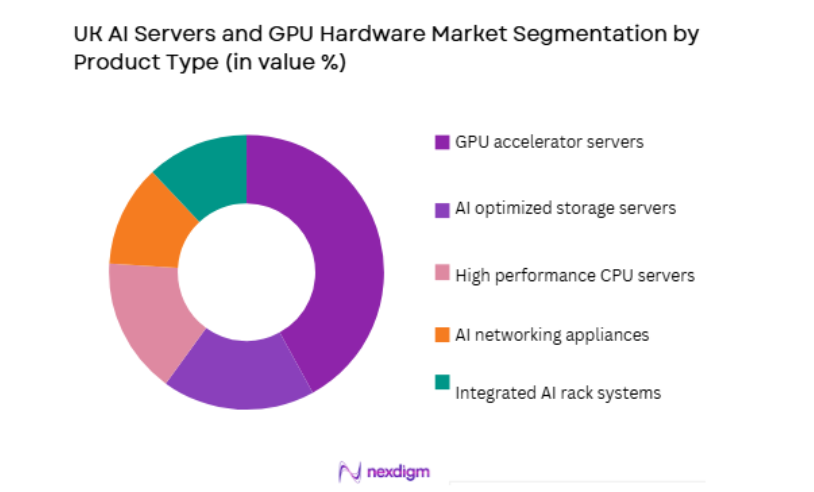
UK AI Servers and GPU Hardware market is segmented by product type into GPU accelerator servers, AI optimized storage servers, high performance CPU servers, AI networking appliances, and integrated AI rack systems. Recently, GPU accelerator servers has a dominant market share due to factors such as demand patterns, brand presence, infrastructure availability, or consumer preference.
By End User
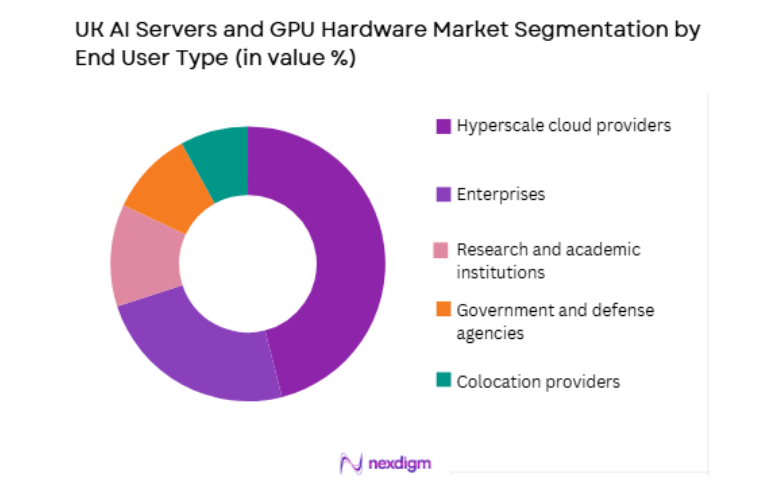
UK AI Servers and GPU Hardware market is segmented by end user into hyperscale cloud providers, enterprises, research and academic institutions, government and defense agencies, and colocation providers. Recently, hyperscale cloud providers has a dominant market share due to factors such as demand patterns, brand presence, infrastructure availability, or consumer preference.
Competitive Landscape
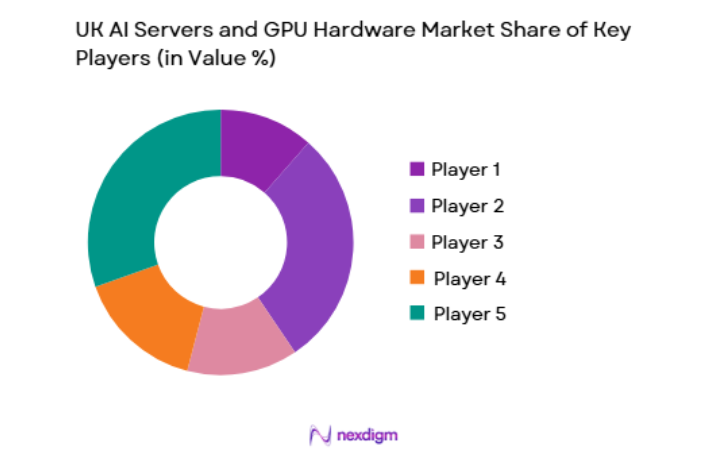
The UK AI servers and GPU hardware market exhibits moderate consolidation, with global semiconductor and server vendors controlling accelerator supply while cloud providers influence architecture standards and procurement scale. Competition centers on GPU density, energy efficiency, and AI-optimized system integration. Strategic partnerships between chip manufacturers, server OEMs, and cloud operators shape technology roadmaps and deployment cycles.
| Company Name | Establishment Year | Headquarters | Technology Focus | Market Reach | Key Products | Revenue | UK AI Deployment Presence |
| NVIDIA | 1993 | USA | ~ | ~ | ~ | ~ | ~ |
| Dell Technologies | 1984 | USA | ~ | ~ | ~ | ~ | ~ |
| Hewlett Packard Enterprise | 2015 | USA | ~ | ~ | ~ | ~ | ~ |
| Supermicro | 1993 | USA | ~ | ~ | ~ | ~ | ~ |
| Lenovo | 1984 | China | ~ | ~ | ~ | ~ | ~ |
UK AI Servers and GPU Hardware Market Analysis
Growth Drivers
Hyperscale AI Cloud and Sovereign Compute Expansion
Accelerated procurement of GPU clusters by hyperscale cloud providers and sovereign compute initiatives is scaling domestic server deployments across national data center regions. Government backed AI supercomputing programs and public sector frameworks are prioritizing onshore hardware capacity, stimulating local supply chains and anchoring long term demand for advanced accelerators across multiple industries nationwide. Major cloud regions operated by global providers are expanding UK availability zones, necessitating dense GPU server racks, high bandwidth networking, and energy efficient cooling architectures within modern colocation facilities nationwide. Enterprise migration from pilot AI workloads toward production inference and training environments is increasing order volumes for standardized accelerator servers, storage optimized nodes, and integrated orchestration ready hardware platforms across. Strategic partnerships between cloud operators, semiconductor vendors, and UK data center developers are compressing deployment timelines, enabling faster capacity additions and reinforcing localized procurement of AI optimized server infrastructure nationwide. Power availability agreements and renewable integration strategies are allowing hyperscale campuses to sustain energy intensive GPU clusters, addressing sustainability requirements while supporting scale economics for domestic AI hardware deployment growth.
Enterprise Generative AI and Data Center Modernization
Rapid enterprise adoption of generative AI applications across finance, healthcare, and retail sectors is accelerating replacement of legacy servers with GPU accelerated AI optimized infrastructure platforms. Organizations are redesigning data center architectures around heterogeneous compute, integrating GPUs, high speed fabrics, and parallel storage to support training and inference workloads efficiently. Rising data volumes from analytics, automation, and customer interaction systems are necessitating scalable AI hardware capable of sustained throughput and low latency processing. AI adoption strategies increasingly require dedicated on premises GPU clusters for sensitive data environments, expanding enterprise procurement beyond cloud consumption toward hybrid deployment models. Software ecosystem maturity around AI frameworks, orchestration platforms, and containerized workloads is reducing integration complexity and encouraging standardized AI server adoption across industries. Hardware refresh cycles are shortening as enterprises seek compatibility with latest accelerators, interconnects, and memory architectures to maintain competitive AI performance benchmarks.
Market Challenges
Power and Cooling Constraints in High Density AI Data Centers
Escalating power density of GPU clusters is exceeding traditional data center design thresholds, requiring substantial electrical upgrades and advanced cooling technologies that increase deployment complexity and cost. Limited grid capacity near major data center hubs is constraining expansion of hyperscale AI campuses, delaying hardware installations and elongating infrastructure planning timelines. Retrofitting existing facilities to support liquid cooling and high rack densities involves structural modifications, operational disruption, and significant capital expenditure commitments. Energy price volatility is elevating operating costs for GPU intensive workloads, reducing economic attractiveness of on premises AI infrastructure investments for some enterprises. Environmental regulations governing energy consumption and heat dissipation are imposing compliance burdens on new AI data center developments across regions. Skilled engineering shortages in thermal management and power distribution are slowing implementation of advanced cooling architectures required for next generation AI hardware deployments.
GPU Supply Concentration and Semiconductor Dependency Risks
Global concentration of advanced GPU manufacturing capacity among limited semiconductor vendors is creating supply bottlenecks affecting availability of AI servers for UK deployments. Export controls and geopolitical tensions influencing semiconductor trade are introducing uncertainty in procurement timelines and long term hardware access planning. Dependence on overseas fabrication and packaging facilities exposes UK AI infrastructure expansion to international logistics disruptions and lead time variability. Rapid technology cycles in accelerator design are increasing obsolescence risk for purchased hardware, complicating enterprise investment decisions and capacity planning strategies. Price volatility driven by constrained supply and surging global demand is inflating capital costs of AI server deployments across hyperscale and enterprise segments. Vendor allocation policies prioritizing largest global customers can disadvantage regional buyers, limiting equitable access to latest generation GPUs for domestic projects.
Opportunities
Sovereign AI Infrastructure and National Compute Initiatives
National strategies emphasizing data sovereignty and domestic AI capability are creating funding programs and procurement mandates supporting local AI server and GPU hardware deployments. Public sector demand for secure compute environments handling sensitive government, healthcare, and defense data is expanding requirements for domestically hosted AI infrastructure platforms. Collaborative national supercomputing projects integrating academia, industry, and government stakeholders are catalyzing large scale procurement of advanced GPU clusters. Policy incentives for local data processing are encouraging enterprises to repatriate workloads from overseas clouds into UK based AI data centers. Domestic manufacturing and assembly initiatives targeting AI hardware components are emerging to reduce reliance on global supply chains. Regional development programs are funding AI infrastructure in nontraditional data center locations, broadening geographic distribution of deployments. Sovereign cloud frameworks are mandating compliant hardware environments, increasing demand for certified AI servers tailored to national regulatory standards.
Edge AI and Industry Specific Accelerated Computing Adoption
Industrial digitalization and real time analytics requirements are expanding deployment of GPU accelerated servers at edge locations across manufacturing, transportation, and energy sectors. Latency sensitive applications including autonomous systems, predictive maintenance, and computer vision are driving localized AI compute installations outside centralized data centers. Telecom operators deploying 5G and edge platforms are integrating GPU servers into distributed infrastructure to support AI enabled network optimization and services. Smart city and public infrastructure projects are requiring on site AI processing hardware for surveillance, traffic management, and environmental monitoring applications. Healthcare imaging, diagnostics, and genomics workloads are adopting GPU servers within hospital and research facilities for data privacy and performance reasons. Retail and logistics automation initiatives are deploying AI inference servers at warehouses and distribution centers for operational optimization. Energy and utilities sectors are implementing AI driven monitoring systems at remote sites requiring ruggedized GPU hardware deployments.
Future Outlook
The UK AI servers and GPU hardware market is expected to expand steadily over the next five years driven by hyperscale expansion, enterprise AI adoption, and sovereign compute programs. Continued GPU innovation, liquid cooling advances, and energy efficiency improvements will shape infrastructure evolution. Regulatory emphasis on data sovereignty and sustainability will influence deployment patterns. Demand will diversify into edge AI and industry-specific compute environments beyond centralized data centers.
Major Players
- NVIDIA
- Dell Technologies
- Hewlett Packard Enterprise
- Lenovo
- Supermicro
- AMD
- Intel
- Atos
- Fujitsu
- Cisco
- Inspur
- Gigabyte Technology
- Penguin Solutions
- Quanta Cloud Technology
- Eviden
Key Target Audience
- Hyperscale cloud providers
- Enterprise IT infrastructure buyers
- Semiconductor and hardware manufacturers
- Data center operators
- Telecom operators
- Government and regulatory bodies
- Investments and venture capitalist firms
- Defense and security agencies
Research Methodology
Step 1: Identification of Key Variables
Key demand drivers, deployment patterns, hardware configurations, and end-user procurement behaviors were identified through secondary research and technology trend analysis. Market boundaries and segmentation frameworks were defined using infrastructure architecture and AI workload classifications.
Step 2: Market Analysis and Construction
Market sizing was constructed using vendor revenue mapping, deployment capacity indicators, and data center infrastructure metrics. Bottom-up modeling aggregated hardware categories and end-user spending across UK regions to estimate total market value.
Step 3: Hypothesis Validation and Expert Consultation
Industry experts across cloud, semiconductor, and data center domains validated assumptions on demand drivers, technology adoption, and deployment constraints. Cross-verification ensured consistency between supply chain indicators and procurement trends.
Step 4: Research Synthesis and Final Output
All quantitative and qualitative insights were synthesized into structured market forecasts and competitive analysis. Final outputs were aligned with technological, regulatory, and demand-side developments shaping UK AI infrastructure evolution.

- Executive Summary
- Research Methodology (Definitions, Scope, Industry Assumptions, Market Sizing Approach, Primary & Secondary Research Framework, Data Collection & Verification Protocol, Analytic Models & Forecast Methodology, Limitations & Research Validity Checks)

- Market Definition and Scope
- Value Chain & Stakeholder Ecosystem
- Regulatory / Certification Landscape
- Sector Dynamics Affecting Demand

- Growth Drivers
Expansion of sovereign and enterprise AI compute capacity in the UK
Rapid adoption of generative AI workloads across financial and healthcare sectors
Government backed HPC and AI research infrastructure investments - Market Challenges
High energy consumption and cooling constraints in dense GPU deployments
Supply chain dependence on advanced semiconductor fabrication outside the UK
Integration complexity across heterogeneous AI hardware and software stacks - Market Opportunities
Development of liquid cooled and energy efficient AI server architectures
Growth of edge AI infrastructure supporting real time analytics and autonomy
Expansion of AI infrastructure services through UK colocation and hosting ecosystems - Trends
Shift toward rack scale GPU clusters with high bandwidth interconnects
Rising demand for AI inference optimized servers alongside training systems
Adoption of composable and disaggregated AI infrastructure designs - Government regulations
UK AI regulation and data governance frameworks affecting AI compute deployment
Energy efficiency and carbon reporting standards for data centers and HPC sites
Public funding programs supporting national AI and supercomputing capacity - SWOT analysis
- Porters Five forces

- By Market Value, 2020-2025
- By Installed Units, 2020-2025
- By Average System Price, 2020-2025
- By System Complexity Tier, 2020-2025

- By System Type (In Value%)
GPU Accelerated AI Servers
AI Training Supercomputers
AI Inference Edge Servers
Hybrid CPU GPU AI Servers
High Density Rack Scale AI Systems - By Platform Type (In Value%)
Hyperscale Cloud Data Centers
Enterprise Private AI Infrastructure
Colocation AI Ready Facilities
Telecom Edge AI Sites
Government and Research HPC Platforms - By Fitment Type (In Value%)
Rack Integrated Systems
Blade AI Server Modules
Preconfigured AI Appliances
Custom AI Cluster Deployments
Edge Hardened AI Units - By End User Segment (In Value%)
Cloud Service Providers
Financial and Fintech Firms
Healthcare and Life Sciences Organizations

- Market Share Analysis
- Cross Comparison Parameters (Compute Density, GPU Architecture, Cooling Technology, Interconnect Bandwidth, Deployment Model, Power Efficiency, Memory Bandwidth, Scalability Architecture, Software Stack Compatibility, Form Factor Design)
- SWOT Analysis of Key Competitors
- Pricing & Procurement Analysis
- Key Players
NVIDIA
Advanced Micro Devices
Intel
Dell Technologies
Hewlett Packard Enterprise
Lenovo
Supermicro
Cisco Systems
Fujitsu
Atos
Graphcore
IBM
Inspur
Gigabyte Technology
Quanta Computer

- Cloud providers scaling GPU clusters to support generative AI services
- Financial institutions deploying private AI servers for risk and fraud analytics
- Healthcare organizations adopting AI compute for imaging and genomics
- Universities expanding HPC AI systems for research and innovation

- Forecast Market Value, 2026-2035
- Forecast Installed Units, 2026-2035
- Price Forecast by System Tier, 2026-2035
- Future Demand by Platform, 2026-2035


 Request a Sample
 Ask for Customization
 Get a Quote
 Enquire Now