

 Download PDF
Market Overview
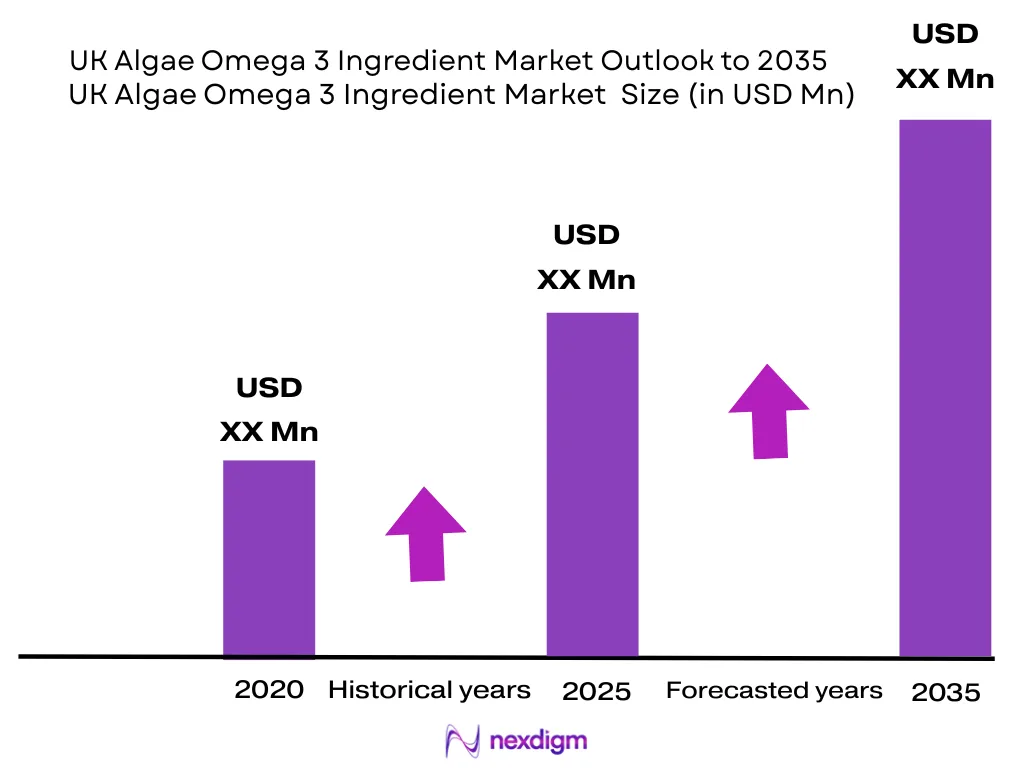
The UK Algae Omega-3 Ingredient Market is valued at USD ~ million, with the next annual market value disclosed at USD ~ million and long-term growth projected at 7.2% CAGR. The base-year value is normalised from Future Market Insights’ UK algae omega market disclosure, while demand is driven by vegan DHA/EPA supplements, infant nutrition fortification, functional food innovation, and fish-oil substitution. The wider global EPA/DHA ingredient market reached USD 2.38 billion and 131,183 metric tons, supporting supplier interest in algae-derived alternatives. England dominates UK ingredient demand because it concentrates supplement brands, contract manufacturers, retail head offices, e-commerce wellness channels, and food innovation clusters around London, Cambridge, Oxford, Birmingham, and Manchester. Scotland is strategically important because Atlantic salmon production reached 192,000 tonnes, up by 41,051 tonnes from the previous production base, creating aquafeed relevance for algae-derived EPA/DHA. Regulatory acceptance also supports commercialisation, as Schizochytrium sp. oil rich in DHA and EPA is authorised as a UK novel food.
Market Segmentation
By Ingredient Type
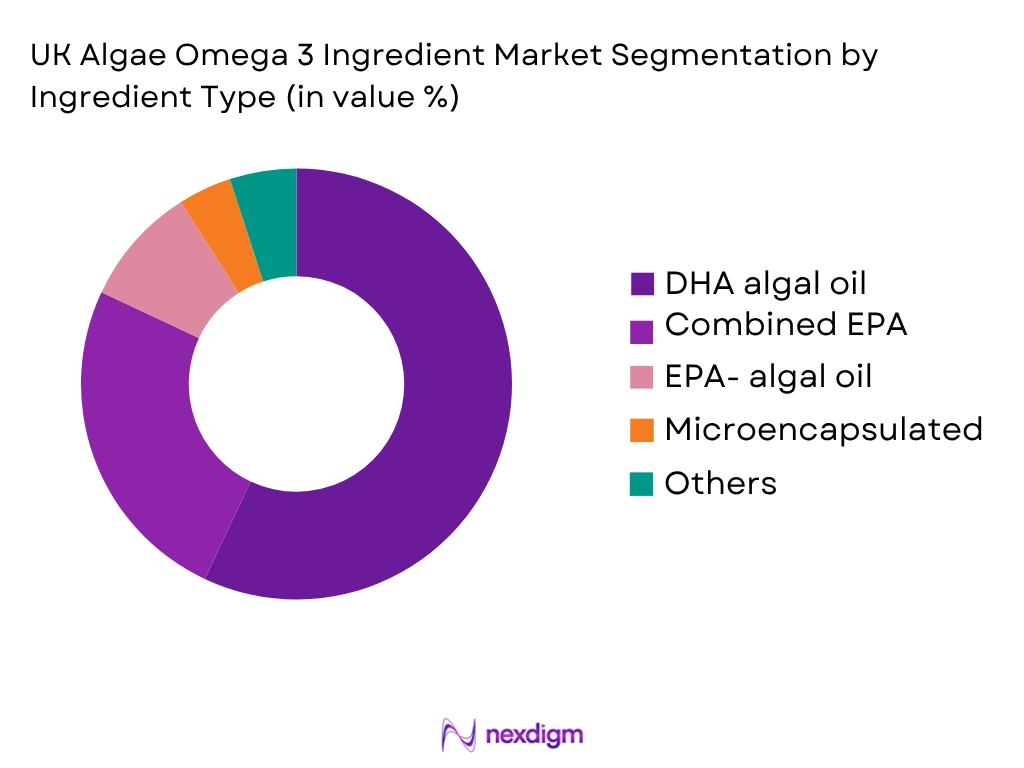
The UK Algae Omega-3 Ingredient Market is segmented by ingredient type into DHA-dominant algal oil, EPA-dominant algal oil, combined EPA+DHA algal oil, microencapsulated powder, and algal biomass. DHA-dominant algal oil holds the leading share because it has the broadest validated application base across infant nutrition, pregnancy supplements, children’s DHA drops, cognition supplements, and eye-health products. Its dominance is supported by regulatory relevance in infant formula, where DHA is a required ingredient under retained European compositional rules. DHA-rich Schizochytrium oil also has clearer commercial acceptance than newer EPA-dominant algae inputs, making it easier for UK formulators to qualify suppliers, obtain technical dossiers, manage stability, and launch vegan-positioned products.
By Application
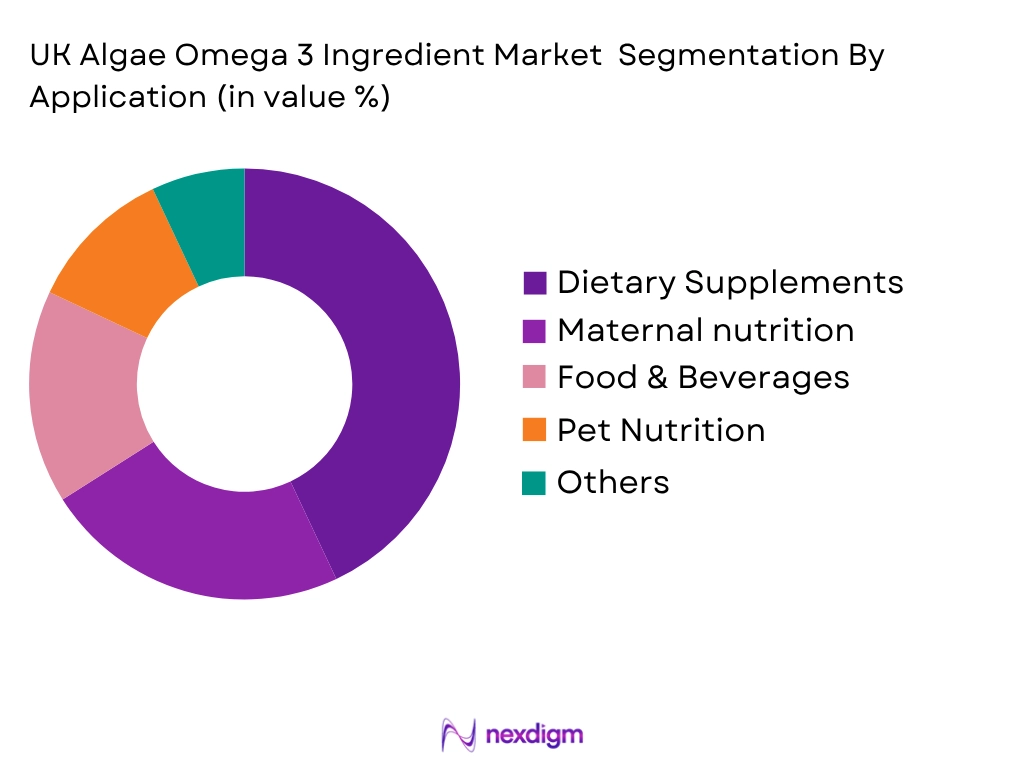
The UK Algae Omega-3 Ingredient Market is segmented by application into dietary supplements, infant and maternal nutrition, functional foods and beverages, pet nutrition, aquafeed and animal nutrition, and clinical nutrition. Dietary supplements dominate because algae-derived omega-3 is easiest to commercialise in softgels, vegan capsules, liquid drops, gummies, and prenatal formulations, where brands can communicate “fish-free,” “vegan,” “sustainable,” and “DHA/EPA” claims directly to consumers. The UK dietary supplements market was estimated at USD 4.79 billion, creating a large downstream demand base for specialist lipid ingredients. Supplements also allow higher price recovery than mass food fortification, reducing the impact of algal oil’s price premium over fish oil.
Competitive Landscape
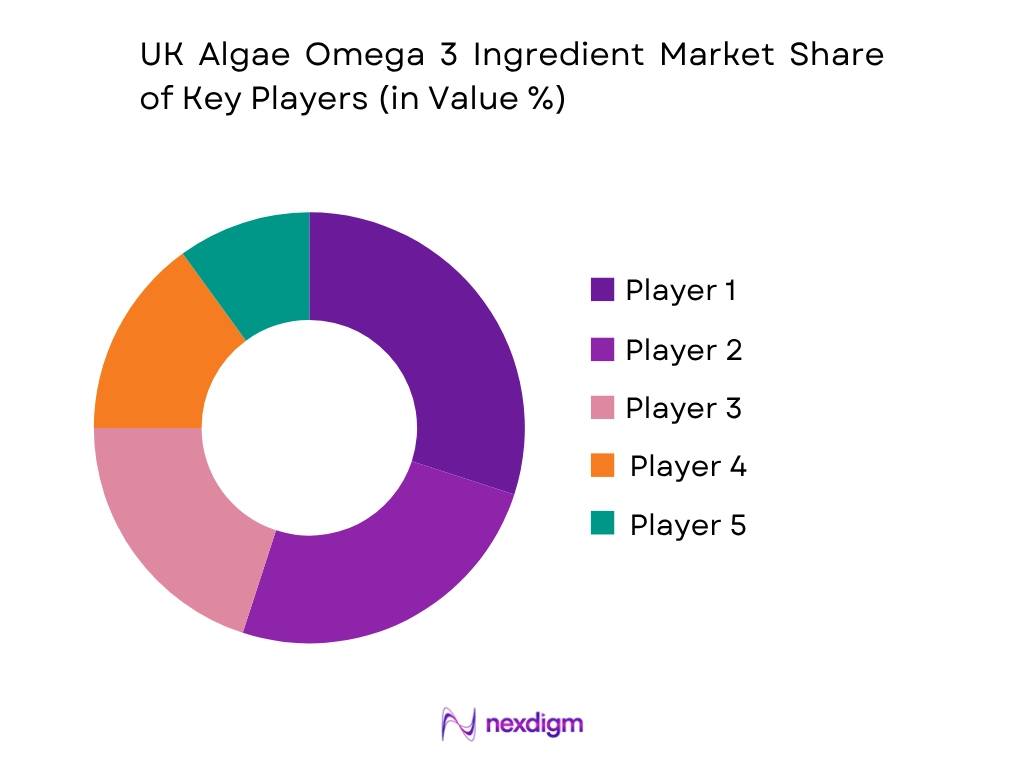
The UK Algae Omega-3 Ingredient Market is moderately consolidated at the upstream level, with global biotechnology and nutrition ingredient companies controlling high-quality DHA/EPA oils, while UK-based algae innovators and distributors support local access. dsm-firmenich, Corbion, Veramaris, Mara Renewables, and AlgaeCytes are among the most relevant companies because they cover human nutrition, aquafeed, EPA/DHA ratios, fermentation, photobioreactor cultivation, and UK/EU regulatory documentation. dsm-firmenich positions life’sOMEGA as a plant-based EPA+DHA source, while Veramaris supplies algae-derived EPA/DHA for feed applications.
| Company | Establishment Year | Headquarters | Main UK-Relevant Ingredient | Technology Base | Core Application | EPA/DHA Capability | Certifications / Quality Position | UK Market Relevance |
| dsm-firmenich | 2023 | Kaiseraugst, Switzerland / Maastricht, Netherlands | ~ | ~ | ~ | ~ | ~ | ~ |
| Corbion | 1919 | Amsterdam, Netherlands | ~ | ~ | ~ | ~ | ~ | ~ |
| Veramaris | 2018 | Delft, Netherlands | ~ | ~ | ~ | ~ | ~ | ~ |
| Mara Renewables | 2012 | Halifax, Canada | ~ | ~ | ~ | ~ | ~ | ~ |
| AlgaeCytes | 2008 | Kent, UK | ~ | ~ | ~ | ~ | ~ | ~ |
UK Algae Omega-3 Ingredient Market Analysis
Growth Drivers
Regulatory-Enabled Use of Algal DHA/EPA in Supplements, Maternal Nutrition and Young-Child Nutrition
The UK Algae Omega-3 Ingredient Market is supported by clear authorised-use pathways for Schizochytrium-derived DHA/EPA oil. Food Standards Agency and Food Standards Scotland state that the ingredient is manufactured through self-contained fermentation and is authorised as a novel food in the UK. The authorised combined DHA/EPA use level reaches 3,000 mg/day for adult food supplements, 450 mg/day for pregnant and lactating women, 250 mg/meal for meal replacements, and 200 mg/100 g for milk-based drinks for young children. This supports supplement, prenatal and paediatric formulation demand across a UK consumer base of 69,226,000 people and GDP per capita of USD 53,246.4.
Scottish Aquaculture Creates Feed-Grade Omega-3 Demand for Algal EPA/DHA
The UK Algae Omega-3 Ingredient Market benefits from Scotland’s salmon and trout farming base, where algal EPA/DHA can be used as a sustainable fish-oil alternative in aquafeed. The Scottish Government reported Atlantic salmon production of 192,000 tonnes and an increase of 41,051 tonnes over the previous production base, while total smolt production stood at 44.6 million. Rainbow trout production was 8,171 tonnes, giving algae omega-3 suppliers a direct feed-grade application beyond human nutrition. The opportunity is supported by the UK’s macroeconomic base, including World Bank-reported GDP of USD 3.69 trillion, which underpins advanced food, feed and biotechnology supply chains.
Market Challenges
Strict Novel Food Specification and Oxidation-Control Requirements Increase Supplier Qualification Barriers
The UK Algae Omega-3 Ingredient Market faces a technical compliance challenge because suppliers must meet exact novel-food specifications, not just provide generic omega-3 oil. The FSA/FSS assessment lists minimum DHA at 150 mg/g, minimum EPA at 100 mg/g, peroxide value at not more than 5.0 meq/kg, acid value at not more than 0.5 mg KOH/g, moisture and volatiles at not more than 0.05, unsaponifiable matter at not more than 4.5, and trans fatty acids at not more than 1. These quality limits create barriers for new entrants, especially when supplying a country with 69,226,000 consumers and regulated infant, supplement and food applications.
Infant Nutrition Opportunity Is Constrained by a Smaller Birth Base in the Core Formulation Segment
The UK Algae Omega-3 Ingredient Market has strong relevance in infant and maternal nutrition, but the addressable infant-formula base is constrained by birth-volume trends. The Office for National Statistics reported 594,677 live births in England and Wales, followed by 585,396 live births in the next reported year. This matters because DHA fortification in infant and follow-on formula is one of the most technically suitable uses for algal oil, but fewer births reduce the number of new infant-nutrition consumers entering the category. At the macro level, the UK still has high income capacity, with World Bank GDP per capita of USD 53,246.4, but volume growth in infant-focused formulations remains demographically limited.
Market Opportunities
Expansion into Meat and Fish Analogue Applications Opens a New B2B Formulation Route
The UK Algae Omega-3 Ingredient Market has a future opportunity in fortified meat analogues and fish analogues. FSA/FSS recorded a GB extension-of-use application for Schizochytrium sp. oil rich in DHA and EPA covering 2 additional food categories: meat analogues and fish analogues. The same assessment confirms that the ingredient remains produced through controlled fermentation and retains DHA/EPA identity, supporting clean-label fortification in plant-based and seafood-alternative products. The commercial base is supported by a UK economy of USD 3.69 trillion and a population of 69,226,000, giving ingredient suppliers a large consumer-facing food market without relying only on capsules and softgels.
Formulation-Ready Algal Omega-3 Can Move Beyond Supplements into Sports, Weight Management and Young-Child Foods
The UK Algae Omega-3 Ingredient Market has an opportunity to expand through formulation-ready oils, emulsions and powders in non-capsule applications. FSA/FSS authorised-use categories include foods for intense muscular effort, total diet replacement products, meal replacements, processed cereal-based foods, baby foods, and milk-based drinks for young children. Permitted use levels include 250 mg/meal for meal-replacement applications and 200 mg/100 g for milk-based drinks intended for young children. This supports B2B product development in functional nutrition, sports nutrition and paediatric foods. The macro backdrop is favourable because the UK has 69,226,000 consumers and GDP per capita of USD 53,246.4, supporting premium fortified nutrition formats.
Future Outlook
The UK Algae Omega-3 Ingredient Market is expected to expand steadily through the outlook period, with a forecast CAGR of 7.2% based on disclosed UK algae omega market projections. Growth will be supported by plant-based nutrition, cleaner omega-3 sourcing, infant and maternal DHA demand, and premium supplement formats. Functional food and pet nutrition will become more meaningful as encapsulation improves oxidation control and taste masking. Aquafeed adoption will depend on price competitiveness, sustainability requirements, and Scottish salmon feed reformulation.
Market expansion will not be volume-led alone; value growth will come from high-potency concentrates, branded EPA+DHA ratios, infant-grade inputs, and formulation-ready powders. UK buyers will prioritise suppliers with novel food readiness, technical documentation, stability data, low contaminant profiles, and reliable lead times. Fish-oil volatility, marine sustainability concerns, and consumer discomfort with animal-derived ingredients will support algae omega-3 substitution, though high cost and limited EPA supply will remain key adoption barriers.
Major Players
- dsm-firmenich
- Corbion
- BASF
- Archer Daniels Midland
- Cargill
- Polaris Nutritional Lipids
- Fermentalg
- Veramaris
- Mara Renewables
- AlgaeCytes
- MiAlgae
- AlgiSys BioSciences
- Cellana
- Cyanotech Corporation
- Algarithm Ingredients
Key Target Audience
- Nutraceutical and dietary supplement manufacturers
- Infant formula and maternal nutrition companies
- Functional food and beverage manufacturers
- Pet nutrition and veterinary supplement companies
- Aquafeed and salmon farming companies
- Ingredient distributors and speciality lipid importers
- Investments and venture capitalist firms
- Government and regulatory bodies: Food Standards Agency, Food Standards Scotland, Department for Environment, Food & Rural Affairs, Medicines and Healthcare products Regulatory Agency, Scottish Environment Protection Agency
Research Methodology
Step 1: Identification of Key Variables
The initial phase involves constructing an ecosystem map for the UK Algae Omega-3 Ingredient Market, covering microalgae strain developers, algal oil producers, importers, distributors, supplement brands, infant nutrition companies, pet nutrition manufacturers, and aquafeed buyers. Key variables include DHA/EPA concentration, ingredient form, end-use application, regulatory authorisation, price tier, and supplier qualification requirements.
Step 2: Market Analysis and Construction
Historical demand is analysed using UK-specific algae omega disclosures, global EPA/DHA ingredient data, supplement market benchmarks, aquaculture production, and downstream formulation demand. Market size is built through top-down validation from published market values and bottom-up checks across dietary supplements, infant formula, functional food, pet nutrition, and aquafeed consumption pools.
Step 3: Hypothesis Validation and Expert Consultation
Market hypotheses are validated through interviews with ingredient distributors, nutraceutical formulators, supplement contract manufacturers, regulatory specialists, infant nutrition buyers, aquafeed nutritionists, and algae technology companies. These discussions refine assumptions around price premiums, adoption barriers, active DHA/EPA inclusion rates, supplier switching, certification demand, and formulation constraints.
Step 4: Research Synthesis and Final Output
The final phase integrates secondary research, supplier benchmarking, ingredient specification analysis, regulatory review, and expert validation. Outputs are triangulated across market value, active omega-3 equivalent demand, application-level consumption, and supplier positioning to develop a commercially relevant outlook for business professionals evaluating the UK algae omega-3 ingredient opportunity.

- Executive Summary
- Research Methodology (Market definitions and assumptions, algae omega-3 ingredient inclusion/exclusion, DHA/EPA purity mapping, algal oil equivalent conversion, algal biomass-to-oil yield assumptions, top-down market sizing, bottom-up supplier revenue triangulation, ingredient distributor interviews, supplement manufacturer interviews, infant nutrition formulation checks, functional food pipeline validation, import-export screening, UK retail SKU benchmarking, price-per-kg active omega-3 normalisation, regulatory limitation mapping, forecast model sensitivity)

- Definition and Scope
- Overview Genesis
- Evolution of Algae-Based DHA/EPA Ingredients
- UK Ingredient Market Business Cycle
- Supply Chain and Value Chain Analysis
- UK Algae Omega-3 Ingredient Ecosystem Map

- Growth Drivers (vegan supplement adoption, fish-oil sustainability concerns, contaminant-free positioning, infant nutrition DHA compliance, premiumisation of women’s health, pet humanisation, aquaculture omega-3 enrichment)
- Market Challenges (high cost versus fish oil, limited EPA supply, oxidation sensitivity, taste masking, UK novel food authorisation timelines, supplier concentration, MOQ pressure)
- Opportunities (white-space categories, channel expansion, clinical positioning, B2B partnerships, UK manufacturing localisation)
- Market Trends (ingredient innovation, formulation formats, sustainability claims, procurement shifts, certification intensity)
- SWOT Analysis
- Porter’s Five Forces

- By Value (2020-2025)
- By Volume (2020-2025)
- By Average Ingredient Price (2020-2025)

- By Omega-3 Type (In Value %)
DHA-Dominant Algal Oil
EPA-Dominant Algal Oil
Combined EPA+DHA Algal Oil
DHA/EPA Powder and Beadlets - By Application (In Value %)
Dietary Supplements
Infant Formula and Follow-On Nutrition
Functional Food and Beverages
Pharmaceuticals and Medical Nutrition
Pet Nutrition - By Distribution Channel (In Value %)
Direct Sales from Global Ingredient Manufacturers
UK Ingredient Distributors
Contract Manufacturers and CDMOs
Online B2B Ingredient Platforms - By Region (In Value %)
England
Scotland
Wales
Northern Ireland

- Market Share of Major Players by Value and Volume (bulk oil sales, active DHA/EPA equivalent, powder equivalent, application-wise supply share)
- Cross Comparison Parameters (DHA/EPA concentration range, EPA:DHA ratio capability, UK novel food readiness, oxidation quality metrics, ingredient form portfolio, fermentation/photobioreactor technology, certifications and traceability, UK distribution and technical support coverage)
- SWOT Analysis of Major Players
- Detailed Profiles of Major Companies
dsm-firmenich
Corbion
BASF
Archer Daniels Midland
Cargill
Polaris Nutritional Lipids
Fermentalg
Veramaris
Mara Renewables / Algal Omega-3
AlgaeCytes
MiAlgae
AlgiSys BioSciences
Cellana
Cyanotech Corporation
Algarithm Ingredients

- Demand and Utilisation by End-User Industry
- Procurement Budget and Purchasing Power
- Regulatory and Compliance Requirements
- Needs, Desires and Pain Point Analysis
- Decision-Making Process

- By Value (2026-2035)
- By Volume (2026-2035)
- By Average Ingredient Price (2026-2035)


 Request a Sample
 Ask for Customization
 Get a Quote
 Enquire Now