
 Download PDF
Market Overview
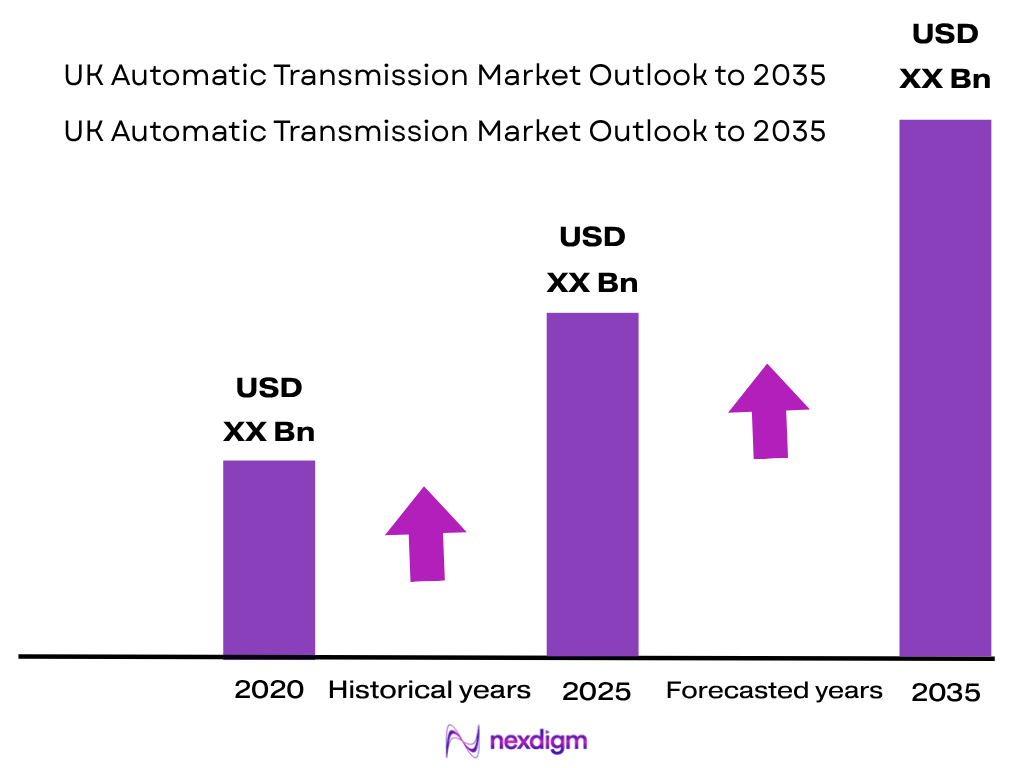
The UK Automatic Transmission Market is valued at approximately ~USD XX billion, using the requested placeholder valuation. Demand is supported by rising automatic fitment, hybridization and electrified drivetrains. New-car registrations increased from 1,903,054 units in the preceding annual observation to 1,952,778 units in the latest annual observation. Automatic-transmission vehicles in the UK vehicle parc also continued increasing as manual-equipped vehicles declined, reinforcing demand for automatic, hybrid and electronically controlled drivetrain systems.
The West Midlands, North East, North West, London and South East represent the most important UK demand and manufacturing centres. British factories moved from approximately 905,117 cars in the preceding annual observation to 779,584 cars in the latest annual observation, while commercial-vehicle production reached 125,649 units. London and the South East contained 8,993,282 cars, providing a particularly large automatic-transmission vehicle parc, while major manufacturing clusters support OEM, drivetrain, remanufacturing and component demand.
Market Segmentation
By Transmission Type
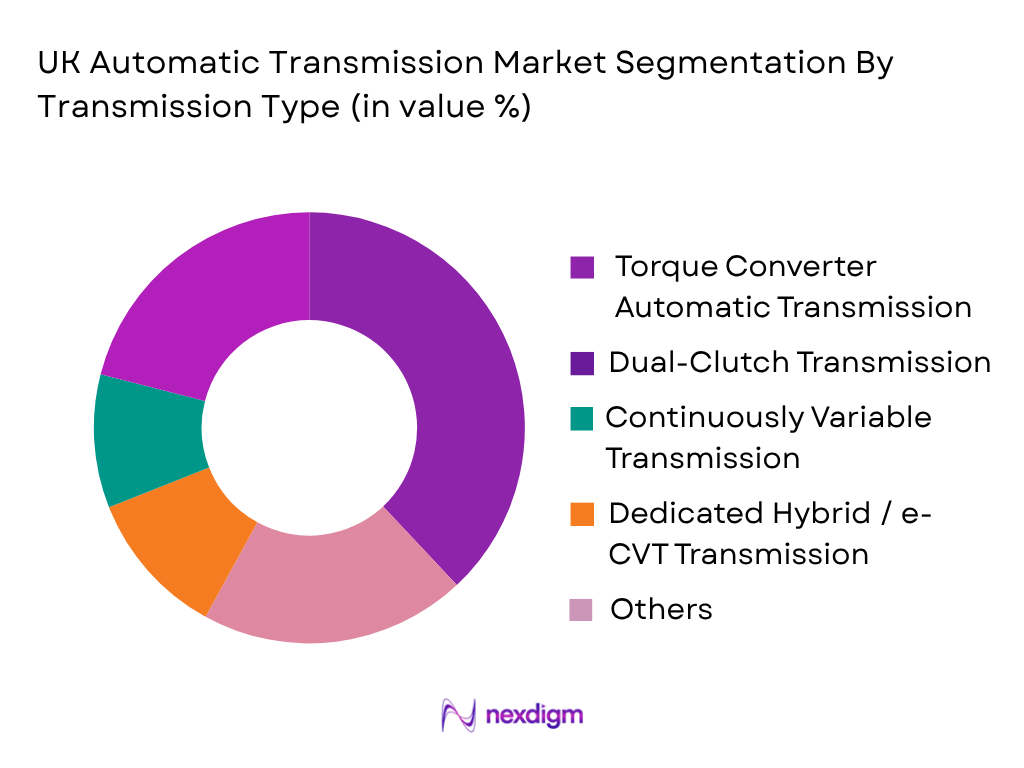
The UK Automatic Transmission Market is segmented by transmission type into torque-converter automatic transmissions, dual-clutch transmissions, continuously variable transmissions, automated manual transmissions, dedicated hybrid and electronic continuously variable transmissions, heavy-duty fully automatic systems and electric reduction gear units. Torque-converter automatic transmissions hold the dominant modeled market share because they remain deeply established across premium cars, SUVs, executive vehicles, light commercial applications and higher-torque vehicles. Their widespread OEM adoption is supported by mature 6-speed, 8-speed, 9-speed and 10-speed architectures, smooth shift characteristics and compatibility with conventional and hybrid powertrains. Dual-clutch systems retain an important position in European passenger-car platforms, while CVTs and e-CVT architectures benefit from hybrid applications. Electric reduction gears are emerging rapidly as battery-electric registrations rise, creating a structural shift away from conventional multi-speed transmission architectures. The UK’s regulatory transition therefore expands automatic drivetrain penetration while simultaneously changing the technology mix within the market.
By Vehicle Type
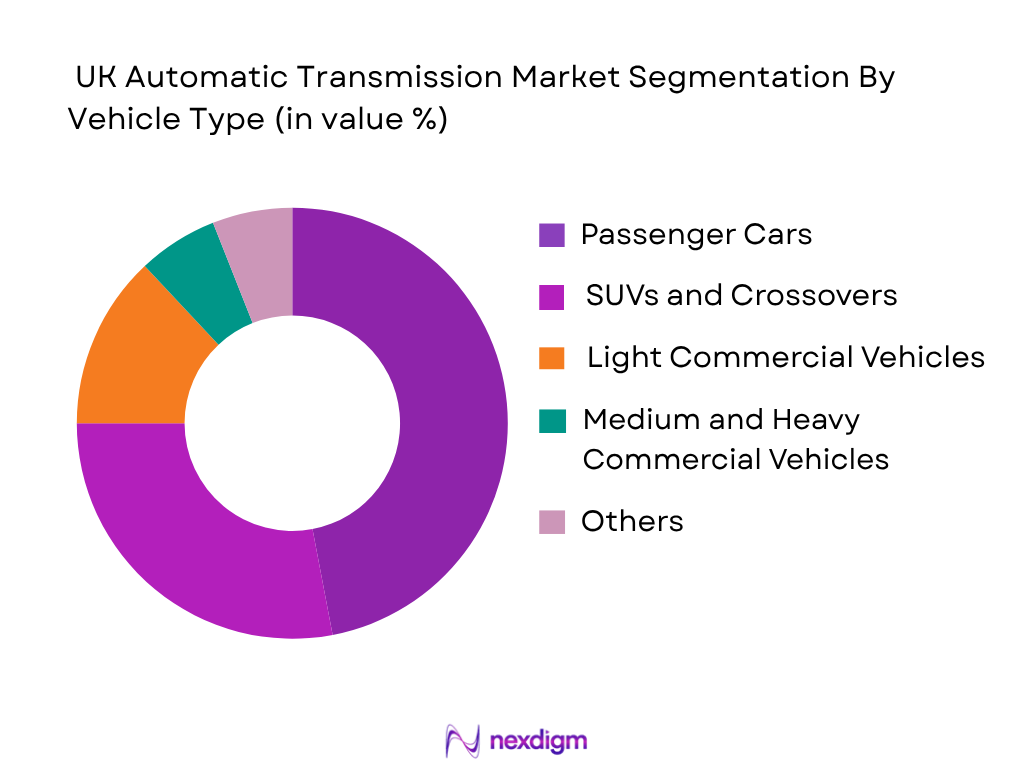
The UK Automatic Transmission Market is segmented by vehicle type into passenger cars, SUVs and crossovers, light commercial vehicles, medium and heavy commercial vehicles, buses and coaches, and specialist vehicles. Passenger cars represent the dominant modeled segment because the UK operates a large passenger-vehicle parc and automatic transmission availability has expanded substantially across mass-market, premium, hybrid and electric models. Premium and executive vehicles increasingly use torque-converter automatics or dual-clutch systems, while full hybrids typically use dedicated hybrid or e-CVT architectures. Battery-electric passenger cars further expand the broader automatic drivetrain category because they eliminate manual gear selection and normally rely on single-speed reduction systems. Commercial vehicles represent a smaller but technically significant segment, particularly for torque-intensive fully automatic transmissions, automated manual systems and electrified propulsion. Fleet operators, leasing companies and urban users also favour automatic drivetrains because of ease of operation, driver convenience and compatibility with increasingly electrified vehicle platforms.
Competitive Landscape
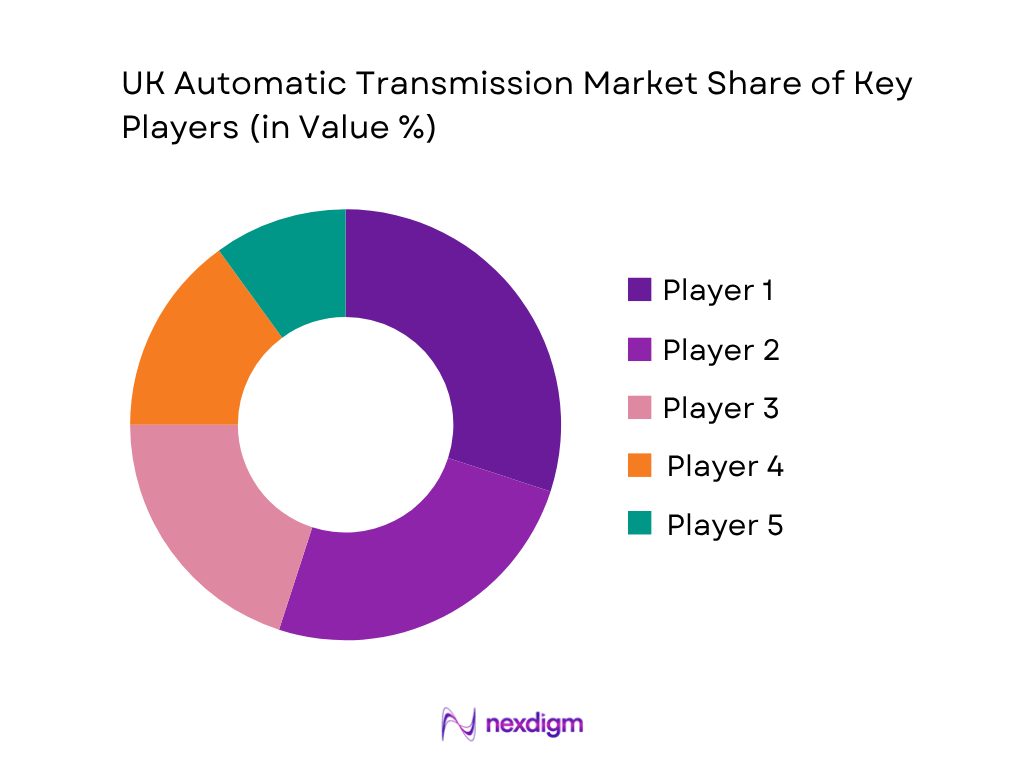
The UK Automatic Transmission Market is served predominantly by global Tier-1 transmission and drivetrain specialists supplying vehicle manufacturers through European and global production networks. ZF and Aisin maintain particularly broad conventional and hybrid automatic-transmission portfolios, while BorgWarner and Magna have strong positions in dual-clutch, hybrid and electrified propulsion technologies. Allison is differentiated by its focus on fully automatic commercial-vehicle transmissions and electrified propulsion. Competition is increasingly shifting from gear-count leadership toward integrated hybrid systems, e-axles, software control, efficiency and vehicle-platform integration.
| Company | Establishment Year | Headquarters | Major Transmission Technology | Hybrid Capability | Electric Drivetrain Capability | Vehicle Coverage | UK Market Position | Aftermarket / Technical Capability |
| ZF Friedrichshafen AG | 1915 | Friedrichshafen, Germany | ~ | ~ | ~ | ~ | ~ | ~ |
| Aisin Corporation | 1949 | Kariya, Japan | ~ | ~ | ~ | ~ | ~ | ~ |
| BorgWarner Inc. | 1928 | Auburn Hills, USA | ~ | ~ | ~ | ~ | ~ | ~ |
| Magna International | 1957 | Aurora, Canada | ~ | ~ | ~ | ~ | ~ | ~ |
| Allison Transmission | 1915 | Indianapolis, USA | ~ | ~ | ~ | ~ | ~ |
UK Automatic Transmission Market Analysis
Growth Drivers
Rising Electrified-Vehicle Registrations Are Expanding Automatic Transmission Demand
The rapid transition toward hybrid, plug-in hybrid and battery-electric vehicles is strengthening demand across the UK Automatic Transmission Market because these vehicles depend on e-CVTs, dedicated hybrid transmissions, electrified dual-clutch systems or electric reduction gears rather than conventional manual gearboxes. SMMT recorded 381,970 battery-electric cars, 261,398 hybrid-electric cars and 167,178 plug-in hybrid cars registered in 2024, creating more than 810,000 new electrified vehicle applications for automatic or direct-drive propulsion systems. The transition accelerated in 2025, with 473,348 battery-electric, 280,185 hybrid-electric and 225,143 plug-in hybrid cars registered. Through July 2026, registrations already included 327,683 battery-electric, 182,387 hybrid-electric and 171,491 plug-in hybrid cars. Department for Transport data further show that the UK had 1,394,000 licensed zero-emission vehicles at the end of 2024. These vehicles expand requirements for transmission control electronics, hybrid gearsets, reduction gears, differentials, e-axles, bearings and thermal-management components. The economic environment supports continued drivetrain modernization, with World Bank data recording UK GDP of USD 3,686.033 billion in 2024 and GDP per capita of USD 53,246.4. The shift therefore increases automatic drivetrain penetration while simultaneously expanding the addressable market for suppliers with hybrid and electric transmission capabilities.
Large UK Vehicle Parc Supports OEM and Automatic Transmission Aftermarket Demand
The size and ageing profile of the UK vehicle parc supports automatic transmission demand beyond new vehicle production by creating recurring requirements for repair, servicing, component replacement and remanufacturing. Department for Transport data show that 41.7 million licensed vehicles were operating in the UK at the end of 2024, while approximately 2,605,000 vehicles were registered for the first time during the year. SMMT subsequently recorded a vehicle parc of 42,549,649 vehicles in 2025, including approximately 36.68 million passenger cars. New-car registrations remained substantial at 1,952,778 units in 2024 and increased to 2,020,520 units in 2025, continually adding newer automatic, hybrid and electric drivetrains to the installed base. This creates demand for transmission fluids, valve bodies, torque converters, mechatronic assemblies, DCT clutch packs, control modules, sensors, seals, bearings and remanufactured gearboxes. The growing electric fleet also creates emerging requirements for reduction gear and integrated e-drive servicing. World Bank data place UK GDP at USD 3,686.033 billion in 2024, with GDP per capita of USD 53,246.4, supporting a substantial vehicle ownership and automotive servicing ecosystem. The coexistence of conventional automatic, hybrid and electric vehicles therefore creates multiple parallel revenue pools for OEM transmission suppliers and aftermarket specialists.
Market Challenges
Battery-Electric Transition Is Replacing Conventional Multi-Speed Automatic Transmissions
The accelerating transition toward battery-electric vehicles represents the principal structural challenge for conventional automatic transmission suppliers because most BEVs replace complex multi-speed gearboxes with relatively simple single-speed reduction units. SMMT recorded 381,970 battery-electric passenger-car registrations in 2024, rising to 473,348 units in 2025, while another 327,683 battery-electric cars were registered during January–July 2026. Department for Transport statistics show that 1,394,000 licensed zero-emission vehicles were already operating in the UK at the end of 2024, with the zero-emission parc subsequently reaching approximately 1.9 million vehicles in 2025. Each additional BEV shifts component requirements away from torque converters, hydraulic valve bodies, multi-speed planetary gearsets and conventional clutch systems toward reduction gears, bearings, differentials, electric motors, inverters and integrated e-axles. Consequently, increasing automatic driving does not necessarily generate equivalent growth for traditional automatic transmission architectures. World Bank data record UK GDP of USD 3,686.033 billion in 2024 and GDP per capita of USD 53,246.4, demonstrating strong automotive purchasing capacity, but the underlying drivetrain technology mix is changing rapidly. Established suppliers therefore face significant pressure to convert mechanical engineering, manufacturing and transmission-control expertise toward dedicated hybrid systems, reduction gearsets and integrated electric propulsion modules.
UK Vehicle Production Volatility Pressures Domestic Transmission Suppliers
Fluctuating domestic vehicle manufacturing creates uncertainty for UK automatic transmission and drivetrain suppliers because OEM gearbox demand depends directly on vehicle assembly volumes and individual model allocation decisions. SMMT reported that UK factories manufactured 905,233 vehicles in 2024, while total production declined to 764,715 vehicles in 2025, comprising 717,371 passenger cars and 47,344 commercial vehicles. Manufacturing pressure remained visible during January–July 2026, when UK factories produced 433,523 cars, compared with 454,937 cars during the corresponding period of 2025. The industry is also strongly exposed to overseas markets: 555,826 of the 717,371 passenger cars manufactured in 2025 were exported. Lower domestic production directly affects potential demand for automatic transmission assemblies, torque converters, clutch modules, mechatronic systems, differentials and electrified reduction units supplied to UK vehicle plants. Meanwhile, the UK registered 2,020,520 new cars in 2025, showing that domestic vehicle demand can remain considerably larger than local production and can therefore be served through imported vehicles and imported drivetrain systems. World Bank data place UK GDP at USD 3,686.033 billion in 2024, but automotive suppliers remain exposed specifically to manufacturing throughput. Transmission businesses therefore need diversified OEM contracts, export customers, aftermarket activities and electrified drivetrain programmes to reduce dependence on individual UK assembly platforms.
Market Opportunities
Dedicated Hybrid and Electrified Transmission Systems Offer Strong Growth Potential
Hybrid powertrains provide a major future opportunity for the UK Automatic Transmission Market because they preserve sophisticated transmission functionality while adding electric motors, power electronics and regenerative-energy systems. SMMT recorded 261,398 hybrid-electric cars and 167,178 plug-in hybrid cars in 2024, representing 428,576 newly registered hybrid vehicles requiring automatic drivetrain architectures. In 2025, registrations increased to 280,185 hybrid-electric cars and 225,143 plug-in hybrids, creating 505,328 additional hybrid applications. Through July 2026, another 182,387 hybrid-electric and 171,491 plug-in hybrid cars were registered, equivalent to 353,878 vehicles before completion of the year. These volumes create opportunities for dedicated hybrid transmissions, e-CVT systems, planetary power-split architectures, hybrid DCTs, electric oil pumps, integrated motor-generator units and advanced transmission-control electronics. Hybrid systems are particularly attractive to established transmission suppliers because they retain precision gears, bearings, clutch mechanisms and lubrication expertise while adding electrification and software capabilities. World Bank data record UK GDP of USD 3,686.033 billion in 2024 and GDP per capita of USD 53,246.4, supporting adoption of increasingly sophisticated vehicle technologies. Suppliers developing modular hybrid platforms can therefore address current vehicle demand while building competencies transferable to future fully electrified drivetrain systems.
Electric Drive Units, Reduction Gearsets and UK Manufacturing Localization
The expansion of electric vehicle manufacturing creates an important future opportunity for UK transmission and drivetrain companies to shift from conventional gearboxes toward electric reduction gearsets, integrated e-axles, differentials and complete electric drive units. The UK government’s DRIVE35 programme provides £4 billion of capital and research-and-development support for zero-emission vehicle technologies and manufacturing, while the Scale-Up Fund provides access to £150 million for manufacturing facilities and process development. Nissan also committed £450 million to next-generation LEAF production at Sunderland, supporting approximately 6,000 jobs across associated operations and strengthening the North East automotive manufacturing ecosystem. Existing industrial capacity provides a foundation for localization: UK factories manufactured 717,371 passenger cars, 47,344 commercial vehicles and approximately 1.6 million engines in 2025, while another 433,523 cars were produced during January–July 2026. Electric drivetrains continue to require precision-machined gears, bearings, shafts, differentials, housings, seals, lubrication systems and sophisticated electronic controls, allowing established transmission suppliers to transfer core manufacturing competencies into electrified propulsion. World Bank data place UK GDP at USD 3,686.033 billion in 2024 and GDP per capita at USD 53,246.4. Localizing these technologies can strengthen UK OEM supply relationships while positioning drivetrain manufacturers to participate in both domestic electric vehicle programmes and export-oriented platforms.
Future Outlook
The UK Automatic Transmission Market is projected to expand at approximately ~X.X% CAGR during 2026–2035, using the requested placeholder forecast. Growth will increasingly come from hybrid transmissions, dedicated hybrid architectures, electrified reduction gears, e-axles and electronically controlled drivetrain systems rather than solely from conventional ICE automatic gearboxes. The market will undergo a significant technology transition as vehicle manufacturers balance conventional automatic, hybrid and battery-electric platforms. The UK Zero Emission Vehicle framework progressively increases zero-emission requirements, encouraging OEMs and Tier-1 suppliers to reallocate engineering resources toward integrated electric drive units and reduction gearsets.
Conventional automatic transmissions should nevertheless retain an important installed base throughout the forecast period because millions of petrol, diesel and hybrid vehicles will remain in operation. This creates continuing requirements for transmission fluids, mechatronic units, torque converters, clutch packs, valve bodies, repairs and remanufactured gearboxes. Hybridization represents an important bridge between conventional automatic transmission technology and full electrification. Suppliers capable of combining gearing, electric motors, power electronics and transmission control software are expected to become increasingly important as drivetrain architectures converge.
Major Players
- ZF Friedrichshafen AG – ZF Automatic / Hybrid Transmissions
- Aisin Corporation – Aisin Automatic / Hybrid Transmissions
- JATCO Ltd. – CVT / Automatic Transmissions
- Magna International – Magna Powertrain / Dual-Clutch and Hybrid Transmissions
- BorgWarner Inc. – DCT / Hybrid and Electrified Drivetrain Systems
- Allison Transmission Holdings Inc. – Fully Automatic Commercial Vehicle Transmissions
- Hyundai Transys Inc. – Automatic / DCT / Hybrid Transmissions
- Punch Powertrain N.V. – CVT / DCT / Hybrid Transmissions
- Schaeffler AG – Hybrid Transmission and E-Mobility Systems
- Valeo SE – Torque Converter / Dual-Clutch and Electrified Transmission Systems
- Dana Incorporated – Spicer / Electrified Drivetrain Systems
- Eaton Corporation – Automated and Electrified Commercial Vehicle Transmissions
- Voith GmbH & Co. KGaA – DIWA Automatic Bus Transmissions
- GKN Automotive – eDrive / Electric Drivetrain Systems
- Ricardo plc – Transmission and Electrified Powertrain Engineering
Key Target Audience
- Automatic Transmission and Drivetrain Manufacturers
- Passenger Car and Commercial Vehicle OEMs
- Automotive Tier-1 and Tier-2 Component Suppliers
- Transmission Remanufacturers, Distributors and Aftermarket Service Providers
- Fleet, Leasing and Commercial Vehicle Operators
- Electric Drivetrain, E-Axle and Power Electronics Manufacturers
- Investments and Venture Capitalist Firms
- Government and Regulatory Bodies (Department for Transport, Office for Zero Emission Vehicles, Vehicle Certification Agency, Driver and Vehicle Standards Agency, Competition and Markets Authority)
Research Methodology
Step 1: Identification of Key Variables
The initial phase involves developing an ecosystem map covering transmission manufacturers, vehicle OEMs, drivetrain suppliers, component producers, remanufacturers, distributors, workshops and fleet operators operating within the UK Automatic Transmission Market. Secondary and proprietary databases are analyzed to identify variables including transmission architecture, vehicle type, propulsion system, OEM fitment, domestic production, import dependence, vehicle parc and replacement demand.
Step 2: Market Analysis and Construction
Historical market information is analyzed using both top-down and bottom-up methodologies. The top-down model evaluates vehicle registrations, automotive production, automatic fitment patterns, hybrid and electric penetration and vehicle parc structure. The bottom-up model assesses OEM platforms, transmission suppliers, installation volumes, aftermarket replacement demand and remanufacturing activity to construct the UK Automatic Transmission Market across technology and vehicle segments.
Step 3: Hypothesis Validation and Expert Consultation
Market hypotheses are validated through structured discussions and computer-assisted telephone interviews with transmission suppliers, vehicle manufacturers, drivetrain specialists, remanufacturers, distributors and automotive service providers. Primary consultations evaluate transmission fitment, technology substitution, vehicle applications, repair patterns, component requirements and supplier relationships. These inputs are used to validate secondary findings and refine assumptions underlying segment-level market calculations and competitive positioning.
Step 4: Research Synthesis and Final Output
The final phase triangulates vehicle-registration data, OEM production indicators, transmission-fitment estimates, supplier information and aftermarket demand. Bottom-up results are reconciled with top-down automotive indicators to reduce inconsistencies between installed transmission volumes and underlying vehicle activity. The resulting analysis provides an integrated view of conventional automatic, hybrid and electrified transmission technologies and establishes a validated framework for market segmentation, competition and long-term strategic assessment.

- Executive Summary
- Research Methodology (Market Definition and Scope, UK Automatic Transmission Taxonomy, Transmission Architecture Classification, Vehicle Powertrain Mapping, OEM Fitment Assessment, Gear Configuration Mapping, Transmission Component Assessment, Domestic Manufacturing Assessment, Import and Export Mapping, Vehicle Registration Assessment, Replacement and Remanufacturing Analysis, Market Sizing Framework)

- Definition and Scope
- UK Automatic Transmission Industry Evolution and Technology Development
- Automatic Transmission Manufacturing and Assembly Process
- Automatic Transmission Value Chain Analysis
- UK Transmission and Drivetrain Supply Chain Analysis
- Transmission Component and Sub-System Ecosystem Analysis
- UK Automatic Transmission Import Dependency and Localization Assessment
- OEM Transmission Fitment Architecture and Aftermarket Service Framework

- Growth Drivers (Declining Manual Transmission Fitment, Increasing Automatic Gearbox Adoption, Expansion of Hybrid Vehicle Registrations, Growth of Plug-in Hybrid Powertrains, Rising SUV and Premium Vehicle Demand, Urban Driving Convenience, Fleet and Leasing Demand, Increasing Transmission Electronics Content)
- Market Challenges (Transition from Multi-Speed ICE Transmissions to Single-Speed EV Reduction Drives, UK Vehicle Production Volatility, High Automatic Transmission Repair Complexity, Mechatronics and Electronics Failure Risk, Imported Transmission Dependency, Skilled Transmission Technician Constraints, Supply-Chain Restructuring, Increasing Powertrain Platform Consolidation)
- Market Opportunities (Dedicated Hybrid Transmissions, Hybrid Dual-Clutch Systems, Electric Reduction Gear Units, Integrated E-Axles, High-Efficiency Transmission Control Systems, Transmission Remanufacturing, Commercial Vehicle Automatic Transmissions, Software-Defined Transmission Control)
- Market Trends (8-Speed and 9-Speed Automatic Adoption, Hybridized DCT Architectures, Dedicated Hybrid Transmissions, Shift-by-Wire Systems, Integrated Mechatronics, Transmission Electrification, E-Axle Integration, Predictive Transmission Diagnostics)
- Regulatory and Standards Landscape (UK Zero Emission Vehicle Mandate, Vehicle Emissions Trading Scheme, GB Vehicle Type Approval Requirements, UNECE Vehicle Regulations, Vehicle CO2 Compliance Requirements, DRIVE35 Automotive Manufacturing Support, End-of-Life Vehicle Requirements, Automotive Cybersecurity and Functional Safety Requirements)
- SWOT Analysis
- Porter’s Five Forces Analysis
- PESTLE Analysis
- Stakeholder Ecosystem
- Competition Ecosystem

- By Market Value (2020-2025)
- By Automatic Transmission Installation Volume (2020-2025)
- By New Vehicle Automatic Transmission Fitment Volume (2020-2025)
By Domestic Transmission Production Volume (2020-2025) - By Import Volume (2020-2025)
- By Export Volume (2020-2025)
- By Average Selling Price (2020-2025)
- By Hybrid Transmission Volume (2020-2025)
- By Replacement and Remanufactured Transmission Volume (2020-2025)

- By Transmission Type (In Value %)
Torque Converter Automatic Transmission
Dual-Clutch Transmission
Continuously Variable Transmission
Automated Manual Transmission
Dedicated Hybrid Transmission
Electronic Continuously Variable Transmission
Hybrid Dual-Clutch Transmission
Planetary Hybrid Transmission
Heavy-Duty Fully Automatic Transmission
Electric Reduction Gear Transmission
Multi-Speed Electric Vehicle Transmission
Other Automatic Transmission Architectures - By Vehicle Type (In Value %)
Passenger Cars
SUVs and Crossovers
Luxury and Performance Cars
Light Commercial Vehicles
Medium Commercial Vehicles
Heavy Commercial Vehicles
Buses and Coaches
Taxis and Private-Hire Vehicles
Off-Highway and Specialist Vehicles
Defence and Tactical Vehicles - By Propulsion Type (In Value %)
Petrol Internal Combustion Vehicles
Diesel Internal Combustion Vehicles
Mild Hybrid Vehicles
Full Hybrid Vehicles
Plug-in Hybrid Vehicles
Battery Electric Vehicles
Range-Extended Electric Vehicles
Alternative-Fuel Commercial Vehicles - By Gear Configuration (In Value %)
Single-Speed Reduction Gear
4-Speed Automatic Transmission
5-Speed Automatic Transmission
6-Speed Automatic Transmission
7-Speed Automatic Transmission
8-Speed Automatic Transmission
9-Speed Automatic Transmission
10-Speed Automatic Transmission
Variable-Ratio CVT
Multi-Speed Electrified Transmission - By Sales Channel (In Value %)
OEM / Factory-Fitted Transmission
Tier-1 Direct Supply
Original Equipment Service Parts
Independent Automotive Aftermarket
Transmission Specialists
Remanufactured Transmission Suppliers
Authorized Dealer and Service Networks
Independent Garages and Workshops
Online Automotive Parts Platforms
Fleet Maintenance Contracts - By Region (In Value %)
London
South East England
West Midlands
North West England
North East England
Yorkshire and the Humber
East Midlands
East of England
South West England
Scotland
Wales
Northern Ireland

- Market Share of Major Players (By Revenue, Installation Volume, Transmission Type, Vehicle Type, Propulsion Type, OEM Fitment, Aftermarket Presence, Electrified Drivetrain)
- Cross Comparison Parameters (UK OEM Supply and Manufacturing Footprint, Automatic Transmission Architecture Breadth, Hybrid and Dedicated Hybrid Transmission Capability, Electric Reduction Gear and E-Axle Capability, Passenger and Commercial Vehicle Application Coverage, Torque Capacity and Gear-Ratio Portfolio, Transmission Electronics and Software Integration Capability, UK Aftermarket Remanufacturing and Technical Support Network)
- SWOT Analysis of Major Players
- Pricing and Distribution Network Benchmarking
- Market Entry Strategy Assessment
- Detailed Profiles of Major Companies
ZF Friedrichshafen AG – ZF Automatic / Hybrid Transmissions
Aisin Corporation – Aisin Automatic / Hybrid Transmissions
JATCO Ltd. – CVT / Automatic Transmissions
Magna International – Magna Powertrain / Dual-Clutch and Hybrid Transmissions
BorgWarner Inc. – DCT / Hybrid and Electrified Drivetrain Systems
Allison Transmission Holdings Inc. – Fully Automatic Commercial Vehicle Transmissions
Hyundai Transys Inc. – Automatic / DCT / Hybrid Transmissions
Punch Powertrain N.V. – CVT / DCT / Hybrid Transmissions
Schaeffler AG – Hybrid Transmission and E-Mobility Systems
Valeo SE – Torque Converter / Dual-Clutch and Electrified Transmission Systems
Dana Incorporated – Spicer / Electrified Drivetrain Systems
Eaton Corporation – Automated and Electrified Commercial Vehicle Transmissions
Voith GmbH & Co. KGaA – DIWA Automatic Bus Transmissions
GKN Automotive – eDrive / Electric Drivetrain Systems
Ricardo plc – Transmission and Electrified Powertrain Engineering

- Buyer Segmentation
- Vehicle OEM Procurement Behaviour
- Fleet Operator Procurement Behaviour
- Transmission Supplier Selection Criteria
- Buyer Pain Points
- Automatic versus Manual Transmission Preference Assessment
- Hybrid and Electrified Transmission Adoption Assessment
- Replacement and Remanufacturing Behaviour

- By Market Value (2026-2035)
- By Automatic Transmission Installation Volume (2026-2035)
- By New Vehicle Automatic Transmission Fitment Volume (2026-2035)
- By Domestic Transmission Production Volume (2026-2035)
- By Import Volume (2026-2035)
- By Export Volume (2026-2035)
- By Average Selling Price (2026-2035)
- By Hybrid Transmission Volume (2026-2035)
- By Replacement and Remanufactured Transmission Volume (2026-2035)


 Request a Sample
 Ask for Customization
 Get a Quote
 Enquire Now