

 Download PDF
Market Overview
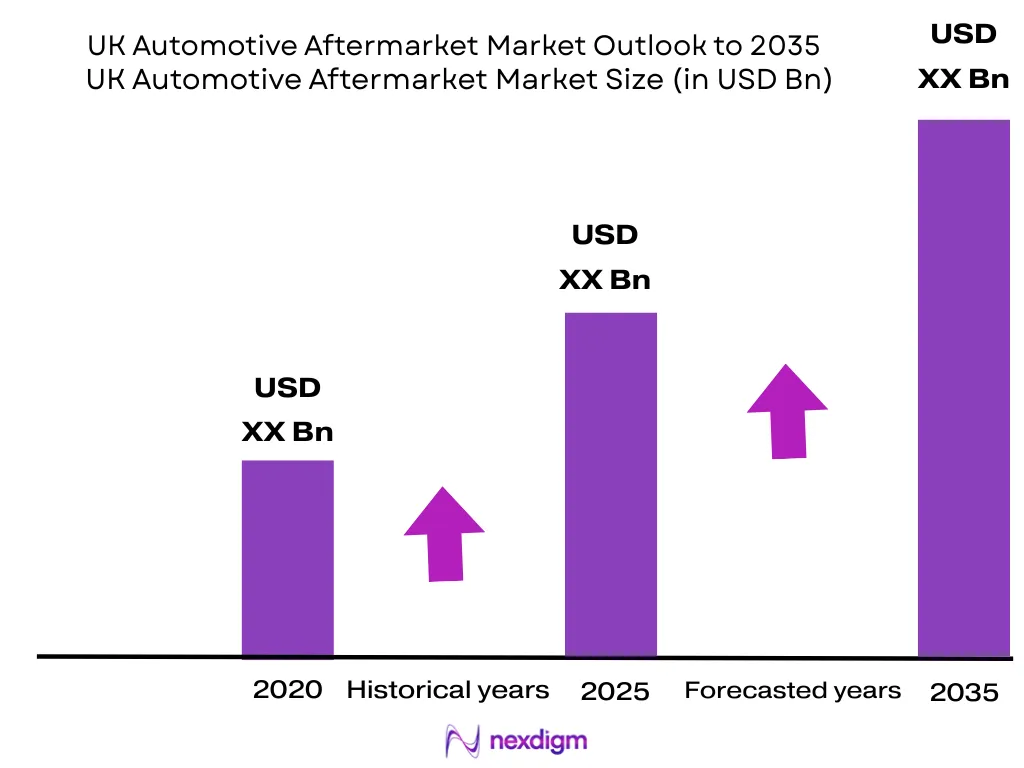
The UK Automotive Aftermarket Market is valued at approximately ~ billion, compared with ~ billion in the preceding reporting period. Demand is supported by an increase in licensed vehicles from 41.4 million to 41.7 million, while first registrations rose from approximately 2.53 million to 2.61 million vehicles. The expanding vehicle base, compulsory roadworthiness testing and continued retention of older cars and vans sustain replacement-parts and workshop activity.
London, South East England, the West Midlands, North West England and Scotland dominate the UK Automotive Aftermarket Market because they combine large vehicle populations, dense garage networks, major distribution centers and extensive commercial-fleet activity. London generates substantial taxi, private-hire and delivery-vehicle demand, while the Midlands supports automotive manufacturing and national parts logistics. The national car parc increased from 35,694,845 to 36,165,401 vehicles, strengthening workshop demand across these regions.
Market Segmentation
By Aftermarket Offering
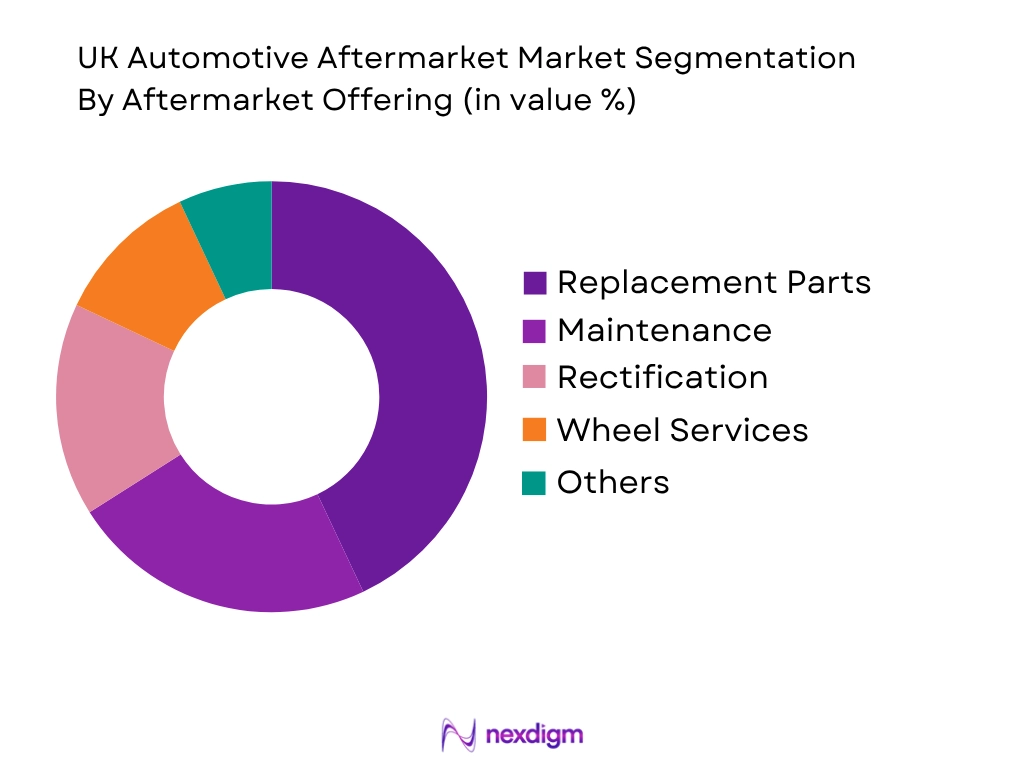
The UK Automotive Aftermarket Market is segmented into replacement parts, maintenance and mechanical repair, MOT testing and rectification, tires and wheel services, batteries and electrical services, lubricants and fluids, collision repair, and accessories and car-care services. Replacement parts hold the dominant market share, because nearly every repair, scheduled service or MOT rectification requires one or more components or consumables.
The UK’s parc of 41.7 million licensed vehicles supports recurring demand for filters, braking products, suspension components, batteries, tires, lighting, exhaust parts and engine-management sensors. The dominance of replacement parts is reinforced by an aging legacy fleet and the continued operation of petrol and diesel vehicles alongside a growing electrified parc. Motor factors provide rapid trade delivery to garages, allowing workshops to source several quality tiers for the same application. MOT testing further stimulates component replacement by identifying defects that must be repaired before a vehicle can legally return to compliant road use.
By Service Provider Type
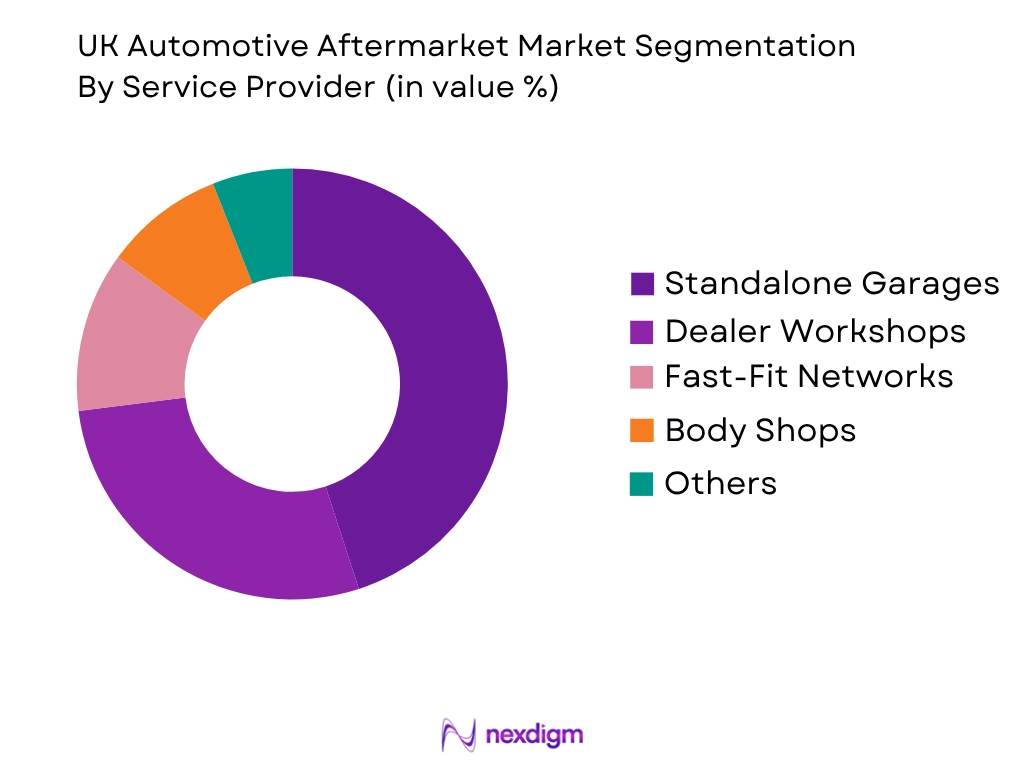
The UK Automotive Aftermarket Market is segmented into independent standalone garages, franchised dealer workshops, national autocentre chains, tire and fast-fit networks, collision repairers, mobile mechanics, roadside assistance providers and specialist diagnostic centers. Independent standalone garages hold the dominant market share, supported by their extensive geographic coverage, local customer relationships and strong position among out-of-warranty vehicles.
Independent garages can source parts through competing national and regional motor factors, giving customers flexibility across branded, private-label, remanufactured and recycled options. Many also operate as MOT testing stations, allowing them to combine annual inspection, defect rectification and scheduled maintenance in one location. Their principal competitive advantages are convenience, trust and lower operating overheads than franchised dealerships. National autocentre groups are gaining ground through online booking, standardized warranties, fleet contracts and multi-site coverage, while franchised workshops retain technically complex and manufacturer-supported work.
Competitive Landscape
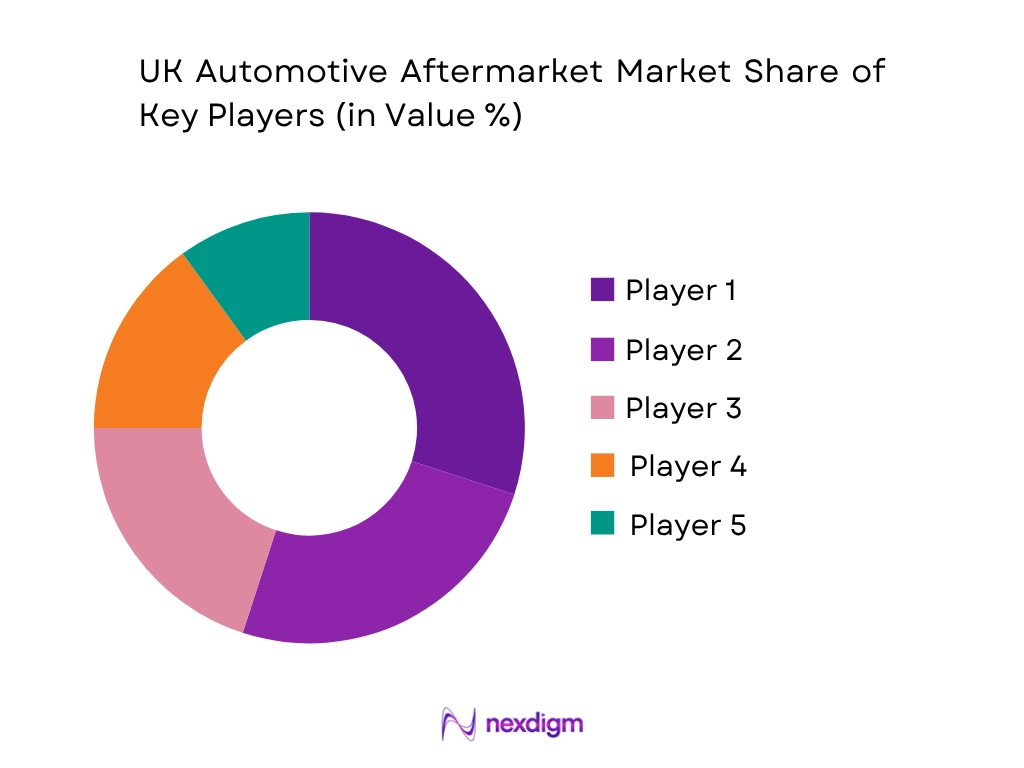
The UK Automotive Aftermarket Market combines major national motor factors, retail and service groups, tire networks, roadside organizations and thousands of independent garages. Halfords operates an integrated retail, autocentre and mobile-service model, while LKQ Euro Car Parts and GSF Car Parts lead trade-component distribution. Kwik Fit has a long-established national tire and maintenance network. Alliance Automotive Group supplies independent workshops through multiple distribution brands and affiliated garage programs. Competition centers on branch density, parts availability, same-day delivery, service-bay coverage and digital ordering.
| Company | Establishment Year | Headquarters | Primary Business Model | Core Aftermarket Offering | Network Scale | Main Customer Base | Digital Capability | Market-Specific Strength |
| Halfords Group | 1892 | Redditch, England | ~ | ~ | ~ | ~ | ~ | ~ |
| LKQ Euro Car Parts | 1978 | Tamworth, England | ~ | ~ | ~ | ~ | ~ | ~ |
| GSF Car Parts | 1960 heritage | London, England | ~ | ~ | ~ | ~ | ~ | ~ |
| Kwik Fit | 1971 | Letchworth Garden City, England | ~ | ~ | ~ | ~ | ~ | ~ |
| Alliance Automotive Group UK | 1989 group heritage | Milton Keynes, England | ~ | ~ | ~ | ~ | ~ | ~ |
UK Automotive Aftermarket Market Analysis
Growth Drivers
Large Aging Vehicle Parc and MOT-Linked Repair Demand
The UK’s large operating vehicle parc and statutory roadworthiness regime create recurring, non-discretionary demand for automotive parts and repair services. Department for Transport records show 41.7 million licensed vehicles at the end of 2024, including approximately 36.2 million cars. During the same period, 2.605 million vehicles were registered for the first time, compared with roughly 2.53 million vehicles in 2023. These additions enlarge the future serviceable parc, while older vehicles already outside manufacturer warranty generate immediate demand for filters, brakes, tires, batteries, suspension components, exhaust systems and electrical repairs. The MOT system reinforces this replacement cycle. Driver and Vehicle Standards Agency data recorded approximately 35.2 million MOT tests during the 2024–25 testing period, with around 8.2 million initial failures. Classes covering cars, vans and passenger vehicles accounted for the overwhelming majority of tests, while the overall initial failure rate was close to 28 vehicles per 100 tests. Failed vehicles frequently require lighting, visibility, tire, braking, suspension or emission-system work before returning to compliant road use. The macroeconomic environment also encourages vehicle retention. UK real GDP expanded by approximately 1.1% in 2024, while the IMF recorded growth of 1.4% in 2025 and projected 1.0% in 2026. Moderate economic growth and pressure on household budgets can delay vehicle replacement, increasing the average age and repair intensity of the existing parc. This combination supports independent garages, autocentres, MOT stations, motor factors and remanufacturers because essential roadworthiness work remains necessary even when motorists defer cosmetic repairs or discretionary accessories.
Expansion of Van, Delivery and Commercial-Fleet Utilization
The growing operational importance of vans, delivery vehicles, taxis, private-hire cars and commercial fleets is strengthening UK aftermarket demand. Light goods vehicles are heavily used by building trades, utilities, parcel operators, food-delivery businesses, field-service companies and online retailers. Their stop-start operating cycles, payloads and high annual mileage accelerate wear on brakes, clutches, tires, suspension systems, batteries and diesel emission components. The national vehicle parc included more than 4.6 million licensed light goods vehicles during 2024, giving workshop networks and motor factors a large commercial customer base. First registrations across all vehicle types reached 2.605 million units, while zero-emission light goods vehicle registrations exceeded 22,000 units. These additions require conventional maintenance services today while creating future requirements for electric-van battery diagnostics, charging systems, thermal management and high-voltage safety. Road traffic volumes provide further evidence of aftermarket utilization. Department for Transport estimates indicate that motor vehicles travelled approximately 336.7 billion miles on Great Britain’s roads during 2024, including substantial mileage generated by vans and heavy commercial vehicles. Commercial operators generally treat maintenance as an uptime requirement rather than discretionary spending; an immobilized vehicle can interrupt deliveries, customer visits or infrastructure work. This supports preventive service contracts, mobile repair, roadside assistance and same-day parts delivery. The broader economic setting remains relevant because the IMF reported UK growth of 1.4% in 2025, even as it projected moderation to 1.0% in 2026. Continued activity in logistics, services, construction and public infrastructure sustains commercial vehicle use despite slower aggregate growth. Aftermarket providers capable of offering national coverage, consolidated billing, telematics-linked maintenance and guaranteed turnaround can secure recurring fleet contracts that are less volatile than household repair demand.
Market Challenges
Increasing Complexity of Electric, Hybrid and Software-Defined Vehicles
The rapid expansion of electrified and digitally controlled vehicles is increasing the technical burden on UK independent garages. At the end of 2024, the country had 1.394 million licensed zero-emission vehicles, compared with approximately 1.02 million at the end of 2023. During 2024, 410,000 zero-emission vehicles were registered for the first time, including 382,000 zero-emission cars and more than 22,000 zero-emission light goods vehicles. The transition continued through 2025, with 120,000 zero-emission cars registered during the first quarter and another 124,000 during the third quarter. These vehicles still require tires, suspension, brakes, air-conditioning, body repair and low-voltage electrical work, but they also introduce traction batteries, inverters, onboard chargers, electric compressors and high-voltage cooling systems. Workshops need insulated tools, battery isolation equipment, protected work areas and manufacturer-compatible diagnostic software. Technical complexity also extends to petrol and diesel vehicles equipped with radar, cameras, electronic steering, networked control units and advanced driver-assistance systems. A windscreen replacement, wheel alignment, bumper repair or suspension job may require sensor calibration before the vehicle can be safely returned to service. Charging infrastructure growth confirms the expanding installed base: the UK had 73,334 public charging devices in January 2025, 82,002 in July 2025 and 116,052 public chargers in January 2026 under the revised reporting measure. The IMF’s forecast of 1.0% economic growth in 2026 indicates that smaller garages may need to make these investments during a period of restrained economic expansion. Businesses unable to finance diagnostic subscriptions, calibration systems and EV-safe equipment risk losing complex work to dealerships, national chains and specialist centers.
Shortage of Vehicle Technicians, MOT Testers and Advanced Diagnostic Skills
The availability of qualified technicians is a structural constraint on the UK automotive aftermarket. The government placed vehicle technicians, mechanics and electricians on the Temporary Shortage List in 2025, alongside vehicle body builders, repairers and paint technicians. The listed occupations include car and light-vehicle technicians, heavy-vehicle technicians, motorcycle mechanics, MOT testers, roadside-assistance technicians and auto electricians, demonstrating that shortages extend across multiple service categories. The standard going rate for vehicle technicians, mechanics and electricians was set at GBP 35,500 annually, equivalent to GBP 18.21 per hour, while the applicable reduced threshold was GBP 27,900, or GBP 14.31 per hour. Wage pressure is occurring alongside rising economy-wide earnings: the Office for National Statistics recorded median gross annual earnings of GBP 37,430 for full-time employees in April 2024, increasing to approximately GBP 39,039 in 2025. Workshops must therefore compete with manufacturing, engineering, construction and other technical sectors for workers with transferable mechanical and electrical abilities. The workload continues to expand, with 41.7 million licensed vehicles, approximately 35.2 million MOT tests and more than 1.3 million zero-emission vehicles requiring support. New technicians must understand conventional engines, diesel emission systems, vehicle networks, ADAS, high-voltage isolation and digital fault analysis. Training cannot immediately close this gap because apprentices require supervised experience, while established technicians need continuous upskilling. The IMF’s projection of 1.0% UK GDP growth in 2026 may limit the ability of smaller garages to increase wages, release technicians for training or purchase specialist equipment. The resulting capacity pressure can lengthen booking times, increase outsourcing and concentrate advanced work among larger workshop networks.
Market Opportunities
EV Diagnostics, Battery Health and ADAS Calibration Services
The UK’s current electrified-vehicle parc creates a substantial future opportunity for aftermarket operators that establish battery, high-voltage and electronic diagnostic capability before more vehicles leave manufacturer warranty. The country had 1.394 million licensed zero-emission vehicles at the end of 2024, while 410,000 zero-emission vehicles entered the parc during the year. New zero-emission car registrations reached 120,000 units during the first quarter of 2025 and 124,000 units during the third quarter. These vehicles will progressively require independent support for battery-health assessment, thermal-management repair, charging faults, low-voltage batteries, tires, suspension and collision work. Public charging infrastructure provides further evidence of adoption: the network contained 73,334 devices in January 2025, 82,002 devices in July 2025 and 116,052 chargers under the new measurement in January 2026. The opportunity extends beyond EV-only workshops. Modern petrol, diesel and hybrid vehicles increasingly require scan-tool diagnostics, software coding, radar calibration and camera alignment. Businesses can establish dedicated high-voltage bays, battery state-of-health certificates, pre-purchase EV inspections, mobile diagnostic services and ADAS calibration centers. Such services can support motorists, fleets, leasing companies, insurers and used-vehicle retailers. The Department for Transport reported that more than 1.4 million zero-emission vehicles were already operating nationally during the 2024–25 reporting period, demonstrating a present serviceable base rather than a theoretical future market. The IMF recorded population at approximately 69.85 million and projected real GDP growth of 1.0% in 2026, giving technology-enabled providers a large but cost-conscious customer population. Operators that combine conventional servicing with EV, hybrid and ADAS capability can spread equipment investment across several repair categories while positioning themselves for vehicles transitioning from franchised dealerships to independent channels.
Mobile Repair, Fleet Maintenance and Regional Same-Day Parts Fulfilment
The scale and geographic dispersion of the UK vehicle parc create an opportunity for mobile servicing, contract maintenance and digitally coordinated parts distribution. The country operated 41.7 million licensed vehicles at the end of 2024, while vehicles travelled approximately 336.7 billion miles on Great Britain’s roads. These figures support a large addressable base for mobile tire fitting, battery replacement, roadside diagnostics, minor repairs and vehicle collection services. Commercial fleets are particularly attractive because delivery vans, utility vehicles, taxis and company cars require predictable uptime and consolidated maintenance reporting. Mobile technicians can perform preventive inspections and routine work at depots, reducing vehicle movement and workshop congestion. Regional motor factors can support this model through registration-based catalogues, live inventory, route optimization and same-day delivery to garages or fleet sites. The MOT system provides another opportunity for integrated service models: approximately 35.2 million tests were conducted in the 2024–25 period, with more than 8 million initial failures generating potential rectification work. Operators can combine MOT reminders, collection and delivery, digital inspection reports and pre-authorized repairs to improve customer retention. Public charging infrastructure also expands the range of mobile support requirements. The UK had 82,002 public charging devices in July 2025 and 116,052 chargers in January 2026, while zero-emission light goods vehicle registrations increased during several reporting quarters. Mobile providers can add low-voltage battery support, charging-fault diagnosis and fleet EV health checks. The IMF’s estimate of 69.85 million residents and projected 1.0% economic growth in 2026 indicate a large customer base operating in a restrained spending environment, favoring convenient services that reduce downtime rather than premium discretionary offerings. National workshop groups, roadside organizations, leasing companies and motor factors can use mobile fleets and digital scheduling to extend coverage into commuter towns, rural areas and locations where fixed-site workshop capacity is limited.
Future Outlook
The UK Automotive Aftermarket Market is forecast to expand at approximately ~XX% CAGR during the forecast period. Growth will be supported by continued vehicle-parc expansion, aging petrol and diesel vehicles, MOT-related repairs and the growing technical requirements of hybrid and electric vehicles. Conventional replacement categories will remain central because the UK operates more than 41 million licensed vehicles. Electrification will gradually shift expenditure toward battery diagnostics, thermal management, tires, suspension, low-voltage electrical systems, charging components and software-enabled repair. The licensed zero-emission vehicle parc reached 1,394,000 units, while 410,000 zero-emission vehicles were registered for the first time during the latest annual reporting period. This growth creates an expanding future customer base for independent workshops once vehicles leave manufacturer warranty and service packages. The car parc increased to 36,165,401 vehicles, including more than one million battery-electric cars. New-car registrations reached 1.953 million units, with fleet purchasing contributing significantly to electrified-vehicle adoption. The resulting aftermarket will require mixed-propulsion capability because workshops must continue servicing a large petrol and diesel legacy fleet while developing specialist EV knowledge. MOT testing will continue to stabilize demand. The annual testing system creates a legally supported repair cycle, particularly for older vehicles. The latest complete testing data recorded approximately 34.7 million tests, 7.9 million initial failures and 7.1 million final failures across relevant vehicle classes. Brake, tire, suspension, lighting, visibility and emission defects therefore create a recurring pool of non-discretionary repair work.
Major Players
- Halfords Group
- LKQ Euro Car Parts
- GSF Car Parts
- Alliance Automotive Group UK
- Kwik Fit
- National Tyres and Autocare
- Formula One Autocentres
- Protyre
- Elite Garages
- Arnold Clark Autoparts
- RAC Motoring Services
- The AA
- Fix Auto UK
- Autoglass
- Tructyre
Key Target Audience
- Automotive component manufacturers and remanufacturers
- National and regional motor factors
- Independent garage chains and autocentre operators
- Tire, battery and automotive specialty retailers
- Leasing, rental, delivery and commercial-fleet operators
- Automotive e-commerce and workshop-technology providers
- Investments and venture capitalist firms
- Government and regulatory bodies (Department for Transport, Driver and Vehicle Licensing Agency, Driver and Vehicle Standards Agency, Vehicle Certification Agency, Competition and Markets Authority and Environment Agency)
Research Methodology
Step 1: Identification of Key Variables
The initial phase constructs an ecosystem map covering component manufacturers, importers, motor factors, retailers, garages, dealerships, MOT stations, fleets, insurers and digital platforms. Critical variables include licensed vehicle parc, vehicle age, propulsion type, annual mileage, MOT exposure, repair frequency, component replacement intervals and workshop throughput.
Step 2: Market Analysis and Construction
Historical vehicle licensing, first-registration, MOT, parts-trade and workshop information is compiled. Top-down analysis evaluates total maintenance and repair expenditure, while bottom-up analysis estimates demand from vehicle populations, replacement cycles, MOT failures, service visits and average repair-order structures.
Step 3: Supply-Side Assessment
National motor factors, automotive retailers, autocentre chains, tire networks and independent garages are evaluated according to branch count, warehouse reach, service bays, SKU breadth, trade delivery frequency and customer composition. Company disclosures are used to reconstruct the organized market and benchmark fragmented independent activity.
Step 4: Demand-Side Assessment
Vehicle owners and fleet operators are analyzed by vehicle type, age, mileage, propulsion, warranty status and service channel. The assessment examines franchised-dealer versus independent-garage behavior, parts-quality preferences, repair deferral, MOT rectification patterns and demand for mobile services.

- Executive Summary
- Research Methodology (Market Definitions and Assumptions, Abbreviations, Automotive Aftermarket Boundary, Vehicle Parc–Based Market Modeling, Top-Down Analysis, Bottom-Up Analysis, Demand-Side Assessment, Supply-Side Assessment, Component Replacement-Rate Modeling, MOT Defect and Repair Analysis, Workshop Throughput Assessment, Parts Import and Distribution Analysis, Primary Industry Interviews, Data Triangulation, Forecasting Framework, Limitations and Future Conclusions)

- Definition and Scope
- Market Evolution and Industry Genesis
- Timeline of Major Industry Developments
- Automotive Aftermarket Business Cycle
- UK Vehicle Parc and Replacement Demand Ecosystem
- Passenger Car, Van and Heavy Commercial Vehicle Aftermarket Structure

- Growth Drivers (Aging Vehicle Parc, Extended Vehicle Retention, MOT Compliance, High Van Utilization, Used-Vehicle Transactions, Fleet Maintenance)
- Market Challenges (Technician Shortage, Workshop Overcapacity, Parts Inflation, Vehicle Technology Complexity, Margin Pressure, Regulatory Change)
- Market Opportunities (EV Servicing, ADAS Calibration, Fleet Contracts, Green Parts, Mobile Repair, Digital Procurement)
- Market Trends (Digitalization, Workshop Consolidation, Electrification, Omnichannel Retailing, Service Transparency, Circularity)
- Government Regulations (MOT Rules, Type Approval, Consumer Protection, Repair Information Access, Emission Compliance, Environmental Management)
- SWOT Analysis
- Porter’s Five Forces Analysis
- PESTLE Analysis
- Stakeholder Ecosystem

- By Market Value (2020-2025)
- By Replacement Parts Revenue (2020-2025)
- By Maintenance and Mechanical Repair Revenue (2020-2025)

- By Aftermarket Offering (In Value %)
Replacement Parts
Scheduled Maintenance Services
Mechanical Repair Services
MOT Testing and Rectification
Tires and Wheel Services
Batteries and Automotive Electrical Services - By Vehicle Type (In Value %)
Passenger Cars
Sports Utility Vehicles and Crossovers
Light Commercial Vehicles and Vans
Heavy Goods Vehicles
Buses and Coaches
Taxis and Private-Hire Vehicles
Ride-Hailing Vehicles - By Service Provider Type (In Value %)
Franchised Dealer Workshops
Independent Multi-Brand Garage Chains
Independent Standalone Garages
Vehicle Brand–Specialist Garages
Fast-Fit and Autocentre Networks - By English Region (In Value %)
London
South East England
East of England
South West England
West Midlands
East Midlands
North West England

- Market Share of Major Players (By Aftermarket Revenue, Parts Revenue, Retail Revenue, Service Revenue, Distribution Reach)
- Cross Comparison Parameters (Automotive SKU Portfolio and Vehicle Parc Coverage, Trade Branch and Garage Network Footprint, Same-Day Parts Delivery and Inventory Fill Rate, Passenger Car–Van–HGV Customer Coverage, OEM–OES–Aftermarket–Private-Label Product Mix, MOT–Mechanical–Tire–ADAS–EV Service Capability, B2B Digital Ordering and Registration Lookup Capability, Fleet Contract Portfolio and Workshop Throughput)
- SWOT Analysis of Major Players
- Detailed Profiles of Major Companies
Halfords Group
LKQ Euro Car Parts
GSF Car Parts
Alliance Automotive Group UK
Kwik Fit
National Tyres and Autocare
Formula One Autocentres
Protyre
Elite Garages
Arnold Clark Autoparts
RAC Motoring Services
The AA
Fix Auto UK
Autoglass
Tructyre

- Individual Vehicle Owner Demand Analysis
- Passenger Car Owner Maintenance Behavior
- Van and Light Commercial Vehicle Operator Analysis
- Corporate Fleet Demand Analysis
- Leasing and Contract-Hire Company Analysis
- Taxi and Private-Hire Operator Analysis

- By Market Value (2026-2035)
- By Replacement Parts Revenue (2026-2035)
- By Maintenance and Mechanical Repair Revenue (2026-2035)


 Request a Sample
 Ask for Customization
 Get a Quote
 Enquire Now