
 Download PDF
Market Overview
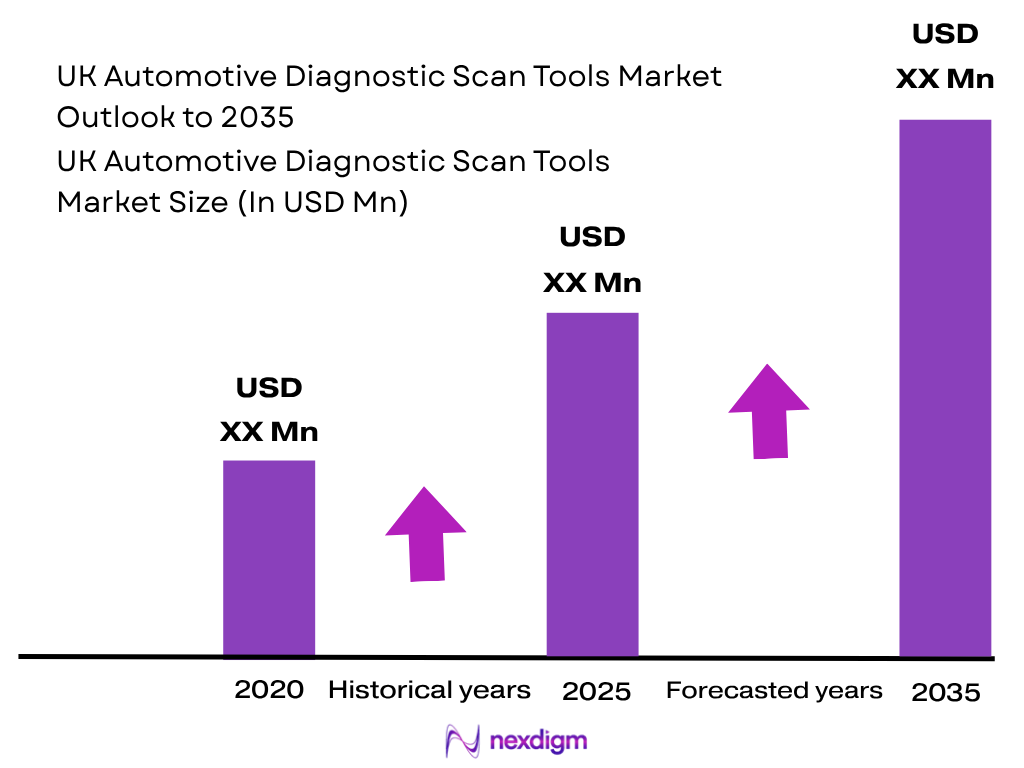
The UK Automotive Diagnostic Scan Tools Market is valued at approximately USD ~ million, with the market supported by a large installed vehicle base, increasing electronic complexity, and continued demand for professional vehicle servicing. The UK vehicle parc reached 41,964,268 vehicles, including 36,165,401 cars, 5,102,180 light commercial vehicles, 625,509 heavy commercial vehicles, and 71,178 buses and coaches in the latest annual Motorparc dataset. New-car registrations reached 1,952,778 units, while UK automotive production included 779,584 cars and 125,649 commercial vehicles. These conditions sustain recurring requirements for fault-code diagnosis, ECU communication, coding, programming, service resets, ADAS calibration and electronic system testing.
The UK Automotive Diagnostic Scan Tools Market is concentrated around major automotive, commercial and population centres because these locations combine large vehicle parc volumes, dense workshop networks, dealership infrastructure and higher concentrations of automotive businesses. London and the South East represent the largest combined vehicle concentration, with 8,993,282 cars in use, while the North West has more than 4.0 million cars. The West Midlands also remains strategically important because of its manufacturing and engineering ecosystem. The electrification transition further increases diagnostic requirements, with more than 1.3 million electric cars already in use and 382,000 new EV registrations recorded during the latest annual registration cycle.
Market Segmentation
By Diagnostic Tool Type
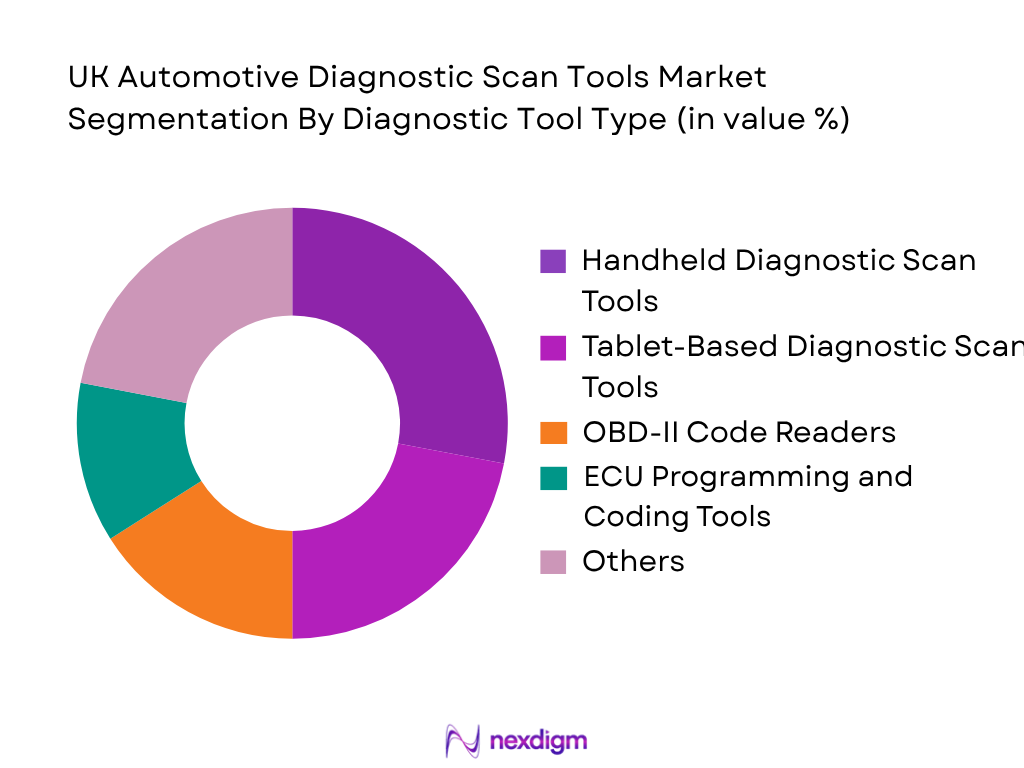
The UK Automotive Diagnostic Scan Tools Market is segmented into handheld diagnostic scan tools, tablet-based diagnostic scan tools, PC-based diagnostic systems, pass-thru diagnostic interfaces, OEM diagnostic systems, multi-brand diagnostic systems, wireless VCI diagnostic systems, remote diagnostic platforms, ADAS diagnostic and calibration systems, and EV and hybrid diagnostic systems. Tablet-based diagnostic scan tools are positioned as the leading segment because they combine portability with larger displays, graphical live-data analysis, integrated technical information, wireless vehicle communication and software-based diagnostic functionality. Their relevance is strengthened by the scale and diversity of the UK vehicle parc, which exceeds 41.9 million vehicles, creating demand for tools capable of supporting multiple brands and vehicle generations. The continued presence of 36.2 million cars and more than 5.1 million light commercial vehicles also requires workshops to handle varied diagnostic protocols and electronic architectures. EV penetration adds another layer of demand for battery management system diagnostics, high-voltage monitoring and electric powertrain fault analysis. Modern tablet platforms can combine conventional OBD/EOBD functions with coding, actuation testing, service resets and increasingly ADAS and EV functionality. This broad functionality makes them particularly relevant to independent workshops seeking one platform for multiple vehicle categories.
By End User
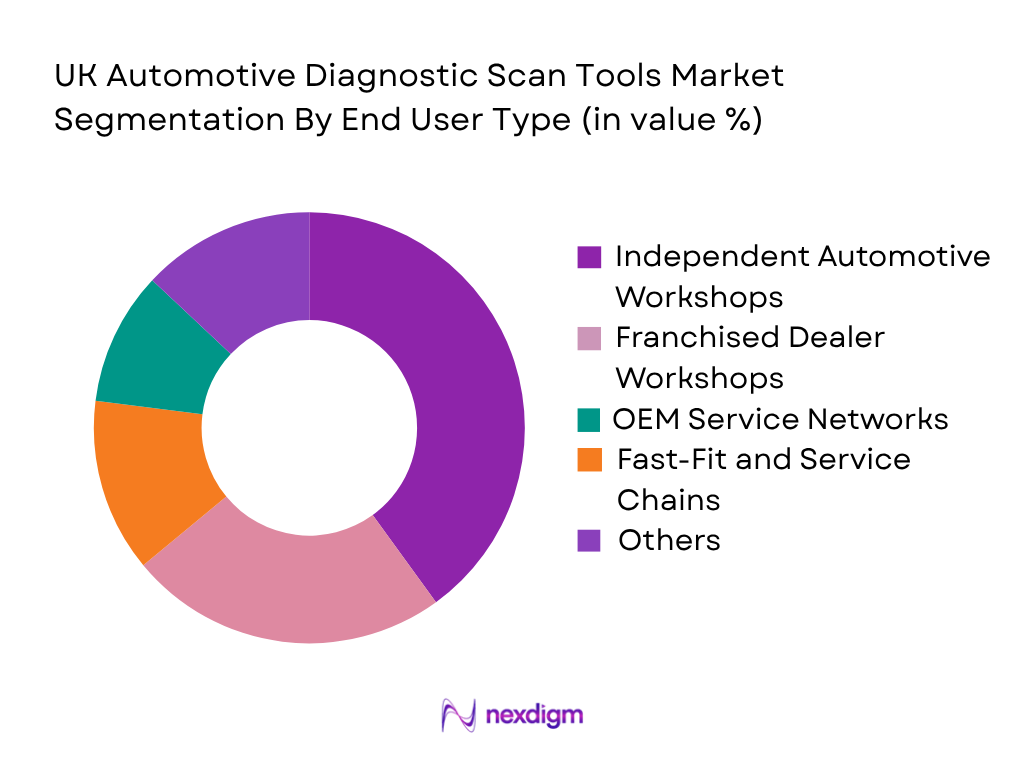
The UK Automotive Diagnostic Scan Tools Market is segmented by end user into independent automotive workshops, franchised dealer workshops, OEM service networks, fast-fit and service chains, vehicle inspection and MOT centres, bodyshops and accident repair centres, fleet maintenance operators, mobile diagnostic service providers, specialist EV and hybrid workshops, and automotive technical service centres. Independent automotive workshops are expected to represent the dominant segment because they service a broad mix of vehicle brands and increasingly require multi-brand equipment capable of accessing electronic control units, reading manufacturer-specific faults, performing service functions and supporting coding and programming. The extensive UK vehicle parc provides a large recurring maintenance base, while the average passenger vehicle age has reached 9.5 years, increasing the importance of repair and diagnostic activity across ageing vehicles. Commercial vehicles also contribute materially, with 5,102,180 vans and 625,509 heavy goods vehicles in use. At the same time, electrification is changing workshop requirements: more than 1.3 million electric cars were already operating on UK roads, requiring specialist battery, power electronics and high-voltage diagnostic capabilities. Independent workshops therefore have an incentive to upgrade equipment to retain customers as vehicle technology becomes more complex.
Competitive Landscape
The UK Automotive Diagnostic Scan Tools Market comprises global diagnostic-equipment manufacturers, automotive technology suppliers and specialist diagnostic providers competing across professional workshops, dealership networks, aftermarket repair businesses and fleet operators. Major competitors differentiate through vehicle coverage, ECU coding and programming, secure gateway access, ADAS calibration, EV diagnostics, technical-data integration, software update capabilities and workshop support. The competitive environment is becoming more technology-intensive as UK vehicles incorporate increasing numbers of electronic control units, connected functions and software-dependent systems. The requirement to diagnose both conventional powertrains and increasingly sophisticated electric vehicles is encouraging suppliers to broaden their hardware and software portfolios.
| Company | Establishment Year | Headquarters | Multi-Brand Coverage | ECU Coding & Programming | EV Diagnostic Capability | ADAS Capability | Secure Gateway Access | Cloud Connectivity | Workshop Support |
| Robert Bosch GmbH | 1886 | Gerlingen, Germany | ~ | ~ | ~ | ~ | ~ | ~ | ~ |
| Snap-on Incorporated | 1920 | Kenosha, USA | ~ | ~ | ~ | ~ | ~ | ~ | ~ |
| HELLA Gutmann Solutions GmbH | 1988 | Ihringen, Germany | ~ | ~ | ~ | ~ | ~ | ~ | ~ |
| Autel Intelligent Technology Corp., Ltd. | 2004 | Shenzhen, China | ~ | ~ | ~ | ~ | ~ | ~ | ~ |
| LAUNCH Tech Co., Ltd. | 1992 | Shenzhen, China | ~ | ~ | ~ | ~ | ~ | ~ |
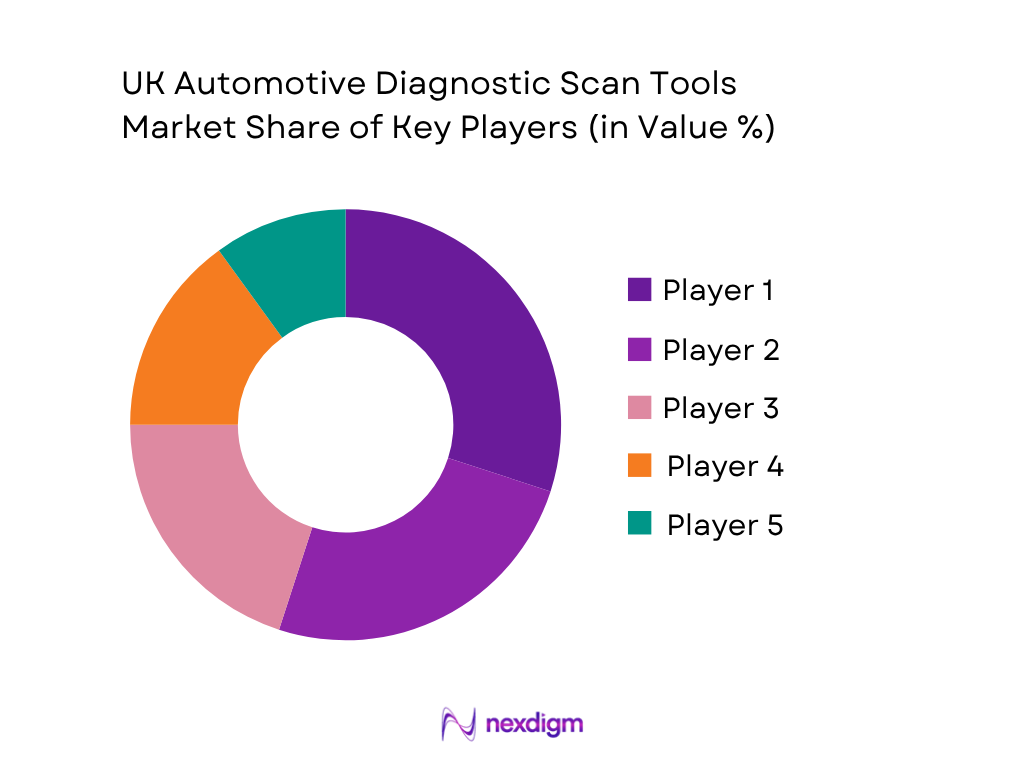
UK Automotive Diagnostic Scan Tools Market Analysis
Growth Drivers
Increasing UK Vehicle Parc and Electronic Diagnostic Complexity
The expanding installed vehicle base is a direct structural driver for the UK Automotive Diagnostic Scan Tools Market because every additional vehicle represents a recurring requirement for fault detection, ECU diagnosis, service resetting and electronic system maintenance. According to the Society of Motor Manufacturers and Traders (SMMT), the UK vehicle parc reached 41,964,268 vehicles in 2024, while the number of cars in use reached 36,165,401. The same SMMT data recorded 5,102,180 vans, 625,509 heavy goods vehicles and 71,718 buses and coaches, creating demand across passenger, commercial and fleet workshops. New-vehicle electronics are also becoming more complex, with 1,952,778 new cars registered in 2024. SMMT reported that 132 zero-emission vehicle models were available during 2024, demonstrating the expanding range of electronically controlled platforms requiring specialised diagnostic coverage. For scan-tool manufacturers, this broad vehicle base supports recurring demand for professional multi-brand systems, ECU communication, live-data analysis, coding and programming. The combination of a large installed fleet and increasing electronic content therefore creates a sustained requirement for diagnostic equipment across independent garages, dealer workshops and commercial-vehicle service operations.
Growth of Electric Vehicles and Advanced Vehicle Electronics
Electrification is expanding the technical scope of vehicle diagnostics and creating demand for scan tools capable of accessing battery-management systems, electric powertrains, inverters, charging systems and high-voltage-related electronic modules. SMMT reported 381,970 battery electric vehicle registrations in 2024, compared with 314,687 in 2023, while plug-in hybrid registrations reached 167,178 and hybrid registrations reached 261,398. The UK therefore added a substantial number of vehicles requiring diagnostic procedures beyond conventional engine and transmission fault detection. SMMT also reported 1,952,778 new car registrations during 2024, providing a large flow of newer vehicles incorporating connected functions, ADAS, sophisticated electronic control units and software-dependent features. The availability of 132 zero-emission models further broadens the diagnostic coverage required by workshops. These developments support demand for tools with EV battery diagnostics, high-voltage system analysis, manufacturer-specific communication, service functions and software-related capabilities. The increasing number of electronically controlled systems also encourages workshops to replace basic code readers with professional platforms capable of comprehensive vehicle-system scanning. This transition strengthens demand for higher-function diagnostic equipment across independent repairers, dealer networks and fleet-maintenance operations.
Market Challenges
Increasing Diagnostic Software and Vehicle-System Complexity
Rapid expansion in the number of electronically controlled vehicle systems creates a significant challenge for the UK Automotive Diagnostic Scan Tools Market because diagnostic platforms must continually expand vehicle coverage and software functionality. The UK recorded 1,952,778 new car registrations in 2024, according to SMMT, meaning workshops increasingly encounter newer vehicles incorporating multiple electronic control modules, connected services, ADAS and software-dependent functions. SMMT also identified 132 zero-emission vehicle models available in the UK market during 2024, increasing the variety of battery-electric and electrified architectures that diagnostic equipment must support. The UK vehicle parc of 41,964,268 vehicles further means that tools must simultaneously support older conventional vehicles and newer software-defined platforms. This creates pressure for manufacturers to maintain extensive databases covering fault codes, communication protocols, service functions, coding and programming requirements. Independent workshops can face difficulties when diagnostic procedures differ substantially between manufacturers or when certain functions require secure authentication. The coexistence of ICE, hybrid and battery-electric vehicles therefore increases the technical breadth required from a single diagnostic platform. Continuous software development, cybersecurity compliance and vehicle-specific updates consequently become essential competitive requirements rather than optional features for diagnostic-tool suppliers.
Limited Workshop Capability for Advanced EV and ADAS Diagnostics
The growing technical requirements of modern vehicles can create capability constraints among workshops, particularly where technicians require additional expertise for high-voltage systems, advanced driver assistance systems and software-enabled vehicle functions. SMMT recorded 381,970 new battery electric vehicle registrations in 2024, alongside 167,178 plug-in hybrids and 261,398 hybrids, demonstrating the expanding range of electrified powertrain architectures entering the UK vehicle parc. The total vehicle population reached 41,964,268 vehicles, ensuring that workshops must manage multiple generations of technology simultaneously. Diagnostic requirements increasingly extend beyond conventional engine fault codes toward battery-management systems, electric motors, inverters, charging systems, radar, cameras and electronic gateways. The presence of 132 zero-emission vehicle models further increases platform diversity. Independent repair businesses may therefore need diagnostic tools with EV-specific functions, ADAS calibration interfaces and secure gateway access while also developing appropriate technician capabilities. The challenge is particularly relevant because diagnostic accuracy depends not only on hardware but also on software coverage, technical information and correct interpretation of live vehicle data. Consequently, suppliers must provide broader vehicle coverage and user support while workshops face increasing technical demands when servicing electronically sophisticated vehicles.
Market Opportunities
Expansion of EV-Specific Diagnostic and High-Voltage System Capabilities
The expanding UK electric-vehicle fleet creates a clear opportunity for diagnostic-tool suppliers to develop specialised platforms for battery, charging and electric-powertrain diagnosis. SMMT recorded 381,970 battery electric vehicle registrations in 2024, compared with 314,687 in 2023, while the UK vehicle parc reached 41,964,268 vehicles. This creates an increasingly substantial installed base requiring future maintenance and diagnostic support. EV diagnostic requirements differ materially from traditional ICE diagnostics because workshops may need access to battery-management systems, cell-level information, thermal-management controls, charging modules, inverters and electric-drive systems. The presence of 167,178 plug-in hybrid registrations and 261,398 hybrid registrations additionally creates demand for tools capable of supporting multiple electrified architectures rather than BEVs alone. SMMT also recorded 132 zero-emission vehicle models available in 2024, reinforcing the need for broad vehicle coverage. Diagnostic suppliers can therefore expand their offerings through EV battery health assessment, high-voltage fault identification, charging-system diagnostics, isolation-fault detection and specialised service functions. Integration of these capabilities into established multi-brand platforms can help workshops manage electrified vehicles without requiring separate diagnostic ecosystems, creating an important product-development and aftermarket opportunity.
Integrated ADAS, Connected Diagnostics and Advanced Workshop Platforms
The increasing sophistication of UK vehicles creates opportunities for diagnostic-tool suppliers to combine conventional ECU scanning with ADAS, connectivity, remote assistance and guided diagnostic functions. SMMT reported 1,952,778 new cars registered in 2024, while the UK vehicle parc reached 41,964,268 vehicles, providing a large installed base containing increasingly sophisticated electronic architectures. SMMT also recorded 132 zero-emission vehicle models available during 2024, highlighting the growing diversity of software-controlled vehicle platforms. Modern diagnostic requirements increasingly involve communication with multiple control modules, secure gateways, connected services and sensor-based safety systems. This creates an opportunity for integrated platforms that can identify faults, interpret live data, perform service functions, support coding and programming, and connect diagnostic findings with repair information. ADAS-related functionality can further extend scan-tool applications toward radar, camera and sensor diagnostics and calibration workflows. Cloud-connected platforms can also support frequent software updates and expanding vehicle coverage as manufacturers introduce new models. Suppliers that combine multi-brand diagnostics, EV functionality, ADAS capabilities and connected workshop services can therefore address the increasing technical requirements of UK repair businesses while improving the usefulness of professional diagnostic equipment across the large national vehicle parc.
Future Outlook
The UK Automotive Diagnostic Scan Tools Market is expected to expand as vehicle electronic architectures become more complex and repair businesses require broader diagnostic coverage. The transition toward electric and hybrid vehicles will create demand for battery management, high-voltage, power-electronics and electric-motor diagnostics, while ADAS deployment will increase demand for calibration-related equipment. The UK vehicle parc provides a substantial recurring service base, with more than 41.9 million vehicles requiring periodic maintenance and electronic diagnosis. The continued presence of 1.95 million new car registrations and more than 779,000 domestically produced cars also continually introduces new electronic architectures into the service ecosystem.
Remote diagnostics, cloud-based technical information, wireless vehicle communication interfaces and secure gateway access are expected to become increasingly important. Diagnostic platforms are likely to evolve from basic fault-code readers into integrated vehicle-service systems covering ECU diagnostics, guided troubleshooting, programming, coding, technical repair information and ADAS calibration. EV adoption will further expand the addressable technology requirement, while the ageing conventional vehicle fleet will maintain demand for traditional OBD/EOBD and powertrain diagnostics. The market’s forecast CAGR for the 2026-2035 period is ~%, with the future market value projected at ~ USD ~ million.
Major Players
- Robert Bosch GmbH
- Snap-on Incorporated
- HELLA Gutmann Solutions GmbH
- Autel Intelligent Technology Corp., Ltd.
- LAUNCH Tech Co., Ltd.
- TEXA S.p.A.
- MAHLE GmbH
- ACTIA Group
- Autologic Diagnostics Ltd.
- DENSO Corporation
- TOPDON Technology Co., Ltd.
- Innova Electronics Corporation
- NEXIQ Technologies
- SPX Technologies
- Thinkcar Technology
Key Target Audience
- Automotive Diagnostic Equipment Manufacturers
- Automotive OEMs and Dealer Service Networks
- Independent Automotive Workshop Groups and Fast-Fit Service Chains
- Fleet Maintenance Operators and Commercial Vehicle Service Providers
- Automotive Aftermarket Parts and Equipment Distributors
- Investments and Venture Capitalist Firms
- Government and Regulatory Bodies (Driver and Vehicle Standards Agency, Department for Transport)
- Automotive Technology and Vehicle Electronics Suppliers
Research Methodology
Step 1: Identification of Key Variables
The initial phase involves mapping the UK Automotive Diagnostic Scan Tools Market ecosystem, covering diagnostic equipment manufacturers, OEM service networks, independent workshops, fleet operators, vehicle inspection centres and aftermarket distributors. Key variables include vehicle parc, diagnostic tool deployment, vehicle electronics complexity, diagnostic functions, EV adoption, ADAS requirements and software-enabled diagnostic capabilities.
Step 2: Market Analysis and Construction
Historical market information is compiled to evaluate diagnostic equipment adoption across professional workshops, dealerships, fleets and aftermarket service providers. The analysis incorporates UK vehicle registrations, vehicles in use, commercial vehicle volumes, EV deployment and workshop requirements to establish demand-side relationships between the vehicle parc and diagnostic-equipment utilisation.
Step 3: Hypothesis Validation and Expert Consultation
Market hypotheses are assessed against automotive diagnostic workflows and equipment requirements across independent garages, franchised dealers, specialist EV workshops and commercial vehicle service providers. Industry consultations are used to validate assumptions regarding diagnostic coverage, ECU programming, secure gateway access, ADAS calibration, software updates and equipment replacement cycles.
Step 4: Research Synthesis and Final Output
The final stage triangulates secondary information, industry inputs and vehicle-level indicators to develop the UK Automotive Diagnostic Scan Tools Market assessment. Bottom-up analysis evaluates equipment deployment across end users, while top-down analysis considers the overall vehicle service ecosystem. The resulting framework supports market sizing, segmentation, competitive benchmarking and the future outlook.

- Executive Summary
- Research Methodology (Market Definition and Scope, UK Automotive Diagnostic Scan Tool Classification, OBD and EOBD Diagnostic Architecture, Vehicle Electronic Control Unit Mapping, Diagnostic Protocol Assessment, OEM-Level and Multi-Brand Diagnostic Coverage, Secure Gateway Access Assessment, EV and Hybrid Diagnostic Requirements, ADAS Diagnostic and Calibration Interface Mapping, Remote Diagnostics and Cloud Connectivity Assessment, Workshop Demand-Side Assessment, Aftermarket Supply-Side Assessment, Top-Down Market Sizing, Bottom-Up Market Sizing, Data Triangulation and Forecasting Framework)

- Definition and Scope
- UK Automotive Diagnostic Scan Tools Industry Evolution and Development of Vehicle Electronic Diagnostics Ecosystem
- Automotive Diagnostic Architecture, OBD Interface and Vehicle Communication Protocol Structure
- UK Automotive Diagnostic Scan Tools Value Chain Analysis
- UK Automotive Diagnostic Scan Tools Supply Chain Analysis
- ECU Diagnostics, Fault-Code Reading, Live Data, Actuation Testing, Coding and Programming Ecosystem Analysis
- Secure Diagnostic Access, OEM Gateway Authentication and Cybersecurity Requirements Assessment
- EV, Hybrid, ICE and ADAS Diagnostic Workflow Integration Assessment
- Workshop Diagnostic Infrastructure and Technician Equipment Ecosystem Analysis

- Growth Drivers (Increasing Vehicle Electronic System Complexity, Rising ADAS Fitment, Expansion of EV and Hybrid Vehicle Diagnostics, Increasing ECU Coding and Programming Requirements, Growth of Independent Automotive Workshops, Increasing Need for Multi-Brand Diagnostic Coverage, Expansion of Connected and Software-Defined Vehicle Technologies)
- Market Challenges (OEM-Protected Diagnostic Systems, Increasing Secure Gateway Access Requirements, High Software Update Dependency, Shortage of Advanced Diagnostic Technicians, Rapid Vehicle Protocol Evolution, High Equipment Acquisition and Subscription Requirements, Cybersecurity and Data-Access Restrictions)
- Market Opportunities (Expansion of EV and High-Voltage Diagnostics, Growth of Remote Diagnostics and Programming, Increasing ADAS Calibration Requirements, Development of Cloud-Based Diagnostic Platforms, Secure Gateway Diagnostic Access Solutions, AI-Assisted Fault Diagnosis, Integrated Diagnostic and Workshop Management Platforms, Expansion of Mobile Diagnostic Services)
- Market Trends (Shift Toward Tablet-Based Diagnostics, Increasing Wireless VCI Adoption, Growth of DoIP and Ethernet Diagnostics, Integration of AI-Assisted Diagnostics, Expansion of Secure Diagnostic Access, Increasing Remote Coding and Programming, Growth of EV Battery Diagnostics, Integration of ADAS Calibration With Diagnostic Platforms, Cloud-Based Technical Information Integration)
- Government Regulations and Standards (DVSA MOT Testing Equipment Requirements, UK Vehicle Type Approval Framework, MOT Testing Standards, OBD and Emissions Diagnostic Requirements, Vehicle Cybersecurity Requirements, SERMI Secure Vehicle Repair and Maintenance Information Access, Data Protection Requirements, EV High-Voltage Safety Requirements, Automotive Repair Equipment Compliance Standards)
- SWOT Analysis
- Porter’s Five Forces Analysis
- PESTLE Analysis
- Stakeholder Ecosystem
- Competition Ecosystem
- Automotive Diagnostic Data Access Ecosystem

- By Market Value (2020-2025)
- By Diagnostic Scan Tool Unit Sales Volume (2020-2025)
- By Professional Workshop Diagnostic Tool Deployment Volume (2020-2025)
- By Independent Garage Diagnostic Tool Deployment Volume (2020-2025)
- By OEM and Dealer Diagnostic Tool Deployment Volume (2020-2025)
- By EV and Hybrid Diagnostic Tool Deployment Volume (2020-2025)
- By ADAS Diagnostic and Calibration Tool Deployment Volume (2020-2025)
- By Remote Diagnostic and Programming System Deployment Volume (2020-2025)
- By Diagnostic Software Subscription and Update Revenue (2020-2025)

- By Diagnostic Tool Type (In Value %)
Handheld Diagnostic Scan Tools
Tablet-Based Diagnostic Scan Tools
PC-Based Diagnostic Systems
Pass-Thru Diagnostic Interfaces
OEM Diagnostic Systems
Multi-Brand Diagnostic Systems
Wireless VCI Diagnostic Systems
Remote Diagnostic Platforms
ADAS Diagnostic and Calibration Systems
EV and Hybrid Diagnostic Systems - By Diagnostic Function (In Value %)
OBD-II / EOBD Fault-Code Diagnostics
ECU Fault-Code Reading and Clearing
Live Data and Parameter Monitoring
Actuation and Bi-Directional Testing
ECU Coding and Configuration
ECU Programming and Reprogramming
Service Reset and Maintenance Functions
Key Programming and Immobilizer Diagnostics
ADAS Diagnostics and Calibration
Battery, BMS and High-Voltage System Diagnostics - By Vehicle Type (In Value %)
Passenger Cars
Premium Passenger Cars
Electric Passenger Vehicles
Hybrid Passenger Vehicles
Light Commercial Vehicles
Heavy Commercial Vehicles
Buses and Coaches
Fleet and Specialist Vehicles
Agricultural and Off-Highway Vehicles
Motorcycles and Powersports Vehicles - By End User (In Value %)
Independent Automotive Workshops
Franchised Dealer Workshops
OEM Service Networks
Fast-Fit and Service Chains
Vehicle Inspection and MOT Centres
Bodyshops and Accident Repair Centres
Fleet Maintenance Operators
Mobile Diagnostic Service Providers
Specialist EV and Hybrid Workshops
Automotive Training and Technical Service Centres - By Region (In Value %)
London
South East England
East of England
West Midlands
East Midlands
North West England
Yorkshire and the Humber
South West England
North East England
Scotland
Wales
Northern Ireland

- Market Share of Major Players (By Revenue, Diagnostic Tool Type, Diagnostic Function, Vehicle Segment, End User, Connectivity Technology, Software Subscription Revenue, OEM-Level Diagnostic Coverage)
- Cross Comparison Parameters (Multi-Brand Vehicle Coverage Breadth, ECU Coding and Programming Capability, Secure Gateway Access Coverage, EV and Hybrid Diagnostic Capability, ADAS Diagnostic and Calibration Integration, Diagnostic Protocol and DoIP Compatibility, Cloud and Remote Diagnostic Capability, Software Update and Technical Data Coverage)
- SWOT Analysis of Major Players
- Competitive Positioning Matrix
- Pricing and Subscription Model Benchmarking
- Detailed Profiles of Major Companies
Robert Bosch GmbH – KTS Diagnostic Systems, ESI[tronic] Software and Secure Diagnostic Access Solutions
Snap-on Incorporated – Professional Diagnostic Scan Tools, Software Platforms and Workshop Diagnostic Solutions
HELLA Gutmann Solutions GmbH – mega macs Diagnostic Systems, Cyber Security Management and EV Diagnostics
Autel Intelligent Technology Corp., Ltd. – MaxiSys Diagnostic Platforms, ADAS Systems and Advanced Vehicle Programming
LAUNCH Tech Co., Ltd. – X-431 Professional Diagnostic Systems, ADAS Calibration and EV Diagnostic Solutions
TEXA S.p.A. – IDC Diagnostic Systems, Vehicle Communication Interfaces and Multi-Brand Workshop Diagnostics
MAHLE GmbH – TechPRO Diagnostic Systems, Digital ADAS and EV Workshop Diagnostic Equipment
ACTIA Group – Multi-Diag Diagnostic Systems, Commercial Vehicle Diagnostics and Telematics Solutions
Autologic Diagnostics Ltd. – OEM-Level Vehicle Diagnostics, Coding, Programming and Technical Support
DENSO Corporation – Vehicle Diagnostic Equipment, Electronic Systems Diagnostics and Workshop Solutions
TOPDON Technology Co., Ltd. – Professional Diagnostic Scanners, ADAS Calibration and EV Diagnostic Equipment
Innova Electronics Corporation – OBD Diagnostic Tools, Automotive Scan Equipment and Vehicle Health Monitoring
NEXIQ Technologies – Vehicle Communication Interfaces, Heavy-Duty Diagnostics and Telematics Connectivity
SPX Technologies – Diagnostic Equipment, OEM Service Solutions and Automotive Workshop Technologies
Thinkcar Technology – THINKTOOL Diagnostic Systems, ECU Programming, ADAS and EV Diagnostic Solutions

- End User Segmentation Assessment
- Independent Garage Diagnostic Equipment Adoption Analysis
- Franchised Dealer Diagnostic System Utilisation Analysis
- MOT Testing Centre Diagnostic Requirements Analysis
- Bodyshop and Accident Repair Diagnostic Requirements Analysis
- EV and Hybrid Workshop Diagnostic Capability Assessment
- Fleet Maintenance Diagnostic Equipment Requirements Analysis
- Mobile Diagnostic Technician Equipment Adoption Analysis
- Diagnostic Software Subscription and Technical Data Usage Assessment
Technician Purchasing Criteria and Equipment Replacement Cycle Analysis
Diagnostic Workflow and Vehicle Repair Decision-Making Analysis

- By Market Value (2026-2035)
- By Diagnostic Scan Tool Unit Sales Volume (2026-2035)
- By Professional Workshop Diagnostic Tool Deployment Volume (2026-2035)
- By Independent Garage Diagnostic Tool Deployment Volume (2026-2035)
- By OEM and Dealer Diagnostic Tool Deployment Volume (2026-2035)
- By EV and Hybrid Diagnostic Tool Deployment Volume (2026-2035)
By ADAS Diagnostic and Calibration Tool Deployment Volume (2026-2035) - By Remote Diagnostic and Programming System Deployment Volume (2026-2035)
- By Diagnostic Software Subscription and Update Revenue (2026-2035)


 Request a Sample
 Ask for Customization
 Get a Quote
 Enquire Now