
 Download PDF
Market Overview
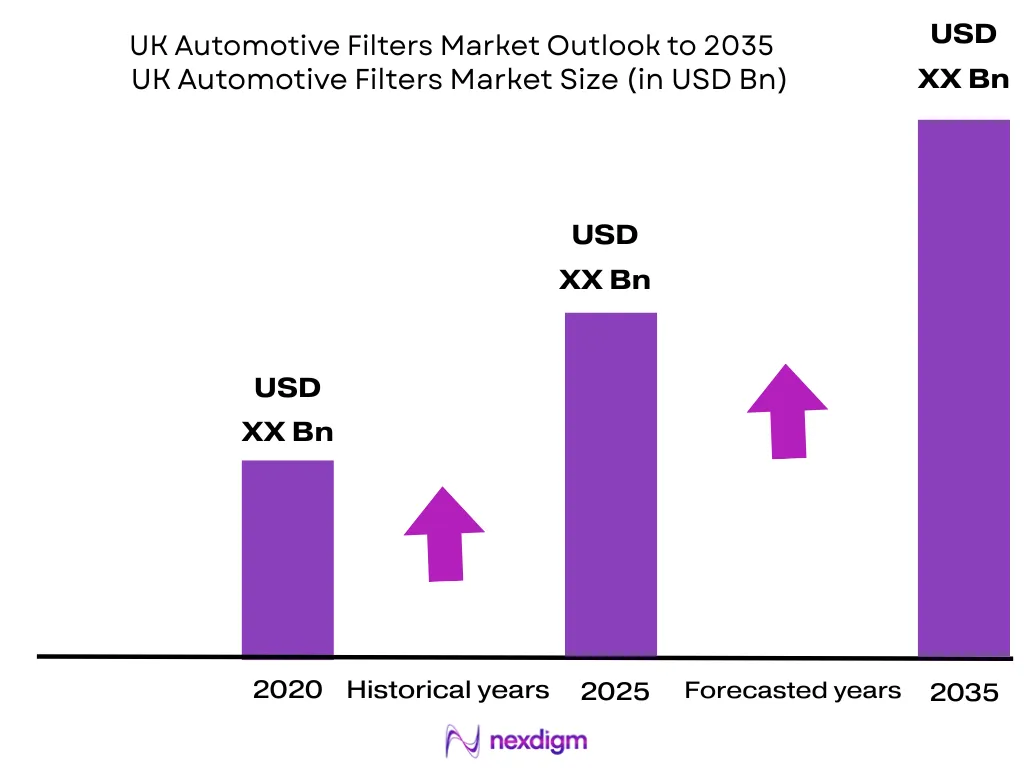
The UK Automotive Filters Market is valued at approximately ~ billion, compared with ~ billion in the preceding reporting period. Demand is supported by licensed vehicles increasing from approximately 41.3 million to 41.7 million, while first registrations rose from around 2.53 million to 2.61 million vehicles. Great Britain’s road traffic increased from approximately 330.8 billion to 336.2 billion vehicle miles, sustaining recurring replacement of oil, air, fuel, cabin, transmission, and emission-control filters. London, South East England, the West Midlands, North West England, Yorkshire and the Humber, and Scotland dominate the UK Automotive Filters Market because they combine large vehicle populations, dense garage networks, motorway activity, vehicle manufacturing, and commercial fleets. London supports taxi, private-hire, and delivery-vehicle maintenance, while the Midlands anchors automotive manufacturing and national parts distribution. Northern and central freight corridors generate substantial demand for diesel fuel, air, oil, crankcase, AdBlue, and particulate-filter servicing.
Market Segmentation
By Filter Type
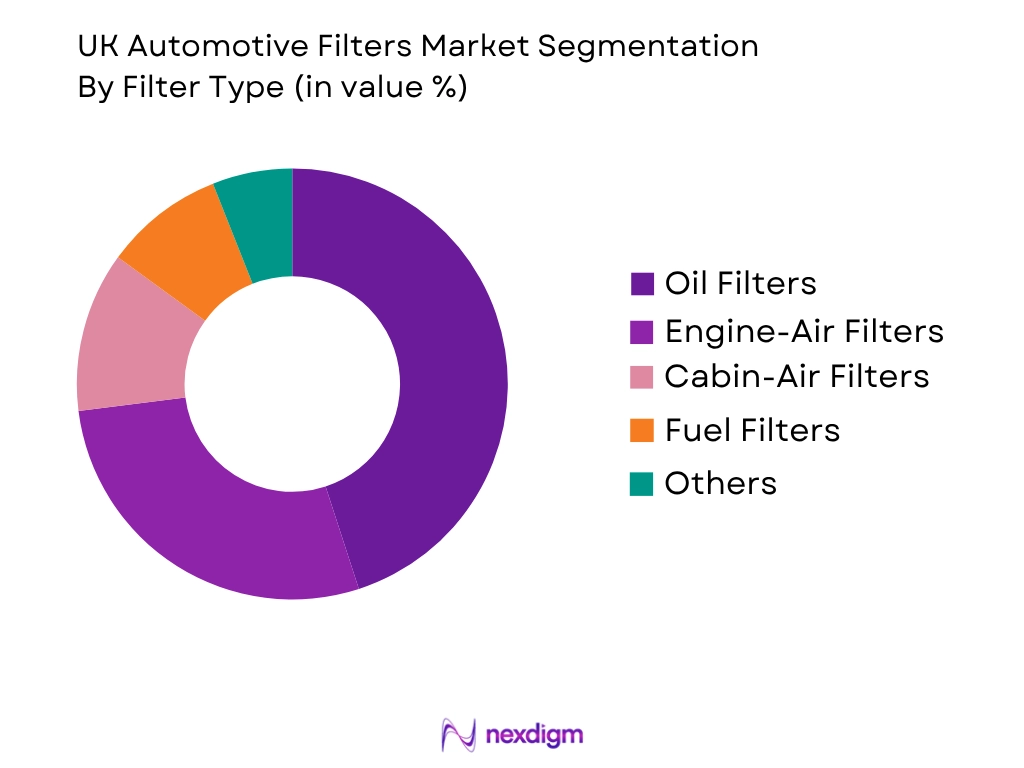
By filter type, the UK Automotive Filters Market is segmented into oil filters, engine-air filters, cabin-air filters, fuel filters, transmission and hydraulic filters, emission-control filters, and other filtration products. Oil filters hold the dominant market share because petrol, diesel, mild-hybrid, full-hybrid, van, HGV, bus, agricultural, and construction vehicles require recurring lubricant servicing. Oil filters are replaced during scheduled engine-oil changes and therefore benefit from one of the most established maintenance triggers in the automotive aftermarket. The segment includes spin-on, cartridge, full-flow, bypass, combination, centrifugal, synthetic-media, and extended-life filters. Dealerships and garages generally bundle oil filters into routine servicing, reducing dependence on consumers remembering a separate replacement interval. Commercial fleets generate additional demand because their vehicles operate at high annual mileage and require close control of lubrication cleanliness, downtime, and engine durability. Battery-electric vehicles gradually reduce addressable demand, but the installed petrol, diesel, and hybrid parc will preserve substantial replacement volumes throughout the outlook period.
By Sales Channel
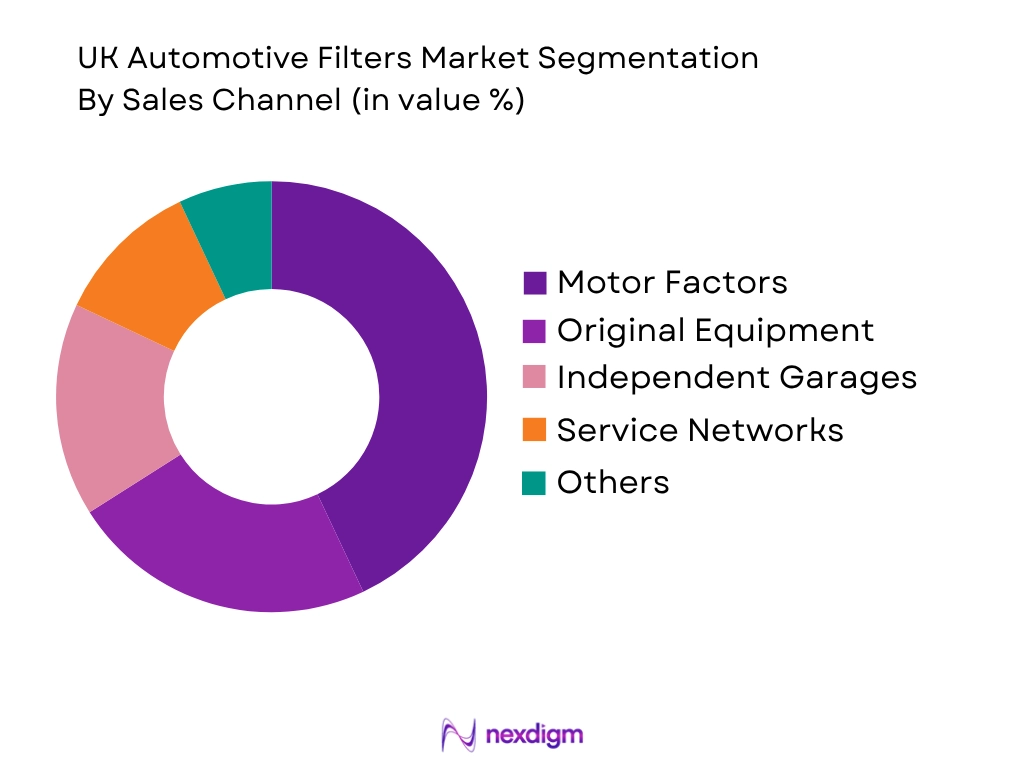
By sales channel, the UK Automotive Filters Market is segmented into motor factors and parts distributors, original-equipment supply, franchised dealerships, independent garages and autocentres, commercial fleet channels, online retailers, and mobile-service providers. Motor factors and parts distributors hold the dominant market share because they connect manufacturers with thousands of independent garages, mobile mechanics, body shops, fast-fit centres, and trade customers. This channel maintains extensive make–model–engine catalogues and provides same-day delivery of long-tail filter SKUs. Fitment accuracy is critical because filters differ by dimensions, seal profiles, bypass settings, flow rates, connector types, and engine variants. Motor factors also offer premium brands, original-equipment supplier products, mid-tier ranges, and private labels, allowing garages to match customer budgets. Online sales are expanding through registration-based lookup systems, but trade distribution remains important where vehicles occupy workshop bays and technicians require immediate replacement parts.
Competitive Landscape
The UK Automotive Filters Market is led by global filtration specialists, European automotive suppliers, heavy-duty filtration companies, and domestic aftermarket brands. MANN+HUMMEL, MAHLE, Donaldson, Parker Hannifin, and Hengst compete through original-equipment engineering, extensive replacement catalogues, proprietary media, filtration modules, and commercial-vehicle capability. Competition at workshop level is broader because these suppliers face private-label ranges, economy imports, genuine vehicle-manufacturer parts, and domestic distributors such as Comline, Apec, and Blue Print.
| Company | Establishment Year | Headquarters | Core Filter Portfolio | Vehicle Coverage | UK Channel Position | Media Capability | Heavy-Duty Capability | EV and Future-Mobility Readiness |
| MANN+HUMMEL | 1941 | Ludwigsburg, Germany | ~ | ~ | ~ | ~ | ~ | ~ |
| MAHLE | 1920 | Stuttgart, Germany | ~ | ~ | ~ | ~ | ~ | ~ |
| Donaldson Company | 1915 | Minneapolis, United States | ~ | ~ | ~ | ~ | ~ | ~ |
| Parker Hannifin | 1917 | Cleveland, United States | ~ | ~ | ~ | ~ | ~ | ~ |
| Hengst Filtration | 1958 | Münster, Germany | ~ | ~ | ~ | ~ | ~ | ~ |

UK Automotive Filters Market Analysis
Growth Drivers
Large Ageing Vehicle Parc and Increasing Road Utilisation
The UK’s large vehicle population and rising road mileage create recurring replacement demand for oil, engine-air, fuel, cabin-air, transmission and emission-control filters. The Department for Transport recorded 41.7 million licensed vehicles at the end of 2024, compared with approximately 41.3 million vehicles in 2023. The parc included 2.605 million vehicles registered for the first time, adding immediate original-equipment filter demand and enlarging the future service population. Great Britain’s road traffic increased from approximately 330.8 billion vehicle miles in 2023 to 336.2 billion miles in 2024, before reaching 342.6 billion miles in 2025. Cars and taxis travelled 256.1 billion miles in 2024, while vans completed 58.5 billion miles. These distances expose filters to oil degradation, intake dust, pollen, moisture, soot and fuel contamination. Older vehicles increasingly migrate from franchised dealerships to independent garages, autocentres and motor factors, supporting branded aftermarket and private-label filter sales. Petrol, diesel and hybrid vehicles require recurring engine filtration, while vans and commercial fleets generate shorter service cycles because of intensive daily operation. The IMF projects UK real GDP growth of 1.0% in 2026, consumer-price growth of 3.2%, and a population of 69.85 million. Although moderate growth may increase maintenance price sensitivity, owners must continue servicing essential filtration systems to protect engines, maintain fuel efficiency and keep vehicles operational.
Van, HGV and Diesel Emission-System Maintenance
High commercial-vehicle utilisation supports demand for advanced air, oil, fuel, crankcase, coolant, AdBlue and particulate filtration. Van traffic reached 58.5 billion vehicle miles in 2024, increasing from the preceding year and standing well above its pre-pandemic level. During the twelve months ending March 2025, vans travelled 59.0 billion miles, while lorries completed 16.6 billion miles and motorway traffic reached 69.9 billion miles. Delivery vans, tradespeople, logistics operators, buses and heavy goods vehicles operate under long-mileage, stop-start or high-load conditions that increase contaminant accumulation and shorten practical maintenance intervals. Modern common-rail diesel systems require fine fuel filtration and effective water separation because small particles or moisture can damage injectors and pumps. Diesel particulate filters also accumulate soot and non-combustible ash, creating demand for diagnosis, regeneration, professional cleaning and eventual replacement. MOT rules require a vehicle to fail where a factory-fitted particulate filter has been removed, preserving the integrity of the installed emission-control system. DVSA’s vehicle market-surveillance programme continued examining emissions-related vehicles and components during 2024, including technologies whose malfunction can increase particulate emissions. The IMF expects UK output to grow by 1.0% in 2026, indicating continued freight and business activity despite a restrained macroeconomic environment. Suppliers capable of combining heavy-duty filter portfolios with rapid parts delivery, mobile servicing, DPF support and fleet maintenance contracts can capture recurring demand from high-utilisation commercial operators.
Market Challenges
Battery-Electric Vehicle Expansion and Declining Engine-Filter Content
Battery-electric vehicle adoption creates a structural challenge for conventional oil, fuel, engine-air and exhaust-filtration suppliers. The UK had 1.394 million licensed zero-emission vehicles at the end of 2024, while 410,000 zero-emission vehicles were registered for the first time during the year. New registrations included 382,000 zero-emission cars and more than 22,000 zero-emission light goods vehicles. Electrification accelerated further in 2025, when 473,000 zero-emission cars and 31,000 zero-emission light commercial vehicles entered the road fleet. A battery-electric vehicle does not require an engine oil filter, combustion-air filter, petrol or diesel fuel filter, crankcase filter or tailpipe particulate filter. This reduces lifetime filter content compared with an internal-combustion vehicle and threatens suppliers concentrated in routine engine-service products. The transition does not remove filtration entirely: EVs continue to require cabin-air filters and may incorporate battery-cooling, vent, electric-drive, gearbox and thermal-fluid filtration. However, these products generally have different specifications, volumes and replacement intervals. Suppliers must manage a mixed parc containing petrol, diesel, mild-hybrid, full-hybrid, plug-in hybrid and battery-electric vehicles, each with distinct service requirements. The IMF projects only 1.0% UK GDP growth in 2026, making inefficient allocation of production capacity or inventory more costly. Manufacturers must therefore preserve coverage for the large combustion fleet while investing selectively in high-efficiency cabin filters, battery-system protection, fuel-cell air filtration and integrated thermal-management modules.
Extended Service Intervals, Fitment Complexity and Maintenance Deferral
Longer service intervals and growing vehicle-specific complexity can reduce annual filter transactions while increasing inventory and catalogue-management costs. Modern lubricants, improved engine control, cartridge filter modules and onboard service indicators allow many newer vehicles to operate longer between oil and filter changes than older models. At the same time, the UK parc contains 41.7 million vehicles spanning numerous engines, model generations, transmissions, emissions packages and hybrid systems. Filters can differ by thread size, cartridge height, seal diameter, bypass pressure, connector type, fuel-heater integration and cabin-filter shape. A catalogue or installation error can cause leakage, restricted flow, unfiltered bypass, warning lights, engine damage or workshop warranty claims. The challenge extends across motor factors, online retailers, garages and mobile mechanics that must hold or rapidly source thousands of low-volume SKUs. Consumer maintenance deferral creates additional pressure. The IMF projects consumer-price growth of 3.2% in 2026, while economic growth is expected to reach only 1.0%, encouraging some households to postpone non-visible maintenance such as cabin or engine-air filter replacement. Yet road traffic increased to 342.6 billion vehicle miles in 2025, meaning contamination exposure continues even when servicing is delayed. Counterfeit, economy and incorrectly specified products can also undermine trust in aftermarket filtration. Suppliers must invest in registration- and VIN-based fitment systems, detailed technical catalogues, installer training and transparent performance information covering filtration efficiency, pressure drop, dirt capacity and service life. Efficient same-day distribution is equally important because workshops cannot leave vehicles occupying service bays while uncommon filters are sourced.
Market Opportunities
Premium Cabin-Air Filtration for Urban Pollution and Allergens
Cabin-air filtration offers a significant growth opportunity because it remains relevant across petrol, diesel, hybrid and battery-electric vehicles. The UK operates 41.7 million licensed vehicles, including 1.394 million zero-emission vehicles, creating a broad powertrain-neutral replacement base. Cars and taxis travelled 256.1 billion miles in 2024, exposing occupants and HVAC systems to road dust, pollen, brake particles, tyre debris, odours and urban pollutants. Standard particulate filters can be upgraded to activated-carbon, allergen-reduction, antimicrobial, electrostatic and multilayer products that provide additional control of gases, fine particles and odours. Electric vehicles are particularly attractive for premium cabin filtration because their quieter powertrains make HVAC noise, odour and cabin-air quality more noticeable. High-utilisation taxis, private-hire vehicles, delivery vans and public fleets also provide recurring demand because multiple occupants and continuous ventilation increase filter loading. The opportunity extends beyond product sales to digital reminders, seasonal replacement programmes and inspection-led upselling through garages and autocentres. Suppliers can develop product ranges tailored to metropolitan pollution, pollen seasons and high-mileage fleet use rather than relying on a single standard filter. The IMF projects a UK population of 69.85 million in 2026, supporting a large consumer base, while 473,000 zero-emission cars were newly registered in 2025, further expanding future EV cabin-filter replacement demand. Brands that demonstrate low airflow resistance, verified particle capture, activated-carbon capacity and precise fitment can justify premium positioning without depending on conventional engine-filter demand.
Connected Fleet Filtration and DPF Service Networks
Connected filtration and specialised emission-system services create an opportunity to move from component sales toward recurring fleet-management revenue. Great Britain recorded 58.5 billion van miles in 2024, while vans travelled 59.0 billion miles and lorries 16.6 billion miles in the twelve months ending March 2025. These high-utilisation fleets are sensitive to roadside failures, workshop downtime, fuel contamination and missed service intervals. Air-filter restriction sensors can identify excessive pressure drop, while fuel-water sensors, oil-condition monitoring and telematics can support condition-based replacement rather than fixed calendar servicing. This helps operators avoid both premature filter changes and failures caused by overloaded media. DPF services provide another opportunity. Vehicles requiring a particulate filter must retain it for MOT compliance, and government research has examined particle-number testing as a more effective method of identifying damaged or removed filters. Specialist providers can offer forced regeneration, thermal or pneumatic cleaning, flow testing, ash measurement, core exchange and post-service diagnostics. Fleets can also bundle oil, fuel, crankcase, coolant and air-dryer filters into mileage-based maintenance contracts supported by automatic replenishment. Motorway traffic reached 71.9 billion vehicle miles in 2025, illustrating the scale of long-distance vehicle operation that can benefit from predictive servicing. Despite IMF-projected GDP growth of only 1.0% in 2026, logistics, public transport, utilities and essential delivery activity will continue. Filtration suppliers with connected monitoring, nationwide motor-factor coverage, mobile technicians and documented cost-per-mile performance can build durable relationships with van, HGV, bus and municipal fleet operators.
Future Outlook
The UK Automotive Filters Market is forecast to expand at approximately ~ CAGR during the forecast period. Growth will be supported by an ageing vehicle parc, increasing road mileage, van activity, commercial-fleet maintenance, cabin-air-quality awareness, and tighter control of in-use vehicle emissions.The market will undergo a shift in product composition rather than uniform expansion across all filter categories. Battery-electric vehicles reduce conventional engine-air, oil, and fuel-filter demand, but create requirements for premium cabin filtration, battery-cooling filters, vent protection, electric-drive filtration, and thermal-management products. Road usage will remain a fundamental demand driver. Great Britain recorded 336.2 billion vehicle miles, followed by 342.6 billion vehicle miles in the subsequent annual reporting period. Van traffic is particularly relevant, reaching approximately 59.9 billion miles in the twelve months ending September 2025, while lorries travelled approximately 16.7 billion miles. These duty cycles support frequent air, oil, fuel, crankcase, coolant, and emission-system maintenance.
Major Players
- MANN+HUMMEL UK
- MAHLE Aftermarket UK
- Robert Bosch UK
- Donaldson Filtration Great Britain
- Parker Hannifin UK
- Hengst Filtration UK
- UFI Filters UK
- Sogefi Filtration
- DENSO Aftermarket UK
- Atmus Filtration Technologies UK
- First Brands Group
- K&N Filters Europe
- Comline Auto Parts
- Apec Automotive
- Blue Print
Key Target Audience
- Automotive filter and filtration-module manufacturers
- Passenger, van, HGV, bus, and off-highway vehicle manufacturers
- Motor factors and automotive parts distributors
- Independent garages, autocentres, and franchised service networks
- Logistics, rental, taxi, delivery, bus, and municipal fleets
- Filter-media, activated-carbon, housing, seal, and sensor suppliers
- Investments and venture capitalist firms
- Government and regulatory bodies (Department for Transport, Driver and Vehicle Standards Agency, Vehicle Certification Agency, Environment Agency, Office for Zero Emission Vehicles, and local authority environmental bodies)
Research Methodology
Step 1: Identification of Key Variables
The first stage constructs an ecosystem map covering filter manufacturers, vehicle OEMs, media suppliers, motor factors, garages, fleets, recyclers, and regulators. Core variables include licensed vehicles, vehicle age, annual mileage, filter content per vehicle, replacement intervals, propulsion type, product tier, and distribution channel.
Step 2: Market Analysis and Construction
Historical vehicle-licensing, traffic, MOT, new-registration, and servicing data are compiled. Top-down analysis estimates the share of automotive maintenance expenditure attributable to filtration, while bottom-up analysis uses vehicle populations, service intervals, filter quantities, replacement rates, and average selling values.
Step 3: Hypothesis Validation and Expert Consultation
Market hypotheses are validated through computer-assisted telephone interviews with filter manufacturers, motor factors, garage owners, technicians, fleet managers, DPF specialists, and media suppliers. These interviews assess SKU movement, service frequency, fitment errors, private-label penetration, fleet contracts, and electrification effects.
Step 4: Research Synthesis and Final Output
The final phase triangulates official vehicle data, supplier catalogues, company disclosures, workshop evidence, and primary interviews. Market values are reconciled across original equipment, dealer servicing, independent aftermarket, fleet-direct, and online channels to prevent distributor and retail revenue from being counted twice.

- Executive Summary
- Research Methodology (Market Definitions and Assumptions, Automotive Filter Market Boundary, Abbreviations, Market Sizing Approach, Top-Down Analysis, Bottom-Up Analysis, Vehicle Parc–Based Demand Modelling, Filter Replacement Interval Assessment, Vehicle Mileage Analysis, Original Equipment Installation Assessment, Aftermarket Sell-Out Assessment, Fleet Maintenance Assessment, Primary Industry Interviews, Data Triangulation, Forecasting Framework, Limitations and Future Conclusions)

- Definition and Scope
- Market Evolution and Industry Genesis
- Timeline of Major Industry Developments
- Automotive Filtration Technology Evolution
- Passenger Car, Van and Commercial Vehicle Filtration Ecosystem

- Growth Drivers (Large Ageing Vehicle Parc, High Vehicle Mileage, Preventive Maintenance Demand, Van Fleet Expansion, HGV Utilisation, Cabin Air Quality Awareness)
- Market Challenges (EV Transition, Extended Service Intervals, Private-Label Competition, Counterfeit Risk, Imported Supply, Fitment Complexity)
- Market Opportunities (Cabin Filtration, Connected Filters, EV Thermal Management, Fleet Analytics, DPF Services, Sustainable Materials)
- Market Trends (Digital Fitment, Premium Cabin Filtration, Connected Maintenance, Longer Service Life, Sustainable Media, Omnichannel Retail)
- Government Regulations (Vehicle Emissions, MOT Requirements, Product Safety, Type Approval, Waste Management, Workshop Compliance)
- SWOT Analysis
- Porter’s Five Forces Analysis
- PESTLE Analysis

- By Market Value (2020-2025)
- By Filter Unit Sales (2020-2025)
- By Original Equipment Revenue (2020-2025)


- Market Share of Major Players (By Value, Unit Volume, Filter Type, Vehicle Application, Sales Channel)
- Cross Comparison Parameters (Engine Air–Oil–Fuel–Cabin–Transmission–Emission Filter Portfolio Breadth, Passenger–SUV–Van–HGV–Off-Highway Vehicle Coverage, UK and European OEM Fitment and Integrated Filtration Module Capability, Filtration Efficiency–Pressure Drop–Dirt-Holding Capacity–Service-Life Performance, Motor Factor–Garage–HGV Distributor–E-Commerce Network Reach, Synthetic–Nanofibre–Activated Carbon–Biofunctional Media Capability, EV Battery Cooling–Fuel Cell–Thermal Management Filtration Readiness, Connected Filter Monitoring–Private-Label–Sustainable Product Innovation)
- SWOT Analysis of Major Players
- Detailed Profiles of Major Companies
MANN+HUMMEL UK
MAHLE Aftermarket UK
Robert Bosch UK
Donaldson Filtration Great Britain
Parker Hannifin UK
Hengst Filtration UK
UFI Filters UK
Sogefi Filtration
DENSO Aftermarket UK
Atmus Filtration Technologies UK
First Brands Group
K&N Filters Europe
Comline Auto Parts
Apec Automotive
Blue Print

- Individual Passenger Car Owner Analysis
- SUV and Crossover Owner Analysis
- Van and Light Commercial Vehicle Operator Analysis
- Battery Electric Vehicle Owner Analysis
- Hybrid Vehicle Owner Analysis

- By Market Value (2026-2035)
- By Filter Unit Sales (2026-2035)
- By Original Equipment Revenue (2026-2035)


 Request a Sample
 Ask for Customization
 Get a Quote
 Enquire Now