

 Download PDF
Market Overview
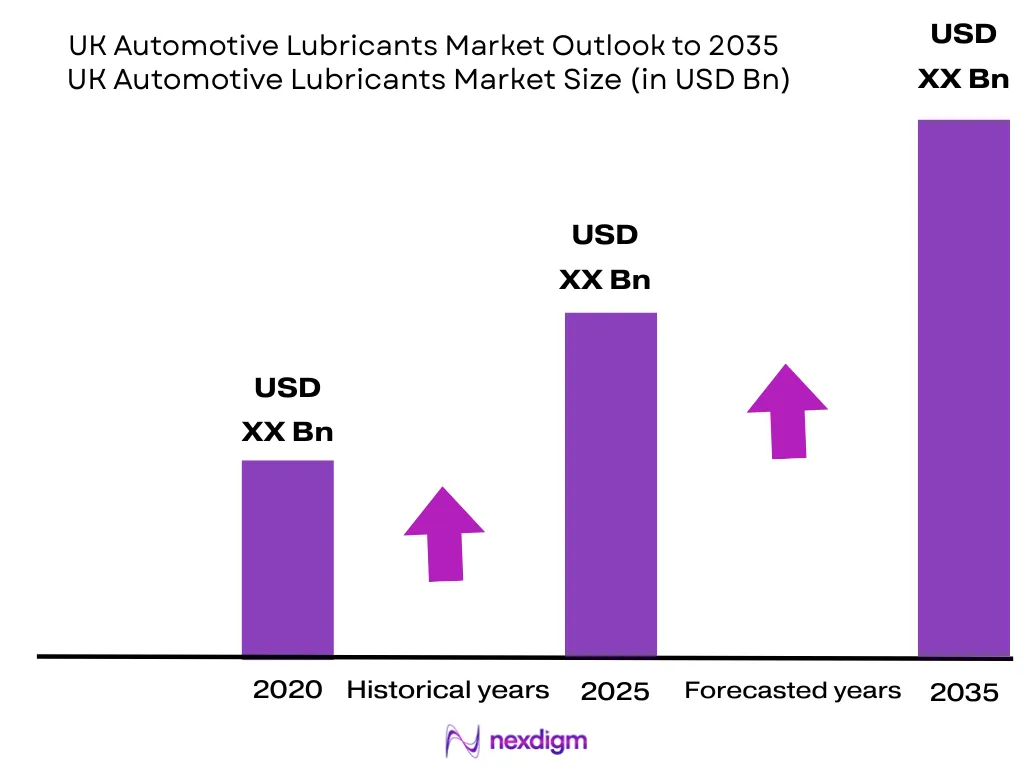
The UK Automotive Lubricants Market is valued at approximately ~ billion, supported by a licensed vehicle base that increased from 41.2 million to 41.7 million vehicles and first-time registrations that increased from approximately 2.5 million to 2.605 million vehicles. Road activity simultaneously expanded from 330.8 billion to 336.2 billion vehicle miles, sustaining recurring consumption of engine oils, transmission fluids, gear lubricants, greases, coolants and other service fluids. South East England, the East of England, North West England, West Midlands and Greater London are major UK automotive-lubricant demand centres because they combine dense vehicle populations, motorway corridors, logistics fleets, workshops, parts factors and dealerships. South East road traffic increased from 52.8 billion to 53.6 billion vehicle miles, while East of England traffic increased from 37.9 billion to 38.3 billion miles, supporting frequent passenger-car, van and commercial-vehicle maintenance requirements.
Market Segmentation
By Product Type
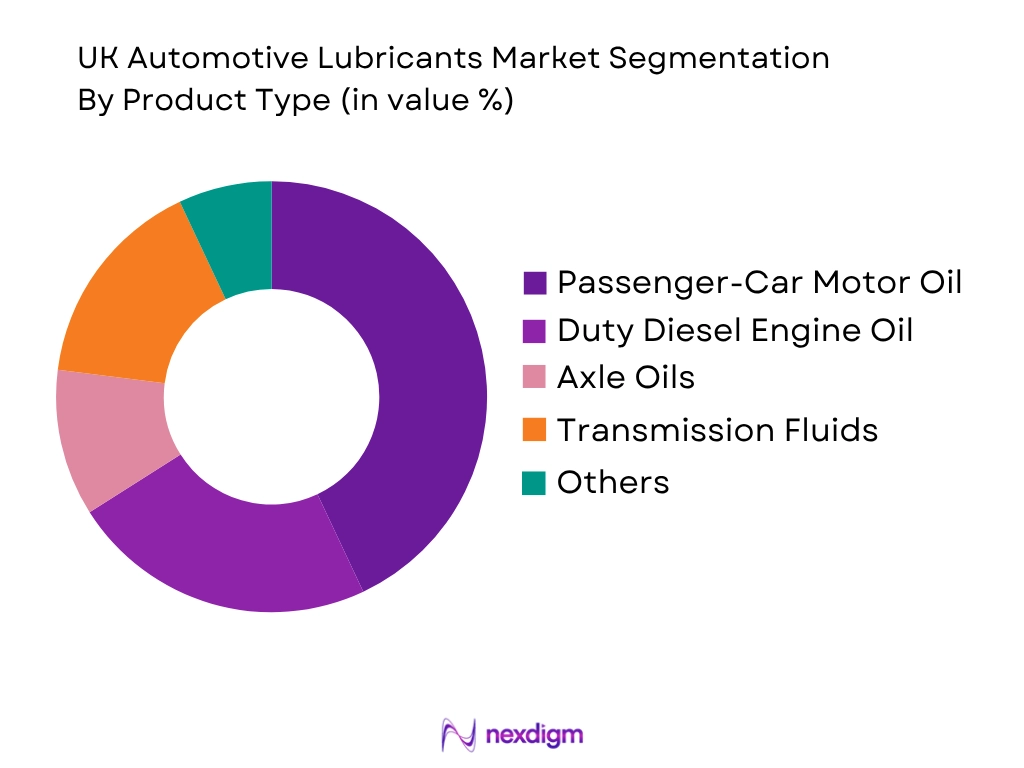
By product type, the UK Automotive Lubricants Market is segmented into passenger-car motor oil, heavy-duty diesel engine oil, transmission fluids, gear and axle oils, automotive greases, coolants and antifreeze, brake and hydraulic fluids, and hybrid or electric-vehicle functional fluids. Passenger-car motor oil holds the dominant market share because the UK operates a substantial passenger-car parc requiring recurring service-fill maintenance throughout increasingly long vehicle lifecycles. The average licensed car is now approximately 10 years old, making engine condition, viscosity suitability and high-mileage protection increasingly important. Passenger-car oils also have greater specification diversity than many other lubricant categories, covering low-SAPS formulations, full synthetics, high-mileage oils and OEM-specific approvals. The extensive network of franchised dealerships, independent garages, fast-fit chains, motor factors and online retailers further strengthens replacement availability. Lower-viscosity SAE grades are also increasing the value contribution of technologically advanced synthetic formulations as modern engines require stronger oxidation, wear and emission-system protection.
By Lubricant Technology
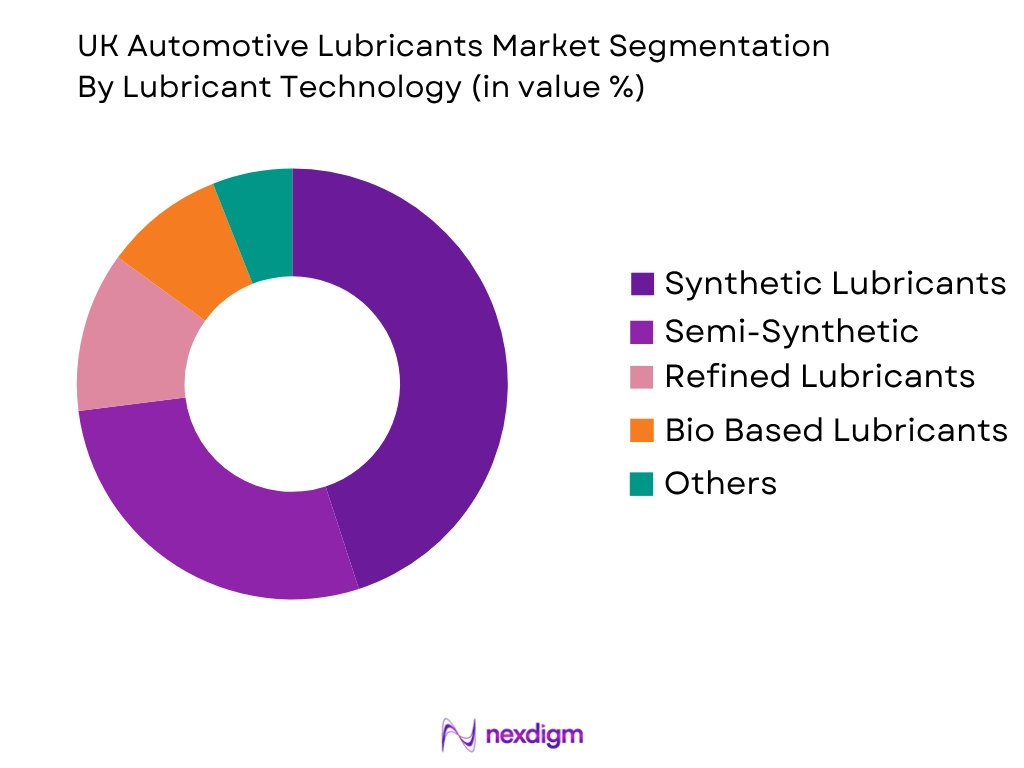
By lubricant technology, the UK Automotive Lubricants Market is segmented into mineral lubricants, semi-synthetic lubricants, full-synthetic lubricants, low-SAPS lubricants, re-refined products and specialised hybrid or electric-vehicle fluids. Full-synthetic lubricants hold the dominant market share because the UK vehicle parc contains a high concentration of relatively sophisticated European and Asian vehicles requiring precise viscosity grades and manufacturer approvals. Turbocharging, gasoline direct injection, diesel particulate filters, start-stop systems and extended service intervals increase the importance of oxidation stability and viscosity retention. ACEA C-category low-SAPS products have particular relevance for vehicles fitted with exhaust after-treatment equipment. Full-synthetic oils also support increasingly common SAE 0W-20, 0W-30 and 5W-30 applications. Longer vehicle retention reinforces synthetic demand because motorists and workshops frequently select premium formulations to protect ageing engines while retaining compatibility with manufacturer specifications. Electrified vehicles are further expanding the importance of technically specialised fluids rather than commodity mineral oils.
Competitive Landscape
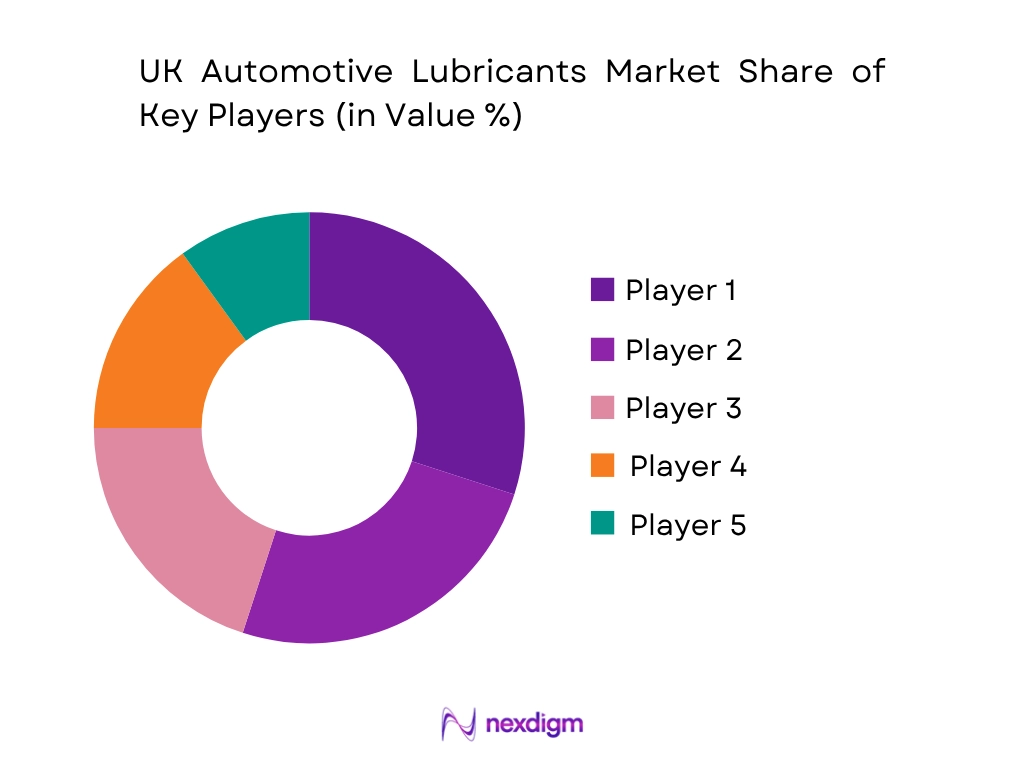
The UK Automotive Lubricants Market combines multinational energy and lubricant companies with established domestic independent manufacturers. Castrol, Shell, Mobil, FUCHS and Morris Lubricants maintain strong positions through broad passenger-car and commercial-vehicle portfolios, OEM approvals, synthetic technologies, workshop relationships and technical support. Competition increasingly centres on low-SAPS oils, low-viscosity formulations, hybrid compatibility, EV fluids, digital lubricant selectors and sustainability rather than conventional engine oil alone. ExxonMobil markets both Mobil and Esso lubricants in the UK, while FUCHS operates a UK manufacturing site in Stoke-on-Trent.
| Company | Established | Headquarters | Core Automotive Portfolio | Synthetic / Low-SAPS Capability | Heavy-Duty Capability | Hybrid / EV Readiness | UK Operating Footprint | Primary Market Channels |
| Castrol | 1899 | Sunbury-on-Thames, UK | ~ | ~ | ~ | ~ | ~ | ~ |
| Shell | 1907 | London, UK | ~ | ~ | ~ | ~ | ~ | ~ |
| ExxonMobil | 1999 | Spring, Texas, USA | ~ | ~ | ~ | ~ | ~ | ~ |
| FUCHS | 1931 | Mannheim, Germany | ~ | ~ | ~ | ~ | ~ | ~ |
| Morris Lubricants | 1869 | Shrewsbury, UK | ~ | ~ | ~ | ~ | ~ | ~ |
UK Automotive Lubricants Market Analysis
Growth Drivers
Large Aging Vehicle Parc and Sustained Road Utilisation
The UK Automotive Lubricants Market is fundamentally supported by a large vehicle parc that continues to generate recurring service-fill requirements for engine oils, transmission fluids, gear lubricants, greases, coolants and brake fluids. Department for Transport data show that the UK had 41.7 million licensed vehicles at the end of 2024, including 33.967 million cars, 4.790 million light goods vehicles, 518,000 heavy goods vehicles, 1.355 million motorcycles, and 143,000 buses and coaches. During the same period, 2.605 million vehicles were registered for the first time, continually replenishing the future lubricant-service population. Road usage provides an even stronger indication of lubricant demand intensity. Great Britain recorded 336.2 billion vehicle miles in 2024, comprising 256.1 billion car miles, 58.5 billion van miles, and 16.6 billion lorry miles. Department for Transport figures for 2025 subsequently show car traffic reaching 262.4 billion miles, van traffic 58.8 billion miles, and lorry traffic 16.3 billion miles, demonstrating that the underlying service requirement remains substantial even as the powertrain mix changes. High mileage matters directly to lubricant suppliers because repeated thermal cycling, mechanical loading, contaminant accumulation and oxidation gradually degrade engine and driveline fluids. The UK’s ageing vehicle stock further strengthens this mechanism because older combustion vehicles remain in operation longer and can require high-mileage oils, higher-viscosity grades, coolant replacement, transmission servicing and differential lubricants. Commercial vans are especially relevant: they accumulated 58.5 billion miles during 2024, including 13.2 billion motorway miles, 24.7 billion miles on A roads, and 20.6 billion miles on minor roads. Such vehicles support parcel delivery, trades, utilities and other business activity and often operate under stop-start or heavily loaded conditions that place additional stress on lubricants. The broader macroeconomic environment provides a substantial consumption base. World Bank data place UK GDP at approximately USD 3.686 trillion in 2024, GDP per capita at USD 53,246.4, and population at 69,226,000. The population increased to 69,487,000 in 2025, sustaining a large mobility and vehicle-maintenance ecosystem. These conditions give lubricant manufacturers continuing opportunities across independent garages, fast-fit chains, franchised dealerships, parts factors, fleet depots and e-commerce channels. The most important implication is that electrification does not immediately remove lubricant demand: more than 40 million road-using vehicles remain in operation, while hundreds of billions of vehicle miles continue to create wear and service events. This provides a durable installed base for passenger-car motor oils, heavy-duty lubricants and functional fluids throughout the outlook period.
Synthetic Lubricant Adoption Driven by Modern Engine and Emission-System Requirements
The technological sophistication of the UK vehicle parc is increasing the importance of full-synthetic, low-viscosity and low-SAPS automotive lubricants. Modern petrol and diesel engines incorporate turbocharging, direct injection, particulate filters, catalytic after-treatment systems, start-stop operation, variable valve timing and tighter mechanical tolerances. These technologies require oils with greater oxidation stability, deposit control, wear protection and carefully controlled sulphated ash, phosphorus and sulphur characteristics. The size of the addressable service population makes this transition commercially significant: the UK contained 33.967 million licensed cars, 4.790 million light goods vehicles, and 518,000 heavy goods vehicles in 2024. New registrations added another 2.605 million vehicles, ensuring that more engines designed around modern lubricant specifications entered the parc. Road operating intensity reinforces the requirement. Cars travelled 256.1 billion miles during 2024, while vans travelled 58.5 billion miles and lorries 16.6 billion miles. During 2025, car mileage increased further to 262.4 billion miles, meaning sophisticated lubricants are being subjected to substantial real-world operating conditions rather than remaining low-utilisation niche products. The transition also affects product mix because European vehicle manufacturers commonly specify SAE 0W-20, 0W-30 and 5W-30 oils alongside detailed ACEA and proprietary OEM requirements. For independent workshops and parts distributors, this increases the need to stock multiple specification-specific products rather than generic multigrade oils. Synthetic products are particularly well positioned because they can deliver improved cold-flow performance, viscosity retention and oxidation control while supporting extended service intervals.
Market Challenges
Rapid Electrification and Structural Reduction in Crankcase Lubricant Demand
Electrification represents the most important structural challenge for the UK Automotive Lubricants Market because battery-electric vehicles eliminate conventional internal-combustion engine oil and remove several associated service requirements. Department for Transport statistics show that the UK had 1.394 million licensed zero-emission vehicles at the end of 2024, including 1.287 million zero-emission cars, 86,000 light goods vehicles, 14,000 motorcycles, 5,000 buses and coaches, and approximately 1,000 heavy goods vehicles. During 2024 alone, 410,000 zero-emission vehicles were registered for the first time, including 382,000 zero-emission cars. This creates a direct substitution challenge because each battery-electric passenger vehicle entering service permanently removes recurring crankcase-oil changes that would otherwise occur throughout a combustion vehicle’s operating life. The effect extends beyond engine oil: fully electric architectures can eliminate conventional automatic-transmission fluids used in multi-speed ICE gearboxes, while reducing demand for certain exhaust-system, combustion-related and engine-cooling maintenance products. At the same time, the transition does not happen uniformly. The UK still had 40.848 million licensed road-using vehicles in 2024, meaning lubricant manufacturers must serve an enormous legacy petrol and diesel population while investing in fluid technologies for a much smaller but rapidly expanding electric fleet. This parallel requirement increases formulation, inventory and technical-support costs. The changing manufacturing base reinforces the issue. UK factories produced 905,233 vehicles during 2024, but the Society of Motor Manufacturers and Traders characterised the period as one of major EV transformation and retooling. As new production shifts toward battery-electric and electrified models, factory-fill lubricant requirements also change from engine oils toward reduction-gear fluids, e-axle lubricants, dielectric coolants and specialised greases. The broader economy can absorb this transition—the World Bank reports UK GDP at USD 3.686 trillion in 2024 and population at 69,226,000—but lubricant suppliers must still redesign their revenue mix. The challenge is especially important for companies heavily exposed to packaged passenger-car motor oil or frequent oil-change channels. Battery-electric vehicles need far fewer litres of routinely replaced lubricant, and emerging fluids may have longer service lives. Suppliers must therefore compensate through technically specialised products, transmission and driveline servicing for the remaining ICE fleet, commercial-vehicle lubricants, high-mileage formulations, and new thermal-management technologies. Electrification is consequently not simply another segment within the market; it changes the volume economics of lubricant consumption and requires suppliers to migrate from recurring crankcase demand toward lower-volume but higher-specification functional fluids.
Extended Drain Intervals, Specification Fragmentation and Workshop Compliance Complexity
The UK Automotive Lubricants Market also faces pressure from longer service intervals and increasingly fragmented technical requirements. Modern full-synthetic formulations, sophisticated oil-life monitoring systems and improved engine management allow many vehicles to operate longer between scheduled oil changes than older vehicles. This reduces lubricant litres consumed per vehicle even when road mileage remains strong. Great Britain recorded 336.2 billion vehicle miles in 2024, rising from the previous year, while car mileage reached 256.1 billion miles and van mileage 58.5 billion miles. In 2025, car traffic increased again to 262.4 billion miles and van traffic reached 58.8 billion miles. Despite this high utilisation, improved lubricant durability means service events do not necessarily increase in direct proportion to mileage, requiring suppliers to generate more value from each maintenance occasion. The problem is compounded by product fragmentation. A modern UK workshop may service vehicles requiring different ACEA categories, SAE viscosity grades and proprietary manufacturer approvals across BMW, Mercedes-Benz, Volkswagen Group, Stellantis, Jaguar Land Rover, Ford, Toyota, Hyundai, Kia and other brands. The 33.967 million licensed passenger cars and 4.790 million light goods vehicles recorded during 2024 contain multiple generations of engine technology, from older naturally aspirated petrol and diesel engines to downsized turbocharged engines, mild hybrids and plug-in hybrids. Incorrect fluid selection can affect particulate-filter durability, timing systems, turbocharger lubrication and warranty compliance, making technical data management increasingly important. Environmental compliance adds another operational burden. GOV.UK requirements apply specific oil-storage controls to business containers holding 201 litres or more of covered oils, including synthetic motor oils and lubricating or hydraulic oils under applicable circumstances. Waste-oil activities can additionally require environmental permits or exemptions. Under the S1 waste-storage exemption, eligible operators can store waste oil before recovery under prescribed conditions, including a maximum of 20 containers, storage not exceeding 12 months, and secondary containment for waste oils and oil filters. These obligations affect workshops, fleet maintenance facilities and other lubricant-handling businesses, increasing requirements for storage infrastructure, documentation and trained personnel. The UK’s USD 3.686 trillion economy supports a sophisticated automotive aftermarket, but that sophistication itself creates costs. Distributors must carry more SKUs, technicians must identify exact specifications, and suppliers must maintain product databases and technical support. The resulting challenge is a market where substantial vehicle mileage does not guarantee equivalent volume expansion because longer intervals reduce consumption while regulation and specification complexity simultaneously raise the cost of serving each vehicle accurately.
Market Opportunities
Hybrid and Electric-Vehicle Functional Fluids as a New High-Technology Product Category
The UK’s accelerating electrification creates a substantial opportunity for lubricant companies that can reposition themselves from engine-oil suppliers toward broader vehicle-fluid technology providers. Department for Transport data show 1.394 million licensed zero-emission vehicles on UK roads at the end of 2024, including 1.287 million zero-emission cars and 86,000 zero-emission light goods vehicles. In the same year, 410,000 zero-emission vehicles were registered for the first time. These are current installed vehicles requiring real-world servicing rather than future projections, providing a measurable base for specialised electric-drive and thermal-management products. Electric vehicles require reduction-gear fluids, e-axle lubricants, bearing greases, compressor oils and cooling fluids capable of meeting electrical, thermal and material-compatibility requirements. Compared with conventional engine oil, these products must often combine lubrication with characteristics such as controlled conductivity, copper compatibility, oxidation stability, heat transfer and resistance to degradation around electronic components. Hybrid vehicles create another opportunity because they retain combustion engines while introducing unusual lubrication conditions. Their engines may experience frequent cold starts, intermittent operation and long inactive periods, increasing the importance of moisture control, corrosion protection and low-temperature performance. The UK’s broader vehicle parc ensures suppliers can develop these technologies without abandoning conventional demand. There were 41.7 million licensed vehicles in total at the end of 2024, so the market provides a long transition period during which hybrid, electric and ICE products can coexist. Commercial interest in advanced thermal-management technology is already evident. Shell completed its acquisition of UK-based MIDEL and MIVOLT in 2024, adding ester-based dielectric and immersion-cooling technologies relevant to batteries and electrical equipment. Such corporate activity shows that lubricant companies increasingly view thermal management as an extension of their automotive fluid capabilities. The macroeconomic base further supports product commercialisation: World Bank figures place UK GDP at USD 3.686 trillion, GDP per capita at USD 53,246.4, and population at 69,226,000 in 2024, increasing to 69,487,000 in 2025. This provides a large, affluent market for technologically advanced vehicles and premium maintenance products. For lubricant companies, future growth can come from securing OEM approvals, partnering with EV component manufacturers, developing e-fluid laboratory capability and training workshops to identify appropriate EV and hybrid products. The opportunity is not to replace every lost litre of engine oil with an equal litre of EV fluid; it is to migrate into specialised categories where technical performance, safety and manufacturer compatibility create stronger barriers to entry and higher strategic value.
Fleet Lubrication, Condition Monitoring and Circular Used-Oil Services
Commercial fleets provide a major growth opportunity for the UK Automotive Lubricants Market because fleet operators place greater emphasis on vehicle uptime, maintenance predictability and total operating efficiency than individual motorists. Great Britain’s vans travelled 58.5 billion miles during 2024, including 13.2 billion miles on motorways, 24.7 billion miles on A roads and 20.6 billion miles on minor roads. Lorries accumulated another 16.6 billion miles. Department for Transport data for 2025 show van traffic remaining high at 58.8 billion miles and lorry traffic at 16.3 billion miles. These volumes provide a substantial current operating base for heavy-duty engine oil, transmission fluid, axle oil, chassis grease, coolant and specialised commercial-vehicle maintenance products. The addressable fleet population is similarly large, with 4.790 million licensed light goods vehicles and 518,000 heavy goods vehicles in 2024. Instead of competing solely through packaged lubricants, suppliers can use this installed base to offer bulk delivery, tank monitoring, oil analysis, lubricant-consolidation programs and condition-based drain optimisation. Used-oil recovery creates an additional service layer. UK environmental requirements regulate storage and handling of oil at businesses, with specific requirements applying to relevant storage containers from 201 litres upward. Waste-storage rules can permit eligible waste oil to be held before recovery under controlled conditions, including prescribed container and retention limits. These requirements create an opportunity for lubricant suppliers and waste-management partners to bundle virgin lubricant supply with compliant collection and recovery services. A fleet depot purchasing bulk heavy-duty engine oil can generate predictable quantities of used lubricant at the same location, making closed-loop logistics operationally attractive. Digitalisation can further strengthen the proposition. Telematics, vehicle mileage data, engine hours, laboratory oil analysis and bulk-tank sensors can help operators schedule maintenance based on actual condition rather than generic intervals. With Great Britain’s road system carrying 336.2 billion vehicle miles in 2024 and the UK economy producing USD 3.686 trillion of GDP, even incremental improvements in commercial-fleet maintenance represent a significant addressable service opportunity. The transition to electric vans and trucks does not eliminate this model; it changes the fluid portfolio. Suppliers can gradually incorporate reduction-gear fluids, battery coolants and electric-motor greases into the same fleet relationship. Companies that integrate lubricant chemistry, monitoring, supply logistics, waste-oil recovery and technical support can therefore move beyond commodity product sales and build recurring service relationships with delivery fleets, logistics companies, bus operators, leasing companies and public-sector fleets.
Future Outlook
The UK Automotive Lubricants Market is projected to expand at approximately ~XX% CAGR during 2026-2035. Market development will increasingly depend on product-value growth rather than proportional increases in lubricant volume. Full-synthetic conversion, ageing combustion vehicles, sophisticated OEM specifications and commercial-vehicle utilisation will sustain conventional lubricant demand, while electrification will redirect product development toward e-drive fluids, thermal-management liquids and electrically compatible greases. Battery-electric vehicles will progressively reduce crankcase lubricant demand. The number of licensed zero-emission vehicles increased from approximately 1.0 million to 1.394 million, while zero-emission first registrations increased from 342,000 to 410,000. This transition creates simultaneous contraction and diversification: suppliers lose repeated engine-oil changes from BEVs but gain opportunities in reduction-gear fluids, e-axle lubrication, electric-motor bearing grease, compressor oil and battery thermal management. A sizeable combustion-engine aftermarket will nevertheless persist. The UK had approximately 33.967 million licensed road-using cars, 4.790 million light goods vehicles, 518,000 heavy goods vehicles and 1.355 million motorcycles at the end of the reporting period. Moreover, the average licensed passenger car was approximately 10 years old, supporting high-mileage engine oils, transmission servicing, coolant replacement and other maintenance fluids even as new-car electrification accelerates. Commercial vehicles will remain strategically important. Van traffic reached approximately 58.5 billion vehicle miles, while HGV traffic amounted to 16.6 billion vehicle miles. Commercial operators place greater emphasis on uptime, drain intervals, fuel economy, oil analysis and total maintenance cost, creating opportunities for lubricant manufacturers to combine products with technical services, condition monitoring and bulk supply contracts.
Major Players
- Castrol
- Shell Lubricants UK
- ExxonMobil – Mobil
- FUCHS Lubricants UK
- PETRONAS Lubricants International UK
- TotalEnergies Lubricants UK
- Valvoline Global Operations
- Motul UK
- Gulf Oil International UK
- Morris Lubricants
- Millers Oils
- Witham Group
- Comma Oil & Chemicals
- LIQUI MOLY UK
- Chevron Lubricants – Texaco/Havoline
Key Target Audience
- Automotive lubricant manufacturers and blenders
- Base-oil producers and lubricant additive suppliers
- Automotive OEMs and vehicle dealership groups
- Automotive parts factors, workshops and fast-fit service networks
- Passenger, van, HGV, bus, rental and leasing fleet operators
- Used-oil collectors, processors and lubricant circularity companies
- Investments and venture capitalist firms
- Government and regulatory bodies (Department for Transport, Driver and Vehicle Licensing Agency, Environment Agency, Department for Energy Security and Net Zero, Health and Safety Executive, Competition and Markets Authority)
Research Methodology
Step 1: Identification of Key Variables
The initial phase develops an ecosystem map covering base-oil suppliers, additive manufacturers, lubricant blenders, importers, distributors, parts factors, dealerships, workshops, fast-fit centres, fleet operators and waste-oil processors. Critical variables include vehicle parc, annual mileage, oil-change frequency, sump capacity, viscosity grade, ACEA classification, OEM approval and distribution channel.
Step 2: Market Analysis and Construction
Historical vehicle registrations, vehicle miles, automotive manufacturing, factory-fill requirements and service-fill lubricant demand are compiled. The analysis separates passenger-car engine oil, heavy-duty diesel oil, transmission fluids, axle lubricants, greases, coolants and emerging EV functional fluids to establish the market structure.
Step 3: Demand-Side Assessment
Individual motorists, company-car fleets, leasing providers, delivery fleets, HGV operators, bus companies, dealerships, independent workshops and fast-fit chains are evaluated. Key demand variables include vehicle age, mileage, powertrain, service interval, lubricant specification, pack size, brand preference and maintenance channel.
Step 4: Supply-Side Assessment
Major suppliers are compared across synthetic-product breadth, ACEA categories, OEM approvals, UK manufacturing or distribution capacity, passenger and commercial portfolios, fleet support, workshop penetration, hybrid formulations, EV-fluid development and environmental initiatives.

- Executive Summary
- Research Methodology (Market Definitions and Assumptions, Abbreviations, Market Sizing Approach, Top-Down Analysis, Bottom-Up Analysis, UK Vehicle Parc Mapping, Vehicle Miles and Duty-Cycle Assessment, Lubricant Consumption per Vehicle, Drain Interval Assessment, Factory-Fill Assessment, Service-Fill Assessment, Demand-Side Assessment, Supply-Side Assessment, Distributor and Workshop Interviews, Fleet Operator Interviews, Data Triangulation, Forecasting Framework, Limitations and Future Conclusions)

- Definition and Scope
- Market Evolution and Industry Genesis
- Evolution from Mineral to Full-Synthetic Automotive Lubricants
- Development of Low-Viscosity Engine Oil Architecture
- Evolution of Euro Emission-Compatible Lubricants

- Growth Drivers (Large Vehicle Parc, Aging ICE Fleet, High Van Utilisation, Commercial Road Freight, Synthetic Conversion, Complex OEM Specifications)
- Market Challenges (Electrification, Extended Drain Intervals, Low-SAPS Complexity, Base Oil Volatility, Workshop Skills, Waste-Oil Compliance)
- Market Opportunities (EV Fluids, Hybrid Oils, Premium Synthetics, Fleet Analytics, Circular Lubricants, Digital Compatibility)
- Market Trends (Synthetic Premiumisation, ACEA Specification Migration, Lower Viscosity, EV Fluids, Connected Maintenance, Circularity)
- Government Regulations (Environment Agency Requirements, Waste-Oil Duty of Care, Oil Storage Rules, Hazardous Waste Controls, Product Claims, Chemical Compliance)
- SWOT Analysis
- Porter’s Five Forces Analysis
- PESTLE Analysis

- By Market Value (2020-2025)
- By Lubricant Consumption Volume (2020-2025)
- By Passenger Car Lubricant Value (2020-2025)


- Individual Motorist Analysis
- Company Car Fleet Analysis
- Leasing Fleet Analysis
- Rental Fleet Analysis
- Taxi and Private-Hire Vehicle Analysis

- By Market Value (2026-2035)
- By Lubricant Consumption Volume (2026-2035)
- By Passenger Car Motor Oil Value (2026-2035)


 Request a Sample
 Ask for Customization
 Get a Quote
 Enquire Now