

 Download PDF
Market Overview
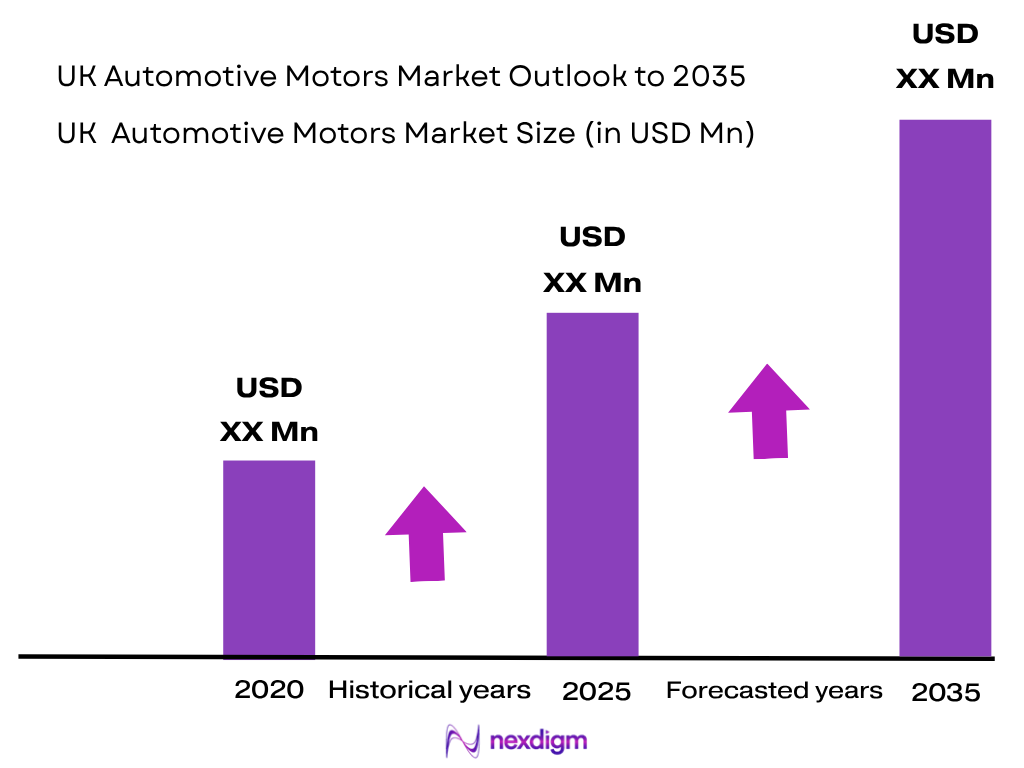
The UK automotive motors market represents demand for traction and auxiliary electric motors integrated across passenger cars, commercial vehicles and automotive systems. The market is estimated at ~USD ~ billion in 2024, supported by the country’s substantial vehicle-manufacturing ecosystem and transition toward electrified powertrains. UK vehicle production reached 1,025,474 units in 2023, including 905,117 cars and 120,357 commercial vehicles, while 2024 production totaled 905,233 vehicles, including 779,584 cars and 125,649 commercial vehicles. The automotive sector also includes more than 2,500 component suppliers.
The UK automotive motors market is concentrated around established vehicle and component-manufacturing clusters, particularly the West Midlands, North East England, North West England, East Midlands, South East England and Wales. The West Midlands benefits from a dense automotive engineering and supplier base, while the North East hosts major vehicle and battery-related manufacturing activity. The UK’s export-oriented production structure also strengthens motor demand: eight out of ten UK-built cars were exported to more than 140 markets in the industry’s 2023 assessment. This creates demand for motors meeting global OEM specifications.
Market Segmentation
By Motor Type
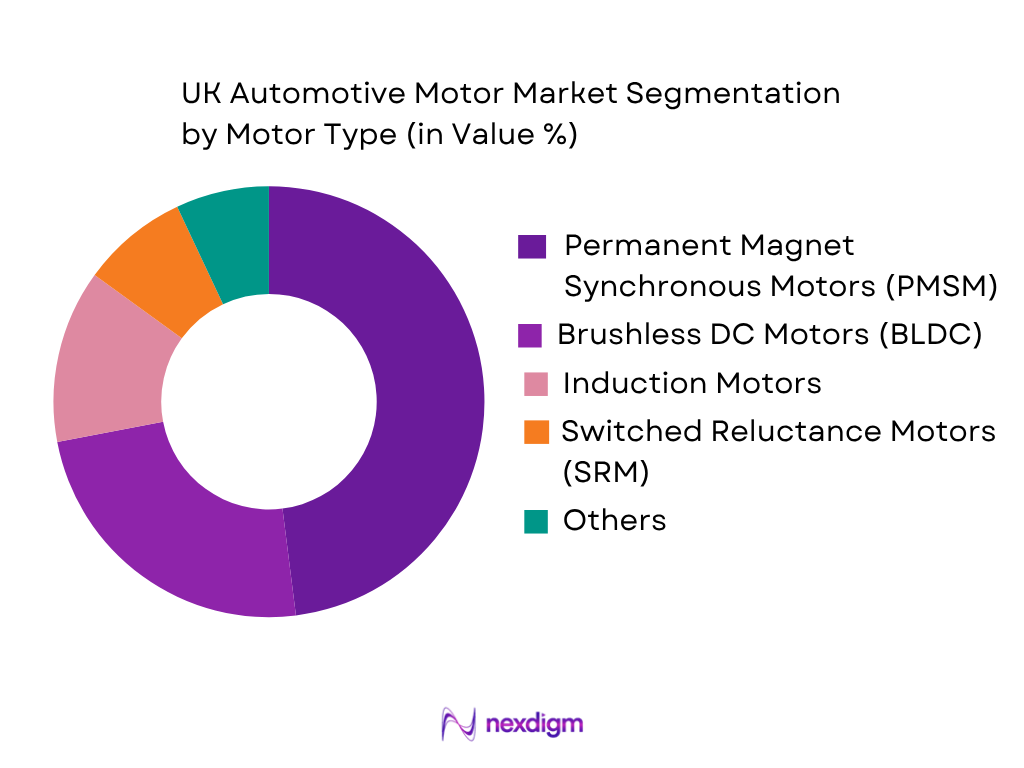
The UK automotive motors market is segmented by motor type into permanent magnet synchronous motors (PMSM), brushless DC motors (BLDC), induction motors, switched reluctance motors (SRM), and brushed DC motors. PMSM is expected to represent the dominant motor type, supported by its combination of high efficiency, torque density and compact packaging for electrified vehicle traction systems. The shift toward EV architectures is increasing the importance of high-performance traction motors and integrated e-axle systems, while auxiliary automotive functions continue to require BLDC and brushed DC technologies. UK manufacturers are actively transitioning production toward electrified models; SMMT reported that electrified vehicle production reached 346,451 units in 2023, while significant manufacturing investment has been directed toward EV platforms and their supply chains. The growing requirement for energy-efficient propulsion, regenerative braking and compact powertrain packaging therefore supports PMSM adoption. At the same time, BLDC and other motor technologies remain important for thermal-management systems, pumps, fans, steering, braking, HVAC and other vehicle functions.
By Vehicle Application
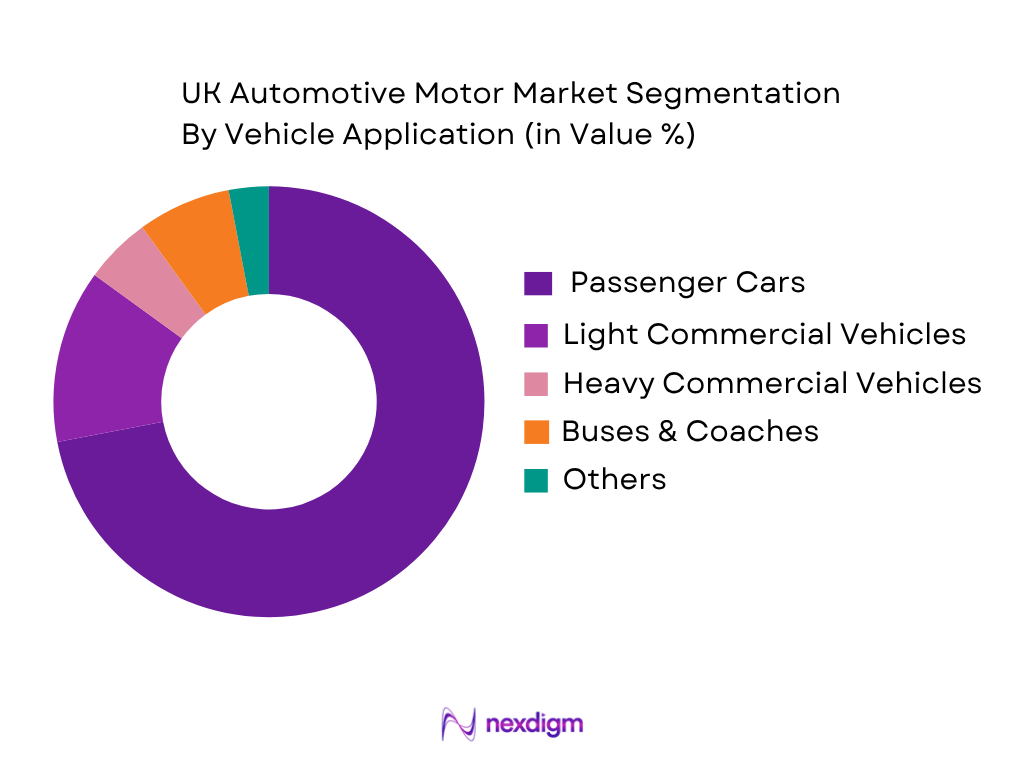
The UK automotive motors market is segmented by vehicle application into passenger cars, light commercial vehicles, heavy commercial vehicles, buses and coaches, and specialty vehicles. Passenger cars are expected to account for the dominant portion of demand because they represent the largest vehicle-production category and incorporate a high number of electric motors across propulsion, thermal management, steering, braking, HVAC, seating, windows, wipers and ADAS functions. UK factories produced 779,584 cars in 2024, compared with 125,649 commercial vehicles, creating a substantially larger installed manufacturing base for automotive motor integration. Electrification further increases motor content per vehicle because BEVs require traction motors and electric thermal-management components, while hybrids incorporate additional motor-generator systems. Commercial vehicles nevertheless represent an important opportunity because electric steering, braking, refrigeration, auxiliary systems and electrified drivetrains increase motor requirements. The application mix is therefore shifting from conventional starter, alternator and accessory motors toward higher-value traction, e-axle and electronically controlled motor systems.
Competitive Landscape
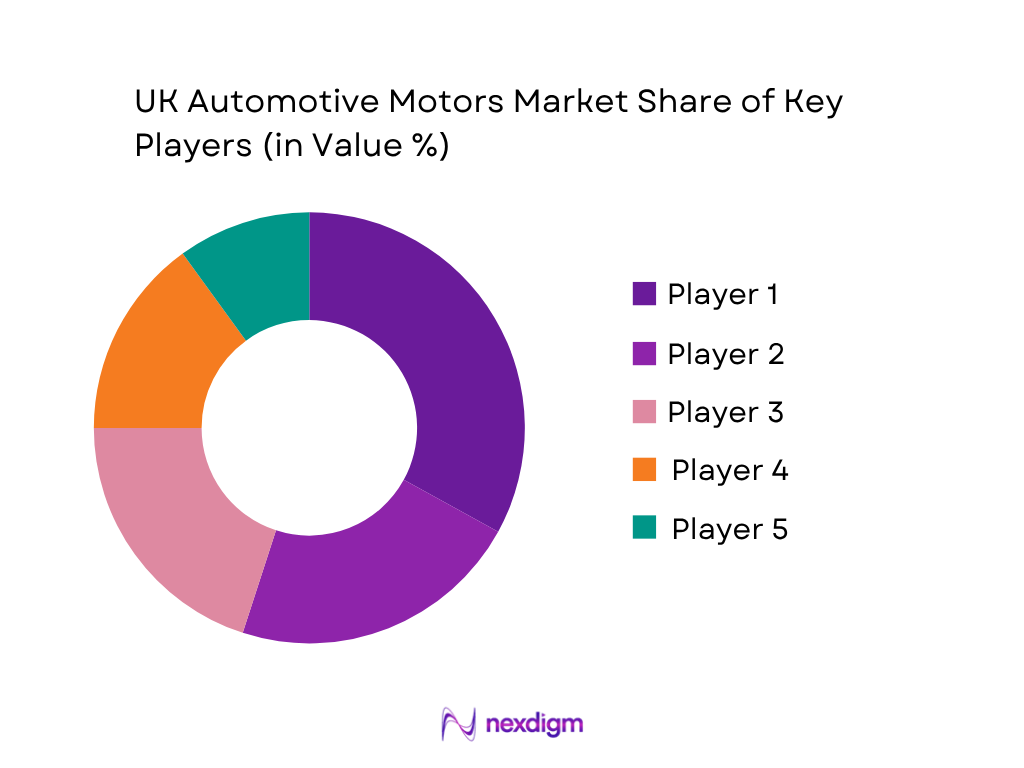
The UK automotive motors market is characterized by a combination of global automotive component suppliers, specialized motor manufacturers and vertically integrated automotive technology companies. Major participants compete through motor efficiency, power density, thermal performance, compact packaging, functional safety, electronic integration and OEM qualification capabilities. The market is being reshaped by the transition from ICE vehicles toward BEV, PHEV and hybrid platforms, making traction motors, e-axles, electric pumps and electronically controlled auxiliary motors increasingly important. The breadth of the UK component ecosystem—with more than 2,500 suppliers—also provides an extensive customer base for motor suppliers and system integrators.
| Company | Established | Headquarters | Motor Portfolio | Key Automotive Applications | Electrification Focus | OEM Integration | Technology Focus |
| Bosch | 1886 | Stuttgart, Germany | ~ | ~ | ~ | ~ | ~ |
| Denso | 1949 | Kariya, Japan | ~ | ~ | ~ | ~ | ~ |
| Nidec | 1973 | Kyoto, Japan | ~ | ~ | ~ | ~ | ~ |
| Valeo | 1923 | Paris, France | ~ | ~ | ~ | ~ | ~ |
| Marelli | 1919 | Corbetta, Italy | ~ | ~ | ~ | ~ | ~ |
UK Automotive Motors Market Analysis
Growth Drivers
EV Production and Vehicle Electrification
The UK automotive motors market is being structurally supported by the transition from internal-combustion powertrains toward battery-electric, plug-in hybrid and hybrid vehicles, increasing the number and technical value of motors installed per vehicle. UK factories produced 905,233 vehicles in 2024, comprising 779,584 cars and 125,649 commercial vehicles, according to the Society of Motor Manufacturers and Traders (SMMT). Electrified vehicle production totaled 275,896 units, representing a substantial installed production base for traction motors, motor-generators, electric compressors, coolant pumps, steering motors and other electrically driven systems. The UK automotive industry also recorded more than £3.5 billion of additional investment commitments in 2024 specifically associated with the transition toward EV production, following more than £20 billion announced in 2023, according to SMMT. The electrification trend is also visible in the vehicle parc: the number of electric cars on UK roads exceeded 1.3 million in 2024, while the total vehicle parc reached 41,964,268 units. The World Bank recorded UK GDP growth of 1.1% in 2024, providing a relatively stable macroeconomic environment for industrial investment. For motor suppliers, electrification expands the addressable opportunity from conventional starter, alternator and accessory motors toward high-voltage traction motors, integrated motor-inverter systems and e-axles. Higher electrified-vehicle penetration also creates additional demand for thermal-management motors, electric pumps, fans and compressors because EV platforms rely extensively on electrically powered auxiliary systems. SMMT data therefore indicates that the UK is not simply replacing one propulsion technology with another; it is moving toward vehicle architectures with substantially greater dependence on electronically controlled motor systems.
Rising Motor Content and Advanced Vehicle Features
Increasing motor content per vehicle is another important driver for the UK automotive motors market because modern vehicles increasingly use electric actuation across propulsion, thermal management, steering, braking, seating, doors, windows, mirrors, pumps and advanced driver-assistance functions. SMMT reported 36,165,401 cars in the UK vehicle parc in 2024, alongside 5,102,180 vans, 625,509 heavy goods vehicles and 71,718 buses and coaches. This large installed base supports continued replacement demand for auxiliary motors while new vehicle architectures increase the number of electronically controlled motorized functions. The UK produced 1.59 million engines in 2024, according to SMMT industry data, illustrating the scale of the domestic automotive manufacturing ecosystem even as production transitions toward electrified propulsion. The sector also includes more than 2,500 component providers, creating a broad supplier base for motor, actuator, power-electronics and thermal-management technologies. The Office for National Statistics recorded £452.2 billion in total UK manufacturing product sales in 2024, while motor vehicles remained among the country’s highest-value manufactured products. Premiumization further supports demand for compact and high-performance motors because luxury and premium vehicles increasingly incorporate electrically adjustable seats, powered tailgates, active aerodynamic systems, electric steering, intelligent HVAC and ADAS actuators. At the same time, the UK’s £47 billion automotive export trade reported by SMMT makes compliance with international OEM specifications particularly important. This favors suppliers capable of delivering high power density, low noise and vibration, thermal robustness, functional safety and precise electronic control. The combination of a large installed vehicle fleet, extensive component ecosystem, premium-feature adoption and electrified vehicle development therefore increases both the volume and value of automotive motor applications.
Market Challenges
Raw Material, Rare-Earth Magnet and Semiconductor Exposure
The UK automotive motors market faces significant supply-chain exposure because advanced traction and auxiliary motors depend on specialized materials, electronic components and globally distributed manufacturing networks. Permanent-magnet motors require magnet materials and high-performance electrical steels, while motor-control systems depend on semiconductors, sensors, microcontrollers and power electronics. The UK’s automotive sector remains strongly integrated with international trade: SMMT reported that 603,565 UK-built cars were exported in 2024, while the industry operates within a supply network exceeding 2,500 component providers. This international structure creates exposure to geopolitical disruption, shipping interruptions, trade restrictions and changes in supplier availability. The issue is particularly relevant to rare-earth permanent-magnet motors, where high-performance magnets are difficult to substitute without redesigning the motor architecture. Semiconductor availability also remains strategically important because inverter-controlled motors require power devices, control ICs, sensors and communication electronics. UK vehicle production declined to 905,233 units in 2024, down from 1,025,474 units in 2023, demonstrating the sensitivity of domestic production to model transitions, global demand and supply-chain conditions, according to SMMT. The Office for National Statistics reported that total UK manufacturers’ product sales declined from £466.7 billion in 2023 to £452.2 billion in 2024, indicating a challenging manufacturing environment. The World Bank recorded UK GDP growth of 1.1% in 2024, while the IMF has highlighted continuing exposure to global trade and external demand conditions. For motor suppliers, these conditions increase the importance of dual sourcing, material qualification, inventory resilience and alternative motor architectures. Rare-earth-free induction and reluctance technologies therefore become strategically relevant, although switching technologies can require new inverter calibration, thermal designs, control algorithms and OEM validation.
OEM Pricing Pressure, Miniaturization and Qualification Requirements
Automotive motor suppliers in the UK face simultaneous pressure to reduce component size, improve efficiency and satisfy increasingly demanding OEM qualification requirements while vehicle manufacturers seek competitive system costs. This challenge is particularly pronounced as motors move from relatively simple auxiliary applications into safety-critical steering, braking, thermal-management and propulsion systems. UK automotive manufacturing generated £93 billion of turnover and £22 billion of value added, while the industry typically invests around £4 billion annually in R&D, according to SMMT. These figures illustrate the technological intensity of the sector and the level of engineering capability required to remain competitive. Motor manufacturers must increasingly deliver higher torque and power density from smaller packages while managing heat generation, electromagnetic interference, vibration and acoustic performance. The requirement is particularly difficult for EV traction motors, where continuous operation at high loads creates demanding thermal conditions. The UK also produced 125,649 commercial vehicles in 2024, while its vehicle parc included 625,509 heavy goods vehicles, creating requirements for highly durable motors capable of extended operating cycles. Qualification requirements can further lengthen commercialization timelines because OEMs typically require validation of durability, thermal cycling, corrosion resistance, electrical insulation, functional safety and electromagnetic compatibility before production approval. Meanwhile, UK vehicle production declined by 11.8% in 2024 to 905,233 units, according to SMMT, increasing the importance of supplier productivity and platform economics. Manufacturers must therefore invest in automated production, modular motor platforms and design-for-manufacturing approaches while meeting tighter OEM cost and performance targets. These pressures can disproportionately affect smaller suppliers that lack the engineering resources, testing infrastructure and production scale needed to qualify advanced motor technologies across multiple vehicle platforms.
Market Opportunities
EV Traction Motors and Integrated E-Axles
The UK’s expanding electrification ecosystem creates a significant opportunity for higher-value traction motors, integrated e-axles and motor-inverter systems. UK manufacturers produced 275,896 electrified vehicles in 2024, while the country had more than 1.3 million electric cars in operation, according to SMMT. These figures demonstrate an established vehicle and infrastructure base around which advanced propulsion components can be developed. The opportunity is not limited to supplying standalone motors. E-axles integrate the electric motor, reduction gearing and power electronics into a compact propulsion module, reducing packaging complexity and potentially improving vehicle efficiency. This architecture aligns with the automotive industry’s broader requirement for lower mass, greater power density and simplified vehicle assembly. The UK’s automotive industry also recorded £3.5 billion of additional investment commitments in 2024, following more than £20 billion in 2023, supporting the transition of domestic production facilities toward electrified vehicles and related technologies. The country’s manufacturing ecosystem includes more than 2,500 component suppliers, providing potential customers and technology partners for motor manufacturers, e-axle developers, inverter suppliers and precision-machining companies. The opportunity is reinforced by the export orientation of UK vehicle production: 603,565 cars were exported in 2024, giving suppliers an opportunity to participate in global vehicle platforms rather than relying solely on domestic demand. Advanced traction motors can therefore become a strategic component category as UK plants introduce new BEV and hybrid models. Suppliers capable of combining high-efficiency PMSM or reluctance motors with inverters, reduction gears, thermal-management systems and software controls can capture more system value than manufacturers supplying individual motor components. The current scale of electrified production provides the industrial foundation for this transition.
Axial-Flux, High-Efficiency Motors and Electrified Auxiliary Systems
The UK’s move toward higher vehicle efficiency creates opportunities for axial-flux motors, high-efficiency BLDC motors, advanced steering motors, electric pumps and ADAS actuators across both passenger and commercial vehicles. The opportunity is supported by the size of the domestic vehicle base: 41,964,268 vehicles were operating on UK roads in 2024, including 36,165,401 cars, 5,102,180 vans and 625,509 heavy goods vehicles, according to SMMT. As vehicles become more electronically controlled, motor demand increasingly extends beyond propulsion. EV thermal systems require electric coolant pumps, refrigerant compressors and cooling fans, while steer-by-wire, electric power steering, active braking, seating and ADAS systems create additional requirements for compact, precise actuators. The UK automotive industry also maintains a substantial engineering base, employing more than 198,000 people in manufacturing and approximately 813,000 across the wider automotive industry, according to SMMT. This provides an established talent and supplier ecosystem for developing sophisticated motor technologies. High-efficiency motor architectures can also address the industry’s need to minimize auxiliary electrical consumption, particularly in EVs where every electrical load influences available driving range. Rare-earth-free motors, including switched-reluctance and other magnet-free architectures, offer another opportunity by reducing dependence on permanent-magnet materials. The country’s manufacturing sector recorded £452.2 billion of product sales in 2024, according to the ONS, demonstrating the scale of the broader industrial base available for technology commercialization. Suppliers that combine compact electromagnetic designs with advanced control electronics, thermal management, sensors and software can therefore address several emerging applications simultaneously. The opportunity is particularly relevant to UK-based engineering and component companies seeking to move from conventional mechanical components toward higher-value electrification technologies.
Future Outlook
The UK automotive motors market is expected to expand over the forecast period, supported by accelerating vehicle electrification, increasing motor content per vehicle and continued development of electric powertrain technologies. The market is projected to register a ~% CAGR during 2026–2035, reaching an estimated ~USD ~ billion by the end of the forecast period. Electrification will remain the central structural driver. UK production already includes substantial electrified-vehicle output, while manufacturers continue to retool facilities for BEV and hybrid platforms. SMMT reported 157,224 electrified vehicles produced during the first half of 2024, demonstrating the growing relevance of electrified architectures within domestic manufacturing.
The opportunity extends beyond traction motors. EVs require electric compressors, coolant pumps, thermal-management fans, electric steering systems, braking actuators, battery-management auxiliaries and other motor-driven systems. Consequently, increasing electrification can raise motor content even where vehicle production volumes remain under pressure.
Major Players
- Bosch
- Denso
- Nidec
- Johnson Electric
- Valeo
- Marelli
- Brose
- Continental
- BorgWarner
- Hitachi Astemo
- Mitsubishi Electric
- Mabuchi Motor
- Mitsuba
- ZF Friedrichshafen
- Magna International
Key Target Audience
- Automotive OEMs and Vehicle Manufacturers
- Tier-1 Automotive Component Suppliers
- Electric Powertrain and E-Axle Manufacturers
- Automotive Motor and Actuator Manufacturers
- Battery-Electric Vehicle and Hybrid Technology Developers
- Investments and Venture Capitalist Firms
- Government and Regulatory Bodies (Department for Business and Trade, Department for Transport, Advanced Propulsion Centre UK)
- Automotive Fleet and Commercial Vehicle Operators
Research Methodology
Step 1: Identification of Key Variables
The research begins with construction of the UK automotive motor ecosystem covering vehicle OEMs, Tier-1 suppliers, motor manufacturers, e-axle producers, component suppliers and aftermarket participants. Key variables include vehicle production, electrification mix, motor content per vehicle, motor type, application, power rating, OEM sourcing and technology adoption.
Step 2: Market Analysis and Construction
Historical and current automotive production data are compiled alongside motor applications across propulsion, steering, HVAC, thermal management, braking, pumps, fans and vehicle actuators. The market is constructed using a bottom-up assessment of motor applications and an independent top-down validation against automotive manufacturing activity and component demand.
Step 3: Hypothesis Validation and Expert Consultation
Market hypotheses are validated through interviews with automotive OEM procurement teams, Tier-1 suppliers, motor manufacturers, powertrain specialists and engineering stakeholders. Discussions focus on motor specifications, sourcing structures, electrification requirements, qualification cycles, production localization and technology migration.
Step 4: Research Synthesis and Final Output
The final analysis triangulates production statistics, automotive-industry datasets, company disclosures, regulatory information and expert inputs. Motor demand is reconciled across vehicle categories and applications to establish market segmentation, competitive positioning, technology trends and the forward market outlook.

- Executive Summary
- Research Methodology (Market Definition and Scope, Automotive Motor Classification, Motor Application Mapping, Vehicle Production Assessment, Motor Content per Vehicle, Top-Down Market Sizing, Bottom-Up Market Reconstruction, OEM Production Mapping, Motor Unit-Volume Analysis, Revenue Validation, Import and Export Assessment, Aftermarket Reconstruction, Primary Industry Interviews, Supply-Side Validation, Demand-Side Validation, Data Triangulation, Forecasting Framework, Scenario Modelling, Assumptions and Limitations)

- Definition and Scope
- Automotive Motors Industry Evolution
- UK Automotive Manufacturing Ecosystem
- Automotive Motor Value Chain
- Automotive Motor Supply Chain
- UK Vehicle Production and Assembly Landscape

- Growth Drivers (EV Production, Hybridization, Rising Motor Content, ADAS Penetration, Thermal Management Electrification, Premium Vehicle Features, Vehicle Electrification)
Market Challenges (Raw Material Exposure, Rare-Earth Magnet Dependency, Semiconductor Supply, OEM Pricing Pressure, Motor Miniaturization, Thermal Constraints, Qualification Requirements) - Market Opportunities (EV Traction Motors, E-Axles, Axial-Flux Motors, Electric Pumps, Advanced Steering Motors, ADAS Actuators, High-Efficiency BLDC Motors, Rare-Earth-Free Motors)
- Technology Trends (Hairpin Windings, High-Speed Motors, Integrated Inverters, Sensorless Control, Silicon-Carbide Power Electronics, Advanced Cooling, Motor–Controller Integration)
- Porter’s Five Forces Analysis
- PESTLE Analysis
- SWOT Analysis

- By Market Value (2020-2025)
- By Motor Unit Volume (2020-2025)
- By Average Motor Value (2020-2025)
- By Vehicle Production (2020-2025)
- By Motor Content per Vehicle (2020-2025)

- By Motor Type (in value %)
Brushed DC Motors
Brushless DC Motors
Stepper Motors
Permanent-Magnet Synchronous Motors
Induction Motors
Switched Reluctance Motors
Axial-Flux Motors
Traction Motors
Integrated Motor-Actuator Systems - By Vehicle Powertrain (in value %)
Internal Combustion Engine Vehicles
Mild Hybrid Electric Vehicles
Hybrid Electric Vehicles
Plug-in Hybrid Electric Vehicles
Battery Electric Vehicles
Fuel Cell Electric Vehicles - By Vehicle Type (in value %)
Passenger Cars
SUVs and Crossovers
Light Commercial Vehicles
Medium-Duty Commercial Vehicles
Heavy-Duty Commercial Vehicles
Buses
Performance and Luxury Vehicles - By Motor Application (in value %)
Electric Power Steering Motors
HVAC and Blower Motors
Cooling Fan Motors
Electric Water Pump Motors
Electric Oil Pump Motors
Fuel Pump Motors - By Functional Category (in value %)
Powertrain Motors
Chassis and Steering Motors
Thermal Management Motors
Body and Exterior Motors
Interior and Comfort Motors
Safety and ADAS Motors
Utility and Auxiliary Motors - By Motor Power Output (in value %)
Below 100 W
100–500 W
501 W–1 kW
1–5 kW
5–20 kW
21–100 kW
Above 100 kW

- Market Share of Major Players (By Revenue, Unit Volume, Motor Type, Application, Vehicle Type, Powertrain, OEM Supply and Aftermarket)
- Cross Comparison Parameters (Automotive Motor Portfolio Breadth, Motors per Vehicle Supported, EV Traction Motor Capability, Maximum Motor Power Density, BLDC/PMSM Technology Capability, UK Manufacturing Footprint, OEM and Tier-1 Customer Coverage, Integrated Motor–Controller Capability)
- SWOT Analysis of Major Players
- Detailed Profiles of Major Companies
Robert Bosch GmbH
DENSO Corporation
Valeo SE
Johnson Electric Holdings Limited
Nidec Corporation
ZF Friedrichshafen AG
Continental AG
BorgWarner Inc.
Mitsubishi Electric Corporation
Hitachi Astemo, Ltd.
MAHLE GmbH
Marelli Holdings Co., Ltd.
Brose Fahrzeugteile SE & Co. KG
Mabuchi Motor Co., Ltd.
YASA Limited

- Automotive OEM Demand Assessment
- Tier-1 Supplier Demand Assessment
- Vehicle Manufacturer Motor Preferences
- EV Motor Demand Behaviour
- Hybrid Vehicle Motor Demand Behaviour

- By Market Value (2026-2035)
- By Motor Unit Volume (2026-2035)
- By Average Motor Value (2026-2035)
- By Vehicle Production (2026-2035)
- By Motor Content per Vehicle (2026-2035)


 Request a Sample
 Ask for Customization
 Get a Quote
 Enquire Now