
 Download PDF
Market Overview
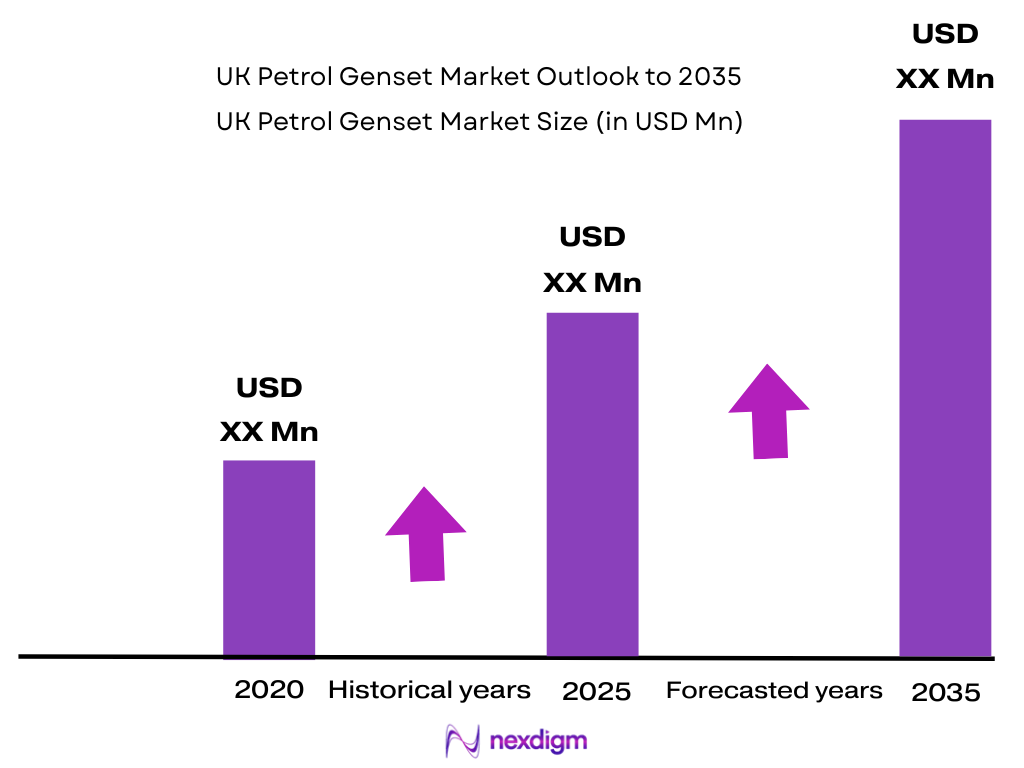
The UK Petrol Genset Market is valued at approximately ~ million, supported by construction, emergency backup, mobile trades, outdoor leisure and temporary-power applications. Great Britain’s new-work construction output increased from approximately £138.78 billion to £140.68 billion, sustaining demand for portable electricity at sites without permanent grid connections. Petrol gensets remain especially relevant for power tools, lighting, maintenance crews, small contractors, caravans, events and short-duration residential backup applications. London, the South East, West Midlands and North West constitute important UK petrol-genset demand centres because of dense construction activity, commercial premises, transport infrastructure, tradespeople and large residential populations. The UK population expanded from approximately 68.53 million to 69.28 million people, increasing the underlying number of households and businesses requiring resilient or mobile power solutions. London additionally combines intensive construction with stricter non-road machinery requirements, influencing demand toward newer, compliant and lower-emission generating equipment.
Market Segmentation
By Generator Type
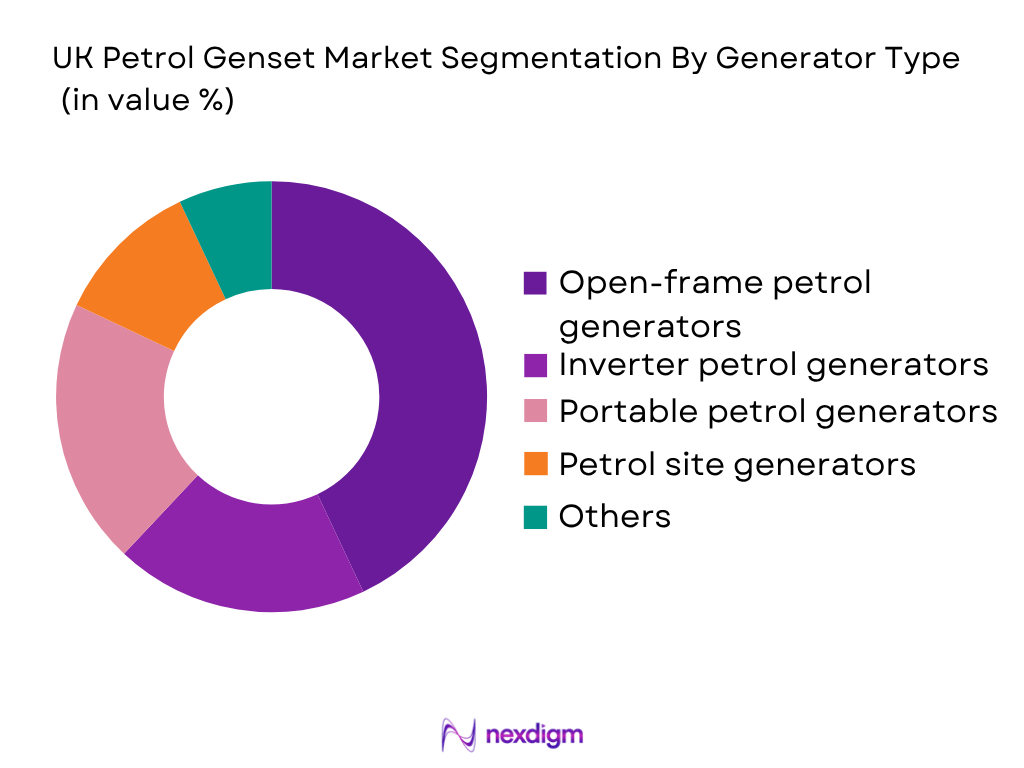
The UK Petrol Genset Market is segmented into conventional open-frame petrol generators, inverter petrol generators, enclosed portable generators, site generators and petrol-capable dual-fuel generators. Conventional open-frame petrol generators hold a dominant position because their power-to-weight characteristics, relatively straightforward engine architecture and suitability for power tools make them practical for construction, property maintenance and mobile trades. Current UK products extend from compact units around 3 kW to open-frame systems approaching 8 kW. Hyundai, Champion and other brands maintain extensive open-frame ranges, demonstrating the continuing importance of conventional portable petrol systems. Inverter generators, however, are becoming increasingly strategic where users require lower noise, improved fuel management and stable electricity for laptops, communications devices and electronically controlled equipment. Honda, Hyundai, Briggs & Stratton, Champion and Pramac all market inverter products, indicating increasing differentiation between rugged site power and clean portable electricity for leisure or residential applications.
By Power Rating
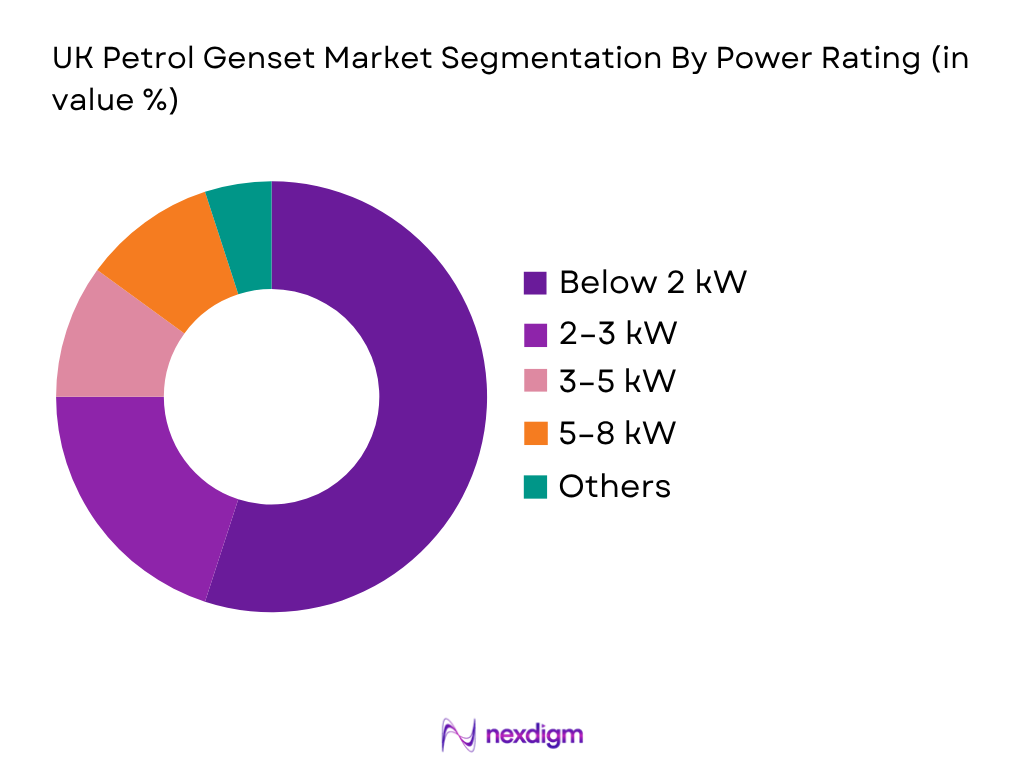
The UK Petrol Genset Market is segmented into below 2 kW, 2–3 kW, 3–5 kW, 5–8 kW and above 8 kW systems. The 2–5 kW range holds a dominant position because it addresses the broadest combination of household backup, caravan, workshop, tradesperson and construction requirements while remaining reasonably portable. Honda currently offers models spanning approximately 1 kW to 7 kW, while Hyundai markets petrol inverter and open-frame products around 2.2 kW, 3.2 kW, 4 kW and 5.5 kW. Champion similarly supplies products around 2.8 kW, 3.2 kW, 3.6 kW and higher. This power band can operate lighting, small appliances, communications equipment, pumps and multiple power tools without the size and fuel requirements associated with larger industrial generators. Below-2-kW units remain important for camping and electronics, while 5–8-kW generators suit heavier site loads, workshops and broader emergency-backup requirements.
Competitive Landscape
The UK Petrol Genset Market is fragmented across global engine manufacturers, specialist generator companies and UK-focused power-equipment suppliers. Honda occupies the premium inverter segment with compact fuel-injected systems, while Hyundai Power Products competes across inverter and open-frame generators. Champion maintains petrol, inverter and dual-fuel offerings, Briggs & Stratton participates through portable inverter technology and engines, and Pramac covers professional and recreational portable power. Product competition centres increasingly on rated output, runtime, noise, waveform quality, portability, emissions compliance and after-sales support.
| Major Player | Establishment | Headquarters | Petrol Power Range | Inverter Capability | Primary Applications | Fuel-Efficiency Features | Portability Focus | UK Service / Distribution |
| Honda Motor Co. | 1948 | Tokyo, Japan | ~ | ~ | ~ | ~ | ~ | ~ |
| Hyundai Power Products | UK power-equipment operation | United Kingdom | ~ | ~ | ~ | ~ | ~ | ~ |
| Champion Power Equipment | 2003 | Wisconsin, USA | ~ | ~ | ~ | ~ | ~ | ~ |
| Briggs & Stratton | 1908 | Wisconsin, USA | ~ | ~ | ~ | ~ | ~ | ~ |
| Pramac | 1966 | Siena, Italy | ~ | ~ | ~ | ~ | ~ | ~ |
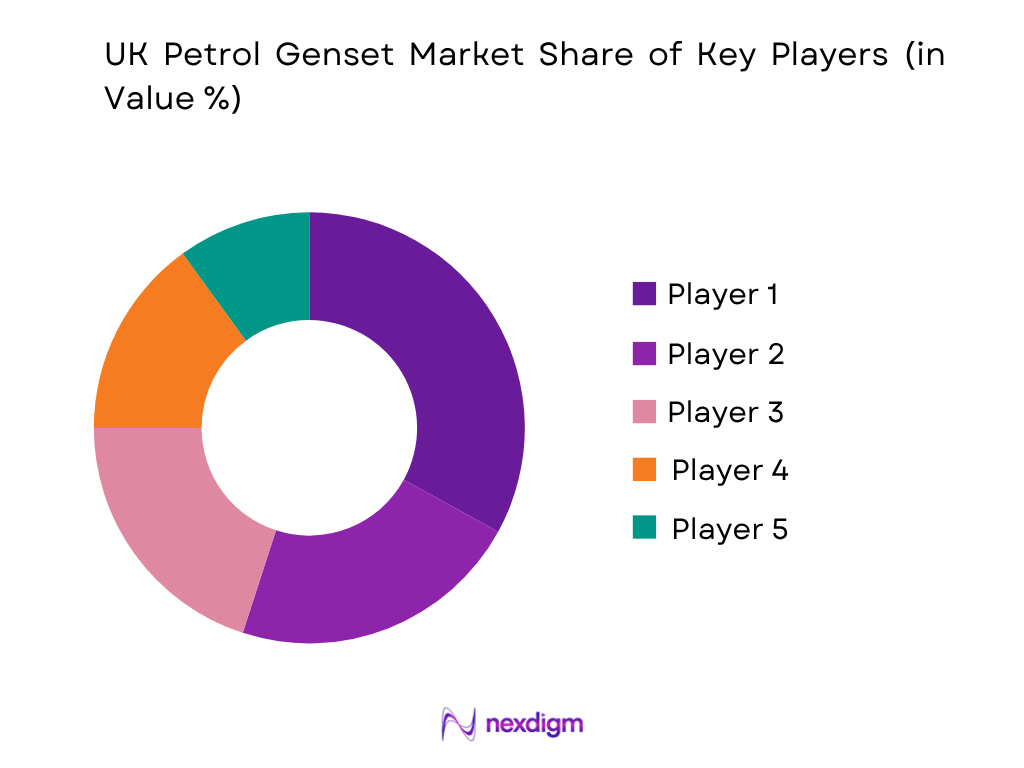
UK Petrol Genset Market Analysis
Growth Drivers
Rising Power-Outage Exposure and Demand for Rapid Backup Power
Weather-related disruption is strengthening demand for portable petrol gensets across UK households, small businesses, mobile service fleets, farms, workshops and emergency-response applications because petrol generators provide deployable electricity without requiring fixed gas connections or permanent standby infrastructure. The relevance of backup generation became particularly visible during the 2024–2025 storm season. The UK Met Office reported that Storm Bert affected power supplies to around 350,000 homes, while Storm Darragh caused more than 2.3 million electricity customers to lose power. The latter storm produced wind gusts reaching 96 mph at Berry Head and rainfall totals exceeding 100 mm in western Wales, demonstrating the scale of weather conditions capable of interrupting electricity distribution. In January 2025, Storm Éowyn subsequently disrupted electricity supplies to approximately 1 million homes, accompanied by wind gusts reaching 100 mph at Drumalbin. These events demonstrate that backup electricity requirements are not confined to isolated rural users but extend to residential communities, workshops, telecommunications-linked operations, retailers and service businesses during widespread grid disruption.
Construction, Repair and Mobile Worksite Power Requirements
The UK’s substantial construction, repair and maintenance economy creates recurring demand for petrol gensets used to power tools, lighting, temporary site facilities, pumps, compressors, charging equipment and mobile maintenance operations where permanent electricity has not yet been connected. Office for National Statistics data shows that total Great Britain construction output continued expanding in 2024, marking a fourth consecutive annual increase. More importantly for small portable generating equipment, repair and maintenance activity recorded particularly strong expansion, while construction activity continued growing during 2025. ONS subsequently reported that annual construction output increased again in 2025, representing a fifth consecutive year of growth, and that construction output rose further during the first quarter of 2026. Repair and maintenance activity is especially relevant to petrol gensets because many jobs are fragmented across residential buildings, commercial properties, roads, utilities and small infrastructure locations rather than concentrated at permanent major construction sites. Portable generators can therefore be transported in vans or small trailers and deployed where temporary electricity is required for drills, saws, lighting, pressure washers, pumps and diagnostic tools. Petrol equipment has historically been attractive for lower-output applications because of compact engine architecture, relatively simple refuelling and wide equipment availability.
Market Challenges
Tightening Emissions Requirements and Pressure on Combustion-Based Site Equipment
Environmental regulation represents a substantial challenge for UK petrol genset suppliers because portable generators are part of the wider non-road mobile machinery ecosystem increasingly targeted by decarbonisation and local air-quality policies. The UK government identifies generators among non-road mobile machinery applications, while its assessment of the sector estimated NRMM emissions at approximately 11.4 million tonnes of CO₂-equivalent annually in the underlying national evidence base. A separate government-backed feasibility assessment published in 2024 identified approximately 6 million tonnes of CO₂-equivalent from industrial NRMM excluding agricultural machinery and indicated that construction accounted for approximately half of those emissions. This creates policy pressure on combustion-based portable equipment, including petrol gensets, even when individual small units represent only a fraction of total emissions. The direction of regulation is visible most clearly in London. The Greater London Authority’s Non-Road Mobile Machinery Low Emission Zone applies emissions requirements to construction machinery, and constant-speed engines such as generators must satisfy applicable Stage V standards where covered. London has also established a pathway under which NRMM standards tighten further across the city, with zero-emission machinery targeted over the longer term. This increases technical requirements for equipment manufacturers and reduces the attractiveness of older generator designs for professional contractors working in regulated urban environments.
Carbon-Monoxide, Ventilation and Fuel-Safety Constraints
Safety requirements represent another substantial challenge for the UK petrol genset market because petrol engines can produce dangerous concentrations of carbon monoxide when operated incorrectly. The UK Health and Safety Executive explicitly warns that petrol-powered equipment, including generators, can generate lethal amounts of carbon monoxide when used indoors or within enclosed spaces. HSE guidance updated in November 2024 states that even operating petrol-powered equipment for only a few minutes in inappropriate enclosed conditions can generate significant CO concentrations capable of killing workers. This creates an important limitation on generator deployment in buildings, workshops, trenches, temporary shelters, garages and partially enclosed construction environments. For professional users, the issue extends beyond user awareness. The Control of Substances Hazardous to Health framework requires employers to assess and control carbon-monoxide exposure. HSE advises locating petrol generators outdoors in well-ventilated spaces and preventing exhaust gases from entering buildings. Where combustion-powered equipment must operate around enclosed work areas, ventilation design, detectors, training and supervision can become necessary. Consequently, the petrol genset purchase decision involves not only output capacity and runtime but also safety management. These constraints are increasingly important because portable generators are frequently purchased precisely during emergencies, when users may have limited experience operating combustion machinery. Severe power cuts increase this risk. During the 2024–2025 storm season, approximately 350,000 homes lost power during Storm Bert, more than 2.3 million customers experienced outages during Storm Darragh and around 1 million homes were affected during Storm Éowyn. Large outage events can lead households to deploy generators near homes, garages or temporary shelters, creating potential CO exposure if installation guidance is ignored.
Market Opportunities
Inverter Generators, CO Shutoff and Hybrid Battery-Generator Systems
Technological advancement creates one of the strongest future opportunities in the UK Automotive Petrol Genset Market because the market can migrate from conventional fixed-speed open-frame products toward quieter, electronically controlled and safer generating platforms. The opportunity is supported by the continued need for portable electricity demonstrated during recent severe outages. More than 2.3 million electricity customers lost supply during Storm Darragh, while around 1 million homes experienced outages during Storm Éowyn. These events demonstrate that emergency power requirements persist even as the national grid modernises, but customers increasingly demand backup solutions that are easier and safer to operate around homes, vans, workshops and temporary work locations. Inverter technology is particularly relevant because an inverter generator can vary engine speed according to electrical load rather than continuously operating at maximum governed speed. This architecture can reduce fuel consumption and noise during partial-load operation while supplying stable electricity for laptops, chargers, communication systems and electronically controlled tools. These characteristics make inverter petrol gensets well suited to service vans, recreational vehicles, emergency response, residential backup and small contractors. Safety technology offers another opportunity. HSE guidance updated in 2024 specifically identifies dangerous carbon-monoxide exposure from petrol-powered generators operated in enclosed locations. Manufacturers can respond through integrated CO sensors that automatically stop the engine when hazardous concentrations are detected. Products can additionally incorporate digital displays, low-oil shutdown, overload protection, remote start and Bluetooth or app-based operating information. Rather than being treated solely as compliance costs, these features provide meaningful differentiation in a mature equipment category.
Resilience Solutions for Remote Work, Infrastructure Maintenance and Emergency Response
A second major opportunity lies in positioning petrol gensets as specialised mobile-resilience equipment for applications where grid electricity or fixed backup infrastructure is unavailable. The UK experienced multiple severe weather events during 2024 and 2025 that demonstrated the importance of deployable electricity. Storm Bert disrupted electricity for approximately 350,000 homes, Storm Darragh caused outages affecting more than 2.3 million customers, and Storm Éowyn interrupted supplies to around 1 million homes. Rather than relying solely on household retail demand, genset manufacturers can target professional resilience applications involving utilities, telecom maintenance, roadside operations, emergency services, construction contractors, local authorities, agriculture and mobile workshops. The opportunity is particularly strong in locations where power must be restored before permanent infrastructure can be repaired. Fallen trees, damaged distribution lines, flooding and inaccessible roads can prevent immediate network restoration. Somerset alone reported more than 13,000 households without electricity during Storm Darragh, while Bridgend County Borough recorded 3,191 properties affected by outages. Utility contractors and local-response teams working in these environments require portable lighting, pumps, communications equipment and electrically powered tools. Construction and infrastructure maintenance provide an additional demand base. Office for National Statistics data shows construction activity continued expanding through 2025 and into 2026. Annual Great Britain construction output rose for a fifth consecutive year in 2025, while total construction output increased again during the first quarter of 2026. Repair and maintenance remained an important contributor, which is relevant because temporary power requirements often arise during maintenance at sites where permanent circuits are unavailable or isolated for worker safety.
Future Outlook
The UK Petrol Genset Market is expected to expand at approximately ~ CAGR during 2026–2035, with growth increasingly concentrated in technologically improved rather than basic commodity generators. Demand will continue from construction contractors, mobile trades, households seeking emergency resilience, caravanning, outdoor recreation and temporary-event applications. However, emissions, noise and carbon-monoxide considerations will progressively influence product design and purchasing decisions. Inverter architectures are expected to gain importance because they provide cleaner electrical output for sensitive electronics while supporting quieter and more fuel-efficient operation. Honda, Briggs & Stratton, Hyundai, Champion and Pramac already compete in this category. The market will simultaneously face substitution from battery power stations and hybrid energy systems. Petrol genset suppliers will therefore compete increasingly through runtime, fast refuelling, reliability, higher-output capability, remote start, automatic protection, lower emissions and compatibility with professional site applications rather than through basic electricity generation alone.
Major Players
- Honda Power Products
- Hyundai Power Products
- Champion Power Equipment
- Briggs & Stratton
- Pramac
- Stephill Generators
- Generac Power Systems
- Clarke International
- SIP Industrial Products
- JCB Power Products
- Evolution Power Tools
- P1 Power Equipment
- SGS Engineering
- Yamaha Motor Power Products
- Könner & Söhnen
Key Target Audience
- Petrol generator manufacturers and engine suppliers
- Construction equipment and plant-hire companies
- Mobile workshop and roadside-support operators
- Home-improvement, power-tool and equipment retail chains
- Caravan, motorhome and outdoor-leisure equipment distributors
- Electrical contractors, facilities-management companies and emergency-power integrators
- Investments and venture capitalist firms
- Government and regulatory bodies (Department for Energy Security and Net Zero, Health and Safety Executive, Vehicle Certification Agency, Environment Agency, Office of Gas and Electricity Markets)
Research Methodology
Step 1: Identification of Key Variables
The initial phase develops a complete ecosystem map of the UK Automotive Petrol Genset Market covering generator manufacturers, petrol-engine suppliers, importers, plant-hire firms, home-improvement retailers, electrical distributors, contractors and end users. Critical variables include generator wattage, engine displacement, rated versus maximum output, runtime, fuel-tank capacity, noise output, portability, inverter penetration, application and emissions compliance.
Step 2: Market Analysis and Construction
Historical market demand is modelled through construction activity, temporary-power use, residential backup requirements, recreational applications and portable-equipment distribution. Bottom-up calculations assess units sold by power rating, generator type and application, while supply-side analysis evaluates manufacturer portfolios, retailer availability, distributor coverage and petrol-engine specifications. ONS construction data and UK energy-network indicators are used to triangulate the underlying demand environment.
Step 3: Hypothesis Validation and Expert Consultation
Market hypotheses are validated through structured interviews and CATIs with generator distributors, plant-hire operators, electrical contractors, construction-equipment dealers, retailers and generator-service technicians. Discussions evaluate the relative importance of power output, runtime, noise, inverter technology, portability, fuel efficiency, carbon-monoxide safety, warranties, spare-parts availability and customer movement toward battery alternatives.
Step 4: Research Synthesis and Final Output
The final stage reconciles demand-side estimates with manufacturer product portfolios and distribution information. Honda, Hyundai, Champion, Briggs & Stratton and Pramac product specifications provide reference points for power-rating, inverter and portability segmentation. Regulatory evidence covering NRMM type approval, emissions and generator carbon-monoxide risks is incorporated into the forecast framework to ensure that the final market structure reflects both commercial demand and product-compliance requirements.

- Executive Summary
- Research Methodology (Market Definitions and Assumptions, Petrol Genset Classification, Abbreviations, Market Sizing Approach, Top-Down Analysis, Bottom-Up Analysis, Import and Domestic Supply Assessment, Manufacturer Shipment Assessment, Distributor Sell-Through Analysis, Retail Channel Assessment, End-User Demand Assessment, Power Rating Mapping, Runtime Analysis, Fuel Consumption Assessment, Construction Demand Mapping, Residential Backup Assessment, Caravan and Motorhome Demand Assessment, Rental Fleet Assessment, Primary Industry Interviews, Dealer Interviews, Rental Company Interviews, Electrical Contractor Interviews, Data Triangulation, Forecasting Framework, Limitations and Future Conclusions)

- Definition and Scope
- Market Evolution and Industry Genesis
- Evolution of Portable Petrol Generator Technology
- Development of Inverter Generator Technology
- Evolution of Open-Frame Petrol Gensets

- Growth Drivers (Power Outage Preparedness, Construction Site Activity, Caravan and Leisure Demand, Mobile Trade Activity, Small-Load Backup Requirement)
- Market Challenges (Carbon-Monoxide Risk, Fuel Storage, Noise, Emissions Compliance, Battery Storage Competition)
- Market Opportunities (Inverter Technology, CO Detection, Vehicle Mounting, Rural Backup, Connected Generators)
- Market Trends (Inverter Migration, Safety Integration, Lower Noise, Electronic Controls, Hybrid Backup)
- Government Regulations (Engine Emissions, Carbon-Monoxide Safety, Electrical Safety, Fuel Storage, Workplace Operation)
- SWOT Analysis
- Porter’s Five Forces Analysis
- PESTLE Analysis

- By Market Value (2020-2025)
- By Unit Sales Volume (2020-2025)
- By Installed Units (2020-2025)

- By Generator Type (In Value %)
Portable Conventional Petrol Generators
Portable Inverter Petrol Generators
Open-Frame Petrol Generators
Silent Petrol Generators
Vehicle-Mounted Petrol Generators - By Power Output (In Value %)
Below 1 kW
1–2 kW
2–3 kW
3–5 kW
5–7 kW
7–10 kW - By Application (In Value %)
Residential Emergency Backup
Construction and Building Sites
Automotive Workshops
Mobile Service Vehicles
Caravans and Motorhomes - By Region (In Value %)
London
South East England
South West England
East of England
West Midlands

- Market Share of Major Players (By Value, Unit Volume, Generator Type, Power Rating, Application, Sales Channel)
- Cross Comparison Parameters (Petrol Generator Power Range, Inverter and Pure-Sine-Wave Portfolio, Rated Runtime and Fuel Tank Capability, Noise Level and Acoustic Enclosure Performance, CO Safety–Low Oil–Overload Protection Features, Stage V and UK Product Compliance, Portable–Site–Vehicle-Mounted Application Coverage, UK Dealer–Service–Spare Parts Network)
- SWOT Analysis of Major Players
- Detailed Profiles of Major Companies
Honda Power Equipment
Hyundai Power Products
Stephill Generators
Pramac
Champion Power Equipment
Briggs & Stratton
Clarke International
SIP Industrial Products
JCB Tools
Könner & Söhnen
Warrior Power Equipment
Kohler / SDMO
Loncin
Excel Power
Impax Power Tools

- Household Backup User Analysis
- Construction Contractor Analysis
- Professional Tradesperson Analysis
- Automotive Workshop Analysis
- Mobile Mechanic Analysis

- By Market Value (2026-2035)
- By Unit Sales Volume (2026-2035)
- By Installed Units (2026-2035)


 Request a Sample
 Ask for Customization
 Get a Quote
 Enquire Now