
 Download PDF
Market Overview
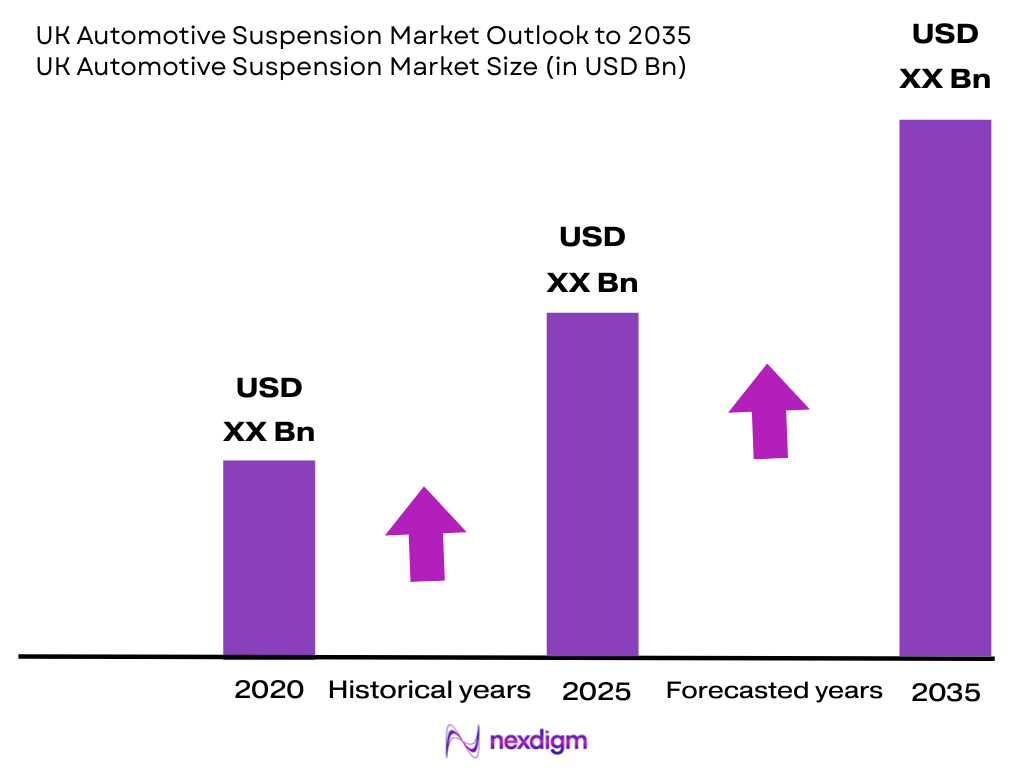
The UK Automotive Suspension Market is valued at approximately USD ~ billion, compared with USD ~ billion in the preceding annual benchmark. The country supported 41.7 million licensed vehicles, while annual first registrations increased to 2.605 million vehicles from roughly 2.53 million in the preceding benchmark. New car registrations reached 1.953 million units, creating substantial original-equipment and replacement demand for dampers, springs, control arms, air-suspension components and electronically controlled chassis systems. West Midlands, Sunderland, Oxford, Burnaston and the wider Midlands automotive corridor dominate the UK Automotive Suspension Market because they combine vehicle manufacturing, chassis engineering, Tier-1 suppliers and specialist motorsport capability. National vehicle production stood at 905,233 units, compared with approximately 1.03 million units in the preceding benchmark. The West Midlands additionally hosts ZF suspension and chassis operations in Solihull and Darlaston, strengthening the region’s concentration of suspension engineering, assembly and aftermarket expertise.
The UK Automotive Suspension Market encompasses shocks, struts, coil and leaf springs, control arms, wishbones, ball joints, anti-roll bars, bushings, air springs, electronic dampers, sensors, suspension ECUs and integrated active chassis systems supplied through OEM and aftermarket channels. The market is increasingly moving from conventional passive hardware toward electronically controlled ride systems, particularly in premium, luxury, performance and electrified vehicles.
Market Segmentation
By Suspension Technology
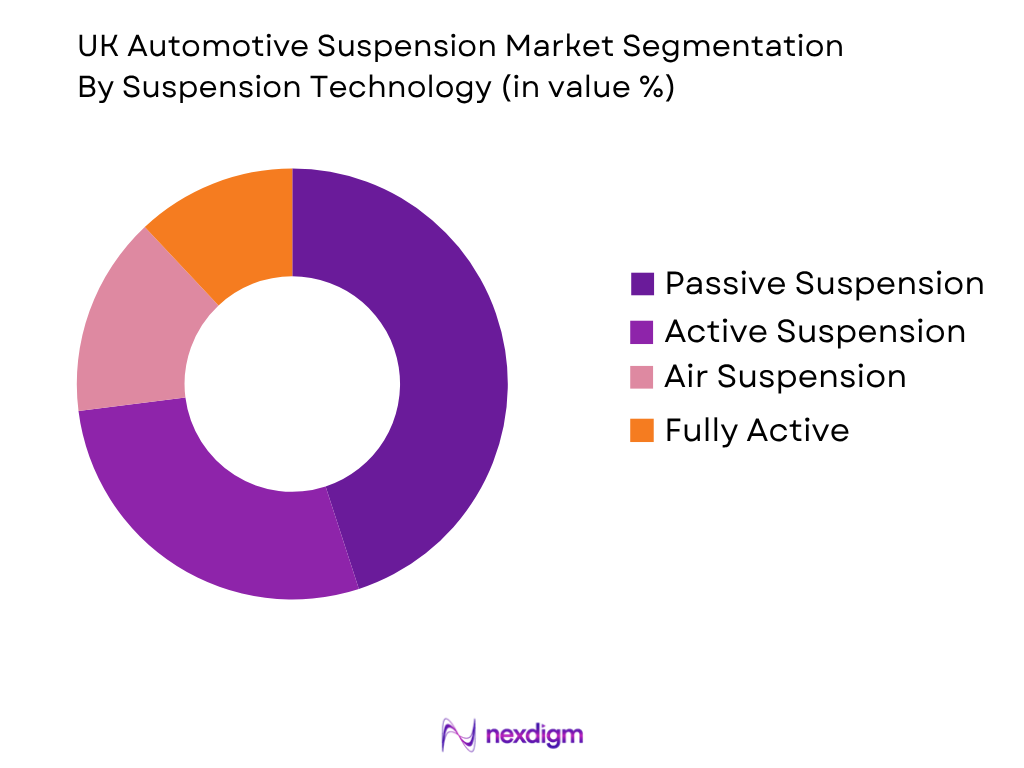
The UK Automotive Suspension Market is segmented into passive suspension, semi-active suspension, active suspension and air suspension systems. Passive systems retain the dominant market position because twin-tube and mono-tube shocks, struts and mechanical springs remain fitted across most mainstream passenger cars, light commercial vehicles and older vehicles in the parc. Their established durability, lower electronic complexity and extensive aftermarket coverage support scale. However, semi-active systems are gaining importance in premium and performance applications. Tenneco’s Monroe Intelligent Suspension supplies electronically controlled CVSA2/Kinetic technology to McLaren, demonstrating the UK’s adoption of advanced damping within high-performance vehicles. Air suspension is also increasingly relevant in premium SUVs and luxury EVs, while fully active technologies remain concentrated in high-value platforms.
By Vehicle Type
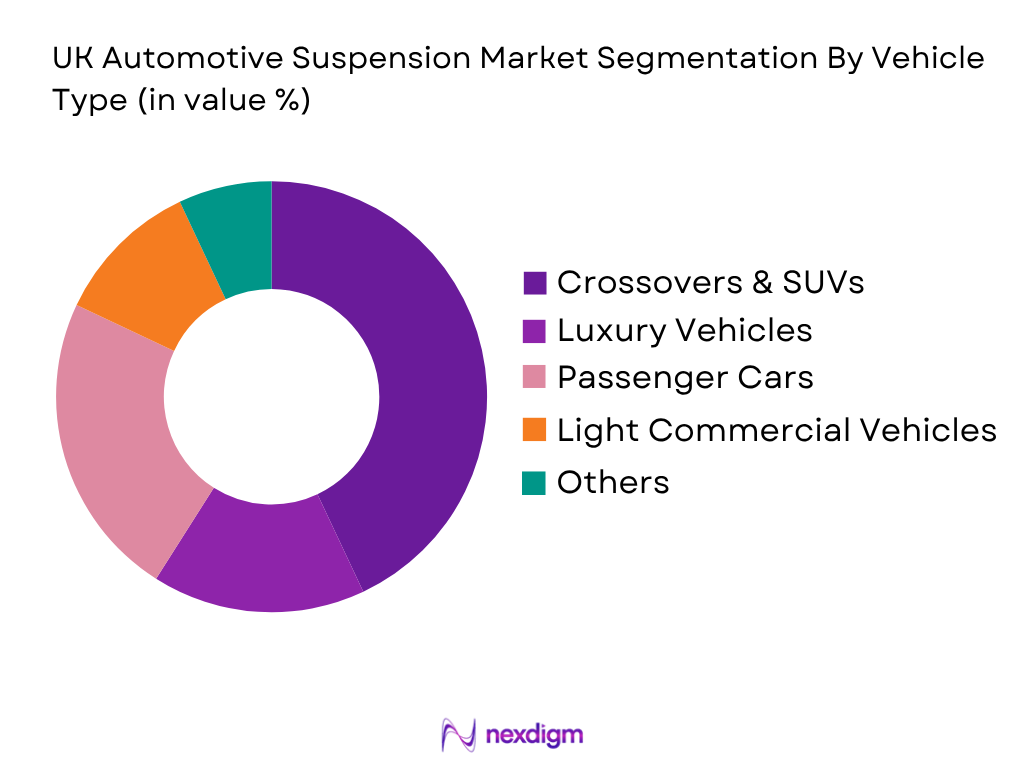
The UK Automotive Suspension Market is segmented into passenger cars, crossovers and SUVs, premium/luxury vehicles, light commercial vehicles and medium/heavy commercial vehicles. Crossovers and SUVs hold the dominant analytical market share because consumer demand has shifted away from traditional hatchbacks and saloons toward higher-riding vehicles that typically use higher-capacity springs, more complex rear suspension architectures and increasingly adaptive damping. Premium SUVs further raise suspension content through air suspension, electronic damper control and active roll-management systems. Passenger cars remain important because the UK licensed fleet is large and old enough to generate substantial replacement demand. Light commercial vehicles provide another meaningful source of springs, dampers and suspension-arm demand, supported by 351,834 new vans, pickups and 4x4s registered in the base period.
Competitive Landscape
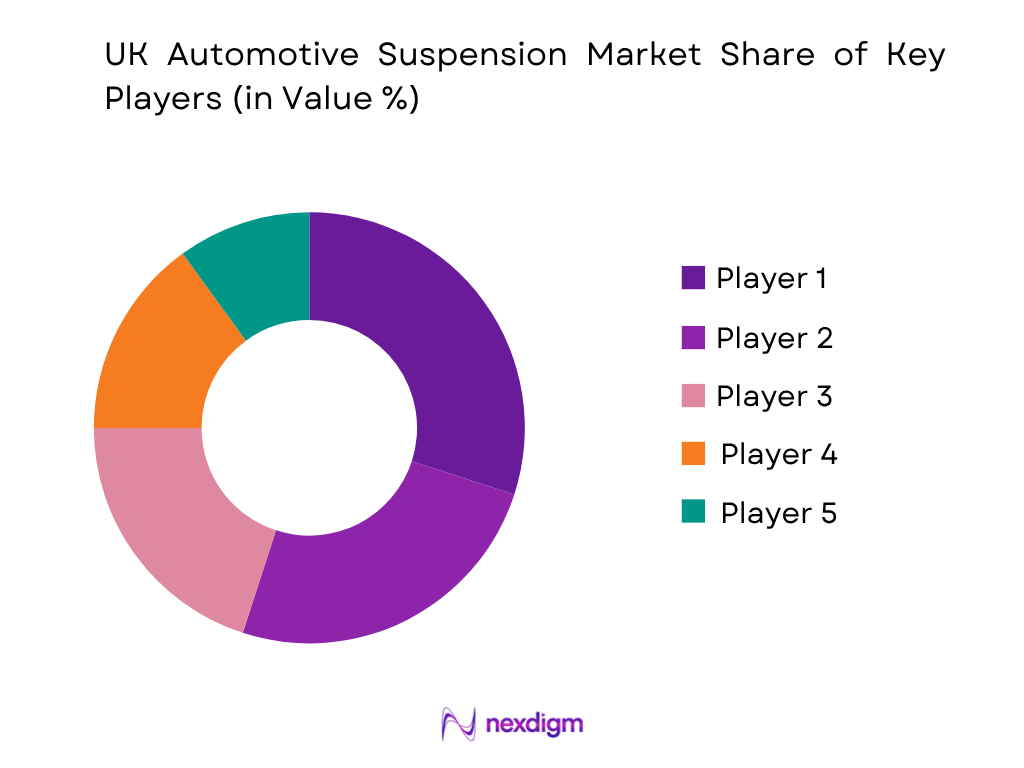
The UK Automotive Suspension Market is served by global chassis Tier-1 suppliers, specialised damper manufacturers and performance-suspension companies. ZF, Tenneco/Monroe, KYB, thyssenkrupp BILSTEIN and BWI Group represent important participants across OE, aftermarket, adaptive damping and premium ride-control applications. Competition is increasingly based on electronic-damping capability, vehicle-motion software, lightweight chassis design, local engineering support, aftermarket breadth and the ability to supply both conventional and electrified vehicle platforms.
| Company | Establishment Year | Headquarters | UK Presence | Suspension Portfolio | Electronic Suspension Capability | Aftermarket Position | Performance / Premium Capability | Key UK Advantage |
| ZF Friedrichshafen AG | 1915 | Friedrichshafen, Germany | ~ | ~ | ~ | ~ | ~ | ~ |
| Tenneco / Monroe | 1999 Tenneco structure | Northville, USA | ~ | ~ | ~ | ~ | ~ | ~ |
| KYB Corporation | 1919 | Tokyo, Japan | ~ | ~ | ~ | ~ | ~ | ~ |
| thyssenkrupp BILSTEIN | 1873 heritage | Ennepetal, Germany | ~ | ~ | ~ | ~ | ~ | ~ |
| BWI Group | 2009 | Beijing, China | ~ | ~ | ~ | ~ | ~ | ~ |
UK Automotive Suspension Market Analysis
Growth Drivers
Ageing Vehicle Parc and Rising Suspension Replacement Requirement
The UK Automotive Suspension Market is being supported by a progressively ageing vehicle parc that creates recurring replacement demand for shock absorbers, struts, coil springs, control arms, wishbones, ball joints, anti-roll-bar links and suspension bushings. Department for Transport data show that the UK had 41.7 million licensed vehicles at the end of 2024, while the average licensed car had reached 10 years of age, compared with 9 years at the end of 2023. By 2025, SMMT reported a record 42.55 million vehicles in use, including 36.68 million cars, while 16.77 million cars were more than 10 years old. This ageing installed base is highly relevant to suspension demand because mechanical wear accumulates through repeated compression cycles, road impacts, corrosion and bushing deterioration. MOT requirements reinforce replacement activity because the DVSA inspection framework explicitly checks springs, shock absorbers, suspension arms, joints, wheel bearings and related safety-critical components. UK road conditions provide another usage-related driver: Department for Transport road-condition statistics covered 145 local authorities with valid condition data in 2024, while central government subsequently committed GBP 7.3 billion to local-road maintenance programmes, highlighting the scale of road-surface remediation requirements. For suspension suppliers, this means the replacement opportunity is not dependent solely on domestic vehicle production. Even when new-car manufacturing weakens, millions of ageing vehicles continue to require safety and ride-control maintenance. The economic environment provides a supporting macro backdrop: the IMF recorded UK real GDP growth of approximately 1.1 units for every 100 units of output in 2024, while the UK population approached 70 million people. The combination of a large vehicle parc, increasing average age and mandatory MOT inspection therefore creates durable demand for OE-equivalent and premium replacement suspension products across independent garages, franchised workshops, motor factors and e-commerce channels.
Electrification, Premium Vehicle Engineering and Higher Suspension Content per Vehicle
Electrification is increasing the technical value of suspension systems in the UK because battery-electric vehicles require chassis calibration around greater battery mass, different axle loads, low-mounted battery packs and elevated expectations for ride refinement. Department for Transport data show that 382,000 zero-emission cars were registered for the first time in 2024, compared with approximately 315,000 in 2023, while SMMT recorded 381,970 battery-electric new-car registrations during the same base year. In 2025, the UK added almost 500,000 new battery-electric cars, taking the zero-emission vehicle parc to approximately 1.9 million vehicles. The growing installed base directly increases demand for EV-specific springs, dampers, control arms, bushings and electronically controlled suspension technologies. EVs also expose chassis NVH more clearly because electric drivetrains produce less engine vibration and combustion noise, making road impact, damper friction, wheel hop and bushing characteristics more perceptible inside the cabin. This supports higher-value technologies such as frequency-selective damping, continuously controlled dampers, adaptive air suspension and active roll management. UK premium and performance manufacturing provides an additional technology pull. The domestic ecosystem includes Jaguar Land Rover, Bentley, Rolls-Royce, Aston Martin, McLaren and Lotus, all operating in vehicle categories where ride quality and chassis differentiation are commercially important. UK factories produced 905,233 vehicles in 2024, including 779,584 cars and 125,649 commercial vehicles, preserving a sizeable OE component demand base despite production restructuring. Macroeconomic conditions add context: the IMF records UK population at approximately 69.85 million people, while real output continued expanding during 2024 and 2025. For suspension suppliers, electrification therefore represents more than a shift in propulsion. It increases content per vehicle through stronger springs, lightweight aluminium links, electronic dampers, height sensors, air springs and chassis-control software. Suppliers able to combine mechanical hardware with electronics and vehicle-motion control can capture a larger value position as UK OEMs launch heavier, more digitally controlled EV platforms.
Market Challenges
Domestic Vehicle Production Volatility and Pressure on OE Suspension Volumes
A major challenge for the UK Automotive Suspension Market is weakening and volatile domestic vehicle production, which directly affects original-equipment volumes for dampers, springs, control arms, subframes and electronically controlled suspension modules. SMMT reported that UK vehicle manufacturing declined to 905,233 units in 2024, including 779,584 cars and 125,649 commercial vehicles. Production weakened further in 2025, when total vehicle output fell to 764,715 units, reducing the number of suspension systems required for UK-built vehicles. Monthly volatility also became pronounced: in November 2025, only 65,932 vehicles left UK factories, including 63,126 cars and 2,806 commercial vehicles. Such production contraction affects Tier-1 utilisation rates because suspension programmes involve fixed engineering, tooling, validation and plant costs that are designed around expected platform volumes. When vehicle production falls, suppliers may operate below optimal capacity while still carrying engineering and quality obligations. The UK automotive supply chain is also exposed to model transitions as manufacturers retool plants for electrified vehicles. Suspension suppliers must often invest in new tooling, revised spring and damper specifications, lighter aluminium components and electronic controls before replacement platforms reach stable production volumes. The macroeconomic backdrop adds another layer of uncertainty. The IMF’s 2026 Article IV assessment projects UK real GDP growth at only 1.0 unit per 100 units of output in 2026, after comparatively modest expansion in preceding periods. Slower economic growth can weaken vehicle demand, restrict OEM capital expenditure and intensify purchasing pressure on component suppliers. Suspension companies therefore face a difficult balance: they must fund advanced technologies such as electronic damping and software-controlled chassis systems while managing lower or uncertain OE volumes. This environment favours suppliers with diversified revenue across OE and aftermarket channels, broad customer portfolios and manufacturing systems that can serve multiple vehicle platforms. Companies heavily dependent on one UK assembly programme face greater exposure to production interruptions, platform cancellation or model-volume underperformance.
Increasing Electronic Complexity and Diagnostic Burden in Suspension Systems
The transition from passive suspension toward adaptive dampers, air suspension and software-managed chassis systems creates a technical challenge across both OE development and aftermarket servicing. Traditional hydraulic shocks and coil springs can generally be diagnosed mechanically, whereas semi-active and active systems depend on electronic valves, body-acceleration sensors, wheel-movement sensors, ride-height sensors, air compressors, valve blocks and central chassis controllers. UK garages must increasingly distinguish between mechanical wear and electronic faults before replacing expensive assemblies. This challenge is amplified by the age of the vehicle parc. Department for Transport records show an average licensed-car age of 10 years in 2024, while SMMT reported 16.77 million cars older than 10 years in 2025. As premium vehicles equipped with air suspension and adaptive dampers age beyond warranty, more technologically complex suspension systems enter the independent aftermarket. DVSA’s MOT framework also explicitly treats suspension components as safety-critical items, covering springs, dampers, suspension arms and joints during inspection. Consequently, repair quality cannot be compromised simply because electronic systems are difficult to diagnose. Vehicle electrification adds additional complexity: the UK zero-emission fleet reached approximately 1.9 million vehicles in 2025, meaning a growing number of garages must handle suspension systems designed around heavier battery platforms and software-based ride-height or damping functions. Chassis service can also interact with wheel alignment, steering-angle inputs and advanced driver-assistance calibration. Macroeconomic conditions make technician productivity increasingly important: the IMF projects relatively subdued UK growth in 2026, increasing pressure on workshops and parts suppliers to control labour time and repeat repairs. For suspension manufacturers, the challenge extends beyond selling parts. They increasingly need to provide diagnostic information, fitting instructions, electronic compatibility data, calibration procedures and technician training. Brands with insufficient technical support risk losing aftermarket confidence, particularly where an incorrect electronic damper or ride-height component can trigger persistent fault codes or degraded vehicle behaviour.
Market Opportunities
Semi-Active, Active and Software-Defined Suspension Technology
Advanced damping represents one of the clearest growth opportunities in the UK Automotive Suspension Market because the country combines premium vehicle manufacturing, motorsport engineering and an expanding electrified vehicle base. Current market conditions already provide a substantial addressable platform: 381,970 battery-electric cars were newly registered in 2024, and the zero-emission vehicle fleet expanded to roughly 1.9 million vehicles in 2025. UK-built premium and performance vehicles create particularly attractive applications because consumers in these segments expect both comfort and dynamic body control. Electronically controlled dampers can continuously adjust compression and rebound forces using information from wheel acceleration, body movement, steering and braking systems. Active systems extend this by generating chassis forces that counteract pitch and roll. The opportunity becomes stronger as suspension control migrates into centralised vehicle-domain controllers. Rather than tuning separate mechanical components for every trim level, OEMs can increasingly create comfort, sport or dynamic modes through software and electronically adjustable hardware. This supports greater component value through sensors, valves, ECUs and embedded software in addition to the damper itself. The UK’s performance-engineering base provides evidence that this technology is commercially relevant today: McLaren uses Tenneco’s electronically controlled CVSA2/Kinetic suspension technology, demonstrating the integration of hydraulic and electronic vehicle-motion control in a UK-manufactured road car. The broader automotive base remains substantial, with 905,233 vehicles produced in 2024, giving technology suppliers domestic platform opportunities alongside export programmes. Current macroeconomic conditions also sustain advanced engineering activity even though growth is modest; the UK population is approximately 69.85 million, supporting a sizeable premium and replacement market. For suppliers, the opportunity is therefore to move from being hardware vendors toward complete chassis-system partners offering adaptive dampers, sensors, vehicle-motion software and integration engineering.
Ageing Premium Vehicle Parc, MOT Replacement and High-Value Aftermarket Components
The mature UK vehicle parc creates a significant aftermarket growth opportunity, especially as sophisticated suspension technologies move from new vehicles into older ownership cohorts. At the end of 2024, the UK had 41.7 million licensed vehicles, while the average car age reached 10 years. By 2025, the total vehicle parc had increased to 42.55 million vehicles, including 36.68 million cars, and 16.77 million cars were more than a decade old. These figures establish a large replacement population for conventional shocks and struts but also for higher-value products such as complete strut assemblies, aluminium wishbones, electronically controlled dampers, air springs, compressors and ride-height sensors. The MOT framework makes suspension condition a recurring safety checkpoint because inspectors assess springs, shock absorbers, suspension arms and joints. This supports repair conversion when worn components become advisory, major or dangerous defects. Road condition also reinforces the need for durable suspension: Department for Transport assessments received valid local-road condition data from 145 local authorities in 2024, while government subsequently allocated GBP 7.3 billion to local-road maintenance programmes, indicating the continuing scale of road-surface deterioration requiring intervention. The opportunity is particularly attractive for premium SUVs and executive vehicles originally equipped with air suspension or adaptive dampers. As these vehicles age beyond manufacturer warranties, owners increasingly turn to independent garages and motor factors for replacement components. The expanding EV fleet adds another future replacement cohort: approximately 1.9 million zero-emission vehicles were already on UK roads in 2025, meaning EV-specific dampers, bushings and suspension arms will gradually enter normal wear cycles. The most attractive strategy for suppliers is therefore not merely adding more SKUs, but providing accurate vehicle fitment, complete repair solutions and installation support. Complete strut assemblies can reduce garage labour complexity, while electronic replacement products require correct connectors, resistance values and software compatibility. Brands that integrate e-commerce fitment data, motor-factor distribution and technician support can capture both conventional mechanical replacement and the higher-value electronic suspension aftermarket.
Future Outlook
The UK Automotive Suspension Market is forecast to expand at approximately ~ CAGR during 2026–2035. Growth is expected to come increasingly from higher suspension content per vehicle rather than from vehicle-production volume alone. Adaptive damping, active suspension, air springs, software-defined chassis systems and EV-specific lightweight components should become more important contributors to market value. Electrification will be a major structural influence. The UK already added approximately 382,000 newly registered zero-emission cars in the base period and had 1.394 million zero-emission vehicles licensed on the road. Battery-electric platforms require suspension tuning around additional battery mass, altered axle loads and heightened NVH expectations, creating opportunities for stronger springs, sophisticated damping and lightweight aluminium chassis parts.
The transition is occurring while domestic vehicle manufacturing restructures. UK factories produced 905,233 vehicles, including 779,584 cars and 125,649 commercial vehicles, as manufacturers retooled certain plants for next-generation models. Future suspension demand will therefore be shaped by platform replacement cycles and supplier nominations linked to new electrified models rather than only aggregate factory output.
Major Players
- ZF Friedrichshafen AG / ZF UK
- Tenneco / Monroe Ride Solutions
- KYB Corporation / KYB Europe UK
- Astemo Ltd.
- thyssenkrupp BILSTEIN / BILSTEIN UK
- BWI Group
- HL Mando Corporation
- Magna International
- Multimatic Inc.
- BENTELER International
- Sogefi Group
- Hendrickson
- KW automotive UK
- Eibach UK
- Nitron Racing Systems
Key Target Audience
- Automotive OEM Manufacturers
- Suspension and Chassis Tier-1 Suppliers
- Shock Absorber, Strut, Spring and Chassis Component Manufacturers
- Automotive Aftermarket Parts Distributors and Motor Factors
- Performance, Motorsport and Premium Suspension Companies
- Fleet Operators and Automotive Service Networks
- Investments and Venture Capitalist Firms
- Government and Regulatory Bodies (Department for Transport, Driver and Vehicle Standards Agency, Vehicle Certification Agency, Department for Business and Trade, Office for Zero Emission Vehicles)
Research Methodology
Step 1: Identification of Key Variables
The initial phase develops a detailed ecosystem map for the UK Automotive Suspension Market covering OEMs, Tier-1 suspension suppliers, damper manufacturers, spring producers, electronic-chassis companies, motor factors, garages and performance specialists. Core variables include vehicle production, licensed vehicle parc, suspension architecture, OE content per vehicle, vehicle age, replacement frequency and electronic-suspension penetration. Government vehicle-licensing statistics, production information and supplier disclosures are combined with proprietary databases to identify relationships between vehicle segment, suspension type and sales channel. Particular attention is given to EVs, premium SUVs and ageing vehicles.
Step 2: Market Analysis and Construction
The top-down model begins with total UK chassis and suspension expenditure and isolates revenue attributable to suspension systems and replacement components. The bottom-up model maps vehicle production and the licensed vehicle parc against suspension units per vehicle, replacement incidence, average component value and technology penetration. OE and aftermarket demand are calculated independently because vehicle-platform sourcing differs fundamentally from replacement demand through motor factors, garages and dealer networks. Passive, semi-active, active and air-suspension categories are separately modelled.
Step 3: Hypothesis Validation and Expert Consultation
Market hypotheses are validated through computer-assisted telephone interviews with suspension suppliers, vehicle manufacturers, chassis engineers, motor factors, independent garages and performance specialists. Discussions assess vehicle-platform wins, suspension architectures, component replacement cycles, adaptive-system adoption and customer purchasing behaviour. The interviews are used to validate assumptions around the relative importance of premium vehicles, EV platform requirements, MOT-linked replacement activity and the penetration of electronically controlled suspension systems.
Step 4: Research Synthesis and Final Output
Primary findings are triangulated with Department for Transport, SMMT and supplier information to create the final market model. Demand is segmented by suspension technology, vehicle type, component type, propulsion system and sales channel. The forecast incorporates licensed vehicle age, new vehicle production, electrification, adaptive damping penetration, air-suspension adoption and aftermarket replacement. Alternative scenarios test the impact of weaker domestic production and faster software-defined chassis adoption.

- Executive Summary
- Research Methodology (Market Definitions and Assumptions, Suspension Market Boundary, Abbreviations, Top-Down Market Sizing, Bottom-Up Vehicle Platform Mapping, UK Vehicle Production Assessment, Vehicle Parc Assessment, OE Fitment Analysis, Suspension Content per Vehicle, Shock and Strut Replacement Modelling, Vehicle Age Analysis, Demand-Side Assessment, Supply-Side Assessment, OEM and Tier-1 Interviews, Independent Aftermarket Interviews, Garage and Distributor Interviews, Data Triangulation, Forecasting Framework, Scenario Analysis, Limitations and Future Conclusions)

- Definition and Scope
- Market Evolution and Industry Genesis
- Evolution of UK Ride-Control Technology
- UK Vehicle Manufacturing Ecosystem
- Passenger Car Suspension Ecosystem

- Growth Drivers (Ageing Vehicle Parc, Growing SUV Mix, EV Vehicle Mass, Premium Vehicle Production, MOT Replacement Demand, Adaptive Damping, Motorsport Technology Transfer)
- Market Challenges (OEM Cost Pressure, Vehicle Production Volatility, Steel and Aluminium Costs, Electronic Complexity, Warranty Risk, Aftermarket Price Competition, Platform Consolidation)
- Market Opportunities (EV Suspension, Adaptive Damping, Active Suspension, Vehicle Motion Control, Premium Replacement, Motorsport, Lightweight Components, Commercial Air Suspension)
- Market Trends (Continuous Damping, Air Suspension, Active Roll Control, Sensorisation, Chassis Software, Lightweighting, Predictive Control)
- SWOT Analysis
- Porter’s Five Forces Analysis
- PESTLE Analysis

- By Market Value (2020-2025)
- By Suspension System Units (2020-2025)
- By Shock Absorber and Strut Units (2020-2025)

- By Suspension Technology (In Value %)
Passive Suspension Systems
Semi-Active Suspension Systems
Fully Active Suspension Systems
Air Suspension Systems - By Vehicle Type (In Value %)
Small and Compact Passenger Cars
Mid-Size and Executive Cars
Crossovers
Compact SUVs
Mid-Size SUVs - By Sales Channel (In Value %)
Original Equipment Manufacturers
Original Equipment Service Parts
Motor Factors and Parts Distributors
National Automotive Parts Retailers
Independent Garages - By Region (In Value %)
West Midlands
North East England
North West England
East Midlands
South East England

- Market Share of Major Players by Market Value
- Cross Comparison Parameters (Suspension Technology Portfolio Breadth, UK OE Vehicle Platform Wins, Passive-to-Active Damping Capability, Air Suspension and Ride-Height Control Capability, UK Manufacturing–Engineering–Motorsport Footprint, EV and High-Mass Vehicle Suspension Capability, UK Aftermarket SKU Coverage and Motor-Factor Reach, Chassis Software–Sensor–Vehicle Motion Control Integration)
- SWOT Analysis of Major Players
- Detailed Profiles of Major Companies
ZF Friedrichshafen AG / ZF UK
Tenneco / Monroe Ride Solutions
KYB Corporation / KYB Europe UK
Astemo Ltd.
thyssenkrupp BILSTEIN / BILSTEIN Technical Centre UK
BWI Group
HL Mando Corporation
Magna International
Multimatic Inc.
BENTELER International
Sogefi Group
Hendrickson
KW automotive UK
Eibach UK
Nitron Racing Systems

- Ride Comfort Preference
- Handling and Steering Response
- Ride Height Preference
- Premium Ride Expectations
- Performance Driving Requirements

- By Market Value (2026-2035)
- By Suspension System Units (2026-2035)
- By Shock and Strut Units (2026-2035)


 Request a Sample
 Ask for Customization
 Get a Quote
 Enquire Now