

 Download PDF
Market Overview
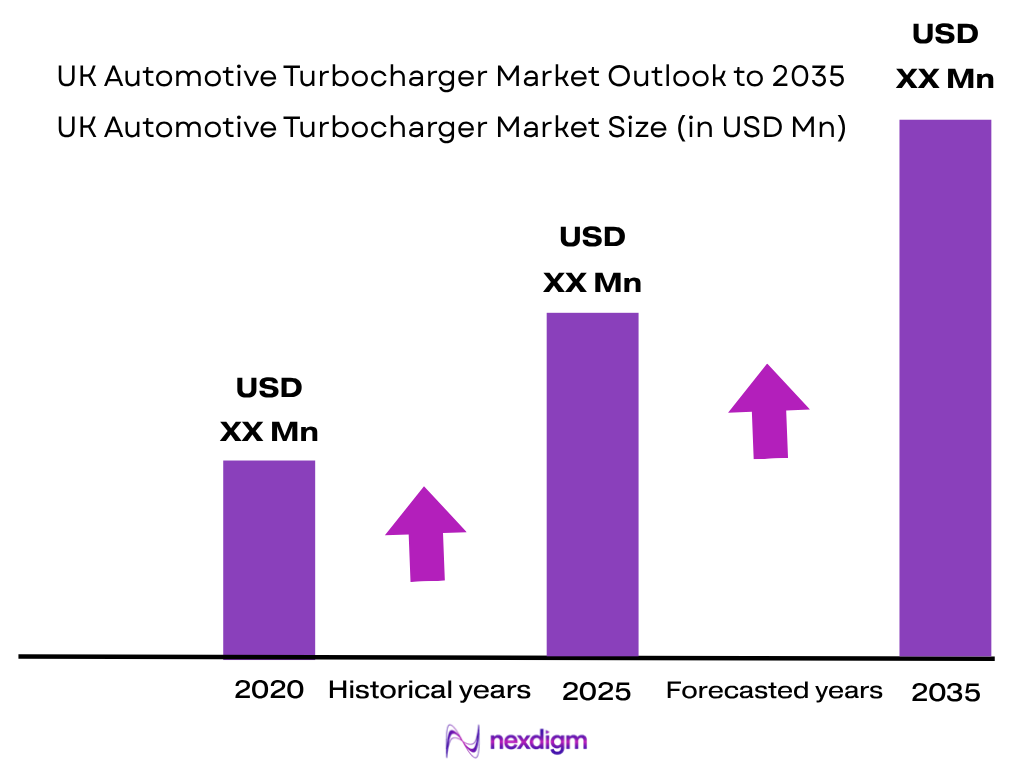
The UK Automotive Turbocharger Market is valued at approximately ~USD XX million, supported by a substantial installed vehicle base, engine manufacturing, premium vehicle production and aftermarket replacement demand. UK factories produced 1,025,474 vehicles and around 1.6 million engines in the preceding period, followed by 905,233 vehicles and 1,589,751 engines in the subsequent period. Turbocharged gasoline, diesel and hybrid powertrains therefore continue generating OEM, replacement, CHRA and remanufacturing demand.
The West Midlands, West Yorkshire, North East England and Oxford-Midlands automotive corridor dominate UK Automotive Turbocharger Market activity because they combine powertrain engineering, vehicle assembly, component production, motorsport expertise and specialist remanufacturing. National car production moved from 905,117 units to 779,584 units, while commercial-vehicle production moved from 120,357 units to 125,649 units. The presence of more than 2,500 automotive suppliers, 23 R&D centres and 10 engine manufacturers reinforces these regional engineering ecosystems.
Market Segmentation
By Turbocharger Technology
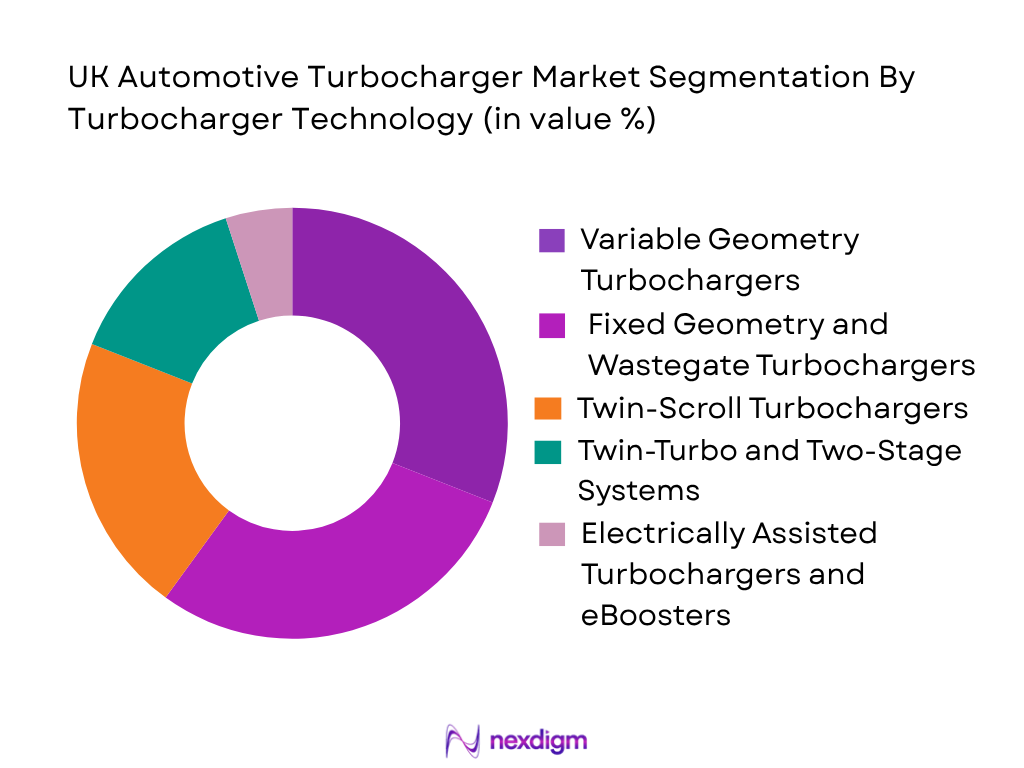
The UK Automotive Turbocharger Market is segmented into fixed-geometry and wastegate turbochargers, variable-geometry turbochargers, twin-scroll turbochargers, twin-turbo and two-stage systems, and electrically assisted boosting systems. Variable-geometry turbochargers represent a major segment because of their established use in diesel-powered commercial vehicles, vans and selected passenger vehicles, where turbine-flow adjustment helps deliver usable torque across a broad operating range. Fixed-geometry and wastegate systems retain a strong position in gasoline applications because they provide a comparatively mature architecture for downsized turbo-petrol engines. Twin-scroll turbochargers are particularly relevant to the UK’s premium, performance and higher-output gasoline vehicle base, where exhaust-pulse separation can improve transient response. Twin-turbo and two-stage systems are concentrated in premium, high-performance and higher-load diesel applications. Electrically assisted turbochargers and 48V compressors remain an emerging category as manufacturers progressively combine combustion engines with electrified powertrain architectures.
By Vehicle Type
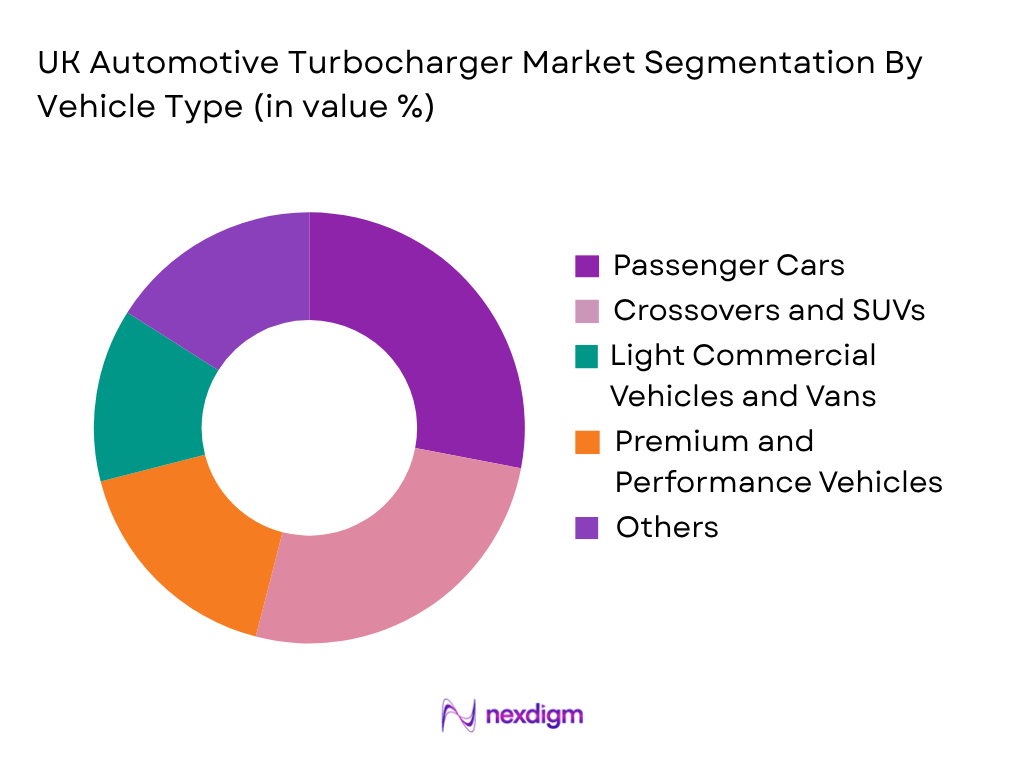
The UK Automotive Turbocharger Market is segmented into passenger cars, crossovers and SUVs, premium and performance vehicles, light commercial vehicles, medium and heavy commercial vehicles, and specialist and off-highway vehicles. Passenger cars and crossovers collectively form the largest demand pool because the UK vehicle parc contains a substantial number of turbocharged petrol and diesel vehicles requiring OEM and aftermarket turbocharger support. Crossovers and SUVs are particularly important because manufacturers frequently combine smaller-displacement engines with turbocharging to provide the low-speed torque required by heavier vehicle platforms. Premium and performance vehicles contribute disproportionately to technology intensity through twin-scroll, multi-turbo and high-output applications. Light commercial vehicles and vans remain important because fleet mileage increases turbocharger utilization and replacement requirements. Medium and heavy commercial vehicles depend strongly on turbocharged diesel engines, supporting variable-geometry and heavy-duty turbocharger demand. Specialist and off-highway applications provide additional demand for durable high-load boosting systems.
Competitive Landscape
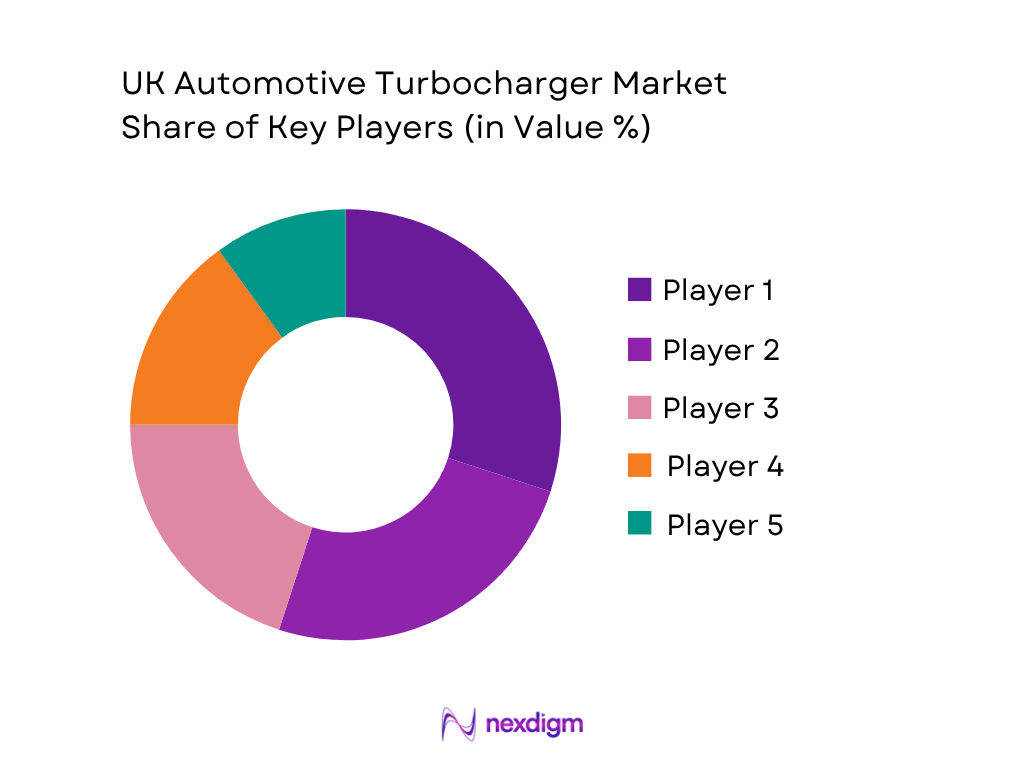
The UK Automotive Turbocharger Market combines global OE technology suppliers with a particularly developed domestic aftermarket, remanufacturing and performance-engineering ecosystem. BorgWarner, Garrett Motion and Cummins Turbo Technologies compete strongly around OEM and commercial-vehicle applications, while Melett/BMTS and specialist UK companies reinforce the replacement and remanufacturing segment. Competition increasingly depends on variable-geometry technology, electronic actuation, OE application coverage, remanufacturing quality, CHRA availability, high-speed balancing, diagnostic capability and the ability to support both established internal-combustion platforms and emerging hybrid boosting architectures.
| Major Player | Establishment Year | Headquarters | Core Turbocharger Portfolio | UK Market Position | Gasoline Turbo Capability | Diesel / CV Capability | Electrified Boosting Capability | Aftermarket / Remanufacturing Capability |
| BorgWarner Inc. | 1928 | Auburn Hills, USA | ~ | ~ | ~ | ~ | ~ | ~ |
| Garrett Motion Inc. | 1954 | Rolle, Switzerland | ~ | ~ | ~ | ~ | ~ | ~ |
| Cummins Turbo Technologies – Holset | 1952 | Huddersfield, UK | ~ | ~ | ~ | ~ | ~ | ~ |
| Melett Limited / BMTS Technology | 1995 | Barnsley, UK | ~ | ~ | ~ | ~ | ~ | ~ |
| Mitsubishi Heavy Industries | 1884 | Tokyo, Japan | ~ | ~ | ~ | ~ | ~ | ~ |
UK Automotive Turbocharger Market Analysis
Growth Drivers
Large Installed Combustion-Vehicle Base Sustaining Replacement and Remanufacturing Demand
The UK Automotive Turbocharger Market is supported by a very large operating vehicle base that continues to create replacement demand even as new-vehicle powertrains become more electrified. SMMT recorded 41,964,268 vehicles on British roads in 2024, including 36,165,401 cars, 5,102,180 vans, 625,509 heavy goods vehicles and 71,718 buses and coaches. The Department for Transport separately recorded 40,848,000 licensed road-using vehicles, including 33,967,000 cars, 4,790,000 light goods vehicles and 518,000 heavy goods vehicles. This scale is directly relevant to turbocharger suppliers because a substantial portion of the installed petrol and diesel vehicle population uses wastegate, variable-geometry, twin-scroll or multi-stage turbocharging. The aftermarket is reinforced by 7,643,180 used-car transactions in 2024, creating repeated ownership changes through which ageing turbocharged vehicles enter independent workshops, dealer networks and specialist repair channels. Replacement demand extends beyond complete turbocharger assemblies to CHRA cores, bearings, turbine shafts, compressor wheels, electronic actuators, wastegate mechanisms and variable-vane assemblies. Commercial vehicles intensify this requirement because high annual mileage, heavy loads and continuous operation expose turbochargers to prolonged thermal and rotational stress. The macroeconomic environment also provides a substantial demand platform: World Bank data records UK GDP at USD 3.69 trillion in 2024 and GDP per capita at USD 53,246.4. The combination of a large vehicle parc, active used-vehicle circulation and substantial national purchasing capacity provides a durable foundation for UK turbocharger repair, remanufacturing, exchange-unit and replacement-component demand.
UK Engine, Passenger Vehicle and Commercial Vehicle Production Supporting OE Turbocharger Integration
Domestic automotive and engine manufacturing remains an important structural driver for the UK Automotive Turbocharger Market because turbocharger suppliers participate directly in engine development, exhaust-air management, thermal engineering and powertrain calibration. UK factories produced 779,584 cars, 125,649 commercial vehicles and 1,589,751 engines in 2024. Commercial-vehicle production included vans, trucks, taxis, buses and coaches, while 82,097 commercial vehicles were manufactured for export, extending turbocharger-related demand beyond the domestic fleet. In 2025, UK factories still produced 717,371 cars, 47,344 commercial vehicles and approximately 1,608,100 engines, demonstrating that substantial engine-manufacturing capability remained present despite factory restructuring and model transitions. The wider automotive ecosystem contains more than 2,500 component providers, giving turbocharger manufacturers access to machining, casting, electronics, engine-management, test and validation capabilities required for advanced wastegate, VGT, twin-scroll and electronically actuated systems. Domestic production is especially relevant to premium SUVs, performance vehicles, vans and commercial vehicles where forced induction remains important for torque delivery and engine efficiency. Turbocharger suppliers can therefore participate not only through complete assemblies but also through turbine housings, compressor systems, actuators, bearing assemblies and application engineering. World Bank data places UK GDP at USD 3.69 trillion in 2024 and GDP per capita at USD 53,246.4, supporting a high-value automotive manufacturing economy. The combination of nearly 1.59 million engines produced in 2024, continuing engine output in 2025 and a deep supplier base provides a measurable platform for OE turbocharger engineering and component demand.
Market Challenges
Accelerating Zero-Emission Vehicle Adoption Reducing Long-Term New Turbocharger Fitment
The principal structural challenge for the UK Automotive Turbocharger Market is the expanding number of zero-emission vehicles, because battery-electric and fuel-cell vehicles do not require conventional exhaust-driven turbochargers. Department for Transport administrative data recorded 410,173 zero-emission vehicles registered for the first time in 2024, including 381,869 cars, 22,457 light goods vehicles, 270 heavy goods vehicles and 1,724 buses and coaches. The transition accelerated further in 2025, when 528,000 zero-emission vehicles were registered for the first time, including 473,226 road-using zero-emission cars, 30,524 light goods vehicles and 632 heavy goods vehicles. The licensed zero-emission vehicle stock reached 2,012,000 units at the end of 2025, with 1,874,000 road-using zero-emission vehicles and 1,737,000 zero-emission cars. At the same time, new petrol-car registrations declined from 750,000 units in 2024 to 610,000 units in 2025, shrinking the pool of newly registered combustion cars potentially requiring gasoline turbochargers. This shift affects OE turbocharger demand more directly than the aftermarket because each battery-electric vehicle replacing a combustion platform permanently removes an exhaust boosting system, turbine housing, CHRA and related actuator from that vehicle architecture. Suppliers must therefore balance current demand from tens of millions of existing combustion vehicles with a shrinking long-term addressable base in new passenger cars. The UK economy remains substantial, with World Bank GDP of USD 3.69 trillion in 2024 and GDP per capita of USD 53,246.4, allowing manufacturers to fund technological transition, but this same investment capacity accelerates adoption of electric drivetrains that bypass conventional turbocharger technology.
Manufacturing Restructuring and Falling Vehicle Output Increasing OE Demand Volatility
UK turbocharger suppliers also face substantial production-cycle volatility as domestic vehicle manufacturing restructures around new models, electrification and plant changes. SMMT recorded 905,233 vehicles produced in 2024, comprising 779,584 cars and 125,649 commercial vehicles. In 2025, combined car and commercial-vehicle output fell to 764,715 units, including 717,371 cars and only 47,344 commercial vehicles. The commercial-vehicle decline is particularly relevant to turbocharger suppliers because vans, trucks and buses remain among the most turbocharger-intensive vehicle categories, particularly for diesel wastegate and variable-geometry systems. Production weakness continued into 2026: February output amounted to 68,061 vehicles, consisting of 65,885 cars and 2,176 commercial vehicles. By July 2026, year-to-date car production stood at 433,523 units, while commercial-vehicle production totaled only 16,111 units. Engine production also faced pressure, with 928,476 engines produced through July 2026, compared with 1,000,008 engines over the corresponding 2025 period. These figures directly affect turbocharger component demand because fewer domestically produced engines reduce requirements for turbine housings, compressor assemblies, VGT mechanisms and electronic wastegates supplied into UK powertrain programs. The challenge extends beyond unit volumes: suppliers must maintain engineering, tooling, validation and service capability even while individual programs are discontinued or reconfigured. World Bank data records USD 3.69 trillion of UK GDP in 2024 and USD 53,246.4 GDP per capita, demonstrating a large economy, but automotive production restructuring can still create concentrated demand shocks for highly specialized turbocharger manufacturers tied to specific vehicle and engine platforms.
Market Opportunities
Commercial Vehicle, Van and Heavy-Duty Turbocharger Aftermarket Creating Long-Term Service Opportunity
The UK’s commercial-vehicle population provides a strong future opportunity for turbocharger replacement, VGT servicing, actuator repair and remanufacturing because these vehicles remain heavily exposed to combustion-engine technology and high annual utilization. SMMT recorded 5,798,867 commercial vehicles on British roads in 2024, including 5,102,180 vans, 625,509 heavy goods vehicles and 71,718 buses and coaches. Department for Transport licensing data similarly recorded 4,790,000 light goods vehicles and 518,000 heavy goods vehicles in active road use. Freight intensity strengthens this opportunity: GB-registered HGVs operating domestically transported 1.59 billion tonnes of goods, moved 168 billion tonne-kilometres and travelled 19.4 billion kilometres in 2024. Of that distance, vehicles accumulated 5,843 million kilometres while running empty, meaning turbocharged engines continued operating even when not carrying revenue-generating freight. This duty profile creates substantial thermal cycling and shaft-speed exposure across turbine wheels, bearings, vane mechanisms and electronic actuators. Future market growth can therefore come from organized exchange programs, CHRA replacement, high-speed balancing, VGT cleaning, actuator calibration and complete remanufactured units rather than depending exclusively on new-vehicle production. The opportunity is reinforced by 363,000 new light goods vehicles and 53,000 heavy goods vehicles registered in 2024, continually refreshing the future service population. World Bank data records UK GDP at USD 3.69 trillion in 2024 and GDP per capita at USD 53,246.4, supporting fleet maintenance expenditure and an established specialist aftermarket. The size and utilization of the existing commercial fleet create a measurable foundation for specialist turbocharger service networks to expand even as passenger-car electrification reduces OE combustion demand.
Remanufacturing, Exchange Turbochargers and Specialist Engineering Creating a Defensible Growth Path
The UK Automotive Turbocharger Market has a significant future opportunity in remanufacturing and specialist engineering because the country combines an ageing combustion-vehicle population with mature automotive component and repair infrastructure. SMMT recorded 41,964,268 vehicles on British roads in 2024, while 7,643,180 used cars changed ownership during the same period. The scale of secondary vehicle circulation is strategically important because older turbocharged cars and vans are more likely to enter independent repair channels where owners consider CHRA replacement, electronic actuator repair, VGT mechanism cleaning, bearing renewal or exchange turbochargers rather than replacing an entire vehicle. The domestic industrial base strengthens this opportunity: the UK automotive sector includes more than 2,500 component providers, employs more than 183,000 people in manufacturing and approximately 830,000 people across the wider automotive industry, while automotive-related manufacturing generates around £85 billion in turnover and £18 billion in value added. UK factories also produced approximately 1.60 million engines in 2025, demonstrating that substantial powertrain engineering and machining capability remains available. This creates conditions for specialist firms to expand controlled disassembly, component inspection, precision balancing, VSR validation, actuator calibration and traceable remanufacturing services. Future growth can also come from supplying exchange turbochargers across UK and overseas aftermarket channels, supported by existing export-oriented automotive infrastructure reaching more than 140 international markets. World Bank data places UK GDP at USD 3.69 trillion in 2024 and GDP per capita at USD 53,246.4, providing a strong economic base for professional repair and remanufacturing services. Rather than competing solely in shrinking new ICE fitment, suppliers can build recurring revenue around the enormous installed fleet requiring continued maintenance and component replacement.
Future Outlook
The UK Automotive Turbocharger Market is expected to expand at approximately ~X.X% CAGR during 2026–2035, although its growth pattern will differ significantly between OEM and aftermarket applications. New battery-electric vehicles reduce conventional turbocharger fitment, while the large installed combustion and hybrid vehicle population sustains replacement demand. Commercial vehicles, vans, premium vehicles and performance applications will remain important, while remanufacturing and electrically assisted boosting are expected to gain strategic relevance. Gasoline turbochargers will remain important because downsized turbocharged engines continue to operate across a substantial proportion of the UK passenger-car and crossover fleet. Wastegate and twin-scroll architectures will benefit from replacement requirements as vehicles age and accumulate mileage. Premium applications will also support higher-specification units using advanced bearings, electronic wastegates and temperature-resistant turbine materials.
Commercial vehicles represent another durable opportunity. Vans, trucks, buses and specialist vehicles continue to rely heavily on turbocharged combustion engines because of torque and duty-cycle requirements. Variable-geometry turbochargers, heavy-duty wastegate systems and two-stage configurations can therefore retain relevance even as passenger-car electrification advances faster. The UK’s large aftermarket creates an important counterbalance to weakening long-term ICE vehicle production. SMMT data shows 41,964,268 vehicles on UK roads, while used-car transactions reached 7,643,180 units in 2024. An ageing and frequently traded vehicle parc creates demand for turbocharger diagnosis, CHRA replacement, actuator calibration, variable-vane cleaning, remanufactured units and complete replacement turbochargers.
Major Players
- BorgWarner Ltd. – Bradford Automotive Turbocharger Manufacturing and Engineering
- Garrett Motion Inc. – Garrett OE, Replacement and Performance Turbochargers
- Cummins Turbo Technologies Ltd. – Holset Commercial Vehicle Turbochargers
- Melett Limited / BMTS Technology – UK Turbochargers, CHRA and Aftermarket Components
- BMTS Technology GmbH & Co. KG – Passenger and Commercial Vehicle Turbocharger Systems
- Mitsubishi Heavy Industries – MHI Automotive Turbochargers
- IHI Corporation – IHI Passenger and Commercial Vehicle Turbocharger Systems
- AET Engineering Ltd. – New, Remanufactured and Re-Engineered Turbochargers
- Turbo Technics Ltd. – Turbocharger Remanufacturing, Balancing and Technical Systems
- Turbo Dynamics Ltd. – Replacement, Reconditioned and Performance Turbochargers
- Universal Turbos Ltd. – New, Exchange and Remanufactured Turbochargers
- Midland Turbo – Turbocharger Repair, Exchange and Electronic Actuator Services
- Owen Developments UK Ltd. – Motorsport, Hybrid and Performance Turbochargers
- Rotomaster International – Replacement and Remanufactured Automotive Turbochargers
- Precision Turbo & Engine – Performance and Motorsport Turbocharger Systems
Key Target Audience
- Automotive Turbocharger Manufacturers
- Passenger Vehicle and Premium Vehicle OEMs
- Commercial Vehicle and Engine Manufacturers
- Automotive Tier-1 and Powertrain System Suppliers
- Turbocharger Distributors, Remanufacturers and Aftermarket Networks
- Commercial Fleet, Vehicle Repair and Service Operators
- Investments and Venture Capitalist Firms
- Government and Regulatory Bodies (Department for Transport, Vehicle Certification Agency, Driver and Vehicle Standards Agency, Office for Zero Emission Vehicles, Department for Business and Trade)
Research Methodology
Step 1: Identification of Key Variables
The initial phase develops an ecosystem map for the UK Automotive Turbocharger Market covering turbocharger manufacturers, vehicle OEMs, engine producers, component suppliers, distributors, remanufacturers, workshops and commercial fleets. Secondary research identifies major variables including turbocharged vehicle population, engine production, fuel type, turbocharger architecture, replacement cycles, OEM fitment and remanufacturing activity. The resulting framework separates OE demand from aftermarket demand and establishes the variables required to evaluate passenger-car, van, HGV, premium and specialist-vehicle turbocharger applications.
Step 2: Market Analysis and Construction
Historical UK vehicle production, engine manufacturing, registrations, vehicle-parc information and powertrain trends are compiled and mapped against turbocharger-relevant applications. Bottom-up analysis evaluates addressable turbocharged vehicles, replacement requirements, application categories and turbocharger technology. The analysis is cross-checked through top-down automotive manufacturing, component-industry and aftermarket indicators. This process enables the market structure to be constructed across technology type, vehicle category and replacement channel without relying on a single demand indicator.
Step 3: Hypothesis Validation and Expert Consultation
Market hypotheses are validated through computer-assisted telephone interviews and structured discussions with turbocharger manufacturers, remanufacturers, automotive distributors, workshop operators, engine specialists and fleet service participants. Interviews are designed to validate technology adoption, product availability, replacement intervals, actuator failures and remanufacturing patterns. Industry feedback is also used to assess differences between OE, independent aftermarket, exchange and reconditioned turbocharger demand. These findings refine competitive positioning and segmentation assumptions.
Step 4: Research Synthesis and Final Output
The final phase combines vehicle-production data, engine-manufacturing activity, vehicle-parc indicators, supplier information, aftermarket structures and primary findings. Bottom-up turbocharger demand calculations are triangulated with broader UK automotive manufacturing and replacement-market indicators to establish consistency. The final analysis provides market segmentation, technology benchmarking, competitive assessment, remanufacturing analysis and future opportunity mapping. Particular attention is given to commercial vehicles, premium applications, electrically assisted boosting and the UK aftermarket.

- Executive Summary
- Research Methodology (Market Definition and Scope, UK Automotive Turbocharger Taxonomy, Gasoline and Diesel Turbocharger Classification, Passenger Car SUV LCV and HGV Application Mapping, Turbocharged Vehicle Production Assessment, UK Engine Production Assessment, OEM Turbocharger Fitment Mapping, Vehicle Parc Assessment, Replacement Cycle Analysis, Turbocharger Manufacturing and Remanufacturing Assessment, Aftermarket Distribution Mapping, Import and Export Assessment, Market Sizing Framework)

- Definition and Scope
- UK Automotive Turbocharger Industry Evolution and Technology Development
- Automotive Turbocharger Manufacturing and Assembly Process
- Automotive Turbocharger Value Chain Analysis
- UK Automotive Turbocharger Supply Chain Analysis
- Compressor Wheel, Turbine Wheel, CHRA, Bearing Housing, Actuator and Variable Vane Ecosystem Analysis
- UK Automotive Turbocharger Manufacturing, Engineering and Remanufacturing Footprint Assessment
- OEM, Tier-1, Distributor and Turbocharger Service Framework

- Growth Drivers (Turbocharged Gasoline Engine Penetration, Premium and Performance Vehicle Production, Commercial Vehicle Turbocharger Demand, UK Engine Manufacturing Base, Passenger Vehicle Replacement Demand, Strong Automotive Aftermarket, Turbocharger Remanufacturing Capability, Export-Oriented Automotive Manufacturing)
- Market Challenges (Battery Electric Vehicle Transition, Declining Internal Combustion Vehicle Production, Diesel Passenger Vehicle Contraction, Electronic Actuator Calibration Complexity, High-Precision Turbocharger Manufacturing Requirements, Exhaust Thermal Management Requirements, Imported Component and Material Exposure, Engine Platform and Turbocharger Fitment Complexity)
- Market Opportunities (Commercial Vehicle Variable Geometry Turbochargers, Premium and Performance Turbocharging, Turbocharger Remanufacturing and Exchange Programs, CHRA and Electronic Actuator Replacement, Motorsport and Hybrid Turbocharger Systems, 48V Electrically Assisted Boosting, UK Engineering and Export Capability, Low-Carbon Hybrid Powertrain Turbocharging)
- Market Trends (Twin-Scroll Gasoline Turbochargers, Variable Geometry Commercial Vehicle Systems, Electronic Wastegate Actuation, Ball-Bearing Turbochargers, Integrated Exhaust Manifolds, High-Temperature Turbine Materials, Electrically Assisted Boosting, Advanced Remanufacturing and VSR Balancing)
- Regulatory and Standards Landscape (UK Vehicle Emissions Regulations, Euro 6 and Successor Emission Requirements, Vehicle Certification Agency Type Approval, Department for Transport Vehicle Standards, Driver and Vehicle Standards Agency Requirements, MOT Emissions Testing Requirements, UK Zero Emission Vehicle Mandate, End-of-Life Vehicle and Remanufacturing Requirements)
- SWOT Analysis
- Porter’s Five Forces Analysis
- PESTLE Analysis
- Stakeholder Ecosystem
- Competition Ecosystem

- By Market Value (2020-2025)
- By New Automotive Turbocharger Unit Volume (2020-2025)
- By OEM-Fitted Turbocharger Volume (2020-2025)
- By Replacement Turbocharger Volume (2020-2025)
- By Passenger Vehicle Turbocharger Volume (2020-2025)
- By Commercial Vehicle Turbocharger Volume (2020-2025)

- By Turbocharger Technology (In Value %)
Fixed Geometry Turbochargers
Wastegate Turbochargers
Variable Geometry Turbochargers
Variable Nozzle Turbochargers
Twin-Scroll Turbochargers
Twin-Turbo Systems
Sequential Turbocharger Systems
Two-Stage Turbocharger Systems
Electrically Assisted Turbochargers
48V Electric Compressors and eBoosters - By Vehicle Type (In Value %)
Hatchbacks and Compact Passenger Cars
Sedans and Executive Cars
Crossovers and SUVs
Premium and Luxury Vehicles
Performance Vehicles
Light Commercial Vehicles and Vans
Medium Commercial Vehicles
Heavy Goods Vehicles
Buses and Coaches
Specialist and Off-Highway Vehicles
Motorsport and Performance Vehicles - By Application Type (In Value %)
Passenger Vehicle Gasoline Engines
Passenger Vehicle Diesel Engines
SUV and Crossover Engines
Premium and Luxury Vehicle Engines
Performance and Motorsport Engines
Light Commercial Vehicle Engines
Medium and Heavy Commercial Vehicle Engines
Bus and Coach Engines
Fleet and Logistics Vehicle Engines
Agricultural and Off-Highway Engines
Specialist Vehicle Engines
Replacement and Remanufacturing Applications - By Fuel and Powertrain Type (In Value %)
Gasoline Turbocharged Vehicles
Diesel Turbocharged Vehicles
Mild-Hybrid Turbocharged Vehicles
Full-Hybrid Turbocharged Vehicles
Plug-In Hybrid Turbocharged Vehicles
Alternative-Fuel Turbocharged Vehicles
48V Electrically Assisted Combustion Powertrains
Other Turbocharged Powertrain Architectures - By Sales Channel (In Value %)
OEM Direct Supply
Tier-1 Engine and Powertrain Integrators
Authorized Dealership Parts Networks
OEM Replacement Channel
Independent Automotive Parts Distributors
Turbocharger Specialist Distributors
Commercial Vehicle Parts Networks
Independent Repair Workshops
Turbocharger Remanufacturing Specialists
Performance and Motorsport Specialists
Online Automotive Parts Channels
Fleet Service and Maintenance Networks - By Region (In Value %)
London and South East England
West Midlands Automotive Corridor
North West England
Yorkshire and Humber
North East England
East Midlands
South West England
Wales
Scotland
Bradford-West Yorkshire Turbocharger Manufacturing and Remanufacturing Cluster
West Midlands-Wolverhampton Automotive Powertrain Cluster
North East-Sunderland Automotive Manufacturing Corridor
Oxford-Motorsport Valley Performance Engineering Cluster
Other UK

- Market Share of Major Players (By Revenue, Unit Sales, Passenger Vehicle Turbochargers, Commercial Vehicle Turbochargers, Gasoline Turbochargers, Diesel Turbochargers, OEM Channel, Aftermarket and Remanufacturing Channel)
- Cross Comparison Parameters (Gasoline Diesel and Commercial Vehicle Turbocharger Portfolio Breadth, Fixed Geometry VGT Twin-Scroll and Two-Stage Technology Capability, UK Manufacturing Engineering and Remanufacturing Footprint, Passenger SUV Premium LCV HGV and Motorsport Application Coverage, UK OEM and Engine Platform Fitment Relationship Strength, Electronic Actuator Ball-Bearing and Electrified Boosting Capability, CHRA Exchange Remanufacturing Diagnostic and Aftermarket Network Strength, UK Export Application Engineering and Technical Service Capability)
- SWOT Analysis of Major Players
- Competitive Positioning Matrix
- Product and Technology Portfolio Benchmarking
- Pricing and Distribution Network Benchmarking
- Market Entry Strategy Assessment
- Detailed Profiles of Major Companies
BorgWarner Ltd. – Bradford Automotive Turbocharger Manufacturing and Engineering
Garrett Motion Inc. – Garrett OE, Replacement and Performance Turbochargers
Cummins Turbo Technologies Ltd. – Holset Commercial Vehicle Turbochargers
Melett Limited / BMTS Technology – UK Turbochargers, CHRA and Aftermarket Components
BMTS Technology GmbH & Co. KG – Passenger and Commercial Vehicle Turbocharger Systems
Mitsubishi Heavy Industries – MHI Automotive Turbochargers
IHI Corporation – IHI Passenger and Commercial Vehicle Turbocharger Systems
AET Engineering Ltd. – New, Remanufactured and Re-Engineered Turbochargers
Turbo Technics Ltd. – Turbocharger Remanufacturing, Balancing and Technical Systems
Turbo Dynamics Ltd. – Replacement, Reconditioned and Performance Turbochargers
Universal Turbos Ltd. – New, Exchange and Remanufactured Turbochargers
Midland Turbo – Turbocharger Repair, Exchange and Electronic Actuator Services
Owen Developments UK Ltd. – Motorsport, Hybrid and Performance Turbochargers
Rotomaster International – Replacement and Remanufactured Automotive Turbochargers
Precision Turbo & Engine – Performance and Motorsport Turbocharger Systems

- Turbocharger Buyer Segmentation
- OEM, Fleet and Aftermarket Procurement Behaviour
- Turbocharger Brand and Supplier Selection Criteria
- Turbocharger Buyer Pain Points
- Turbocharger Technology and Replacement Type Adoption Assessment
- Replacement, Repair and Repurchase Behaviour

- By Market Value (2026-2035)
- By New Automotive Turbocharger Unit Volume (2026-2035)
- By OEM-Fitted Turbocharger Volume (2026-2035)
- By Replacement Turbocharger Volume (2026-2035)
- By Passenger Vehicle Turbocharger Volume (2026-2035)
- By Commercial Vehicle Turbocharger Volume (2026-2035)


 Request a Sample
 Ask for Customization
 Get a Quote
 Enquire Now