

 Download PDF
Market Overview
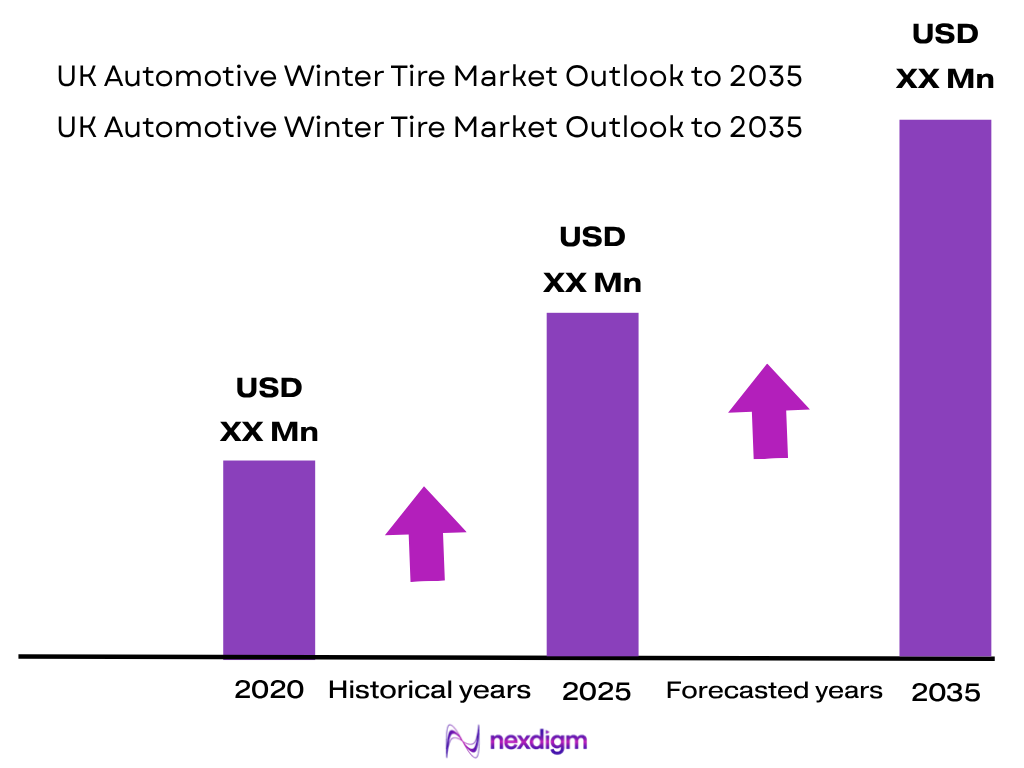
The UK Automotive Winter Tire Market is valued at approximately ~USD XX million, supported by a large replacement-oriented vehicle parc and recurring cold-weather fitment requirements. Licensed vehicles increased from 41.175 million to 41.7 million, including cars rising from 33.580 million to 33.967 million and light goods vehicles from 4.710 million to 4.790 million. New vehicle registrations also increased from 2.535 million to 2.605 million, strengthening the future replacement base for winter tyres.
Scotland, Northern England and upland areas of Wales are the strongest geographical demand centres for the UK Automotive Winter Tire Market because colder temperatures, frost, snow exposure and rural driving increase the practical benefit of dedicated winter compounds. Met Office climate averages show Scotland experiences around 53.37 air-frost days annually, including 11.32 days in January, 10.69 in February and 10.95 in December. UK registrations concurrently expanded from 2.535 million to 2.605 million vehicles, enlarging the national replacement pool.
Market Segmentation
By Vehicle Type
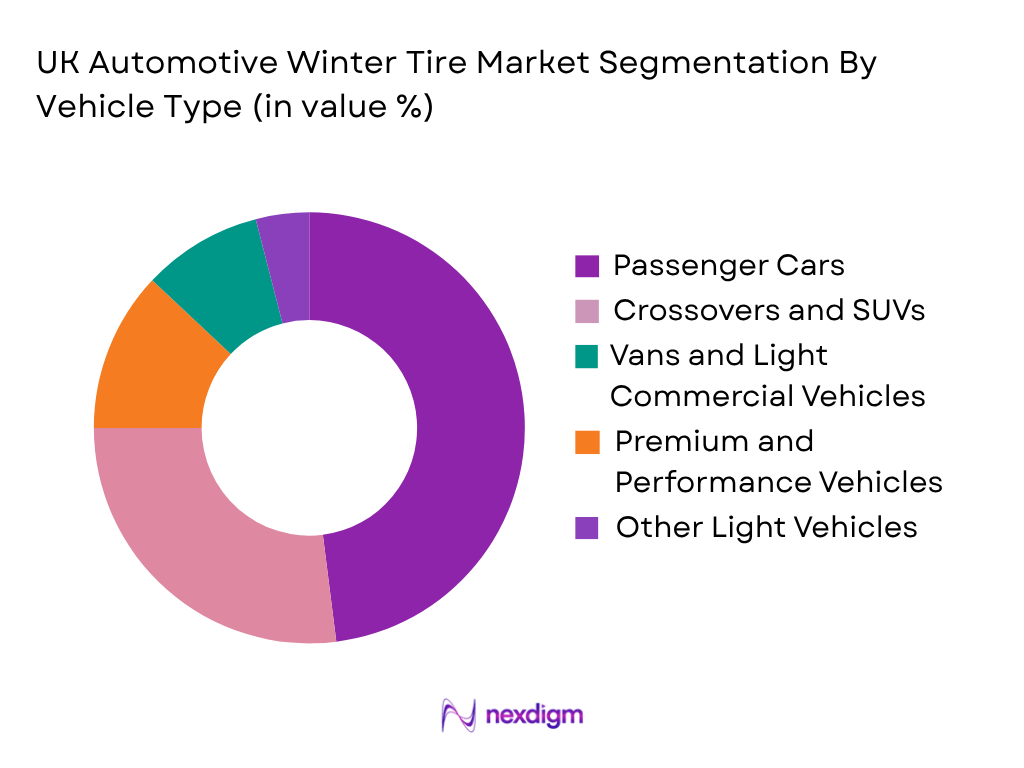
The UK Automotive Winter Tire Market is segmented into passenger cars, SUVs and crossovers, vans and light commercial vehicles, premium and performance vehicles and other light vehicles. Passenger cars represent the dominant segment, reflecting the scale of the UK passenger vehicle parc and the broad availability of winter tyres across mainstream rim diameters. The Department for Transport records nearly 34 million licensed cars, creating a substantially larger replacement base than other vehicle categories. Winter tyres for passenger cars also benefit from compatibility across hatchbacks, saloons, estates, hybrids and battery electric models. However, SUVs and crossovers constitute an increasingly important premium demand segment because larger rim diameters, higher vehicle mass and year-round rural use increase interest in high-performance cold-weather tyres. Winter tyre manufacturers increasingly provide XL load ratings, EV-compatible structures, directional tread patterns and silica-rich compounds for these applications. Passenger vehicle owners in Scotland, northern England and other frost-exposed regions are particularly relevant because winter tyres retain greater compound flexibility under low-temperature road conditions.
By Sales Channel
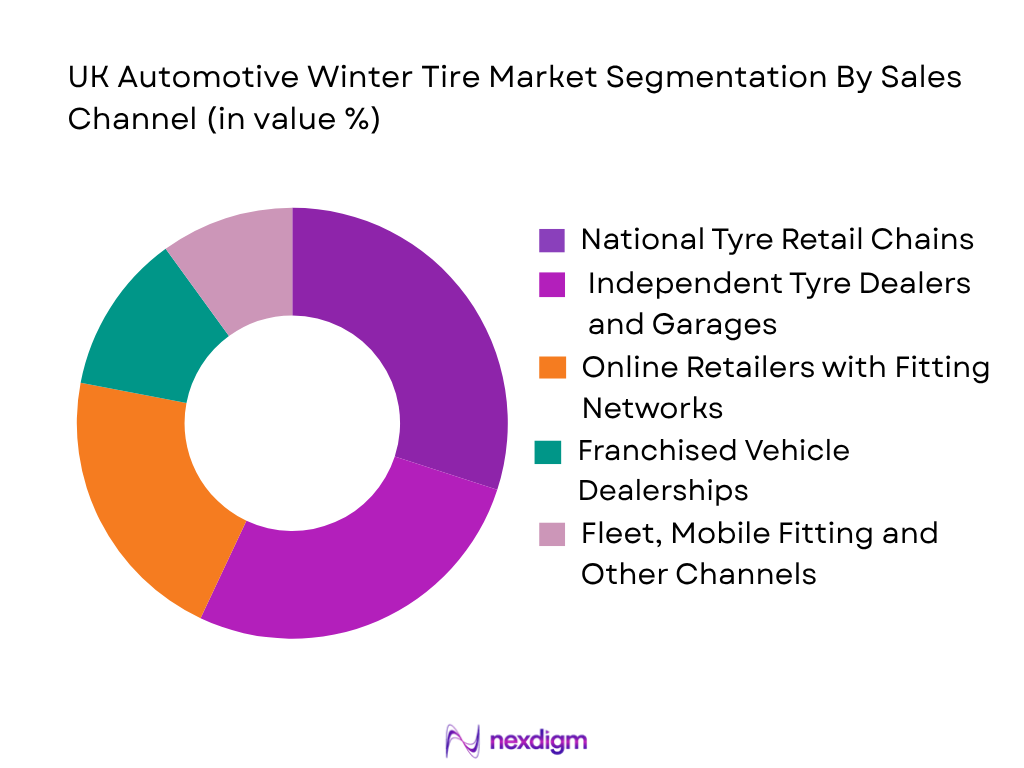
The UK Automotive Winter Tire Market is segmented into national tyre retail chains, independent tyre dealers and garages, online tyre retailers with fitting networks, franchised vehicle dealerships and fleet or mobile-fitting channels. National tyre chains and independent fitters collectively form the dominant distribution structure because winter tyres require vehicle-specific sizing, balancing, wheel removal and seasonal replacement rather than simple product delivery. The market also has a strong digital component, with consumers increasingly comparing tyre specifications, EU/UK labels, 3PMSF certification, wet-grip performance and fitting appointments online before purchase. Online retailers generally rely on affiliated garages or mobile installers, making the UK market a hybrid digital-and-service distribution environment. Fleet customers, leasing operators and light-commercial users require more structured seasonal scheduling because vehicle downtime and tyre storage must be managed across multiple units. Franchised dealers remain relevant for premium OEM-homologated winter tyres, particularly on luxury, performance and battery-electric vehicles requiring specific load, noise and rolling-resistance characteristics.
Competitive Landscape
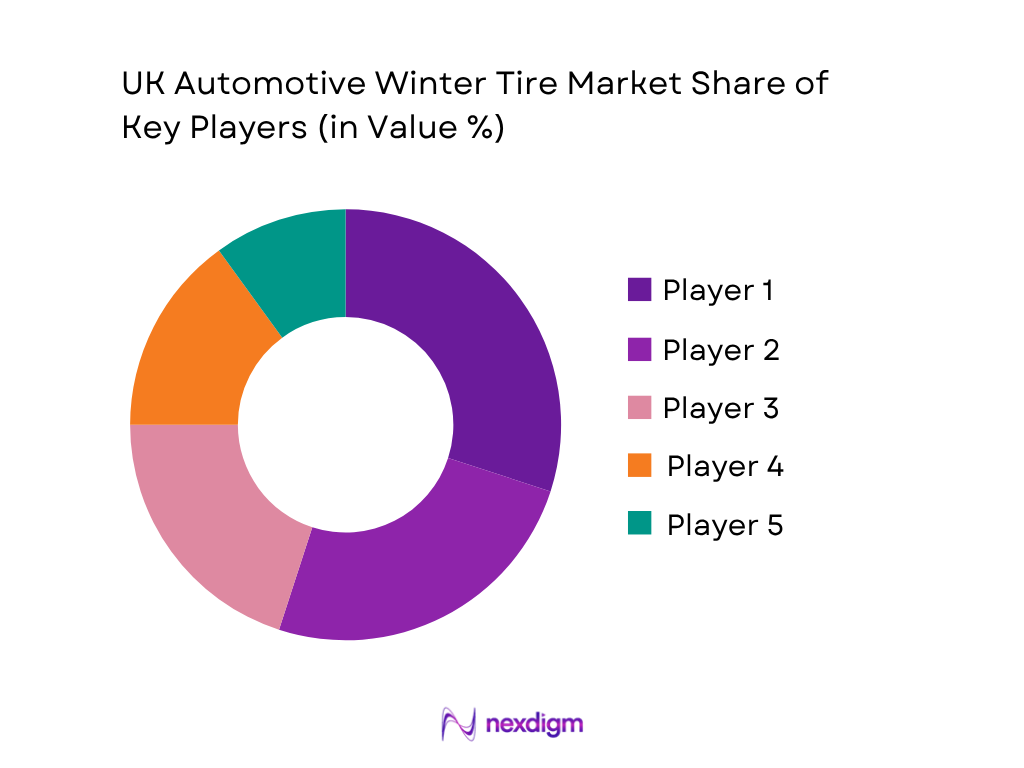
The UK Automotive Winter Tire Market is characterised by strong competition among premium European, Japanese, Korean and international tyre manufacturers. Michelin, Continental, Bridgestone, Goodyear and Pirelli occupy important positions because of their broad 3PMSF-certified portfolios, extensive passenger car and SUV fitment coverage, established UK retail availability and premium OEM relationships. Competition is increasingly determined by wet braking, snow traction, rolling resistance, EV suitability, road-noise reduction, high-load capability and coverage of larger 18-inch to 22-inch wheel applications.
| Major Player | Establishment Year | Headquarters | 3PMSF Winter Portfolio | Passenger & SUV Coverage | EV Winter Capability | High-Performance Winter Range | UK Distribution Strength | Premium OEM Fitment |
| Michelin | 1889 | Clermont-Ferrand, France | ~ | ~ | ~ | ~ | ~ | ~ |
| Continental AG | 1871 | Hanover, Germany | ~ | ~ | ~ | ~ | ~ | ~ |
| Bridgestone Corporation | 1931 | Tokyo, Japan | ~ | ~ | ~ | ~ | ~ | ~ |
| Goodyear Tire & Rubber Company | 1898 | Akron, USA | ~ | ~ | ~ | ~ | ~ | ~ |
| Pirelli & C. S.p.A. | 1872 | Milan, Italy | ~ | ~ | ~ | ~ | ~ | ~ |
UK Automotive Winter Tire Market Analysis
Growth Drivers
Expanding UK Vehicle Parc Strengthens the Winter Tyre Replacement Base
The expanding UK vehicle parc is a fundamental growth driver for the UK Automotive Winter Tire Market because every additional passenger car, SUV and light commercial vehicle enlarges the installed base requiring periodic tyre replacement. Department for Transport and DVLA statistics recorded 40,848,000 licensed road-using vehicles in 2024, comprising 33,967,000 cars and 4,790,000 light goods vehicles. The parc expanded further to 41,462,000 road-using vehicles in 2025, including 34,485,000 cars and 4,880,000 light goods vehicles. New registrations also remained substantial, with 2,605,000 vehicles registered for the first time in 2024 and 2,617,000 in 2025, continually refreshing the addressable tyre base. The average licensed UK car was 10 years old in 2024 and remained 10 years old in 2025, supporting recurring replacement requirements beyond initial vehicle fitment. This automotive demand operates within a substantial economy: World Bank data place UK GDP at USD 3.69 trillion and GDP per capita at USD 53,246.4 in 2024. For winter tyre manufacturers and retailers, the combination of a large mature vehicle parc, continuous new registrations and ageing vehicles provides a broad foundation for seasonal replacement, premium winter fitment and specialist cold-weather tyre services.
High Vehicle Utilisation and Recurring Winter Weather Support Seasonal Tyre Demand
High road utilisation combined with recurring periods of frost, snow and ice provides another market-specific growth driver for the UK Automotive Winter Tire Market. Department for Transport statistics show that motorists travelled 336.2 billion vehicle miles across Great Britain in 2024, including 256.1 billion car and taxi miles, 58.5 billion van miles, 16.6 billion lorry miles and 2.0 billion bus and coach miles. This large distance travelled accelerates tread wear and exposes vehicles to changing road surfaces, increasing the importance of replacement tyres with suitable wet, cold and snow performance. The Met Office recorded a UK mean temperature of 4.62°C during winter 2024/25, together with 308.0 millimetres of rainfall and more than 100 weather warnings during the season. January also included widespread frost, freezing fog, snow and ice, while Scotland experienced particularly persistent cold-weather conditions. These conditions directly support demand for winter compounds, dense siping, snow-grip tread designs and 3PMSF-certified products. The economic backdrop also remains substantial, with the World Bank recording USD 3.69 trillion of UK GDP and USD 53,246.4 GDP per capita in 2024, supporting continued expenditure on vehicle maintenance and safety-oriented replacement products across private, commercial and fleet applications.
Market Challenges
Mild and Highly Variable Winters Create Seasonal Inventory and Demand Risk
Weather variability is a major challenge for the UK Automotive Winter Tire Market because dedicated winter tyre demand depends heavily on the timing, intensity and geographical distribution of low-temperature conditions. Met Office data show that winter 2023/24 recorded a UK mean temperature of 5.29°C, while winter 2024/25 recorded 4.62°C. The latter season delivered 308.0 millimetres of UK rainfall, yet the overall mean temperature remained above the long-term climatic baseline despite periods of snow, widespread frost and freezing fog. December 2024 was the fifth-warmest December in the UK observational record, while colder conditions developed in January. This creates a difficult stocking environment: wholesalers and retailers must secure winter tyres before seasonal conditions are known, but mild periods can delay consumer purchases while sudden snow or frost can concentrate demand into short regional windows. The challenge is amplified by a road-using fleet of 40,848,000 vehicles in 2024 and 41,462,000 in 2025, which requires extensive size and fitment coverage. World Bank data show UK GDP of USD 3.69 trillion and GDP per capita of USD 53,246.4 in 2024, highlighting a large automotive economy in which weather-driven inventory misalignment can affect substantial retail and distribution operations.
Absence of Compulsory Winter Tyre Fitment Limits Nationwide Adoption
The absence of a nationwide legal requirement for dedicated winter tyres remains a structural challenge for the UK Automotive Winter Tire Market because motorists can legally continue using compliant standard tyres throughout winter conditions. Current UK roadworthiness rules require car and light-van tyres to retain at least 1.6 millimetres of tread depth across the central three-quarters of the tyre and around its entire circumference, but they do not establish compulsory seasonal winter tyre replacement. This leaves dedicated winter fitment primarily dependent on voluntary safety considerations, geographic exposure, vehicle type and individual driving patterns. The scale of the addressable fleet is substantial: Department for Transport data record 33,967,000 road-using cars and 4,790,000 light goods vehicles in 2024, rising to 34,485,000 cars and 4,880,000 light goods vehicles in 2025. Nevertheless, without mandatory fitment, conversion of this parc into winter tyre demand remains uneven, particularly across milder southern regions. The Met Office recorded a UK winter mean temperature of 4.62°C during 2024/25, further illustrating why some consumers may postpone dedicated winter purchases. World Bank data show UK GDP at USD 3.69 trillion in 2024, confirming that the constraint is primarily regulatory and behavioural rather than the absence of a sizeable automotive economy.
Market Opportunities
Expanding Electric Vehicle Parc Creates Opportunity for EV-Specific Winter Tyres
The rapidly expanding electric vehicle parc creates a future growth opportunity for the UK Automotive Winter Tire Market because battery-electric vehicles require tyres engineered for higher vehicle mass, immediate torque delivery, low rolling resistance and reduced road noise while still delivering cold-weather traction. Department for Transport and DVLA statistics recorded 1,287,000 licensed zero-emission cars in 2024. This expanded to 1,737,000 zero-emission cars in 2025, creating a substantially larger installed base for EV-compatible replacement tyres. The new-vehicle pipeline is also strengthening: 382,000 zero-emission cars were registered for the first time in 2024, followed by 473,000 in 2025. Zero-emission light goods vehicles provide an additional application base, increasing from 86,000 licensed units in 2024 to 113,000 in 2025. These current vehicle counts support future demand for high-load winter tyres, reinforced constructions, low-energy-loss compounds and noise-optimised tread designs without relying on future sales forecasts. World Bank data place UK GDP at USD 3.69 trillion and GDP per capita at USD 53,246.4 in 2024, supporting a relatively high-value automotive environment where technologically differentiated tyre products can gain adoption. Winter tyre suppliers with dedicated EV homologation and larger rim-size coverage are therefore positioned to benefit as the electrified replacement parc matures.
Large Van Parc and Commercial Mileage Create Scope for Fleet Winter Tyre Programmes
Fleet-focused winter tyre programmes represent a strong future opportunity in the UK Automotive Winter Tire Market because commercial vans operate at high utilisation levels and must maintain mobility through cold, wet and potentially icy conditions. Department for Transport statistics recorded 4,790,000 licensed light goods vehicles in 2024, increasing to 4,880,000 in 2025. Great Britain’s vans travelled 58.5 billion vehicle miles in 2024, including 13.2 billion miles on motorways, 24.7 billion miles on A roads and 20.6 billion miles on minor roads. This substantial annual utilisation creates recurring tyre wear and makes braking, wet grip, cold-temperature flexibility and reliable fleet uptime commercially important. New light goods vehicle registrations totalled 363,000 in 2024 and 330,000 in 2025, continuously introducing additional vehicles into replacement cycles. The Met Office also recorded snow, ice, widespread frost and more than 100 weather warnings during winter 2024/25, reinforcing the operational value of seasonal tyre preparedness for courier, utility, leasing and service fleets. World Bank data show UK GDP of USD 3.69 trillion and GDP per capita of USD 53,246.4 in 2024. These current indicators support future expansion of contracted winter tyre fitting, mobile servicing, tyre storage and fleet replacement programmes targeted specifically at high-mileage commercial operators.
Future Outlook
The UK Automotive Winter Tire Market is expected to expand at approximately ~X.X% CAGR during 2026–2035, supported by the growing vehicle parc, premium SUV penetration, electrification, larger wheel sizes and the development of more sophisticated cold-weather tyre technologies. Growth will remain uneven geographically because winter tyre demand is considerably stronger in Scotland, northern England and exposed rural or upland areas than in milder southern urban markets. The replacement base is structurally significant. The Department for Transport recorded 40.848 million licensed road-using vehicles, including 33.967 million cars and 4.790 million light goods vehicles, at the end of 2024. The average licensed car was around 10 years old, reinforcing long-term demand for replacement tyres across the existing parc rather than dependence solely on new vehicle registrations.
Electrification will gradually alter winter tyre specifications. The UK had 1.287 million licensed zero-emission cars and registered 381,869 new zero-emission cars during 2024. Battery electric vehicles typically require tyres capable of supporting higher vehicle mass, managing instantaneous torque, reducing rolling resistance and controlling cabin-perceived road noise. These requirements create space for EV-optimised winter tyres with reinforced load structures and low-energy-loss compounds.
Major Players
- Michelin – Alpin / Pilot Alpin / Latitude Alpin Winter Tyres
- Continental AG – WinterContact / ContiWinterContact Winter Tyres
- Bridgestone Corporation – Blizzak Winter Tyres
- Goodyear Tire & Rubber Company – UltraGrip Winter Tyres
- Pirelli & C. S.p.A. – Cinturato Winter / P Zero Winter / Scorpion Winter Tyres
- Nokian Tyres plc – Snowproof / Snowproof P / WR Winter Tyres
- Hankook Tire & Technology Co., Ltd. – Winter i*cept Winter Tyres
- Falken Tire / Sumitomo Rubber Industries – Eurowinter Winter Tyres
- Yokohama Rubber Co., Ltd. – BluEarth-Winter Winter Tyres
- Toyo Tire Corporation – Observe Winter Tyres
- Kumho Tire Co., Inc. – WinterCraft Winter Tyres
- Apollo Tyres Ltd. / Vredestein – Wintrac / Wintrac Pro Winter Tyres
- Giti Tire – GitiWinter Winter Tyres
- Maxxis International – Premitra Snow / Winter Tyre Range
- Nankang Rubber Tire Corporation – Winter Activa Winter Tyres
Key Target Audience
- Automotive Tyre Manufacturers and Winter Tyre Brand Owners
- Tyre Importers Wholesalers and National Distribution Companies
- National Tyre Retail Chains and Independent Tyre Dealer Networks
- Vehicle Leasing Fleet Management and Rental Companies
- Passenger Vehicle SUV and Light Commercial Vehicle OEMs
- E-Commerce Tyre Retailers and Mobile Tyre Fitting Platforms
- Investments and Venture Capitalist Firms
- Government and Regulatory Bodies (Department for Transport, Driver and Vehicle Standards Agency, Vehicle Certification Agency, Driver and Vehicle Licensing Agency)
Research Methodology
Step 1: Identification of Key Variables
The initial phase involves developing an ecosystem map covering tyre manufacturers, importers, wholesalers, retailers, fitment centres, fleet operators and vehicle owners within the UK Automotive Winter Tire Market. Extensive secondary research is used to identify major variables including vehicle parc, vehicle type, winter weather exposure, replacement frequency, rim diameter, 3PMSF certification, sales channel and regional cold-weather intensity.
Step 2: Market Analysis and Construction
Historical demand is constructed through analysis of licensed passenger vehicles, SUVs, vans, replacement tyre requirements, winter fitment behaviour and regional climatic conditions. A top-down vehicle-parc approach is reconciled with bottom-up assumptions involving tyres per vehicle, replacement cycles, seasonal adoption, distribution channels and average category positioning to develop consistent estimates across product and customer segments.
Step 3: Hypothesis Validation and Expert Consultation
Market hypotheses are validated through computer-assisted telephone interviews with tyre distributors, independent fitters, national retail chains, fleet operators, tyre technicians and automotive aftermarket participants. Consultations assess seasonal sell-through patterns, preferred tyre sizes, winter-versus-all-season substitution, premium brand preferences, EV tyre requirements, tyre-storage demand and differences between northern and southern regional purchasing behaviour.
Step 4: Research Synthesis and Final Output
The final phase triangulates vehicle licensing, replacement demand, regional weather conditions, tyre distribution and retailer-level insights. Manufacturer and distributor information is compared with fitting-channel observations to validate market structure and avoid duplication between wholesale and retail volumes. The resulting analysis provides an integrated assessment of winter tyre technology, regional demand, customer behaviour, competitive positioning and future market opportunities across the United Kingdom.

- Executive Summary
- Research Methodology (Market Definition and Scope, UK Automotive Winter Tyre Taxonomy, Passenger Car SUV and Van Winter Tyre Classification, 3PMSF and M+S Tyre Classification, Vehicle Parc Assessment, New Vehicle Registration Assessment, Winter Weather and Seasonal Demand Mapping, Replacement Tyre Assessment, Rim Size and Vehicle Fitment Mapping, Winter Tyre Import and Distribution Assessment, Online and Offline Retail Channel Mapping, Independent Tyre Fitter and Service Network Assessment, Market Sizing Framework)

- Definition and Scope
- UK Automotive Winter Tyre Industry Evolution and Seasonal Demand Development
- Automotive Winter Tyre Manufacturing and Compound Development Process
- Automotive Winter Tyre Value Chain Analysis
- UK Automotive Winter Tyre Supply Chain Analysis
- Natural Rubber, Synthetic Rubber, Silica, Carbon Black, Steel Cord and Tyre Compound Ecosystem Analysis
- UK Automotive Winter Tyre Import, Distribution and Seasonal Inventory Footprint Assessment
- Tyre Manufacturer, Distributor, National Retail Chain, Independent Fitter and Online Retail Framework

- Growth Drivers (Large Passenger Car and Light Commercial Vehicle Parc, Seasonal Frost and Snow Exposure, Premium SUV and Performance Vehicle Fitment, Increasing Cold-Weather Safety Awareness, Expansion of EV-Compatible Winter Tyres, Growth of Online Tyre Retail and Mobile Fitting, Fleet Winter-Safety Requirements, Replacement Demand from Ageing Vehicle Parc)
- Market Challenges (Absence of Mandatory Nationwide Winter Tyre Fitment, Relatively Mild Winters in Southern UK, Strong All-Season Tyre Substitution, Seasonal Inventory Risk, Short Winter Selling Window, Consumer Tyre Storage Requirements, Weather-Dependent Replacement Decisions, Dependence on Imported Winter Tyres)
- Market Opportunities (EV-Specific Winter Tyres, High-Performance SUV Winter Fitments, Fleet Winter Tyre Programmes, Mobile Tyre Fitting Services, Tyre Hotel and Seasonal Storage Services, Premium 3PMSF-Certified Product Expansion, Northern UK Regional Distribution, Digital Tyre Selection and Appointment Booking)
- Market Trends (3PMSF-Certified Product Adoption, Silica-Rich Cold-Temperature Compounds, Directional and V-Shaped Tread Designs, High-Density Siping Systems, EV Load-Index Optimization, Low-Rolling-Resistance Winter Tyres, Larger Rim Diameter Winter Fitments, Noise-Optimized EV Winter Tyres)
- Regulatory and Standards Landscape (Driver and Vehicle Standards Agency Tyre Safety Requirements, Vehicle Certification Agency Tyre Labelling Requirements, UK Minimum Legal Tread Depth Requirements, UNECE Regulation No. 117 Compliance, Wet-Grip Classification, Rolling-Resistance Classification, External Rolling Noise Requirements, 3PMSF Severe-Snow Certification, M+S Marking Requirements, MOT Tyre Condition Requirements)
- SWOT Analysis
- Porter’s Five Forces Analysis
- PESTLE Analysis
- Stakeholder Ecosystem
- Competition Ecosystem

- By Market Value (2020-2025)
- By Winter Tyre Replacement Volume (2020-2025)
- By Passenger Car Winter Tyre Volume (2020-2025)
- By SUV and Crossover Winter Tyre Volume (2020-2025)
- By Van and Light Commercial Vehicle Winter Tyre Volume (2020-2025)
- By Premium and Performance Winter Tyre Volume (2020-2025)

- By Vehicle Type (In Value %)
Passenger Cars
Compact SUVs and Crossovers
Mid-Size SUVs
Large SUVs and 4×4 Vehicles
Premium and Luxury Vehicles
Performance and Sports Cars
Vans and Light Commercial Vehicles
Electric Passenger Vehicles
Electric SUVs and Crossovers
Other Light Vehicles - By Winter Tyre Category (In Value %)
Standard European Winter Tyres
High-Performance Winter Tyres
Ultra-High-Performance Winter Tyres
SUV and 4×4 Winter Tyres
Van and Commercial Winter Tyres
Nordic-Style Studless Winter Tyres
Electric Vehicle Winter Tyres
Run-Flat Winter Tyres
Self-Sealing Winter Tyres
OEM-Homologated Winter Tyres - By Rim Diameter (In Value %)
Below 16-Inch
16-Inch
17-Inch
18-Inch
19-Inch
20-Inch
21-Inch
22-Inch and Above - By Sales Channel (In Value %)
National Tyre Retail Chains
Independent Tyre Dealers and Fitters
Independent Garages and Workshops
Online Tyre Retailers with Local Fitting
Online Direct-to-Consumer Tyre Retail
Franchised Vehicle Dealerships
Fast-Fit Automotive Service Networks
Fleet Tyre Management Providers
Wholesale Tyre Distributors
Mobile Tyre Fitting Services - By End-User Type (In Value %)
Private Passenger Vehicle Owners
SUV and 4×4 Owners
Premium and Performance Vehicle Owners
Company Car Users
Vehicle Leasing Fleets
Rental Vehicle Fleets
Van and Light Commercial Vehicle Operators
Courier and Last-Mile Delivery Fleets
Emergency and Public Service Fleets
Rural and High-Winter-Exposure Drivers - By Propulsion Type (In Value %)
Petrol Vehicles
Diesel Vehicles
Mild Hybrid Vehicles
Full Hybrid Vehicles
Plug-In Hybrid Vehicles
Battery Electric Vehicles
Other Electrified Light Vehicles - By Region (In Value %)
Scotland
North East England
North West England
Yorkshire and the Humber
East Midlands
West Midlands
East of England
South East England
South West England
London
Wales
Northern Ireland

- Market Share of Major Players (By Revenue, Winter Tyre Volume, Passenger Car Applications, SUV Applications, Van Applications, Premium Segment, Sales Channel, EV-Compatible Winter Tyres)
- Cross Comparison Parameters (UK Winter Tyre Product and Size Portfolio Breadth, 3PMSF-Certified Cold-Weather and Snow-Grip Capability, Passenger Car SUV Van and Performance Vehicle Fitment Coverage, Wet-Grip Rolling-Resistance and External-Noise Performance, EV-Specific High-Load Low-Noise and Low-Rolling-Resistance Capability, UK National Retail Online and Independent Dealer Availability, Premium OEM-Homologated and Run-Flat Winter Tyre Capability, Winter Compound Tread Technology and Seasonal Product Innovation Strength)
- SWOT Analysis of Major Players
- Competitive Positioning Matrix
- Pricing and Distribution Network Benchmarking
- Detailed Profiles of Major Companies
Michelin – Alpin / Pilot Alpin / Latitude Alpin Winter Tyres
Continental AG – WinterContact / ContiWinterContact Winter Tyres
Bridgestone Corporation – Blizzak Winter Tyres
Goodyear Tire & Rubber Company – UltraGrip Winter Tyres
Pirelli & C. S.p.A. – Cinturato Winter / P Zero Winter / Scorpion Winter Tyres
Nokian Tyres plc – Snowproof / Snowproof P / WR Winter Tyres
Hankook Tire & Technology Co., Ltd. – Winter i*cept Winter Tyres
Falken Tire / Sumitomo Rubber Industries – Eurowinter Winter Tyres
Yokohama Rubber Co., Ltd. – BluEarth-Winter Winter Tyres
Toyo Tire Corporation – Observe Winter Tyres
Kumho Tire Co., Inc. – WinterCraft Winter Tyres
Apollo Tyres Ltd. / Vredestein – Wintrac / Wintrac Pro Winter Tyres
Giti Tire – GitiWinter Winter Tyres
Maxxis International – Premitra Snow / Winter Tyre Range
Nankang Rubber Tire Corporation – Winter Activa Winter Tyres

- Winter Tyre Buyer Segmentation
- Winter Tyre Purchase and Replacement Behaviour
- Winter Tyre Brand and Retailer Selection Criteria
- Consumer Tyre Storage and Seasonal Fitment Pain Points
- 3PMSF EV and Winter Tyre Technology Adoption Assessment
- Replacement and Repurchase Behaviour

- By Market Value (2026-2035)
- By Winter Tyre Replacement Volume (2026-2035)
- By Passenger Car Winter Tyre Volume (2026-2035)
- By SUV and Crossover Winter Tyre Volume (2026-2035)
- By Van and Light Commercial Vehicle Winter Tyre Volume (2026-2035)
- By Premium and Performance Winter Tyre Volume (2026-2035)


 Request a Sample
 Ask for Customization
 Get a Quote
 Enquire Now