

 Download PDF
 Download PDF
Market Overview
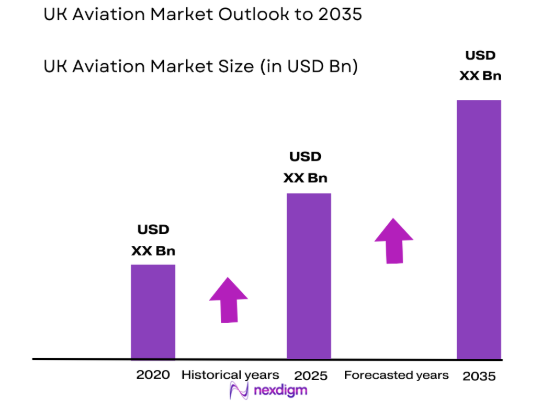
The UK aviation market has experienced significant growth, with a market size reaching USD ~ billion based on a recent historical assessment. The demand for air travel, both domestic and international, has been a key factor in driving this growth. Increased investments in infrastructure, airport expansions, and rising passenger traffic have also contributed to the market’s expansion. The market is further fueled by advancements in aircraft technology, making flights more efficient and cost-effective.
The UK aviation sector is dominated by key cities like London, Manchester, and Birmingham, owing to their well-established international airports and robust connectivity. London, with its multiple airports, serves as a global hub for international flights, driving the market’s growth. The strategic positioning of these cities, coupled with a high volume of both business and leisure travelers, has cemented their role in the aviation market. Regulatory support and infrastructure development have played a crucial role in maintaining the UK’s dominance in aviation.
Market Segmentation
By Product Type
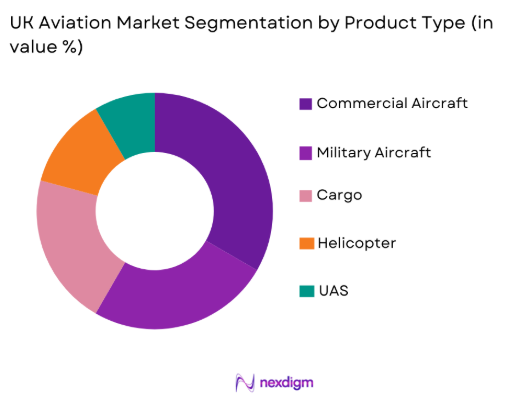
The UK aviation market is segmented by product type into commercial aircraft, cargo aircraft, military aircraft, helicopters, and unmanned aerial systems. Recently, commercial aircraft has a dominant market share due to factors such as the growing demand for air travel, airline fleet expansions, and the increasing adoption of low-cost carriers. The demand for commercial aircraft has surged as airlines focus on modernizing their fleets to enhance fuel efficiency and cater to the rising number of passengers.
By Platform Type
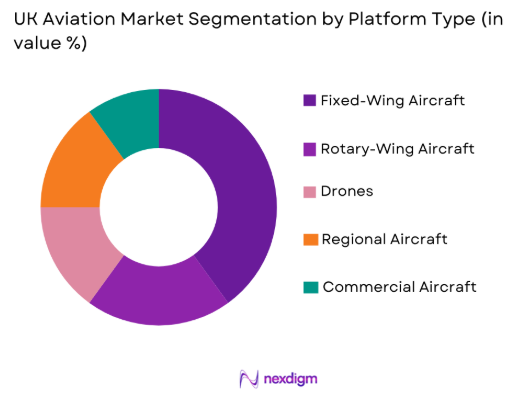
The UK aviation market is segmented by platform type into fixed-wing aircraft, rotary-wing aircraft, drones, regional aircraft, and commercial aircraft. Recently, fixed-wing aircraft has a dominant market share due to its widespread use in both commercial and military sectors. Fixed-wing aircraft dominate because of their ability to cover long distances, making them essential for international and regional travel. Additionally, advancements in aerodynamics and fuel efficiency have bolstered the adoption of fixed-wing aircraft in the market.
Competitive Landscape
The competitive landscape of the UK aviation market is marked by strong competition among global aircraft manufacturers, airlines, and service providers. Consolidation is ongoing, with key players dominating both the commercial and military sectors. Companies in this market have focused on technology adoption and infrastructure growth to cater to the increasing demand for air travel and cargo services. A key feature is the role of government regulations in shaping the market dynamics, with strict standards around emissions and safety.
| Company Name | Establishment Year | Headquarters | Technology Focus | Market Reach | Key Products | Revenue | Sustainability Initiatives |
| Airbus | 1970 | Toulouse, France | ~ | ~ | ~ | ~ | ~ |
| Rolls-Royce | 1906 | Derby, UK | ~ | ~ | ~ | ~ | ~ |
| Boeing | 1916 | Chicago, USA | ~ | ~ | ~ | ~ | ~ |
| British Airways | 1974 | London, UK | ~ | ~ | ~ | ~ | ~ |
| Thales | 1893 | Paris, France | ~ | ~ | ~ | ~ | ~ |

UK Aviation Market Analysis
Growth Drivers
Increased demand for air travel
The UK aviation market is experiencing significant growth driven by a surge in passenger traffic. This is mainly attributed to the rise in both leisure and business travel, supported by an expanding middle class and increased disposable income in global markets. Furthermore, UK-based airlines are investing in expanding their fleets and improving passenger services to accommodate this growing demand. The development of low-cost carriers has also contributed to making air travel more accessible, thereby stimulating the market further. As international connectivity strengthens and airports expand their facilities, the UK is poised to benefit from a consistently rising demand for air travel. Additionally, the recovery of global tourism post-pandemic is further accelerating market growth, particularly in popular destinations across the UK.
Technological advancements in aircraft
The UK aviation market is being significantly impacted by technological innovations in aircraft design and performance. Airlines and aircraft manufacturers are increasingly adopting fuel-efficient aircraft models, such as the Airbus A320neo and the Boeing 787, which offer improved aerodynamics and lower fuel consumption. These advancements help reduce operational costs for airlines and make flying more affordable for passengers. Moreover, innovations in avionics, air traffic management, and aircraft safety technologies are further enhancing the operational efficiency of airlines. The push toward sustainable aviation, including the development of electric and hybrid aircraft, also plays a crucial role in the market’s growth. These advancements are not only helping to reduce environmental impact but are also attracting increased investment into the sector.
Market Challenges
Rising fuel prices
One of the most significant challenges facing the UK aviation market is the volatility in fuel prices. Fluctuating oil prices significantly affect operational costs for airlines, which often pass these costs onto passengers in the form of higher ticket prices. Rising fuel costs increase the financial burden on airlines, especially when global fuel prices rise unexpectedly. Additionally, airlines face difficulties in managing fuel costs while maintaining competitive ticket pricing and service standards. In the long term, this could affect profit margins and customer demand for air travel. The UK aviation market must address these fuel price fluctuations through diversification in energy sources, including exploring sustainable aviation fuels or electric propulsion systems as a potential solution to reduce dependency on conventional jet fuel.
Regulatory compliance and environmental concerns
Another major challenge in the UK aviation market is the increasing regulatory burden related to environmental concerns. Stricter regulations surrounding carbon emissions, noise pollution, and fuel efficiency are being implemented both within the UK and across Europe. Airlines must invest in newer, more efficient aircraft and technology to meet the environmental standards set by regulators such as the European Union Aviation Safety Agency (EASA) and the UK Civil Aviation Authority (CAA). These regulations require considerable investment in fleet upgrades and the adoption of more sustainable practices. Furthermore, public and governmental pressure to reduce aviation’s carbon footprint means that compliance with environmental standards is becoming a more significant operational challenge, especially for smaller regional airlines that may lack the resources to invest in such advancements.
Opportunities
Growth in electric aircraft development:
A major opportunity for the UK aviation market is the growing development of electric and hybrid aircraft. As the aviation industry faces increasing pressure to reduce its carbon emissions, electric aircraft are gaining traction as a cleaner alternative to traditional fuel-powered aircraft. Several UK-based and international companies are actively investing in the development of electric aircraft for short-haul flights. This technology promises to reduce operational costs while significantly lowering emissions, contributing to environmental sustainability goals. The UK government is also offering support in the form of funding for research and development of electric aviation technologies. These efforts position the UK as a leader in the global race to develop and commercialize electric aircraft, which is expected to drive the market forward in the coming years.
Expansion of urban air mobility
The rise of urban air mobility (UAM) presents significant opportunities for the UK aviation market, especially with the country’s emphasis on innovation and sustainability. UAM refers to the use of small, electric aircraft for short trips within urban areas, potentially bypassing traditional transportation infrastructure like roads and railways. This opportunity is particularly attractive for congested cities such as London, where air taxis or drones could provide efficient alternatives to ground transport. The UK government has already expressed interest in supporting UAM through regulatory frameworks, infrastructure development, and pilot projects. As cities face challenges like traffic congestion and pollution, UAM offers a promising solution for urban transport, which could reshape the way people move within metropolitan areas. The development of this technology also opens up new avenues for investment and job creation within the aviation and technology sectors.
Future Outlook
Over the next five years, the UK aviation market is expected to experience steady growth driven by technological advancements, an increase in air travel demand, and regulatory support. Continued fleet modernization and investments in sustainability will play a key role in shaping the future of the sector. The rise of electric and hybrid aircraft is set to revolutionize the industry, while urban air mobility is gaining traction as an innovative solution for city transportation. Additionally, as international travel continues to recover, the UK is positioned to remain a dominant player in global aviation.
Major Players
- Airbus
- Rolls-Royce
- Boeing
- British Airways
- Thales
- Lockheed Martin
- GE Aviation
- Leonardo
- GKN Aerospace
- Raytheon Technologies
- Lufthansa Technik
- IAG (International Airlines Group)
- Bombardier
- ATR
- BAE Systems
Key Target Audience
- Airlines and airline operators
- Aircraft manufacturers
- Government and regulatory bodies
- Airports and airport operators
- Aircraft maintenance providers
- Defense contractors
- Investment and venture capitalist firms
- Aviation technology developers
Research Methodology
Step 1: Identification of Key Variables
Identify and define key variables that affect market trends and growth, such as market size, segmentation, technology adoption, and consumer demand patterns.
Step 2: Market Analysis and Construction
Conduct a detailed analysis of the aviation market using primary and secondary data sources, with a focus on historical trends, forecasts, and competitive landscapes.
Step 3: Hypothesis Validation and Expert Consultation
Validate hypotheses with expert interviews, consultations with industry leaders, and input from market specialists to ensure accuracy and relevance.
Step 4: Research Synthesis and Final Output
Synthesize findings into a comprehensive report, including data-driven insights and projections that align with market dynamics and trends.

- Executive Summary
- Research Methodology (Definitions, Scope, Industry Assumptions, Market Sizing Approach, Primary & Secondary Research Framework, Data Collection & Verification Protocol, Analytic Models & Forecast Methodology, Limitations & Research Validity Checks)

- Market Definition and Scope
- Value Chain & Stakeholder Ecosystem
- Regulatory / Certification Landscape
- Sector Dynamics Affecting Demand
- Strategic Initiatives & Infrastructure Growth

- Growth Drivers
Increased Demand for Air Travel
Government Investments in Aviation Infrastructure
Technological Advancements in Aircraft Efficiency
Rising Demand for Military Aircraft
Increase in Global Freight and Cargo Movements - Market Challenges
High Operational Costs
Environmental Regulations
Rising Fuel Prices
Safety and Security Threats
Global Economic Instability - Market Opportunities
Emerging Demand for Electric Aircraft
Advancements in Sustainable Aviation Technologies
Growth in Regional Air Mobility - Trends
Increased Adoption of Electric and Hybrid Aircraft
Automation and AI in Aviation Systems
Rise in Urban Air Mobility Solutions
Demand for Sustainable Aviation Fuels
Use of Drones for Cargo and Surveillance - Government Regulations & Defense Policy
EU Emission Regulations Impact
UK Aviation Safety Standards
National Security and Defense Procurement Policies

- By Market Value, 2020-2025
- By Installed Units, 2020-2025
- By Average System Price, 2020-2025
- By System Complexity Tier, 2020-2025

- By System Type (In Value%)
Passenger Aircraft
Cargo Aircraft
Military Aircraft
Helicopters
Unmanned Aerial Systems - By Platform Type (In Value%)
Fixed-wing Aircraft
Rotary-wing Aircraft
Drones
Regional Aircraft
Commercial Aircraft - By Fitment Type (In Value%)
OEM
Aftermarket
Maintenance, Repair, and Overhaul (MRO)
Refurbishment
Upgrades - By End User Segment (In Value%)
Commercial Airlines
Cargo Operators
Military Organizations
Private & Business Aviation
Government & Regulatory Bodies - By Procurement Channel (In Value%)
Direct Procurement
Public Procurement
Private Sector Procurement
Online Bidding Platforms
Third-party Distributors - By Material / Technology (in Value%)
Composites
Avionics
Aerostructures
Power Systems
Airframe Materials

- Market structure and competitive positioning
- Market share snapshot of major players
- Cross Comparison Parameters (System Type, Platform Type, Procurement Channel, End User Segment, Fitment Type)
- SWOT Analysis of Key Players
- Pricing & Procurement Analysis
- Porter’s Five Forces
- Key Players
Rolls-Royce
BAE Systems
Airbus
British Airways
EasyJet
Thales
London Heathrow Airport
Virgin Atlantic
QinetiQ
Lockheed Martin
GE Aviation
Airbus Helicopters
Leonardo
GKN Aerospace
Raytheon Technologies

Commercial Airlines Adapting to Demand Surge
Government Bodies Focusing on Aviation Safety
Cargo Operators Enhancing Fleet Efficiency
Military Forces Investing in Advanced Aircraft

Forecast Market Value, 2026-2035
Forecast Installed Units, 2026-2035
Price Forecast by System Tier, 2026-2035
Future Demand by Platform, 2026-2035


 Request a Sample
 Ask for Customization
 Get a Quote
 Enquire Now