
 Download PDF
Market Overview
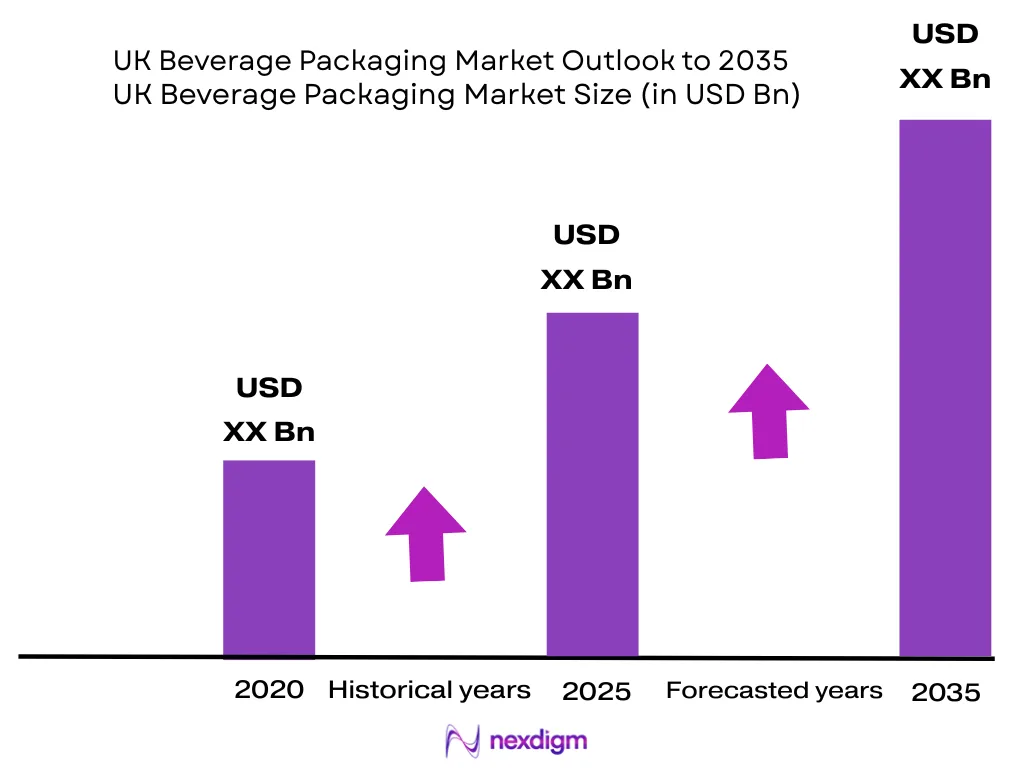
The UK Beverage Packaging Market is valued at approximately ~ billion and is forecast to expand at a CAGR of % during 2026–2035. The two latest annual economic readings show real GDP growth strengthening from 0.4% to 1.1%, while the population exceeded 69 million people. Demand is generated by soft drinks, bottled water, beer, cider, dairy beverages, juice, ready-to-drink alcohol, low-alcohol products, wine, spirits and functional beverages. England dominates through London, the South East, North West, Yorkshire, the Midlands and South Wales-linked supply corridors, where beverage fillers, can plants, PET converters, glass furnaces, warehouses and retailers are concentrated. Scotland leads whisky, brewing, soft-drink and premium-glass demand; Wales supports beverage-can manufacturing and filling; Northern Ireland benefits from glass, can and cross-border beverage operations. Encirc operates in Derrylin, Elton and Bristol, demonstrating the importance of these integrated production and logistics clusters.
Market Segmentation
By Packaging Material
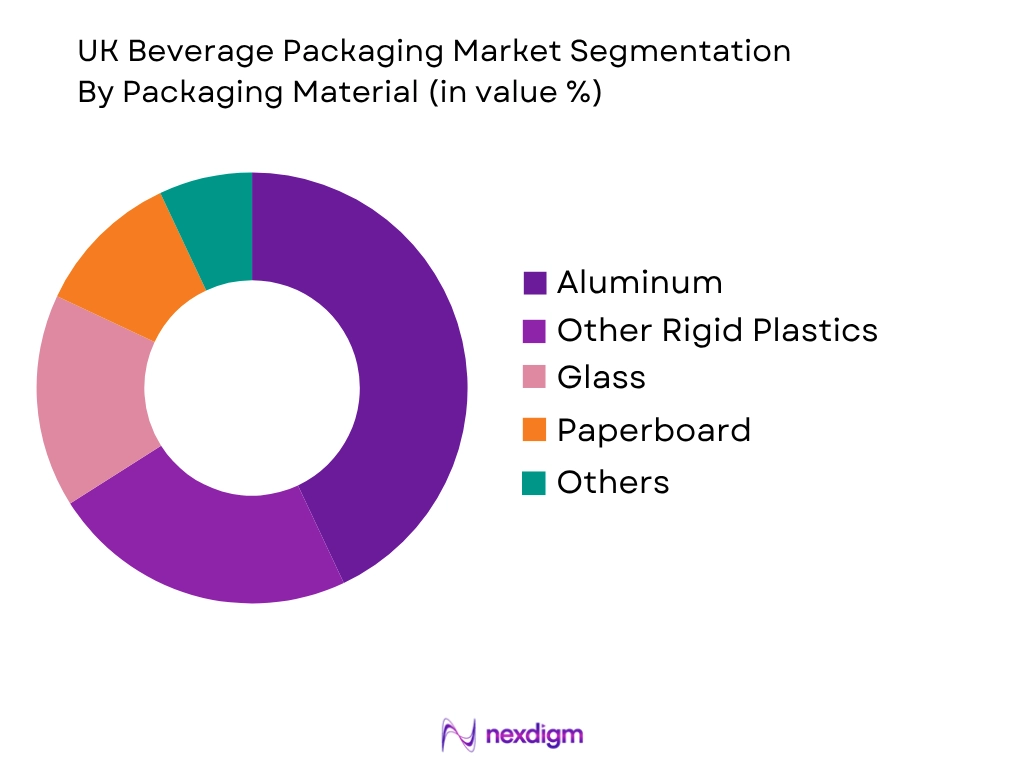
The UK Beverage Packaging Market is segmented into aluminium and steel, PET and other rigid plastics, glass, paperboard beverage cartons, and flexible or composite packaging. Metal packaging holds the dominant indicative share because cans are extensively used for carbonated soft drinks, beer, cider, energy drinks, sparkling water, ready-to-drink cocktails and low-alcohol products. Aluminium cans provide pressure resistance, rapid chilling, high-speed line compatibility, efficient pallet density and extensive decoration options. Ball and Ardagh provide standard and specialty beverage-can formats, while Ardagh operates 12 European production facilities. PET remains critical for bottled water, soft drinks and sports beverages because it is lightweight, resealable and compatible with established filling lines. Glass maintains a strong position in beer, wine, spirits and premium beverages. Beverage cartons serve dairy, juice and shelf-stable drinks, while flexible packaging is concentrated in bag-in-box, concentrates and foodservice systems.
By Beverage Category
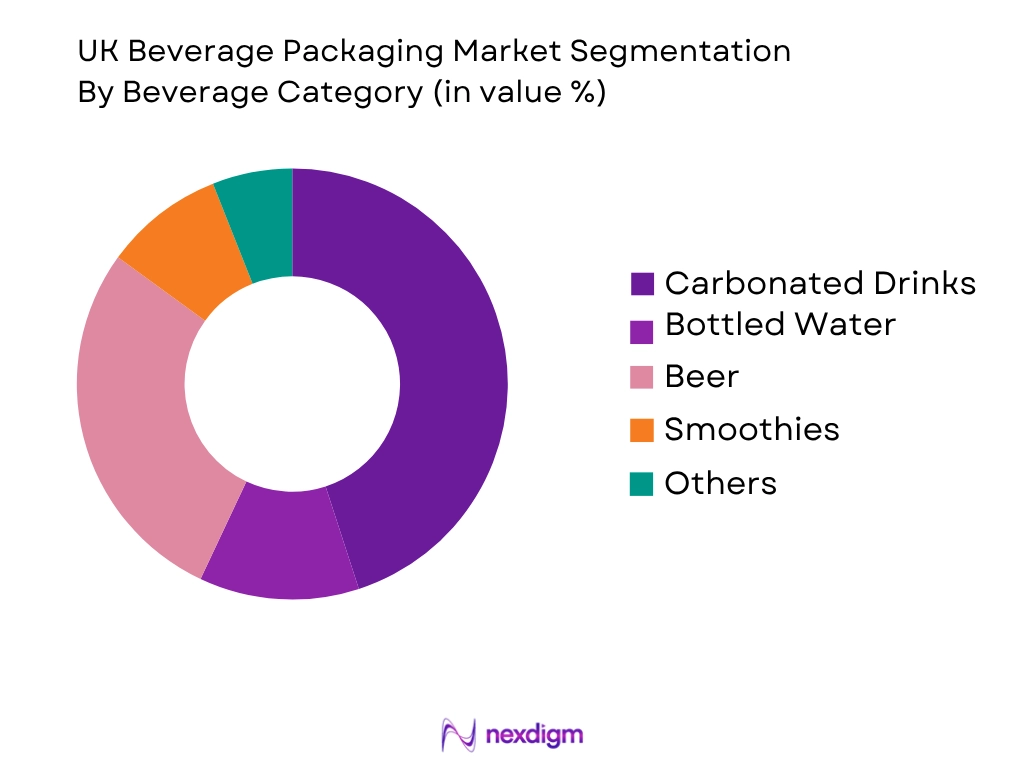
The UK Beverage Packaging Market is segmented into carbonated soft drinks, bottled water, beer and cider, juice and smoothies, dairy and plant-based beverages, energy and sports drinks, ready-to-drink tea and coffee, wine and spirits, ready-to-drink alcohol, and functional or low-alcohol beverages. Carbonated soft drinks hold the dominant indicative position because they use a broad range of cans, single-serve PET bottles, multi-serve bottles, labels, closures, multipacks, corrugated cases and bag-in-box fountain systems. Beer and cider create substantial demand for cans, glass bottles, kegs, paperboard carriers and reusable transport equipment. Bottled water supports lightweight and recycled-content PET development. The expansion of energy drinks, canned cocktails and low- or no-alcohol beverages is increasing demand for sleek cans, smaller portion sizes, digital printing and variety packs. Wine and spirits sustain premium glass, closures, labels, gift cartons and alternative formats such as cans and bag-in-box.
Competitive Landscape
The UK Beverage Packaging Market is concentrated among multinational metal-can, PET-container, glass-bottle, carton and closure suppliers, supported by regional converters and filling specialists. Ball, Ardagh Metal Packaging, Encirc, Plastipak and Tetra Pak influence the market through manufacturing scale, beverage-grade material capability, high-speed technical support, recycled-content integration and relationships with major beverage producers. Competition is increasingly shaped by packaging EPR fees, Plastic Packaging Tax exposure, Deposit Return Scheme readiness, recyclability ratings, lightweighting and food-contact documentation.
| Company | Establishment Year | Headquarters | Core Beverage Portfolio | Material Capability | Principal Beverage Applications | UK Footprint | Circularity Capability | Strategic Differentiation |
| Ball Corporation | 1880 | Westminster, United States | ~ | ~ | ~ | ~ | ~ | ~ |
| Ardagh Metal Packaging | 1932 group heritage | Luxembourg | ~ | ~ | ~ | ~ | ~ | ~ |
| Encirc | 1998 | Derrylin, Northern Ireland | ~ | ~ | ~ | ~ | ~ | ~ |
| Plastipak | 1967 | Plymouth, United States | ~ | ~ | ~ | ~ | ~ | ~ |
| Tetra Pak | 1951 | Pully, Switzerland | ~ | ~ | ~ | ~ | ~ | ~ |
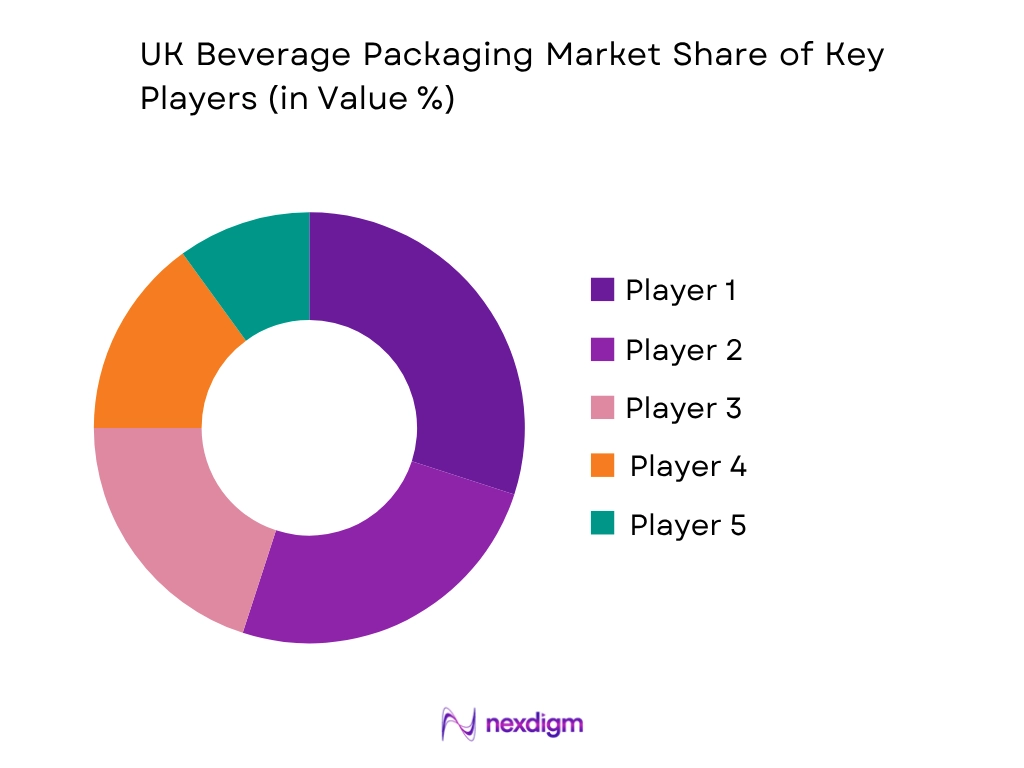
UK Beverage Packaging Market Analysis
Growth Drivers
Large Packaged-Beverage Consumption and Retail Distribution Base
The UK’s large consumer economy and concentrated retail network support recurring demand for aluminium cans, PET bottles, glass containers, beverage cartons, closures, labels, paperboard multipacks, corrugated cases, kegs and bag-in-box systems. The national population exceeded 69 million people in 2024, while current-price gross domestic product was approximately £2.85 trillion. Real economic output increased by 1.0 point in 2024 and a further 1.3 points in 2025, providing a broad operating base for supermarkets, convenience stores, pubs, restaurants, hotels, online grocery services and institutional beverage channels. These outlets distribute carbonated soft drinks, bottled water, beer, cider, juice, smoothies, dairy beverages, plant-based drinks, energy products, ready-to-drink coffee, wine, spirits and low- or no-alcohol products. Each category requires packaging designed around pressure, oxygen exposure, light protection, filling temperature, reclosure, serving size and shelf life. Carbonated drinks depend on cans and pressure-resistant PET; beer and cider use cans, glass and kegs; dairy and juice products require chilled or aseptic cartons; and spirits depend heavily on decorated glass, closures and secondary presentation packaging. The government estimates that consumers across England, Scotland and Northern Ireland purchase approximately 30 billion single-use drinks containers annually, comprising around 12 billion plastic bottles and 13 billion cans. Approximately 6.5 billion bottles and cans are not recycled each year, showing that the same consumption base generating packaging demand also creates a large recoverable material stream. Dense urban markets such as London, Birmingham, Manchester, Leeds, Liverpool, Glasgow, Edinburgh, Cardiff and Belfast allow beverage fillers and packaging suppliers to serve high-volume customers through established motorway, port, warehouse and retail infrastructure. Beverage brands can also commercialise multiple container configurations, including 250-millilitre slim cans, 330-millilitre standard cans, 440-millilitre beer cans, 500-millilitre bottles, family-size PET formats and grocery multipacks. The growth driver is therefore the interaction between more than 69 million consumers, approximately £2.85 trillion of annual output and a beverage portfolio requiring technically differentiated packaging across at-home, on-the-go, on-trade and e-commerce channels. Sources: Office for National Statistics and Department for Environment, Food and Rural Affairs.
Packaging EPR, Plastic Tax and Deposit-Return Regulation
The UK regulatory framework is converting beverage-packaging sustainability from a voluntary corporate commitment into a measurable design, reporting and financial obligation. Extended producer responsibility requires affected manufacturers, importers, brand owners and marketplace operators to collect and report packaging information by material, weight, activity, nation and household-waste status. The reported data is used to calculate recycling obligations and waste-disposal fees. Final first-year EPR base fees were published in June 2025, before producer invoices were issued from October 2025, making package weight and material selection commercially important for beverage companies. From 1 January 2025, liable producers supplying household packaging, public-bin packaging or household glass drinks containers also became responsible for conducting recyclability assessments. Beverage bottles, cans, cartons, caps, sleeves, labels and multipacks therefore need to be evaluated as complete packaging systems rather than isolated materials. Plastic Packaging Tax reinforces this transition. Plastic packaging containing less than 30 parts of recycled plastic in every 100 parts was taxed at £217.85 per tonne from April 2024, £223.69 per tonne from April 2025 and £228.82 per tonne from April 2026. Beverage companies must maintain evidence covering plastic component weight, recycled content, imported materials and exempt exports. The forthcoming Deposit Return Scheme adds another layer of package-specific responsibility. It is scheduled to begin on 1 October 2027 across England, Scotland and Northern Ireland and will cover single-use PET, aluminium and steel drinks containers from 150 millilitres to 3 litres. Producers will need scheme registration, container-level data, compatible barcodes and scheme markings, while retailers will require return points, storage and refund arrangements. Around 30 billion relevant single-use containers are purchased annually in the participating nations, giving the scheme substantial operational scale. The framework influences packaging development before implementation because beverage companies need time to modify artwork, register product ranges, qualify bottle and can formats, adjust inventory and contract with scheme participants. It also favours packaging with lower weight, compatible closures, limited sleeve coverage, separable components and established reprocessing markets. Suppliers capable of providing packaging-weight databases, recycled-content declarations, recyclability assessments, deposit-readiness support and food-contact documentation can differentiate themselves from businesses offering containers without compliance infrastructure. Sources: PackUK, HM Revenue and Customs and Department for Environment, Food and Rural Affairs.
Market Challenges
Fragmented Collection and Beverage-Grade Feedstock Constraints
The UK beverage-packaging industry is constrained by uneven collection practices, contamination in mixed recycling, differing devolved policies and limited supplies of specification-grade secondary material. Packaging enters several systems, including household kerbside collection, workplace recycling, commercial waste contracts, bottle banks, hospitality collection, event recovery and future deposit-return channels. Differences in collection frequency, accepted materials, container preparation and sorting technology affect the quality of PET bottles, cans, glass and cartons arriving at reprocessors. Official waste statistics show that the UK recycled 64.1 parts of every 100 parts of packaging waste in 2024. Paper and cardboard achieved 74.3 parts, metal reached 68.4 parts, and glass reached 65.7 parts. These results indicate substantial recovery, but they also show that millions of beverage containers and secondary packs remain outside closed-loop systems. The government estimates that approximately 6.5 billion single-use bottles and cans are not recycled annually despite an annual purchasing base of around 30 billion containers. Beverage-grade feedstock requires higher quality than general recycled material. PET bottle bales may contain coloured resin, PVC, food residue, oils, sleeve labels, adhesives, caps and non-bottle plastics. These contaminants can affect colour, intrinsic viscosity, odour, acetaldehyde levels and food-contact suitability. Aluminium cans must be separated from steel, foil, aerosols and non-packaging scrap before remelting and can-sheet production. Glass needs separation by colour and removal of ceramics, stones, metals and heat-resistant glass. Beverage cartons require hydrapulping systems capable of recovering fibre while managing polymer and aluminium residues. The future Deposit Return Scheme can create cleaner streams, but implementation requires reverse-vending machines, manual return points, counting centres, collection vehicles, compactors, fraud controls, digital records and additional reprocessing capacity. The government’s baseline figures for scheme development identified collection levels of 76 parts out of 100 for PET bottles and 71 parts out of 100 for aluminium and steel cans, with a statutory trajectory toward 90 parts out of 100 once the scheme is fully operational. Until that infrastructure is functioning consistently, bottle manufacturers may have technical capacity to use recycled PET but insufficient dependable feedstock. Glass furnaces may seek additional cullet but face regional transport and contamination constraints. Beverage brands may also compete with textile, sheet, automotive and non-food applications for recycled polymers. The challenge is therefore not an absence of discarded containers; it is converting a dispersed waste stream into clean, traceable and food-contact-suitable inputs at the scale required by national beverage fillers. Sources: Department for Environment, Food and Rural Affairs and UK Government waste statistics.
Food-Contact Compliance and High-Speed Filling-Line Complexity
Beverage-packaging innovation must preserve food-contact safety, line efficiency, product stability, mechanical performance and distribution durability while also improving recyclability and recycled content. This combination restricts rapid material substitution. A food-grade recycled PET bottle requires controlled post-consumer feedstock, sorting, washing, decontamination, extrusion, filtration, pellet testing, preform qualification and bottle-blowing validation. Variation in colour, intrinsic viscosity, thermal history and contamination can alter preform heating, stretch ratios, top-load strength and bottle clarity. Lightweighting can reduce material use but may cause panel deformation, closure leakage, bottle instability or pallet collapse. Changing from a PET bottle to an aluminium can requires different depalletising, filling, seaming, inspection and secondary-packaging systems. Glass lightweighting must retain pressure resistance, thermal-shock performance, dimensional accuracy and compatibility with high-speed filling lines. Aseptic cartons require sterile filling, validated barrier layers and reliable longitudinal and transverse seals. Flexible pouches and bag-in-box systems must maintain spout welding, tap performance, oxygen barriers and puncture resistance. The scale of the UK economy raises the consequences of technical failure. Current-price GDP was approximately £2.85 trillion in 2024, while manufacturing, food production, retail, accommodation and foodservice support high-throughput packaged-beverage operations. A small dimensional variation in a can end, preform neck, closure liner or carton blank can interrupt a filling line processing tens of thousands of containers per hour. Beverage loss, rejected containers, additional cleaning and delayed shipments can eliminate the environmental benefit achieved through packaging reduction. Regulatory interaction adds further complexity. Plastic components containing less than 30 parts of recycled content in every 100 parts are exposed to Plastic Packaging Tax, while EPR requires detailed material reporting and recyclability classification. Deposit-eligible PET bottles and metal cans between 150 millilitres and 3 litres will need approved scheme marks and barcodes. Northern Ireland businesses may also face EU-aligned food-contact and market-access requirements alongside UK packaging rules. Packaging companies therefore require polymer scientists, glass technologists, can-seaming specialists, food-contact experts, migration-testing laboratories, line technicians, regulatory professionals and lifecycle specialists. Smaller beverage brands commonly depend on co-packers, packaging suppliers and third-party laboratories for these capabilities. The core challenge is ensuring that a new package is simultaneously safe, manufacturable, tax-efficient, scheme compatible, transport resistant and realistically recyclable through UK infrastructure. Sources: Office for National Statistics, HM Revenue and Customs, PackUK and Department for Environment, Food and Rural Affairs.
Market Opportunities
Deposit-Compatible Containers and Beverage-Grade rPET Systems
The forthcoming Deposit Return Scheme creates an opportunity to develop high-quality bottle-to-bottle recycling, reverse-vending infrastructure, container-registration platforms and long-term recycled-resin agreements. Consumers in England, Scotland and Northern Ireland purchase approximately 30 billion single-use drinks containers each year, including around 12 billion plastic bottles and 13 billion cans. Approximately 6.5 billion bottles and cans currently escape recycling, providing a substantial existing stream that can be redirected through dedicated returns. The scheme is scheduled to begin on 1 October 2027 and will cover PET, aluminium and steel containers from 150 millilitres to 3 litres. Although the implementation date is future-facing, the current number of containers provides the factual basis for investment in return points, counting centres, compaction systems, transport, sorting, digital fraud prevention and reprocessing. PET recovery is particularly attractive because clean deposit bottles can support food-grade recycled resin. A closed-loop system begins with container design: clear bottle bodies, limited pigmentation, smaller labels, wash-off adhesives, compatible caps and minimal use of full-body sleeves improve sorting and washing. Reverse-vending machines can recognise barcodes, dimensions, material and scheme markings before compacting accepted containers. Digital systems can connect the producer, container specification, deposit transaction, return location, recycler input, pellet output, preform manufacturer and final beverage application. The UK Plastic Packaging Tax provides an additional incentive to use recycled plastic. The tax threshold remains 30 parts of recycled plastic in every 100 parts, and the rate increased from £217.85 per tonne in 2024 to £228.82 per tonne in 2026. Businesses developing beverage-grade rPET can therefore serve both regulatory compliance and voluntary brand targets. Deposit collection should improve feedstock quality relative to mixed kerbside recycling, but success will require sufficient washing, decontamination, pelletising and preform capacity. Opportunities extend to barcode software, reverse-vending maintenance, retailer storage systems, collection logistics, fraud analytics, food-contact testing and material-certification services. The strongest growth model will connect beverage brands, retailers, the deposit-management organisation, waste contractors, recyclers, preform producers and bottle manufacturers through multi-year procurement agreements. Existing annual consumption of 12 billion plastic drinks bottles, combined with the current tax framework, creates a measurable basis for regional bottle-to-bottle investment without relying on speculative future container volumes. Sources: Department for Environment, Food and Rural Affairs and HM Revenue and Customs.
Low-Carbon Glass, Specialty Cans and Fibre-Based Multipacks
The UK’s premium beverage, brewing, cider, spirits, ready-to-drink and low-alcohol sectors create opportunities for lightweight glass, specialty aluminium cans, digital decoration and fibre-based secondary packaging. The opportunity is supported by current container consumption rather than projected market statistics. Consumers in the participating Deposit Return Scheme nations purchase around 13 billion drinks cans annually, while UK packaging-waste data shows that metal achieved a recycling level of 68.4 parts out of 100 in 2024. Dedicated deposit collection can raise the availability and cleanliness of used beverage cans, strengthening can-to-can recycling and domestic secondary-aluminium demand. Beverage companies are expanding beyond traditional 330-millilitre and 440-millilitre formats into slim, sleek, mini, sharing and resealable containers suited to energy drinks, functional products, canned cocktails, alcohol-free beverages and premium soft drinks. Digital printing enables smaller production runs, regional artwork, seasonal launches and direct-to-consumer variety packs without the inventory requirements associated with conventional lithographic printing. Paperboard clip carriers, wraparound cartons and basket carriers create a parallel opportunity by replacing selected plastic rings or shrink film. These systems must retain strength under condensation, refrigeration and retail handling, but they can achieve favourable recyclability classifications when coatings and adhesives are appropriately designed. Glass remains strategically important for beer, cider, wine, spirits and premium water. UK glass producers can reduce lifecycle burdens through lighter bottles, higher cullet use, electric boosting, lower-carbon fuels and shorter transport routes. Government data indicates that glass packaging achieved a recycling level of 65.7 parts out of 100 in 2024, providing a substantial existing cullet stream for furnace operations. The EPR framework makes packaging weight and recyclability increasingly relevant, which can encourage bottle redesign, label simplification and use of removable closures. Refillable glass and reusable kegs can also grow within controlled hospitality, dairy, brewery and institutional networks where containers have defined return routes. Technology opportunities include automated glass inspection, bottle-cycle tracking, digital can printing, high-speed clip-carrier application, lightweight container simulation and lifecycle-data platforms. The commercial opportunity is broader than replacing one material with another. It involves matching the container, closure, label and secondary pack to the beverage’s pressure, light sensitivity, shelf life, retail channel, deposit status and recovery infrastructure. Current annual demand for 13 billion cans, together with official recovery data for metal and glass, provides a concrete foundation for investment in specialty formats and closed-loop manufacturing. Sources: Department for Environment, Food and Rural Affairs and UK Government packaging-waste statistics.
Future Outlook
The UK Beverage Packaging Market will increasingly be shaped by regulatory cost allocation, deposit-system implementation, recycled-content procurement and measurable recyclability. Aluminium cans, beverage-grade rPET bottles, lightweight glass, paperboard multipacks and aseptic cartons will remain the principal investment categories. Suppliers will need to combine container manufacturing with regulatory data, lifecycle analysis, recycling partnerships and filling-line engineering. Packaging extended producer responsibility has moved waste-management expenditure toward obligated producers. The first EPR base fees apply to packaging supplied during the preceding reporting period and finance local-authority collection, recycling and disposal activities. From subsequent scheme years, fee modulation will differentiate packaging according to recyclability performance, creating stronger incentives to simplify components, improve material compatibility and avoid formats likely to receive less favourable recyclability ratings.
Major Players
- Ball Beverage Packaging UK
- Ardagh Metal Packaging UK
- Crown Bevcan UK
- CANPACK UK
- O-I Glass UK
- Encirc
- Ardagh Glass Packaging UK
- Plastipak UK
- ALPLA UK
- Esterform Packaging
- Berry Global UK
- Tetra Pak UK
- SIG UK
- Graphic Packaging International UK
- Guala Closures UK
Key Target Audience
- Beverage-container and packaging-material manufacturers
- Soft-drink, water, beer, cider, dairy, juice, wine, spirits and functional-beverage producers
- Contract beverage fillers and co-packaging companies
- Supermarkets, convenience retailers, discounters, wholesalers and on-trade operators
- Packaging recyclers, PET reclaimers, glass processors and Deposit Return Scheme infrastructure providers
- Investments and venture capitalist firms
- Private-equity and strategic packaging investors
- Government and regulatory bodies
Research Methodology
Step 1: Identification of Key Variables
The initial phase constructs an ecosystem map covering material suppliers, can manufacturers, bottle and preform producers, glass companies, carton suppliers, closure companies, beverage fillers, retailers, deposit-system participants and recyclers. Critical variables include container units, beverage volume, material weight, recycled content, pack size, filling technology, EPR classification, tax exposure and deposit eligibility.
Step 2: Market Analysis and Construction
Historical data is compiled by material, container format, beverage category, pack size, closure, filling process, distribution channel and nation. Bottom-up analysis evaluates plant capacity, shipments, package units, material tonnage and company revenue. Top-down analysis reviews beverage production, population, GDP, retail activity, imports, exports and recycling flows.
Step 3: Hypothesis Validation and Expert Consultation
Market hypotheses are validated through computer-assisted telephone interviews with packaging manufacturers, beverage companies, contract fillers, retailers, recyclers, waste contractors, scheme participants and regulatory specialists. Consultations assess capacity utilisation, material qualification, EPR reporting, Plastic Packaging Tax evidence, deposit readiness, filling-line performance and customer switching.
Step 4: Research Synthesis and Final Output
Supply-side and demand-side findings are triangulated to reconcile packaging production, beverage filling, imports, recycled-feedstock availability and customer procurement. Segment shares and forecasts are tested against container weights, filling volumes, plant footprints, EPR requirements, tax thresholds, deposit rules, company disclosures and primary-industry feedback.

- Executive Summary
- Research Methodology (Market Definitions and Assumptions, Beverage Packaging Inclusion and Exclusion Criteria, Abbreviations, Market Sizing Approach, Top-Down Analysis, Bottom-Up Analysis, Beverage Filling Volume Model, Container Unit Conversion Model, Packaging Material Tonnage Assessment, Domestic Production Analysis, Import and Export Assessment, Demand-Side Interviews, Supply-Side Interviews, Data Triangulation, Devolved-Nation Regulatory Scenario Modelling, Forecasting Framework, Limitations and Future Conclusions)

- Definition and Scope
- Market Evolution and Industry Genesis
- Evolution of Beverage Container Materials
- Development of the UK Beverage Can Industry
- Expansion of PET Beverage Bottles

- Growth Drivers (Ready-to-Drink Beverage Launches, Aluminium Can Adoption, Low- and No-Alcohol Growth, Bottled-Water Demand, Premium Spirits, Convenience Retail, Online Grocery and Sustainability Regulation)
- Market Challenges (Aluminium and Resin Availability, Glass Energy Intensity, Beverage-Grade rPET Supply, Devolved Regulatory Differences, EPR Fee Exposure, Deposit-System Transition and Flexible-Packaging Recovery)
- Market Opportunities (Food-Grade rPET, Deposit-Compatible Containers, Lightweight Glass, Digital Can Printing, Fibre-Based Multipacks, Refillable Beverage Systems, High-Barrier Cartons and Smart Packaging)
- Market Trends (Can Premiumisation, Sleek and Slim Formats, Lightweight PET, Recycled Content, Low-Carbon Glass, Paperboard Multipacks, Direct Printing, Variety Packs and Packaging Carbon Disclosure)
- SWOT Analysis
- Porter’s Five Forces Analysis
- PESTLE Analysis

- By Market Value (2020-2025)
- By Beverage Container Units (2020-2025)
- By Packaged Beverage Volume (2020-2025)

- By Packaging Material (In Value %)
Aluminium
Steel and Tinplate
PET
HDPE
Polypropylene
Glass - By Beverage Category (In Value %)
Carbonated Soft Drinks
Bottled Water
Flavoured and Enhanced Water
Energy Drinks
Sports and Isotonic Drinks
Functional Beverages - By Distribution Channel (In Value %)
Supermarkets and Hypermarkets
Convenience Stores
Discounters
Cash-and-Carry Wholesalers
Independent Grocery Stores
Off-Licences
Specialty Beverage Retailers
Online Grocery - By Region (In Value %)
London and South East
South West
East of England
West Midlands
East Midlands

- Market Share of Major Players
- Cross Comparison Parameters (Beverage Container Material and Format Breadth, Annual Beverage Container and Closure Manufacturing Capacity, UK Plant Footprint and Proximity to Filling Clusters, Recycled Content and Closed-Loop Material Capability, Filling-Line Compatibility and High-Speed Technical Support, Beverage Category and Pack-Size Coverage, Packaging EPR Deposit Return and Plastic Tax Compliance Support, Lightweighting and New-Format Commercialisation Capability)
- SWOT Analysis of Major Players
- Detailed Profiles of Major Companies
Ball Beverage Packaging UK
Ardagh Metal Packaging UK
Crown Bevcan UK
CANPACK UK
O-I Glass UK
Encirc
Ardagh Glass Packaging UK
Plastipak UK
ALPLA UK
Esterform Packaging
Berry Global UK
Tetra Pak UK
SIG UK
Graphic Packaging International UK
Guala Closures UK

- Carbonated Soft Drink Producer Analysis
- Bottled-Water Producer Analysis
- Energy and Sports Drink Producer Analysis
- Juice and Smoothie Producer Analysis
- Dairy and Plant-Based Beverage Producer Analysis
- Brewer Analysis

- By Market Value (2026-2035)
- By Beverage Container Units (2026-2035)
- By Packaged Beverage Volume (2026-2035)


 Request a Sample
 Ask for Customization
 Get a Quote
 Enquire Now