
 Download PDF
Market Overview
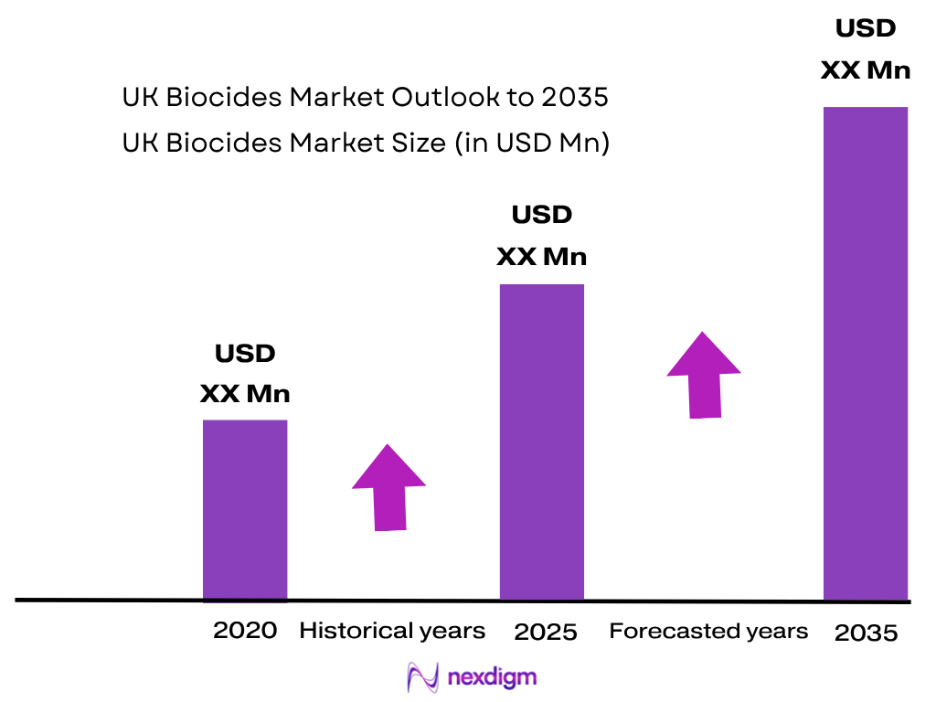
The UK Biocides Market generated USD 394.7 million in 2024 and is forecast to reach USD 446.6 million by 2030, representing a 2.1% CAGR during 2025–2030. Halogen compounds accounted for 27.36% of 2024 revenue, making them the largest product category, while quaternary ammonium compounds were identified as the fastest-growing product segment. Demand is supported by microbial-control requirements across water treatment, paints and coatings, healthcare, food processing, industrial hygiene, preservatives and other applications.
The regulatory environment is an important demand determinant. In Great Britain, HSE recorded 63 active-substance/product-type combinations subject to non-approval decisions in February 2024, with affected products required to be phased out of supply by 2 February 2025 and use by 2 August 2025. HSE subsequently recorded 16 unsupported active-substance/product-type combinations receiving non-approval decisions in April 2026. These regulatory actions create replacement demand for compliant active substances and reformulated products.
Market Segmentation
By Active Substance Chemistry
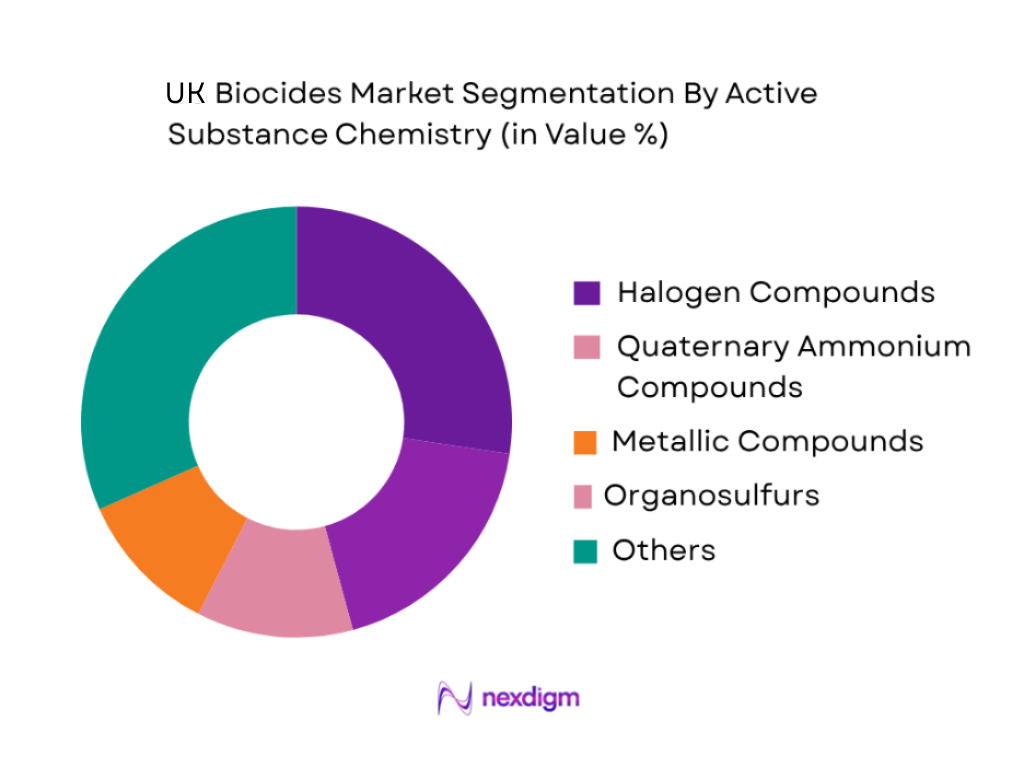
The UK Biocides Market is segmented into halogen compounds, metallic compounds, organosulfurs, organic acids, quaternary ammonium compounds, phenolic compounds, nitrogen compounds and glutaraldehyde. Halogen compounds were the largest category, generating 27.36% of UK biocides revenue in 2024. Their dominance reflects broad-spectrum antimicrobial efficacy and established use across water treatment, disinfection, cooling systems and industrial applications. Quaternary ammonium compounds were identified as the fastest-growing product segment, supported by applications in surface disinfection, institutional hygiene and industrial sanitation. The regulatory framework is increasingly influencing chemistry selection. HSE requires suppliers to establish whether active substances are approved, under renewal, under review, expired, not approved or otherwise affected by the GB BPR process. Products containing non-approved active substances can face supply and use phase-out periods of up to 12 months for supply and 18 months for use after publication of a non-approval decision.
By Application
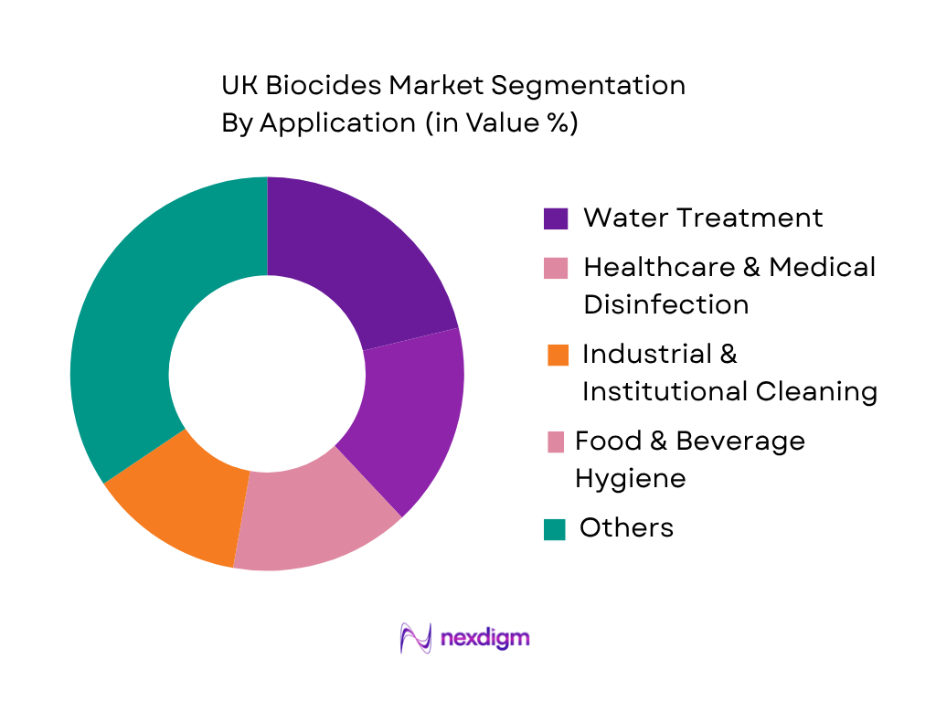
The UK Biocides Market is segmented by application into water treatment, healthcare and medical disinfection, industrial and institutional hygiene, food and beverage hygiene, paints and coatings preservation, wood preservation, marine antifouling, oil and gas, pulp and paper, metalworking fluids, pharmaceuticals and personal care. Water treatment is a particularly important application because microbial growth can generate biofilms, fouling and operational problems in cooling and process-water systems. Paints and coatings represent another major demand pool because preservatives protect water-based formulations and finished films from microbial deterioration. Healthcare and food-processing applications create recurring disinfection requirements, while wood, construction materials and industrial fluids require preservation against bacteria, fungi and other microorganisms. The breadth of applications reduces the market’s dependence on any single industrial sector. At the same time, active-substance decisions are creating opportunities for suppliers with compliant replacement chemistries. HSE’s 2024 decision affected 63 active-substance/product-type combinations, while its 2026 decisions affected 16 unsupported combinations, reinforcing the importance of regulatory positioning in application-specific product development.
Competitive Landscape
The UK Biocides Market contains global chemical companies, specialty antimicrobial manufacturers, water-treatment suppliers, industrial hygiene companies and formulation specialists. Competition is determined by active-substance breadth, authorised-product portfolios, regulatory capability, efficacy, formulation technology and technical support. HSE’s authorised-product database records product-level information including product name, authorisation holder, authorisation type, status, start and end dates, active substance, CAS number, EC number, product type and user category, making regulatory coverage an important competitive parameter.
| Company | Established | Headquarters | Active Substance Portfolio | UK Regulatory Coverage | Water Treatment | Industrial Preservation | Coatings Preservation | Technical Capability |
| LANXESS AG | 2004 | Cologne, Germany | ~ | ~ | ~ | ~ | ~ | ~ |
| BASF SE | 1865 | Ludwigshafen, Germany | ~ | ~ | ~ | ~ | ~ | ~ |
| Arxada AG | 2021 | Basel, Switzerland | ~ | ~ | ~ | ~ | ~ | ~ |
| Ecolab Inc. | 1923 | St. Paul, USA | ~ | ~ | ~ | ~ | ~ | ~ |
| Nouryon | 2018 | Amsterdam, Netherlands | ~ | ~ | ~ | ~ | ~ | ~ |
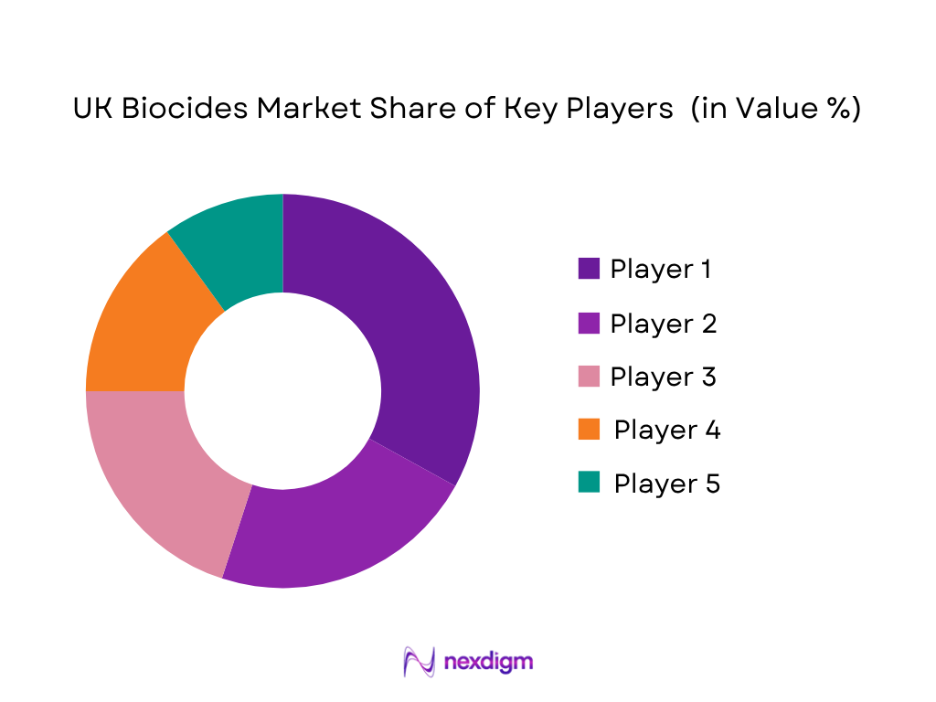
UK Biocides Market Analysis
Market Growth Drivers
Industrial Water Treatment Demand
Industrial and municipal water management remains a structural demand driver for the UK Biocides Market because microbial contamination, biofilm formation and algae can affect cooling systems, process-water circuits, wastewater infrastructure and other water-dependent assets. The macroeconomic base is substantial: the World Bank records UK GDP at USD 3.686 trillion in 2024, with GDP per capita of USD 53,246.4, while ONS reported that UK production included manufacturing, electricity and gas, and water supply and sewerage as major production-industry components. ONS recorded 1.2% growth in water supply and sewerage output in Q4 2024, even while overall production fell 0.8%, indicating continued operational activity in the water infrastructure segment. The regulatory and infrastructure pipeline provides a more direct market-specific stimulus: the Environment Agency’s Water Industry National Environment Programme contains more than 24,000 environmental actions and represents £22.1 billion of investment over the five-year programme period. In England, the government also fast-tracked £180 million of water-sector investment during 2024, with the programme expected to prevent more than 8,000 sewage spills. These investments require monitoring, sanitation, process-water management and microbial-control systems, supporting recurring biocide requirements across treatment and industrial water applications. The UK’s 451 designated bathing waters in 2024 and more than 7,000 samples planned for monitoring further demonstrate the scale of water-quality management activity.
Food Processing and Industrial Hygiene Requirements
Food processing and industrial hygiene provide another durable demand base for the UK Biocides Market because microbial control is required throughout food manufacturing, processing environments, equipment sanitation, water systems and institutional cleaning operations. The UK’s food and drink manufacturing industry generated £39.3 billion of gross value added in 2024, compared with £37.1 billion in 2023, while employment in Great Britain reached 443,000 people in 2024. The wider UK agri-food sector contributed £162.3 billion of GVA in 2024, demonstrating the scale of the production ecosystem in which sanitation and microbial-control products are consumed. ONS also reported that UK manufacturers generated £452.2 billion of product sales in 2024, with food manufacturing remaining the largest manufacturing division and representing 21% of total manufacturers’ product sales. This large manufacturing footprint creates recurring requirements for disinfectants, surface sanitizers, preservatives and process-water biocides. UK food, feed and drink exports reached £24.6 billion in 2024, while imports reached £64.1 billion, reinforcing the importance of maintaining internationally acceptable hygiene and production standards. From a macroeconomic perspective, World Bank data place UK GDP at USD 3.686 trillion in 2024, while the IMF recorded 1.1% real GDP growth and 2.5% average CPI inflation in its later 2026 assessment of the year. For biocide suppliers, the combination of a large food-manufacturing base, extensive production activity, export requirements and stringent hygiene practices supports recurring demand for microbial-control formulations rather than one-time consumption.
Market Challenges
Stringent Regulatory Requirements and Active-Substance Restrictions
Regulatory requirements represent a major structural challenge for the UK Biocides Market because manufacturers must maintain compliant active substances, product authorisations, efficacy evidence, human-health assessments and environmental-risk documentation. The GB Biocidal Products Regulation requires companies to verify active-substance status and applicable product authorisation requirements before placing products on the market, while Northern Ireland follows the EU BPR framework. HSE’s 2024 regulatory decisions affected 63 active-substance/product-type combinations, while the February 2026 non-compliance process identified active-substance/product-type combinations for which compliant notifications had not been received. A 2026 HSE decision document specifies a use end date of 1 October 2027 and a treated-article placing-on-the-market end date of 28 September 2026 for the relevant decision, demonstrating how regulatory action can create defined product transition windows. These requirements increase dossier-development workload, reformulation requirements and portfolio-management complexity. The macroeconomic environment adds pressure: World Bank data show UK GDP of USD 3.686 trillion in 2024, GDP growth of 1.1%, and consumer-price inflation of 3.3%, while the IMF’s 2026 assessment records 1.0% real GDP growth in 2024 and 2.5% average CPI inflation. A relatively moderate-growth environment can make manufacturers more selective about regulatory expenditure, particularly for products serving smaller application niches. Consequently, suppliers must prioritise active substances with durable regulatory status, broad product-type applicability and strong efficacy evidence.
Environmental and Operational Compliance Pressure
Environmental performance, microbial-control efficacy and operational safety create a second major challenge because biocides are deliberately designed to control living organisms and therefore require careful management of exposure, persistence, aquatic toxicity, residues and discharge. The challenge is particularly significant in water-intensive applications. Environment Agency data show that 100% of storm overflows associated with monitored bathing waters were fitted with event-duration monitors by 2024, creating a much larger evidence base for assessing pollution events and environmental performance. The agency reported 451 bathing-water sites in England in 2024, including 27 newly designated sites, of which 12 were rivers. Overall, 91.8% of bathing waters passed required standards, compared with 95.7% in 2023, while the number of sites classified as poor reached its highest level since the current classification system began in 2015. These figures demonstrate the intensity of environmental monitoring around water quality and the resulting need for treatment technologies that balance microbial performance with environmental risk. The macroeconomic backdrop reinforces the importance of efficient operations: the World Bank reports USD 53,246.4 GDP per capita and USD 3.686 trillion GDP for the UK in 2024, while the IMF reports 2.5% average CPI inflation and 4.3% unemployment for 2024 in its 2026 assessment. Suppliers therefore face simultaneous requirements to improve efficacy, reduce environmental burden, optimise dosing and demonstrate regulatory compliance without compromising industrial operating performance.
Market Opportunities
Advanced Water Treatment and Infrastructure Modernisation
Advanced water treatment represents a significant future opportunity for the UK Biocides Market because the country’s expanding environmental-monitoring and water-infrastructure programme creates sustained requirements for microbial control, biofilm management, sanitation and process-water protection. The strongest current indicator is the Environment Agency’s Water Industry National Environment Programme, which contains more than 24,000 required actions and represents £22.1 billion of environmental investment over its programme period. During 2024, the government also accelerated £180 million of water-sector investment intended to prevent more than 8,000 sewage spills, demonstrating the scale of infrastructure activity already underway. England had 451 designated bathing waters in 2024 and the Environment Agency planned to collect more than 7,000 samples during the bathing season, creating an extensive monitoring environment around microbial and water-quality conditions. The opportunity extends beyond municipal wastewater into industrial water, cooling-water systems, process water and water reuse. ONS reported that water supply and sewerage output increased 1.2% in Q4 2024, despite overall production output declining 0.8% during the quarter, indicating continued activity in this infrastructure segment. The wider economy provides substantial investment capacity, with World Bank data recording USD 3.686 trillion UK GDP and USD 53,246.4 GDP per capita in 2024. For biocide suppliers, this environment creates opportunities for lower-dose formulations, automated dosing, biofilm-control technologies, treatment monitoring and products designed for demanding water-quality applications.
Sustainable Biocides for Food, Coatings and Industrial Manufacturing
Sustainable and lower-impact biocides represent an important opportunity because UK manufacturers are operating across a large industrial base while facing stronger environmental, product-safety and resource-efficiency requirements. ONS recorded £452.2 billion in UK manufacturers’ product sales in 2024, with food manufacturing representing 21% of total manufacturing product sales. DEFRA reported £39.3 billion of GVA from food and drink manufacturing and 443,000 workers in Great Britain during 2024, creating a large downstream base for food-contact-area hygiene, surface disinfection and preservation technologies. The food chain excluding agriculture generated £147.8 billion of GVA in 2024, providing further evidence of the scale of processing, distribution and catering activity requiring microbial management. UK food, feed and drink exports were £24.6 billion in 2024, while imports were £64.1 billion, increasing the importance of consistent production and sanitation standards across internationally traded products. The opportunity also extends to coatings, polymers, construction materials and industrial fluids, where preservatives must protect products while meeting increasingly demanding environmental requirements. The IMF’s 2026 assessment records UK real GDP growth of 1.0% in 2024, domestic demand growth of 1.7%, and average CPI inflation of 2.5%, indicating an operating environment in which industrial customers have incentives to improve productivity and extend product life while controlling resource use. Biocide suppliers can therefore differentiate through low-dose technologies, improved biodegradability, targeted microbial spectra, reduced environmental persistence and formulations compatible with water-based products. Such technologies align microbial-control performance with the broader industrial shift toward resource efficiency and environmental compliance.
Future Outlook
The UK Biocides Market is expected to expand steadily as microbial-control requirements remain embedded in water treatment, healthcare, food manufacturing, industrial processing, coatings and materials preservation. The published UK dataset provides a base of USD 394.7 million in 2024, rising to USD 446.6 million in 2030, equivalent to a 2.1% CAGR during 2025–2030. Future competitive opportunities are expected to centre on low-toxicity formulations, targeted microbial control, sustainable preservatives, advanced cooling-water treatment and compliant replacement chemistries. Regulation will remain a central market variable: HSE recorded 16 new non-approval decisions in April 2026, following the 63 combinations affected in February 2024.
Major Players
- LANXESS AG
- BASF SE
- Arxada AG
- Ecolab Inc.
- Nouryon
- Solvay SA
- Clariant AG
- ICL Group Ltd.
- Lonza Group Ltd.
- Troy Corporation
- Thor Group Limited
- Neogen Corporation
- Ashland Inc.
- Stepan Company
- Kersia Group
Key Target Audience
- Biocide active-substance manufacturers and formulators
- Water-treatment and industrial hygiene companies
- Paint, coatings, construction-material and wood-preservation manufacturers
- Healthcare, pharmaceutical and food-processing companies
- Chemical distributors and specialty-chemical suppliers
- Investments and venture capitalist firms (specialty chemicals, antimicrobial technologies, sustainable chemistry and water-treatment technologies)
- Government and regulatory bodies (Health and Safety Executive, Department for Environment, Food & Rural Affairs, Environment Agency, Health and Safety Executive for Northern Ireland)
- Industrial procurement and corporate strategy divisions (water utilities, food manufacturers, healthcare operators, chemical manufacturers and industrial-process companies)
Research Methodology
Step 1: Identification of Key Variables
The first stage develops a UK-specific biocides ecosystem covering active-substance producers, formulators, authorisation holders, distributors and downstream users. Product type, active substance, formulation, application, regulatory status, end-use industry and user category are mapped at product level. HSE’s authorised-product database provides the regulatory structure, including separate GB and NI information.
Step 2: Market Analysis and Construction
Historical market revenue is constructed using the reported USD 394.7 million 2024 base and product-level segmentation across the 8 chemistry categories reported for the UK. The analysis is supplemented by product authorisations, trade flows, industrial demand and application-level consumption. Market calculations are reconciled using top-down revenue assessment and bottom-up product/application modelling.
Step 3: Hypothesis Validation and Expert Consultation
Market hypotheses are validated through discussions with active-substance manufacturers, formulators, water-treatment companies, coatings producers, healthcare suppliers, food processors and industrial users. Interviews focus on active-substance substitution, regulatory phase-outs, treatment frequency, formulation selection, procurement criteria and demand by end-use industry. Regulatory evidence is cross-checked against HSE decisions.
Step 4: Research Synthesis and Final Output
The final stage triangulates company information, HSE authorised-product data, Article 95 information, active-substance decisions and market revenue datasets. GB and Northern Ireland are modelled separately where regulatory treatment differs. HSE’s Article 95 framework is incorporated because an unlisted active-substance supplier can prevent the associated biocidal product from being made available on the GB market.

- Executive Summary
- Research Methodology (Market Definition and Scope, GB–NI Regulatory Boundary, Biocidal Product Classification, Product Type Mapping, Active Substance Mapping, Market Sizing Framework, Top-Down Analysis, Bottom-Up Analysis, Demand-Side Assessment, Supply-Side Assessment, Primary Industry Interviews, Import-Export Assessment, Product Authorization Mapping, Data Triangulation, Forecasting Framework, Scenario Analysis, Assumptions and Limitations)

- Definition and Scope
- UK Biocides Industry Evolution
- UK Biocides Industry Ecosystem
- UK Biocides Value Chain
- UK Biocides Supply Chain Analysis

- Market Growth Drivers (Industrial Water Treatment, Cooling-System Microbial Control, Healthcare Disinfection, Food Hygiene, Materials Preservation, Industrial Process Protection, Marine Antifouling, Construction-Material Protection)
- Market Challenges (GB BPR Authorisation Requirements, Active Substance Non-Approval, Regulatory Divergence Between GB and NI, Efficacy Data Requirements, Environmental Risk Assessment, Toxicological Requirements, Supply-Chain Dependence, Reformulation Requirements)
- Market Opportunities (Advanced Water Treatment, Low-Hazard Biocides, Bio-Based Biocides, PFAS-Free Formulations, Sustainable Preservatives, High-Performance Cooling-Water Treatment, Specialty Coatings Preservation, Pharmaceutical and Healthcare Disinfection, Industrial Hygiene)
- Market Trends (Low-Toxicity Formulations, Sustainable Active Substances, Reduced-Dose Formulations, Combination Biocides, Targeted Microbial Control, Biofilm Management, Longer-Lasting Preservation, Water-Efficient Treatment, Digital Dosing and Monitoring)
- Regulatory Cost and Authorisation-Burden Analysis (Active Substance Validation, Technical Evaluation, Opinion Development, Product Authorisation Modules, Technical Equivalence, Article 95 Listing, Renewal Assessment, Pre-Submission Meetings, Dossier Requirements)
- Porter’s Five Forces Analysis
- PESTLE Analysis
- SWOT Analysis

- By Revenue (2020-2035)
- By Biocidal Product Consumption Volume (2020-2035)
- By Active Substance Consumption (2020-2035)
- By Formulated Biocide Volume (2020-2035)
- By Active Substance Revenue (2020-2035)
- By Product Type (2020-2035)
- By Application (2020-2035)

- By Product Type (In Value %)
Halogen Compounds
Quaternary Ammonium Compounds
Organosulfur Compounds
Organic Acids
Phenolic Compounds
Metal-Based Biocides
Nitrogen-Based Biocides
Isothiazolinones
Glutaraldehyde - By Product Type / Intended Use (In Value %)
Disinfectants and Sanitizers
Preservatives
Industrial Process Biocides
Water-Treatment Biocides
Wood Preservatives
Antifouling Biocides
Rodenticides
Insecticides
Repellents and Attractants
Veterinary Hygiene Products - By Application (In Value %)
Water Treatment
Paints and Coatings
Industrial and Institutional Cleaning
Food and Beverage Processing
Wood Preservation
Oil and Gas
Pulp and Paper - By End-Use Industry (In Value %)
Municipal Water and Wastewater
Industrial Water Treatment
Paints, Coatings and Construction
Food and Beverage
Healthcare
Pharmaceuticals
Oil and Gas and Energy
Pulp and Paper - By Formulation (In Value %)
Liquid Concentrates
Ready-to-Use Liquids
Water-Soluble Powders
Granules
Tablets
Emulsions and Dispersions
Microencapsulated Formulations - By Mechanism of Action (In Value %)
Oxidizing Biocides
Non-Oxidizing Biocides
Cell-Membrane Disruptors
Protein-Denaturing Biocides
Enzyme-Inhibiting Biocides
Metabolic Inhibitors
Multi-Mechanism Formulations

- Market Share of Major Players (By Revenue, Active Substance, Product Type, Application, End-Use Industry, Distribution Channel, Geography)
- Cross Comparison Parameters (Active Substance Portfolio Breadth, GB-Authorised Product Portfolio, EU/NI Regulatory Coverage, Water-Treatment Biocide Capability, Coatings Preservation Capability, Specialty Biocide Chemistry Coverage, UK Manufacturing and Distribution Footprint, Regulatory and Technical-Service Capability)
- SWOT Analysis of Major Players
- Detailed Profiles of Major Companies
LANXESS AG
BASF SE
Arxada AG
Nouryon
Troy Corporation
Lonza Group Ltd.
Ecolab Inc.
Solvay SA
Clariant AG
ICL Group Ltd.
Neogen Corporation
Ashland Inc.
Stepan Company
Kersia Group
Thor Group Limited

- Water-Treatment Operator Assessment
- Paint and Coatings Manufacturer Assessment
- Food and Beverage Manufacturer Assessment
- Healthcare Facility Assessment
- Industrial Manufacturer Assessment
- Wood-Treatment Operator Assessment
- Marine Operator Assessment

- By Revenue (2025-2035)
- By Biocidal Product Consumption Volume (2025-2035)
- By Active Substance Consumption (2025-2035)
- By Formulated Biocide Volume (2025-2035)
- By Active Substance Revenue (2025-2035)
- By Product Type (2025-2035)
- By Application (2025-2035)


 Request a Sample
 Ask for Customization
 Get a Quote
 Enquire Now