
 Download PDF
Market Overview
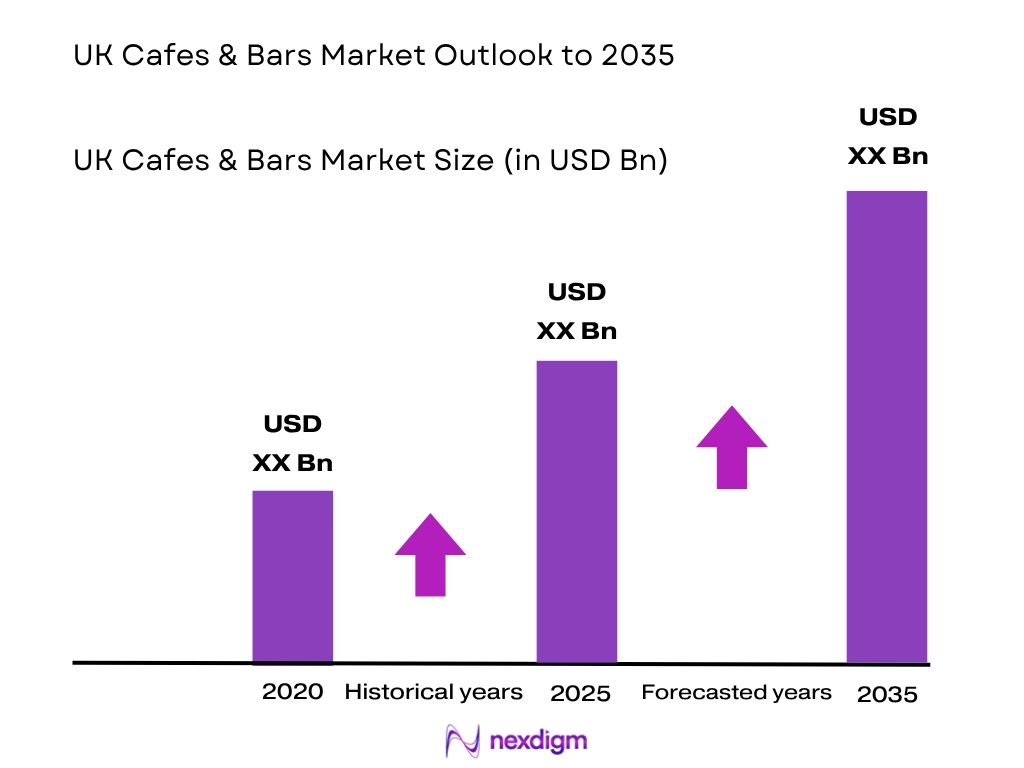
The UK Cafes & Bars Market is valued at USD ~ billion, based on Nexdigm’s five-year historical analysis aligned with the published USD ~ billion base-year value and USD ~ billion near-term market value for the United Kingdom cafes and bars industry. Demand is driven by premium coffee, branded café expansion, all-day foodservice, social drinking occasions, delivery, and lodging-linked outlets. The market is forecast to grow at 3.5% CAGR during 2026-2035, using the long-range cafes and bars industry benchmark.
London dominates the UK Cafes & Bars Market because it combines affluent consumers, dense office districts, tourist traffic, premium coffee adoption, cocktail-led venues, and high transport-hub footfall. Manchester, Birmingham, Edinburgh, Glasgow, Bristol, Leeds, Liverpool, and Cardiff are also strong because they combine student populations, night-time economies, commuter districts, and independent café-bar cultures. Britain’s licensed hospitality estate recorded 99,113 outlets in the prior reported period and 99,120 outlets in the latest reported period, showing stabilisation after contraction.
Market Segmentation
By Service Type
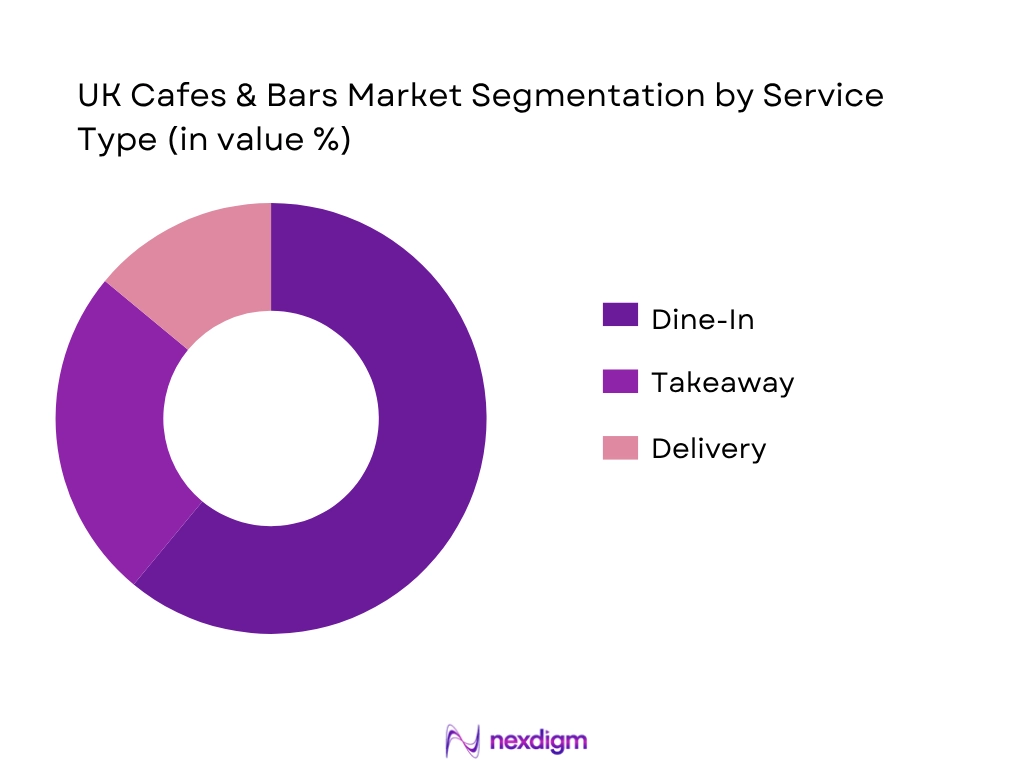
The UK Cafes & Bars Market is segmented by service type into dine-in, takeaway, and delivery. Dine-in holds the dominant market share because cafés, pubs, bars, cocktail venues, and hybrid café-bars remain social-consumption formats rather than purely transactional foodservice channels. Consumers use these venues for brunch, office catch-ups, remote working, after-work drinks, sports viewing, dates, and weekend leisure. Pubs and bars also rely heavily on ambience, draught service, table turnover, event programming, and group occasions, all of which strengthen dine-in revenue. While takeaway is critical for branded coffee chains and bakery cafés, and delivery is growing through aggregators, the sector’s largest revenue pool is still generated by in-premise beverage, food, and experience-led spending. Nexdigm also identifies dine-in as the leading service channel in the UK cafes and bars market.
By Outlet Type
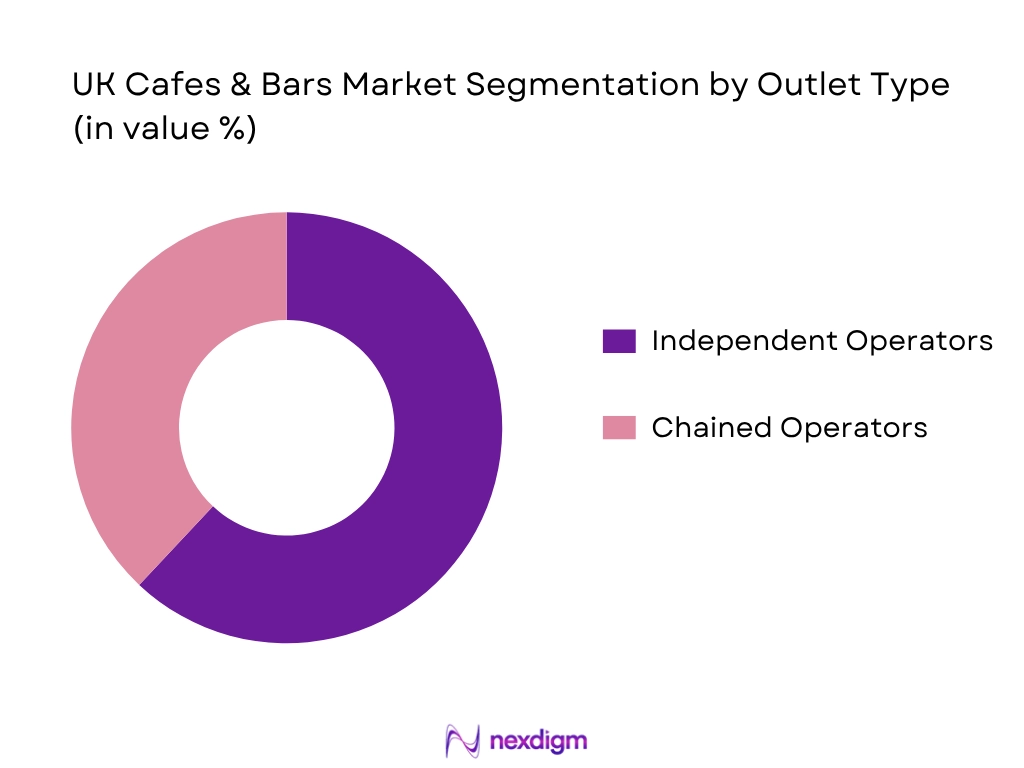
The UK Cafes & Bars Market is segmented by outlet type into independent operators and chained operators. Independent operators hold the dominant market share because the UK has a long-established base of neighbourhood cafés, free houses, wet-led pubs, leased pubs, gastropubs, local cocktail bars, and community-oriented venues. These outlets are embedded in local demand patterns and often differentiate through atmosphere, location, owner-led service, craft beverages, rotating beer taps, locally roasted coffee, brunch menus, and event programming. Chains remain powerful in branded coffee, bakery café, managed pub, and value-led pub segments, but independent venues continue to command relevance in high streets, suburbs, university towns, leisure districts, and tourist catchments. Nexdigm also reports independent operators as the largest outlet group in the UK cafes and bars market.
Competitive Landscape
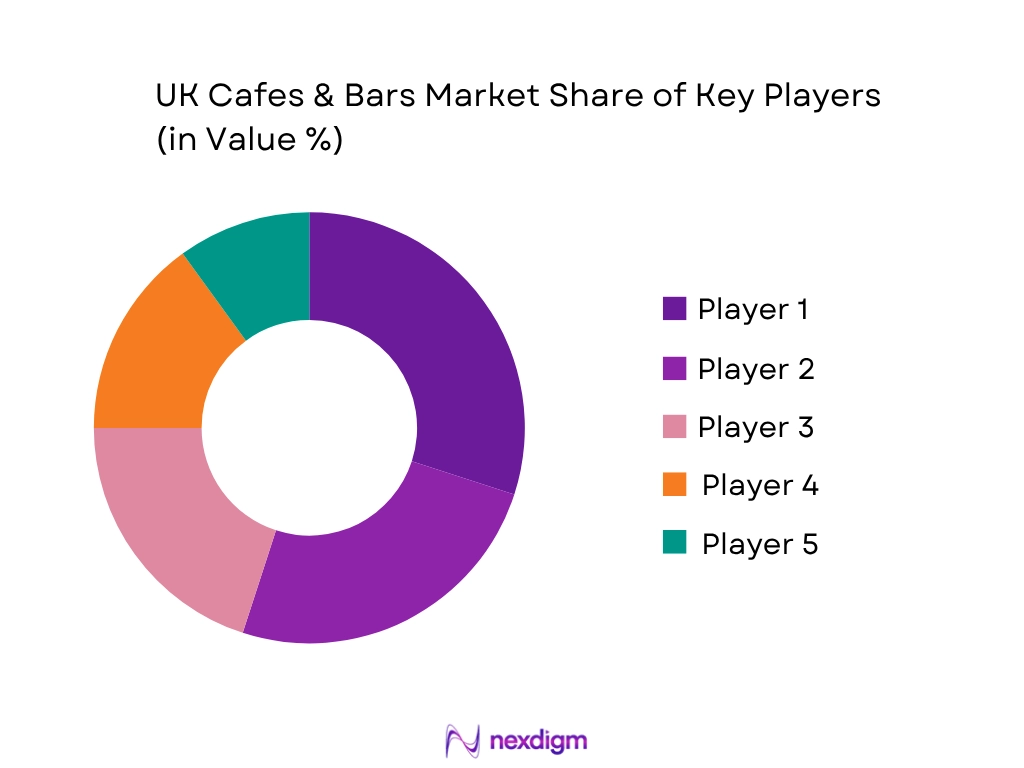
The UK Cafes & Bars Market is moderately concentrated at the branded level but fragmented across the total outlet base. Coffee and food-to-go are led by Costa Coffee, Greggs, Starbucks, Caffè Nero, and Pret A Manger, while pubs and bars are shaped by Stonegate Group, JD Wetherspoon, Greene King, Mitchells & Butlers, Marston’s, and BrewDog. Scale players compete on estate size, price architecture, digital loyalty, breakfast penetration, draught portfolio, delivery readiness, and leasehold efficiency. Independents compete through locality, ambience, menu authenticity, premium coffee, craft beer, and social experience.
| Player | Establishment Year | Headquarters | Core Format | Approx. UK Positioning | Beverage Strength | Food Attach Strategy | Digital / Loyalty Focus | Expansion Model |
| Costa Coffee | 1971 | Loudwater, Buckinghamshire | ~ | ~ | ~ | ~ | ~ | ~ |
| Greggs | 1939 | Newcastle upon Tyne | ~ | ~ | ~ | ~ | ~ | ~ |
| JD Wetherspoon | 1979 | Watford | ~ | ~ | ~ | ~ | ~ | ~ |
| Stonegate Group | 2010 | Solihull | ~ | ~ | ~ | ~ | ~ | ~ |
| Caffè Nero | 1997 | London | ~ | ~ | ~ | ~ | ~ | ~ |
UK Cafes & Bars Market Analysis
Growth Drivers
Coffee Culture
Coffee culture is a structural growth driver for the UK Cafes & Bars Market because the addressable urban consumer base remains large and concentrated around high-street, transport-hub, office, university, and neighbourhood café formats. The UK had 69,226,000 people and 58,761,798 urban residents in the latest World Bank-referenced series, giving café operators a dense daily-consumption base for espresso drinks, iced beverages, breakfast coffee, and work-from-café occasions. World Bank also reports UK GDP per capita at USD 53,246.4, supporting discretionary beverage spending in major cities. DEFRA’s official food statistics show food and drink eaten out at GBP 135.6 billion, while ONS-linked VisitBritain data records 42.6 million inbound visits and 293 million visitor nights, reinforcing café demand in London, Edinburgh, Manchester, Birmingham, Liverpool, Bristol, and transport corridors. Coffee supply depth is also visible in official food trade data: UK imports of coffee, tea, cocoa, spices and related products reached GBP 6.0 billion, supporting branded coffee chains, independent specialty cafés, bakery cafés, and hotel cafés with broad beverage availability.
Premiumisation
Premiumisation is strengthening the UK Cafes & Bars Market as operators move beyond basic hot beverages and standard bar menus toward specialty coffee, iced drinks, origin-led beans, premium mixers, craft beer, cocktails, brunch-led food attach, and branded bakery café formats. The macroeconomic base supports this shift: World Bank reports UK GDP at USD 3.69 trillion and GDP per capita at USD 53,246.4, indicating a large consumer economy with room for discretionary hospitality occasions. DEFRA’s official data shows food and drink eaten out at GBP 135.6 billion, confirming continued scale in out-of-home consumption despite household pressure. The supply side also supports premiumisation: government food trade statistics show imports of coffee, tea, cocoa, spices and related categories at GBP 6.0 billion, giving café and bar operators access to specialty beans, cocoa-based beverages, tea infusions, syrups, and premium menu inputs. Tourism further supports premium venues, as ONS-linked VisitBritain data records 42.6 million inbound visits and GBP 32.5 billion in visitor spend, benefiting experience-led cafés, cocktail bars, hotel bars, and city-centre brunch venues.
Market Challenges
Business Rates
Business rates remain a material challenge for the UK Cafes & Bars Market because cafés, pubs, cocktail bars, bakery cafés, and high-street coffee chains are property-intensive operators that depend on visible, footfall-led premises. The pressure is sharper for city-centre, transport-hub, shopping-centre, and premium high-street locations, where fixed occupancy exposure affects independent venues and multi-site operators alike. Government guidance shows Retail, Hospitality and Leisure relief at 75% for the 2024-2025 billing period and 40% for 2025-2026, with a GBP 110,000 cash cap per business; from 1 April 2026, operators move to rate multipliers rather than new relief claims. This creates planning uncertainty for cafés and bars with multiple eligible premises. The macro backdrop compounds the issue: World Bank reports UK GDP growth of 1.1 and consumer inflation of 3.3 in the latest reported year, while DEFRA records food and drink eaten out at GBP 135.6 billion, showing that operators must protect venue economics in a large but cost-sensitive foodservice environment.
Employer National Insurance
Employer National Insurance is a direct challenge for the UK Cafes & Bars Market because cafés, pubs, bars, and bakery cafés are labour-intensive, relying on baristas, bartenders, chefs, kitchen assistants, supervisors, cleaners, delivery-pack staff, and venue managers. UK legislation notes that employer NICs increased to 15% from April 2025, while the per-employee secondary threshold was reduced to GBP 5,000; HMRC employer guidance also lists the secondary threshold at GBP 96 per week, GBP 417 per month, and GBP 5,000 per year. The Employment Allowance rose to GBP 10,500, but multi-site operators and labour-heavy venues still face higher payroll administration and staffing-cost sensitivity. The scale of exposure is visible in DEFRA’s official labour data: the GB food and drink sector employed 3.7 million people in 2025, or 4.1 million including agriculture and self-employed farmers. For cafés and bars, this intensifies pressure on rota design, table service models, opening hours, kitchen productivity, and franchisee profitability.
Market Opportunities
Suburban Café Formats
Suburban café formats represent a clear growth opportunity in the UK Cafes & Bars Market because operators can capture repeat local demand from hybrid workers, families, students, retirees, and neighbourhood social occasions without relying only on central-business-district footfall. The demographic case is strong: World Bank-linked data records 69,226,000 people in the UK and 58,761,798 urban residents, showing a large urban and suburban customer base outside core city-centre trading streets. This supports smaller-format coffee shops, bakery cafés, drive-to retail park cafés, neighbourhood brunch cafés, and hybrid café-workspace models. Official foodservice demand also remains sizeable, with DEFRA recording GBP 135.6 billion of food and drink eaten out and 3.7 million people employed in the GB food and drink sector, indicating operational depth across foodservice labour and supply chains. VisitBritain’s ONS-linked data records 293 million visitor nights, which also supports suburban and regional café demand around family visits, domestic trip extensions, airports, rail-linked districts, and accommodation-led neighbourhoods.
Premium Brunch
Premium brunch is a forward-facing opportunity for the UK Cafes & Bars Market because it expands café and bar utilisation across late morning, lunch, afternoon treat, and weekend social occasions. Brunch allows operators to combine high-frequency beverages with eggs, bakery, sandwiches, small plates, cocktails, non-alcoholic serves, and premium coffee, improving relevance beyond a single coffee run or evening drink. The demand base is supported by official foodservice consumption: DEFRA records food and drink eaten out at GBP 135.6 billion and total consumer expenditure on food and alcoholic drinks at GBP 300.4 billion in constant-price terms. Tourism strengthens the opportunity in destination cities and hotel-adjacent districts, with ONS-linked VisitBritain reporting 42.6 million inbound visits, 293 million visitor nights, and GBP 32.5 billion in visitor spend. The macro income base also supports premium occasions, with World Bank reporting UK GDP per capita at USD 53,246.4. For cafés and bars, premium brunch supports weekend covers, social dining, low/no-alcohol pairings, and daytime cocktail menus.
Future Outlook
The UK Cafes & Bars Market is expected to expand steadily, supported by premium beverage adoption, branded coffee-shop rollouts, digital ordering, café-led remote-work usage, and experience-led bar concepts. Growth will be uneven because labour costs, business rates, rent, food inflation, energy costs, and alcohol moderation continue to pressure pubs and late-night bars. Long-term opportunity will be strongest in suburban coffee, travel hubs, student cities, lodging-based venues, low/no-alcohol ranges, and premium social experiences. The published UK near-term forecast indicates 5.03% CAGR to 2031, while the long-range cafes and bars benchmark points to 3.5% CAGR through 2035.
Major Players
- Costa Coffee
- Greggs
- Starbucks UK
- Caffè Nero
- Pret A Manger
- Gail’s Bakery
- Black Sheep Coffee
- Blank Street Coffee
- AMT Coffee
- JD Wetherspoon
- Stonegate Group
- Mitchells & Butlers
- Greene King
- Marston’s
- Brew Dog
Key Target Audience
- Café chains and branded coffee-shop operators
- Pubcos, managed pub groups, and leased pub operators
- Bar, cocktail-bar, and late-night venue operators
- Bakery café, dessert café, and food-to-go operators
- Coffee roasters, breweries, distillers, and beverage suppliers
- Commercial landlords, retail property owners, and travel-hub concessionaires
- Investments and venture capitalist firms
- Government and regulatory bodies
Research Methodology
Step 1: Identification of Key Variables
The initial phase involves constructing an ecosystem map of the UK Cafes & Bars Market, covering cafés, coffee shops, pubs, bars, hybrid café-bars, bakery cafés, travel-hub formats, and lodging-based venues. The research identifies core variables such as revenue, outlet count, average transaction value, dine-in mix, delivery share, licensing exposure, labour cost, rent, beverage mix, and food attach rate.
Step 2: Market Analysis and Construction
The second phase compiles historical market indicators from public industry sources, company filings, hospitality trackers, trade bodies, and published market research. The market is assessed through top-down sizing using industry revenue benchmarks and bottom-up modelling based on outlet formats, average sales per outlet, service channels, and consumer occasions.
Step 3: Hypothesis Validation and Expert Consultation
Market hypotheses are validated through structured consultations with café operators, pub operators, bar owners, roasters, brewers, foodservice distributors, landlords, EPOS providers, delivery platforms, and licensing specialists. These interviews help test assumptions on channel mix, outlet productivity, city dominance, menu trends, alcohol moderation, cost pressure, and competitive intensity.
Step 4: Research Synthesis and Final Output
The final phase synthesises secondary data, operator benchmarks, expert inputs, and bottom-up calculations into a validated market view. The output includes market sizing, segmentation, competitive benchmarking, future outlook, key target audiences, and strategic implications for business professionals operating in or investing in the UK Cafes & Bars Market.

- Executive Summary
- Research Methodology (Market Definition, Café-Bar Boundary Conditions, Licensed Premises Classification, Coffee-Shop Classification, Pub-Bar Classification, Top-Down Sizing, Bottom-Up Outlet Mapping, Spend-per-Visit Modelling, Benchmarking, Footfall Indexing, Primary Interviews with Operators, Landlords, Distributors, Brewers, Coffee Roasters, POS Providers, Delivery Platforms, Trade Bodies, Mystery Shopping, Limitations)

- Definition and Scope
- Market Genesis and Evolution
- Timeline of Major Operators
- Business Cycle
- Value Chain and Supply Chain Analysis
- Demand Occasions and Consumption Need States
- High-Street, Travel-Hub, Neighbourhood and Night-Time Economy Role
- Licensed and Non-Licensed Operating Models
- Coffee, Tea, Alcoholic Beverages, Low/No-Alcohol and Food Attach Ecosystem
- Unit Economics Snapshot

- Growth Drivers (Coffee Culture, Premiumisation, Iced Beverage Adoption, Brunch Demand, Experiential Drinking, Tourism Recovery, Urban Socialising, Hybrid Work, Travel Retail Footfall, Low/No-Alcohol Innovation, Loyalty Apps, Menu Engineering, Franchise Expansion)
- Market Challenges (Business Rates, Employer National Insurance, National Living Wage, Food Inflation, Coffee Bean Prices, Energy Bills, Rent Reviews, Staff Shortages, Venue Closures, Late-Night Safety Costs)
- Market Opportunities (Suburban café formats, premium brunch, travel retail, loyalty monetisation, experiential nightlife, food attach optimisation
- UK Cafes & Bars Market Trends (Iced Drinks, Matcha, Specialty Coffee, Guinness-Led Stout Demand, Dog-Friendly Pubs, Co-Working Cafés, TikTok-Led Menu Items, Dynamic Pricing, Sustainability)
- UK Cafes & Bars Market Regulatory Landscape (Alcohol Duty, VAT, Business Rates, National Living Wage, Employer National Insurance, Licensing Act, Food Standards, Late-Night Levy, Planning Permission, Music Licensing)
- UK Cafes & Bars Market Ecosystem Analysis (Coffee importers, roasters, beverage distributors, breweries, distillers, food suppliers, franchise operators, delivery platforms, POS vendors,consumers)
- Stakeholder Ecosystem (Importers, roasters, wholesalers, operators, landlords, delivery platforms, regulators, technology providers, employees, customers)
- SWOT Analysis (Brand loyalty, high fixed costs, beverage margins, regulatory complexity, estate scale, independent differentiation, digital loyalty, labour dependence)
- PESTLE Analysis (Consumer spending, alcohol policy, technology adoption, labour law, sustainability, business taxation, food safety, high-street planning)

- By Value (2020-2025)
- By Outlet Count (2020-2025)
- By Average Transaction Value (2020-2025)
- By Average Spend per Visit (2020-2025)
- By Visits and Footfall (2020-2025)
- By Revenue per Outlet (2020-2025)
- By Licensed vs Non-Licensed Revenue Pool (2020-2025)
- By Chain vs Independent Revenue Pool (2020-2025)

- By Outlet Format (In Value%)
Independent Cafés
Branded Coffee Shops
Bakery Cafés
Dessert Parlours
Food-Led Pubs
Wet-Led Pubs
Managed Bars
Cocktail Bars
Wine Bars
Hybrid Café-Bar Concepts - By Beverage Category (In Value%)
Hot Coffee
Iced Coffee and Cold Brew
Tea and Infusions
Matcha and Functional Beverages
Draught Beer and Cask Ale
Lager and Craft Beer
Cider
Wine and Sparkling Wine
Spirits and Premium Mixers
Cocktails and Ready-to-Drink Serves
Low/No-Alcohol Drinks - By Food Attach and Menu Proposition (In Value%)
Breakfast-Led Menus
Brunch-Led Menus
Bakery and Pastry-Led Menus
Sandwiches, Wraps and Salads
Pub Food and Casual Dining
Small Plates and Sharing Menus
Dessert and Sweet Treat Menus
Plant-Based and Health-Led Menus - By Consumer Occasion (In Value%)
Morning Commuter Occasion
Work-from-Café Occasion
Lunch and Snack Occasion
Afternoon Treat Occasion
After-Work Drinking Occasion
Weekend Brunch Occasion
Sports and Event-Led Occasion
Late-Night Occasion
Tourist and Travel Occasion - By Location Type (In Value%)
City-Centre High Streets
Suburban Neighbourhoods
Office and Commercial Districts
Train Stations and Transport Hubs
Airports and Travel Retail
Shopping Centres
Retail Parks
University Catchments
Tourist and Heritage Locations - By Region (In Value%)
London
South East
North West
Scotland
West Midlands
Yorkshire and the Humber
South West
East of England
East Midlands
Wales
North East
Northern Ireland - By Ownership and Operating Model (In Value%)
Company-Owned Managed Stores
Franchise Stores
Tenanted and Leased Pubs
Independent Freehold Venues
Independent Leasehold Venues
Travel and Retail Concessions
Delivery-Enabled Satellite Formats - By Order and Sales Channel (In Value%)
Dine-In
Takeaway
Click-and-Collect
Delivery Aggregators
Own App and Loyalty Channel
Table QR Ordering
Events, Private Hire and Group Bookings - By Price Tier (In Value%)
Value-Led Operators
Mid-Market Operators
Premium Coffee and Café Operators
Craft Beer and Specialist Bar Operators
Premium Cocktail and Experience-Led Venues - By Consumer Cohort (In Value%)
Gen Z
Students
Young Professionals
Office Workers
Families
Tourists
Remote and Hybrid Workers
Low/No-Alcohol Consumers

- Competition Ecosystem (Branded Coffee Chains, Bakery Cafés, Pub Groups, Bar Operators, Independents, Travel Concessions)
- Market Share of Major Players (Revenue, Outlet Count, Visits, Regional Presence, Format Type)
- Cross Comparison Parameters (Outlet Count, Revenue per Outlet, Beverage Mix, Food Attach Rate, Average Transaction Value, Licensed Estate Share, Digital Loyalty Penetration, Franchise vs Managed Estate Mix)
- Pricing Benchmarking (Flat White, Cappuccino, Iced Latte, Matcha Latte, Pint of Lager, Pint of Stout, House Wine, Cocktail, Breakfast Bundle, Brunch Plate)
- Menu Benchmarking (Core Beverage Range, Seasonal Limited-Time Offers, Vegan Range, Low/No-Alcohol Range, Snack Range, Premium Add-Ons)
- Location Strategy Benchmarking (High Street, Suburban, Transport Hub, Retail Park, Shopping Centre, Tourist District, University Area)
- Digital and Loyalty Benchmarking (App Ordering, Subscription, Rewards, CRM, Delivery Integration, Table Ordering)
- SWOT Analysis of Major Players (Scale, Brand Equity, Estate Quality, Menu Innovation, Cost Structure, Expansion Capability)
- Detailed Profiles of Major Companies
Costa Coffee
Greggs
Starbucks UK
Caffè Nero
Pret A Manger
Gail’s Bakery
Black Sheep Coffee
Blank Street Coffee
AMT Coffee
JD Wetherspoon
Stonegate Group
Mitchells & Butlers
Greene King
Marston’s
BrewDog

- Consumer Need States (Caffeine, Convenience, Socialising, Treat, Meal Replacement, Celebration, Work Space, Night Out)
- Purchasing Behaviour (Average Ticket, Frequency, Basket Composition, Promotion Response, Trade-Up/Trade-Down)
- Decision-Making Criteria (Location, Price, Ambience, Menu Quality, Speed of Service, Brand Trust, Seating, Wi-Fi, Licensing Hours)
- Pain Points (Queue Time, Price Inflation, Seating Availability, Noise, Service Speed, Menu Complexity, Payment Friction)
- Cohort-Level Behaviour (Gen Z, Millennials, Office Workers, Families, Students, Tourists, Older Pub Users)
- Daypart and Occasion Mapping (Morning, Lunch, Afternoon, Early Evening, Late Night, Weekend, Event-Led Demand)
- Loyalty and Retention (App Rewards, Stamps, Subscriptions, Pub Loyalty Clubs, Personalised Offers)
- Low/No-Alcohol Consumer Journey (Trial, Repeat, Occasion Fit, Price Acceptance, Menu Visibility)
- B2B Demand Analysis (Corporate Catering, Office Workers, Universities, Transport Hubs, Retail Landlords, Event Venues, Tourism Districts, Brewers, Roasters, Food Distributors, Delivery Platforms, POS Providers)

- By Value (2026-2035)
- By Outlet Count (2026-2035)
- By Average Transaction Value (2026-2035)
- By Average Spend per Visit (2026-2035)
- By Revenue per Outlet (2026-2035)
- By Licensed vs Non-Licensed Revenue Pool (2026-2035)
- By Chain vs Independent Revenue Pool (2026-2035)


 Request a Sample
 Ask for Customization
 Get a Quote
 Enquire Now