

 Download PDF
Market Overview
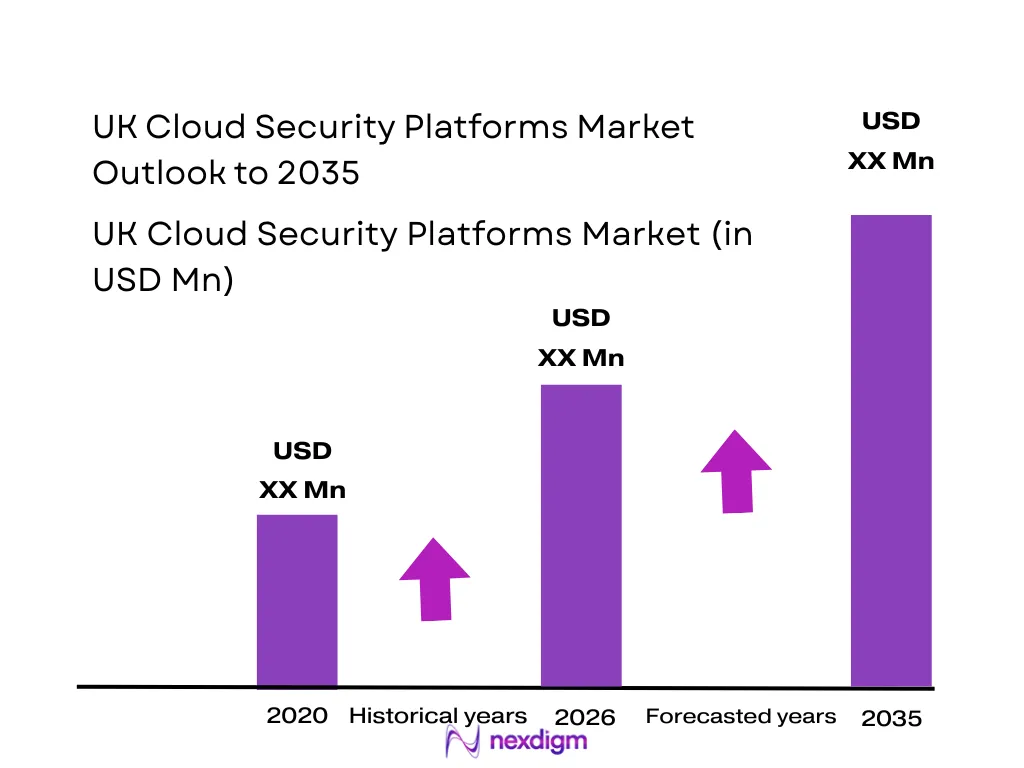
The UK cloud security platforms market was valued at USD ~ million in 2025, according to Nexdigm. Demand has been supported by a broader surge in cloud dependence: the UK Competition and Markets Authority said customers spent GBP 10.5 billion on cloud services in 2024, while the NCSC recorded 430 nationally significant cyber incidents in the same period, up from 371 in the prior year. This combination of rising cloud spending and a higher incident load is keeping cloud security platforms on UK board agendas.
Within Europe, the UK held 18.9% of the regional cloud security market in 2024, supported by its fintech-heavy demand base, mature cyber institutions, and dense hyperscaler and security-vendor presence. London dominates because it concentrates large BFSI buyers, cloud procurement teams, venture-backed security scaleups, and multinational headquarters. Cheltenham remains strategically important because of the NCSC and GCHQ ecosystem, while Manchester is emerging as a major cyber node; government-backed sector analysis shows 38% of UK cyber firms are still registered in Greater London, with dense clusters also visible in Manchester, Bristol-Bath, Cheltenham, Belfast, and Glasgow.
Market Segmentation
By Component
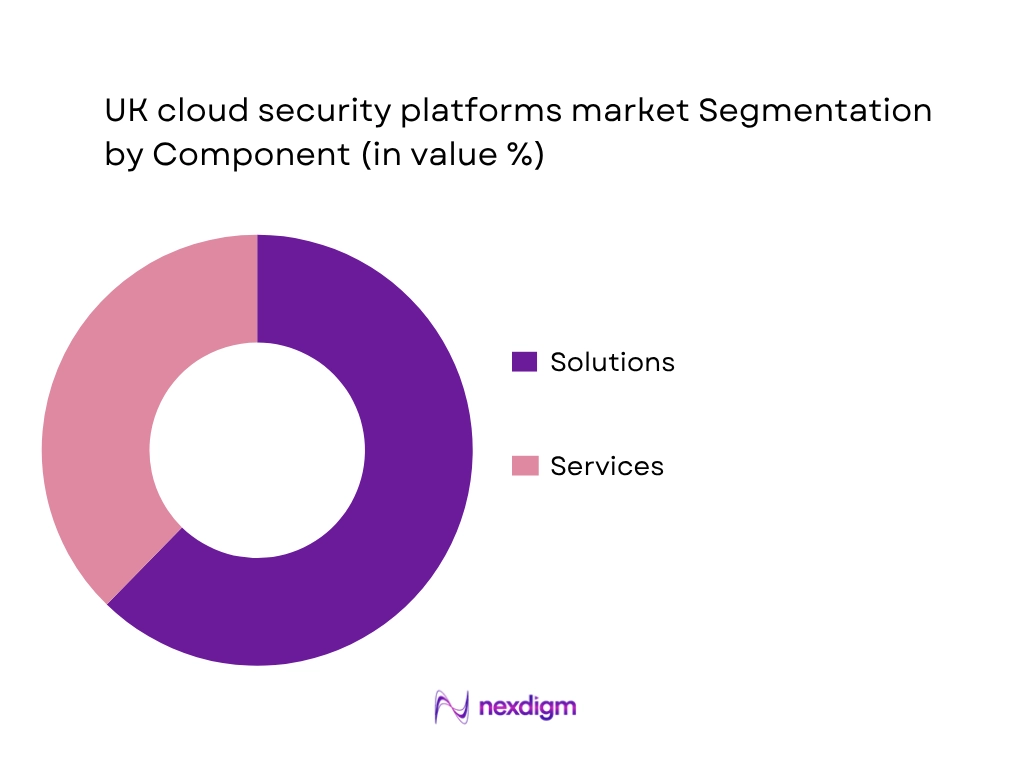
The UK cloud security platforms market is segmented by component into solutions and services. The dominant sub-segment is solutions. Publicly available 2024 share splits are more transparent at the Europe level than at the UK-only level; the closest published benchmark shows solutions at 62.3% of the European cloud security market, and this pattern is highly relevant to the UK because the country is Europe’s largest country market after Germany and has a strong concentration of regulated cloud buyers. Solutions dominate because buyers in the UK typically start with always-on controls rather than advisory-only spending. In practice, enterprises are prioritizing CNAPP, CSPM, CWPP, identity-centric controls, and posture-management tools that continuously monitor cloud estates. Services are growing, but the first budget line still tends to go to deployable platforms that reduce misconfiguration risk, improve policy visibility, and support compliance evidence generation for financial services, government, retail, and digital-native enterprises.
By Deployment Model
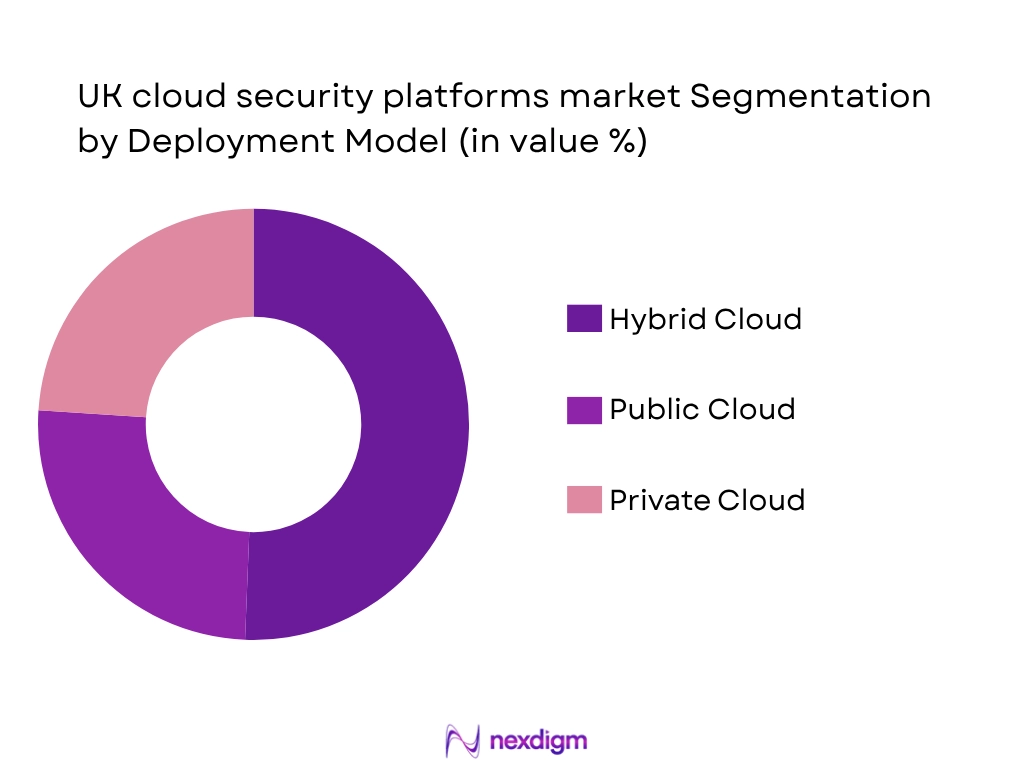
The market is segmented by deployment model into public cloud, private cloud, and hybrid cloud. The dominant sub-segment is hybrid cloud. The most transparent published benchmark available for the closely aligned European cloud security market shows hybrid cloud at 48.6% in 2024, and that logic strongly applies to the UK because many British enterprises run sensitive workloads across private environments while expanding analytics, collaboration, and customer-facing workloads on public cloud. Hybrid architectures dominate cloud security spending because they create the most complex control environment: security teams must enforce common posture, identity, data, and workload protection rules across several estates at once. That complexity makes platform-based security more valuable. In the UK, this is especially relevant in BFSI, healthcare, government, and critical infrastructure, where data sensitivity, outsourcing governance, resilience obligations, and migration in phases all favor hybrid environments rather than single-environment models.
Competitive Landscape
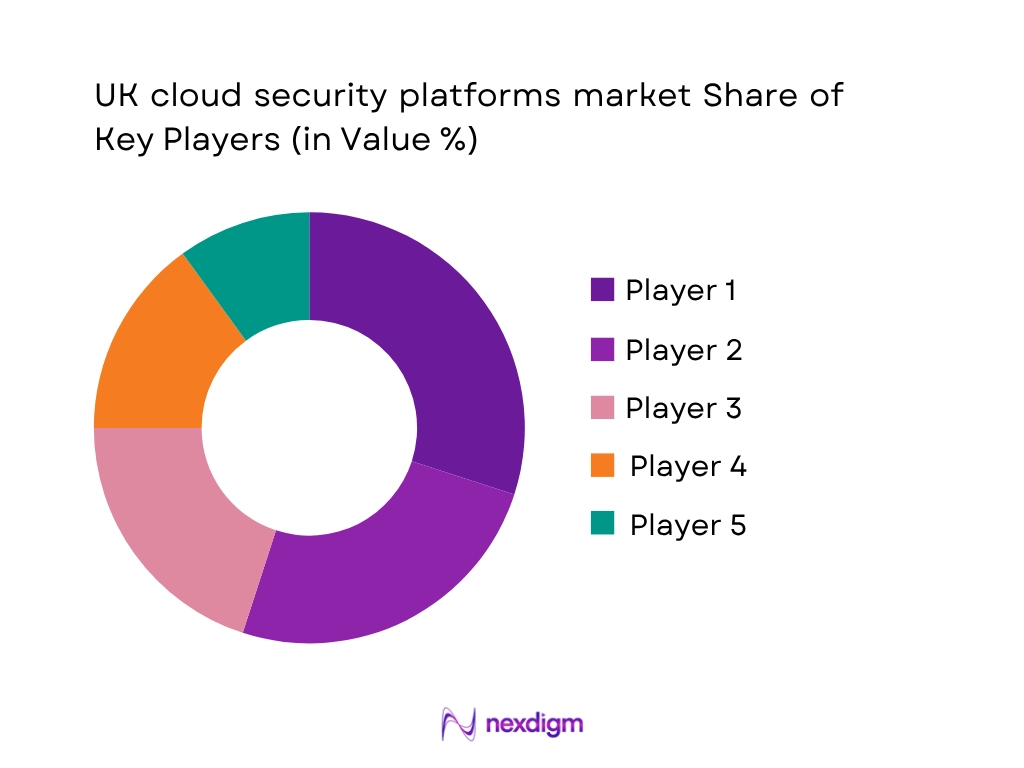
The UK cloud security platforms market is led by a concentrated group of global platform vendors, with Microsoft, Palo Alto Networks, Wiz, CrowdStrike, and Zscaler featuring prominently in enterprise evaluations. The market is competitive but not fragmented at the top end: large UK buyers, especially in regulated sectors, increasingly prefer vendors that combine posture management, workload protection, identity-risk visibility, compliance mapping, and strong partner support. Commercial differentiation is shaped not only by security efficacy, but also by pricing model clarity, bundling logic, cloud coverage, and ease of procurement through direct sales, MSSPs, and cloud marketplaces.
| Company | Establishment Year | Headquarters | Core Cloud Security Focus | Pricing Posture | Deployment Style | UK/Regulated Sector Relevance | Marketplace / Channel Reach | Commercial Positioning |
| Microsoft | 1975 | Redmond, Washington, U.S. | – | – | – | – | – | – |
| Palo Alto Networks | 2005 | Santa Clara, California, U.S. | – | – | – | – | – | – |
| Wiz | 2020 | New York City, U.S. | – | – | – | – | – | – |
| CrowdStrike | 2011 | Austin, Texas, U.S. | – | – | – | – | – | – |
| Zscaler | 2007 | San Jose, California, U.S. | – | – | – | – | – | – |
UK Cloud Security Platforms Market Analysis
Growth Drivers
Multi-Cloud Expansion
UK cloud security platform demand is being pushed higher by the scale and complexity of cloud adoption across the country. The CMA states that UK customers spent GBP 10.5 billion on cloud services in 2024, up from GBP 3.7 billion in 2020, with GBP 6.0 billion tied to IaaS and GBP 4.4 billion to PaaS. That matters for cloud security platforms because larger IaaS and PaaS estates usually mean more identities, workloads, APIs, containers, and policy layers to monitor across different environments. This expansion is occurring inside a large, digitally intensive economy: the World Bank records UK GDP at USD 3.69 trillion in 2024, GDP per capita at USD 53,246.4, and GDP growth at 1.1. In practical terms, a bigger cloud base inside a high-value economy increases the need for CNAPP, CSPM, CWPP, CIEM, and DSPM controls that can operate across distributed architectures rather than a single perimeter. For the UK market specifically, multi-cloud growth is not just a technology trend; it is becoming an operational reality for financial institutions, retailers, public services, and digital businesses that need unified visibility, continuous control validation, and scalable governance across multiple cloud environments.
Cloud Misconfiguration Risk
Cloud misconfiguration risk is a direct demand driver for UK cloud security platforms because the country’s cyber threat data shows a rising operational burden that cannot be managed manually at scale. The NCSC reported 1,957 cyber attack reports in its latest annual cycle, which were triaged into 430 incidents requiring support, up from 371 in the prior year. Of these, 89 were nationally significant, 12 were at the most severe end of the scale, 347 involved some level of data exfiltration, and 20 involved ransomware. Those figures are highly relevant to cloud security platforms because cloud misconfiguration frequently affects exposure paths, identity permissions, storage settings, and external attack surfaces that lead to unauthorized access or data leakage. The NCSC’s current cloud security guidance and its 2026 CSPM note both stress the need for tooling and automation to maintain secure cloud estates and continuously manage configuration drift. In a UK economy worth USD 3.69 trillion with GDP per capita of USD 53,246.4, the cost of insecure cloud operations is magnified across high-value sectors such as BFSI, public services, and telecom. This is why cloud security platforms that automate posture assessment, alert prioritization, and policy enforcement are becoming more essential to enterprise operations.
Market Challenges
Pricing Opacity
Pricing opacity is a structural challenge in the UK cloud security platforms market because enterprise buyers are already procuring security on top of a cloud market that the CMA has formally investigated for competition frictions tied to committed spend agreements, licensing, and egress-related barriers. UK cloud customers spent GBP 10.5 billion on cloud services in 2024, and the CMA found that the two largest IaaS providers each held a [30–40] share band in that year, highlighting the importance of contract design and commercial leverage in the underlying cloud layer. When security vendors then add their own per-asset, per-user, per-workload, module-based, or consumption-based pricing logic, buyers face difficulty comparing like-for-like offers across CNAPP, CSPM, CWPP, SSPM, and DSPM products. This matters more in the UK because cloud security is increasingly bought by regulated and cost-disciplined enterprises that must justify spend to procurement, risk, and finance teams. In a national economy of USD 3.69 trillion with GDP growth at 1.1, pricing complexity slows vendor selection, lengthens proof-of-value cycles, and pushes buyers toward vendors that can show clearer unit economics, better bundle logic, and lower commercial ambiguity across multiyear contracts.
Tool Sprawl
Tool sprawl is a serious challenge for the UK cloud security platforms market because many organizations are trying to secure growing cloud estates with fragmented tools while facing limited cyber capacity. The UK government estimates that 2,165 firms were active in the domestic cyber security sector as of December 2024, up from 2,091 previously, which shows a broad and expanding vendor landscape. At the same time, the government’s cyber skills assessment found that 699,000 UK businesses had a basic technical cyber security skills gap in 2025. On the threat side, the NCSC handled 430 serious incidents in its latest annual cycle, including 347 involving data exfiltration. This combination matters for cloud security platforms because more available tools do not automatically improve resilience if enterprises lack enough skilled people to operate multiple dashboards, normalize alerts, correlate risks, and execute remediation across identity, workload, and data layers. In a UK economy valued at USD 3.69 trillion, this operational fragmentation raises the appeal of platform-based architectures that consolidate posture management, workload protection, entitlement analysis, and reporting into fewer consoles. For UK buyers, tool sprawl is no longer just an IT inconvenience; it is a scaling problem that affects response speed, audit readiness, and total security operating efficiency.
Market Opportunities
Platform Consolidation
Platform consolidation is a strong market opportunity because UK organizations are being pushed toward fewer, broader cloud security control layers that are easier to operate and easier to justify commercially. The same market is dealing with GBP 10.5 billion of cloud services spending, 430 serious cyber incidents requiring NCSC support, and 699,000 businesses with basic technical cyber skills gaps. Those numbers point to a clear operating reality: many UK enterprises need better coverage with fewer consoles, fewer manual handoffs, and more automation. The NCSC’s current CSPM guidance explicitly emphasizes tooling and automation to maintain secure cloud estates, which supports demand for consolidated CNAPP-style platforms that combine posture management, workload protection, entitlement visibility, and remediation workflows. This is particularly relevant in a USD 3.69 trillion economy where enterprises in financial services, public sector, retail, and telecom must manage large digital estates while controlling staffing pressure. Consolidation therefore reflects more than procurement preference; it reflects the need to reduce alert duplication, unify policy management, simplify reporting, and improve operational efficiency. Vendors that can replace several standalone tools with a coherent platform are well positioned to benefit from this shift in the UK market.
AI Security and AI-SPM, DSPM Expansion
AI security and adjacent categories such as AI-SPM and DSPM represent a clear growth opportunity in the UK because AI adoption is rising while cloud remains the delivery backbone for AI workloads and data pipelines. The ONS reported that 23 out of every 100 businesses were already using some form of AI technology in late September 2025, while 15 out of every 100 planned to adopt AI within the next three months in late December 2025; among businesses with 250 or more employees, current AI use reached 44 out of every 100. The CMA has separately stated that cloud services underpin AI model development and deployment, linking AI growth directly to cloud infrastructure demand. At the same time, the NCSC recorded 347 incidents involving data exfiltration in its latest annual cycle, which is especially relevant for DSPM because AI systems depend on wider data access, more sensitive repositories, and more machine-readable information flows. In a UK economy of USD 3.69 trillion, that combination creates a commercially important opportunity for vendors that can secure AI data, govern model exposure, enforce least privilege, and continuously assess AI-connected cloud assets. UK enterprises are not just adopting AI; they are creating a larger attack surface that cloud security platforms can monetize through specialized AI and data-security layers.
Future Outlook
The market outlook remains favorable as UK enterprises continue to deepen cloud usage while facing tighter scrutiny over resilience, third-party risk, and data protection. Buyers are moving from point products to broader cloud security platforms that reduce tool sprawl and improve operational visibility. Demand is also shifting toward agentless assessment, attack-path prioritization, DSPM, SaaS posture management, and cloud-native runtime controls. Commercially, vendors that can simplify pricing, bundle adjacent modules effectively, and prove lower total cost of ownership are likely to gain share.
Major Players
- Microsoft
- Palo Alto Networks
- Wiz
- CrowdStrike
- Zscaler
- Netskope
- Check Point Software Technologies
- Orca Security
- Trend Micro
- Tenable
- SentinelOne
- Sysdig
- Proofpoint
- AppOmni
- Fortinet
Key Target Audience
- Chief Information Security Officers and Security Leadership Teams
- Chief Information Officers and Enterprise Architecture Leaders
- Cloud Infrastructure and Platform Engineering Teams
- Security Operations Centers and Threat Detection Teams
- Managed Security Service Providers and Cybersecurity Integrators
- Investments and Venture Capitalist Firms
- Government and Regulatory Bodies
- BFSI, Healthcare, Public Sector, Retail, Telecom, and Critical Infrastructure Procurement Heads
Research Methodology
Step 1: Identification of Key Variables
The first step maps the UK cloud security platform ecosystem across vendors, buyers, channel partners, MSSPs, cloud marketplaces, and regulators. Secondary research is used to define the market boundary around cloud security platforms rather than the entire cyber market. Key variables include platform category, pricing model, deployment architecture, buyer cohort, regulatory pressure, and cloud-environment complexity.
Step 2: Market Analysis and Construction
In this phase, historical market data and adjacent indicators are compiled to build the market view. These include published UK cloud security market revenues, UK cloud services spending, regional cloud security positioning, and threat-intensity indicators. The market structure is then organized around two lenses: demand drivers and commercial benchmarking.
Step 3: Hypothesis Validation and Expert Consultation
Initial hypotheses are tested through interviews with enterprise security buyers, solution architects, channel partners, and former vendor-side practitioners. These interviews help validate which pricing metrics actually matter in deals, where discounting is common, how buyers compare bundled vs modular platforms, and which capabilities most influence selection in the UK.
Step 4: Research Synthesis and Final Output
The final stage triangulates desk research, published market data, and expert validation to produce a practical market narrative. Outputs are synthesized into market size, segmentation, competitive benchmarking, future outlook, and buying-intelligence sections. The aim is to provide decision-useful intelligence for strategy, investments, market entry, and vendor positioning.

- Executive Summary
- Research Methodology (Market Definitions and Inclusions, Abbreviations, Pricing Benchmarking Framework, Competitive Intelligence Framework, Market Sizing Logic, Forecasting Logic, Primary Interviews with Buyers/Partners/Resellers, Secondary Source Validation, Vendor Offer Mapping, Deal Triangulation Approach, Limitations and Assumptions)

- Definition and Scope
- Market Taxonomy and Category Boundaries
- Evolution of the UK Cloud Security Stack
- Buyer Journey and Adoption Lifecycle
- Cloud Security Control Tower Architecture
- Value Chain Analysis
- Stakeholder Ecosystem
- UK Regulatory and Compliance Context
- Procurement and Buying-Motion Overview

- Growth Drivers (Multi-Cloud Expansion, Cloud Misconfiguration Risk, Cloud-Native Application Growth, Identity-Centric Security Needs, SaaS Sprawl, UK Compliance Pressure, Runtime Threat Exposure, Board-Level Cyber Resilience Spending)
- Market Challenges (Pricing Opacity, Tool Sprawl, Alert Fatigue, Deployment Complexity, Skills Shortage, Integration with Legacy Security Stack, False Positive Burden, Budget Consolidation Pressure)
- Market Opportunities (Platform Consolidation, AI Security and AI-SPM, DSPM Expansion, Shift-Left Security Monetization, Managed Cloud Security Services, Industry-Specific Compliance Bundles, Cloud Marketplace Acceleration, Mid-Market Penetration)
- Market Trends (CNAPP Convergence, Agentless-First Assessment, Attack Path Prioritization, Unified Data Security, SaaS Security Posture Growth, Exposure Management Integration, AI-Assisted Remediation, Vendor Bundling Strategies)
- Regulatory and Compliance Landscape (NCSC Cloud Security Principles, Cyber Essentials Alignment, UK GDPR/Data Governance, FCA/PRA Outsourcing Expectations, Operational Resilience Requirements, Sector-Specific Assurance Expectations)
- Pricing Benchmarking Analysis (List Price vs Realized Price, Floor-to-Ceiling Price Spread, Discounting Patterns, Bundled vs Standalone Pricing, Add-On Module Premiums, Free Tier/Trial Strategy, Minimum Contract Thresholds, Multi-Year Deal Structures)
- Demand-Side Pain Point Analysis (Visibility Gaps, Prioritization Gaps, Remediation Latency, SaaS Governance Gaps, Identity Entitlement Risks, Compliance Evidence Burden, Skills Constraints, Board Reporting Needs)
- Porter’s Five Forces
- SWOT Analysis
- Competition Ecosystem

- By Revenue, 2020-2025
- By Number of Enterprise Customers, 2020-2025
- By Average Annual Contract Value, 2020-2025
- By Average Realized Pricing Metric, 2020-2025

- By Platform Category (In Value %)
CNAPP
CSPM
CWPP
CIEM
DSPM
SSPM
CASB
SSE - By Pricing Model (In Value %)
Per Workload
Per Asset/Resource
Per User
Per SaaS Application
Consumption-Based
Enterprise License - By Deployment Architecture (In Value %)
Agentless
Agent-Based
Hybrid
API-Based - By Cloud Environment Coverage (In Value %)
Single-Cloud
Multi-Cloud
Hybrid Cloud
Kubernetes/Containers
SaaS Estate - By Organization Size (In Value %)
SMEs
Mid-Market Enterprises
Large Enterprises
Strategic/Global Accounts - By End-User Industry (In Value %)
BFSI
Public Sector
Healthcare & Life Sciences
Retail & E-Commerce
Telecom & Digital Services
Manufacturing & Industrial
Energy & Utilities - By Buying Channel (In Value %)
Direct Sales
Channel Partners/VARs
MSSPs
Cloud Marketplace

- Pricing Architecture by Vendor (Per Workload vs Per Asset vs Per User vs Platform License Structuring)
- Entry-Level vs Enterprise Pricing Tier Benchmarking (Minimum Commit Levels, Entry Barriers, Expansion Thresholds)
- List Price vs Realized Price Analysis (Discount Bands, Negotiation Levers, Volume-Based Pricing Variations, Deal-Level Flexibility)
- Pricing Benchmark by Platform Category (CNAPP vs CSPM vs CWPP vs DSPM vs SSPM vs CASB vs SSE Pricing Differentials)
Bundling vs Modular Pricing Strategy Comparison (All-in-One CNAPP Bundles vs Best-of-Breed Modular Add-Ons, Pricing Uplift from Add-Ons) - Consumption-Based vs Subscription Pricing Benchmark (Usage-Based Billing Models, Elastic Scaling Economics, Cost Predictability vs Variability)
- Pricing Benchmark by Deployment Model (Agentless vs Agent-Based Cost Implications, API-Based Pricing Efficiency, Operational Overhead Impact)
- Pricing Benchmark by Customer Segment (SMEs vs Mid-Market vs Large Enterprises vs Regulated Enterprises Pricing Variance)
- Cloud Marketplace vs Direct Sales Pricing Comparison (Marketplace Discounts, Private Offers, Channel Margins, Procurement Efficiency)
- Add-On Monetization Benchmark (DSPM, CIEM, SSPM, Threat Detection Modules, AI Security Add-Ons Pricing Uplift)
- Contract Structuring and Commercial Terms (Multi-Year Discounts, Prepaid vs Annual Billing, Ramp Deals, Renewal Uplift Trends)
Total Cost of Ownership (TCO) Benchmarking (Licensing Cost, Deployment Cost, Integration Cost, Operational Cost, Hidden Cost Drivers) - Cost per Risk Coverage Benchmark (Cost vs Coverage Depth, Cost vs Number of Assets Protected, Cost vs Attack Surface Visibility)
- Pricing Transparency and Complexity Index (Vendor Pricing Clarity, SKU Complexity, Ease of Buyer Understanding)
- Deal Case Studies and Benchmark Scenarios (Mid-Market Deployment Scenario, Multi-Cloud Enterprise Scenario, SaaS Security Expansion Scenario, Regulated Industry Deployment Scenario)

- Market Share of Major Players (By Revenue, By Enterprise Customers, By Regulated Enterprise Penetration, By Platform Category Presence)
- Cross Comparison Parameters (Pricing Metric and Billing Unit, Pricing Transparency and Packaging, Cloud Coverage Depth, Module Breadth Across CNAPP/CSPM/CWPP/CIEM/DSPM/SSPM/CASB, Deployment Architecture, Compliance and Policy Coverage, Remediation Automation and Workflow Integration, UK Go-to-Market Strength)
- Benchmarking of Commercial Models (Subscription Structure, Minimum Commit, Contract Tenure, Bundling Strategy, Add-On Economics, Marketplace Availability, Channel Margin Flexibility, Proof-of-Value Structure)
- Pricing Analysis Basis Representative SKUs and Commercial Packages (Entry Tier, Mid Tier, Enterprise Tier, Add-On Modules, Workload Packs, User Packs, Consumption Units, Support Tiers)
- Detailed Profiles of Major Companies
Microsoft
Palo Alto Networks
Wiz
CrowdStrike
Netskope
Zscaler
Check Point Software Technologies
Orca Security
Trend Micro
Tenable
SentinelOne
Sysdig
Proofpoint
AppOmni
Fortinet

- Cloud Security Maturity by Buyer Cohort (Cloud-First Enterprises, Regulated Enterprises, Digital Natives, Hybrid Enterprises)
- Budget Ownership and Spend Allocation (CISO Office, Cloud Platform Team, Infrastructure/SecOps, Risk and Compliance, Shared IT-Security Budgets)
- Purchase Decision Criteria (Coverage Breadth, Ease of Deployment, Compliance Reporting, Risk Prioritization, Automation Depth, Total Cost of Ownership, Integration Readiness, Vendor Trust)
- Procurement Motion and Sales Cycle (POC-Led Buying, Platform Consolidation Buying, Renewal/Upsell Motions, Marketplace Procurement, Channel-Led Procurement)
- Buyer Pain Points and Unmet Needs (Contextual Risk Scoring, Unified Dashboards, Faster Remediation, Better SaaS Visibility, Lower Operational Overhead, Transparent Pricing, Stronger UK Support, Board-Ready Reporting)

- By Revenue, 2026-2035
- By Number of Enterprise Customers, 2026-2035
- By Average Annual Contract Value, 2026-2035
- By Average Realized Pricing Metric, 2026-2035


 Request a Sample
 Ask for Customization
 Get a Quote
 Enquire Now