
 Download PDF
Market Overview
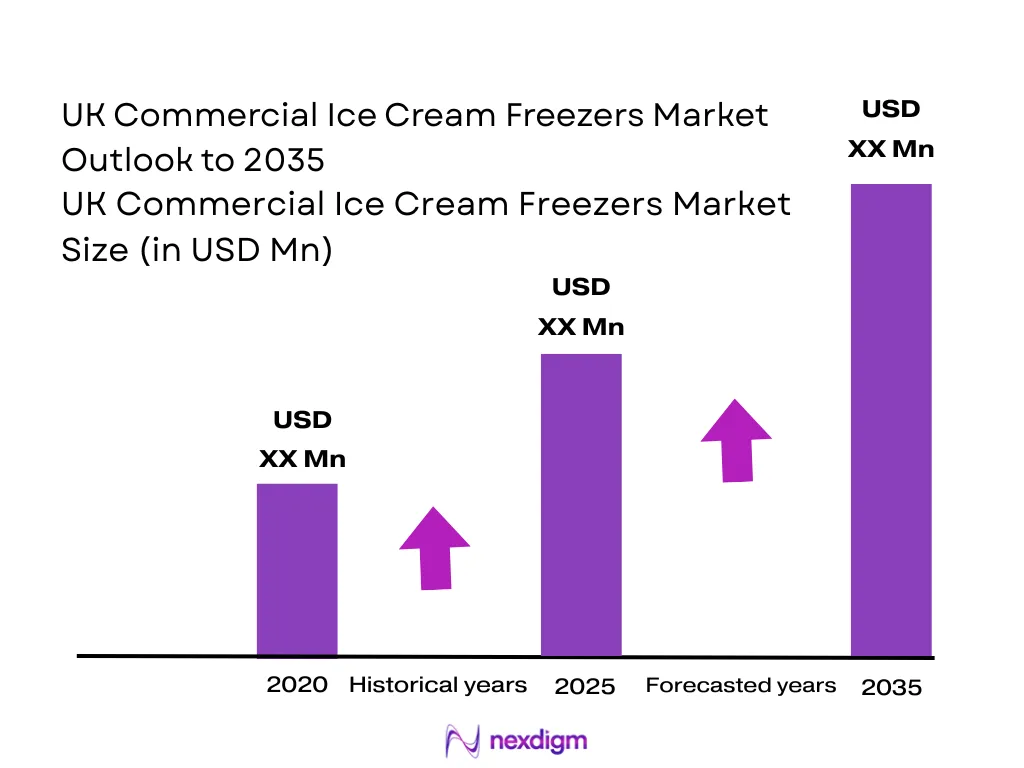
The UK commercial refrigeration equipment market—of which commercial ice cream freezers are a part—generated revenue of USD ~ million in 2025, highlighting substantial demand for food equipment that supports frozen product storage and display in retail and foodservice channels. Refrigerators and freezers comprised the largest segment of this market, driven by the expansion of grocery retail networks, convenience outlets, restaurants, and hospitality venues that require structured cold display solutions for products such as ice cream and frozen desserts. Growth in retail outlet counts, including over 100,000 fast‑food and café outlets reported by the Office for National Statistics, underpins capital expenditure on commercial freezer infrastructure. The continued upgrade to energy‑efficient units due to rising operational cost pressures and evolving condensate and refrigerant standards further stimulates demand within the UK environment.
Major urban and retail hubs such as London, Manchester, Birmingham, and Glasgow dominate the deployment of commercial ice cream freezers in the UK due to high footfall and dense concentrations of supermarkets, convenience chains, foodservice establishments, and hospitality venues that sell ice cream and frozen desserts. London’s vast urban population and international tourism base create year‑round demand for impulse and premium frozen products, necessitating robust freezer infrastructure. Manchester and Birmingham, as major metropolitan centres with vibrant retail districts and foodservice sectors, similarly support the procurement of advanced display and storage freezers. Glasgow’s mix of hypermarkets and seasonal tourism in nearby regions further bolsters installation volumes. These cities’ retail structures, combined with foodservice density, create greater penetration of specialised freezer formats to meet diversified cold storage needs.
Market Segmentation
By Product Type
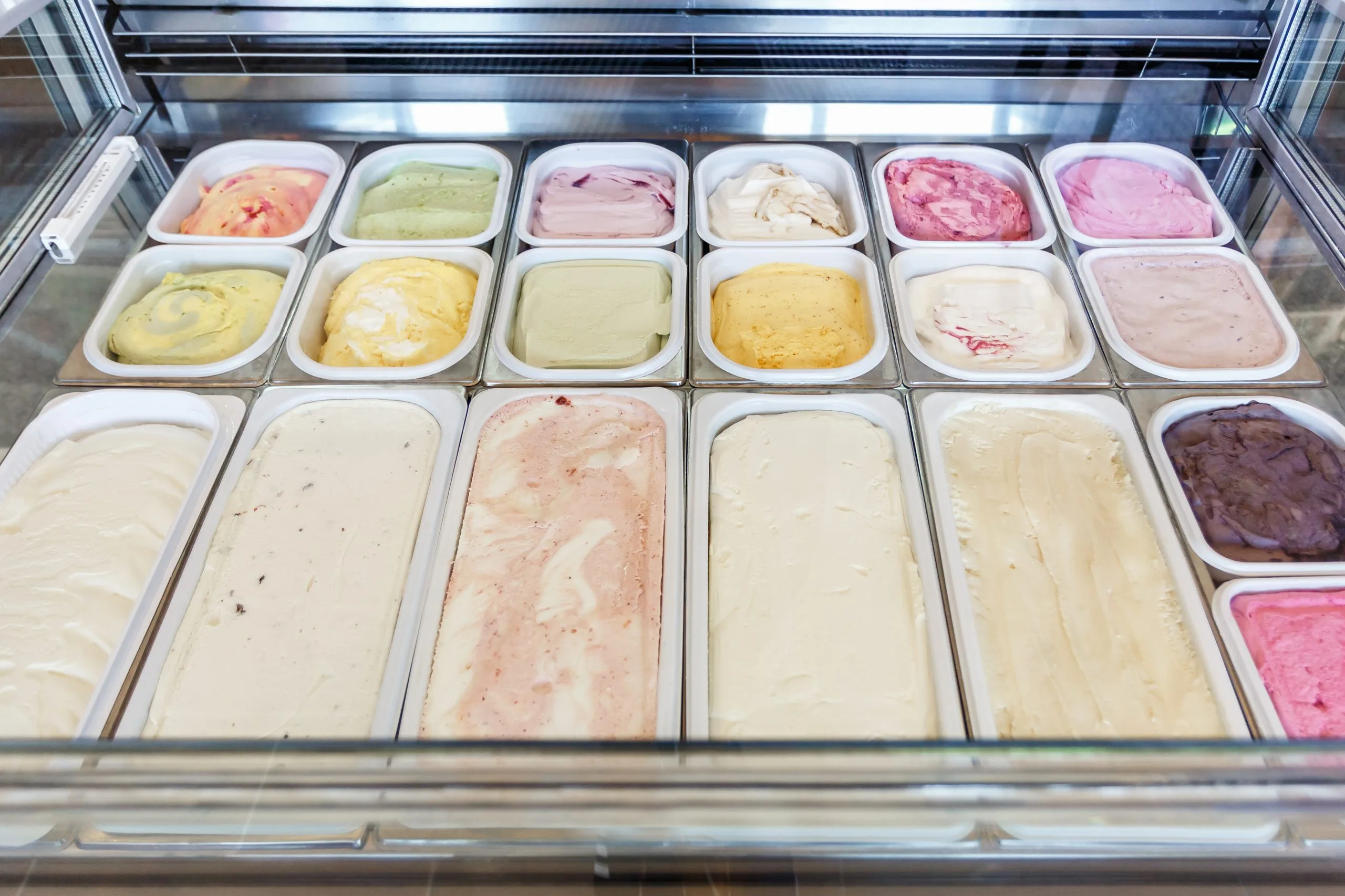
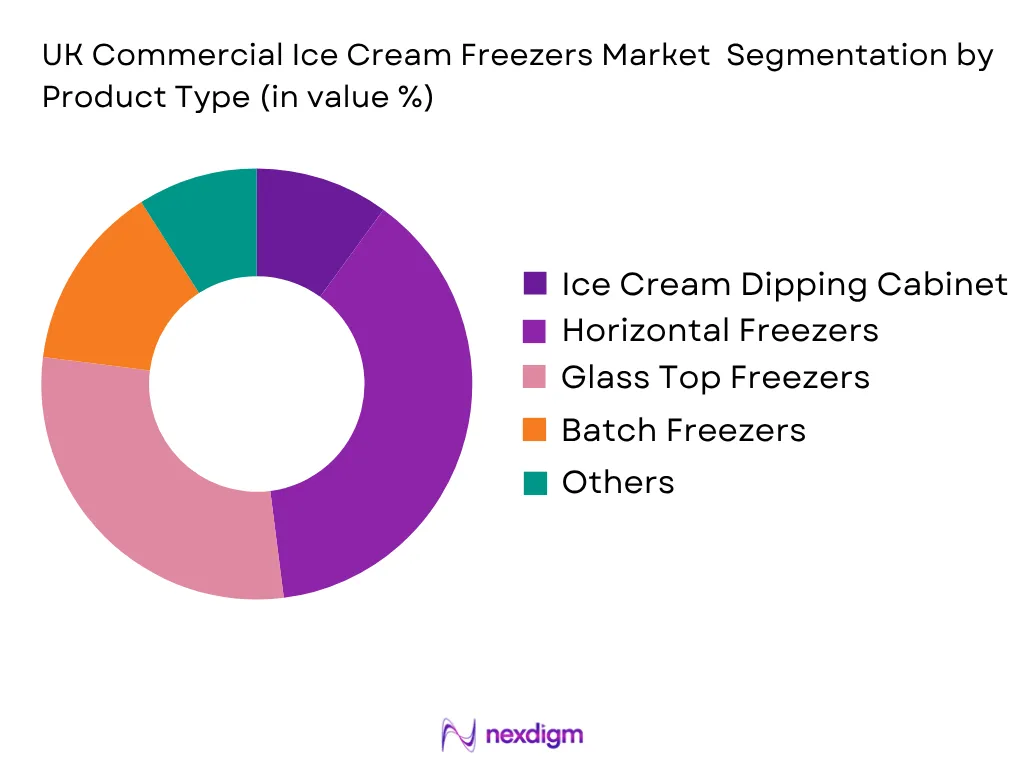
By product type, chest/horizontal freezers dominate the UK commercial ice cream freezers segment due to their widespread use in supermarkets, hypermarkets, and convenience stores for impulse frozen desserts. These units offer high storage capacity and efficient energy usage when positioned in aisles or near checkouts, aligning with retailer priorities for product visibility and ease of access. Chest freezers typically require minimal maintenance and provide broad product exposure, which is critical for retail formats focusing on bulk frozen product sales. Upright and glass‑top display freezers also hold significant share, particularly in premium supermarkets and ice cream parlours where visual merchandising and customer interaction with products are prioritised. Soft‑serve and batch freezers, while smaller in share, are essential in foodservice environments like QSRs and dessert shops that offer on‑site frozen treats. Ice‑cream dipping cabinets and gelato formats, though niche, cater to specialist operators seeking bespoke presentation options that reflect premium branding and customer experience. These product priorities indicate that functional utility and merchandising capability strongly influence the equipment mix in the UK market.
By End‑Use Channel
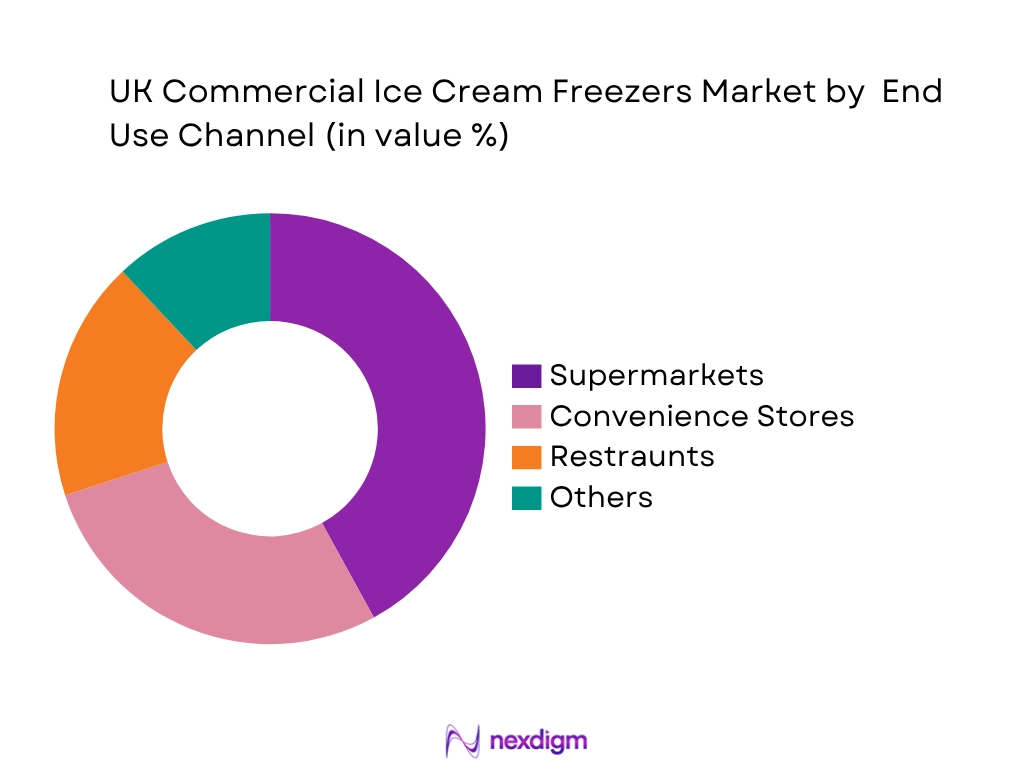
Under end‑use segmentation, supermarkets and hypermarkets lead the UK commercial ice cream freezers market, driven by their role as primary retail platforms for frozen dessert products and their broad store footprint. Major supermarket and hypermarket chains deploy multi‑door freezer banks and horizontal chest units to support both branded and own‑label frozen desserts, responding to consumer demand for diverse ice cream assortments. Convenience stores also contribute meaningfully, especially in urban zones where on‑the‑go impulse purchases are common and require compacter freezer solutions. Foodservice restaurants and cafés increasingly incorporate specialised freezer units to diversify dessert offerings, particularly in casual dining and quick‑service formats. Ice cream parlours and gelaterias, though smaller in share, maintain dedicated freezer deployments tailored to product presentation and artisanal appeal. Hotels and hospitality venues use multi‑capacity freezers to support varied guest offerings but represent a limited overall share due to concentrated seasonal demand. These channel dynamics reflect how deployment patterns align with consumer access points and retail strategy priorities within the UK’s diverse food landscape.
Competitive Landscape
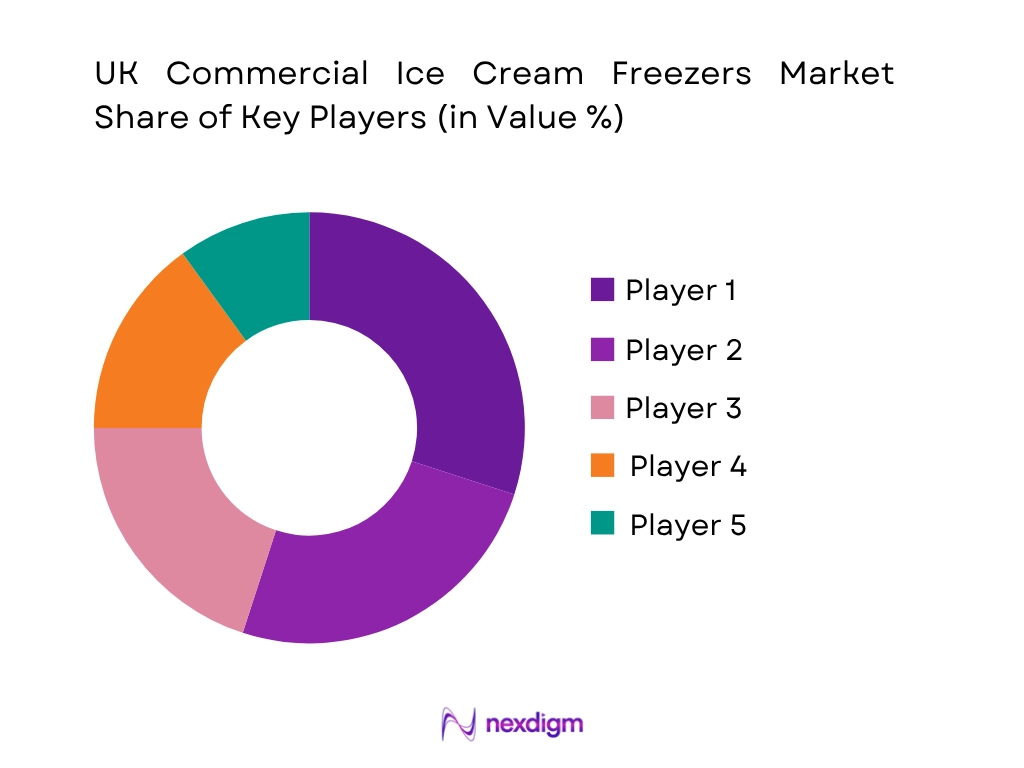
The UK commercial ice cream freezers market features established refrigeration and cold equipment providers operating across product innovation, sustainability compliance, and multi‑channel distribution. Competition centres on energy‑efficient systems, service support networks, product reliability, and compliance with evolving refrigerant regulations that impact purchase and replacement cycles. Key players provide a range of freezing formats—from basic chest models to digitally controlled display freezers—serving supermarkets, hospitality, and foodservice customers.
| Company | Est. Year | Headquarters | Product Range Breadth | Energy/Efficiency Focus | Distribution Coverage (UK) | Service & Maintenance Network | Refrigerant Technology Offering | Customer End‑Use Focus |
| Hussmann UK | 1906 | UK/USA | ~ | ~ | ~ | ~ | ~ | ~ |
| Electrolux Professional | 1910 | Sweden | ~ | ~ | ~ | ~ | ~ | ~ |
| AHT Cooling Systems | 1932 | Austria/UK | ~ | ~ | ~ | ~ | ~ | ~ |
| Haier Commercial Refrigeration | 1984 | China | ~ | ~ | ~ | ~ | ~ | ~ |
| True Manufacturing (UK Partners) | 1945 | USA/UK | ~ | ~ | ~ | ~ | ~ | ~ |
UK Commercial Ice Cream Freezers Market Outlook to 2035
Growth Drivers
Expansion of UK Retail and Foodservice Infrastructure Underpinning Freezer Demand
The expansion in UK retail and foodservice infrastructure strongly supports demand for commercial ice cream freezers. Official data shows that UK retail sales value reached approximately ~ million in 2025, up from 2023 and indicating that physical retail activity continues to drive equipment investments across store formats where frozen products are sold. Retail’s economic output contributed roughly ~ million to national GDP, reflecting the scale of supermarket, convenience, and specialist stores that require reliable refrigeration and freezing units. Commercial ice cream freezers are integral to this infrastructure, serving both impulse frozen dessert sales and inventory storage in diverse retail settings. The breadth of outlets—from large supermarkets in London and Manchester to independent dessert parlours in regional cities—has expanded the addressable base for specialised freezer units. This pervasive deployment context underscores how retail and foodservice expansion directly propels the installation and replacement of commercial ice cream freezer equipment throughout the UK, supporting consistent demand for durable and efficient freeze solutions.
Household Food & Out‑of‑Home Expenditure Trends Supporting Frozen Dessert Consumption
Consumer expenditure patterns in the UK provide foundational support for commercial freezer demand. Government survey data shows that average weekly household expenditure on food and drink at current prices was £47.19 per person in the financial year ending 2024, up from £43.33 per person in the previous period, indicating increased spending on both groceries and eating‑out occasions. The same data also reveals meaningful increases in expenditure on eating out — from £10.06 to £11.25 per person per week — showing that out‑of‑home consumption remains relevant for cold and frozen dessert categories. These spending trends translate into robust floorspace and menu offerings across casual dining, cafés, and quick‑service outlets that include ice cream products, necessitating commercial freezer capacity to maintain quality and food safety. The commercial refrigeration and freezer segment is further underpinned by consumer demand stability in the food sector, even as overall discretionary retail sales have moderated. Such household and hospitality expenditure patterns justify ongoing investment in industrial‑grade freezing equipment by retailers and foodservice operators, reinforcing the structural linkage between consumer food spend behaviour and commercial ice cream freezer deployment across the UK market.
Challenges
Weak Consumer Spending Patterns Constraining Retail Investment in Freezers
Sluggish consumer spending and cautious retail sales present a structural challenge to the UK commercial ice cream freezers market. Government and retail sector data indicate that overall consumer expenditure growth remains modest, with household spending growth in late 2024 reported at only 0.1% growth quarter‑on‑quarter for total household spending, and food and non‑alcoholic beverages showing a contraction in the same period. On a broader scale, consumer expenditure on food and drink—and the portion eaten out—fell in constant prices from ~ billion in 2023 to ~ million in 2024 according to official UK food statistics. This decline in core food spending signals subdued discretionary purchase behaviour, which can dampen retailers’ willingness to allocate capital toward freezer upgrades or expansions that are principally justified by increased sales throughput. A muted retail environment is particularly relevant for high‑footfall settings where commercial ice cream freezers are installed, such as supermarkets and convenience outlets. Retailers tend to defer non‑essential capital expenditures, including freezer equipment upgrades or expansion, when face sales growth uncertainty. This cautious investment stance, influenced by overall consumer spending headwinds and a contraction in food service expenditure, represents a tangible constraint on new equipment adoption and replacement cycles for commercial freeze infrastructure.
Cost Pressures from UK Energy and Operating Environment Affecting Business‑Level Freezer Decisions
Operating cost pressures in the UK pose a notable challenge to commercial ice cream freezer investments. Data on consumer price inflation for refrigeration units indicates that the CPIH index for “refrigerators, freezers and fridge‑freezers” dropped by 3.0 points in 2024, reflecting broader price adjustments in appliance categories. Despite this, commercial operators face significant energy cost burdens tied to running high‑capacity freezer units in retail and foodservice establishments, especially as UK electricity and gas costs have remained elevated relative to prior norms. The cold chain sector contributes £14 million in gross value added (GVA) to the UK economy and supports over 184,000 jobs, underscoring its economic importance but also its exposure to energy market volatility. These energy and operational cost pressures can reduce the financial attractiveness of investing in new or upgraded freezers, particularly for smaller operators that manage tighter profit margins. Capital planning in hospitality and retail sectors often prioritises essentials when operating overheads are high, and investment budgets are limited. The need to balance energy consumption, equipment performance, and compliance with environmental standards complicates procurement decisions. These economic headwinds influence the timing, scale, and configuration of freezer purchases, representing a barrier to accelerated market uptake of commercial ice cream freezers in the UK context.
Opportunities
Growth of Cold Chain Infrastructure Providing Expanded Deployment for Freezer Solutions
The development and maturation of the UK’s cold chain infrastructure present a significant opportunity for commercial ice cream freezers. Official analysis highlights that the temperature‑controlled logistics sector contributes £14 million in GVA and supports 184,000 jobs across the UK economy, reflecting extensive storage and distribution activity for frozen and chilled products. Enhanced cold chain facilities—including warehouses, cross‑docking sites, and refrigerated transport networks—improve the reliability and geographic reach of frozen dessert distribution, enabling retailers and horeca operators to carry a broader range of ice cream and frozen items with reduced spoilage risk. A robust cold chain foundation encourages investment in advanced commercial freezer units at retail endpoints since businesses can rely on improved upstream logistics to maintain consistent product quality. Cold chain enhancements also facilitate entry into new retail channels such as online grocery fulfilment and micro‑fulfilment hubs, where compact yet efficient freezer equipment is increasingly required. As consumer demand for frozen desserts gains traction alongside broader chilled food trends, the alignment between logistics infrastructure and commercial freezer deployment positions the market to capture incremental demand tied to expanded distribution networks and service models across the UK.
Evolving Consumer Eating‑Out Behaviour Driving Specialized Freezer Demand
Shifts in UK consumer eating behaviour towards more frequent dining experiences outside the home present an opportunity for commercial ice cream freezers, particularly within foodservice and hospitality channels. Official household spending data shows that weekly expenditure on food eaten outside the home increased from £10.06 to £11.25 per person per week, indicating renewed appetite for out‑of‑home consumption. Even as broader retail sales face headwinds, this segment’s resilience supports demand for specialised freezer units in cafés, restaurants, and artisanal dessert parlours where ice cream and frozen desserts are part of menu offerings. Foodservice outlets increasingly diversify their dessert portfolios to capture additional revenue streams, necessitating reliable, quality‑preserving freezer infrastructure. This behavioural trend also aligns with post‑pandemic shifts in consumer preferences for experiential dining and premium indulgence categories, which require consistent, low‑temperature storage environments for multi‑category frozen products. Operators that recognise this cross‑section between eating‑out frequency and detailed menu enhancements are in a position to deploy commercial freezer solutions that support higher turnover and broader assortment of frozen desserts. Thus, evolving foodservice dynamics represent a tangible opportunity for commercial ice cream freezer market growth linked directly to consumption patterns rather than aggregate market size statistics.
Future Outlook
The UK commercial ice cream freezers market is expected to grow steadily driven by continued retail modernisation, rising demand for frozen dessert products, and regulatory pressure to upgrade to energy‑efficient and environmentally sustainable refrigeration solutions. Retail chains and convenience formats will continue to invest in upgrade cycles as foodservice sectors expand menu offerings featuring ice cream and frozen treats. Sustainability drivers such as refrigerant phase‑downs and UK energy efficiency regulations will influence product design and replacement decisions. Integration of smart temperature monitoring, predictive maintenance, and remote diagnostics will further shape future freezer deployments, improving operational reliability and aligning with broader digital transformation trends in food retail and hospitality infrastructure.
Major Players
- Hussmann UK
- Electrolux Professional
- AHT Cooling Systems
- Haier Commercial Refrigeration
- True Manufacturing (via UK partners)
- Panasonic (UK distribution)
- Carrier (through distribution networks)
- Turbo Air UK (import/distribution)
- Nor‑Lake UK (partner operations)
- Summit Appliance (European supply)
- BCM Commercial Freezers
- Williams Refrigeration
- Foster Refrigerator
- Beverage‑Air (UK channels)
- Metalfrio Solutions (export/vendor partners)
Key Target Audience
- Supermarket Chain Procurement Heads
- Retail Equipment Buyers
- Foodservice & QSR Operations Directors
- Franchise Dessert Outlet Expansion Leaders
- Commercial Refrigeration Project Developers
- Investments and Venture Capitalist Firms (refrigeration/retail tech)
- Government and Regulatory Bodies (UK Department for Business & Trade, Environment Agency F‑Gas Division)
- Hospitality Facility Managers
Research Methodology
Step 1: Identification of Key Variables
The initial phase involves comprehensive mapping of the commercial ice cream freezer ecosystem, including product types, end‑user channels, and key customer purchase drivers. Secondary sources such as UK market revenue statistics and appliance deployment patterns were reviewed to define variables shaping market structure.
Step 2: Market Analysis and Construction
This phase compiles historical data on commercial refrigeration revenue and unit installations in the UK, evaluating patterns across supermarkets, convenience stores, hospitality sectors, and foodservice. Rigorous segmentation was applied to isolate ice cream freezer demand within broader refrigeration equipment.
Step 3: Hypothesis Validation and Expert Consultation
Market hypotheses were validated via expert interviews with refrigeration suppliers, retail equipment buyers, and industry practitioners. These sessions provided insights into equipment replacement cycles, regulatory impacts, and technology adoption, refining market forecasts.
Step 4: Research Synthesis and Final Output
Validated data and expert insights were synthesised into a comprehensive market model, ensuring accurate representation of UK commercial ice cream freezer demand drivers, segment momentum, and competitive landscape trends supporting forecasting through 2035.

- Executive Summary
- Research Methodology (Market Definitions & Scope, Abbreviations and Glossary, Data Collection Framework, Bottom‑Up & Top‑Down Sizing Approach, Primary Validation Techniques, Secondary Data Integration, Market Modelling & Forecasting Logic, Limitations & Assumptions)

- Definition and Scope of Equipment
- Overview Genesis
- Business Use‑Case Dynamics
- Cold Chain & Distribution Infrastructure
- Regulatory & Energy Efficiency Framework

- Growth Drivers (Retail Expansion, Frozen Dessert Consumption Trends)
- Market Challenges (Energy Costs, Refrigerant Transitions)
- Opportunities (Eco‑Efficient & Smart Systems)
- Market Trends (Digital Integration, Retail Display Evolution)
- Policy & Regulatory Environment (Energy & Refrigerant Compliance)
- SWOT Analysis
- Competitive Ecosystem Dynamics
- Porter’s Five Forces Analysis

- By Market Value (2020-2025)
- By Unit Installations (2020-2025)
- By Average Equipment Lifecycle & Replacement Frequency (2020-2025)

- By Product Type (In Value %)
Chest/Horizontal Freezers (Impulse & Storage)
Upright Freezers (Multiple Door Display)
Glass‑Top Display Cabinets
Soft‑Serve Freezing Cabinets
Blast Freezers (Specialty Operators) - By End‑Use/Channel (In Value %)
Supermarkets & Hypermarkets
Convenience Stores & Petrol Retailers
Quick‑Service Restaurants (QSR)
Hospitality & Hotel Food Service - By Distribution Channel (In Value %)
Direct OEM Sales to Retail Chains
Dealer & Distributor Network
Specialist Foodservice Equipment Resellers
E‑commerce & Digital Marketplace
Lease/Rental Solutions - By Cooling Technology (In Value %)
Static / Direct Expansion
Remote Air Cooled
Glycol Loop Systems
Natural Refrigerants (CO2/Propane)
Smart & Energy Efficient Freezers

- Market Share of Major Players (Retail Revenue, Volume by SKU, Local vs International Brands)
- Cross Comparison Parameters (Company Overview, Product Portfolio Breadth, Cooling Technology Leadership, Energy Efficiency Ratings, Dealer & Service Network Coverage, Warranty & After‑Sales Support, National Supply Chain Integration, Innovation/Feature Differentiation)
- SWOT Analysis for Key Competitors
- Pricing Structure Benchmarks (SKU Tier Analysis)
- Competitive Service & Spare Parts Ecosystem

- Purchasing Decision Processes
- Budget Allocations & CapEx Planning
- Demand & Utilisation Profiles
- End‑User Needs, Feature Prioritisation, and Pain Points
- Maintenance & Lifecycle Cost Expectations

- By Market Value (2026-2035)
- By Unit Shipments (2026-2035)
- By Technology Adoption (2026-2035)


 Request a Sample
 Ask for Customization
 Get a Quote
 Enquire Now