

 Download PDF
Market Overview
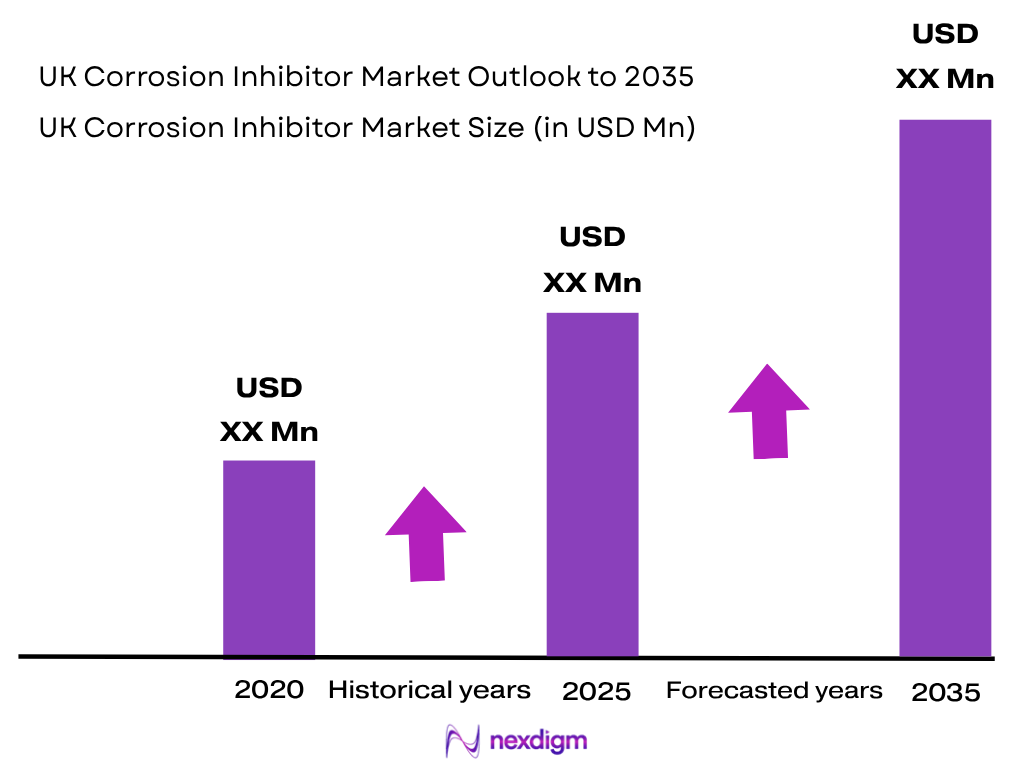
The UK Corrosion Inhibitor Market is valued at approximately USD ~X.X million, based on historical demand analysis, and is supported by offshore production chemistry, refining, industrial cooling water, boiler treatment and drinking-water corrosion control. UK refinery production moved from approximately 50.0 million tonnes to 50.8 million tonnes, while manufacturers’ product sales moved from GBP 466.7 billion to GBP 452.2 billion, sustaining a substantial installed base of corrosion-sensitive industrial equipment.
Scotland and the North Sea energy corridor, Teesside, Humber and the North West dominate the UK Corrosion Inhibitor Market because they concentrate offshore production infrastructure, pipelines, refineries and chemical-processing facilities. Refinery output moved from 50.0 million tonnes to 50.8 million tonnes, while UK Continental Shelf assets had cumulatively produced 47.7 billion boe and retained 2.9 billion boe of proven and probable reserves, sustaining specialised production-chemistry and industrial-treatment requirements.
Market Segmentation
By Chemistry Type
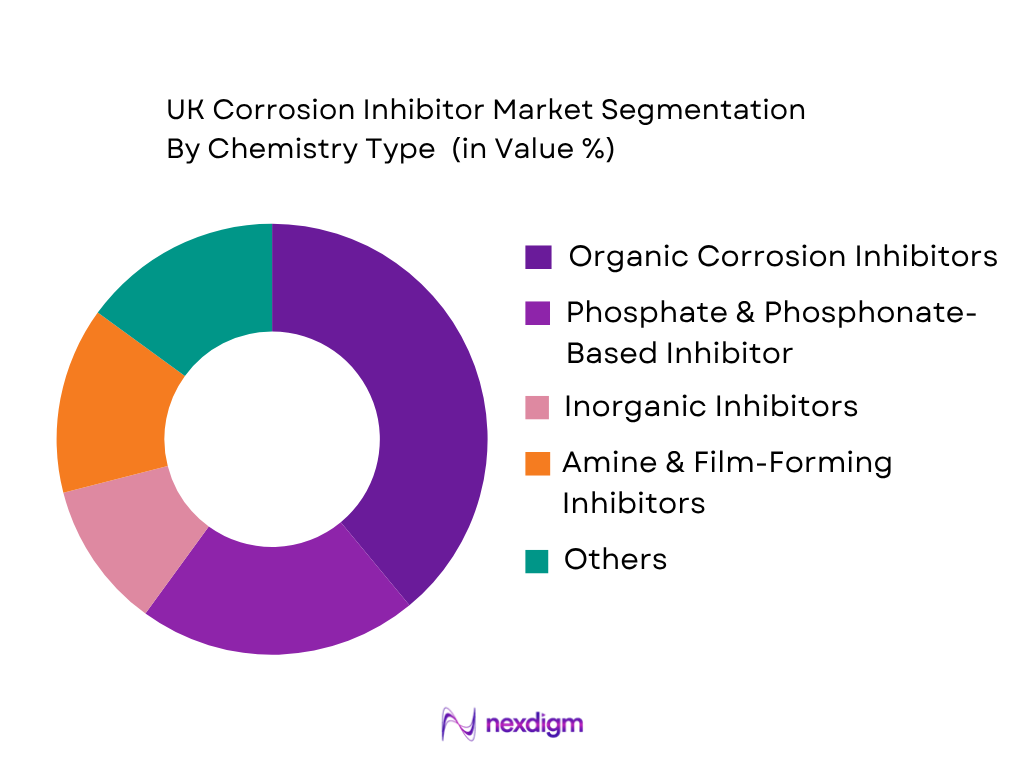
The UK Corrosion Inhibitor Market is segmented into organic inhibitors, phosphate and phosphonate inhibitors, amine and film-forming inhibitors, inorganic inhibitors, azoles and other specialty blends. Organic corrosion inhibitors hold the dominant position because they are extensively applicable across offshore oil and gas, refinery operations, industrial cooling systems and process equipment. Imidazolines, amines, carboxylates and other adsorptive organic chemistries can form protective films on carbon-steel surfaces exposed to water, carbon dioxide, hydrogen sulphide and chlorides. Their flexibility is particularly important in mature North Sea infrastructure, where treatment conditions can vary materially between producing wells, topsides equipment, subsea flowlines and produced-water systems. Organic chemistry is also increasingly incorporated into blended treatment programmes combining corrosion protection with scale, deposit and microbiological control. Phosphate and phosphonate formulations remain significant in industrial and drinking-water treatment, while film-forming amines are gaining relevance in boiler, steam and condensate systems. Drinking Water Inspectorate guidance additionally recognises orthophosphate, polyphosphate and silicate treatment for corrosion control in distribution systems.
By End-Use Industry
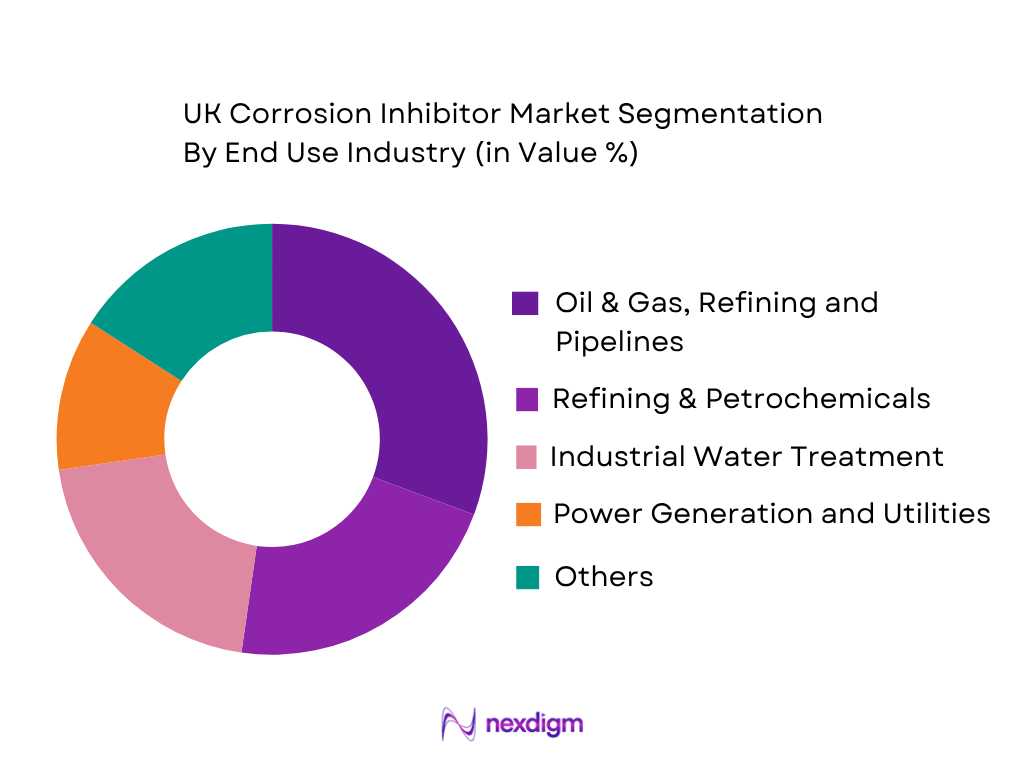
The UK Corrosion Inhibitor Market is segmented into offshore oil and gas, refining and chemicals, industrial water treatment, power generation, water utilities, HVAC and closed systems, metals and other industrial applications. Offshore oil and gas represents the leading end-use segment because the UK Continental Shelf contains a mature but technically demanding installed base of producing platforms, pipelines, subsea equipment, separators and produced-water systems. By the end of the latest reported period, UKCS fields had cumulatively produced 47.7 billion boe, with 2.9 billion boe of proven and probable reserves and another 6.2 billion boe of contingent resources. Mature production infrastructure typically requires intensive integrity management because water cut, chloride exposure and corrosive gases can become increasingly important as fields age. Refining and chemical production form the next major application group, supported by approximately 50.8 million tonnes of refinery output and a chemical-products manufacturing gross-value measure of GBP 11.824 billion. Industrial water, power and closed HVAC systems further diversify corrosion-inhibitor consumption.
Competitive Landscape
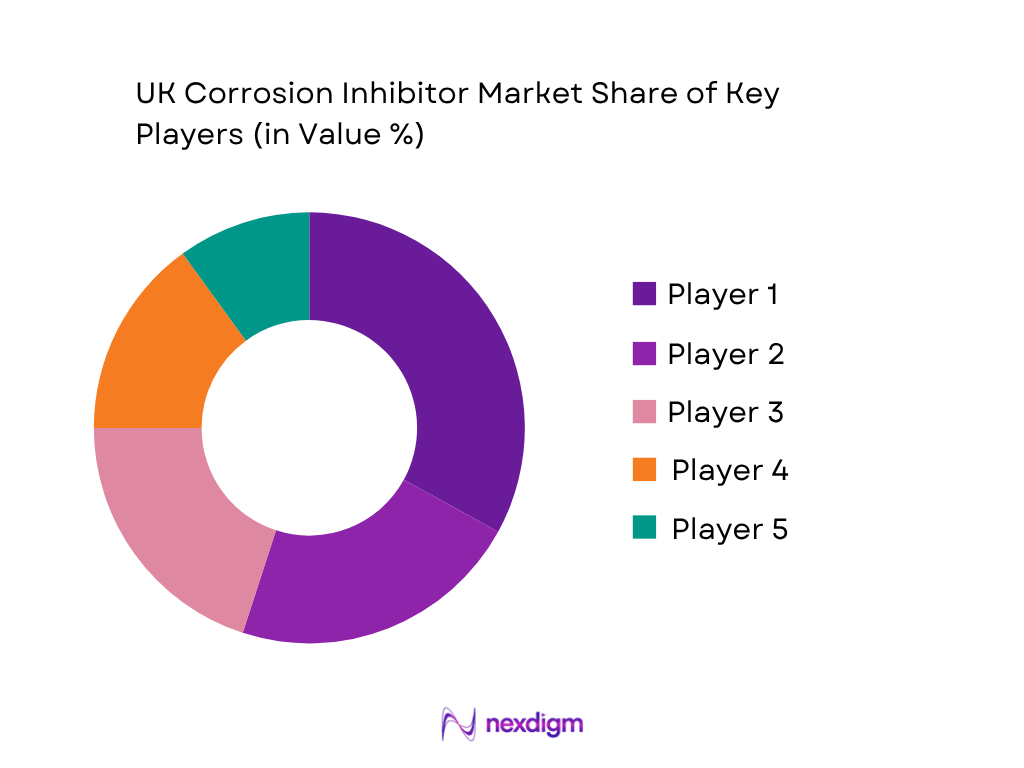
The UK Corrosion Inhibitor Market combines multinational industrial-water and production-chemistry suppliers with specialist domestic manufacturers. Large international companies compete through integrated chemistry portfolios, offshore technical expertise, laboratory services, digital monitoring and nationwide field support, while UK manufacturers compete through local formulation, flexible production, own-label supply and rapid technical response. Competition is particularly differentiated by North Sea environmental compliance, low-phosphorus chemistry, closed-system treatment capability and the ability to integrate chemical dosing with corrosion monitoring.
| Company | Establishment | Headquarters | Offshore Oilfield Capability | Cooling & Boiler Water | Refinery/Chemical Applications | Low-Phosphorus Chemistry | Digital Monitoring | UK Manufacturing/Technical Service |
| Nalco Water / Ecolab | 1928 heritage | St. Paul, USA | ~ | ~ | ~ | ~ | ~ | ~ |
| Kurita | 1949 | Tokyo, Japan | ~ | ~ | ~ | ~ | ~ | ~ |
| Solenis | 2014 | Wilmington, USA | ~ | ~ | ~ | ~ | ~ | ~ |
| Veolia Water Technologies & Solutions | 2017 formation | Trevose, USA | ~ | ~ | ~ | ~ | ~ | ~ |
| B & V Chemicals | 1978 | Daventry, UK | ~ | ~ | ~ | ~ | ~ | ~ |
UK Corrosion Inhibitor Market Analysis
Growth Drivers
North Sea Asset Integrity and Offshore Pipeline Corrosion-Control Requirements
The UK’s mature North Sea infrastructure creates recurring demand for corrosion inhibitors because ageing wells, topsides, subsea flowlines, produced-water systems and pipelines remain exposed to carbon dioxide, hydrogen sulphide, chloride-rich water and changing production-fluid chemistry. UK Continental Shelf production reached 401 million barrels of oil equivalent in 2024, while cumulative production reached 47.7 billion barrels of oil equivalent. At the end of the same period, the basin still contained 2.9 billion barrels of oil equivalent of proven and probable reserves, 6.2 billion barrels of oil equivalent of contingent resources and 4.6 billion barrels of oil equivalent of prospective resources. The continuing coexistence of remaining hydrocarbons with a very mature asset base makes integrity management essential even when overall production declines. Domestic crude-oil and natural-gas-liquid production amounted to 30.4 million tonnes in 2024, meaning substantial quantities continued to move through offshore gathering, separation, transportation and export infrastructure. Mature-field operations can require particularly intensive chemical management because rising water handling, saline fluids and extended equipment service periods place pressure on carbon-steel systems. Corrosion-inhibitor suppliers therefore address continuous injection at production facilities, batch treatment of pipelines, topsides process protection and produced-water circuits, while field operators require corrosion coupons, probes, residual inhibitor monitoring and compatibility testing with scale inhibitors and biocides. Refinery and downstream operations further reinforce this installed-base effect: UK refineries processed approximately 50.8 million tonnes of petroleum products in 2024, creating additional corrosion-control requirements across crude units, overhead systems, heat exchangers, utilities and storage infrastructure. The macroeconomic backdrop is also material: the United Kingdom generated USD 3.686 trillion of GDP in 2024, with GDP per capita of USD 53,246.4, supporting a capital-intensive industrial economy where maintaining existing energy assets and avoiding corrosion-related outages remains commercially important. These operating statistics establish North Sea asset integrity as a structural demand driver for higher-performance organic inhibitors, imidazoline-based chemistry, amine formulations and multifunctional production-chemical packages.
Refining, Industrial Water, Drinking-Water and Data-Centre Infrastructure Broadens Recurring Inhibitor Demand
UK corrosion-inhibitor demand is strengthened by a diversified industrial and water-treatment base extending well beyond offshore oil and gas. Domestic refineries produced 50.8 million tonnes of petroleum products in 2024, while total petroleum-product demand reached 60.6 million tonnes, sustaining corrosion-control requirements across crude processing, cooling towers, boilers, steam-condensate networks, heat exchangers and storage systems. Manufacturing provides another substantial installed base: UK manufacturers recorded product sales of GBP 452.2 billion in 2024, creating extensive requirements for industrial cooling, closed-loop water treatment and process-equipment protection across chemicals, food processing, engineering and other manufacturing operations. Water infrastructure adds a distinct corrosion-control application. In England, 13,394 drinking-water samples were analysed for lead in 2024, with 53 compliance sample failures; phosphate dosing remains an established treatment for reducing plumbosolvency and limiting lead release from legacy pipework. The wider water system is operationally large: English water companies abstracted 14,636 megalitres per day during 2024–2025, while the Environment Agency regulated approximately 20,500 abstraction and impounding licences capable of authorising about 45 billion cubic metres of annual abstraction. Cooling-intensive digital infrastructure is creating an additional demand pool. Great Britain had approximately 1.6 GW of colocation data-centre IT capacity in autumn 2024, including 1,048 MW in London, 154 MW in Wales, 128 MW in the South East and 52 MW in the North West. Official energy statistics subsequently identified 239 operational data centres consuming about 4.5 TWh of electricity in 2024, demonstrating a significant base of mission-critical facilities requiring chilled-water, condenser-water and closed-loop corrosion management. Combined with UK GDP of USD 3.686 trillion in 2024, these industrial, utility and digital assets create recurring demand for phosphonate, molybdate, azole, nitrite, carboxylate and film-forming inhibitor technologies. The breadth of applications reduces reliance on any single end-use sector and supports suppliers capable of engineering treatment programmes for different metals, water chemistries and operating temperatures.
Market Challenges
Declining North Sea Production Creates a Mature and Technically Difficult Demand Environment
The principal structural challenge for the UK corrosion-inhibitor market is that one of its most technically intensive end-use sectors is operating within a mature hydrocarbon basin. UK crude-oil and natural-gas-liquid production fell to 30.4 million tonnes in 2024, while total UK energy production stood at only 94.8 million tonnes of oil equivalent, reflecting the progressive depletion of the domestic resource base. UK Continental Shelf operators produced 401 million barrels of oil equivalent in 2024, but proven and probable reserves at year-end stood at 2.9 billion barrels of oil equivalent, which was 0.4 billion barrels of oil equivalent lower than the preceding year. Only a little under 50 million barrels of oil equivalent were added through approvals for two new field-development plans during 2024, while 90 million barrels of oil equivalent were removed from the reserve base through revisions unrelated to production. For corrosion-inhibitor suppliers, this environment creates conflicting pressures. Mature assets can require greater chemical intervention because water handling, chloride exposure, deposits and extended asset life increase corrosion-management complexity, but shrinking production volumes can constrain absolute chemical consumption at individual fields. Suppliers must therefore demonstrate treatment efficiency rather than depend solely on rising throughput. The changing crude slate also complicates refinery treatment: the UK imported 44.6 million tonnes of crude oil and natural-gas liquids in 2024, while domestic crude and NGL production was 30.4 million tonnes, meaning refineries and terminals handle streams with varying sulphur, salt and contaminant characteristics. This variability affects inhibitor choice in crude-unit overheads and associated water systems. Field programmes must additionally remain compatible with scale inhibitors, demulsifiers, biocides and oxygen-control chemicals, making laboratory qualification and field trials critical. With UK GDP at USD 3.686 trillion in 2024, operators manage economically important infrastructure but remain under pressure to extract maximum performance from mature assets. The result is a market where technical complexity can rise even while underlying hydrocarbon production contracts, increasing competition among suppliers for fewer but more demanding treatment programmes.
Chemical Regulation, Environmental Screening and Water-Discharge Controls Raise Formulation Barriers
UK corrosion-inhibitor suppliers operate within a demanding chemical and environmental compliance framework that increases product-development, documentation and customer-qualification requirements. Under UK REACH, any Great Britain-based entity manufacturing or importing a substance at 1 tonne or more per year may be required to register that substance, meaning formulators using imported amines, phosphonates, azoles, surfactants or specialty intermediates must actively manage regulatory status across their supply chains. Between the start of UK REACH and the end of 2024, the Health and Safety Executive received dossiers covering 82 registrations of novel substances and completed compliance checks on dossiers supporting 38 registrations; 6 checks concluded with decisions requesting further information, involving 36 individual information requests. This evidences the depth of scrutiny applied to new chemistry. Water-discharge regulation simultaneously raises pressure on phosphorus-bearing treatment programmes. In 2024, England formally designated the River Avon, Solent, and Teesmouth and Cleveland Coast as catchment permitting areas, requiring environmental-permit reviews for nutrient-significant discharges and allowing nutrient-related permit conditions to be imposed. Broader water-resource controls are also substantial: the Environment Agency regulates about 20,500 abstraction and impounding licences, with approximately 45 billion cubic metres potentially authorised annually; during 2024 it inspected 3,147 licences and recorded 1,047 non-compliances across 706 abstraction licences. These controls encourage industrial operators to reduce blowdown, optimise chemical dosage and limit nutrient discharge, but such changes can concentrate dissolved solids and increase corrosion-management difficulty in cooling systems. Offshore applications add another qualification layer because production chemicals are subject to environmental assessment and offshore chemical controls before use and discharge. Consequently, suppliers increasingly need low-phosphorus, phosphorus-free, biodegradable and lower-persistence formulations without sacrificing performance against carbon steel, copper alloys, aluminium and mixed metallurgy. The UK’s USD 3.686 trillion GDP in 2024 supports a sophisticated industrial base, but that same maturity produces stringent environmental expectations. Regulatory complexity therefore raises barriers to market entry, extends qualification cycles and increases the need for toxicological data, environmental testing, product stewardship and application-specific formulation work.
Market Opportunities
Carbon Capture, Hydrogen and Late-Life Offshore Infrastructure Create New High-Specification Corrosion Applications
The UK’s transition toward carbon-management and low-carbon energy infrastructure creates a future growth avenue for corrosion-inhibitor suppliers because emerging CO2 and hydrogen systems introduce demanding metallurgy, moisture and impurity-control requirements while existing North Sea infrastructure remains available for repurposing and connection. Current government-backed activity provides a concrete foundation for this opportunity. In October 2024, the UK committed GBP 21.7 billion over 25 years to support its initial carbon capture clusters, while the East Coast Cluster transport-and-storage network and Net Zero Teesside reached financial close in December 2024. The HyNet carbon-dioxide pipeline received development consent in March 2024, creating a new-build transportation system intended to carry captured CO2 from industrial and hydrogen-production facilities in North West England and North Wales toward offshore storage. Seven major UK industrial clusters account for a substantial concentration of industrial emissions, making shared CO2 transport and storage infrastructure strategically relevant to process-industry decarbonisation. Hydrogen provides an adjacent application. Government support confirmed 11 green-hydrogen projects under the first allocation round, representing about 125 MW of electrolytic production capacity, while 27 projects across England, Scotland and Wales were shortlisted under the second allocation round in 2025. These developments create future demand for inhibitors and materials-management programmes in hydrogen-production water systems, cooling circuits, compressor infrastructure and potentially associated transportation equipment. At the same time, existing North Sea resources remain extensive enough to sustain late-life integrity demand: 2.9 billion barrels of oil equivalent of proven and probable reserves, 6.2 billion barrels of oil equivalent of contingent resources and 4.6 billion barrels of oil equivalent of prospective resources remained at the end of 2024. This allows suppliers to address two overlapping opportunities: protecting mature oil and gas assets through their extended operating lives and developing chemistry for emerging CO2 and hydrogen infrastructure. The UK economy generated USD 3.686 trillion in GDP in 2024, providing an industrial platform capable of supporting specialist chemical engineering, laboratory qualification and field-service models. Growth potential therefore lies less in commodity inhibitor volumes and more in technically differentiated products for wet CO2 service, high-chloride systems, closed cooling circuits, mixed metallurgy and late-life offshore asset management.
Data Centres, Drinking-Water Optimisation and Water-Efficient Industrial Systems Expand Advanced Treatment Demand
Future growth in the UK corrosion-inhibitor market is also supported by expanding cooling-intensive digital infrastructure, continued drinking-water corrosion management and pressure to improve industrial water efficiency. Great Britain’s colocation data-centre estate had approximately 1.6 GW of IT capacity in autumn 2024, with 1,048 MW located in London, 154 MW in Wales, 128 MW in the South East, 53 MW in the South West, 52 MW in the North West and additional capacity across every major British region. More recent official analysis identified 239 operational data centres in 2024 consuming approximately 4.5 TWh of electricity, illustrating the scale of existing equipment requiring reliable chilled-water and heat-rejection systems. High-density computing places a premium on thermal reliability; corrosion in closed loops, heat exchangers, cooling towers or condenser-water systems can impair heat transfer and equipment availability, creating an attractive application for multi-metal carboxylate, molybdate, azole and phosphorus-free inhibitor programmes. Drinking-water infrastructure presents a second opportunity. England recorded 13,394 lead samples in 2024, including 53 compliance failures, while phosphate dosing remains a principal mechanism for reducing plumbosolvency and limiting lead release. One regulatory investigation in Wales recorded a consumer-tap result of 688 micrograms per litre before flushing and 20.21 micrograms per litre after flushing, compared with a 10 micrograms per litre lead standard, demonstrating the ongoing importance of controlled corrosion treatment in legacy networks. Water-resource pressure further supports more efficient industrial treatment. English water companies abstracted 14,636 megalitres per day during 2024–2025, and the Environment Agency’s Restoring Sustainable Abstraction programme had modified 372 licences, retaining approximately 58 billion litres of water per year in the environment. Industrial users seeking lower abstraction and blowdown must operate cooling systems at more demanding water chemistries, increasing the value of low-phosphorus, phosphorus-free and high-cycle corrosion-control programmes. These applications fit a UK economy generating USD 3.686 trillion of GDP in 2024 and increasingly reliant on digital services, critical water infrastructure and high-value manufacturing. The opportunity therefore extends across data-centre cooling, industrial water reuse, heat networks, closed HVAC systems and drinking-water treatment, favouring suppliers able to combine inhibitor chemistry with automated dosing, conductivity control, corrosion monitoring and site-specific water analysis.
Future Outlook
The UK Corrosion Inhibitor Market is forecast to grow at approximately ~X.X% CAGR during 2026-2035. Future growth will increasingly depend on specialty rather than commodity chemistry as customers focus on ageing-asset integrity, offshore environmental compliance, water efficiency and technically demanding closed-loop systems. North Sea late-life operations, carbon-management infrastructure, industrial water reuse and digital treatment optimisation are expected to provide the principal higher-value demand pools.
Major Players
- Nalco Water / Ecolab
- Kurita UK
- Solenis UK
- Veolia Water Technologies UK
- SLB / ChampionX Production Chemicals
- Baker Hughes
- Clariant Oil Services
- Innospec
- Italmatch Chemicals
- Dorf Ketal
- B & V Chemicals
- Accepta
- Feedwater
- Hydrus
- Chemiphase
Key Target Audience
- Corrosion Inhibitor and Specialty Chemical Manufacturers
- Offshore Oilfield Production Chemical Suppliers
- Industrial Water-Treatment Chemical Companies
- Oil & Gas, Refinery and Chemical Process Operators
- Water Utilities, Power Producers and Industrial Facility Operators
- Investments and Venture Capitalist Firms
- Private Equity Firms and Strategic Chemical Investors
- Government and Regulatory Bodies (Health and Safety Executive, Environment Agency, Offshore Petroleum Regulator for Environment and Decommissioning, Drinking Water Inspectorate, Scottish Environment Protection Agency, Natural Resources Wales)
Research Methodology
Step 1: Identification of Key Variables
The initial phase constructs an ecosystem map covering all major participants in the UK Corrosion Inhibitor Market, including active-ingredient suppliers, formulators, oilfield chemical companies, industrial-water specialists, distributors and end users. Critical variables include offshore production exposure, refinery activity, cooling and boiler systems, water chemistry, corrosion mechanisms, inhibitor dosage, environmental qualification, domestic formulation and regional industrial concentration.
Step 2: Market Analysis and Construction
Historical demand is constructed through top-down and bottom-up approaches. Top-down assessment evaluates inhibitor intensity across offshore oil and gas, refining, industrial water, power, utilities, HVAC and chemical manufacturing, while bottom-up analysis examines supplier revenues, formulated-product volumes, treatment programmes, domestic manufacturing, imports, distribution coverage and recurring chemical consumption.
Step 3: Hypothesis Validation and Expert Consultation
Market hypotheses are validated through CATI discussions with corrosion engineers, offshore production-chemistry specialists, water-treatment professionals, refinery personnel, formulation companies, utility operators and industrial procurement teams. These consultations test chemistry selection, treatment rates, field-service requirements, customer switching barriers, offshore environmental requirements and the relative importance of technical support versus chemical-product supply.
Step 4: Research Synthesis and Final Output
Primary findings are triangulated with DESNZ energy statistics, North Sea Transition Authority information, Drinking Water Inspectorate guidance, Office for National Statistics data, company disclosures and UK regulatory requirements. Supply-side and demand-side estimates are reconciled to establish market segmentation, competitive structure, application demand, domestic manufacturing capability and future opportunity areas in the UK Corrosion Inhibitor Market.

- Executive Summary
- Research Methodology (Market Definition and Scope, Corrosion Inhibitor Chemistry Classification, North Sea Production Chemical Consumption Mapping, Refinery Process Chemical Assessment, Offshore Pipeline Treatment Assessment, Industrial Cooling-Water Treatment Assessment, Boiler and Condensate Treatment Assessment, Drinking-Water Corrosion-Control Assessment, Closed-System Inhibitor Consumption Mapping, Power Generation Water-Chemistry Assessment, Chemical and Process Industry Assessment, Metalworking Fluid Additive Assessment, Corrosion Rate and Treatment Dosage Mapping, Top-Down End-Use Demand Analysis, Bottom-Up Supplier Revenue Assessment, Domestic Formulation and Toll-Blending Assessment, Import-Export Assessment, Primary Industry Interviews, Technical Expert Validation, Data Triangulation, Forecasting Framework)

- Definition and Scope
- UK Corrosion Inhibitor Industry Evolution
- UK Corrosion Inhibitor Value Chain Analysis
- UK Corrosion Inhibitor Supply Chain Analysis
- Domestic Manufacturing versus Imported Specialty Chemistry Structure

- Growth Drivers (North Sea Asset Integrity Requirements, Extensive Offshore Pipeline and Flowline Infrastructure, Refinery Process Corrosion Control, Industrial Cooling-Water Installed Base, Boiler and Steam-System Protection, Drinking-Water Plumbosolvency Control, Closed Heating and Cooling System Treatment, Chemical Manufacturing Activity, Power Plant Water Chemistry, Offshore Asset-Life Extension, Data-Centre Cooling Expansion, Heat-Network Development, Industrial Water-Reuse Requirements)
- Market Challenges (Declining Mature North Sea Production Base, Offshore Chemical Qualification Requirements, High-Chloride and Sour-Fluid Corrosion, Complex Multi-Metallurgy Systems, Chemical Compatibility with Scale Inhibitors and Biocides, UK REACH Compliance, Offshore Chemical Environmental Screening, Wastewater Discharge Restrictions, Phosphorus-Control Requirements, Raw-Material Import Dependence, Customer Qualification Cycles, Treatment Overfeed and Underfeed Risk, Commodity Water-Treatment Price Competition, Persistent-Chemistry Environmental Scrutiny)
- Market Opportunities (Low-Phosphorus Cooling-Water Inhibitors, Phosphorus-Free Closed-System Treatments, North Sea Late-Life Asset Corrosion Programs, Offshore Decommissioning Corrosion Management, Carbon Capture and Storage Pipeline Corrosion Control, Hydrogen Infrastructure Corrosion Protection, Film-Forming Boiler Chemistry, Drinking-Water Orthophosphate Optimisation, Data-Centre Cooling-Water Treatment, Heat-Network Corrosion Control, Multi-Metal HVAC Inhibitors, Digital Chemical Dosing, High-Cycles-of-Concentration Cooling Programs, Biodegradable Offshore Corrosion Inhibitors, Domestic Toll-Blending and Specialty Formulation)
- Market Trends (Phosphorus-Reduced Water-Treatment Chemistry, Multi-Metal Closed-System Inhibitors, Film-Forming Amine Adoption, OSPAR-Compatible Offshore Chemistry, Automated Chemical Dosing, Online Corrosion Monitoring, Corrosion Coupon and Probe Integration, Digital Water-Treatment Analytics, High-Efficiency Closed-System Treatment, Water-Reuse Chemistry, Combination Scale-Corrosion Programs, Environmentally Preferable Offshore Chemicals, Solid Water-Treatment Products, Local Toll Blending, Formulation Customisation)
- Government Regulations and Standards (UK REACH, HSE Chemical Registration and Authorisation Requirements, Offshore Chemicals Regulations, OSPAR Harmonised Mandatory Control System, HOCNF Offshore Chemical Notification Requirements, Environment Agency Environmental Permitting, Water Discharge Requirements, Drinking Water Inspectorate Regulation 31 Approval, Scotland and Northern Ireland Drinking-Water Product Requirements, COSHH Requirements, Biocidal Products Regulation Interface, BS EN Drinking-Water Treatment Chemical Standards)
- SWOT Analysis
- Porter’s Five Forces Analysis
- PESTLE Analysis
- Stakeholder Ecosystem
- Competition Ecosystem

- By Market Value (2020-2025)
- By Consumption Volume (2020-2025)
- By Active Ingredient Volume (2020-2025)
- By Formulated Product Volume (2020-2025)
- By Domestic Production (2020-2025)
- By Import Value (2020-2025)

- By Chemistry Type (In Value %)
Organic Corrosion Inhibitors
Inorganic Corrosion Inhibitors
Phosphate-Based Inhibitors
Phosphonate-Based Inhibitors
Molybdate-Based Inhibitors
Silicate-Based Inhibitors
Nitrite-Based Inhibitors
Azole-Based Copper Corrosion Inhibitors
Amine-Based Inhibitors
Imidazoline-Based Inhibitors
Quaternary Ammonium-Based Inhibitors
Carboxylate-Based Inhibitors
Film-Forming Amines
Tannin-Based Inhibitors
Multi-Metal Inhibitor Packages
Low-Phosphorus and Phosphorus-Free Inhibitors - By Product Form (In Value %)
Water-Soluble Liquid Inhibitors
Oil-Soluble Liquid Inhibitors
Water-Dispersible Inhibitors
Concentrated Liquid Blends
Powder and Solid Inhibitors
Emulsion-Based Products
Volatile Corrosion Inhibitors
Combination Scale and Corrosion Inhibitors
Multi-Functional Water-Treatment Packages - By Corrosion Mechanism (In Value %)
Carbon Dioxide Corrosion
Hydrogen Sulphide Corrosion
Oxygen Corrosion
Chloride-Induced Corrosion
Acid Corrosion
Galvanic Corrosion
Under-Deposit Corrosion
Top-of-Line Corrosion
Condensate Corrosion
Pitting Corrosion
Microbiologically Influenced Corrosion
Multi-Metal Corrosion - By Application System (In Value %)
Offshore Production Systems
Subsea Flowlines and Pipelines
Oil and Gas Processing Systems
Refinery Process Units
Open Recirculating Cooling Towers
Closed Cooling-Water Systems
Industrial Boilers
Steam and Condensate Systems
Closed Heating Systems
Closed Chilled-Water Systems
Drinking-Water Distribution Systems
Metalworking Fluids
Heat Networks
District Energy Systems - By End-Use Industry (In Value %)
Offshore Oil and Gas
Midstream Pipelines and Terminals
Petroleum Refining
Petrochemicals and Chemicals
Industrial Water Treatment
Power Generation
Water Utilities
Building Services and HVAC
Iron and Steel
Pulp and Paper
Food and Beverage Processing
Pharmaceutical Manufacturing
Automotive and Metalworking
Data Centres
Marine and Shipbuilding
General Manufacturing - By Treatment Mode (In Value %)
Continuous Chemical Injection
Batch Treatment
Intermittent Treatment
Subsea Chemical Injection
Pipeline Injection
Cooling-Tower Dosing
Boiler Feedwater Dosing
Condensate Treatment
Closed-Loop Treatment
Drinking-Water Phosphate Dosing
Volatile-Phase Protection
Surface Film Treatment

- Market Share of Major Players (By UK Revenue, Consumption Volume, Chemistry Type, Offshore Oil and Gas Segment, Industrial Water-Treatment Segment, Refinery Segment, Drinking-Water Segment, Regional Coverage)
- Cross Comparison Parameters (UK Corrosion Inhibitor Revenue, Offshore Oilfield-Cooling Water-Boiler-Refinery Portfolio Breadth, CO2-H2S-High-Chloride and Multi-Metallurgy Chemistry Capability, North Sea-Refinery-Industrial Water and Major Utility Customer Exposure, UK Manufacturing Formulation and Toll-Blending Capability, Low-Phosphorus Phosphorus-Free and OSPAR-Compatible Chemistry Capability, Digital Chemical Injection Corrosion Monitoring and Automated Dosing Capability, UK Laboratory Distribution and Field Technical Support Footprint)
- SWOT Analysis of Major Companies
- Detailed Profiles of Major Companies
Nalco Water / Ecolab
Kurita UK
Solenis UK
Veolia Water Technologies UK
SLB / ChampionX Production Chemicals
Baker Hughes
Clariant Oil Services
Innospec
Italmatch Chemicals
Dorf Ketal
B & V Chemicals
Accepta
Feedwater
Hydrus
Chemiphase

- North Sea Operator Production-Chemistry Procurement Assessment
- Offshore Pipeline Operator Corrosion-Control Assessment
- Refinery Process-Chemical Procurement Assessment
- Chemical and Petrochemical Plant Treatment Assessment
- Industrial Cooling-Water Customer Assessment
- Boiler and Steam-System Treatment Assessment

- By Market Value (2026-2035)
- By Consumption Volume (2026-2035)
- By Active Ingredient Volume (2026-2035)
- By Formulated Product Volume (2026-2035)
- By Domestic Production (2026-2035)
- By Import Value (2026-2035)


 Request a Sample
 Ask for Customization
 Get a Quote
 Enquire Now