

 Download PDF
Market Overview
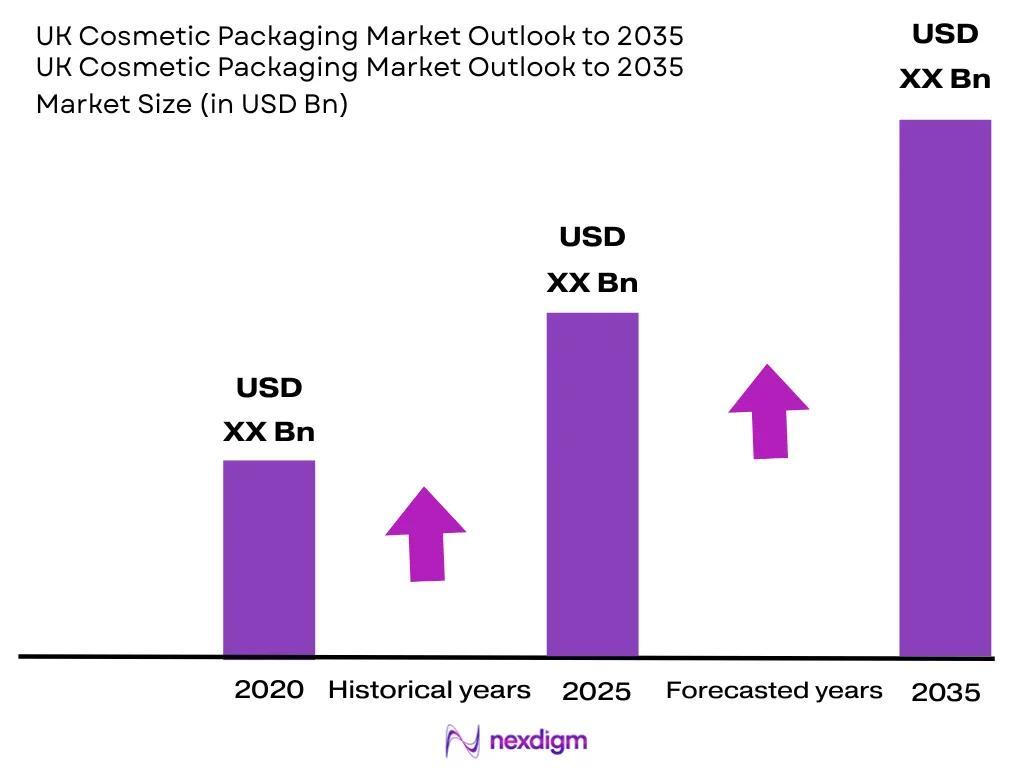
The UK Cosmetic Packaging Market was valued at USD ~ Billion in 2024 and is anticipated to expand at a CAGR of ~% during 2026–2035. The market is primarily driven by an increasingly stringent regulatory environment governing packaging sustainability, rising consumer demand for refillable and recyclable beauty packaging, and continued growth of premium, indie, and direct-to-consumer beauty brands across the UK. The wider UK sustainable packaging market, of which cosmetic packaging forms a significant and fast-growing part, reached USD ~ billion in 2025 and is projected to reach USD ~ billion by 2034, growing at a CAGR of 6.96%, driven by government regulatory measures on plastic use, rising consumer demand for environmentally friendly packaging, and ongoing developments in biodegradable and compostable materials. With the UK generating more than 2 million tonnes of plastic packaging waste annually, and with the Producer Responsibility Obligations (Packaging and Packaging Waste) Regulations 2024 having entered into force on January 1, 2025, cosmetic brands and their packaging suppliers are under sustained pressure to redesign packaging toward more recyclable, reusable, and lower-carbon formats.
Market Segmentation
By Sustainability Type
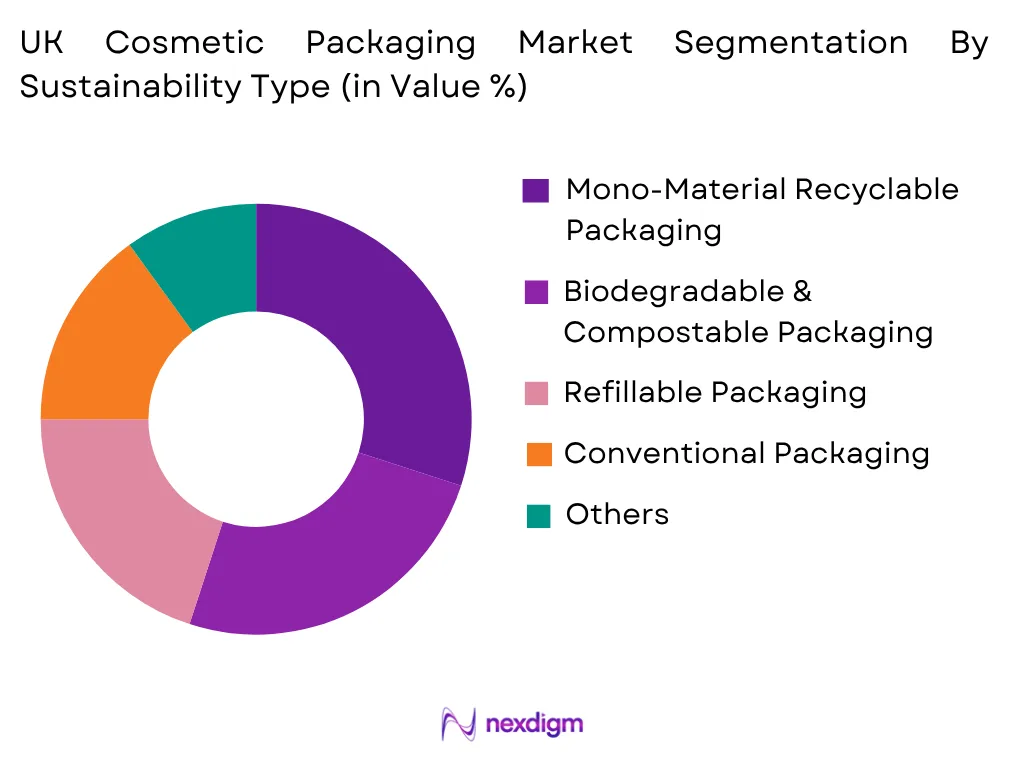
Mono-Material Recyclable Packaging represents the fastest-growing sustainability category within the UK Cosmetic Packaging Market, as brands increasingly adopt packaging made from a single recyclable material, typically PP or PE, to simplify sorting and improve genuine end-of-life recyclability. Refillable Packaging is also gaining significant traction, with cosmetic and cleaning brands increasingly offering refill packs or bottle-return models as part of broader circular design systems; this shift is reinforced by the UK’s Plastic Packaging Tax, which applies to packaging containing less than 30% recycled content and has pushed brands toward higher recycled-content formats since its introduction in April 2022. Biodegradable & Compostable Packaging remains a smaller, innovation-focused category, while Conventional Packaging continues to represent a meaningful share of the market, particularly in mass-market and value-tier cosmetic segments where cost sensitivity limits near-term adoption of premium sustainable alternatives.
By Product Category
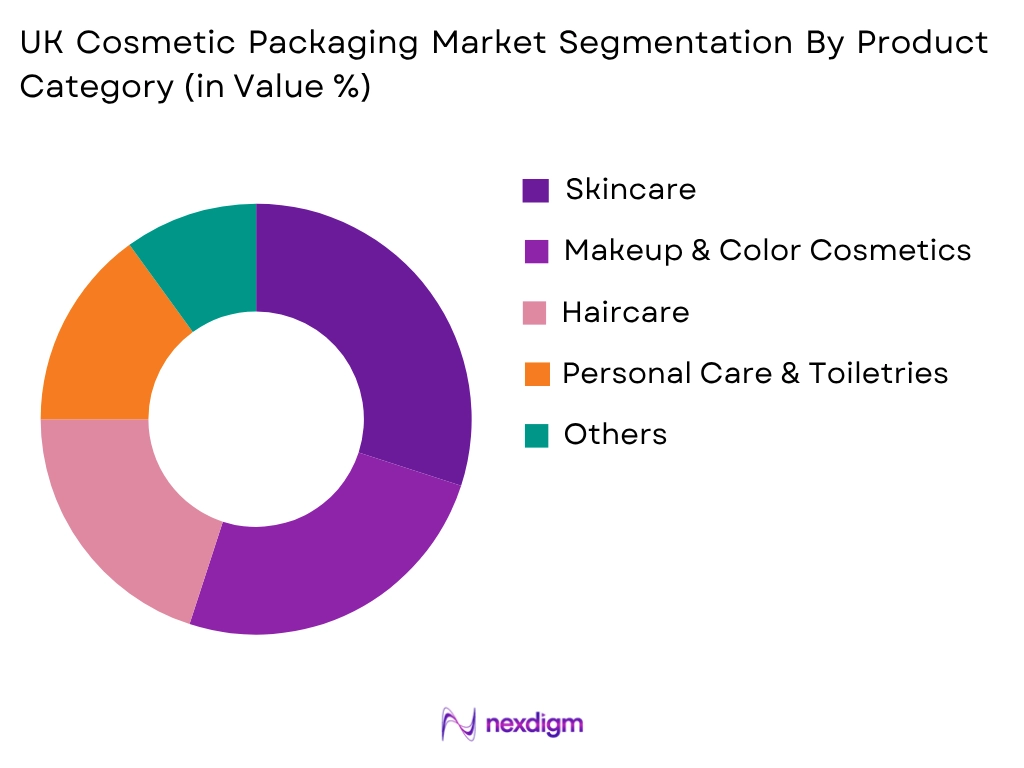
Skincare represents the largest product category within the UK Cosmetic Packaging Market, reflecting the scale and continued premiumization of the UK skincare sector and its correspondingly sophisticated packaging requirements spanning airless pumps, dropper bottles, and refillable jars. Makeup & Color Cosmetics and Haircare also contribute substantial demand, with UK manufacturers such as Herrco Cosmetics, which formulates and packages products across skincare, haircare, and personal care categories for luxury, masstige, and indie beauty brands, illustrating the breadth of packaging formats required across the country’s diverse beauty manufacturing base. Fragrances represent a smaller but high-value category in which packaging aesthetics and material quality carry particular commercial importance, supporting continued demand for glass and premium metal components even as the broader market shifts toward lighter-weight, more recyclable formats.
Competitive Landscape
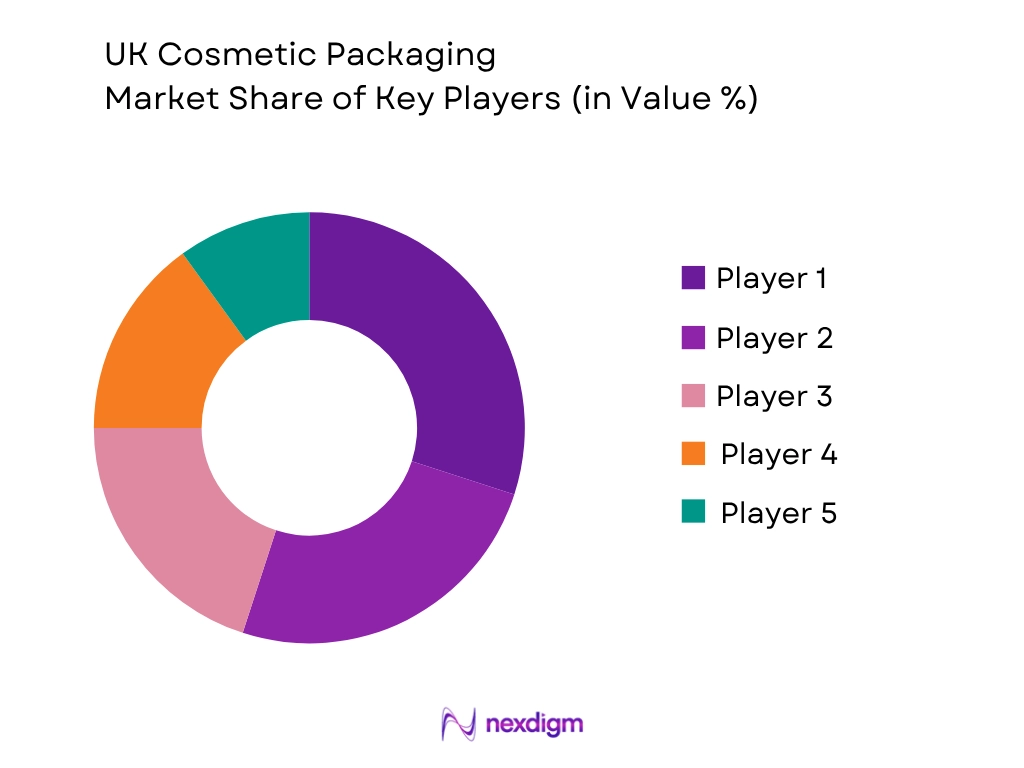
The UK Cosmetic Packaging Market is fragmented, comprising specialized domestic manufacturers, contract beauty producers with integrated packaging capability, and global packaging majors serving UK brands through regional manufacturing and distribution networks. Herrco Cosmetics, founded in 1988 and based in Halesworth, Suffolk, has grown from a small family business into a full-service UK beauty and personal care manufacturer with annual turnover of approximately £32 million, partnering with 78 brands and sourcing packaging through an extensive UK and international supplier network. Global dispensing technology leader AptarGroup and diversified packaging major Berry Global, which retains substantial UK manufacturing capacity built on the legacy of British Polythene Industries, serve UK cosmetic brands with pumps, closures, and rigid and flexible packaging components at scale. Prestige packaging specialists such as HCP Packaging and Quadpack, both of which maintain design and distribution operations serving the UK luxury beauty segment, compete alongside domestic converters including DCC Health & Beauty Solutions and Globe Print n Pack. Competitive dynamics are increasingly shaped by the ability to deliver mono-material, PCR-content, and refillable packaging solutions that satisfy both the UK’s Plastic Packaging Tax and its evolving Extended Producer Responsibility framework.
| Company | Establishment Year | Headquarters | Primary Product Portfolio | Cosmetic Packaging Portfolio
|
Manufacturing Presence | Major End-Use Industries | Key Strategic Focus | Certifications & Compliance |
| Herrco Cosmetics | 1988 | ~ | ~ | ~ | ~ | ~ | ~ | ~ |
| AptarGroup | 1992 | ~ | ~ | ~ | ~ | ~ | ~ | ~ |
| Berry Global | 1967 | ~ | ~ | ~ | ~ | ~ | ~ | ~ |
| HCP Packaging | 1993 | ~ | ~ | ~ | ~ | ~ | ~ | ~ |
| Quadpack | 1920 | ~ | ~ | ~ | ~ | ~ | ~ | ~ |
UK Cosmetic Packaging Market Analysis
Growth Drivers
Regulatory-Driven Shift Toward Recyclable and PCR Packaging
The UK Cosmetic Packaging Market is being reshaped by an increasingly stringent packaging regulatory framework. The UK Plastic Packaging Tax, in effect since April 2022, applies to packaging containing less than 30% recycled content, directly incentivizing cosmetic brands and their converters to increase post-consumer recycled content across bottles, tubes, and closures. This has been reinforced by the Producer Responsibility Obligations (Packaging and Packaging Waste) Regulations 2024, which entered into force on January 1, 2025 and require organizations with annual turnover of £1 million or more to register, report detailed packaging data, and pay fees calculated under an eco-modulated structure that rewards more recyclable or reusable packaging design. With mandatory, harmonized recyclability labelling also planned as part of the broader Extended Producer Responsibility framework, cosmetic brands operating in the UK face sustained regulatory pressure to redesign packaging toward mono-material and higher-recycled-content formats over the coming decade.
Rising Demand for Refillable and Sustainable Premium Packaging
Consumer demand for environmentally responsible beauty packaging continues to accelerate across the UK market, with refillable packaging systems increasingly offered by cosmetic and cleaning brands as part of broader circular design strategies. The UK’s wider sustainable packaging market, valued at USD 10.4 billion in 2025 and projected to grow at a CAGR of 6.96% to reach USD 19.5 billion by 2034, reflects heightened consumer and brand-owner awareness of environmental degradation and carbon footprint reduction, alongside continued innovation in biodegradable and compostable materials. UK cosmetic manufacturers such as Herrco Cosmetics, which has grown its turnover from roughly £1 million to approximately £32 million while partnering with 78 brands, illustrate the scale of growth within the UK’s indie and masstige beauty manufacturing base, a segment increasingly reliant on differentiated, premium, and sustainability-forward packaging to compete for shelf space and online visibility.
Market Challenges
Complex Multi-Layered Regulatory Compliance Burden
Cosmetic brands and packaging suppliers operating in the UK must navigate an increasingly complex, multi-layered regulatory landscape spanning the Plastic Packaging Tax, the Extended Producer Responsibility framework’s data reporting and fee obligations, UKCA marking requirements, and UK-specific cosmetic product notification through the Submit Cosmetic Product Notifications (SCPN) portal. Since Brexit, the UK has operated its own cosmetic regulatory framework separate from the EU, requiring a UK-based Responsible Person distinct from any EU-based equivalent, creating additional compliance complexity and cost for brands seeking to sell across both UK and EU markets simultaneously. For smaller indie and DTC beauty brands in particular, keeping pace with this evolving compliance landscape, layered on top of core product safety regulations such as the Cosmetic Products (Restriction of Chemical Substances) Regulations, represents a material and growing operational burden.
High Cost Premium of Sustainable Material Alternatives
Post-consumer recycled content, mono-material recyclable structures, and biodegradable or compostable packaging alternatives generally carry a meaningful cost premium over conventional virgin plastic packaging, creating financial pressure for brands seeking to comply with tightening regulatory and consumer expectations without eroding margins. This cost premium is particularly challenging for smaller indie and DTC beauty brands that lack the purchasing scale of larger mass-market or prestige beauty houses to negotiate favorable pricing on sustainable packaging materials. Compounding this challenge, UK regulators have intensified scrutiny of greenwashing claims, requiring brands to avoid vague or misleading environmental marketing and instead substantiate specific, evidence-backed claims such as precise recycled content percentages, adding further compliance cost and legal risk to sustainability-focused packaging investment.
Market Opportunities
Growth in Refill and Reuse Business Models
The accelerating adoption of refillable packaging systems and bottle-return models by UK cosmetic and cleaning brands represents a substantial growth opportunity for packaging manufacturers capable of designing durable, reusable primary packaging alongside lower-cost refill formats. As UK brands increasingly build refill and reuse systems into their core sustainability strategies, packaging suppliers that can offer robust, aesthetically premium refillable dispensing systems, particularly for the skincare and fragrance categories where packaging quality carries outsized brand significance, are well positioned to capture growing demand from both prestige and indie beauty brands seeking to differentiate through circular packaging models.
Innovation in Mono-Material and Digital Watermarking Recyclability Technology
Growing regulatory and retailer pressure to improve genuine end-of-life recyclability is creating strong demand for mono-material packaging structures, which use single recyclable resins such as 100% PP or PE to simplify sorting and enable easier recycling, and for emerging technologies such as digital watermarking, which embeds invisible barcodes into packaging to aid smart sorting at recycling facilities. UK packaging technology developers and converters that can commercialize these recyclability-enhancing innovations at competitive cost stand to capture significant share of the market as eco-modulated Extended Producer Responsibility fees increasingly reward packaging design that performs well within the UK’s evolving recycling infrastructure, creating a direct commercial incentive for continued investment in recyclability-focused packaging technology.
Future Outlook
The UK Cosmetic Packaging Market is expected to witness sustained expansion over the forecast period, supported by continued tightening of the UK’s packaging regulatory framework through the Extended Producer Responsibility scheme and Plastic Packaging Tax, rising consumer and brand-owner demand for refillable and recyclable packaging, and continued growth of the UK’s premium, indie, and DTC beauty manufacturing base. Growing investment in mono-material recyclable structures, post-consumer recycled content, and digital watermarking technology will further accelerate demand for next-generation cosmetic packaging solutions. The market is also likely to benefit from the UK’s position as a globally influential beauty and packaging innovation hub, as domestic manufacturers and global packaging majors operating in the UK develop sustainable packaging solutions that shape broader industry practice across European and international beauty markets.
Major Players
- Herrco Cosmetics
- AptarGroup
- Berry Global
- HCP Packaging
- Quadpack
- DCC Health & Beauty Solutions
- Lumson
- Virospack
- Berlin Packaging UK
- Globe Print n Pack
- Amcor plc
- Sonoco Products Company
- Albea Group
- Silgan Holdings
- RPC Group (Berry Global)
Key Target Audience
- Cosmetic Packaging Manufacturers and Converters
- Mass Market and Prestige Beauty Brands
- Indie and Direct-to-Consumer Beauty Brands
- Contract Beauty Manufacturers and Private Label Producers
- Spa and Professional Beauty Product Companies
- Investment and Venture Capitalist Firms
- Government and Regulatory Bodies (Office for Product Safety and Standards, Environment Agency, Department for Environment, Food & Rural Affairs – Defra)
- Raw Material Suppliers and Packaging Material Distributors
Research Methodology
Step 1: Identification of Key Variables
The research process begins with identifying the complete ecosystem of the UK Cosmetic Packaging Market, including raw material suppliers, packaging converters, contract beauty manufacturers, brand owners, retailers, and regulatory authorities. Extensive secondary research is conducted using company reports, government publications, trade associations, customs statistics, industry journals, and proprietary databases to determine the variables influencing market demand, pricing, production, consumption, and technological developments.
Step 2: Market Analysis and Construction
Historical market information is collected and analyzed to estimate market size, import volumes, product-wise demand, and pricing trends. A combination of top-down and bottom-up approaches is used to estimate market revenues and validate segment-level performance. Consumption patterns across skincare, haircare, makeup, fragrance, and personal care categories are evaluated to establish an accurate representation of the industry.
Step 3: Hypothesis Validation and Expert Consultation
The preliminary findings are validated through Computer-Assisted Telephone Interviews (CATIs) and structured discussions with packaging converters, procurement managers, sustainability officers, regulatory experts, and senior executives operating within the UK beauty and packaging industry. These interviews help verify market assumptions, competitive developments, technology adoption trends, pricing dynamics, and future investment opportunities while refining the overall market estimates.
Step 4: Research Synthesis and Final Output
The final stage integrates insights obtained from primary interviews with quantitative information collected through secondary sources. Data triangulation techniques are applied to reconcile differences between supply-side and demand-side estimates, ensuring robust market forecasting. The report is then reviewed through multiple quality assurance checkpoints to deliver a comprehensive analysis covering market size, segmentation, competitive landscape, future outlook, and strategic recommendations for industry stakeholders.

- Executive Summary
- Research Methodology (Market Definitions and Assumptions, Abbreviations, Market Sizing Approach, Top-Down Analysis, Bottom-Up Analysis, Demand-Side Assessment, Supply-Side Assessment, Primary Industry Interviews, Secondary Research Validation, Data Triangulation, Forecasting Framework, Limitations and Future Conclusions)

- Definition and Scope
- Market Evolution and Industry Genesis
- Timeline of Major Industry Developments
- Cosmetic Packaging Industry Value Chain Analysis
- Supply Chain Analysis

- Growth Drivers (Regulatory-Driven Shift Toward Recyclable and PCR Packaging, Rising Demand for Refillable and Sustainable Packaging, Growth of Indie and DTC Beauty Brands, Premiumization of Skincare and Fragrance Packaging, Expansion of Online Beauty Retail, Advances in Mono-Material Recyclable Design)
- Market Challenges (Complex Multi-Layered Regulatory Compliance, High Cost Premium of Sustainable Material Alternatives, Post-Brexit UK-EU Regulatory Divergence, Greenwashing Enforcement Risk, Raw Material and Energy Cost Volatility, Supply Chain Disruption for Imported Components)
- Market Opportunities (Growth in Refill and Reuse Business Models, Innovation in Mono-Material and Digital Watermarking Recyclability Technology, PCR Content Scale-Up, Premium Sustainable Packaging for Luxury Brands, Smart Packaging and Digital Consumer Engagement, Export Growth to EU and Global Beauty Markets)
- Market Trends (Rise of Refillable Packaging Systems, Mono-Material Packaging Adoption, Digital Watermarking for Smart Sorting, Minimalist and Flat-Pack Design, Biodegradable and Compostable Material Innovation, Growing Use of QR Code Consumer Transparency Features)
- Government Regulations (UK Plastic Packaging Tax, Extended Producer Responsibility (pEPR) for Packaging, UKCA Marking Requirements, UK Cosmetic Products Regulations, Mandatory Recyclability Labelling, Responsible Person (RP) Requirements)
- Import and Export Analysis (Trade Volume, Major Import Sources, Export Destinations, HS Code Analysis, Trade Balance)
- Raw Material Availability Analysis (Domestic and Imported Plastic Resin Feedstocks, Glass Manufacturing Capacity, Aluminum and Metal Feedstocks, Post-Consumer Recycled Content Availability, Bioplastic and Compostable Material Feedstocks)
- Technology Landscape (Injection Molding and Blow Molding Technology, Airless and Refillable Dispensing Systems, Digital Watermarking and Smart Sorting Technology, Mono-Material Structure Design, Barrier Coating Innovation)
- Sustainability Assessment (Recyclable and Mono-Material Packaging Adoption, Post-Consumer Recycled Content Integration, Carbon Footprint Reduction, Refill and Reuse System Development, Circular Economy Alignment)
- PESTLE Analysis
- SWOT Analysis
- Porter’s Five Forces Analysis
- Stakeholder Ecosystem
- Competition Ecosystem

- By Market Value (2020-2025)
- By Volume Consumption (2020-2025)
- By Average Selling Price (2020-2025)

- By Material (In Value %)
Plastic (PP, PE, PET)
Glass
Aluminum & Metal
Paperboard & Paper
Bioplastics & PCR (Post-Consumer Recycled) Content - By Packaging Type (In Value %)
Bottles & Jars
Tubes
Compacts & Palettes
Sachets & Pouches
Caps, Closures & Dispensers - By Product Category (In Value %)
Skincare
Haircare
Makeup & Color Cosmetics
Fragrances
Personal Care & Toiletries - By Sustainability Type (In Value %)
Refillable Packaging
Mono-Material Recyclable Packaging
Biodegradable & Compostable Packaging
Conventional Packaging - By Region (In Value %)
England
Scotland
Wales
Northern Ireland

- Market Share of Major Players (By Value, Volume, Material Type, Product Category, End User)
- Cross Comparison Parameters (Sustainable/Recyclable Portfolio Breadth, Refillable System Capability, Dispensing Technology Portfolio, Application Technical Support, Manufacturing Capacity, Regulatory Compliance & Certifications, Customer Base, Innovation & New Product Launch Frequency)
- SWOT Analysis of Major Players
- Pricing Analysis by Product Category and SKU
- Production Capacity Analysis
- Manufacturing Footprint Analysis
- Distribution Network Analysis
- Innovation Benchmarking
- Detailed Profiles of Major Companies
Herrco Cosmetics
AptarGroup
Berry Global
HCP Packaging
Quadpack
DCC Health & Beauty Solutions
Lumson
Virospack
Berlin Packaging UK
Globe Print n Pack
Amcor plc
Sonoco Products Company
Albea Group
Silgan Holdings
RPC Group (Berry Global)

- Consumption Pattern Analysis (Industrial Usage, Batch Size, Product Category Penetration, Seasonal Demand, Reformulation Activity)
- Purchasing Criteria (Recyclability, Regulatory Compliance, Cost Efficiency, Brand Aesthetic Fit, Barrier Performance, Refillability)
- Procurement and Supplier Selection Analysis
- Sustainable and Recyclable Packaging Adoption Assessment
- Premium vs Mass-Market Packaging Demand
- Product Attribute Preference Analysis (Recyclability, Print and Finish Quality, Dispensing Performance, Material Consistency, Tamper Evidence, Shelf Appeal)
- Sustainability & ESG Influence on Procurement Decisions
- Pain Point Analysis
- Decision-Making Process

- By Market Value (2026-2035)
- By Volume Consumption (2026-2035)
- By Average Selling Price (2026-2035)


 Request a Sample
 Ask for Customization
 Get a Quote
 Enquire Now